
BITSAT 2025 June 23 Shift 2 Question Paper with Solutions Pdf


Content Writer | Updated On - Nov 24, 2025
BITSAT 2025 Question Paper with Solutions is now available for download. The Birla Institute of Technology and Science (BITS) conducted the BITS Admission Test for a total duration of 3 hours, and the examination carried a total of 390 marks.
BITSAT 2025 JUNE 23 SHIFT 2 Question Paper with Solutions
| BITSAT 2025 JUNE 23 SHIFT 2 Question Paper | Download PDF | Check Solutions |

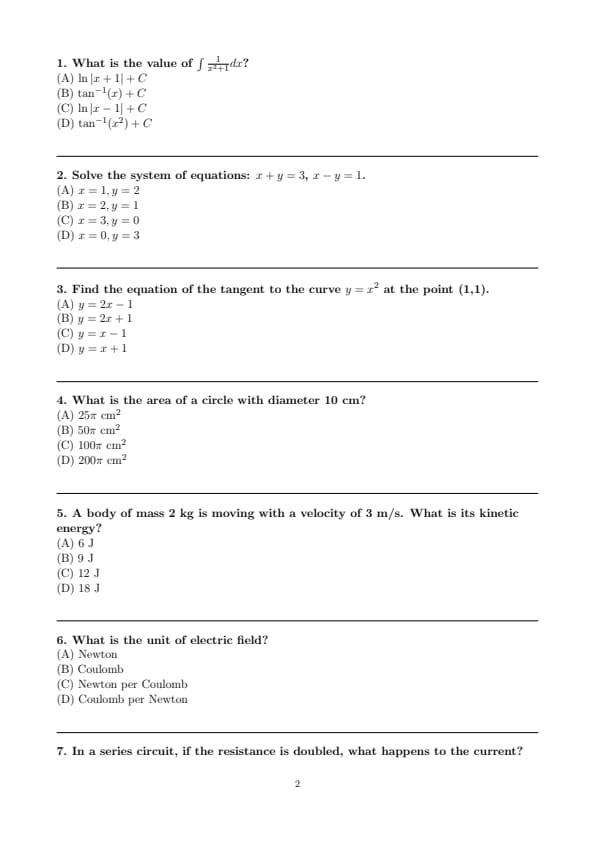
What is the value of \( \int \frac{1}{x^2+1} dx \)?
View Solution
Step 1: Understanding the Concept:
This question asks for the indefinite integral of the function \( f(x) = \frac{1}{x^2+1} \). This is a standard integral form in calculus that corresponds to the derivative of an inverse trigonometric function.
Step 2: Key Formula or Approach:
The standard integration formula for an expression of the form \( \frac{1}{x^2+a^2} \) is:
\[ \int \frac{1}{x^2+a^2} dx = \frac{1}{a} \tan^{-1}\left(\frac{x}{a}\right) + C \]
where \( C \) is the constant of integration.
Step 3: Detailed Explanation:
In the given integral, \( \int \frac{1}{x^2+1} dx \), we can see that it matches the standard form with \( a^2 = 1 \), which means \( a = 1 \).
Now, we apply the formula:
\[ \int \frac{1}{x^2+1^2} dx = \frac{1}{1} \tan^{-1}\left(\frac{x}{1}\right) + C \]
Simplifying this expression gives:
\[ \tan^{-1}(x) + C \]
Step 4: Final Answer:
Therefore, the value of the integral is \( \tan^{-1}(x) + C \). This matches option (B).
Quick Tip: Memorizing the standard integration formulas is crucial for competitive exams. The integral of \( \frac{1}{x^2+1} \) is one of the most common ones and is directly related to the derivative of \( \arctan(x) \).
Solve the system of equations: \( x + y = 3 \), \( x - y = 1 \).
View Solution
Step 1: Understanding the Concept:
This problem requires solving a system of two linear equations with two variables, \(x\) and \(y\). We need to find the values of \(x\) and \(y\) that satisfy both equations simultaneously.
Step 2: Key Formula or Approach:
The elimination method is a straightforward approach for this system. By adding or subtracting the two equations, we can eliminate one of the variables.
Equation 1: \( x + y = 3 \)
Equation 2: \( x - y = 1 \)
Step 3: Detailed Explanation:
Eliminate y:
Add Equation 1 and Equation 2 together:
\[ (x + y) + (x - y) = 3 + 1 \] \[ 2x = 4 \]
Divide by 2 to solve for \(x\):
\[ x = \frac{4}{2} = 2 \]
Solve for y:
Now, substitute the value of \( x = 2 \) back into either of the original equations. Let's use Equation 1:
\[ x + y = 3 \] \[ 2 + y = 3 \]
Subtract 2 from both sides:
\[ y = 3 - 2 = 1 \]
So, the solution is \( x = 2 \) and \( y = 1 \).
Step 4: Final Answer:
The solution to the system of equations is \(x = 2, y = 1\), which corresponds to option (B).
Quick Tip: For systems like \(ax+by=c\) and \(dx-by=f\), adding the equations is the quickest way to eliminate the \(y\) variable. Always double-check your answer by substituting the values back into both original equations.
Find the equation of the tangent to the curve \( y = x^2 \) at the point (1,1).
View Solution
Step 1: Understanding the Concept:
To find the equation of a tangent line to a curve at a specific point, we need two things: the point itself (which is given) and the slope of the tangent at that point. The slope is found by calculating the derivative of the curve's equation.
Step 2: Key Formula or Approach:
1. Find the derivative of the function \( y = f(x) \), which is \( \frac{dy}{dx} \).
2. Evaluate the derivative at the given point \( (x_1, y_1) \) to find the slope \( m \).
3. Use the point-slope form of a line: \( y - y_1 = m(x - x_1) \).
Step 3: Detailed Explanation:
Find the derivative:
The given curve is \( y = x^2 \).
The derivative with respect to \( x \) is:
\[ \frac{dy}{dx} = 2x \]
Find the slope at (1,1):
Substitute \( x = 1 \) into the derivative to find the slope \( m \):
\[ m = 2(1) = 2 \]
Find the equation of the tangent line:
Using the point-slope form with the point \( (x_1, y_1) = (1, 1) \) and slope \( m = 2 \):
\[ y - y_1 = m(x - x_1) \] \[ y - 1 = 2(x - 1) \]
Now, simplify the equation to the slope-intercept form \( y = mx + c \):
\[ y - 1 = 2x - 2 \] \[ y = 2x - 2 + 1 \] \[ y = 2x - 1 \]
Step 4: Final Answer:
The equation of the tangent to the curve \( y = x^2 \) at the point (1,1) is \( y = 2x - 1 \). This matches option (A).
Quick Tip: The derivative of a function at a point gives the instantaneous rate of change, which is geometrically interpreted as the slope of the tangent line to the function's graph at that point.
What is the area of a circle with diameter 10 cm?
View Solution
Step 1: Understanding the Concept:
The question asks for the area of a circle given its diameter. We need to use the formula for the area of a circle.
Step 2: Key Formula or Approach:
The formula for the area \( A \) of a circle is \( A = \pi r^2 \), where \( r \) is the radius.
The radius \( r \) is half of the diameter \( d \): \( r = \frac{d}{2} \).
Step 3: Detailed Explanation:
Find the radius:
The given diameter is \( d = 10 \) cm.
The radius is:
\[ r = \frac{10 cm}{2} = 5 cm \]
Calculate the area:
Now, substitute the radius into the area formula:
\[ A = \pi r^2 \] \[ A = \pi (5 cm)^2 \] \[ A = \pi (25 cm^2) \] \[ A = 25\pi cm^2 \]
Step 4: Final Answer:
The area of the circle is \( 25\pi cm^2 \), which corresponds to option (A).
Quick Tip: Always read the question carefully to see if you are given the radius or the diameter. A common mistake is to use the diameter directly in the area formula \( A = \pi r^2 \).
A body of mass 2 kg is moving with a velocity of 3 m/s. What is its kinetic energy?
View Solution
Step 1: Understanding the Concept:
Kinetic energy is the energy that an object possesses due to its motion. It depends on the mass of the object and the square of its velocity.
Step 2: Key Formula or Approach:
The formula for kinetic energy (KE) is:
\[ KE = \frac{1}{2} m v^2 \]
where \( m \) is the mass and \( v \) is the velocity.
Step 3: Detailed Explanation:
Identify the given values:
Mass \( m = 2 \) kg
Velocity \( v = 3 \) m/s
Calculate the kinetic energy:
Substitute these values into the formula:
\[ KE = \frac{1}{2} \times (2 kg) \times (3 m/s)^2 \] \[ KE = \frac{1}{2} \times 2 \times 9 \] \[ KE = 1 \times 9 \] \[ KE = 9 J \]
The unit of energy is Joules (J).
Step 4: Final Answer:
The kinetic energy of the body is 9 J. This matches option (B).
Quick Tip: Remember that kinetic energy is proportional to the square of the velocity. This means if you double the velocity, the kinetic energy increases by a factor of four.
What is the unit of electric field?
View Solution
Step 1: Understanding the Concept:
The electric field at a point is a vector quantity that represents the electric force experienced by a unit positive test charge placed at that point.
Step 2: Key Formula or Approach:
The electric field (\( E \)) is defined as the force (\( F \)) per unit charge (\( q \)):
\[ E = \frac{F}{q} \]
Step 3: Detailed Explanation:
To find the unit of the electric field, we can look at the units of the quantities in its defining formula.
The SI unit for force (\( F \)) is the Newton (N).
The SI unit for electric charge (\( q \)) is the Coulomb (C).
Therefore, the unit for the electric field (\( E \)) is:
\[ Unit of E = \frac{Unit of F}{Unit of q} = \frac{Newton}{Coulomb} \]
This is commonly written as Newton per Coulomb (N/C).
Step 4: Final Answer:
The unit of electric field is Newton per Coulomb. This corresponds to option (C).
Quick Tip: Another common unit for the electric field is Volts per meter (V/m). Both N/C and V/m are equivalent and correct units for measuring electric field strength.
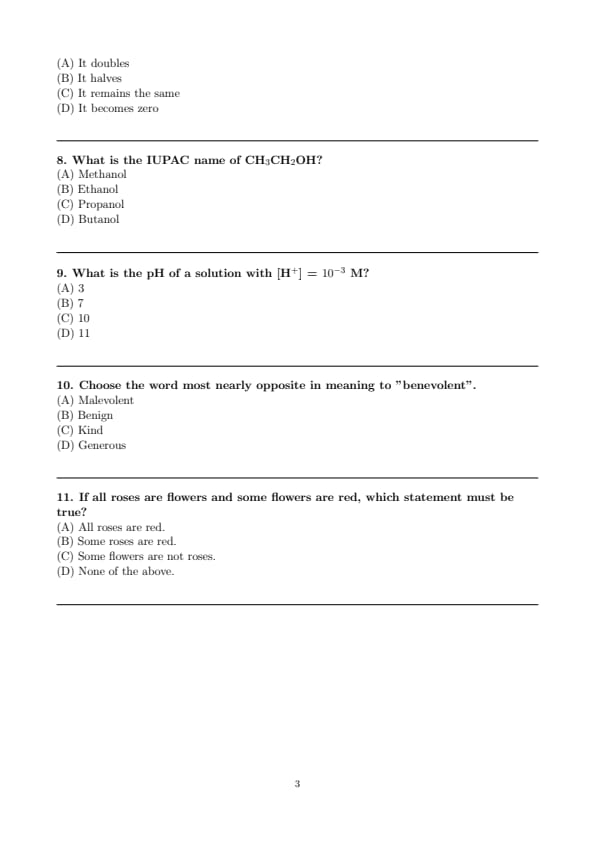
In a series circuit, if the resistance is doubled, what happens to the current?
View Solution
Step 1: Understanding the Concept:
This question relates to Ohm's Law, which describes the relationship between voltage, current, and resistance in an electrical circuit. In a simple series circuit, the voltage supplied by the source is assumed to be constant.
Step 2: Key Formula or Approach:
Ohm's Law is given by the formula:
\[ V = IR \]
where \( V \) is the voltage, \( I \) is the current, and \( R \) is the resistance.
We can rearrange this to solve for the current:
\[ I = \frac{V}{R} \]
Step 3: Detailed Explanation:
From the formula \( I = \frac{V}{R} \), we can see that current (\( I \)) is inversely proportional to resistance (\( R \)), assuming the voltage (\( V \)) remains constant.
Let the initial current be \( I_1 \) and the initial resistance be \( R_1 \). So, \( I_1 = \frac{V}{R_1} \).
Now, the resistance is doubled. Let the new resistance be \( R_2 \).
\[ R_2 = 2R_1 \]
The new current, \( I_2 \), will be:
\[ I_2 = \frac{V}{R_2} = \frac{V}{2R_1} \]
We can rewrite this in terms of the original current \( I_1 \):
\[ I_2 = \frac{1}{2} \left( \frac{V}{R_1} \right) = \frac{1}{2} I_1 \]
This shows that the new current is half of the original current.
Step 4: Final Answer:
If the resistance is doubled, the current is halved. This matches option (B).
Quick Tip: For any question involving Ohm's Law, remember the "inverse relationship" between current and resistance. If one increases, the other decreases, provided the voltage is constant.
What is the IUPAC name of \( CH_3CH_2OH \)?
View Solution
Step 1: Understanding the Concept:
The question asks for the systematic name of an organic compound according to the rules set by the International Union of Pure and Applied Chemistry (IUPAC). We need to identify the parent alkane chain and the functional group.
Step 2: Key Formula or Approach:
1. Identify the longest carbon chain containing the functional group. The length of this chain determines the prefix (meth- for 1 C, eth- for 2 C, prop- for 3 C, etc.).
2. Identify the primary functional group. For an -OH group (hydroxyl), the suffix is "-ol".
3. Combine the prefix and suffix to form the name.
Step 3: Detailed Explanation:
The given chemical formula is \( CH_3CH_2OH \).
Identify the carbon chain:
The chain consists of two carbon atoms (\( CH_3CH_2- \)). The prefix for a two-carbon chain is "eth-". The corresponding alkane is ethane.
Identify the functional group:
The functional group is \( -OH \) (a hydroxyl group), which classifies the compound as an alcohol. The suffix for an alcohol is "-ol".
Combine to form the name:
To name the alcohol, we replace the "-e" from the parent alkane's name (ethane) with the suffix "-ol".
Ethane \(\rightarrow\) Ethan + ol \(\rightarrow\) Ethanol.
Step 4: Final Answer:
The IUPAC name of \( CH_3CH_2OH \) is Ethanol. This corresponds to option (B).
Quick Tip: Associate the prefixes with the number of carbon atoms: 1-Meth, 2-Eth, 3-Prop, 4-But. This is fundamental to all IUPAC nomenclature. Ethanol is the alcohol found in alcoholic beverages.
What is the pH of a solution with [H\(^+\)] = \(10^{-3}\) M?
View Solution
Step 1: Understanding the Concept:
The pH scale is a logarithmic scale used to specify the acidity or basicity of an aqueous solution. It is defined as the negative of the base-10 logarithm of the hydrogen ion concentration.
Step 2: Key Formula or Approach:
The formula to calculate pH is:
\[ pH = -\log_{10}[H^+] \]
where \( [H^+] \) is the molar concentration of hydrogen ions.
Step 3: Detailed Explanation:
Identify the given value:
The hydrogen ion concentration is given as \( [H^+] = 10^{-3} \) M.
Calculate the pH:
Substitute this value into the pH formula:
\[ pH = -\log_{10}(10^{-3}) \]
Using the logarithmic property that \( \log_{10}(10^x) = x \), we get:
\[ pH = -(-3) \] \[ pH = 3 \]
A pH of 3 indicates an acidic solution.
Step 4: Final Answer:
The pH of the solution is 3. This matches option (A).
Quick Tip: For concentrations of H\(^+\) that are simple powers of 10, like \(10^{-x}\), the pH is simply the exponent \(x\). For example, if [H\(^+\)] = \(10^{-5}\), the pH is 5.
Choose the word most nearly opposite in meaning to "benevolent".
View Solution
Step 1: Understanding the Concept:
This question asks for the antonym of the word "benevolent." An antonym is a word that has the opposite meaning of another word.
Step 2: Detailed Explanation:
Meaning of "benevolent":
The word "benevolent" means well-meaning, kind, or charitable. It comes from the Latin roots 'bene' (meaning good) and 'volens' (meaning wishing). So, it literally means "wishing good".
Analyzing the options:
(A) Malevolent: This word comes from the Latin roots 'male' (meaning bad or evil) and 'volens' (meaning wishing). It means having or showing a wish to do evil to others. This is the direct opposite of benevolent.
(B) Benign: This means gentle and kindly; not harmful. It is a synonym for benevolent, not an antonym.
(C) Kind: This is a direct synonym for benevolent.
(D) Generous: This means showing a readiness to give more of something, like money or time, than is strictly necessary or expected. It is a quality of a benevolent person and is therefore a related term or synonym.
Step 3: Final Answer:
The word most nearly opposite in meaning to "benevolent" is "malevolent". This corresponds to option (A).
Quick Tip: Understanding common prefixes and roots can help you deduce the meanings of unfamiliar words. 'Bene-' (good) and 'Mal-' (bad) are very common prefixes that are opposites of each other.
If all roses are flowers and some flowers are red, which statement must be true?
View Solution
Step 1: Understanding the Concept:
This is a question of logical deduction based on two given premises. We need to determine which of the conclusions necessarily follows from the premises. Using Venn diagrams is an effective way to analyze such problems.
Step 2: Detailed Explanation:
Let's represent the given premises with sets:
Premise 1: All roses are flowers.
This means the set of all "Roses" is a subset of the set of "Flowers". In a Venn diagram, the circle for Roses would be completely inside the circle for Flowers.
Premise 2: Some flowers are red.
This means there is an overlap between the set of "Flowers" and the set of "Red things". In a Venn diagram, the circle for Flowers and the circle for Red things intersect.
Analyzing the possibilities:
The intersection between "Flowers" and "Red things" can occur in two possible ways with respect to "Roses":
Scenario 1: The red flowers might not be roses. For example, tulips are flowers and can be red. In this case, the intersection of "Red things" and "Flowers" is completely outside the "Roses" circle. In this scenario, statements (A) "All roses are red" and (B) "Some roses are red" are false.
Scenario 2: The red flowers might be roses. The intersection of "Red things" and "Flowers" could overlap with the "Roses" circle. In this case, "Some roses are red" would be true.
Evaluating the options:
For a statement to "must be true," it has to be true in all possible valid scenarios.
(A) All roses are red: This is not necessarily true, as shown in Scenario 1.
(B) Some roses are red: This is not necessarily true, as shown in Scenario 1. We know some flowers are red, but we don't know if those flowers are roses.
(C) Some flowers are not roses: This is also not necessarily true. It is logically possible (though not true in the real world) that the set of "Flowers" is identical to the set of "Roses". The premise "All roses are flowers" does not exclude the possibility that "All flowers are roses". If all flowers were roses, this statement would be false.
Step 3: Final Answer:
Since none of the statements (A), (B), or (C) must be true based on the given premises, the correct answer is (D) None of the above. The information is insufficient to make a definite conclusion.
Quick Tip: In logic problems, "some" means "at least one." To test if a conclusion "must be true," try to think of a counterexample—a scenario where the premises are true, but the conclusion is false. If you can find one, the conclusion is not necessary.
*The article might have information for the previous academic years, please refer the official website of the exam.