
BITSAT 2025 June 24 Shift 1 Question Paper with Solutions Pdf


Content Writer | Updated On - Nov 20, 2025
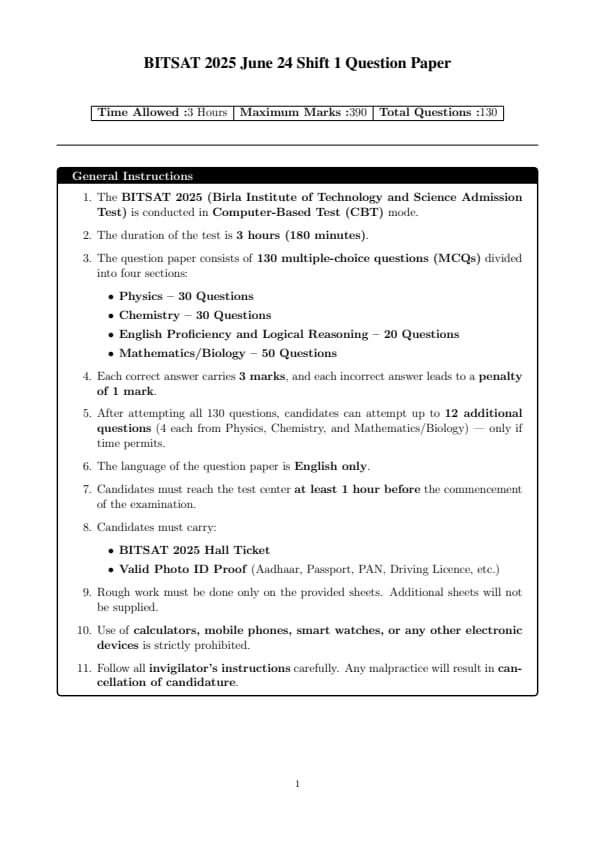
BITSAT 2025 Question Paper with Solutions is now available for download. The Birla Institute of Technology and Science (BITS) conducted the BITS Admission Test for a total duration of 3 hours, and the examination carried a total of 390 marks.
BITSAT 2025 JUNE 24 SHIFT 1 Question Paper with Solutions
| BITSAT 2025 JUNE 24 SHIFT 1 Question Paper | Download PDF | Check Solutions |

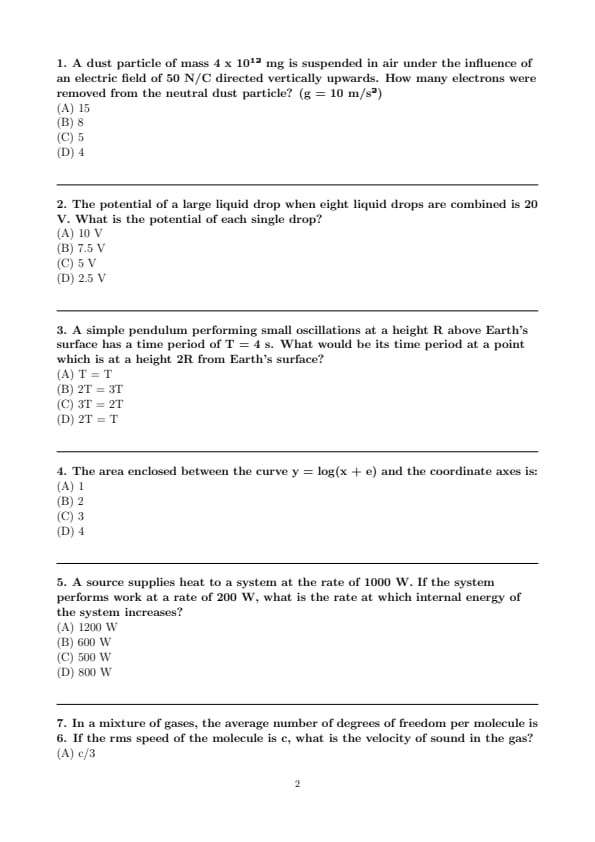
A dust particle of mass 4 x 10⁻¹² mg is suspended in air under the influence of an electric field of 50 N/C directed vertically upwards. How many electrons were removed from the neutral dust particle? (g = 10 m/s²)
View Solution
Step 1: Understanding the Concept:
The dust particle is suspended in mid-air, which means it is in equilibrium.
This state of equilibrium implies that the net force acting on the particle is zero.
The two forces acting on the particle are the gravitational force (\(F_g\)) acting downwards and the electric force (\(F_e\)) acting upwards.
For equilibrium, these two forces must be equal in magnitude.
Step 2: Key Formula or Approach:
1. Gravitational force: \(F_g = mg\), where \(m\) is the mass and \(g\) is the acceleration due to gravity.
2. Electric force: \(F_e = qE\), where \(q\) is the charge on the particle and \(E\) is the electric field strength.
3. Quantization of charge: \(q = ne\), where \(n\) is the number of electrons removed and \(e\) is the elementary charge (\(1.6 \times 10^{-19}\) C).
Equilibrium condition: \(F_e = F_g\).
Step 3: Detailed Explanation:
First, we need to convert the mass of the dust particle from milligrams (mg) to kilograms (kg).
\[ m = 4 \times 10^{-12} mg = 4 \times 10^{-12} \times 10^{-6} kg = 4 \times 10^{-18} kg \]
Given values are:
Mass, \(m = 4 \times 10^{-18}\) kg.
Electric field, \(E = 50\) N/C.
Acceleration due to gravity, \(g = 10\) m/s².
Charge of an electron, \(e = 1.6 \times 10^{-19}\) C.
Now, apply the equilibrium condition:
\[ F_e = F_g \] \[ qE = mg \]
We can solve for the charge \(q\) on the dust particle:
\[ q = \frac{mg}{E} \]
Substituting the given values:
\[ q = \frac{(4 \times 10^{-18} kg) \times (10 m/s^2)}{50 N/C} \] \[ q = \frac{40 \times 10^{-18}}{50} C \] \[ q = 0.8 \times 10^{-18} C = 8 \times 10^{-19} C \]
The charge on the particle is due to the removal of electrons. Using the principle of quantization of charge, \(q = ne\).
We can find the number of electrons removed, \(n\):
\[ n = \frac{q}{e} \] \[ n = \frac{8 \times 10^{-19} C}{1.6 \times 10^{-19} C} \] \[ n = \frac{8}{1.6} = 5 \]
Step 4: Final Answer:
Therefore, 5 electrons were removed from the neutral dust particle.
Quick Tip: In equilibrium problems involving forces, always start by drawing a free-body diagram to identify all the forces acting on the object. Also, pay close attention to unit conversions (like mg to kg) as they are common sources of error in physics problems.
The potential of a large liquid drop when eight liquid drops are combined is 20 V. What is the potential of each single drop?
View Solution
Step 1: Understanding the Concept:
When multiple small, charged liquid drops coalesce to form a single large drop, two physical quantities are conserved: the total volume and the total electric charge.
The electric potential of a spherical drop depends on its charge and radius.
Step 2: Key Formula or Approach:
Let \(r\) and \(q\) be the radius and charge of each small drop, respectively.
Let \(R\) and \(Q\) be the radius and charge of the large drop.
The number of small drops is \(N=8\).
1. Conservation of charge: \(Q = Nq = 8q\).
2. Conservation of volume: Volume of large drop = \(N \times\) Volume of a small drop.
\[ \frac{4}{3}\pi R^3 = N \times \frac{4}{3}\pi r^3 \implies R^3 = Nr^3 \]
3. Potential of a spherical drop: \(V = \frac{kq}{r}\), where \(k\) is Coulomb's constant.
Step 3: Detailed Explanation:
First, let's find the relationship between the radius of the large drop (\(R\)) and the small drops (\(r\)).
From the conservation of volume:
\[ R^3 = 8r^3 \]
Taking the cube root of both sides:
\[ R = (8r^3)^{1/3} = 2r \]
So, the radius of the large drop is twice the radius of a small drop.
Now, let's write the expressions for the potential of a small drop (\(V_{small}\)) and the large drop (\(V_{large}\)).
Potential of a single small drop:
\[ V_{small} = \frac{kq}{r} \]
The total charge of the large drop is \(Q = 8q\).
Potential of the large drop:
\[ V_{large} = \frac{kQ}{R} = \frac{k(8q)}{2r} = 4 \left(\frac{kq}{r}\right) \]
By comparing the two potential expressions, we see that:
\[ V_{large} = 4 \times V_{small} \]
We are given that \(V_{large} = 20\) V. We can now solve for \(V_{small}\).
\[ 20 V = 4 \times V_{small} \] \[ V_{small} = \frac{20 V}{4} = 5 V \]
Step 4: Final Answer:
The potential of each single drop is 5 V.
Quick Tip: For problems where \(N\) drops combine, remember the general relations: \(R = N^{1/3}r\) and \(V_{large} = N^{2/3}V_{small}\). This can save you a lot of time in an exam setting. For this problem, \(N=8\), so \(V_{large} = 8^{2/3}V_{small} = (8^{1/3})^2 V_{small} = 2^2 V_{small} = 4V_{small}\).
A simple pendulum performing small oscillations at a height R above Earth's surface has a time period of T₁ = 4 s. What would be its time period at a point which is at a height 2R from Earth's surface?
View Solution
Step 1: Understanding the Concept:
The time period of a simple pendulum depends on its length and the local acceleration due to gravity, \(g\). The value of \(g\) is not constant but decreases with altitude (height above the Earth's surface). We need to find how the time period changes as the pendulum is moved from a height \(h_1 = R\) to \(h_2 = 2R\).
Step 2: Key Formula or Approach:
1. Time period of a simple pendulum: \(T = 2\pi\sqrt{\frac{L}{g}}\), which shows \(T \propto \frac{1}{\sqrt{g}}\).
2. Acceleration due to gravity at a height \(h\) above the Earth's surface: \(g_h = \frac{GM}{(R_E+h)^2}\), where \(R_E\) is the radius of the Earth.
From these, we can establish a ratio: \(\frac{T_2}{T_1} = \sqrt{\frac{g_1}{g_2}}\).
Step 3: Detailed Explanation:
Let \(g_1\) be the acceleration due to gravity at height \(h_1 = R\) (here \(R\) is used instead of \(R_E\)).
The distance from the center of the Earth is \(R+h_1 = R+R = 2R\).
\[ g_1 = \frac{GM}{(2R)^2} = \frac{GM}{4R^2} \]
Let \(g_2\) be the acceleration due to gravity at height \(h_2 = 2R\).
The distance from the center of the Earth is \(R+h_2 = R+2R = 3R\).
\[ g_2 = \frac{GM}{(3R)^2} = \frac{GM}{9R^2} \]
The time period is inversely proportional to the square root of \(g\). So, we can write the ratio of the time periods \(T_2\) and \(T_1\):
\[ \frac{T_2}{T_1} = \sqrt{\frac{g_1}{g_2}} \]
Substitute the expressions for \(g_1\) and \(g_2\):
\[ \frac{T_2}{T_1} = \sqrt{\frac{GM/4R^2}{GM/9R^2}} = \sqrt{\frac{1/4}{1/9}} = \sqrt{\frac{9}{4}} \] \[ \frac{T_2}{T_1} = \frac{3}{2} \]
This gives the relationship between \(T_1\) and \(T_2\).
\[ 2T_2 = 3T_1 \]
The question gives \(T_1 = 4\) s, but this value is not needed to find the relationship between the periods. If we were to calculate \(T_2\), it would be \(T_2 = \frac{3}{2}T_1 = \frac{3}{2}(4 s) = 6 s\).
Step 4: Final Answer:
The relationship between the time periods is \(3T_1 = 2T_2\), which matches option (C).
Quick Tip: For gravitation problems involving heights, always measure distances from the center of the Earth. The force and acceleration due to gravity follow an inverse square law with respect to the distance from the center. A pendulum will swing slower (longer period) at higher altitudes because gravity is weaker.
The area enclosed between the curve y = logₑ(x + e) and the coordinate axes is:
View Solution
Step 1: Understanding the Concept:
The problem asks for the area of the region bounded by the curve \(y = \ln(x+e)\), the x-axis (\(y=0\)), and the y-axis (\(x=0\)). To find this area, we can use a definite integral.
Step 2: Key Formula or Approach:
The area \(A\) under a curve \(y=f(x)\) from \(x=a\) to \(x=b\) is given by the integral \(A = \int_{a}^{b} f(x) \,dx\).
First, we need to find the limits of integration by determining where the curve intersects the coordinate axes.
Step 3: Detailed Explanation:
1. Find the y-intercept (intersection with the y-axis): Set \(x=0\).
\[ y = \ln(0+e) = \ln(e) = 1 \]
The curve intersects the y-axis at the point (0, 1).
2. Find the x-intercept (intersection with the x-axis): Set \(y=0\).
\[ 0 = \ln(x+e) \]
To solve for \(x\), we take the exponential of both sides:
\[ e^0 = x+e \]
\[ 1 = x+e \]
\[ x = 1 - e \]
The curve intersects the x-axis at the point (\(1-e\), 0). Since \(e \approx 2.718\), this point is in the negative x-axis.
3. Set up the integral: The area is enclosed by the curve, the x-axis (from \(x=1-e\)) and the y-axis (\(x=0\)). So, the limits of integration are from \(1-e\) to 0.
\[ A = \int_{1-e}^{0} \ln(x+e) \,dx \]
To solve this integral, we use substitution. Let \(u = x+e\), then \(du = dx\).
We also need to change the limits of integration:
- When \(x = 1-e\), \(u = (1-e) + e = 1\).
- When \(x = 0\), \(u = 0 + e = e\).
The integral becomes:
\[ A = \int_{1}^{e} \ln(u) \,du \]
The standard integral of \(\ln(u)\) is \(u\ln(u) - u\).
Now, we evaluate the definite integral:
\[ A = [u\ln(u) - u]_{1}^{e} \] \[ A = (e\ln(e) - e) - (1\ln(1) - 1) \] \[ A = (e \cdot 1 - e) - (1 \cdot 0 - 1) \] \[ A = (e - e) - (0 - 1) \] \[ A = 0 - (-1) = 1 \]
Step 4: Final Answer:
The area enclosed between the curve and the coordinate axes is 1 square unit.
Quick Tip: When finding the area bounded by a curve and axes, always sketch the curve or at least find the x and y intercepts. This helps you to correctly identify the region and set the limits of integration. Remembering the integral of \(\ln(x)\) as \(x\ln(x) - x\) is very helpful.
A source supplies heat to a system at the rate of 1000 W. If the system performs work at a rate of 200 W, what is the rate at which internal energy of the system increases?
View Solution
Step 1: Understanding the Concept:
This problem applies the First Law of Thermodynamics, which is a statement of the conservation of energy. It relates the change in internal energy of a system to the heat added to the system and the work done by the system. The problem deals with rates of change, so we will use the law in its differential form.
Step 2: Key Formula or Approach:
The First Law of Thermodynamics is given by:
\[ \Delta U = Q - W \]
Where:
- \(\Delta U\) is the change in internal energy of the system.
- \(Q\) is the heat supplied to the system (positive).
- \(W\) is the work done by the system (positive).
In terms of rates of change with respect to time, the equation is:
\[ \frac{dU}{dt} = \frac{dQ}{dt} - \frac{dW}{dt} \]
The unit of power (rate of energy transfer) is the Watt (W), which is Joules per second (J/s).
Step 3: Detailed Explanation:
We are given the following information:
- The rate at which heat is supplied to the system, \(\frac{dQ}{dt} = 1000\) W. This is positive because heat is supplied to the system.
- The rate at which the system performs work, \(\frac{dW{dt} = 200\) W. This is also positive because work is done by the system.
We need to find the rate at which the internal energy of the system increases, \(\frac{dU{dt}\).
Using the rate form of the First Law of Thermodynamics:
\[ \frac{dU}{dt} = \frac{dQ}{dt} - \frac{dW}{dt} \]
Substitute the given values into the equation:
\[ \frac{dU}{dt} = 1000 W - 200 W \] \[ \frac{dU}{dt} = 800 W \]
The positive sign indicates that the internal energy of the system is increasing.
Step 4: Final Answer:
The rate at which the internal energy of the system increases is 800 W.
Quick Tip: Be very careful with the sign conventions in thermodynamics. Heat supplied to the system is positive. Work done by the system is positive. If heat is lost from the system or work is done on the system, the respective values would be negative.
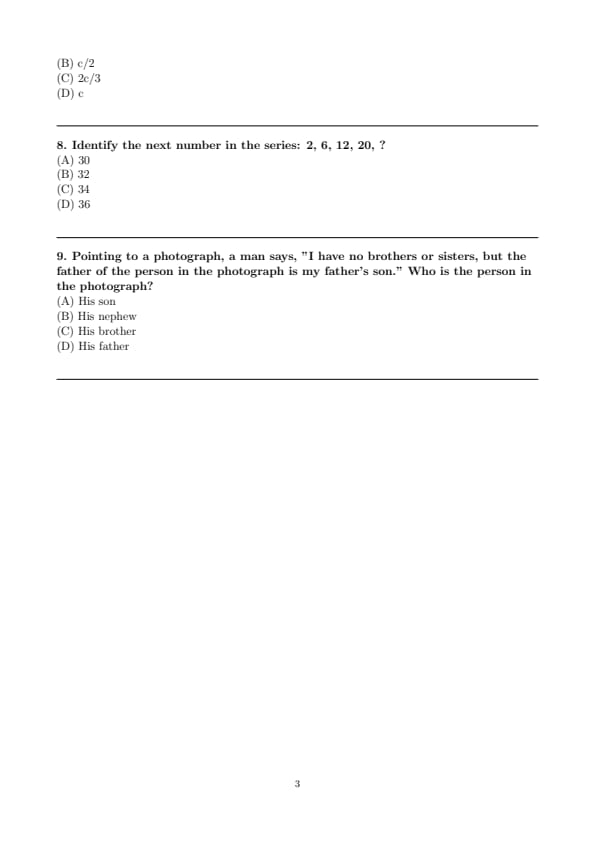
In a mixture of gases, the average number of degrees of freedom per molecule is 6. If the rms speed of the molecule is c, what is the velocity of sound in the gas?
View Solution
Step 1: Understanding the Concept:
The root-mean-square (rms) speed of gas molecules and the speed of sound in that gas are both related to the temperature and molar mass of the gas. They can be related to each other through the adiabatic index (\(\gamma\)), which in turn depends on the degrees of freedom (\(f\)) of the gas molecules.
Step 2: Key Formula or Approach:
1. RMS speed of gas molecules: \(c = v_{rms} = \sqrt{\frac{3RT}{M}}\).
2. Velocity of sound in a gas (Laplace's formula): \(v_{sound} = \sqrt{\frac{\gamma RT}{M}}\).
3. Adiabatic index (\(\gamma\)): \(\gamma = 1 + \frac{2}{f}\), where \(f\) is the number of degrees of freedom.
Step 3: Detailed Explanation:
We are given the average number of degrees of freedom per molecule, \(f=6\).
First, we calculate the adiabatic index \(\gamma\) for this gas mixture.
\[ \gamma = 1 + \frac{2}{f} = 1 + \frac{2}{6} = 1 + \frac{1}{3} = \frac{4}{3} \]
Now we have the formulas for the rms speed (\(c\)) and the speed of sound (\(v_{sound}\)):
\[ c = \sqrt{\frac{3RT}{M}} \] \[ v_{sound} = \sqrt{\frac{\gamma RT}{M}} = \sqrt{\frac{(4/3)RT}{M}} \]
To find the relationship between \(v_{sound}\) and \(c\), we can take their ratio:
\[ \frac{v_{sound}}{c} = \frac{\sqrt{\frac{\gamma RT}{M}}}{\sqrt{\frac{3RT}{M}}} \]
The terms \(RT/M\) cancel out:
\[ \frac{v_{sound}}{c} = \sqrt{\frac{\gamma}{3}} \]
Substitute the value of \(\gamma = 4/3\):
\[ \frac{v_{sound}}{c} = \sqrt{\frac{4/3}{3}} = \sqrt{\frac{4}{9}} = \frac{2}{3} \]
Therefore, the velocity of sound in the gas is:
\[ v_{sound} = \frac{2}{3}c \]
Step 4: Final Answer:
The velocity of sound in the gas is \(2c/3\).
Quick Tip: For any ideal gas, the speed of sound is always less than the rms speed of its molecules because \(\gamma\) is always less than 3 (for monatomic gas, \(\gamma=5/3\); for diatomic, \(\gamma=7/5\)). This can help you eliminate options like (D) in this question.
Identify the next number in the series: 2, 6, 12, 20, ?
View Solution
Step 1: Understanding the Concept:
This is a number series problem where we need to identify the underlying pattern or rule that governs the sequence of numbers to predict the next term.
Step 2: Key Formula or Approach:
There are several common methods to find the pattern in a series:
1. Find the difference between consecutive terms.
2. Look for a pattern in the terms themselves (e.g., squares, cubes, products).
3. Express the terms as a function of their position (\(n\)).
Step 3: Detailed Explanation:
Method 1: Difference between consecutive terms
Let's find the difference between each pair of consecutive numbers in the series:
- \(6 - 2 = 4\)
- \(12 - 6 = 6\)
- \(20 - 12 = 8\)
The differences are 4, 6, 8. This is an arithmetic progression with a common difference of 2.
The next difference in the sequence should be \(8 + 2 = 10\).
To find the next term in the original series, we add this difference to the last term:
\[ 20 + 10 = 30 \]
Method 2: Pattern in the terms
Let's analyze the structure of each term:
- \(2 = 1 \times 2\)
- \(6 = 2 \times 3\)
- \(12 = 3 \times 4\)
- \(20 = 4 \times 5\)
The pattern is that the \(n\)-th term is the product of \(n\) and \((n+1)\).
The given terms are for \(n=1, 2, 3, 4\). The next term will be for \(n=5\).
\[ 5 \times (5+1) = 5 \times 6 = 30 \]
Method 3: Formula based on position (\(n\))
Based on Method 2, the formula for the \(n\)-th term (\(T_n\)) is \(T_n = n(n+1) = n^2 + n\).
- For \(n=1\), \(T_1 = 1^2 + 1 = 2\).
- For \(n=2\), \(T_2 = 2^2 + 2 = 6\).
- For \(n=3\), \(T_3 = 3^2 + 3 = 12\).
- For \(n=4\), \(T_4 = 4^2 + 4 = 20\).
The next term is the 5th term (\(n=5\)):
\[ T_5 = 5^2 + 5 = 25 + 5 = 30 \]
Step 4: Final Answer:
All three methods confirm that the next number in the series is 30.
Quick Tip: When faced with a number series, checking the differences between terms is often the quickest way to find a simple pattern. If the first differences are not constant, check the second differences (the differences of the differences).
Pointing to a photograph, a man says, "I have no brothers or sisters, but the father of the person in the photograph is my father's son." Who is the person in the photograph?
View Solution
Step 1: Understanding the Concept:
This is a logical reasoning problem involving blood relations. The key is to break down the statement and analyze each part systematically to determine the relationship.
Step 2: Key Formula or Approach:
The best approach is to deconstruct the statement piece by piece, starting from the end and working backwards, and resolving pronouns and possessives.
The statement is: "I have no brothers or sisters, but the father of the person in the photograph is my father's son."
Step 3: Detailed Explanation:
Let's analyze the phrase: "my father's son".
- Who is the son of the speaker's father?
- Since the speaker says, "I have no brothers or sisters", he is an only child.
- Therefore, the only son of his father is the speaker himself.
Now, we can substitute this information back into the main statement. The statement becomes:
"The father of the person in the photograph is myself (the speaker)."
So, if the speaker is the father of the person in the photograph, then the person in the photograph must be the speaker's child.
Assuming the person is male (as "son" is an option), the person in the photograph is his son.
Step 4: Final Answer:
The person in the photograph is the speaker's son.
Quick Tip: In blood relation puzzles, always identify the speaker and then resolve phrases like "my father's son" or "her mother's daughter" first. The statement "I have no brothers or sisters" is a crucial piece of information that simplifies the possibilities significantly.
*The article might have information for the previous academic years, please refer the official website of the exam.