
BITSAT 2025 June 24 Shift 2 Question Paper with Solutions Pdf


Content Writer | Updated On - Nov 20, 2025
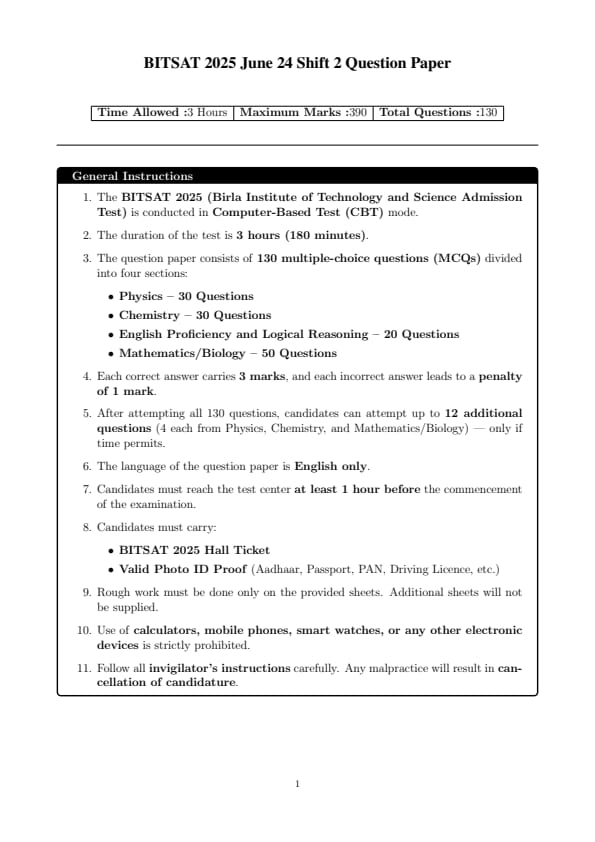
BITSAT 2025 Question Paper with Solutions is now available for download. The Birla Institute of Technology and Science (BITS) conducted the BITS Admission Test for a total duration of 3 hours, and the examination carried a total of 390 marks.
BITSAT 2025 JUNE 24 SHIFT 2 Question Paper with Solutions
| BITSAT 2025 JUNE 24 SHIFT 2 Question Paper | Download PDF | Check Solutions |

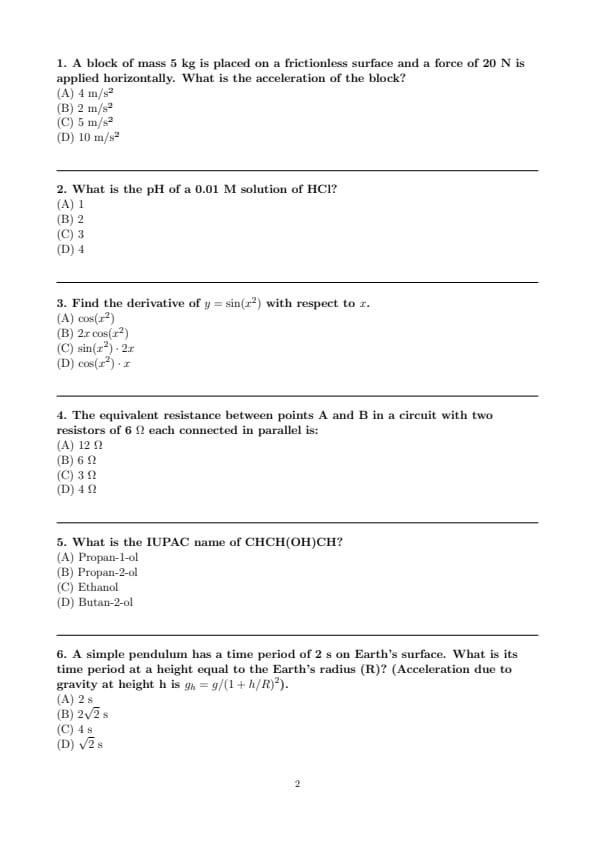
A block of mass 5 kg is placed on a frictionless surface and a force of 20 N is applied horizontally. What is the acceleration of the block?
View Solution
Step 1: Understanding the Concept:
This problem is based on Newton's Second Law of Motion.
The law states that the acceleration of an object is directly proportional to the net force acting on it and inversely proportional to its mass.
Step 2: Key Formula or Approach:
The formula derived from Newton's Second Law is:
\[ F = m \times a \]
where:
\( F \) is the net force applied to the object (in Newtons, N).
\( m \) is the mass of the object (in kilograms, kg).
\( a \) is the acceleration of the object (in meters per second squared, m/s²).
Step 3: Detailed Explanation:
We are given the following values:
Mass of the block, \( m = 5 \) kg.
Force applied, \( F = 20 \) N.
The surface is frictionless, so the applied horizontal force is the net force.
We need to find the acceleration (\(a\)).
Rearranging the formula to solve for \(a\):
\[ a = \frac{F}{m} \]
Substituting the given values into the formula:
\[ a = \frac{20 N}{5 kg} \] \[ a = 4 m/s^2 \]
Thus, the acceleration of the block is 4 m/s².
Step 4: Final Answer:
The calculated acceleration matches option (A).
Quick Tip: In problems involving Newton's Second Law, always identify the net force first. If there are multiple forces (like friction), you must calculate the resultant force before applying \(F = ma\). Since this problem specifies a frictionless surface, the net force is simply the applied force.
What is the pH of a 0.01 M solution of HCl?
View Solution
Step 1: Understanding the Concept:
pH is a measure of the acidity or alkalinity of a solution.
It is defined as the negative logarithm (base 10) of the hydrogen ion concentration \([H^+]\).
HCl (Hydrochloric acid) is a strong acid, which means it completely dissociates in water into its ions, \(H^+\) and \(Cl^-\).
Step 2: Key Formula or Approach:
The formula for pH is:
\[ pH = -\log_{10}[H^+] \]
For a strong acid like HCl, the concentration of hydrogen ions \([H^+]\) is equal to the molar concentration of the acid.
\[ [H^+] = [HCl] \]
Step 3: Detailed Explanation:
We are given the molar concentration of the HCl solution:
\[ [HCl] = 0.01 M \]
Since HCl is a strong acid, it fully ionizes:
\[ HCl \rightarrow H^+ + Cl^- \]
Therefore, the concentration of hydrogen ions is:
\[ [H^+] = 0.01 M \]
We can write this concentration in scientific notation to make the logarithm easier to calculate:
\[ [H^+] = 1 \times 10^{-2} M \]
Now, we can calculate the pH using the formula:
\[ pH = -\log_{10}(10^{-2}) \]
Using the logarithm property \(\log(a^b) = b \cdot \log(a)\):
\[ pH = -(-2) \log_{10}(10) \]
Since \(\log_{10}(10) = 1\):
\[ pH = 2 \times 1 = 2 \]
Step 4: Final Answer:
The pH of the solution is 2, which corresponds to option (B).
Quick Tip: For strong monoprotic acids (like HCl, HBr, HNO₃), if the concentration is given as \(10^{-n}\) M, the pH is simply \(n\). In this case, 0.01 M is \(10^{-2}\) M, so the pH is 2. This shortcut saves valuable time in exams.
Find the derivative of \(y = \sin(x^2)\) with respect to \(x\).
View Solution
Step 1: Understanding the Concept:
This problem requires finding the derivative of a composite function. A composite function is a function within another function. Here, \(x^2\) is inside the \(\sin\) function. To differentiate such functions, we use the chain rule.
Step 2: Key Formula or Approach:
The chain rule states that if \(y = f(g(x))\), then its derivative \(\frac{dy}{dx}\) is given by:
\[ \frac{dy}{dx} = f'(g(x)) \cdot g'(x) \]
In words, this means you differentiate the "outer" function while keeping the "inner" function the same, and then multiply by the derivative of the "inner" function.
Step 3: Detailed Explanation:
In our function \(y = \sin(x^2)\):
The outer function is \(f(u) = \sin(u)\).
The inner function is \(g(x) = u = x^2\).
First, find the derivative of the outer function with respect to its argument:
\[ f'(u) = \frac{d}{du}(\sin(u)) = \cos(u) \]
Next, find the derivative of the inner function with respect to \(x\):
\[ g'(x) = \frac{d}{dx}(x^2) = 2x \]
Now, apply the chain rule:
\[ \frac{dy}{dx} = f'(g(x)) \cdot g'(x) \]
Substitute \(g(x) = x^2\) back into \(f'(u)\):
\[ f'(g(x)) = \cos(x^2) \]
Multiply the two parts:
\[ \frac{dy}{dx} = \cos(x^2) \cdot (2x) \] \[ \frac{dy}{dx} = 2x \cos(x^2) \]
Step 4: Final Answer:
The derivative of \(y = \sin(x^2)\) is \(2x \cos(x^2)\), which corresponds to option (B).
Quick Tip: A helpful mnemonic for the chain rule is "differentiate the outside, leave the inside alone, then multiply by the derivative of the inside." This helps to structure the process and avoid mistakes.
The equivalent resistance between points A and B in a circuit with two resistors of 6 \(\Omega\) each connected in parallel is:
View Solution
Step 1: Understanding the Concept:
When resistors are connected in parallel, the total or equivalent resistance of the circuit decreases. This is because connecting them in parallel provides multiple paths for the current to flow, making it easier for the current to pass through the circuit.
Step 2: Key Formula or Approach:
For resistors connected in parallel, the reciprocal of the equivalent resistance (\(R_{eq}\)) is the sum of the reciprocals of the individual resistances.
\[ \frac{1}{R_{eq}} = \frac{1}{R_1} + \frac{1}{R_2} + \frac{1}{R_3} + \dots \]
For two resistors, the formula is:
\[ \frac{1}{R_{eq}} = \frac{1}{R_1} + \frac{1}{R_2} \]
Step 3: Detailed Explanation:
We are given two resistors with the same resistance:
\(R_1 = 6 \, \Omega\)
\(R_2 = 6 \, \Omega\)
Using the formula for parallel resistors:
\[ \frac{1}{R_{eq}} = \frac{1}{6} + \frac{1}{6} \]
To add the fractions, we find a common denominator, which is 6:
\[ \frac{1}{R_{eq}} = \frac{1+1}{6} = \frac{2}{6} \]
Simplify the fraction:
\[ \frac{1}{R_{eq}} = \frac{1}{3} \]
Now, to find \(R_{eq}\), we take the reciprocal of both sides:
\[ R_{eq} = 3 \, \Omega \]
Step 4: Final Answer:
The equivalent resistance of the parallel circuit is 3 \(\Omega\), which corresponds to option (C).
Quick Tip: For a special case where two resistors of equal value (\(R\)) are connected in parallel, the equivalent resistance is always half the value of one resistor: \(R_{eq} = R/2\). In this case, \(R_{eq} = 6/2 = 3 \, \Omega\). This shortcut is extremely useful for quick calculations.
What is the IUPAC name of CH₃CH(OH)CH₃?
View Solution
Step 1: Understanding the Concept:
This question requires knowledge of IUPAC (International Union of Pure and Applied Chemistry) nomenclature for naming organic compounds, specifically alcohols. The goal is to provide a systematic and unambiguous name for the given chemical structure.
Step 2: Key Formula or Approach:
The steps for IUPAC naming of alcohols are:
1. Identify the parent chain: Find the longest continuous carbon chain that contains the hydroxyl (-OH) group. The parent alkane name is modified by changing the '-e' suffix to '-ol'.
2. Number the parent chain: Start numbering from the end that gives the carbon atom attached to the -OH group the lowest possible number.
3. Name the compound: Combine the number indicating the -OH group's position, the parent chain name, and the '-ol' suffix.
Step 3: Detailed Explanation:
Let's analyze the given structure: CH₃CH(OH)CH₃.
1. Parent Chain: The longest continuous chain of carbon atoms contains three carbons. A three-carbon alkane is propane. Since it's an alcohol, the name will end in '-ol', so the base name is "propanol".
2. Numbering the Chain: We need to number the carbon chain to give the -OH group the lowest number.
- If we number from left to right: C₁H₃-C₂(OH)H-C₃H₃. The -OH group is on carbon 2.
- If we number from right to left: C₃H₃-C₂(OH)H-C₁H₃. The -OH group is also on carbon 2.
In this case, the lowest possible number for the -OH group is 2.
3. Assembling the Name: We combine the parts:
- The parent chain name: Propane.
- The position of the -OH group: 2.
- The suffix for an alcohol: -ol.
The full IUPAC name is Propan-2-ol.
Step 4: Final Answer:
The correct IUPAC name is Propan-2-ol, which matches option (B). Ethanol has 2 carbons, and Butan-2-ol has 4 carbons, so they are incorrect. Propan-1-ol would have the -OH group on a terminal carbon (CH₃CH₂CH₂OH).
Quick Tip: When naming organic molecules, always prioritize the principal functional group (in this case, -OH) by giving it the lowest possible locant (number). Also, quickly count the total carbons in the main chain to eliminate options with the wrong carbon count (like Ethanol or Butan-2-ol in this case).
A simple pendulum has a time period of 2 s on Earth's surface. What is its time period at a height equal to the Earth's radius (R)? (Acceleration due to gravity at height h is \(g_h = g / (1+h/R)^2\)).
View Solution
Step 1: Understanding the Concept:
The time period of a simple pendulum depends on its length and the acceleration due to gravity (\(g\)). The value of \(g\) decreases as we move away from the Earth's surface. This change in \(g\) will affect the pendulum's time period.
Step 2: Key Formula or Approach:
The time period (\(T\)) of a simple pendulum is given by:
\[ T = 2\pi\sqrt{\frac{L}{g}} \]
where \(L\) is the length of the pendulum and \(g\) is the acceleration due to gravity.
From this formula, we can see the relationship between the time period and gravity: \(T \propto \frac{1}{\sqrt{g}}\).
To compare the time periods at two different locations (surface and height \(h\)), we can use the ratio:
\[ \frac{T_h}{T_s} = \frac{2\pi\sqrt{L/g_h}}{2\pi\sqrt{L/g_s}} = \sqrt{\frac{g_s}{g_h}} \]
where \(T_s\) and \(g_s\) are the period and gravity on the surface, and \(T_h\) and \(g_h\) are the values at height \(h\).
Step 3: Detailed Explanation:
We are given:
Time period on the surface, \(T_s = 2\) s.
Height above the surface, \(h = R\) (where \(R\) is the Earth's radius).
Let \(g_s = g\) be the acceleration due to gravity on the surface.
First, let's find the acceleration due to gravity at height \(h=R\), denoted by \(g_h\).
Using the given formula:
\[ g_h = \frac{g}{(1 + h/R)^2} \]
Substitute \(h = R\):
\[ g_h = \frac{g}{(1 + R/R)^2} = \frac{g}{(1 + 1)^2} = \frac{g}{2^2} = \frac{g}{4} \]
So, at a height equal to the Earth's radius, the gravity is one-fourth of the surface gravity.
Now, let's find the new time period \(T_h\) using the ratio:
\[ \frac{T_h}{T_s} = \sqrt{\frac{g_s}{g_h}} \]
Substitute the values of \(g_s\) and \(g_h\):
\[ \frac{T_h}{T_s} = \sqrt{\frac{g}{g/4}} = \sqrt{4} = 2 \]
Now, solve for \(T_h\):
\[ T_h = 2 \times T_s \] \[ T_h = 2 \times 2 s = 4 s \]
Step 4: Final Answer:
The time period of the pendulum at a height equal to the Earth's radius is 4 s, which corresponds to option (C).
Quick Tip: Remember the inverse square relationship between gravity and distance from the center of the Earth. At height \(h=R\), the distance from the center is \(2R\), so gravity becomes \(1/(2^2) = 1/4\) of the surface value. Since \(T \propto 1/\sqrt{g}\), the new period will be \(\sqrt{4} = 2\) times the original period.
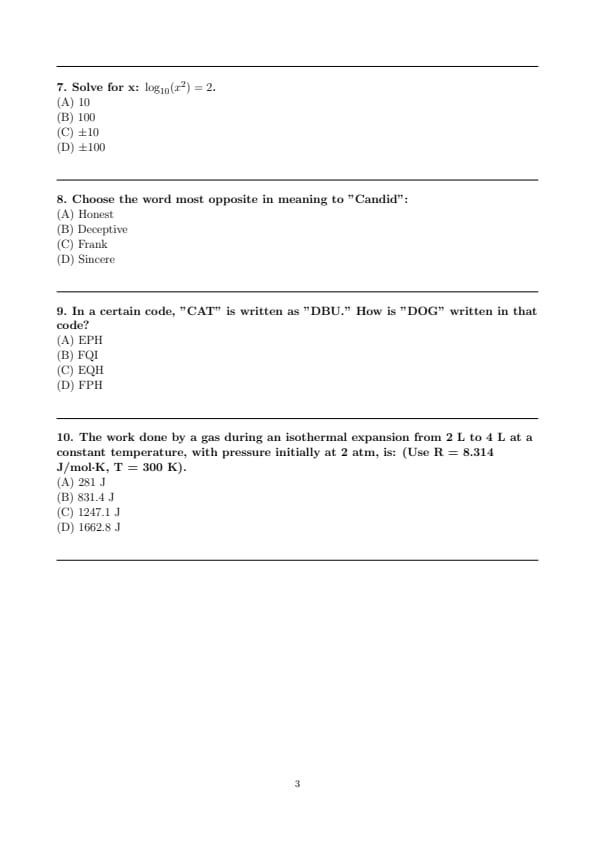
Solve for x: \(\log_{10}(x^2) = 2\).
View Solution
Step 1: Understanding the Concept:
This problem involves solving a logarithmic equation. The key is to convert the logarithmic form of the equation into its equivalent exponential form.
Step 2: Key Formula or Approach:
The definition of a logarithm states that:
\[ \log_b(a) = c \iff b^c = a \]
This means the base (\(b\)) raised to the power of the answer (\(c\)) equals the argument (\(a\)).
Step 3: Detailed Explanation:
We are given the equation:
\[ \log_{10}(x^2) = 2 \]
Here, the base \(b=10\), the argument \(a=x^2\), and the result \(c=2\).
Using the conversion rule, we can rewrite the equation in exponential form:
\[ 10^2 = x^2 \]
Calculate \(10^2\):
\[ 100 = x^2 \]
To solve for \(x\), we take the square root of both sides. It is crucial to remember that taking the square root can result in both a positive and a negative value.
\[ x = \pm\sqrt{100} \] \[ x = \pm 10 \]
So, the possible solutions are \(x = 10\) and \(x = -10\). We should check if these solutions are valid. The argument of a logarithm must be positive. In our case, the argument is \(x^2\).
For \(x = 10\), \(x^2 = 100\), which is positive.
For \(x = -10\), \(x^2 = (-10)^2 = 100\), which is also positive.
Both solutions are valid.
Step 4: Final Answer:
The solutions for \(x\) are +10 and -10, which corresponds to option (C).
Quick Tip: When solving equations of the form \(x^2 = k\) (where \(k > 0\)), always remember to include both the positive and negative square roots. A common mistake is to only consider the positive root. Also, always verify your solutions by checking if they make the argument of the original logarithm positive.
Choose the word most opposite in meaning to "Candid":
View Solution
Step 1: Understanding the Concept:
This question asks for the antonym of the word "Candid". An antonym is a word that has the opposite meaning of another word.
Step 2: Detailed Explanation:
First, let's define the word "Candid".
Candid: Means being truthful, straightforward, frank, and open. Someone who is candid speaks their mind honestly.
Now, let's analyze the given options:
(A) Honest: Means free of deceit; truthful and sincere. This is a synonym of Candid.
(B) Deceptive: Means giving an appearance or impression different from the true one; misleading. This is the opposite of being truthful and straightforward.
(C) Frank: Means open, honest, and direct in speech or writing. This is a synonym of Candid.
(D) Sincere: Means free from pretense or deceit; proceeding from genuine feelings. This is a synonym of Candid.
Step 3: Final Answer:
The words Honest, Frank, and Sincere are all similar in meaning to Candid. The word that is most opposite in meaning is Deceptive. Therefore, option (B) is the correct answer.
Quick Tip: In antonym questions, if you are unsure, try to identify synonyms first. The options that are synonyms of the given word can be eliminated, increasing your chances of selecting the correct antonym from the remaining choices.
In a certain code, "CAT" is written as "DBU." How is "DOG" written in that code?
View Solution
Step 1: Understanding the Concept:
This is a coding-decoding problem, a common type of logical reasoning question. The task is to identify the pattern or rule used to transform the word "CAT" into "DBU" and then apply the same rule to the word "DOG".
Step 2: Detailed Explanation:
Let's analyze the relationship between the letters of the original word and the coded word.
Original Word: C A T
Coded Word: D B U
Let's compare each letter pair:
- The first letter 'C' becomes 'D'. In the English alphabet, 'D' is the letter immediately following 'C'. (C + 1)
- The second letter 'A' becomes 'B'. 'B' is the letter immediately following 'A'. (A + 1)
- The third letter 'T' becomes 'U'. 'U' is the letter immediately following 'T'. (T + 1)
The rule is to replace each letter of the original word with the next letter in the alphabet.
Step 3: Applying the Rule:
Now, we apply this "+1" rule to the word "DOG".
Original Word: D O G
- First letter 'D' + 1 \(\rightarrow\) 'E'
- Second letter 'O' + 1 \(\rightarrow\) 'P'
- Third letter 'G' + 1 \(\rightarrow\) 'H'
Combining these letters, we get the coded word "EPH".
Step 4: Final Answer:
The coded word for "DOG" is "EPH", which corresponds to option (A).
Quick Tip: When faced with a letter-based coding question, the first pattern to check is a simple forward or backward shift in the alphabet (Caesar cipher). Write down the letters and their coded counterparts vertically to easily spot the pattern.
The work done by a gas during an isothermal expansion from 2 L to 4 L at a constant temperature, with pressure initially at 2 atm, is: (Use R = 8.314 J/mol·K, T = 300 K).
View Solution
Step 1: Understanding the Concept:
The problem asks for the work done by a gas during an isothermal expansion. An isothermal process is one that occurs at a constant temperature. For an ideal gas, the work done during such a process can be calculated using a specific formula.
Step 2: Key Formula or Approach:
The work done (\(W\)) by a gas during an isothermal expansion is given by:
\[ W = nRT \ln\left(\frac{V_2}{V_1}\right) \]
where:
\( n \) = number of moles of the gas
\( R \) = universal gas constant
\( T \) = absolute temperature (in Kelvin)
\( V_1 \) = initial volume
\( V_2 \) = final volume
The number of moles (\(n\)) is not given directly, so we must first calculate it using the Ideal Gas Law with the initial conditions:
\[ PV = nRT \implies n = \frac{PV}{RT} \]
Step 3: Detailed Explanation:
Part A: Calculate the number of moles (n)
We are given the initial state of the gas:
Initial Pressure, \( P_1 = 2 \) atm
Initial Volume, \( V_1 = 2 \) L
Temperature, \( T = 300 \) K
The value of \(R\) is given in J/mol·K, but pressure and volume are in atm and L. We must use a value of \(R\) with consistent units. Let's use \( R = 0.0821 \) L·atm/mol·K to find \(n\).
\[ n = \frac{P_1 V_1}{RT} = \frac{(2 atm) \times (2 L)}{(0.0821 L·atm/mol·K) \times (300 K)} \] \[ n = \frac{4}{24.63} \approx 0.1624 mol \]
Part B: Calculate the work done (W)
Now we can use the work formula with the value of R given in Joules (\(R = 8.314\) J/mol·K).
Given:
\( n \approx 0.1624 \) mol
\( R = 8.314 \) J/mol·K
\( T = 300 \) K
\( V_1 = 2 \) L
\( V_2 = 4 \) L
\[ W = nRT \ln\left(\frac{V_2}{V_1}\right) \] \[ W = (0.1624) \times (8.314) \times (300) \times \ln\left(\frac{4}{2}\right) \] \[ W = (0.1624) \times (8.314) \times (300) \times \ln(2) \]
We know that \(\ln(2) \approx 0.693\).
\[ W \approx 405.05 \times 0.693 \] \[ W \approx 280.7 J \]
Alternative Method:
We can combine the formulas: \(W = \left(\frac{P_1V_1}{RT}\right)RT\ln\left(\frac{V_2}{V_1}\right) = P_1V_1\ln\left(\frac{V_2}{V_1}\right)\).
For this to yield an answer in Joules, we must convert the \(P_1V_1\) product from L·atm to Joules. The conversion factor is 1 L·atm = 101.325 J.
\[ P_1V_1 = 2 atm \times 2 L = 4 L·atm \] \[ P_1V_1 in Joules = 4 \times 101.325 J = 405.3 J \] \[ W = (405.3 J) \times \ln(2) \approx 405.3 \times 0.693 \approx 280.9 J \]
Step 4: Final Answer:
The calculated work done is approximately 281 J. This matches option (A).
Quick Tip: In thermodynamics problems, unit consistency is critical. If R is in J/mol·K, ensure pressure is in Pascals (Pa) and volume is in cubic meters (m³). If you use pressure in atm and volume in L, remember the conversion factor 1 L·atm = 101.325 J to get the final work in Joules.
*The article might have information for the previous academic years, please refer the official website of the exam.