
BITSAT 2025 June 25 Shift 2 Question Paper with Solutions Pdf


Content Writer | Updated On - Nov 20, 2025
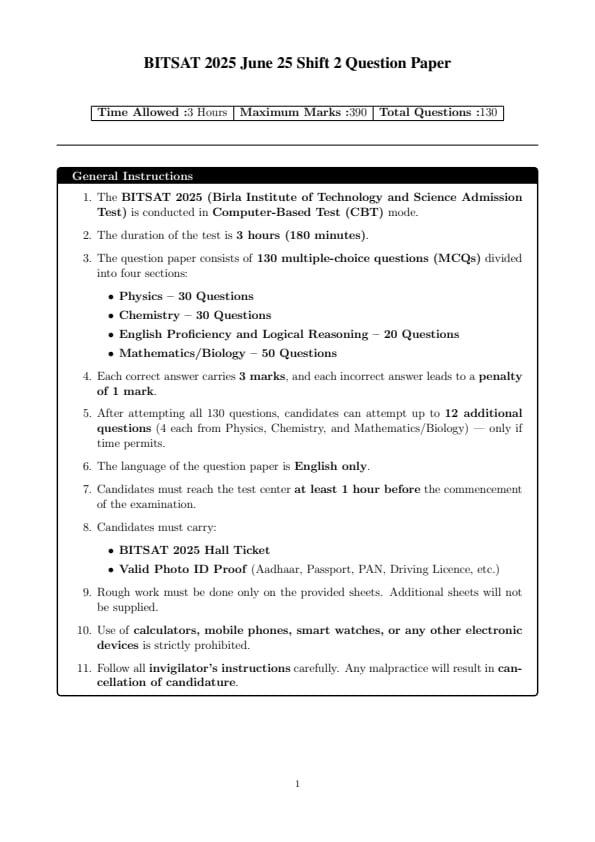
BITSAT 2025 Question Paper with Solutions is now available for download. The Birla Institute of Technology and Science (BITS) conducted the BITS Admission Test for a total duration of 3 hours, and the examination carried a total of 390 marks.
BITSAT 2025 JUNE 25 SHIFT 2 Question Paper with Solutions
| BITSAT 2025 JUNE 25 SHIFT 2 Question Paper | Download PDF | Check Solutions |

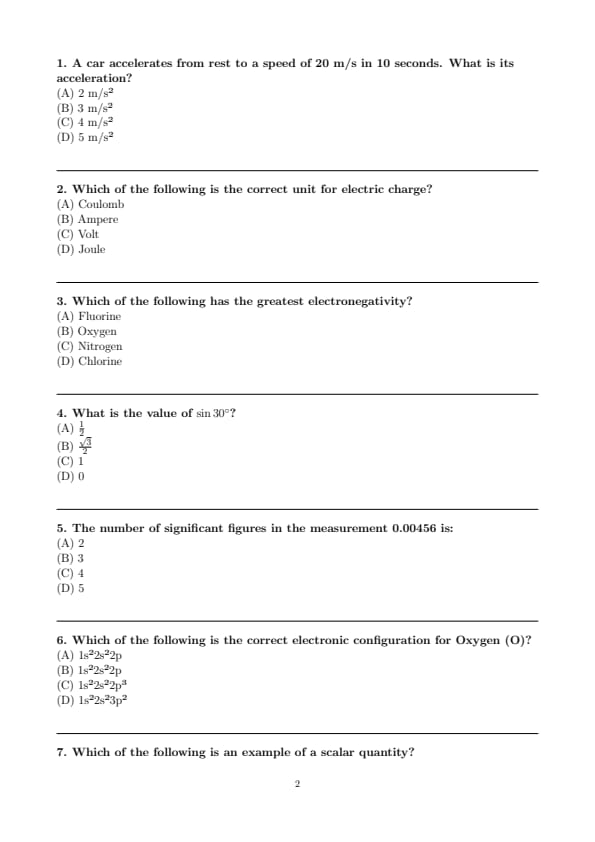
A car accelerates from rest to a speed of 20 m/s in 10 seconds. What is its acceleration?
View Solution
Step 1: Understanding the Concept:
Acceleration is defined as the rate of change of velocity of an object with respect to time. It is a vector quantity, meaning it has both magnitude and direction. In this case, we are calculating the magnitude of the acceleration.
Step 2: Key Formula or Approach:
The formula for acceleration (\(a\)) is given by the change in velocity (\(\Delta v\)) divided by the time taken (\(\Delta t\)).
\[ a = \frac{\Delta v}{\Delta t} = \frac{v_f - v_i}{t} \]
where:
\(v_f\) is the final velocity.
\(v_i\) is the initial velocity.
\(t\) is the time interval.
Step 3: Detailed Explanation:
We are given the following information:
Initial velocity (\(v_i\)) = 0 m/s (since the car starts from rest).
Final velocity (\(v_f\)) = 20 m/s.
Time taken (\(t\)) = 10 s.
Now, we substitute these values into the acceleration formula:
\[ a = \frac{20 \, m/s - 0 \, m/s}{10 \, s} \] \[ a = \frac{20 \, m/s}{10 \, s} \] \[ a = 2 \, m/s^2 \]
Step 4: Final Answer:
The acceleration of the car is 2 m/s². Therefore, option (A) is the correct answer.
Quick Tip: In physics problems, always identify the given quantities (initial velocity, final velocity, time) and what you need to find (acceleration). Then, select the appropriate kinematic equation. The phrase "from rest" is a key indicator that the initial velocity is zero.
Which of the following is the correct unit for electric charge?
View Solution
Step 1: Understanding the Concept:
This question tests the knowledge of fundamental SI units used in physics, specifically in the field of electricity and magnetism. Each physical quantity has a standard unit of measurement.
Step 2: Detailed Explanation:
Let's analyze each option:
Coulomb (C): The Coulomb is the standard SI unit of electric charge. It is defined as the amount of electric charge transported by a constant current of one ampere in one second.
Ampere (A): The Ampere is the SI unit of electric current, which is the rate of flow of electric charge.
Volt (V): The Volt is the SI unit of electric potential difference or electromotive force. It represents the potential energy per unit charge.
Joule (J): The Joule is the SI unit of energy, work, or quantity of heat.
Step 3: Final Answer:
Based on the definitions, the correct unit for electric charge is the Coulomb. Therefore, option (A) is the correct answer.
Quick Tip: Remember the relationship between these units: 1 Coulomb = 1 Ampere × 1 second (Q = I × t), and 1 Volt = 1 Joule / 1 Coulomb (V = W / Q). Understanding these relationships can help you recall the correct units.
Which of the following has the greatest electronegativity?
View Solution
Step 1: Understanding the Concept:
Electronegativity is a measure of the tendency of an atom to attract a bonding pair of electrons. The Pauling scale is the most commonly used scale for electronegativity. The trends in electronegativity in the periodic table are key to answering this question.
Step 2: Detailed Explanation:
The general trends for electronegativity in the periodic table are:
It increases as you move from left to right across a period. This is because the number of protons in the nucleus increases, which attracts the bonding electrons more strongly.
It decreases as you move down a group. This is because the bonding electrons are in shells farther from the nucleus, and they are shielded by more inner electron shells, reducing the nucleus's attractive force.
Let's analyze the positions of the given elements in the periodic table:
Fluorine (F), Oxygen (O), and Nitrogen (N) are all in Period 2. Following the trend, electronegativity increases from N to O to F. So, F > O > N.
Chlorine (Cl) is in the same group as Fluorine (Group 17, Halogens) but in Period 3. Since electronegativity decreases down a group, Fluorine is more electronegative than Chlorine.
Combining these trends, Fluorine is the most electronegative element among the given options and, in fact, the most electronegative element in the entire periodic table.
Step 3: Final Answer:
Fluorine (F) has the highest electronegativity value on the Pauling scale (~3.98) compared to Oxygen (~3.44), Nitrogen (~3.04), and Chlorine (~3.16). Therefore, option (A) is the correct answer.
Quick Tip: A useful mnemonic to remember the most electronegative elements in order is \textbf{F O N Cl Br I S C H} (pronounced "Fon-kuhl-brish"). Fluorine (F) is at the top of this list, making it the most electronegative.
What is the value of \( \sin 30^\circ \)?
View Solution
Step 1: Understanding the Concept:
This question tests the knowledge of standard trigonometric ratios for specific angles. The values of sine, cosine, and tangent for angles like 0°, 30°, 45°, 60°, and 90° are fundamental in trigonometry.
Step 2: Key Formula or Approach:
The value of \( \sin 30^\circ \) can be derived from a 30-60-90 right-angled triangle. In such a triangle, the sides are in the ratio \(1 : \sqrt{3} : 2\). The side opposite the 30° angle is the shortest (1), the side opposite the 60° angle is \( \sqrt{3} \), and the hypotenuse (opposite the 90° angle) is the longest (2).
The definition of sine is:
\[ \sin(\theta) = \frac{Opposite}{Hypotenuse} \]
Step 3: Detailed Explanation:
For an angle of \( \theta = 30^\circ \):
The side opposite the 30° angle has a length of 1 unit.
The hypotenuse has a length of 2 units.
Using the definition of sine:
\[ \sin(30^\circ) = \frac{Opposite}{Hypotenuse} = \frac{1}{2} \]
Step 4: Final Answer:
The value of \( \sin 30^\circ \) is \( \frac{1}{2} \). Therefore, option (A) is the correct answer.
Quick Tip: It's highly recommended to memorize the values of sine and cosine for standard angles (0°, 30°, 45°, 60°, 90°). A simple trick for sine is \( \sin(\theta) = \frac{\sqrt{n}}{2} \), where n=0 for 0°, n=1 for 30°, n=2 for 45°, n=3 for 60°, and n=4 for 90°. For \( \sin 30^\circ \), n=1, so \( \frac{\sqrt{1}}{2} = \frac{1}{2} \).
The number of significant figures in the measurement 0.00456 is:
View Solution
Step 1: Understanding the Concept:
Significant figures are the digits in a number that are reliable and necessary to indicate the quantity of something. They include all certain digits plus one uncertain digit. There are specific rules to determine which digits in a number are significant.
Step 2: Detailed Explanation:
Let's apply the rules for counting significant figures to the number 0.00456:
Non-zero digits are always significant. In our number, the digits 4, 5, and 6 are non-zero, so they are all significant.
Leading zeros (zeros before non-zero digits) are not significant. The three zeros at the beginning (0.00...) are leading zeros. They act only as placeholders to locate the decimal point and are not significant.
Following these rules, we count the significant digits:
The digits 4, 5, and 6 are significant.
The zeros before the 4 are not significant.
Step 3: Final Answer:
The number 0.00456 has 3 significant figures (4, 5, and 6). Therefore, option (B) is the correct answer.
Quick Tip: A simple way to count significant figures is to start counting from the first non-zero digit you encounter from the left. For 0.00456, the first non-zero digit is 4. Start counting from there: 4 (one), 5 (two), 6 (three). This gives a total of 3 significant figures.
Which of the following is the correct electronic configuration for Oxygen (O)?
View Solution
Step 1: Understanding the Concept:
The electronic configuration of an atom describes the distribution of its electrons in various orbitals. We use the Aufbau principle, which states that electrons fill lower-energy atomic orbitals before filling higher-energy ones.
Step 2: Key Formula or Approach:
To determine the electronic configuration, we need to know the atomic number of the element and the order of filling of atomic orbitals.
1. Find the atomic number (Z) of Oxygen. Z represents the number of protons and, in a neutral atom, the number of electrons.
2. Fill the electrons into the orbitals according to the energy level order: 1s, 2s, 2p, 3s, 3p, 4s, etc.
3. Remember the maximum number of electrons each subshell can hold: s-subshell holds 2, p-subshell holds 6, d-subshell holds 10, and f-subshell holds 14.
Step 3: Detailed Explanation:
1. The atomic number of Oxygen (O) is 8. This means a neutral oxygen atom has 8 electrons to place in orbitals.
2. We start filling the orbitals:
- The first orbital is 1s. It can hold a maximum of 2 electrons. So we have 1s². (Remaining electrons: 8 - 2 = 6)
- The next orbital is 2s. It can also hold a maximum of 2 electrons. So we have 2s². (Remaining electrons: 6 - 2 = 4)
- The next orbital is 2p. It can hold a maximum of 6 electrons. We have 4 electrons left to place. So we have 2p⁴. (Remaining electrons: 4 - 4 = 0)
3. Combining these, the full electronic configuration for Oxygen is 1s²2s²2p⁴.
Let's check the other options:
(B) 1s²2s²2p⁶ has 2+2+6 = 10 electrons (This is Neon).
(C) 1s²2s²2p³ has 2+2+3 = 7 electrons (This is Nitrogen).
(D) 1s²2s²3p² is an invalid configuration as the 2p orbital must be filled before the 3p orbital.
Step 4: Final Answer:
The correct electronic configuration for Oxygen is 1s²2s²2p⁴. Therefore, option (A) is the correct answer.
Quick Tip: To quickly check your answer, sum the superscripts in the configuration. The total should equal the atomic number of the element. For option (A), 2 + 2 + 4 = 8, which is the atomic number of Oxygen.
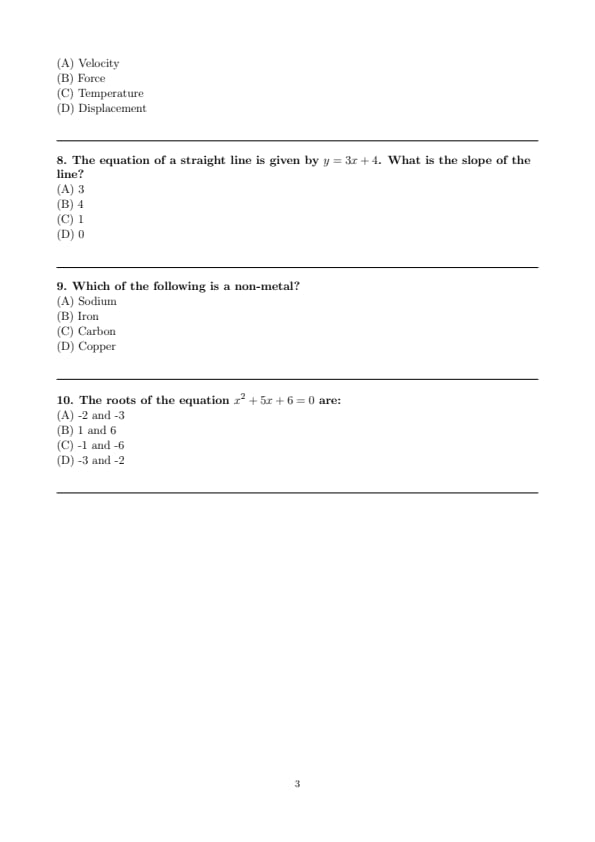
Which of the following is an example of a scalar quantity?
View Solution
Step 1: Understanding the Concept:
Physical quantities can be classified into two main categories: scalars and vectors.
Scalar quantities are those that are fully described by a magnitude (or numerical value) alone. Examples include mass, speed, distance, and temperature.
Vector quantities are those that are described by both a magnitude and a direction. Examples include displacement, velocity, force, and acceleration.
Step 2: Detailed Explanation:
Let's analyze each option based on these definitions:
Velocity: Describes how fast an object is moving and in which direction (e.g., 60 km/h North). It has both magnitude (speed) and direction, so it is a vector.
Force: A push or pull on an object, which has a strength (magnitude) and is applied in a specific direction. For example, a 10 Newton force applied downwards. It is a vector.
Temperature: Describes how hot or cold an object is (e.g., 25°C). It only has a magnitude and no associated direction. Therefore, it is a scalar.
Displacement: Describes the change in position of an object. It is the straight-line distance and direction from the starting point to the ending point (e.g., 5 meters East). It is a vector.
Step 3: Final Answer:
Among the given options, only temperature is a scalar quantity as it is completely defined by its magnitude. Therefore, option (C) is the correct answer.
Quick Tip: When trying to identify a scalar or vector, ask yourself: "Does direction matter for this quantity?" For temperature, it doesn't make sense to say "25°C upwards." For force, velocity, or displacement, direction is a crucial part of the description.
The equation of a straight line is given by \( y = 3x + 4 \). What is the slope of the line?
View Solution
Step 1: Understanding the Concept:
This question requires knowledge of the standard form of a linear equation, specifically the slope-intercept form. This form makes it easy to identify the slope and y-intercept of a straight line directly from its equation.
Step 2: Key Formula or Approach:
The slope-intercept form of a linear equation is:
\[ y = mx + c \]
where:
- \(m\) represents the slope of the line.
- \(c\) represents the y-intercept (the point where the line crosses the y-axis).
Step 3: Detailed Explanation:
The given equation is \( y = 3x + 4 \).
We can directly compare this equation with the standard slope-intercept form \( y = mx + c \).
By comparing the two equations:
- The coefficient of \(x\) is \(m\), which is the slope. In the given equation, the coefficient of \(x\) is 3.
- The constant term is \(c\), which is the y-intercept. In the given equation, the constant term is 4.
Therefore, we can identify:
Slope (\(m\)) = 3
Y-intercept (\(c\)) = 4
Step 4: Final Answer:
The question asks for the slope of the line. From our comparison, the slope (\(m\)) is 3. Therefore, option (A) is the correct answer.
Quick Tip: Whenever you are given a linear equation and asked for the slope, try to rearrange it into the form \( y = mx + c \). The coefficient of the \(x\) term will always be the slope. For example, if the equation is \( 2y - 6x = 8 \), rearrange it to \( 2y = 6x + 8 \), and then \( y = 3x + 4 \). The slope is 3.
Which of the following is a non-metal?
View Solution
Step 1: Understanding the Concept:
Elements in the periodic table are broadly classified into three categories: metals, non-metals, and metalloids. This classification is based on their physical and chemical properties. Metals are typically shiny, malleable, ductile, and good conductors of heat and electricity. Non-metals are generally dull, brittle, and poor conductors.
Step 2: Detailed Explanation:
Let's analyze each of the given options based on its classification in the periodic table:
Sodium (Na): Located in Group 1 of the periodic table, Sodium is an alkali metal. It is highly reactive, soft, and an excellent conductor. It is a metal.
Iron (Fe): This is a transition metal, found in the d-block of the periodic table. It is known for its strength, magnetic properties, and good conductivity. It is a metal.
Carbon (C): Located in Group 14, Carbon is the basis of organic chemistry. It exists in various forms (allotropes) like diamond and graphite. Its properties are characteristic of a non-metal (e.g., brittle in solid form, generally poor conductor, though graphite is an exception).
Copper (Cu): This is another transition metal, well-known for its excellent electrical and thermal conductivity, malleability, and reddish-brown color. It is a metal.
Step 3: Final Answer:
Among the choices provided, Carbon is the only element that is classified as a non-metal. Therefore, option (C) is the correct answer.
Quick Tip: A general rule of thumb is that elements on the left side and in the center of the periodic table are metals, while elements on the upper right side are non-metals. A "staircase" line separates the metals and non-metals, with metalloids located along this line.
The roots of the equation \( x^2 + 5x + 6 = 0 \) are:
View Solution
Step 1: Understanding the Concept:
The question asks for the roots of a quadratic equation. The roots (or solutions) are the values of \(x\) that satisfy the equation. A quadratic equation is an equation of the form \(ax^2 + bx + c = 0\). We can find the roots by factoring the quadratic expression, completing the square, or using the quadratic formula.
Step 2: Key Formula or Approach:
We will use the factoring method. For an equation \(x^2 + bx + c = 0\), we need to find two numbers that multiply to give \(c\) and add to give \(b\).
In our equation, \(x^2 + 5x + 6 = 0\), we have \(b = 5\) and \(c = 6\).
So, we need two numbers that:
Multiply to 6
Add up to 5
Step 3: Detailed Explanation:
Let's list the pairs of integers that multiply to 6:
1 and 6 (Sum = 1 + 6 = 7)
-1 and -6 (Sum = -1 + (-6) = -7)
2 and 3 (Sum = 2 + 3 = 5)
-2 and -3 (Sum = -2 + (-3) = -5)
The pair that adds up to 5 is 2 and 3.
So, we can factor the quadratic expression as:
\[ (x + 2)(x + 3) = 0 \]
To find the roots, we set each factor equal to zero:
Either \( x + 2 = 0 \) or \( x + 3 = 0 \)
Solving for \(x\) in each case:
\[ x = -2 \] \[ x = -3 \]
Step 4: Final Answer:
The roots of the equation are -2 and -3. Therefore, option (A) is the correct answer. (Note: Option D has the same roots in a different order, which is also correct, but typically the first matching option is chosen).
Quick Tip: If factoring seems difficult, you can always use the quadratic formula to find the roots of any quadratic equation \(ax^2 + bx + c = 0\): \[ x = \frac{-b \pm \sqrt{b^2 - 4ac}}{2a} \] For \(x^2 + 5x + 6 = 0\), a=1, b=5, c=6. Plugging these in will give you the roots -2 and -3.
*The article might have information for the previous academic years, please refer the official website of the exam.