
BITSAT 2026 Maths Strategy: Check Important Chapters and Speed Tricks


| Updated On - Apr 8, 2026
The BITSAT Mathematics Syllabus 2026 for BITS admission test is aligned with the NCERT syllabus of classes 11 and 12, and also the CBSE curriculum pattern. Roughly, 40% of the total questions will be from Class 11 topics, while 60% of them will be related to Class 12 topics.
-
The BITSAT Mathematics syllabus consists of 16 chapters in total and primarily focuses on concepts that develop students' analytical thinking, problem-solving skills & mathematical accuracy.
- Main topics included in the syllabus are Algebra, Trigonometry, 2-D and 3-D Geometry, Differential Calculus, Integral Calculus, Probability, Vectors, and Complex Numbers.
- In the BITSAT Mathematics section, you will face 40 multiple-choice questions, each question carrying 3 marks, which makes a total of 120 marks.
Related Article:
- BITSAT 2026 High-Scoring Strategy for Average Students
- BITSAT 2026: One-Month Revision Plan for Session 1
Key Summary:
|
|---|
BITSAT Mathematics Syllabus 2026
You can check the detailed syllabus of BITSAT Mathematics in the tables below.
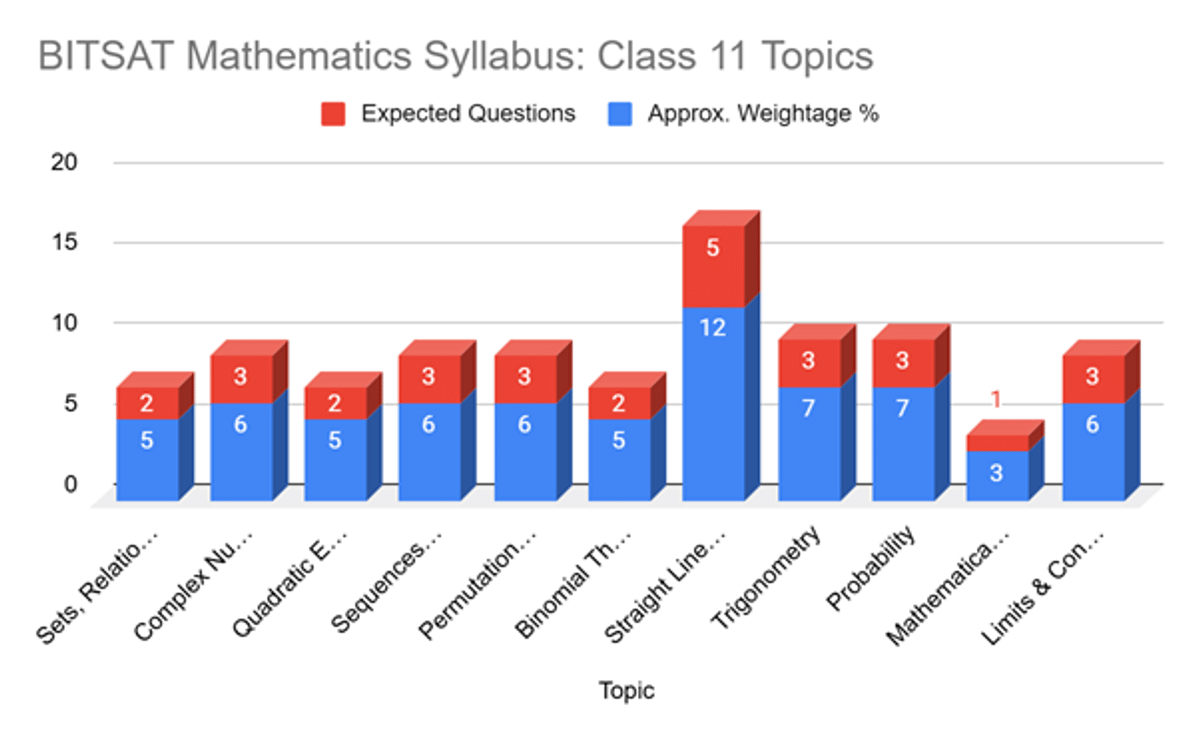
BITSAT Mathematics Syllabus: Class 11 Topics
| Topic | Sub-Topics | Expected Weightage (Questions) | Reddit Insights |
|---|---|---|---|
| Sets, Relations & Functions | Types of sets, Venn diagrams, domain/range, types of functions | 1-2 | Easy but conceptual. Don’t skip Venn diagrams. |
| Complex Numbers | Modulus, argument, conjugate, polar form | 2-3 | Very important & frequent. Practice modulus-argument well. |
| Quadratic Equations | Nature of roots, discriminant | 1-2 | Often combined with Complex Numbers. |
| Sequences & Series | AP, GP, sum to n terms, means | 2-3 | AP/GP sums & means are common. |
| Permutations & Combinations | Counting principle, circular permutations | 2-3 | Frequently mixed with Probability. |
| Binomial Theorem | General & middle term | 1-2 | Easy marks if formula is remembered. |
| Straight Lines & Circles | Equations, slope, tangents, normals | 4-5 | Highest weightage in Coordinate Geometry. Practice tangents & normals. |
| Trigonometry | Identities, equations, height & distance | 2-3 | Identities & equations appear regularly. |
| Probability | Conditional probability, independent events | 2-3 | Often combined with P&C. |
| Mathematical Induction | Principle & applications | 0-1 | Low weightage but easy. |
| Limits & Continuity (Basic) | Limits, continuity at a point | 2-3 | Foundation for Calculus. |
Source: Youtube
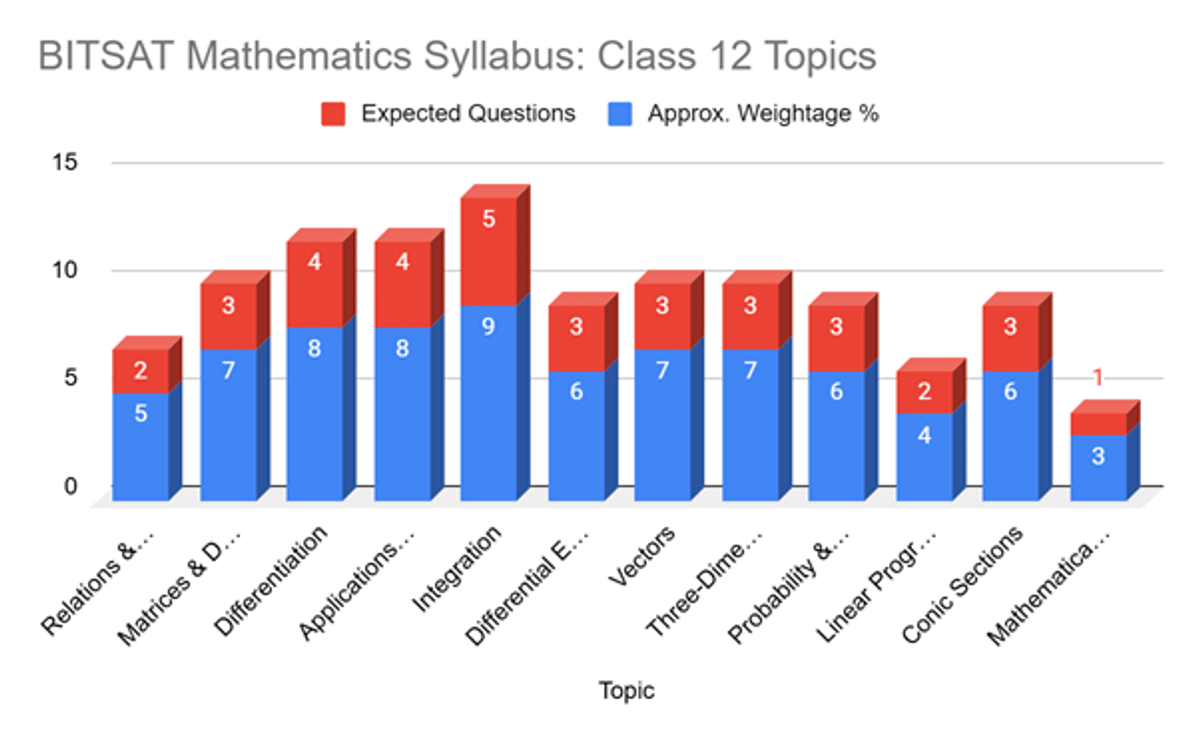
BITSAT Mathematics Syllabus: Class 12 Topics
| Topic | Sub-Topics | Expected Weightage (Questions) | Reddit Insights |
|---|---|---|---|
| Relations & Functions (Advanced) | Composition, invertible functions, binary operations | 1-2 | Easy conceptual questions. Invertible functions are common. |
| Matrices & Determinants | Operations, inverse, solving equations | 2-3 | Frequent. Focus on inverse & system of equations. |
| Differentiation | Chain rule, product/quotient, implicit | 3-4 | Must-do for Calculus foundation. |
| Applications of Derivatives | Tangents, normals, maxima-minima, increasing/decreasing | 3-4 | High scoring. Maxima-minima & tangents are favourites. |
| Integration | Indefinite/definite, substitution, parts, area under curve | 3-5 | Very important. Area under curves is commonly asked. |
| Differential Equations | First-order, variable separable | 2-3 | Straightforward. Variable separable is most common. |
| Vectors | Dot & cross product, scalar triple product | 2-3 | Scoring & less calculation-heavy. |
| Three-Dimensional Geometry | Lines, planes, distance & angle | 2-3 | Important with Vectors. Distance/angle questions repeat. |
| Probability & Statistics (Advanced) | Mean, variance, binomial distribution | 2-3 | Statistics easy. Binomial distribution regular. |
| Linear Programming | Formulation, graphical solution | 0-2 | Low weightage but very easy. |
| Conic Sections | Parabola, ellipse, hyperbola – equations & properties | 2-3 | Parabola & ellipse more frequent. |
| Mathematical Reasoning | Statements, implications, validity | 0-1 | Very easy. Almost always 1 question. |
Source: Youtube
BITSAT Mathematics Preparation Strategy 2026
| Topic / Chapter | Approx. Weightage | Expected Questions | Suggested Time Allocation | Key Preparation Strategy & Tips | Reddit Insights |
| Straight Lines & Circles + Conic Sections | 10-15% | 4-6 | 1-1.5 hrs daily (2-3 weeks) | Master equations, tangents, normals & chord of contact. Practice mixed problems. | Circles is the most important chapter. |
| Calculus (Diff. + App. of Der. + Integration + Area) | 12-18% | 8-12 | 1.5-2 hrs daily (focus first) | Basics → Chain rule → Applications → Definite integrals. Solve 30-40 Qs daily. | Calculus dominates BITSAT. Master it for 100+ score. |
| Vectors & 3D Geometry | 8-10% | 3-5 | 45-60 mins daily (10-12 days) | Focus on dot/cross product, distance & angle between lines/planes. | Scoring and less calculation-heavy. |
| Matrices & Determinants | 5-7% | 2-3 | 30-45 mins, 2-3 times/week | Emphasize inverse, properties & solving equations. | Frequent & straightforward if properties are clear. |
| Complex Numbers + Quadratic Equations | 5-8% | 2-4 | 30 mins daily | Practice polar form, modulus-argument & nature of roots. | Complex Numbers questions repeat often. |
| Permutations & Combinations + Probability | 6-9% | 3-5 | 40-50 mins, 3 times/week | Combine both. Practice conditional probability & circular perms. | Often mixed – can be tricky in application. |
| Limits & Continuity + Differential Equations | 6-8% | 3-5 | 45 mins daily (with Calculus) | Focus on left/right limits, continuity & variable separable DE. | Foundation for Calculus. Practice regularly. |
| Sequences & Series + Binomial Theorem | 5-7% | 2-4 | 30 mins, 2 times/week | Revise sums of series & general/middle term daily. | Easy marks with regular formula revision. |
| Relations & Functions (Basic + Advanced) | 4-6% | 2-3 | 20-30 mins | Cover composition, invertible & binary operations. | Conceptual but easy questions. |
| Probability & Statistics (Advanced) | 4-6% | 2-3 | 30 mins, twice/week | Focus on mean, variance & binomial distribution. | Statistics is easy and scoring. |
| Linear Programming + Mathematical Reasoning + Induction | 3-6% | 1-3 | 20 mins weekly | Quick revision of graphical LPP & logical statements. | Very easy, low effort. Usually 1-2 direct questions. |
Source: Youtube
Harshal (BITS Pillani) has shared how he prepared for the mathematics section for BITSAT, what mistakes to avoid, and how to make a smart plan so that you can make the most of your limited time in order to score the highest.
Also Read:
- BITSAT 2026 High-Scoring Strategy for Average Students
- BITSAT 2026 Preparation Without Coaching – Is It Possible?
FAQs
Ques. Which chapters are most important for BITSAT Maths 2026?
Ans. The top priority chapters for BITSAT Maths cover the areas of Calculus, Coordinate Geometry, Vectors & 3D Geometry, and significant Algebra topics like Complex Numbers and Probability. Calculus alone contributes the most number of questions, thus making it the main area of focus. Coordinate Geometry is equally significant as it often features questions on circles, tangents, and conics.
Ques. How can I improve speed in BITSAT Maths?
Ans. The way to enhance speed in BITSAT Maths is through continuous timed practice combined with thorough formula revision. Daily solving of mixed problems helps to familiarize oneself with various types of problems quickly. Besides that, the use of shortcuts and standard results, together with refraining from long calculations, can help one save precious time.
Ques. What is the best strategy to prepare for BITSAT Maths?
Ans. Initially, to develop a sound understanding of the fundamental concepts, NCERT books should be referred first. Thereafter, additional reference books or study guides by Arihant or RD Sharma can be considered for practising and honing skills. Major scoring areas like Calculus and Coordinate Geometry must be focussed on. Meanwhile, simpler sections must be regularly refreshed.
*The article might have information for the previous academic years, please refer the official website of the exam.