
BITSAT 2026 Question Paper May 25 Shift 1 With Solution Pdf


| Updated On - May 29, 2026
BITS Pilani conducted BITSAT 2026 Session 2 Exam on May 25, Shift 1 from 9 AM to 12 PM in CBT Mode. The BITSAT 2026 today's question paper included five sections: Physics, Chemistry, English Proficiency, Logical Reasoning, and Mathematics/Biology, with 130 MCQs questions carrying a total of 390 marks. As per the BITSAT marking scheme, +3 marks are awarded for every correct answer, and -1 mark is deducted for every wrong answer.
BITSAT 2026 May 25 Shift 1 Question Paper with Solution PDF is available here for download.
BITSAT 2026 May 25 Shift 1 Question Paper with Solution PDF
| BITSAT 2026 May 25 Shift 1 Question Paper | Download PDF | Check Solutions |
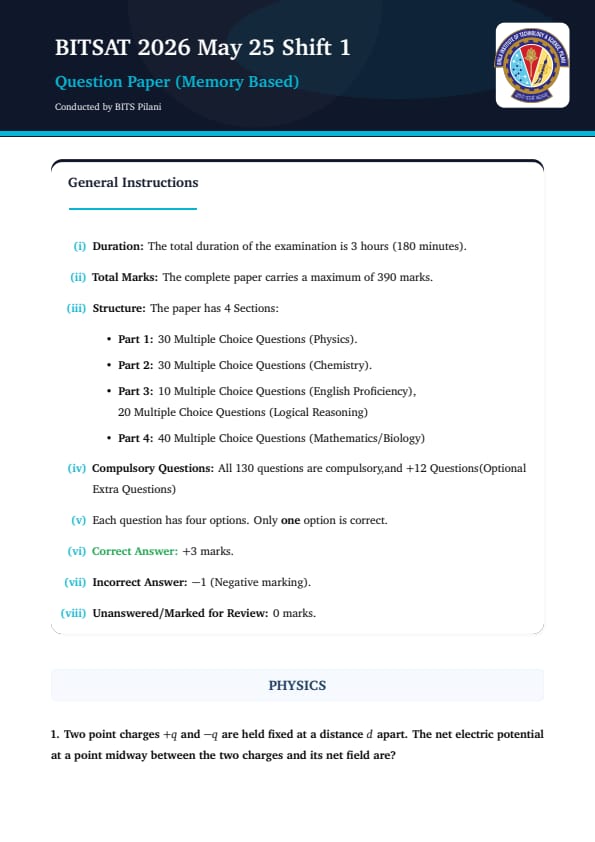
Two point charges \(+q\) and \(-q\) are held fixed at a distance \(d\) apart. The net electric potential at a point midway between the two charges and its net field are?
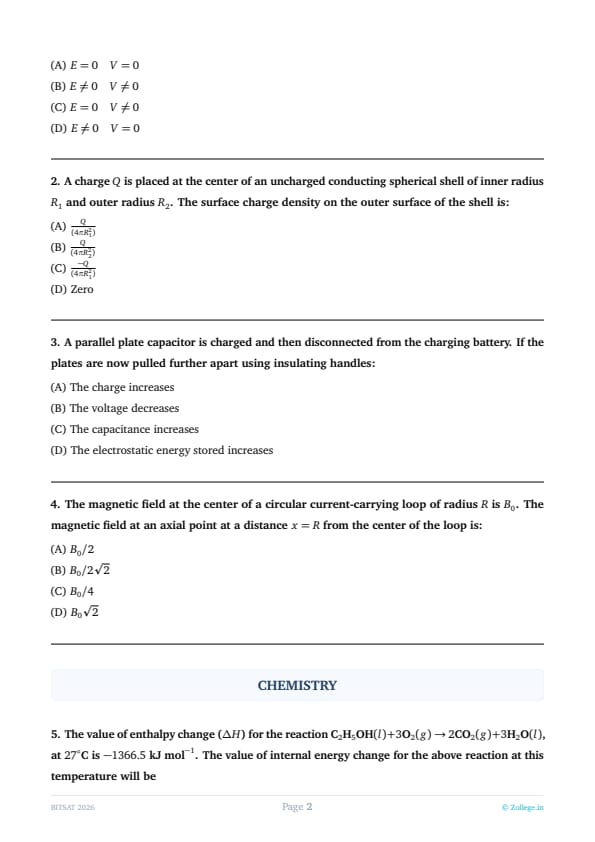
A charge \(Q\) is placed at the center of an uncharged conducting spherical shell of inner radius \(R_1\) and outer radius \(R_2\). The surface charge density on the outer surface of the shell is:
A parallel plate capacitor is charged and then disconnected from the charging battery. If the plates are now pulled further apart using insulating handles:
The magnetic field at the center of a circular current-carrying loop of radius \(R\) is \(B_0\). The magnetic field at an axial point at a distance \(x = R\) from the center of the loop is:
The value of enthalpy change (\(\Delta H\)) for the reaction \(C_2H_5OH(l) + 3O_2(g) \rightarrow 2CO_2(g) + 3H_2O(l)\), at \(27^\circC\) is \(-1366.5 kJ mol^{-1}\). The value of internal energy change for the above reaction at this temperature will be
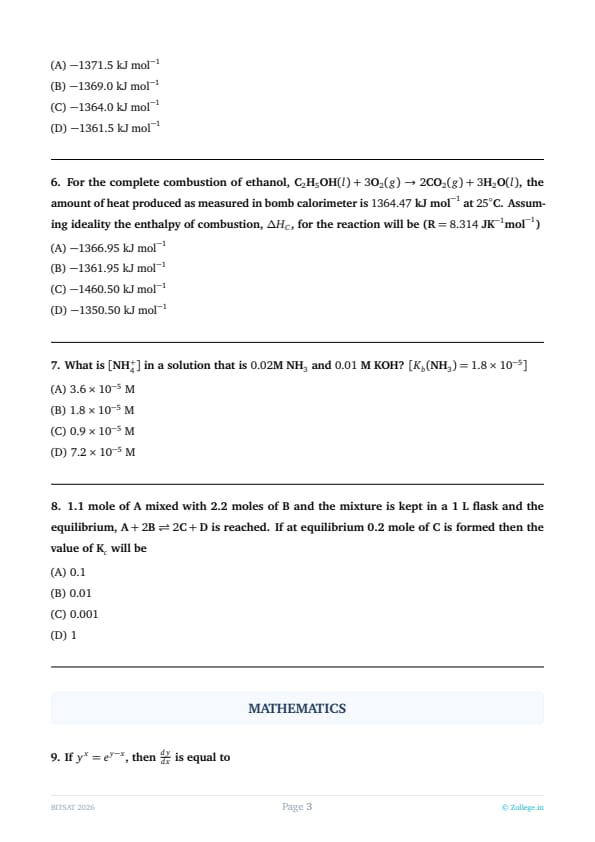
For the complete combustion of ethanol, \(C_2H_5OH(l) + 3O_2(g) \rightarrow 2CO_2(g) + 3H_2O(l)\), the amount of heat produced as measured in bomb calorimeter is \(1364.47 kJ mol^{-1}\) at \(25^\circC\). Assuming ideality the enthalpy of combustion, \(\Delta H_C\), for the reaction will be (\(R = 8.314 JK^{-1}mol^{-1}\))
What is \([NH_4^+]\) in a solution that is \(0.02M NH_3\) and \(0.01 M KOH\)? \([K_b(NH_3) = 1.8 \times 10^{-5}]\)
1.1 mole of A mixed with 2.2 moles of B and the mixture is kept in a 1 L flask and the equilibrium, \(A + 2B \rightleftharpoons 2C + D\) is reached. If at equilibrium 0.2 mole of C is formed then the value of \(K_c\) will be
If \(y^x = e^{y - x}\), then \(\frac{dy}{dx}\) is equal to
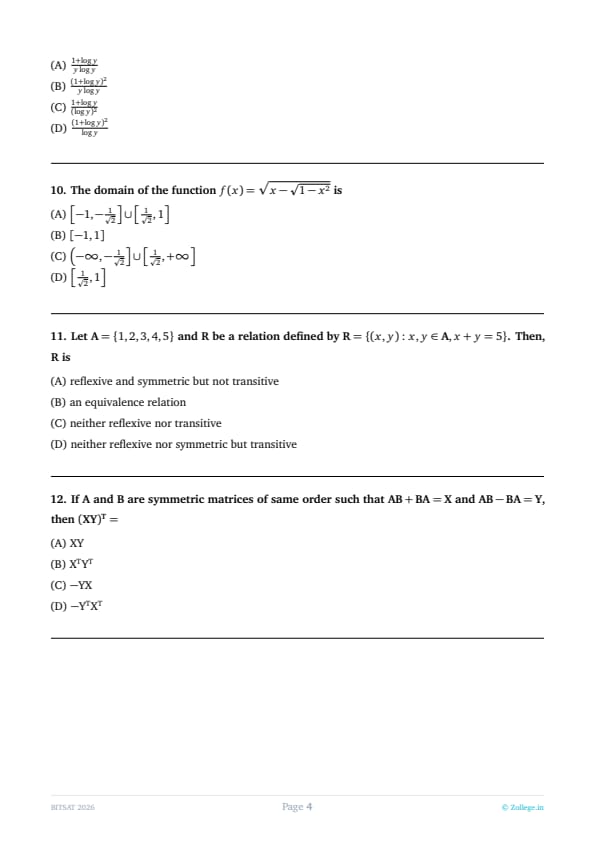
The domain of the function \(f(x) = \sqrt{x - \sqrt{1 - x^2}}\) is
Let \(A = \{1, 2, 3, 4, 5\}\) and \(R\) be a relation defined by \(R = \{(x, y) : x, y \in A, x + y = 5\}\). Then, \(R\) is
If A and B are symmetric matrices of same order such that \(AB + BA = X\) and \(AB - BA = Y\), then \((XY)^T =\)
BITSAT 2026: Most Expected PYQs
*The article might have information for the previous academic years, please refer the official website of the exam.