
BITSAT 2026 Question Paper May 26 Shift 1 with Solution Pdf


| Updated On - May 29, 2026
BITS Pilani conducted BITSAT 2026 Session 2 Exam on May 26, Shift 1 from 9 AM to 12 PM in CBT Mode. The BITSAT 2026 question paper included five sections: Physics, Chemistry, English Proficiency, Logical Reasoning, and Mathematics/Biology, with 130 MCQs questions carrying a total of 390 marks. As per the BITSAT marking scheme, +3 marks are awarded for every correct answer, and -1 mark is deducted for every wrong answer.
BITSAT 2026 May 26 Shift 1 Question Paper with Solution PDF is available here for download.
BITSAT 2026 May 26 Shift 1 Question Paper with Solution PDF
| BITSAT 2026 May 26 Shift 1 Question Paper | Download PDF | Check Solutions |
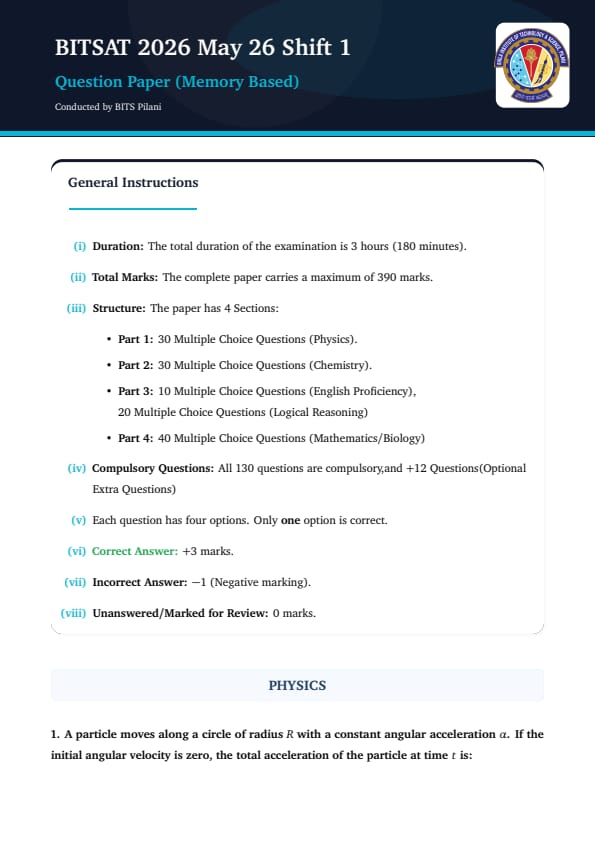
A particle moves along a circle of radius \(R\) with a constant angular acceleration \(\alpha\). If the initial angular velocity is zero, the total acceleration of the particle at time \(t\) is:
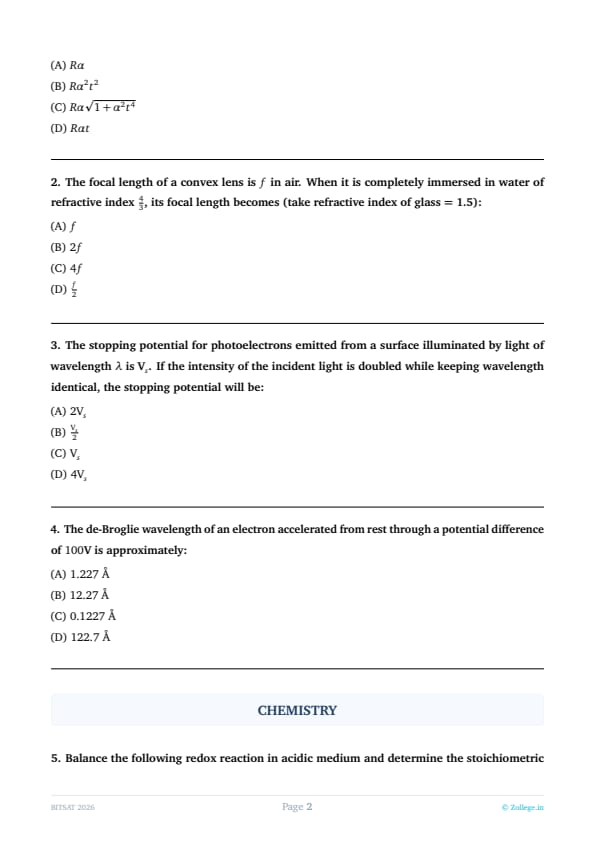
The focal length of a convex lens is \(f\) in air. When it is completely immersed in water of refractive index \(\frac{4}{3}\), its focal length becomes (take refractive index of glass = 1.5):
The stopping potential for photoelectrons emitted from a surface illuminated by light of wavelength \(\lambda\) is \(V_s\). If the intensity of the incident light is doubled while keeping wavelength identical, the stopping potential will be:
The de-Broglie wavelength of an electron accelerated from rest through a potential difference of \(100V\) is approximately:
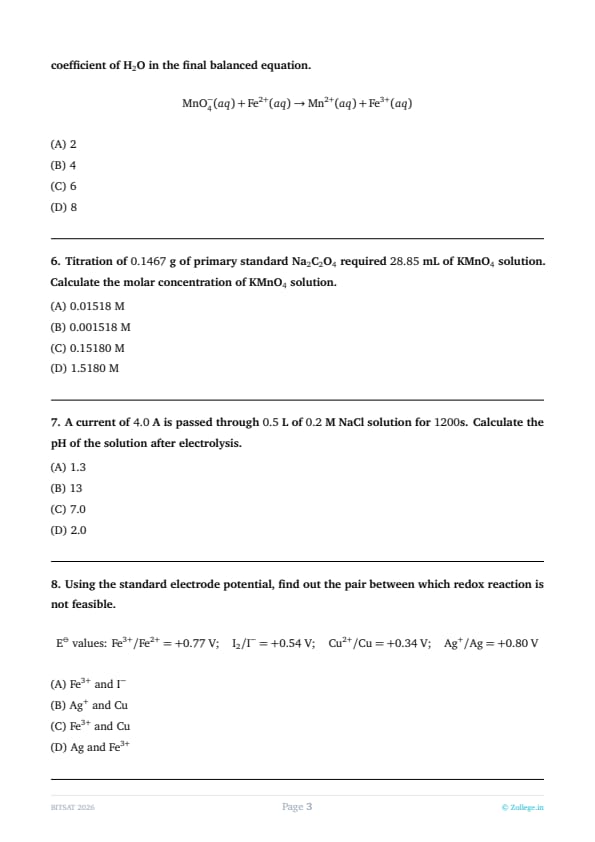
Balance the following redox reaction in acidic medium and determine the stoichiometric coefficient of \(H_2O\) in the final balanced equation. \[ MnO_4^-(aq) + Fe^{2+}(aq) \rightarrow Mn^{2+}(aq) + Fe^{3+}(aq) \]
Titration of \(0.1467 g\) of primary standard \(Na_2C_2O_4\) required \(28.85 mL\) of \(KMnO_4\) solution. Calculate the molar concentration of \(KMnO_4\) solution.
A current of \(4.0 A\) is passed through \(0.5 L\) of \(0.2 M NaCl\) solution for \(1200s\). Calculate the \(pH\) of the solution after electrolysis.
Using the standard electrode potential, find out the pair between which redox reaction is not feasible. \[ E^\ominus values: Fe^{3+}/Fe^{2+} = +0.77 V; \quad I_2/I^- = +0.54 V; \quad Cu^{2+}/Cu = +0.34 V; \quad Ag^+/Ag = +0.80 V \]
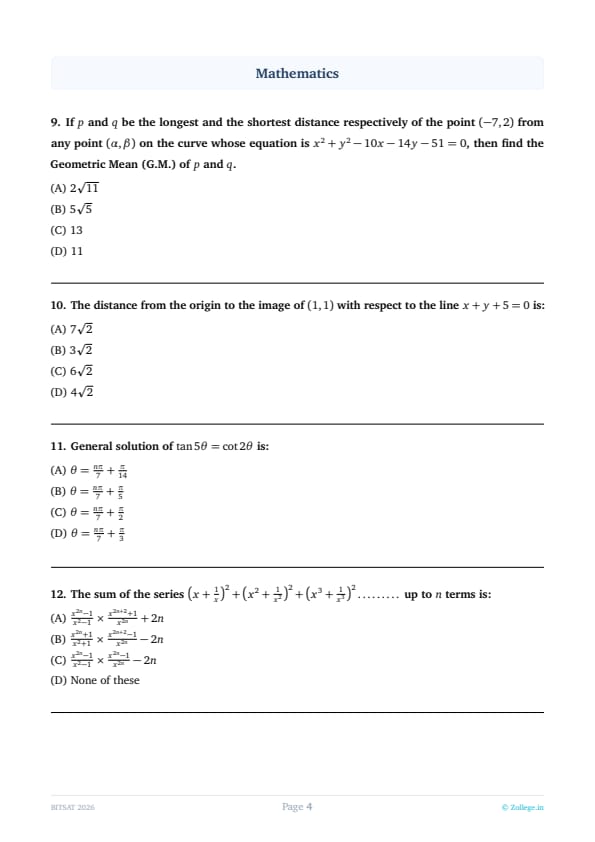
If \(p\) and \(q\) be the longest and the shortest distance respectively of the point \((-7, 2)\) from any point \((\alpha, \beta)\) on the curve whose equation is \(x^2 + y^2 - 10x - 14y - 51 = 0\), then find the Geometric Mean (G.M.) of \(p\) and \(q\).
The distance from the origin to the image of \((1, 1)\) with respect to the line \(x + y + 5 = 0\) is:
General solution of \(\tan 5\theta = \cot 2\theta\) is:
The sum of the series \(\left(x + \frac{1}{x}\right)^2 + \left(x^2 + \frac{1}{x^2}\right)^2 + \left(x^3 + \frac{1}{x^3}\right)^2 \dots\dots\dots\) up to \(n\) terms is:
BITSAT 2026: Most Expected PYQs
*The article might have information for the previous academic years, please refer the official website of the exam.