
BITSAT 2026 April 15 Shift 1 Question Paper with Solution PDF


Content Curator | Updated On - Apr 16, 2026
BITS Pilani conducted BITSAT 2026 Session 1 Exam on April 15, Shift 1 from 9 AM to 12 PM in CBT Mode.T he BITSAT 2026 today's question paper will include five sections: Physics, Chemistry, English Proficiency, Logical Reasoning, and Mathematics/Biology, with 130 MCQs questions carrying a total of 390 marks. As per the BITSAT marking scheme, +3 marks are awarded for every correct answer, and -1 mark is deducted for every wrong answer.
BITSAT 2026 April 15 Shift 1 Question Paper with Solution PDF is available here for download.
BITSAT 2026 April 15 Shift 1 Question Paper with Solution PDF
| BITSAT 2026 April 15 Shift 1 Question Paper | Download PDF | Check Solutions |
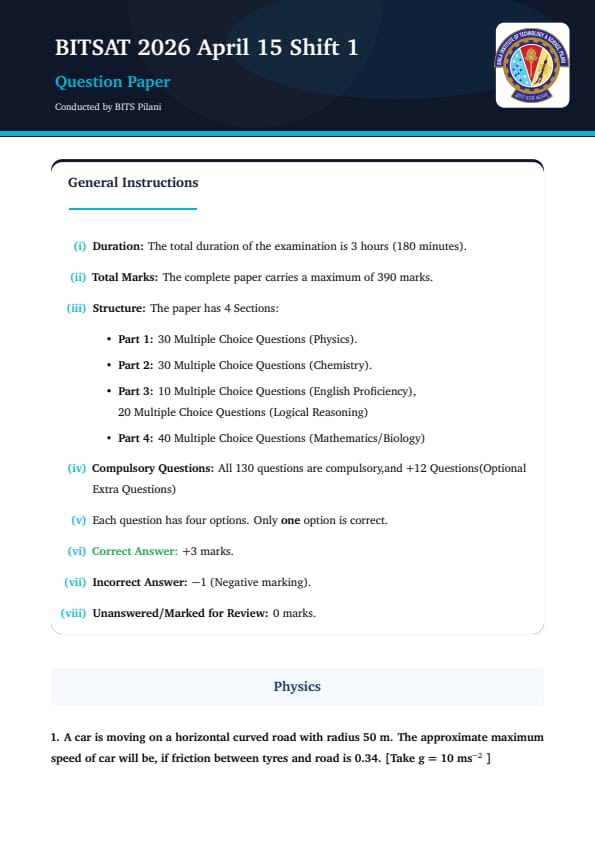
A car is moving on a horizontal curved road with radius 50 m. The approximate maximum speed of car will be, if friction between tyres and road is 0.34. [Take g = 10 ms\(^{-2}\) ]
An electron moving along the x-axis has a position given by \(x = 20te^{-t}\) m, where \(t\) is in second. How far is the electron from the origin when it momentarily stop?
The ranges and heights for two projectiles projected with the same initial velocity at angles 42\(^\circ\) and 48\(^\circ\) with the horizontal are R\(_1\), R\(_2\) and H\(_1\), H\(_2\) respectively. Choose the correct option :
A particle moves under the effect of a force \(F = Cx\) from \(x = 0\) to \(x = x_1\). The work done in the process is
Three-point particles of masses 1.0 kg, 1.5 kg and 2.5 kg are placed at three corners of a right-angle triangle of sides 4.0 cm, 3.0 cm and 5.0 cm as shown in the figure. The center of mass of the system is at a point:
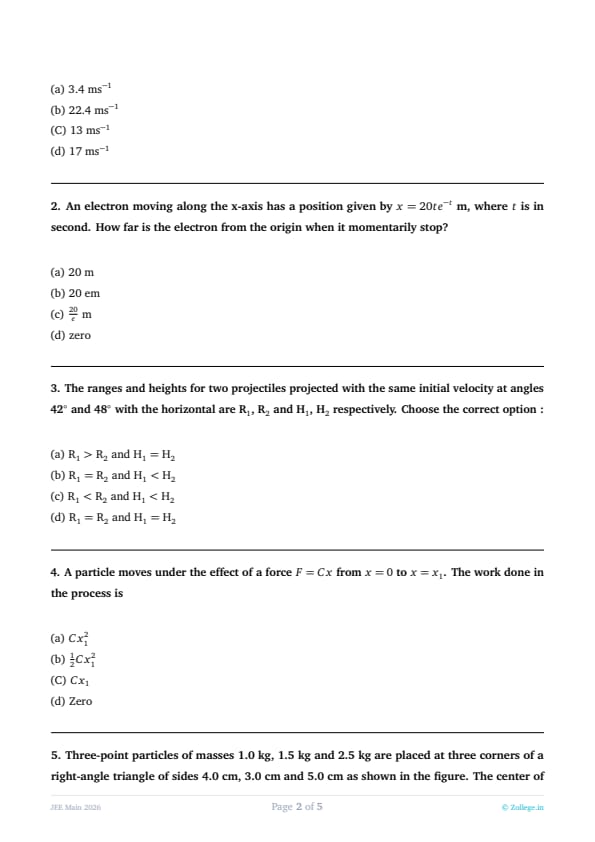
The number of valence electrons present in the metal among Cr, Co, Fe and Ni which has the lowest enthalpy of atomisation is
The Zeta potential is related to which property of colloids"
Based on the data given below:
\(E^0_{Cr_2O_7^{2-}/Cr^{3+}} = 1.33 V \quad E^0_{Cl_2/Cl^-} = 1.36 V\)
\(E^0_{MnO_4^-/Mn^{2+}} = 1.51 V \quad E^0_{Cr^{3+}/Cr} = -0.74 V\)
the strongest reducing agent is:
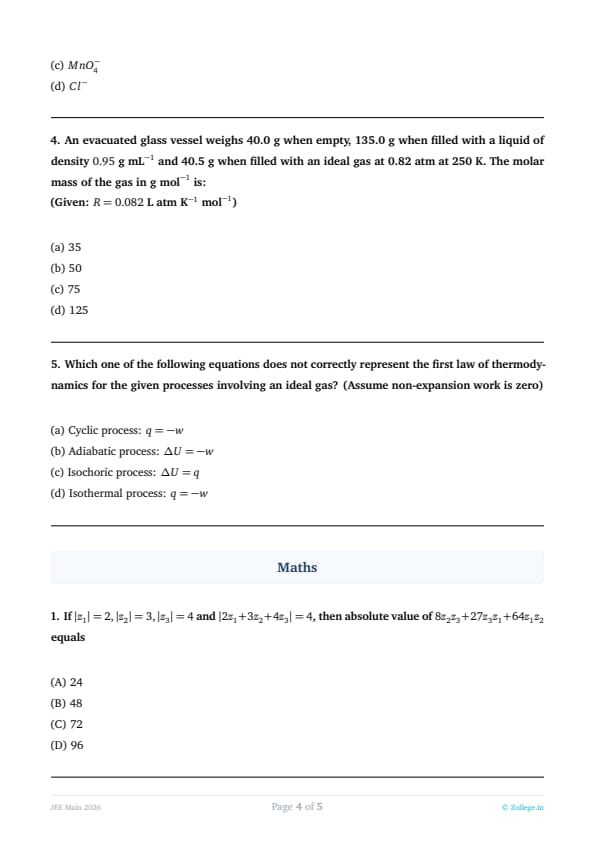
An evacuated glass vessel weighs 40.0 g when empty, 135.0 g when filled with a liquid of density \(0.95 g mL^{-1}\) and 40.5 g when filled with an ideal gas at 0.82 atm at 250 K. The molar mass of the gas in \(g mol^{-1}\) is:
(Given: \(R = 0.082 L atm K^{-1} mol^{-1}\))
Which one of the following equations does not correctly represent the first law of thermodynamics for the given processes involving an ideal gas? (Assume non-expansion work is zero)
If \( |z_1| = 2, |z_2| = 3, |z_3| = 4 \) and \( |2z_1 + 3z_2 + 4z_3| = 4 \), then absolute value of \( 8z_2z_3 + 27z_3z_1 + 64z_1z_2 \) equals
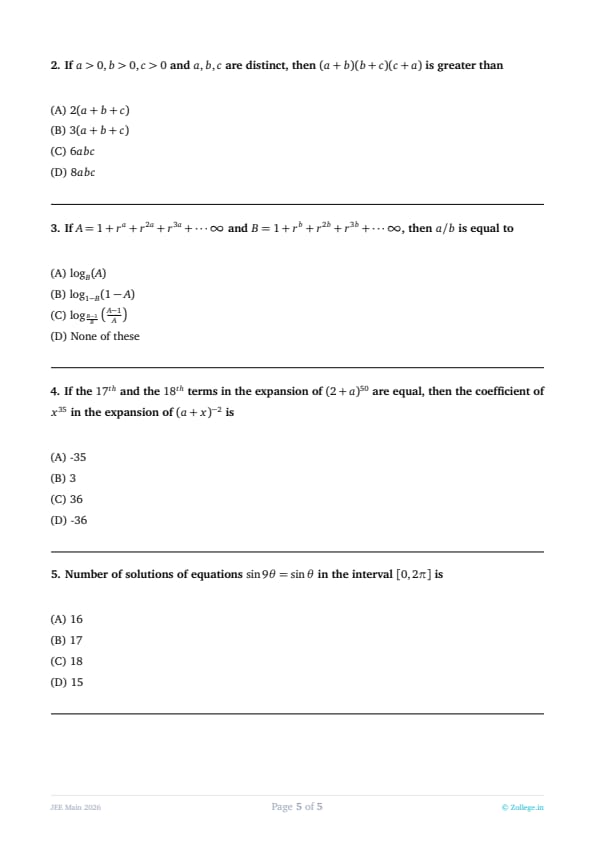
If \( a > 0, b > 0, c > 0 \) and \( a, b, c \) are distinct, then \( (a + b)(b + c)(c + a) \) is greater than
If \( A = 1 + r^a + r^{2a} + r^{3a} + \cdots \infty \) and \( B = 1 + r^b + r^{2b} + r^{3b} + \cdots \infty \), then \( a/b \) is equal to
If the \( 17^{th} \) and the \( 18^{th} \) terms in the expansion of \( (2 + a)^{50} \) are equal, then the coefficient of \( x^{35} \) in the expansion of \( (a + x)^{-2} \) is
Number of solutions of equations \( \sin 9\theta = \sin \theta \) in the interval \( [0, 2\pi] \) is
BITSAT 2026: Last Minute Tips and Tricks
*The article might have information for the previous academic years, please refer the official website of the exam.