
BITSAT 2026 April 15 Shift 2 Question Paper with Solution PDF


Content Curator | Updated On - Apr 15, 2026
BITS Pilani is conducting BITSAT 2026 Session 1 Exam on April 15, Shift 2 from 2 PM to 5 PM in CBT Mode. BITSAT 2026 today's question paper will include five sections: Physics, Chemistry, English Proficiency, Logical Reasoning, and Mathematics/Biology, with 130 MCQs questions carrying a total of 390 marks. As per the BITSAT marking scheme, +3 marks are awarded for every correct answer, and -1 mark is deducted for every wrong answer.
BITSAT 2026 April 15 Shift 2 Question Paper with Solution PDF is available here for download.
BITSAT 2026 April 15 Shift 2 Question Paper with Solution PDF
| BITSAT 2026 April 15 Shift 2 Question Paper | Download PDF | Check Solutions |

An ideal spring with spring-constant \(k\) is hung from the ceiling and a mass \(M\) is attached to its lower end. The mass is released with the spring initially unstretched. Then the maximum extension in the spring is
In a mixture of gases, the average number of degrees of freedom per molecule is 6. The rms speed of the molecule of the gas is \(c\), then the velocity of sound in the gas is
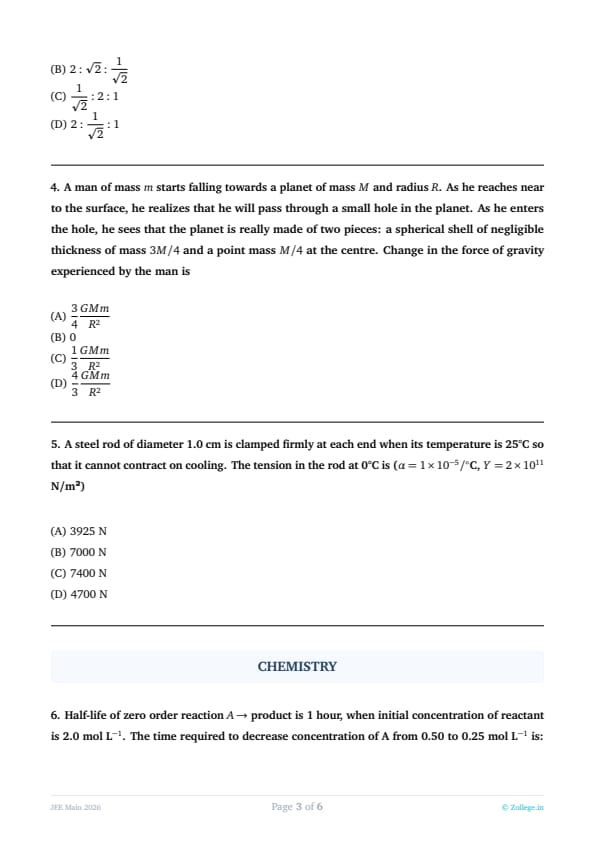
Five identical springs are used in the three configurations as shown in figure. The time periods of vertical oscillations in configurations (a), (b) and (c) are in the ratio.
A man of mass \(m\) starts falling towards a planet of mass \(M\) and radius \(R\). As he reaches near to the surface, he realizes that he will pass through a small hole in the planet. As he enters the hole, he sees that the planet is really made of two pieces: a spherical shell of negligible thickness of mass \(3M/4\) and a point mass \(M/4\) at the centre. Change in the force of gravity experienced by the man is
A steel rod of diameter 1.0 cm is clamped firmly at each end when its temperature is 25\(^\circ\)C so that it cannot contract on cooling. The tension in the rod at 0\(^\circ\)C is (\(\alpha = 1 \times 10^{-5} /^\circC\), \(Y = 2 \times 10^{11} N/m^2\))
Half-life of zero order reaction \(A \rightarrow\) product is 1 hour, when initial concentration of reactant is \(2.0 mol L^{-1}\). The time required to decrease concentration of A from \(0.50\) to \(0.25 mol L^{-1}\) is:
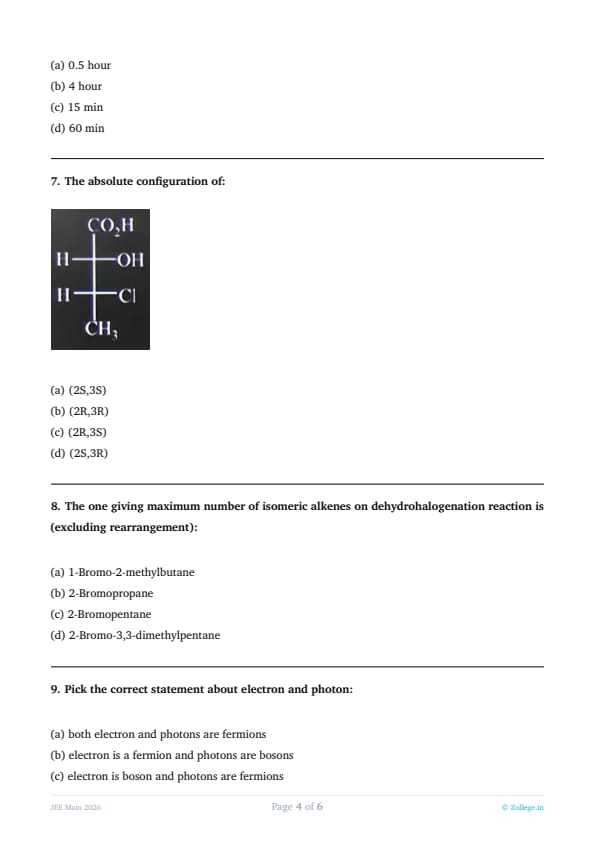
The absolute configuration of:
\textit{(Image represents a Fischer projection with C2 and C3 chiral centers. Top group: CO\(_2\)H, Bottom group: CH\(_3\). At C2: H on left, OH on right. At C3: H on left, Cl on right.)
View Solution
Step 1: Understanding the Concept:
The absolute configuration (R/S) of chiral centers in a Fischer projection is determined using the Cahn-Ingold-Prelog (CIP) priority rules. If the lowest priority group is on a horizontal bond, the actual configuration is opposite to the apparent direction (clockwise vs. counter-clockwise).
Step 2: Key Formula or Approach:
1. Assign priority numbers (1 to 4) to the four groups attached to the chiral center based on atomic number.
2. Trace the path from 1 \(\rightarrow\) 2 \(\rightarrow\) 3.
3. If the path is clockwise, the apparent configuration is R. If counter-clockwise, it is S.
4. Since the lowest priority group (-H) is on the horizontal bond in both centers, reverse the result: R \(\rightarrow\) S and S \(\rightarrow\) R.
Step 3: Detailed Explanation:
For C2 (Top chiral center):
Groups attached to C2: -OH, -CH(Cl)CH\(_3\) (C3 group), -CO\(_2\)H, -H.
Priorities at C2:
1. -OH (Oxygen has the highest atomic number, 8)
2. -CH(Cl)CH\(_3\) (Carbon is attached to Cl, C, H. Max atomic number is 17)
3. -CO\(_2\)H (Carbon is attached to O, O, O. Max atomic number is 8)
4. -H (Lowest priority)
Note: Group 2 wins over Group 3 because the first point of difference yields Cl (17) vs O (8).
Positions on Fischer projection: Top(3), Bottom(2), Right(1), Left(4).
Path 1 \(\rightarrow\) 2 \(\rightarrow\) 3 goes from Right to Bottom to Top, which forms a clockwise circle. Apparent = R.
Since -H is horizontal (Left), we reverse the result. Therefore, actual configuration = 2S.
For C3 (Bottom chiral center):
Groups attached to C3: -Cl, -CH(OH)CO\(_2\)H (C2 group), -CH\(_3\), -H.
Priorities at C3:
1. -Cl (Highest atomic number, 17)
2. -CH(OH)CO\(_2\)H (Carbon attached to O, C, H)
3. -CH\(_3\) (Carbon attached to H, H, H)
4. -H
Positions on Fischer projection: Right(1), Top(2), Bottom(3), Left(4).
Path 1 \(\rightarrow\) 2 \(\rightarrow\) 3 goes from Right to Top to Bottom, which forms a counter-clockwise circle. Apparent = S.
Since -H is horizontal (Left), we reverse the result. Therefore, actual configuration = 3R.
Step 4: Final Answer:
The absolute configuration is (2S, 3R). Quick Tip: When assigning priorities, evaluate atoms one bond further away only if there is a tie at the first point of attachment. Here, C3's attached Chlorine (17) easily beats the Oxygens (8) on the carboxylic acid group!
The one giving maximum number of isomeric alkenes on dehydrohalogenation reaction is (excluding rearrangement):
Pick the correct statement about electron and photon:
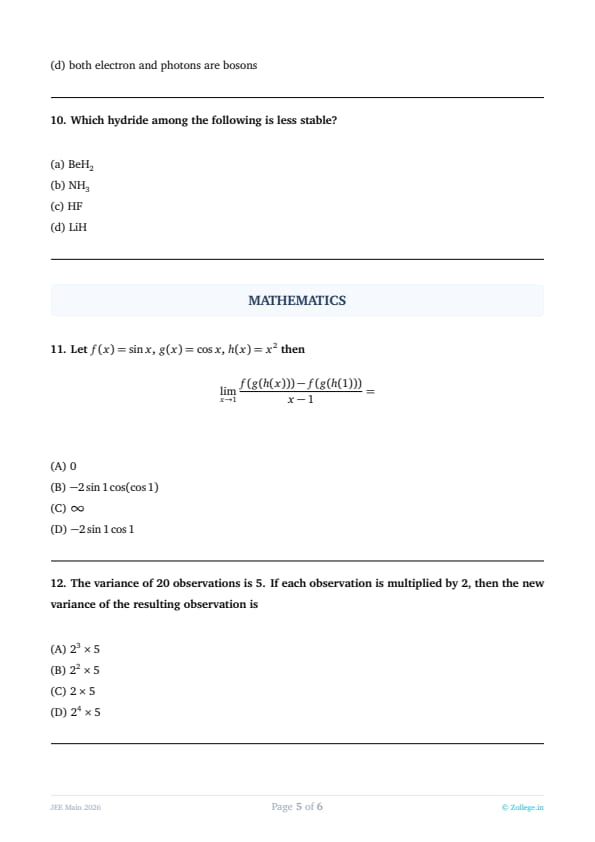
Which hydride among the following is less stable?
Let \(f(x) = \sin x, g(x) = \cos x, h(x) = x^2\) then
\[ \lim_{x\rightarrow 1} \frac{f(g(h(x))) - f(g(h(1)))}{x - 1} = \]
The variance of 20 observations is 5. If each observation is multiplied by 2, then the new variance of the resulting observation is
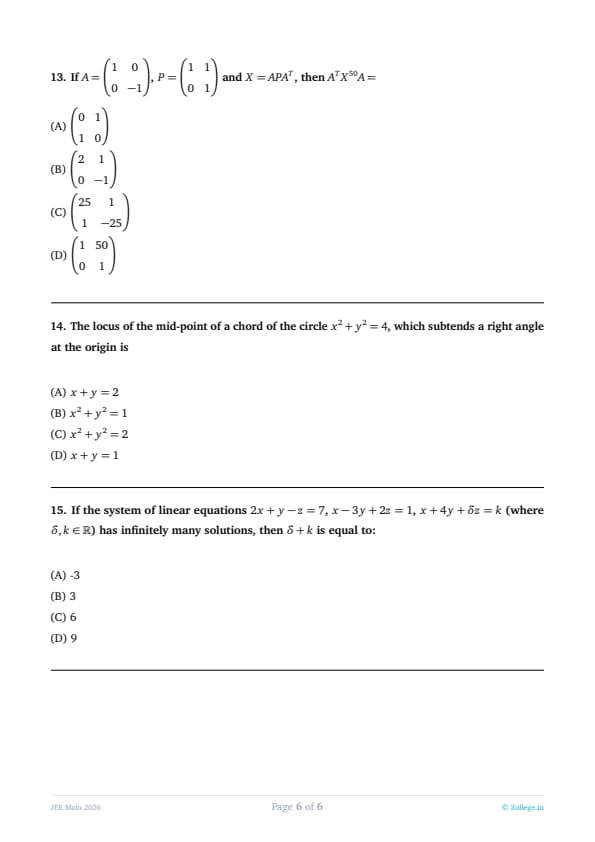
If \(A = \begin{pmatrix} 1 & 0
0 & -1 \end{pmatrix}, P = \begin{pmatrix} 1 & 1
0 & 1 \end{pmatrix}\) and \(X = A P A^T\), then \(A^T X^{50} A =\)
The locus of the mid-point of a chord of the circle \(x^2 + y^2 = 4\), which subtends a right angle at the origin is
If the system of linear equations \(2x + y - z = 7\), \(x - 3y + 2z = 1\), \(x + 4y + \delta z = k\) (where \(\delta, k \in \mathbb{R}\)) has infinitely many solutions, then \(\delta + k\) is equal to:
BITSAT 2026: Last Minute Tips and Tricks
*The article might have information for the previous academic years, please refer the official website of the exam.