
BITSAT 2026 April 16 Shift 2 Question Paper with Solution PDF


Content Writer | Updated On - Apr 16, 2026
BITS Pilani is conducting BITSAT 2026 Session 1 Exam on April 16, Shift 2 from 2 PM to 5 PM in CBT Mode. The BITSAT 2026 today's question paper will include five sections: Physics, Chemistry, English Proficiency, Logical Reasoning, and Mathematics/Biology, with 130 MCQs questions carrying a total of 390 marks. As per the BITSAT marking scheme, +3 marks are awarded for every correct answer, and -1 mark is deducted for every wrong answer.
BITSAT 2026 April 16 Shift 2 Question Paper with Solution PDF is available here for download.
BITSAT 2026 April 16 Shift 2 Question Paper with Solution PDF
| BITSAT 2026 April 16 Shift 2 Question Paper | Download PDF | Check Solutions |

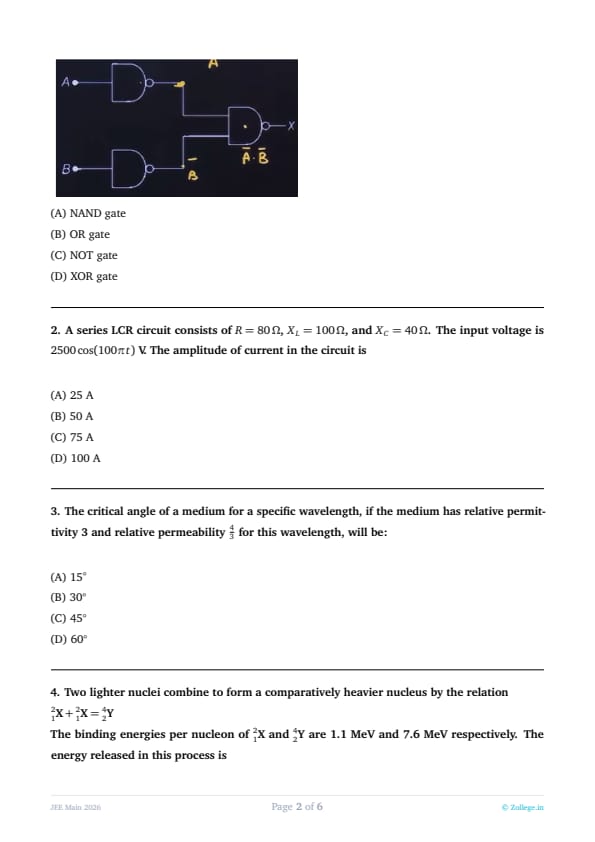
The combination of the gates shown in the following figure yields

A series LCR circuit consists of \(R = 80 \, \Omega\), \(X_L = 100 \, \Omega\), and \(X_C = 40 \, \Omega\). The input voltage is \(2500 \cos(100\pi t)\) V. The amplitude of current in the circuit is
The critical angle of a medium for a specific wavelength, if the medium has relative permittivity 3 and relative permeability \(\frac{4}{3}\) for this wavelength, will be:
Two lighter nuclei combine to form a comparatively heavier nucleus by the relation
\({}_1^2X + {}_1^2X = {}_2^4Y\)
The binding energies per nucleon of \({}_1^2X\) and \({}_2^4Y\) are 1.1 MeV and 7.6 MeV respectively. The energy released in this process is
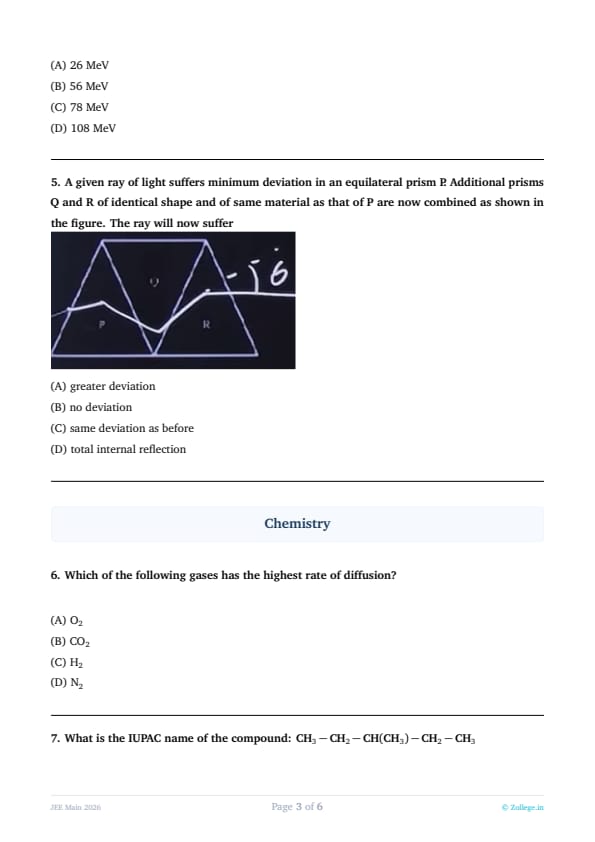
A given ray of light suffers minimum deviation in an equilateral prism P. Additional prisms Q and R of identical shape and of same material as that of P are now combined as shown in the figure. The ray will now suffer

Which of the following gases has the highest rate of diffusion?
What is the IUPAC name of the compound: \(CH_3 - CH_2 - CH(CH_3) - CH_2 - CH_3\)
A first-order reaction is 25% complete in 30 minutes. How much time will it take for the reaction to be 75% complete?
Which of the following substances does not undergo hydrolysis in aqueous solution?
How many moles of oxygen are required to completely combust 1 mole of propane (\(C_3H_8\))?
The area of the region bounded by the curves \(x = y^2 - 2\) and \(x = y\) is
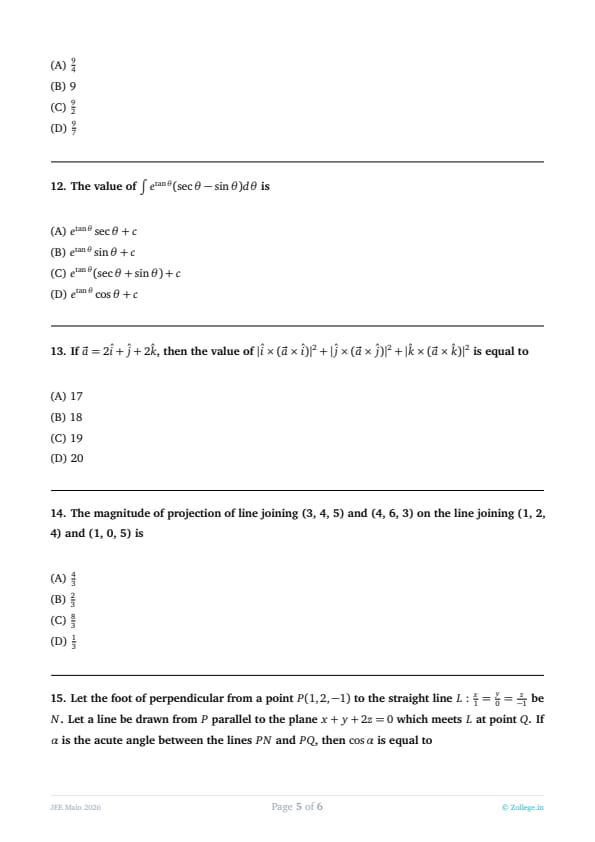
The value of \(\int e^{\tan\theta} (\sec\theta - \sin\theta) d\theta\) is
If \(\vec{a} = 2\hat{i} + \hat{j} + 2\hat{k}\), then the value of \(|\hat{i} \times (\vec{a} \times \hat{i})|^2 + |\hat{j} \times (\vec{a} \times \hat{j})|^2 + |\hat{k} \times (\vec{a} \times \hat{k})|^2\) is equal to
The magnitude of projection of line joining (3, 4, 5) and (4, 6, 3) on the line joining (1, 2, 4) and (1, 0, 5) is
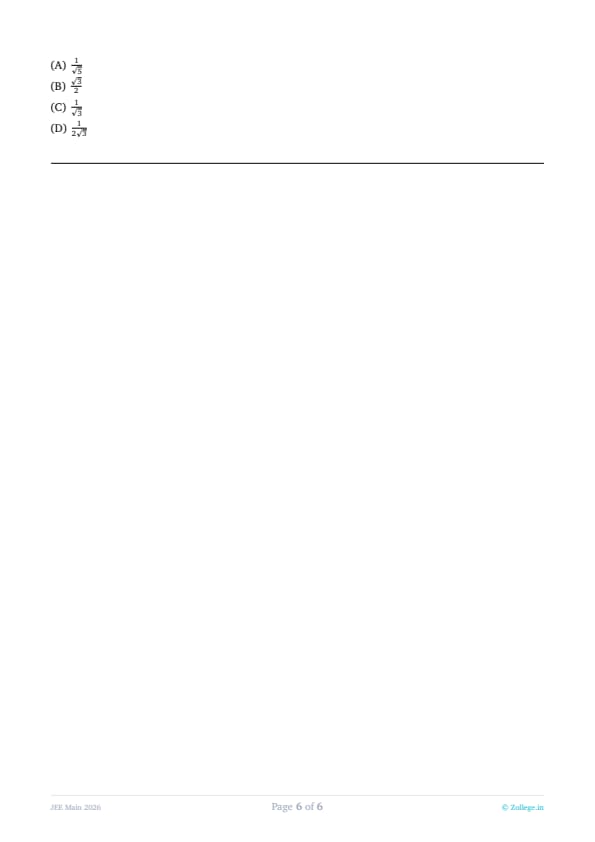
Let the foot of perpendicular from a point \(P(1, 2, -1)\) to the straight line \(L : \frac{x}{1} = \frac{y}{0} = \frac{z}{-1}\) be \(N\). Let a line be drawn from \(P\) parallel to the plane \(x + y + 2z = 0\) which meets \(L\) at point \(Q\). If \(\alpha\) is the acute angle between the lines \(PN\) and \(PQ\), then \(\cos\alpha\) is equal to
BITSAT 2026: Last Minute Tips and Tricks
*The article might have information for the previous academic years, please refer the official website of the exam.