
BITSAT 2026 April 19 Shift 1 Question Paper with Solution PDF


Content Writer | Updated On - Apr 22, 2026
BITS Pilani conducted BITSAT 2026 Session 1 absentees Slot Exam on April 19, Shift 1 from 9 AM to 12 PM in CBT Mode. The BITSAT 2026 question paper included five sections: Physics, Chemistry, English Proficiency, Logical Reasoning, and Mathematics/Biology, with 130 MCQs questions carrying a total of 390 marks. As per the BITSAT marking scheme, +3 marks are awarded for every correct answer, and -1 mark is deducted for every wrong answer.
BITSAT 2026 April 19 Shift 1 Question Paper with Solution PDF is available here for download.
BITSAT 2026 April 19 Shift 1 Question Paper with Solution PDF
| BITSAT 2026 April 19 Shift 1 Question Paper | Download PDF | Check Solutions |
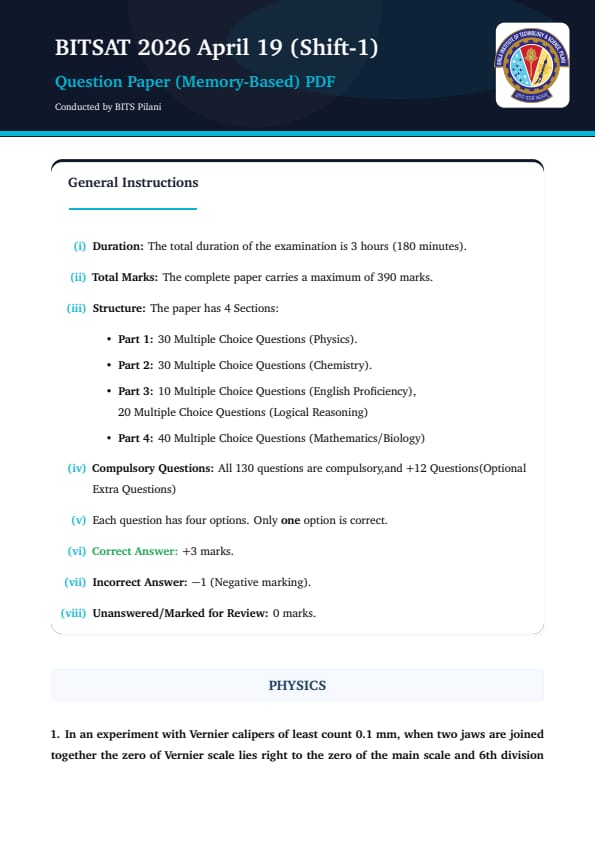
In an experiment with Vernier calipers of least count 0.1 mm, when two jaws are joined together the zero of Vernier scale lies right to the zero of the main scale and 6th division of Vernier scale coincides with the main scale division. While measuring the diameter of a spherical bob, the zero of Vernier scale lies in between 3.2 cm and 3.3 cm marks, and 4th division of Vernier scale coincides with the main scale division. The diameter of bob is measured as:
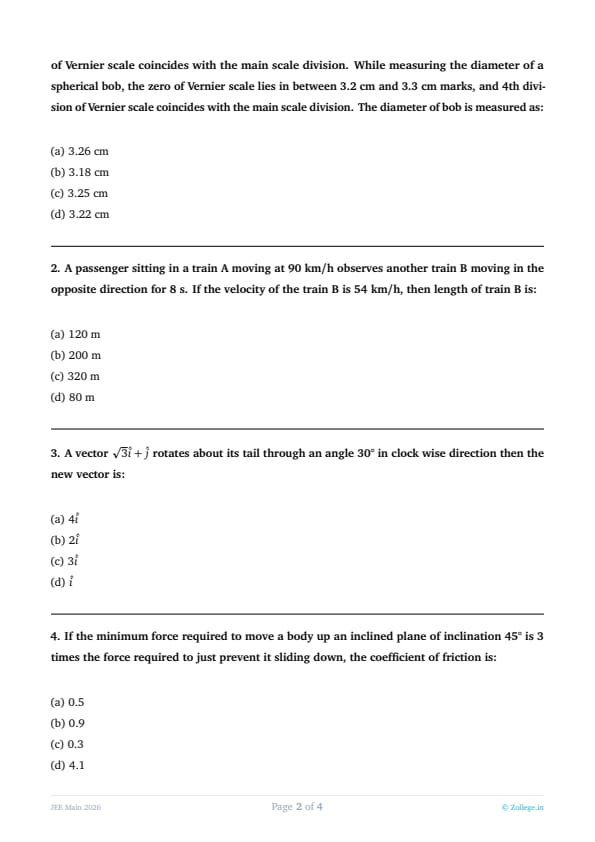
A passenger sitting in a train A moving at 90 km/h observes another train B moving in the opposite direction for 8 s. If the velocity of the train B is 54 km/h, then length of train B is:
A vector \(\sqrt{3}\hat{i}+\hat{j}\) rotates about its tail through an angle 30° in clock wise direction then the new vector is:
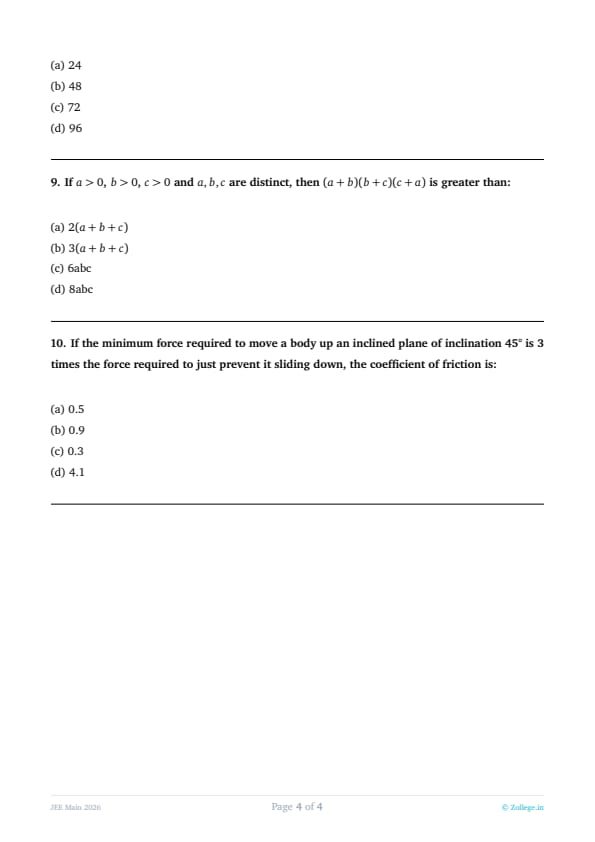
If the minimum force required to move a body up an inclined plane of inclination 45° is 3 times the force required to just prevent it sliding down, the coefficient of friction is:
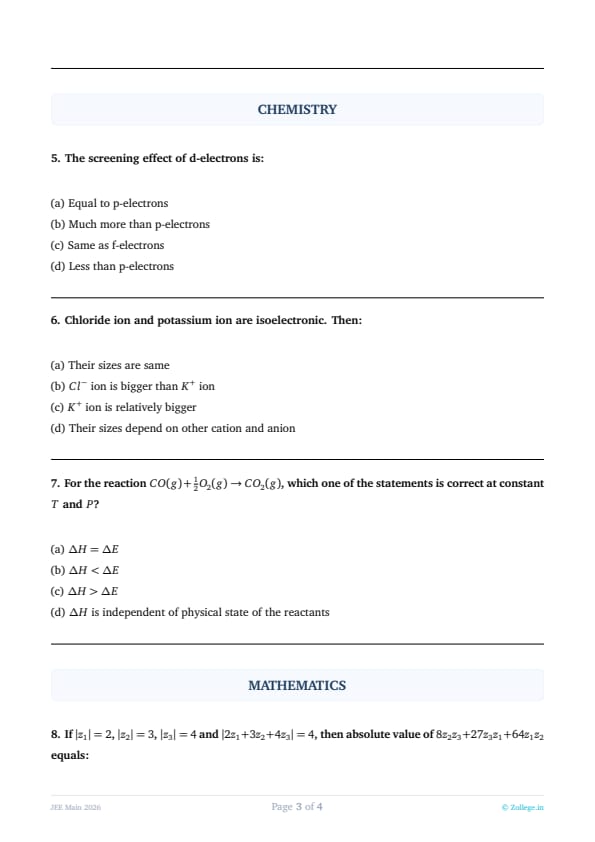
The screening effect of d-electrons is:
Chloride ion and potassium ion are isoelectronic. Then:
For the reaction \(CO(g) + \frac{1}{2}O_{2}(g) \rightarrow CO_{2}(g)\), which one of the statements is correct at constant \(T\) and \(P\)?
If \( |z_{1}|=2 \), \( |z_{2}|=3 \), \( |z_{3}|=4 \) and \( |2z_{1}+3z_{2}+4z_{3}|=4 \), then absolute value of \( 8z_{2}z_{3}+27z_{3}z_{1}+64z_{1}z_{2} \) equals:
If \( a>0 \), \( b>0 \), \( c>0 \) and \( a, b, c \) are distinct, then \( (a+b)(b+c)(c+a) \) is greater than:
If the minimum force required to move a body up an inclined plane of inclination 45° is 3 times the force required to just prevent it sliding down, the coefficient of friction is:
BITSAT 2026: Last Minute Tips and Tricks
*The article might have information for the previous academic years, please refer the official website of the exam.