
AILET 2026 LLM Question Paper: Download Answer Key with Solution PDF


Content Writer | Updated On - Dec 15, 2025
AILET 2026 LLM Question Paper is available for download here. NLU Delhi conducted AILET 2026 on December 14, 2025. AILET question paper consisted a total of 100 questions divided into different branches of Law. Download AILET 2025 LLM Question Paper with Answer Key and Solution PDF from the links provided below.
AILET 2026 LLM Question Paper with Answer Key and Solutions
| AILET 2026 LLM Question Paper with Solutions | Download PDF | Check Solutions |

“Delegated legislation is a growing child called upon to relieve the parent of the strain of overwork and capable of attending to minor matters, while the parent manages the main business” is a metaphor by:
View Solution
Step 1: Understanding the Concept:
The question identifies a famous definition/metaphor regarding Delegated Legislation, which refers to laws made by executive authorities under powers given by the legislature.
Step 2: Detailed Explanation:
Sir Cecil Carr, a distinguished authority on administrative law and author of the book Delegated Legislation, used this metaphor to justify the existence of delegated legislation.
He compared the Legislature (Parliament) to a "parent" and Delegated Legislation to a "growing child".
The Logic: The "parent" (Legislature) is too busy with the "main business" (broad policy and major laws) and suffers from "overwork". Therefore, it delegates the "minor matters" (details, rules, regulations) to the "child" (Executive).
This highlights the functional necessity of delegated legislation in a modern welfare state where the legislature lacks the time and technical expertise for every detail. Quick Tip: \textbf{Key Jurist Definitions:} \textbf{Salmond:} Delegated legislation is that which proceeds from any authority other than the sovereign power. \textbf{Cecil Carr:} "Growing child" metaphor; "Inevitable evil".
The Droit administratif is of _________ model.
View Solution
Step 1: Understanding the Concept:
Droit administratif refers to a distinct system of administrative law governing the relationship between the state and its citizens.
Step 2: Detailed Explanation:
Origin: It is the French system of administrative law.
Key Feature: It operates on the principle that the government and its servants have a special legal status. Disputes involving the administration are not heard by ordinary civil courts but by special Administrative Courts (the highest being the \textit{Conseil d'État).
Comparison: It stands in contrast to the British/English "Rule of Law" model (advocated by A.V. Dicey), where the same ordinary courts adjudicate disputes for both private citizens and government officials.
India follows the English model (Single court system) but has incorporated principles of administrative law. Quick Tip: \textbf{Dicey's Critique: A.V. Dicey famously criticized Droit administratif for exempting officials from the ordinary law of the land, though modern scholars view it as a robust system for holding the state accountable.
‘The Path of the Law’ is the most famous essay by:
View Solution
Step 1: Understanding the Concept:
This question asks for the author of a foundational text in American Legal Realism.
Step 2: Detailed Explanation:
"The Path of the Law" (1897) is a seminal essay (originally a speech) by Oliver Wendell Holmes Jr.
Core Concepts:
The Bad Man Theory: To understand the law, one should look at it from the perspective of a "bad man" who cares only about the material consequences (punishment) of his actions, not the vague moral obligations.
Prediction Theory: "The prophecies of what the courts will do in fact, and nothing more pretentious, are what I mean by the law."
Separation of Law and Morals: He argued for a distinction between legal duty and moral duty. Quick Tip: \textbf{Famous Quote:} "The life of the law has not been logic: it has been experience." — O.W. Holmes Jr.
‘Law as a Means to an End’ is the famous work of:
View Solution
Step 1: Understanding the Concept:
This work relates to the Sociological School of Jurisprudence, focusing on the purpose of law.
Step 2: Detailed Explanation:
Rudolf Von Ihering (German Jurist) authored Der Zweck im Recht, translated as "Law as a Means to an End".
Philosophy: He is known as the "Father of Modern Sociological Jurisprudence."
Key Idea: He rejected the Historical School's view (Savigny) that law evolves unconsciously like language. Instead, he argued that law is a result of conscious human purpose (Zweck) to serve social interests.
Social Utilitarianism: Law is a tool to balance individual interests with social interests to minimize conflict. Quick Tip: \textbf{Ihering's Metaphor:} "The Stone and the Pitcher" — Law is the coercion organized in a set form by the State. Focus on "Purpose" and "Interest".
Which of the following code regarding the expression ‘Counterfeit’ defined under the Bharatiya Nyaya Sanhita, 2023 is true?
View Solution
Step 1: Understanding the Concept:
The definition of "Counterfeit" in the Bharatiya Nyaya Sanhita (BNS), 2023 (which replaced the IPC), retains the core principle regarding the quality of imitation required for an offense.
Step 2: Detailed Explanation:
Definition: A person is said to "counterfeit" who causes one thing to resemble another thing, intending by means of that resemblance to practice deception.
The Rule: The specific explanation attached to the definition (typically in Section 2(6) of BNS or corresponding provisions like Section 179 context) clarifies that:
"It is not essential to counterfeiting that the imitation should be exact."
Reasoning: The law focuses on the intent to deceive. If the resemblance is sufficient to deceive a person, the offense is committed, even if a skilled observer could spot the difference. Quick Tip: \textbf{Presumption of Intention:} If a person causes a resemblance so close that it might deceive, the court presumes they intended to deceive unless proved otherwise.
In which of the following cases, the Supreme Court of India held that the Governor must perform his role of a friend, philosopher and guide with dispassion, guided not by considerations of political expediency but by the sanctity of the constitutional oath he undertakes?
View Solution
Step 1: Understanding the Concept:
The question relates to the constitutional role of the Governor under Article 200 (assent to bills) and recent Supreme Court interventions regarding gubernatorial inaction.
Step 2: Detailed Explanation:
In the landmark case of \textit{State of Tamil Nadu v. Governor of Tamil Nadu (2025 INSC 48), the Supreme Court addressed the issue of the Governor withholding assent to bills passed by the State Legislature.
The Court heavily criticized the practice of "pocket veto" by Governors.
The Observation: The Court remarked that the Governor is a titular head and must act as a "friend, philosopher and guide" to the state government.
It explicitly stated that the Governor's actions must be guided by the "sanctity of the constitutional oath" rather than "political expediency," emphasizing that they cannot indefinitely sit on bills. Quick Tip: Trend in Federalism: Recent SC judgments (Punjab, Kerala, Tamil Nadu cases) have consistently held that the Governor cannot use the proviso to Article 200 to kill legislation by delay.
Under the Factories Act, 1948 which of the following statements is correct about overtime and its calculation?
View Solution
Step 1: Understanding the Concept:
This question tests knowledge of Section 59 of the Factories Act, 1948, which regulates "Extra wages for overtime".
Step 2: Detailed Explanation:
Threshold: Overtime applies if a worker works for more than 9 hours/day OR more than 48 hours/week.
Rate: The worker is entitled to wages at the rate of twice his ordinary rate of wages.
"Ordinary Rate of Wages":
Includes: Basic wages + Dearness Allowance (DA) + Cash equivalent of concessional food/supplies.
Excludes: Bonus and overtime wages.
Therefore, Statement (C) correctly summarizes all these legal provisions.
Statement (A) is incorrect (piece-rated workers are covered). Statement (B) is incorrect (threshold is 9 hours). Quick Tip: \textbf{Calculation Formula:} \[ OT Wages = 2 \times (Basic + DA + Concessions) \]. Note that Bonus is strictly excluded.
Which of the following statement is correct regarding the powers of the High Court under Section 528 of the Bharatiya Nagarik Suraksha Sanhita, 2023 for quashing the proceedings emanating from application under Section 12(1) of the Protection of Women from Domestic Violence Act, 2005?
View Solution
Step 1: Understanding the Concept:
Section 528 of BNSS preserves the inherent powers of the High Court (previously Section 482 CrPC). The question concerns its application to the Domestic Violence (DV) Act.
Step 2: Detailed Explanation:
Nature of Proceedings: DV Act proceedings are quasi-civil/quasi-criminal. While the remedies are civil, the procedure often follows the criminal code.
High Court's Power: The High Court can exercise its inherent power under Section 528 BNSS to quash DV proceedings to prevent abuse of the process of the court or to secure the ends of justice.
Limitation: However, the Supreme Court has held that this power should be exercised sparingly.
Correct View (Option B): Interference is warranted only in cases of gross illegality or gross abuse of process (e.g., dragging distant relatives into the case without evidence). It is not a routine remedy. Quick Tip: \textbf{Quashing Test:} The High Court looks at the allegations in the complaint. If they are absurd or inherently improbable, it may quash. Otherwise, trial must proceed.
Criminal trials and proceedings held under the Bharatiya Nagarik Suraksha Sanhita, 2023 in electronic mode, by use of electronic communication or use of audio-video electronic means are____________ .
View Solution
Step 1: Understanding the Concept:
The BNSS, 2023 introduced significant reforms to digitize the criminal justice system.
Step 2: Detailed Explanation:
Section 530 of BNSS specifically deals with "Trial and proceedings to be held in electronic mode."
Unlike the old CrPC where video conferencing was used based on judicial guidelines (e.g., for remand), the BNSS makes it a statutory provision.
The Code states that all trials, inquiries, and proceedings may be held in electronic mode.
Thus, the use of electronic means is expressly provided in the statute itself, not just implied or a matter of convenience. Quick Tip: \textbf{Digital Era:} BNSS mandates/enables "e-FIR", "e-evidence", and "e-trials" to reduce delays and physical presence requirements.
An advocate who practices in the Court of any Magistrate____________ .
View Solution
Step 1: Understanding the Concept:
This question pertains to judicial ethics and conflict of interest, codified in the procedural law (Section 526 of BNSS or equivalent old 480 CrPC).
Step 2: Detailed Explanation:
The law strictly prohibits an advocate from acting as a judicial officer in the same jurisdiction where they practice law.
The Rule: "No pleader who practises in the Court of any Magistrate shall sit as a Magistrate in that Court or in any Court within the local jurisdiction of that Court."
Purpose: To ensure impartiality. A lawyer cannot judge cases involving colleagues they work with or oppose daily, nor can they judge cases in a court where they have clients.
The prohibition is absolute ("shall not sit"). Quick Tip: \textbf{Nemo judex in causa sua:} No one should be a judge in their own cause (or where they have an interest).
In exercise of power vested under Section 524 of the Bharatiya Nagarik Suraksha Sanhita, 2023, the State Government may, after consultation with the High Court, by notification, direct that references in Sections____________to an Executive Magistrate shall be construed as references to a Judicial Magistrate of the first class.
View Solution
Step 1: Understanding the Concept:
Section 524 of BNSS allows the State to transfer specific functions from the Executive Magistrate (Police/Admin) to the Judicial Magistrate (Courts) to ensure better separation of powers.
Step 2: Detailed Explanation:
The text of Section 524 explicitly enumerates the sections that can be transferred.
These sections are:
127: Security for keeping the peace.
128: Security for good behaviour.
129: Dispersal of assembly by use of civil force.
164: Conditional order for removal of nuisance.
166: Power to prohibit repetition or continuance of public nuisance.
The correct set of numbers listed in the Act is 127, 128, 129, 164 and 166. Quick Tip: These sections relate to Preventive Justice and Public Order, usually handled by Executive Magistrates, but can be shifted to Judicial Magistrates.
In computing the period of limitation under the provisions of Bharatiya Nagarik Suraksha Sanhita, 2023, in relation to an offender, the day from which such period is to be computed____________ .
View Solution
Step 1: Understanding the Concept:
This question deals with the calculation of the "Period of Limitation" (the time limit within which a court can take cognizance of an offense), specifically under Section 471 of BNSS (formerly Section 469 CrPC).
Step 2: Detailed Explanation:
The Rule: When calculating the limitation period for taking cognizance of an offense, the law provides a benefit to the calculation to avoid ambiguity.
Section 471(1)(a): The period of limitation commences on the date of the offense.
Section 471(2): In computing the said period, the day from which such period is to be computed shall be excluded.
Example: If an offense happens on 1st January and the limitation is 1 year, the count starts effectively from 2nd January. Quick Tip: \textbf{General Legal Principle:} In almost all limitation laws (Civil or Criminal), the first day (the day the cause of action arises) is always excluded.
According to Section 49 of the Bharatiya Sakshya Adhiniyam, 2023, in criminal proceedings, the fact that the accused has a bad character is _________, unless evidence has been given that he has a good character in which case it becomes _________.
View Solution
Step 1: Understanding the Concept:
This question tests the rules of evidence regarding the character of the accused in criminal cases, specifically Section 49 of BSA, 2023 (formerly Section 54 of the Indian Evidence Act).
Step 2: Detailed Explanation:
General Rule: In criminal proceedings, the fact that the accused has a bad character is irrelevant. The prosecution cannot lead evidence of bad character just to show the accused is likely to have committed the crime.
Exception: However, if the accused leads evidence to show they have a good character (to prove innocence), then the shield is lost.
Result: In that case, the fact that the accused has a bad character becomes relevant, and the prosecution can introduce such evidence to rebut the claim.
Thus, the sequence is: Irrelevant \(\rightarrow\) Relevant. Quick Tip: \textbf{Character Evidence Rule:} Good character: Always Relevant in criminal cases. Bad character: Irrelevant (unless good character is pleaded or character is a fact in issue).
According to Section 61 of the Bharatiya Sakshya Adhiniyam, 2023, admissibility of electronic or digital record in the evidence, have the same _________ as other document.
View Solution
Step 1: Understanding the Concept:
Section 61 of BSA, 2023 replaces the old Section 65B of the Evidence Act. It establishes the foundational admissibility of electronic records.
Step 2: Detailed Explanation:
The section explicitly states that nothing in the Adhiniyam shall deny admissibility to a record solely because it is electronic.
The Statutory Wording: It declares that such electronic or digital records shall (subject to authentication under Section 63) have the same legal effect, validity and enforceability as other documents.
This provision gives electronic records a status equivalent to primary paper documents ("other documents"). Quick Tip: Keyword Association: Section 61 BSA: Admissibility \& Status (Legal effect, Validity, Enforceability). Section 63 BSA: Certificate requirement (Authentication).
Consider the following statements:
(i) The identification of an accused by a witness in court is substantive evidence.
(ii) The evidence of identification in test identification parade is primary evidence but not substantive evidence.
(iii) Test identification parade can be used only to corroborate identification of the accused by a witness in the court.
Choose the correct answer
View Solution
Step 1: Understanding the Concept:
The question relates to the evidentiary value of identification of an accused, specifically distinguishing between identification in court and a Test Identification Parade (TIP).
Step 2: Analysis of Statements:
Statement (i): The identification of an accused by a witness in the court is substantive evidence. This is Correct. The sworn testimony given before the court is the substantive evidence on which a conviction can be based.
Statement (ii): The evidence of identification in a test identification parade is primary evidence but not substantive evidence. This is Incorrect. TIP held during the investigation stage is not primary or substantive evidence. It is a part of the investigation under Section 162 of the CrPC and is relevant under Section 9 of the Indian Evidence Act solely for corroboration or contradiction. It is generally considered hearsay if not backed by court identification, and definitely not "primary evidence" in the strict sense used here to imply superior weight over court testimony.
Statement (iii): Test identification parade can be used only to corroborate identification of the accused by a witness in the court. This is Correct. The main purpose of TIP is to satisfy the investigating agency that the investigation is proceeding in the right direction and to corroborate the witness's testimony in court.
Step 3: Conclusion:
Since statements (i) and (iii) are correct, and statement (ii) is incorrect, option (C) is the right choice. Quick Tip: Remember: "Identification in Court" = Substantive Evidence. "TIP" = Corroborative Evidence (Section 9, IEA).
Which of the following Latin maxims is related to relevancy of dying declaration?
View Solution
Step 1: Understanding the Concept:
A dying declaration is admissible under Section 32(1) of the Indian Evidence Act. The admissibility is based on a specific legal maxim reflecting the belief that a dying person will not lie.
Step 2: Analyzing the Maxims:
(A) \textit{Actus Curiae Neminem Gravabit: An act of the court shall prejudice no man.
(B) \textit{Nemo Moriturus Praesumitur Mentiri: A man will not meet his maker with a lie in his mouth (literally: no one dying is presumed to lie). This is the foundation of the admissibility of dying declarations.
(C) \textit{Nullum Tempus Aut Locus Occurrit Regi: No time or place runs against the King (Law of Limitation does not apply to the Crown/State).
(D) \textit{Lex Non Cogit Ad Impossibilia: The law does not compel the doing of impossibilities.
Step 4: Conclusion:
The correct maxim is \textit{Nemo Moriturus Praesumitur Mentiri. Quick Tip: Connect keywords: "Moriturus" relates to "Mortality/Death". This helps identify the maxim for Dying Declaration instantly.
Choose the correct answer regarding the doctrine of restitution under Section 144 of the Code of Civil Procedure 1908:
View Solution
Step 1: Understanding Section 144 CPC:
Section 144 of the CPC deals with the doctrine of restitution. The principle is that "no one shall be prejudiced by an act of the Court" (\textit{Actus Curiae Neminem Gravabit).
Step 2: Analyzing the Options:
(A) Incorrect. The term 'restitution' is not explicitly defined in the definition clause, though the section explains the mechanism.
(B) Incorrect. Restitution is not a new substantive right but a procedural mechanism to undo the harm done by an erroneous decree that has been varied or reversed.
(C) Correct. The section recognizes the inherent duty of the court to restore the status quo ante. It regulates the power to ensure parties are placed in the position they would have held had the erroneous decree not been passed.
(D) Incorrect. Courts \textit{do have inherent power to grant restitution, and Section 144 is a statutory recognition of this power (and Section 151 can apply where Section 144 strictly doesn't). Quick Tip: Restitution puts the clock back. It is not a new right but a correction of a mistake made by the legal process itself.
Which of the following maxims is not related to doctrine of res judicata?
View Solution
Step 1: Understanding Res Judicata:
\textit{Res Judicata (Section 11, CPC) prevents the same issue from being tried again between the same parties.
Step 2: Analyzing the Maxims:
(A) \textit{Nemo Debet Bis Vexari...: No one should be vexed twice for the same cause. (Related to Res Judicata).
(B) \textit{Nemo Tenetur Se Ipsum Prodere: No one is bound to accuse himself (Right against self-incrimination). This is related to Criminal Law (Article 20(3) of Constitution), not Res Judicata.
(C) \textit{Interest Reipublicae Ut Sit Finis Litium: It is in the interest of the State that there be an end to litigation. (Related to Res Judicata).
(D) \textit{Res Judicata Pro Veritate Occipitur: A judicial decision must be accepted as correct. (Related to Res Judicata). Quick Tip: Identify the "odd one out". Option (B) is about self-incrimination ("Prodere" \(\approx\) Betray/Accuse), which is distinct from civil procedure concepts like Res Judicata.
Where the court has passed a decree for the payment of money and the decree is silent with respect to the payment of interest during the period from the date of the decree to the date of payment, it shall be deemed that
View Solution
Step 1: Understanding Section 34 of CPC:
Section 34 of the Code of Civil Procedure deals with interest. Sub-section (2) specifically addresses this scenario.
Step 2: Legal Provision:
Section 34(2) states: "Where such a decree is silent with respect to the payment of further interest... the Court shall be deemed to have refused such interest, and a separate suit therefore shall not lie."
Step 3: Conclusion:
If the decree is silent on future interest (from decree date to payment date), it is deemed refused, and a separate suit is barred. Quick Tip: Silence on interest = Refusal. This is a "Deeming Provision" in Section 34(2) CPC.
All questions relating to executability or non-executability of a decree have been conferred within the exclusive jurisdiction of the court executing the decree by virtue of the provision _________ of the Code of Civil Procedure 1908.
View Solution
Step 1: Identify the Subject Matter:
The question is about questions determined by the executing court regarding execution, discharge, or satisfaction of a decree.
Step 2: Analyze Options:
Section 10: Res Sub-Judice (Stay of suit).
Section 11: Res Judicata.
Section 33: Judgment and Decree.
Section 47: Questions to be determined by the Court executing decree. It mandates that all questions arising between the parties to the suit relating to the execution, discharge, or satisfaction of the decree shall be determined by the Court executing the decree and not by a separate suit. Quick Tip: Section 47 is the "Gatekeeper" of execution proceedings, preventing separate suits for execution-related matters.
Section 135 of the Transfer of Property Act 1882 deals with the provision for the assignment of rights under the policy of _________ insurance.
View Solution
Step 1: Direct Section Reference:
Section 135 of the Transfer of Property Act, 1882 is explicitly titled "Assignment of rights under policy of marine insurance."
Step 2: Context:
Section 130 deals with Actionable Claims.
Section 135 specifically addresses Marine Insurance policies.
Life Insurance assignment is generally governed by Section 38 of the Insurance Act, 1938.
Fire insurance assignment often requires insurer consent, governed by general contract/property principles, but Section 135 is exclusively for Marine. Quick Tip: TPA Section 135 = Marine Insurance. This is a specific statutory provision often asked in objective exams.
`X' transfers his property in favor of an unborn person `Y' in accordance with the principle of Section 13 of the Transfer of Property Act 1882. `Y' acquires interest in the property upon his birth, although `Y' is not entitled to enjoy the property immediately on his birth. The interest of `Y' in the property is
View Solution
Step 1: Analyze the Situation:
Transfer to an unborn person is valid if preceded by a prior life interest (Section 13).
Step 2: Application of Section 20 TPA:
Section 20 of the Transfer of Property Act states: "Where, on a transfer of property, an interest therein is created for the benefit of a person not then living, he acquires upon his birth, unless a contrary intention appears from the terms of the transfer, a vested interest, although he may not be entitled to the enjoyment thereof immediately on his birth."
Step 3: Conclusion:
Upon birth, the interest becomes vested, even if possession (enjoyment) is postponed until the termination of the prior life interest. Quick Tip: Key Rule: Unborn Person + Birth = Vested Interest (Section 20 TPA).
The general rule for the apportionment of income between the transferor and transferee under Section 36 of the Transfer of Property Act 1882 is that such income shall be deemed to accrue due from
View Solution
Step 1: Understanding Section 36 TPA:
Section 36 deals with "Apportionment of periodical payments determination of apportionment."
Step 2: Legal Provision:
It states that in the absence of a contract or local usage to the contrary, all rents, annuities, pensions, dividends, and other periodical payments in the nature of income shall, upon the transfer of the interest of the person entitled to receive them, be deemed, as between the transferor and the transferee, to accrue due from day to day, and to be apportionable accordingly. Quick Tip: Section 36 TPA Rule: Income accrues daily. This makes calculation precise for the date of transfer.
Choose the correct answer regarding the doctrine of part performance.
View Solution
Step 1: Understanding Section 53A TPA (Part Performance):
Section 53A protects a transferee who has taken possession of a property based on a written contract, even if the formal instrument of transfer hasn't been registered.
Step 2: Analyzing the Requisites:
(A) Incorrect. If the transferee is already in possession, they must do some \textit{act in furtherance of the contract. Merely continuing in possession is not enough.
(B) Incorrect. The transferee \textit{must be willing to perform their part.
(C) Correct. The section explicitly states that the transferee must have performed or be willing to perform his part of the contract. This "readiness and willingness" is a mandatory condition.
(D) Incorrect. Section 53A requires the contract to be in writing and signed. An oral contract is not sufficient for the doctrine of part performance. Quick Tip: Section 53A Essentials: Written Contract + Possession + Act in Furtherance + Willingness to Perform.
The Universal Donee is liable for
View Solution
Step 1: Direct Section Reference (Section 128 TPA):
Section 128 defines a Universal Donee as one who receives the whole of the donor's property.
Step 2: Liability Scope:
The section states that the universal donee is personally liable for all the debts due by and liabilities of the donor at the time of the gift, to the extent of the property comprised therein.
Step 3: Conclusion:
The liability is not unlimited; it is capped by the value of the assets received. Quick Tip: Universal Donee inherits assets AND liabilities, but liabilities are limited to the value of the assets (no personal liability beyond the gift's value).
Which of the statements regarding the characteristics of `Charges' given under Section 100 of the Transfer of Property Act 1882, is not true?
View Solution
Step 1: Understanding Section 100 TPA:
Section 100 defines a 'Charge'. It exists where immovable property of one person is by act of parties or operation of law made security for the payment of money to another, \textit{and the transaction does not amount to a mortgage.
Step 2: Analyzing Options:
(A) True. Charges can be created by act of parties.
(B) True. Charges can be created by operation of law.
(C) False. The definition specifically says "and the transaction \textit{does not amount to a mortgage". A charge is not a mortgage (no transfer of interest).
(D) True. Section 100 explicitly states that provisions relating to a simple mortgage shall apply to charges. Quick Tip: Charge \(\neq\) Mortgage. In a Mortgage, there is a transfer of interest. In a Charge, there is only a right to payment out of the property.
Which of the following is not required to prove a Will?
View Solution
Step 1: Legal Requirements for a Will:
To prove a Will in a court of law (under the Indian Evidence Act and Indian Succession Act), one must show:
Due execution by the testator (signature, witnesses).
Testamentary capacity (sound mind).
That it is the last will (revocability).
The court satisfies its conscience (satisfaction of a prudent mind) regarding the genuineness.
Step 2: Evaluating Option (D):
"Mathematical accuracy" is not a legal standard for proving wills. Proof in civil matters is based on the "preponderance of probabilities" and the satisfaction of the conscience of the court, not mathematical certainty. Quick Tip: Law deals with probabilities and the "prudent man" standard, not mathematical certainty.
Who is not a domestic worker under the Sexual Harassment of Women at Workplace (Prevention, Prohibition and Redressal) Act, 2013?
View Solution
Step 1: Definition of Domestic Worker:
Section 2(e) of the Act defines "domestic worker".
Step 2: Exclusion Clause:
The definition includes women employed directly or through an agency, for cash or kind, "but does not include any member of the family of the employer."
Step 3: Conclusion:
Option (C) refers to a family member, who is explicitly excluded from the definition of a domestic worker under this Act. Quick Tip: Family members working in the household are not "employees" or "domestic workers" under the POSH Act 2013.
Which of the following statement is false regarding settlement of matter through conciliation under the Sexual Harassment of Women at Workplace (Prevention, Prohibition and Redressal) Act, 2013?
View Solution
Step 1: Section 10 of the POSH Act:
Section 10 allows for conciliation at the request of the aggrieved woman before an inquiry is initiated.
Step 2: Proviso to Section 10(1):
The proviso specifically states: "Provided that no monetary settlement shall be made as a basis of conciliation."
Step 3: Conclusion:
Statement (B) contradicts the explicit legal provision forbidding monetary settlement as the basis for conciliation. Therefore, it is the false statement. Quick Tip: Conciliation in Sexual Harassment cases cannot be about "buying silence". Monetary settlement is strictly prohibited as a basis for conciliation.
Taking measurements of convicts for the purposes of identification and investigation in criminal matters is expressly authorized under the_________.
View Solution
Step 1: Current Legislation:
The \textit{Identification of Prisoners Act, 1920 was repealed and replaced by The Criminal Procedure (Identification) Act, 2022.
Step 2: Scope of the New Act:
This Act expressly authorizes police officers to take "measurements" (fingerprints, palm prints, foot prints, photos, iris and retina scan, biological samples, etc.) of convicts and other persons for the purposes of identification and investigation. Quick Tip: The 2022 Act modernized the 1920 Act to include biometric data like iris scans and biological samples under the term "measurements".
The child born through assisted reproductive technology shall be deemed to be a biological child of _________.
View Solution
Step 1: Relevant Act:
The Assisted Reproductive Technology (Regulation) Act, 2021.
Step 2: Section 24 Reference:
Section 24 of the Act states that a child born through assisted reproductive technology shall be deemed to be a biological child of the commissioning couple and the said child shall be entitled to all the rights and privileges available to a natural child. Quick Tip: The law aims to secure the legitimacy of the child. The "Commissioning Couple" (parents who sought the treatment) are the legal parents, not the donor.
Which of the following is not a commercial surrogacy under the Surrogacy (Regulation) Act, 2021?
View Solution
Step 1: Definition of Commercial Surrogacy:
The Surrogacy (Regulation) Act, 2021 prohibits commercial surrogacy. Commercial surrogacy involves commercialization of surrogacy services or procedures, including selling/buying embryos or trading services for payment, reward, benefit, fees, etc.
Step 2: Exception:
The definition of commercial surrogacy specifically excludes payment for:
Medical expenses incurred on the surrogate mother.
Insurance coverage for the surrogate mother.
These are considered essential protections for the surrogate, not "commercial trading." Quick Tip: Altruistic Surrogacy is allowed. Altruistic includes medical expenses + insurance. Anything beyond that (profit/fee) is Commercial Surrogacy.
The Parliament has enacted an Act to provide for the constitution of the Commission for the purpose of protecting and improving the quality of the air in the National Capital Region and adjoining areas. The name of the Act is
View Solution
Step 1: Understanding the Concept:
The question tests knowledge of recent Environmental Legislation enacted to curb air pollution in Delhi-NCR.
Step 2: Detailed Explanation:
To address the severe air pollution in Delhi and its surrounding regions, the Parliament enacted a specific law replacing the Environment Pollution (Prevention and Control) Authority (EPCA).
The full and correct title of the statute is "The Commission for Air Quality Management in National Capital Region and Adjoining Areas Act, 2021".
It establishes the Commission for Air Quality Management (CAQM) as a statutory body.
Option (D) correctly includes "Commission", "National Capital Region", and "Adjoining Areas". Quick Tip: Always look for the complete scope in the title: It covers not just the NCR but also "Adjoining Areas" (parts of Punjab, Haryana, Rajasthan, and UP contributing to pollution).
Which of the following is not a Social Security Organisation under the Code on Social Security, 2020?
View Solution
Step 1: Understanding the Concept:
The Code on Social Security, 2020 consolidates laws relating to social security. Section 6 of the Code specifically constitutes certain bodies as "Social Security Organisations".
Step 2: Detailed Explanation:
Section 6 of the Code lists the following as Social Security Organisations:
The Central Board of Trustees (EPFO)
The Employees' State Insurance Corporation (ESIC)
The National Social Security Board for Unorganised Workers
State Unorganised Workers' Social Security Boards
State Building and Other Construction Workers' Welfare Boards
Life Insurance Corporation (LIC) is a statutory corporation established under the LIC Act, 1956. While it provides insurance, it is not constituted as a "Social Security Organisation" under the definition provided in the Code on Social Security, 2020. Quick Tip: The Code on Social Security subsumed laws like the EPF Act and ESI Act. LIC operates independently under its own Act.
Person with intersex variations means a person who at birth shows variation in his or her primary sexual characteristics, external genitalia, chromosomes or hormones from ________ of male or female body.
View Solution
Step 1: Understanding the Concept:
This definition is taken from the Transgender Persons (Protection of Rights) Act, 2019.
Step 2: Detailed Explanation:
Section 2(i) of the Act defines "person with intersex variations".
The text states: "...means a person who at birth shows variation in his or her primary sexual characteristics, external genitalia, chromosomes or hormones from the normative standard of male or female body."
The term "normative standard" refers to the typical biological presentation expected of male or female bodies in medical science. Quick Tip: Legal definitions in statutes often use precise terminology. For biological deviations, the law uses "normative standard" rather than "biological" or "social" standard.
‘Harm’, in relation to a product liability under the Consumer Protection Act, 2019 does not include
View Solution
Step 1: Understanding the Concept:
The question focuses on the definition of "harm" under Section 2(22) of the Consumer Protection Act, 2019, specifically in the context of Product Liability.
Step 2: Detailed Explanation:
Section 2(22) defines "harm" to include:
(i) damage to any property, other than the product itself;
(ii) personal injury, illness, or death;
(iii) mental agony or emotional distress attendant to personal injury or damage to property.
Exceptions: The definition explicitly states that "harm" shall not include:
any harm to the product itself;
damage to the property on account of breach of warranty conditions;
any commercial or economic loss.
Therefore, Option (A) is the correct exclusion. Quick Tip: Product Liability covers safety defects causing external harm. Pure economic loss or warranty breaches (contractual issues) are excluded from the definition of "harm" in this context.
The definition of ‘Wages’ under the Code on Wages, 2019 includes
View Solution
Step 1: Understanding the Concept:
The Code on Wages, 2019 introduced a unified definition of "Wages" in Section 2(y).
Step 2: Detailed Explanation:
Section 2(y) defines wages as all remuneration expressed in terms of money.
Inclusions (Explicit):
Basic Pay
Dearness Allowance (DA)
Retaining Allowance (allowance paid for the period of non-employment/lay-off to retain the employee).
Exclusions (Explicit):
Bonus
House Accommodation value
Contribution to PF
Conveyance allowance
House Rent Allowance (HRA)
Overtime allowance
Thus, Retaining Allowance is the only option included in the core definition. Quick Tip: Formula for Wages (Code on Wages): Basic + DA + Retaining Allowance. Most other allowances (HRA, OT, Conveyance) are excluded unless they exceed 50% of total remuneration.
An offence punishable under the Muslim Women (Protection of Rights on Marriage) Act, 2019 is ________ .
View Solution
Step 1: Understanding the Concept:
This Act criminalizes the practice of Triple Talaq. Section 7 specifies the nature of the offence.
Step 2: Detailed Explanation:
Cognizable: Section 7(c) states the offence is cognizable (police can arrest without warrant) if information is given by the married woman or her blood/marriage relative.
Compoundable: Section 7(b) states the offence is compoundable (can be settled) at the instance of the married woman with the permission of the Magistrate.
It is also Non-Bailable (bail can only be granted by a Magistrate, not police).
Hence, Option (A) is correct. Quick Tip: CCC: Cognizable, Compoundable, (but) Non-Bailable. Note that compoundability requires the wife's consent and Magistrate's permission.
Any pronouncement of talaq by a Muslim husband upon his wife, in any manner shall be________.
View Solution
Step 1: Understanding the Concept:
Section 3 of the Muslim Women (Protection of Rights on Marriage) Act, 2019 declares the status of Talaq-e-biddat (instant triple talaq).
Step 2: Detailed Explanation:
Section 3 states: "Any pronouncement of talaq by a Muslim husband upon his wife, by words, either spoken or written or in electronic form or in any other manner whatsoever, shall be void and illegal."
Void: It has no legal effect (the marriage remains intact).
Illegal: It is contrary to law and attracts criminal liability (punishment up to 3 years). Quick Tip: Remember the exact statutory phrase: "Void and Illegal". Void means civilly ineffective; Illegal means criminally punishable.
According to India International Arbitration Centre Act 2019, the India International Arbitration Centre is an institution of ________ importance.
View Solution
Step 1: Understanding the Concept:
The Act was passed to establish an independent body to create a hub for arbitration in India.
Step 2: Detailed Explanation:
Section 2 of the India International Arbitration Centre Act, 2019 makes a specific declaration.
It states: "The India International Arbitration Centre is hereby declared to be an institution of national importance."
This declaration is crucial for the Centre's status and funding. Quick Tip: Institutions established by Parliament for high-priority sectors (like IITs, AIIMS, and now IIAC) are typically declared institutions of "National Importance".
Under the Mental Healthcare Act 2017, offering an option for treatment or a setting for treatment which meets the person’s treatment needs and imposes the least restriction on the person’s rights is called
View Solution
Step 1: Understanding the Concept:
The Mental Healthcare Act, 2017 emphasizes rights-based treatment.
Step 2: Detailed Explanation:
Section 2(q) defines "least restrictive alternative".
It refers to offering an option for treatment or a setting for treatment which meets the person's treatment needs and imposes the least restriction on the person's rights.
This principle ensures that a person is not confined to a mental health establishment if they can be treated in the community or home. Quick Tip: The term used in the Act is strictly "Alternative", not "Environment" or "Option". It is a core principle of modern mental health jurisprudence.
Which of the following is not a principle for empowerment of persons with disabilities adopted by the United Nations General Assembly on 13 December 2006 in its Convention on the Rights of Persons with Disabilities?
View Solution
Step 1: Understanding the Concept:
The question refers to the General Principles listed in Article 3 of the UN Convention on the Rights of Persons with Disabilities (UNCRPD).
Step 2: Detailed Explanation:
Article 3 lists 8 General Principles:
1. Respect for inherent dignity and individual autonomy.
2. Non-discrimination.
3. Full and effective participation and inclusion in society.
4. Respect for difference and acceptance.
5. Equality of opportunity (Option A).
6. Accessibility (Option B).
7. Equality between men and women (Option D).
8. Respect for the evolving capacities of children with disabilities.
Freedom of Religion, while a human right, is not listed as a specific guiding principle for empowerment in Article 3 of the UNCRPD. Quick Tip: The principles focus on access, equality, and inclusion. Religion is a substantive right, not a procedural principle of the Convention's framework.
Which court is designated to be a Special Court to try the offences under the Rights of Persons with Disabilities Act, 2016?
View Solution
Step 1: Understanding the Concept:
Section 84 of the Rights of Persons with Disabilities Act, 2016 deals with the designation of Special Courts for speedy trials.
Step 2: Detailed Explanation:
Section 84 states: "For the purpose of providing for speedy trial, the State Government shall, with the concurrence of the Chief Justice of the High Court, by notification, specify for each district, a Court of Session to be a Special Court to try the offences under this Act."
Therefore, the Sessions Court is the designated authority. Quick Tip: For most serious special acts (SC/ST Act, POCSO, RPWD), the Court of Session is typically the designated Special Court.
The term ‘claim’ defined under the Insolvency and Bankruptcy Code, 2016 includes right to remedy for________ .
View Solution
Step 1: Understanding the Concept:
The definition of "Claim" is fundamental to the Insolvency and Bankruptcy Code (IBC) to determine who is a creditor.
Step 2: Detailed Explanation:
Section 3(6) of the IBC defines "claim" as:
(a) a right to payment...
(b) a right to remedy for breach of contract under any law for the time being in force, if such breach gives rise to a right to payment, whether or not such right is reduced to judgment, fixed, disputed, undisputed, legal, equitable, secured or unsecured.
The definition specifically mentions breach of contract giving rise to a right to payment. Quick Tip: IBC deals with debts. A remedy for breach of contract that results in a monetary liability constitutes a "claim".
Which of the following entity is not expressly named as a ‘financial sector regulator’ under the Insolvency and Bankruptcy Code, 2016?
View Solution
Step 1: Understanding the Concept:
Section 3(18) of the IBC defines "financial sector regulator".
Step 2: Detailed Explanation:
The definition expressly lists Indian regulatory authorities:
Reserve Bank of India (RBI)
Securities and Exchange Board of India (SEBI)
Insurance Regulatory and Development Authority of India (IRDAI)
Pension Fund Regulatory and Development Authority (PFRDA)
The World Bank is an international financial institution, not an Indian regulator, and is not named in the code. Quick Tip: Only domestic regulators having jurisdiction over financial markets in India are included in this definition.
Which section of the Insolvency and Bankruptcy Code, 2016 is not related to extortionate credit transactions?
View Solution
Step 1: Understanding the Concept:
The IBC has provisions to avoid or reverse "extortionate credit transactions" (unfair loans) entered into by the debtor.
Step 2: Detailed Explanation:
Section 50: Extortionate credit transactions (Corporate Insolvency).
Section 51: Orders of Adjudicating Authority in respect of Section 50.
Section 167: Orders of Adjudicating Authority in respect of extortionate credit transactions (Individual/Partnership Insolvency).
Section 173: Deals with "Mutual credit and set-off" in the context of bankruptcy order administration. It is not related to extortionate credit transactions. Quick Tip: Extortionate transactions allow courts to reopen unfair loans. Section 50/51 applies to Companies; Section 167 applies to Individuals.
If a bankrupt dies, the bankruptcy proceedings shall ________ .
View Solution
Step 1: Understanding the Concept:
This concerns the procedural impact of the death of a debtor during bankruptcy proceedings under the IBC (Section 169).
Step 2: Detailed Explanation:
Section 169 of the IBC, 2016 states: "If a bankrupt dies, the bankruptcy proceedings shall, so far as may be, continue as if he were alive."
This ensures that the estate of the bankrupt can still be administered and distributed to creditors despite the death. Quick Tip: Bankruptcy attaches to the estate of the person. Therefore, proceedings survive the death of the individual to resolve claims against that estate.
Which of the following range of age is provided for aftercare under the Juvenile Justice (Care and Protection of Children) Act, 2015?
View Solution
Step 1: Understanding the Concept:
Aftercare is provided to children who leave Child Care Institutions upon attaining majority (18 years) to help them reintegrate into society.
Step 2: Detailed Explanation:
Section 46 of the JJ Act, 2015 states that any child leaving a child care institution on completion of eighteen years of age may be provided with financial support to facilitate re-integration into the mainstream of society.
This support is provided for a period of three years, i.e., from age 18 to 21. Quick Tip: Aftercare starts when "Child" status ends (18 years). It lasts for 3 years. Hence, 18-21.
According to Section 2(34) of the Juvenile Justice (Care and Protection of Children) Act, 2015, the ‘Inter-country adoption’ means
View Solution
Step 1: Understanding the Concept:
Section 2(34) specifically defines this term to regulate adoptions of Indian children by people living abroad.
Step 2: Detailed Explanation:
Section 2(34) defines "inter-country adoption" as "adoption of a child from India by non-resident Indian or by a person of foreign nationality."
Option (C) captures the "from India by a nonresident Indian" aspect correctly.
Option (A) is too generic. Option (B) describes inter-country adoption into India (which is covered but the standard definition focuses on the child leaving India or coming to India, and (C) is the closest strict legal definition text usually cited).
Note: The full definition covers both outgoing (from India to foreign) and incoming (foreign to India), but for the purpose of the options provided, (C) is the one that aligns with the specific text often tested: "Child from India -> NRI/Foreigner". Quick Tip: Inter-country adoption in the JJ Act focuses heavily on protecting Indian children being adopted abroad.
In which of the following cases, the Supreme Court of India has directed to install CCTV cameras and recording equipment in the office of agency which carries out interrogations and holding of accused takes place in the same manner as it would in a police station?
View Solution
Step 1: Understanding the Concept:
This is a landmark judgment regarding custodial torture and transparency in police stations and investigative agencies (CBI, ED, NIA, etc.).
Step 2: Detailed Explanation:
In \textit{Paramvir Singh Saini v. Baljit Singh (2020), the Supreme Court mandated the installation of CCTV cameras with audio recording and night vision in all police stations.
The Court extended this direction to offices of central agencies (like CBI, ED, NIA) where interrogation of accused persons takes place, stating they must also have CCTV coverage to prevent human rights abuses. Quick Tip: This case acts as a follow-up to the D.K. Basu guidelines, making CCTVs mandatory rather than just recommended.
‘Solidarite par similitude’ means:
View Solution
Step 1: Understanding the Concept:
This concept comes from the sociological school of law, specifically the work of Leon Duguit (influenced by Durkheim).
Step 2: Detailed Explanation:
Duguit distinguished between two types of social solidarity:
1. Solidarité par similitude (Mechanical Solidarity): Cohesion arising because individuals have common needs, beliefs, and interests. They are similar to one another.
2. Solidarité par division du travail (Organic Solidarity): Cohesion arising from the division of labor, where individuals depend on each other's different functions (Option B).
Therefore, 'Solidarite par similitude' corresponds to Option (A). Quick Tip: Similitude = Similarity. Society bonds because people are the same (common interests). Division of labor = Differences. Society bonds because people are different but interdependent.
Auguste Comte in his famous work ‘The Course in Positive Philosophy’ developed an idea of the law of the progression of three stages of sociology. Which of the following is not part of three stages notion of Auguste Comte?
View Solution
Step 1: Understanding the Concept:
Auguste Comte, the father of Sociology, proposed the Law of Three Stages to describe the evolution of human thought.
Step 2: Detailed Explanation:
The three stages are:
1. Theological Stage (Fictitious): Explanations based on supernatural beings/Gods.
2. Metaphysical Stage (Abstract): Explanations based on abstract concepts/essences.
3. Positive Stage (Scientific): Explanations based on scientific observation and laws.
Political Stage is not one of the stages in Comte's theory. Quick Tip: Mnemonic: TMP. Theological \(\rightarrow\) Metaphysical \(\rightarrow\) Positive.
Consider the following statements.
(i) Prorogation puts an end to a session of the House and the same House cannot meet again after prorogation.
(ii) The power to prorogue a House is formally vested in the President, but he acts on the advice of the Prime Minister.
(iii) A Bill pending in the House gets lapsed by the prorogation of the House.
Choose the correct answer from the options provided below:
View Solution
Step 1: Understanding the Concept:
Prorogation terminates a session of Parliament. Article 107 of the Constitution deals with the lapsing of bills.
Step 2: Detailed Explanation:
Statement (i): Correct. Prorogation ends the session, not the life of the House (Dissolution does that). However, the House cannot meet again until summoned by the President for the next session.
Statement (ii): Correct. Under Article 85(2), the President prorogues the Houses. Per Article 74, he acts on the aid and advice of the Council of Ministers (headed by PM).
Statement (iii): Incorrect. Article 107(3) explicitly states: "A Bill pending in Parliament shall not lapse by reason of the prorogation of the Houses." Bills only lapse on dissolution of the Lok Sabha (with specific conditions). Quick Tip: Prorogation vs Dissolution: Prorogation: Ends Session. Bills do NOT lapse. Dissolution: Ends Lok Sabha life. Pending bills in LS lapse.
Consider the below given statements.
(i) Reservation provided for women in public employment is characterized as ‘horizontal reservation’.
(ii) Reservation provided for women in public employment is characterized as ‘vertical reservation’.
(iii) Reservation provided for Other Backward Class in public employment is characterized as ‘horizontal reservation’.
Choose the correct answer from the options given below:
View Solution
Step 1: Understanding the Concept:
The Indian Constitution allows for two types of reservations:
Vertical Reservation: Applicable to social categories under Article 16(4) like SC, ST, and OBC. These are mutually exclusive categories.
Horizontal Reservation: Applicable to special categories under Article 16(1) or 15(3) that cut across the vertical categories, such as Women, Persons with Disabilities (PwD), and Ex-servicemen.
Step 2: Analyzing the Statements:
Statement (i): "Reservation provided for women... is horizontal reservation." (True) - As established in Indra Sawhney v. Union of India and \textit{Rajesh Kumar Daria v. RPSC.
Statement (ii): "Reservation provided for women... is vertical reservation." (False)
Statement (iii): "Reservation provided for OBC... is horizontal reservation." (False) - OBC reservation is Vertical.
Step 3: Conclusion:
Since only statement (i) is true, Option (C) is the correct choice. Quick Tip: \textbf{Interlocking Reservations: Horizontal reservations are "interlocking," meaning a woman selected under the horizontal quota will be placed in her respective vertical category (SC/ST/OBC/General).
One person is said to be ______ of another if the two are related by blood or adoption wholly through males.
View Solution
Step 1: Understanding the Concept:
Section 3 of the Hindu Succession Act, 1956 defines various relationships:
Agnate (Section 3(1)(a)): Two persons are agnates if they are related by blood or adoption wholly through males.
Cognate (Section 3(1)(c)): Two persons are cognates if they are related by blood or adoption but not wholly through males (i.e., there is at least one female link).
Full Blood: Related by the same father and same mother.
Uterine Blood: Related by the same mother but different fathers.
Step 2: Analysis:
The question specifies the relationship is "wholly through males". This matches the definition of Agnate. Quick Tip: Mnemonic: \textbf{A}gnate = \textbf{A}ll males. \textbf{C}ognate = \textbf{C}ontains a female link.
Consider the given statements.
(i) After the commencement of the Hindu Succession (Amendment) Act 2005, the court shall not recognise any pious obligation of a son under the Hindu law to discharge any debt due from his father.
(ii) Right of creditor to proceed against a son to recover any debt due from his father solely on the ground of the pious obligation under the Hindu law shall not be affected if the debt was contracted before the commencement of the Hindu Succession (Amendment) Act 2005.
Choose the correct answer from the options given below.
View Solution
Step 1: Understanding the Concept:
The Hindu Succession (Amendment) Act, 2005, significantly altered the liability of sons regarding their father's debts under the doctrine of "Pious Obligation".
Step 2: Detailed Explanation:
Section 6(4) of the amended Act abolished the Pious Obligation doctrine. It states that no court shall recognize any right to proceed against a son, grandson, or great-grandson for the recovery of any debt due from his father/grandfather/great-grandfather solely on the ground of pious obligation. (Statement (i) is True)
Proviso to Section 6(4): However, the Act explicitly saves the rights of creditors for debts contracted before the commencement of the 2005 Amendment. It states that the right of a creditor to proceed against the son... shall not be affected if such debt was contracted before such commencement. (Statement (ii) is True) Quick Tip: The 2005 Amendment Act is prospective regarding the abolition of Pious Obligation. Pre-2005 debts are still recoverable under the old doctrine.
Consider the given statements.
(i) The expression ‘Property’ in Article 300A of the Constitution of India includes land and building.
(ii) The expression ‘Property’ in Article 300A of the Constitution of India includes intangibles like copyrights and other intellectual property.
Choose the correct answer from the options given below.
View Solution
Step 1: Understanding the Concept:
Article 300A states: "No person shall be deprived of his property save by authority of law."
Step 2: Detailed Explanation:
The Supreme Court has interpreted the term "Property" in Article 300A (and formerly Article 19(1)(f)) in a very wide sense.
It includes both corporeal rights (land, buildings, money) and incorporeal rights (copyrights, patents, contract rights, right to receive pension, etc.).
Therefore, both statements correctly describe the ambit of 'Property' under the Constitution. Quick Tip: In K.T. Plantation Pvt. Ltd. v. State of Karnataka, the SC reiterated that 'property' has a wide connotation extending to all kinds of interests and rights.
Which of the following is not necessary for the expression ‘religious denomination’ considered under Article 26 of the Constitution of India?
View Solution
Step 1: Understanding the Concept:
The Supreme Court, in the case of S.P. Mittal v. Union of India (and earlier in the \textit{Shirur Mutt case), laid down three essential conditions for a group to be considered a "religious denomination" under Article 26:
It must be a collection of individuals who have a system of beliefs or doctrines which they regard as conducive to their spiritual well-being (Common Faith).
It must have a common organization.
It must be designated by a distinctive name.
Step 2: Analysis:
Options (A), (B), and (C) correspond to the three established legal tests. Option (D) ("Common community or societal status") is not a legal requirement for a religious denomination. Quick Tip: Remember the "Three-Pronged Test" from the \textit{Shirur Mutt case: Belief, Organization, Name.
Which of the following philosopher made a famous argument usually called as the ‘function argument’?
View Solution
Step 1: Understanding the Concept:
The "Function Argument" (or ergon argument) is a central concept in ancient Greek philosophy, specifically in ethics.
Step 2: Detailed Explanation:
Aristotle, in his work Nicomachean Ethics, argued that to determine the "good" for a human being, one must first identify the characteristic "function" (ergon) of a human being.
He concluded that the unique function of humans is "rational activity of the soul," and thus the human good is acting in accordance with reason (virtue). Quick Tip: Aristotle \(\rightarrow\) Nicomachean Ethics \(\rightarrow\) Teleology (Purpose/Function) \(\rightarrow\) Eudaimonia (Flourishing).
Mr. Rao holds 99.9% of the equity of Timber Co. Ltd. Timber Co.’s timber stock was insured in Mr. Rao’s individual name and was destroyed by fire. Timber Co. sues the insurer for the loss. Which outcome is most consistent with the well settled principle of separate corporate personality ?
View Solution
Step 1: Understanding the Concept:
This question is based on the famous case of Macaura v. Northern Assurance Co. Ltd. (1925). The core principle is the "Separate Legal Personality" of a company (established in \textit{Salomon v. Salomon).
Step 2: Analyzing the Case Logic:
Facts: Mr. Rao (shareholder) insured the company's assets in his own name.
Legal Rule: A company is a distinct legal entity from its shareholders. The assets belong to the company, not the shareholder.
Result: A shareholder (even a 99.9% one) has no insurable interest in the property of the company. Therefore, the insurance policy taken in the shareholder's name is void regarding the company's goods.
Outcome: The claim must fail. The insurer is not liable to pay.
Step 3: Evaluating Options:
(A) is incorrect; beneficial ownership does not create an insurable interest in corporate assets.
(D) is incorrect in its conclusion ("can recover"). If the company sues, the insurer will reject the claim because the policy is in Rao's name, not the Company's name. (Though the reasoning part about "separate legal person" is correct).
(B) states "The claim fails", which is the correct legal outcome. \textit{Note: The reasoning provided in the option ("courts will always pierce the veil") is legally flawed/contradictory (courts actually refused to pierce the veil in Macaura), but in multiple-choice questions for this specific case, the option indicating the claim's failure is the intended answer. Quick Tip: \textbf{Macaura Rule: No Insurable Interest for Shareholders. The assets belong to the company, not the individual.
Definition of ‘Plant’ given under Section 43(3) of the Income Tax Act 1961 does not include
View Solution
Step 1: Understanding the Concept:
Section 43(3) of the Income Tax Act, 1961 defines the term "plant" for the purpose of depreciation.
Step 2: Detailed Explanation:
The definition states: "‘plant’ includes ships, vehicles, books, scientific apparatus and surgical equipment used for the purposes of the business or profession but does not include tea bushes or livestock or buildings or furniture and fittings."
Therefore, tea bushes are expressly excluded. Quick Tip: \textbf{Definition of Plant:} Includes: Ships, Vehicles, Books, Surgical Equipment. Excludes: Tea bushes, Livestock, Buildings.
The standard of care to be taken by bailee for the goods bailed is same as
View Solution
Step 1: Understanding the Concept:
This question relates to Section 151 of the Indian Contract Act, 1872, which lays down the duty of care for a bailee.
Step 2: Detailed Explanation:
Section 151: "In all cases of bailment the bailee is bound to take as much care of the goods bailed to him as a man of ordinary prudence would, under similar circumstances, take of his own goods of the same bulk, quality and value as the goods bailed."
This establishes the "Ordinary Prudence" test. Quick Tip: The standard is not "Special Skill" or "High Prudence," but simply what a reasonable person would do with their own property.
Consider the given statements.
(i) The payment of compensation for the violation of fundamental rights is not to be understood, as it is generally understood in a civil action for damages under the private law.
(ii) The relief of monetary compensation allowed by the court in the proceedings under Article 32 of the Constitution of India are the exemplary damages.
Choose the correct answer from the options given below.
View Solution
Step 1: Understanding the Concept:
These statements are derived from landmark judgments like Nilabati Behera v. State of Orissa (1993) regarding "Constitutional Torts" and compensation for violation of Article 21.
Step 2: Detailed Explanation:
Statement (i): The Supreme Court held that the remedy under Article 32/226 is a public law remedy, distinct from private law tort actions. It is based on strict liability for the state's failure to protect rights. (True)
Statement (ii): The compensation awarded is in the nature of "exemplary damages" or "palliative" measures to vindicate the fundamental right, acknowledging that the state has wronged the citizen. (True) Quick Tip: Keywords: \textit{Rudul Sah, Nilabati Behera. Concept: \textbf{Public Law Remedy}, distinct from Civil Damages.
In which of the landmark judgment of the Supreme Court of India held that the principle of res judicata applies to a petition filed under Article 32 of the Constitution if a similar petition, on the same cause of action, has already been dismissed on merits by a High Court under Article 226?
View Solution
Step 1: Understanding the Concept:
The question addresses the interplay between Writ Jurisdiction of High Courts (Art. 226) and the Supreme Court (Art. 32).
Step 2: Detailed Explanation:
In Daryao v. State of U.P., the Supreme Court held that the rule of \textit{res judicata (Section 11 CPC principle) is based on public policy and applies to writ proceedings.
If a petitioner approaches the High Court under Article 226 and the petition is dismissed on merits, they cannot subsequently approach the Supreme Court under Article 32 on the same facts/cause of action. They should instead file an appeal.
Exception: This rule does not apply to Habeas Corpus petitions. Quick Tip: \textbf{Res Judicata: Once decided by a competent court (HC), the matter is closed. Remedy is Appeal, not a fresh Writ under Art 32.
A suit for recovery of possession of immovable property under Section 6 of the Specific Relief Act, 1963 can be instituted by a person who has been dispossessed ______.
View Solution
Step 1: Understanding the Concept:
Section 6 of the Specific Relief Act provides a speedy remedy for restoring possession to a person who has been illegally dispossessed.
Step 2: Detailed Explanation:
Section 6(1) states: "If any person is dispossessed without his consent of immovable property otherwise than in due course of law, he or any person claiming through him may, by suit, recover possession thereof..."
The essential ingredients are:
1. Plaintiff was in possession.
2. Dispossessed without consent.
3. Otherwise than in due course of law.
4. Suit filed within 6 months. Quick Tip: Section 6 is a "Summary Suit". It does not decide title, only possession.
A suit for ‘rectification of instruments’ can be filed under Section 26 of the Specific Relief Act, 1963 when instrument ______.
View Solution
Step 1: Understanding the Concept:
Rectification is an equitable remedy granted when a written document fails to record the actual agreement reached by the parties.
Step 2: Detailed Explanation:
Section 26 of the Specific Relief Act states that rectification may be claimed:
"When, through fraud or a mutual mistake of the parties, a contract or other instrument in writing does not express their real intention..."
The court can then direct the instrument to be rectified to reflect the true intention. Quick Tip: Keywords for Rectification: Fraud or Mutual Mistake \(\rightarrow\) Failure to express Real Intention.
The remedy of `rescission of a contract' is available under the Specific Relief Act, 1963 when the contract is _________.
View Solution
Step 1: Understanding the Concept:
Rescission refers to the unmaking of a contract between parties. Under the Specific Relief Act, 1963, the court can adjudge a contract to be rescinded in specific circumstances.
Step 2: Legal Provision (Section 27 of SRA, 1963):
Section 27(1) states that any person interested in a contract may sue to have it rescinded, and such rescission may be adjudged by the court in any of the following cases, namely:
(a) where the contract is voidable or terminable by the plaintiff;
(b) where the contract is unlawful for causes not apparent on its face and the defendant is more to blame than the plaintiff.
Step 3: Conclusion:
Since "Voidable" is explicitly mentioned in Section 27(1)(a) as a ground for rescission, it is the correct answer. Quick Tip: Remember: Rescission is primarily for "Voidable" contracts (where consent was not free). A "Void" agreement is void ab initio and does not technically require rescission in the same way, though courts can declare it void.
Under Section 10 of the Specific Relief Act, 1963 a court can enforce specific performance of a contract when _________.
View Solution
Step 1: Understanding Section 10 (Pre-Amendment Context/General Principle):
Before the 2018 Amendment to the Specific Relief Act, Section 10 laid down specific cases in which specific performance of a contract was enforceable.
Step 2: The Specific Grounds:
The court could enforce specific performance when:
(a) there exists no standard for ascertaining the actual damage caused by the non-performance of the act agreed to be done; or
(b) when the act agreed to be done is such that compensation in money for its non-performance would not afford adequate relief.
Step 3: Conclusion:
Option (B) directly corresponds to the statutory language defining when specific performance is granted (specifically referring to the uniqueness of the obligation where damages cannot be calculated). Although the 2018 amendment made specific performance the general rule subject to exceptions, exam questions often reference the traditional grounds or the text prior to amendment depending on the context of the syllabus. Option (B) is the standard legal principle for granting specific relief. Quick Tip: Key phrase for Specific Performance: "Inadequacy of Damages". If money can't fix it or you can't calculate the loss, the court orders performance.
Which provision of the Charter of the United Nations provides for the codification and progressive development of International Law?
View Solution
Step 1: Analyze the UN Charter Articles:
The UN Charter assigns the General Assembly the responsibility to initiate studies and make recommendations for specific purposes.
Step 2: Specific Provisions:
Article 13(1)(a): States that the General Assembly shall initiate studies and make recommendations for the purpose of promoting international cooperation in the political field and encouraging the progressive development of international law and its codification.
Article 10: Functions and powers of the General Assembly (general).
Article 25: Obligations of Member States to accept Security Council decisions.
Step 3: Conclusion:
Article 13(1)(a) is the specific empowering provision for the codification of international law (which led to the creation of the ILC). Quick Tip: "13 is lucky for International Law". Article 13 gave birth to the International Law Commission (ILC).
In which year the International Law Commission (ILC) was established?
View Solution
Step 1: Historical Fact:
The International Law Commission (ILC) was established by the United Nations General Assembly to fulfill the mandate of Article 13(1)(a).
Step 2: Establishment Date:
It was established by UN General Assembly Resolution 174 (II) on 21 November 1947. Quick Tip: UN Charter = 1945. ILC = 1947. It took 2 years after the UN was formed to set up the body for legal codification.
The Hague Codification Conference of 1930 mainly dealt with which of the following topics?
View Solution
Step 1: Context of the 1930 Conference:
The League of Nations convened the First Conference for the Codification of International Law in The Hague in 1930.
Step 2: Agenda Topics:
The conference focused on three specific subjects deemed ripe for codification:
1. Nationality (resulted in the Convention on Certain Questions Relating to the Conflict of Nationality Laws).
2. Territorial Waters (no convention was adopted due to disagreements on the breadth of the territorial sea).
3. Responsibility of States (specifically regarding damage to foreigners; no convention adopted).
Step 3: Conclusion:
Option (A) accurately lists the three specific agenda items of the 1930 Hague Conference. Quick Tip: Mnemonic: \textbf{NTR} (Nationality, Territorial waters, Responsibility). These were the 3 pillars of the 1930 Hague Conference.
Which of the following is true regarding the term `honourable acquittal'?
View Solution
Step 1: Understanding "Honourable Acquittal":
The term "Honourable Acquittal" is not defined in the Code of Criminal Procedure (CrPC). It is a concept evolved by judicial pronouncements, primarily in Service Jurisprudence (reinstatement of employees after criminal cases).
Step 2: Distinguishing from Benefit of Doubt:
- Acquittal on Benefit of Doubt: The prosecution failed to prove the case beyond reasonable doubt, but suspicion may remain.
- Honourable Acquittal: The court finds that the accused was falsely implicated or there is absolutely no evidence against them. It implies a clean chit.
Step 3: Analyzing Option (B):
"Disbelieving the prosecution evidence in toto" implies that the court found the evidence completely unreliable or false, leading to a full exoneration. This aligns with the judicial understanding of an honourable acquittal (e.g., Deputy Inspector General of Police v. S. Samuthiram). Quick Tip: Honourable Acquittal = Clean Slate. Benefit of Doubt = "You got lucky because proof was insufficient".
Under what circumstances the benefit of doubt can be accepted?
View Solution
Step 1: The Golden Rule of Criminal Jurisprudence:
In criminal law, the burden of proof lies on the prosecution to prove the guilt of the accused beyond reasonable doubt.
Step 2: Benefit of Doubt:
If there is any reasonable doubt regarding the guilt of the accused (i.e., a plausible alternative explanation exists consistent with innocence), that doubt must be resolved in favor of the accused. This is not a matter of "preponderance of probability" (which applies to civil cases) but a strict standard of proof required for conviction.
Step 3: Conclusion:
Option (C) correctly defines the basis for granting the benefit of doubt. Quick Tip: Criminal Case = Beyond Reasonable Doubt. Civil Case = Preponderance of Probability.
Which of the following international conventions co-ordinates cybercrime investigations among States parties?
View Solution
Step 1: Identify the Subject Matter:
The question asks about "Cybercrime investigations".
Step 2: Analyze the Conventions:
(A) UNTOC (Palermo Convention): Deals with organized crime (trafficking, smuggling), not specifically cybercrime.
(B) Rome Statute: Establishing the ICC for war crimes, genocide, etc.
(D) Budapest Convention: The Council of Europe Convention on Cybercrime (2001), known as the Budapest Convention, is the first international treaty seeking to address Internet and computer crime by harmonizing national laws and improving investigative techniques and cooperation. Quick Tip: Budapest = Cybercrime. It is the only binding international instrument on this issue currently in force.
Which of the following international agreements provides an international registration system for appellations of origin?
View Solution
Step 1: Identify the Agreement's Purpose:
The question specifically asks for an "international registration system for appellations of origin".
Step 2: Evaluate Options:
(A) TRIPS: Sets minimum standards but does not provide a central registration system.
(B) Lisbon Agreement: Administered by WIPO, it provides for the protection of appellations of origin and their international registration.
(C) Madrid Agreement: This relates to the International Registration of Marks (Trademarks), not Appellations of Origin specifically (though related).
(D) Paris Convention: General industrial property protection, no specific registration system for appellations. Quick Tip: Madrid = Trademarks. Lisbon = Appellations of Origin (Geographical Indications). Hague = Industrial Designs. Patent Cooperation Treaty (PCT) = Patents.
In which of the following cases has the Supreme Court of India directed the Central Government to constitute a National Tribunals Commission (NTC), an independent body to supervise the functioning of tribunals in India?
View Solution
Step 1: Background of the Case:
The Supreme Court has been consistently pushing for the independence of Tribunals. In the 2021 judgment concerning the Tribunal Reforms (Rationalization and Conditions of Service) Ordinance/Act, the Court emphasized the need for an independent body.
Step 2: The Decision:
In \textit{Madras Bar Association v. Union of India (2021), the Supreme Court directed the Union to constitute a National Tribunals Commission (NTC) to oversee the selection, functioning, and infrastructure of tribunals, ensuring their independence from the executive. Quick Tip: Case Law Hack: The "Madras Bar Association" has been the petitioner in a series of landmark cases (2010, 2014, 2020, 2021) challenging Tribunal rules. If the question is about Tribunal reform/independence, this is usually the answer.
Which of the following is the basis for social contract?
View Solution
Step 1: Understanding Social Contract Theory:
Social contract theory typically involves two stages or elements of the agreement:
1. Pactum Unionis: The agreement by individuals to form a society (union).
2. Pactum Subjectionis: The agreement by that society to submit to a sovereign authority or government.
Step 2: Conclusion:
Both elements are essential to the classical social contract concept (Hobbes, Locke, Pufendorf). Therefore, (C) is the correct answer.
Note: \textit{Pacta sunt servanda is a principle of International Law (agreements must be kept), not the basis of Social Contract theory itself. Quick Tip: Unionis = Create Society. Subjectionis = Create Government. Both make the Social Contract.
Appointing a person as director to act in place of a director of a company during his absence for a period of not less than three months from India is known as:
View Solution
Step 1: Legal Provision (Companies Act, 2013):
Section 161(2) of the Companies Act, 2013 deals with the appointment of an Alternate Director.
Step 2: Definition:
The Board of Directors may appoint a person to act as an alternate director for a director during his absence for a period of not less than three months from India.
Step 3: Other Options:
- Additional Director: Appointed between AGMs to hold office till the next AGM (Sec 161(1)).
- Nominee Director: Appointed by a financial institution (Sec 161(3)). Quick Tip: Keywords: "Absence" + "3 Months from India" = Alternate Director.
The process of legal analysis requires
View Solution
Step 1: Defining Legal Analysis:
Legal analysis is the process of identifying the issue, finding the relevant rule of law (statute or precedent), and applying that rule to the specific facts of the case to reach a conclusion (IRAC method: Issue, Rule, Application, Conclusion).
Step 2: Evaluating Options:
Option (C) perfectly encapsulates this process: "Determination of what law applies... and how it applies".
Options (A) and (B) are traits of a lawyer/jurist but not the definition of the \textit{process itself. Option (D) is legislative history/interpretation, not general legal analysis. Quick Tip: Think of the IRAC method. Analysis is the bridge between the "Law" and the "Facts".
A company creates a charge on plant and machinery on Day 1 but files particulars with the Registrar on Day 60. Meanwhile, the company defaults and the chargeholder seeks to enforce the security. Under the Companies Act, 2013, which is most likely:
View Solution
Step 1: Registration Requirements (Section 77):
A charge must be registered within 30 days. The Registrar may allow extension (up to 60 days with additional fees, and further extension with ad valorem fees).
Step 2: Consequence of Non-Registration (Section 77(3) \& (4)):
- If a charge is NOT registered, it is void against the liquidator and any creditor of the company (Sec 77(3)).
- However, Sec 77(4) explicitly states that this shall not prejudice any contract or obligation for the repayment of the money secured.
Step 3: Analyzing the Situation:
The charge was filed on Day 60. Even if we assume it wasn't condoned yet or is treated as unregistered for the sake of the dispute context: The contract/debt remains valid between the company and the lender. However, the \textit{security interest (charge) is void against a liquidator or other creditors who have priority. Option (C) best reflects this legal nuance—it is valid inter-partes (as a debt obligation/contract) but loses its standing as a secured charge against the liquidator/third parties.
\textit{Note: Under current rules, registration can be allowed within 60 days on payment of fees, but the question implies a conflict arising due to the delay/status. Quick Tip: Unregistered Charge = Unsecured Debt. The company still owes the money (valid inter-partes), but the lender loses the security (void against liquidator).
Consider the following Assertion [A] and Reasoning [R]:
[A] The Supreme Court of India ordinarily does not interfere with order of acquittal passed by the High Court in the favor of accused.
[R] The power vested in the Court under Article 136 of the Constitution is plenary, hence the Court itself set the limits by permitting invocation of this power in very exceptional circumstances.
Choose the most suitable answer from the below given options.
View Solution
Step 1: Analyzing Assertion [A]:
It is a settled principle of law that under Article 136 (Special Leave Petition), the Supreme Court does not merely sit as a regular court of appeal against acquittals. It intervenes only if there is "gross miscarriage of justice" or "perversity". Thus, [A] is True.
Step 2: Analyzing Reasoning [R]:
Article 136 confers a wide, discretionary, and plenary power ("Special Leave"). Because the power is so vast, the Court has self-imposed limitations to ensure it is not flooded with ordinary appeals. It restricts usage to "exceptional circumstances". Thus, [R] is True.
Step 3: Establishing the Link:
Why does the Court not ordinarily interfere with acquittals ([A])? Because the power under Art 136 is extraordinary/plenary and meant for exceptional cases only ([R]). Therefore, [R] correctly explains [A]. Quick Tip: Article 136 is a "Residual Power". It is discretionary, not a right of appeal. Hence, the court limits its own interference.
Which of the following statement is true, regarding a document which is deemed admitted under Order XII, Rule 2-A of the Code of Civil Procedure 1908?
View Solution
Step 1: Analyze Order XII, Rule 2-A of CPC:
Order XII deals with Admissions. Rule 2-A was inserted by the 1976 Amendment. It states:
"A document which a party is required to admit under rule 2 and is not denied... shall be deemed to be admitted..."
Step 2: The Proviso:
The rule contains a crucial proviso: "Provided that the Court may, in its discretion, require any document so admitted to be proved otherwise than by such admission."
Step 3: Conclusion:
While the general rule is that admitted facts need not be proved (Section 58, Evidence Act), the CPC explicitly retains the Court's discretion to demand proof even for deemed admissions to prevent fraud or injustice. Thus, Option (C) matches the statutory proviso. Quick Tip: Admission is the best evidence, but it is not conclusive (unless it operates as Estoppel). The Court always retains discretion to ask for independent proof (Proviso to Order XII R. 2A).
Under the Companies Act, 2013, which combination of liabilities attaches to a person who authorised the issue of a prospectus containing a material untrue statement?
View Solution
Step 1: Understanding the Concept:
The Companies Act, 2013 imposes strict liabilities regarding the contents of a prospectus to protect public investors. Misstatements in a prospectus can lead to two distinct types of legal consequences for those responsible: Criminal Liability (Penal) and Civil Liability (Monetary).
Step 2: Detailed Explanation:
Criminal Liability (Section 34): This section states that if a prospectus includes any statement that is untrue or misleading, every person who authorizes the issue of such prospectus shall be liable for fraud under Section 447. This involves imprisonment and hefty fines. Liability is strict unless the person proves the statement was immaterial or they had reasonable grounds to believe it was true.
Civil Liability (Section 35): This section deals with compensating the investor. If a person subscribes to securities based on the misleading statement and sustains a loss, the directors, promoters, and those who authorized the issue are liable to pay compensation to every subscriber for the loss or damage sustained.
Conclusion: The Act does not choose one over the other; both liabilities attach simultaneously to the person authorizing the prospectus. They can only escape if they successfully prove specific statutory defenses (e.g., withdrawal of consent). Quick Tip: \textbf{Memory Aid:} \textbf{Section 34:} Jail (Criminal/Fraud). \textbf{Section 35:} Compensation (Civil/Damages).
Within legal positivism, substantial effort has been devoted for analysing fundamental legal concepts and such analysis serves the basis for
View Solution
Step 1: Understanding the Concept:
Legal Positivism, particularly Analytical Jurisprudence (associated with Austin, Hart, Kelsen), focuses on the structural analysis of law "as it is" rather than its moral content.
Step 2: Detailed Explanation:
The primary goal of analytical positivism is to define and analyze fundamental legal concepts like "Right," "Duty," "Liability," "Person," and "State."
Why analyze them? This analysis creates a logical structure or a "Conceptual Framework".
Role of the Framework: This framework acts as the grammar of law. It serves as the foundation for Legal Dogmatics (the academic study of valid legal rules within a specific system) and the general Philosophy of Law.
While interpretation (Option A) uses these concepts, the primary function of the analysis itself is to build the theoretical scaffolding (the framework) that allows the legal system to be studied scientifically. Therefore, Option (B) is the more precise and scholarly answer describing the outcome of positivist analysis. Quick Tip: Think of Positivism as the "Anatomy" of law. It maps the skeleton (concepts/framework) so that others can study the body (dogmatics).
A captain’s throwing cargo overboard to stop his ship going down: he might well claim, in mitigation, that he had no choice. The excusing condition argued reflecting the source of action as
View Solution
Step 1: Understanding the Concept:
This question references a classic philosophical example from Aristotle's Nicomachean Ethics (Book III), dealing with the nature of voluntary vs. involuntary actions.
Step 2: Detailed Explanation:
The Scenario: A captain throws goods overboard (jettison) during a storm to save the ship and crew.
The Dilemma: Did he want to destroy the goods? No. Did he throw them himself? Yes.
Aristotle's Classification: Such actions are called "Mixed Actions".
They are Voluntary in execution: The principle of movement is in the agent (the captain physically chooses to throw the box).
They are Involuntary in the abstract: No rational person would choose to destroy property for its own sake; the choice is forced by the external circumstance (the storm).
Therefore, the action is a mix of voluntary agency and involuntary necessity. Quick Tip: Mixed Action: Action done from fear of greater evils (Duress/Necessity). It is voluntary at the moment of action but involuntary in intent.
Mother’s right to care and custody of a child under Muslim law is known as
View Solution
Step 1: Understanding the Concept:
Muslim Personal Law distinguishes between the physical custody of a child and legal guardianship.
Step 2: Detailed Explanation:
Hizanat (Custody): This refers to the right of the mother to the physical care and upbringing of her young children. Under Sunni law, a mother retains Hizanat of her son until he is 7 years old and her daughter until she attains puberty.
Wilayat (Guardianship): This refers to the legal authority over the child and their property, which typically belongs to the father.
Other Terms: Dower refers to Mahr (nuptial gift). Hazina and Kadela are not standard legal terms in this context. Quick Tip: Remember the distinction: Hizanat is for nurturing (Mother's priority); Wilayat is for supervision/property (Father's priority).
Which relief is not among those that may be sought in a class-action or oppression/mismanagement application to the Tribunal ?
View Solution
Step 1: Understanding the Concept:
Sections 241, 242 (Oppression and Mismanagement), and 245 (Class Action) of the Companies Act, 2013, empower the National Company Law Tribunal (NCLT) to provide various reliefs to aggrieved shareholders.
Step 2: Detailed Explanation:
Valid Reliefs: The Tribunal can restrain the company from acting on invalid resolutions (Option A), declare changes to the Memorandum void if obtained by fraud (Option B), and award damages against directors (Option D).
The Exception (Option C):
Natural Justice: A fundamental principle of law is Audi Alteram Partem (No one should be condemned unheard). The Tribunal cannot order a draconic measure like "immediate deregistration" without giving the company a chance to be heard.
Procedure: While the Tribunal can order the winding up of a company (Section 242(2)(m)), it is a structured process, not an immediate summary execution without a hearing. Quick Tip: In administrative and corporate law questions, any option that suggests taking adverse action "without hearing" the other party is almost always the correct answer for "what is NOT allowed."
Distinction between the ‘sale’ and ‘agreements to sell’ is necessary to determine
View Solution
Step 1: Understanding the Concept:
Section 4 of the Sale of Goods Act, 1930, distinguishes between a 'Sale' (where property transfers immediately) and an 'Agreement to Sell' (where property transfers in the future).
Step 2: Detailed Explanation:
Risk vs. Ownership: The general rule is res perit domino (risk follows ownership).
Sale: Ownership passes to the buyer. If goods are destroyed, the buyer bears the loss (Liability). The seller can sue for the price (Right).
Agreement to Sell: Ownership remains with the seller. If goods are destroyed, the seller bears the loss. The seller can usually only sue for damages, not the price.
Conclusion: The distinction is crucial because it determines the Rights (remedies available) and Liabilities (who bears the risk) of the buyer and seller. Quick Tip: Sale = Executed Contract (Risk is with Buyer). Agreement to Sell = Executory Contract (Risk is with Seller).
The ‘right to development’ and ‘right to a healthy environment’ have been considered as
View Solution
Step 1: Understanding the Concept:
Human rights are often classified into "generations" (a theory proposed by Karel Vasak) based on the principles of Liberty, Equality, and Fraternity.
Step 2: Detailed Explanation:
First Generation (Liberty): Civil and political rights (Right to life, vote, free speech). These are negative rights (state should not interfere).
Second Generation (Equality): Economic, social, and cultural rights (Right to work, food, housing). These are positive rights (state must provide).
Third Generation (Fraternity/Solidarity): Collective rights that require global cooperation. These include the Right to Development, Right to a Healthy Environment, and Right to Peace. Quick Tip: Classification Guide: Gen 1: "Freedom from..." (Blue Rights) Gen 2: "Right to..." (Red Rights) Gen 3: "Collective/Global..." (Green Rights)
The expression ‘Capital asset’ given under Section 2(14) of the Income Tax Act 1961, does not include:
View Solution
Step 1: Understanding the Concept:
Section 2(14) of the Income Tax Act defines "Capital Asset" as property of any kind held by an assessee, but it provides a specific list of exclusions (items that are NOT capital assets).
Step 2: Detailed Explanation:
Option (A): Stock-in-trade, consumable stores, or raw materials held for business are expressly excluded from the definition of Capital Asset (Section 2(14)(i)). They are treated as revenue assets/business inventory.
Option (B): Securities held by FIIs are expressly included as capital assets under Section 2(14)(b).
Option (C): Personal effects are generally excluded, but Jewellery is an exception (i.e., it IS a capital asset). "Precious stones sewn into wearing apparel" falls under the definition of Jewellery (Explanation 1 to s. 2(14)). Thus, it is a Capital Asset.
Option (D): Agricultural land is excluded only if it is in a rural area. Land within a municipality (Urban Agricultural Land) IS a Capital Asset (Section 2(14)(iii)). Quick Tip: Always check if agricultural land is "Rural" or "Urban". Urban land is a Capital Asset. Rural land is not.
The provision regarding the appointment of income-tax authorities is given under ______ of the Income Tax Act 1961.
View Solution
Step 1: Understanding the Concept:
Chapter XIII of the Income Tax Act establishes the administrative hierarchy.
Step 2: Detailed Explanation:
Section 116: Defines the "Classes" of Income-tax authorities (e.g., CBDT, Commissioners, Officers).
Section 117: Deals with the "Appointment" of these authorities. It empowers the Central Government to appoint persons to these roles.
Section 118: Deals with the "Control" of Income-tax authorities (who is subordinate to whom).
Therefore, the specific provision for Appointment is Section 117. Quick Tip: Sequence of Sections: 116 (Who?) \(\rightarrow\) 117 (Hiring/Appointment) \(\rightarrow\) 118 (Hierarchy/Control).
For the purposes of Section 13A of the Income Tax Act 1961, the word ‘Political party’ means a political party registered under ______ .
View Solution
Step 1: Understanding the Concept:
Section 13A of the IT Act grants tax exemptions to political parties. It requires a specific legal definition for eligibility.
Step 2: Detailed Explanation:
To claim this exemption, the entity must fit the legal definition of a "Political Party".
The Explanation to Section 13A specifically adopts the definition from Election Law.
It states that "political party" means a political party registered under Section 29A of the Representation of the People Act, 1951.
Section 29A is the statutory provision governing the registration of political parties with the Election Commission of India. Quick Tip: \textbf{RPA 1951, Section 29A} is the foundational section for the legal existence of any political party in India.
‘Ex-debito justiciae’ means
View Solution
Step 1: Understanding the Concept:
This is a Latin legal maxim used in procedural and constitutional law.
Step 2: Detailed Explanation:
Etymology: Ex (From) + Debito (Debt/Obligation) + Justiciae (Justice).
Meaning: It translates to "from a debt of justice" or "as a matter of right".
Legal Application: It refers to a remedy that the court is bound to grant because justice demands it, as opposed to a remedy that is discretionary (ex gratia).
Example: If a court order was passed without jurisdiction or by fraud, the aggrieved party has a right ex debito justitiae to have it set aside; the court cannot refuse. Quick Tip: Ex debito justitiae: A Right (Court must do it). Discretionary: A Choice (Court may do it).
In which of the following cases, the concept of curative petition was evolved by the Supreme Court of India?
View Solution
Step 1: Understanding the Concept:
A Curative Petition is the final remedy available for redressal of grievances in court after the dismissal of a review petition. It is meant to prevent a gross miscarriage of justice.
Step 2: Case Law Analysis:
The concept was evolved by a Constitution Bench of the Supreme Court in the landmark case of Rupa Ashok Hurra v. Ashok Hurra (2002). The Court held that to prevent abuse of its process and to cure a gross miscarriage of justice, it may reconsider its judgments in exercise of its inherent powers.
Step 3: Conditions for Curative Petition:
It can be filed only if the petitioner establishes that there was a violation of the principles of natural justice or an apprehension of bias by the judge. Quick Tip: Chronology of Remedies: Original Judgment \(\rightarrow\) Review Petition \(\rightarrow\) Curative Petition (Final).
Which of the following statement regarding the application of Bharatiya Nyaya Sanhita, 2023 is not true?
View Solution
Step 1: Extraterritorial Jurisdiction (Section 1/2 of BNS 2023):
Like the IPC (Section 4), the Bharatiya Nyaya Sanhita (BNS) applies to offences committed beyond India.
Step 2: Specific Provisions:
The BNS expressly applies to:
Any citizen of India in any place without and beyond India.
Any person on any ship or aircraft registered in India.
Any person in any place without and beyond India committing an offence targeting a computer resource located in India.
Step 3: Analyzing Option (B):
Statement (B) claims that the Sanhita shall \textit{not apply to persons targeting computer resources in India from outside. This contradicts the specific statutory provision that grants extraterritorial jurisdiction in such cases. Therefore, statement (B) is not true. Quick Tip: Targeting a computer resource in India gives Indian courts jurisdiction even if the hacker is abroad. This rule comes from the IT Act amendment to IPC, retained in BNS.
Which of the following communication does not come within the meaning of `Electronic communication' as defined under the Bharatiya Nagarik Suraksha Sanhita, 2023?
View Solution
Step 1: Definition of Electronic Communication (Section 2 of BNSS):
The definition of "electronic communication" in the Bharatiya Nagarik Suraksha Sanhita (BNSS) includes communication transmitted:
From a person to another person.
From one device to another device.
From a person to a device.
From a device to a person.
Step 2: Identifying the Error:
The crucial part of the definition states that the devices/forms may be specified by notification by the Central Government.
Option (A) mentions "by the respective governments". Since the BNSS is a central code, the power to notify such definitions lies with the Central Government, not respective state governments. Thus, Option (A) is the incorrect definition. Quick Tip: Read the tail end of the options carefully. In Central Acts (like BNSS/BNS), definitions are usually notified by the "Central Government", not "State" or "Respective Governments".
Which of the following is not an act included in the exclusive rights of performers under Section 38A(1) of Copyright Act, 1957?
View Solution
Step 1: Performer's Rights (Section 38A):
Section 38A gives performers the exclusive right to do or authorize:
Making a sound/visual recording of the performance.
Reproduction of such recording.
Issuance of copies.
Communication to the public (Broadcasting).
Selling or giving on commercial rental.
Step 2: Distinction from Author's Rights:
The lyrics of a song are a "literary work". The right to translate a literary work belongs to the author (lyricist) under Section 14(a), not the performer (singer). Therefore, translating lyrics is not a performer's right. Quick Tip: Performers own the "performance" (how they sing/act). Authors own the "work" (the lyrics/script). Translation is a change to the work, so it's the Author's right.
Which of the following statement is not true regarding the object of the National Green Tribunal Act 2010?
View Solution
Step 1: Analyze the Preamble of NGT Act, 2010:
The Preamble explicitly mentions:
The right to a healthy environment under Article 21.
The implementation of decisions taken at the Stockholm Conference (1972) and Rio Conference (1992).
The enforcement of legal rights relating to the environment.
Step 2: Constitutional Provisions for Environment:
The specific Directive Principle related to the environment is Article 48A (Protection and improvement of environment and safeguarding of forests and wild life), not Article 39 (which relates to livelihood, distribution of resources, etc.). Thus, mentioning Article 39 as the primary object is incorrect. Quick Tip: Environment in Constitution = Article 21 (Fundamental Right) + Article 48A (DPSP) + Article 51A(g) (Duty). Article 39 is generally about economic justice.
What must be shown before the court to obtain an injunction to stop nuisance?
View Solution
Step 1: Remedies for Nuisance:
Nuisance is a tort. The remedies are abatement, damages, or injunction.
Step 2: Requirements for Injunction:
Injunction is an equitable remedy. Courts do not grant injunctions for trivial matters. To obtain an injunction (to stop the nuisance), the plaintiff must prove that the injury caused is of such a grave and permanent character that damages would not be an adequate remedy.
Step 3: Analyzing Options:
(A) Convenience alone is not enough (balance of convenience applies to temporary injunctions). (B) "Guilt" is a criminal law term. (D) accurately describes the substantial nature of harm required for a permanent injunction. Quick Tip: Injunctions are for "irreparable" or "grave" injuries where money (damages) isn't enough to fix the problem.
Match the following.
\begin{tabular{ll
I. Chief Election Commissioner & A. Elected by Rajya Sabha
II. Deputy Chairman of Rajya Sabha & B. Elected by Members of Lok Sabha
III. Speaker of Lok Sabha & C. Appointed by the President
IV. Chairman of Public Accounts Committee & D. Appointed by the Speaker of Lok Sabha
\end{tabular
View Solution
Step 1: Analyze Each Pair:
I. Chief Election Commissioner: Under Article 324(2), the CEC is appointed by the President. (Matches C).
II. Deputy Chairman of Rajya Sabha: Under Article 89(2), the Deputy Chairman is chosen by the Council of States (Rajya Sabha) from amongst its members. Thus, Elected by Rajya Sabha. (Matches A).
III. Speaker of Lok Sabha: Under Article 93, the Speaker is chosen by the House of the People (Lok Sabha). Thus, Elected by Members of Lok Sabha. (Matches B).
IV. Chairman of Public Accounts Committee (PAC): By convention and rules (Rule 258 of Lok Sabha Rules), the Chairman of the PAC is appointed by the Speaker of Lok Sabha from amongst the members of the committee. (Matches D).
Step 2: Conclusion:
The correct sequence is I-C, II-A, III-B, IV-D. Quick Tip: Remember: The Vice-President is the Ex-officio Chairman of Rajya Sabha, but the Deputy Chairman is elected by the House members.

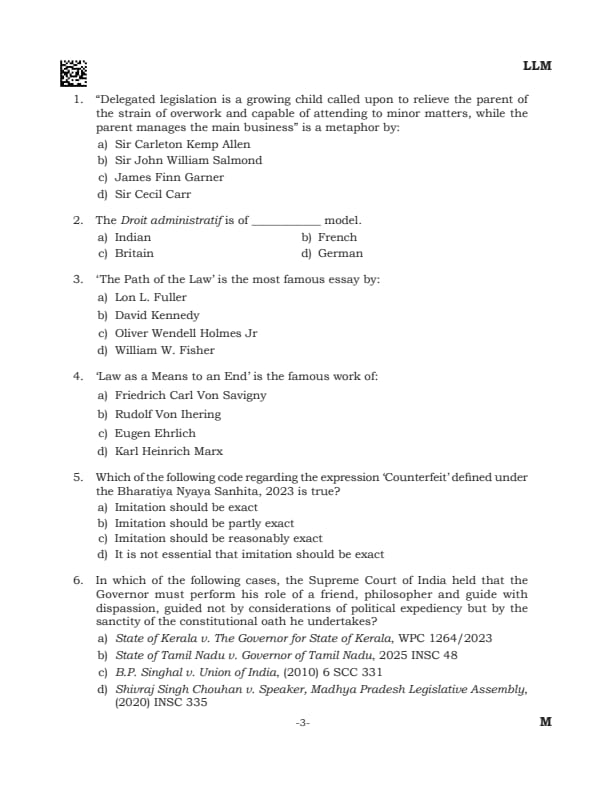
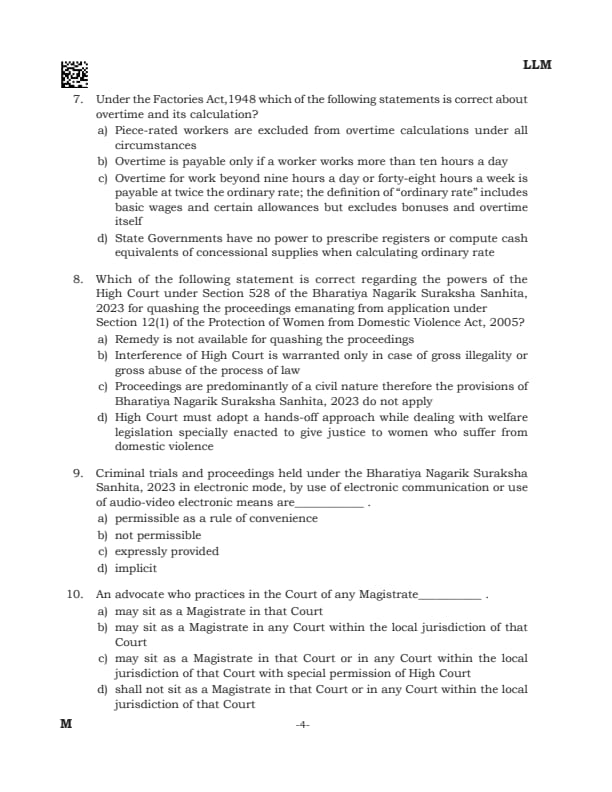
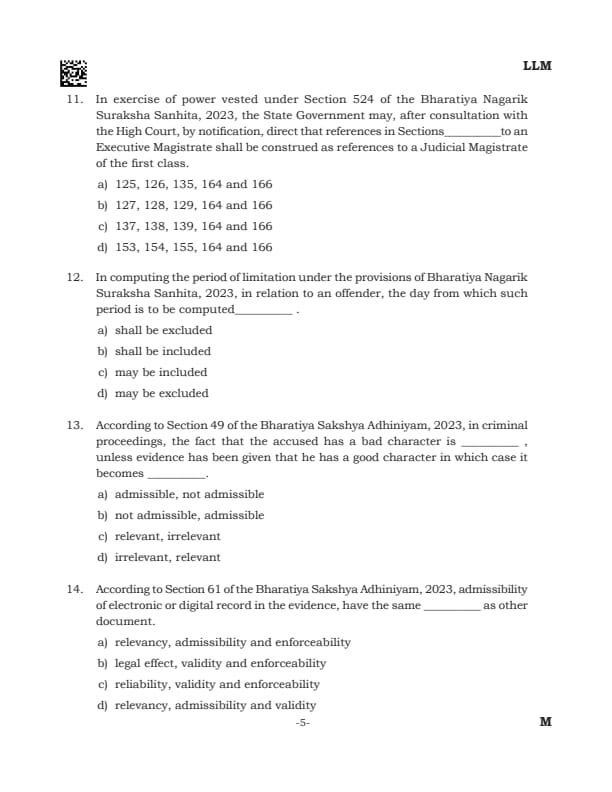
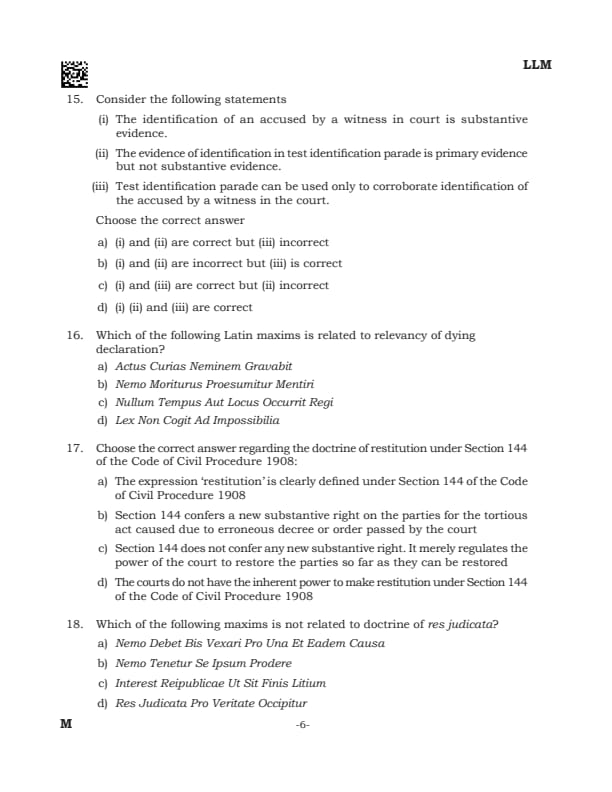
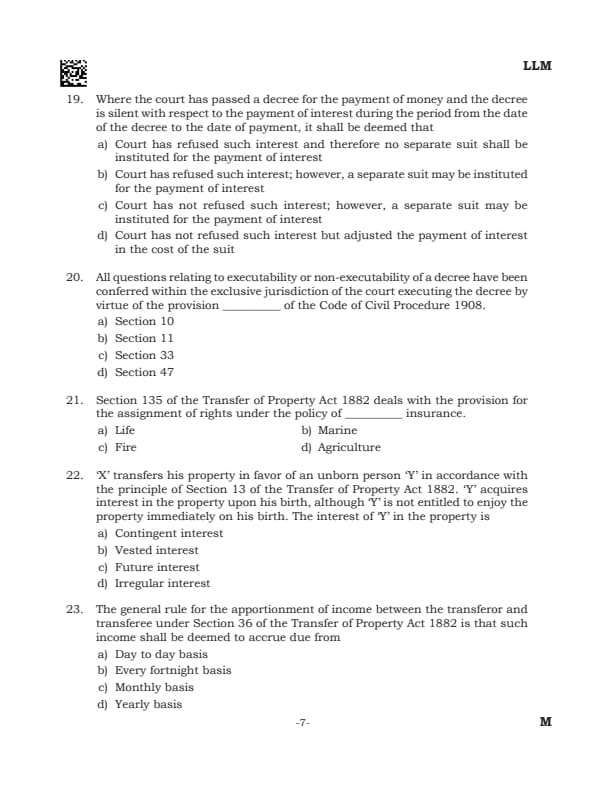
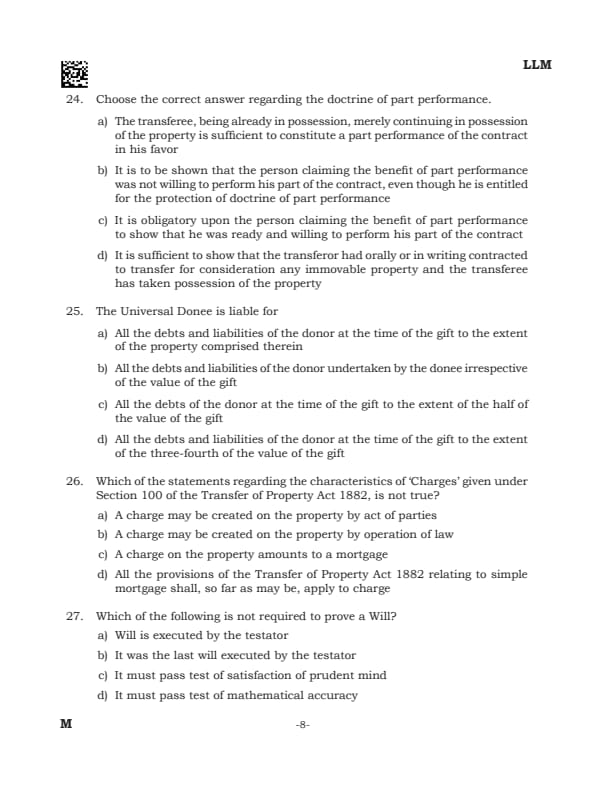
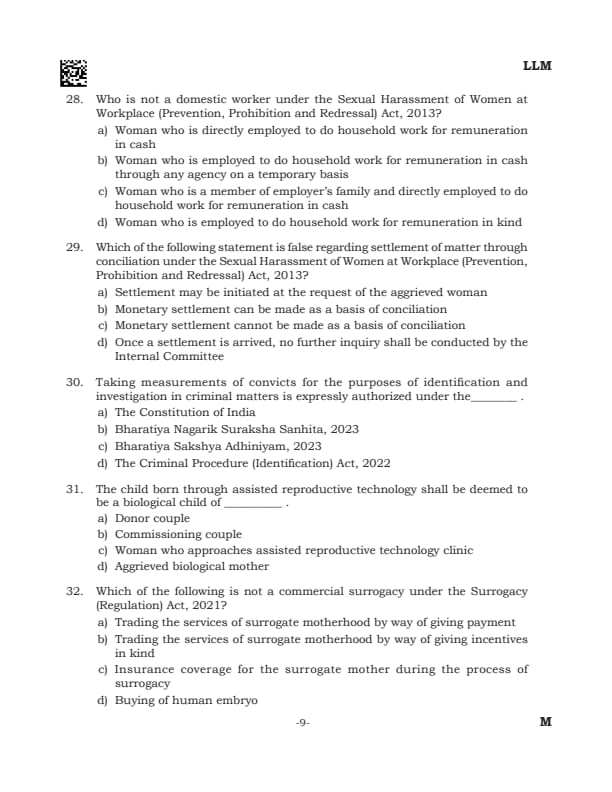
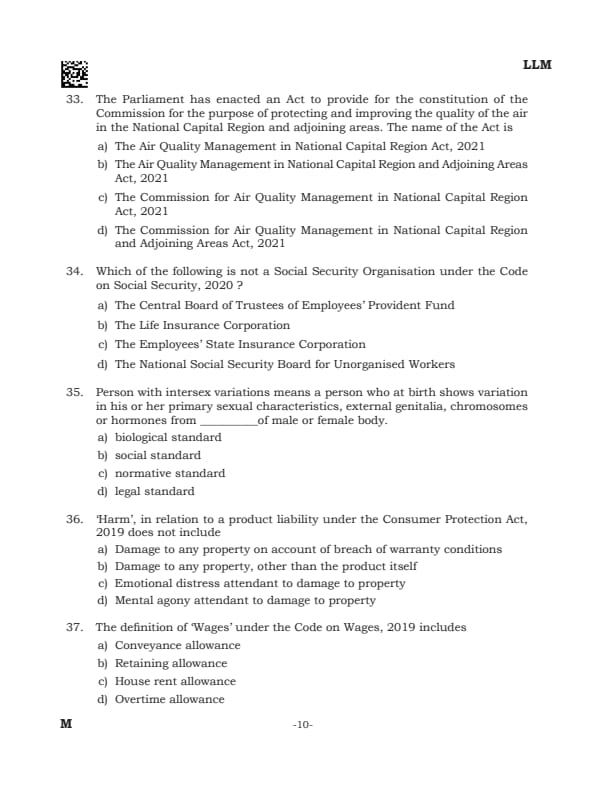
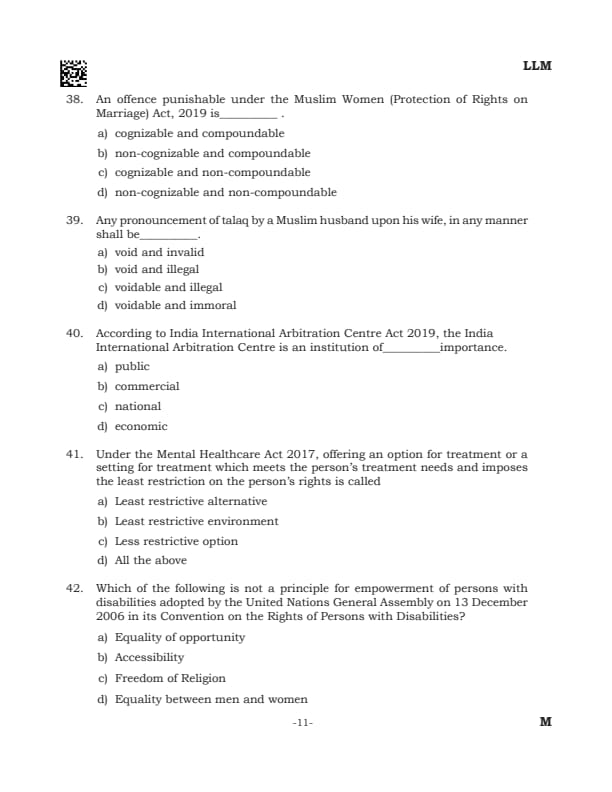
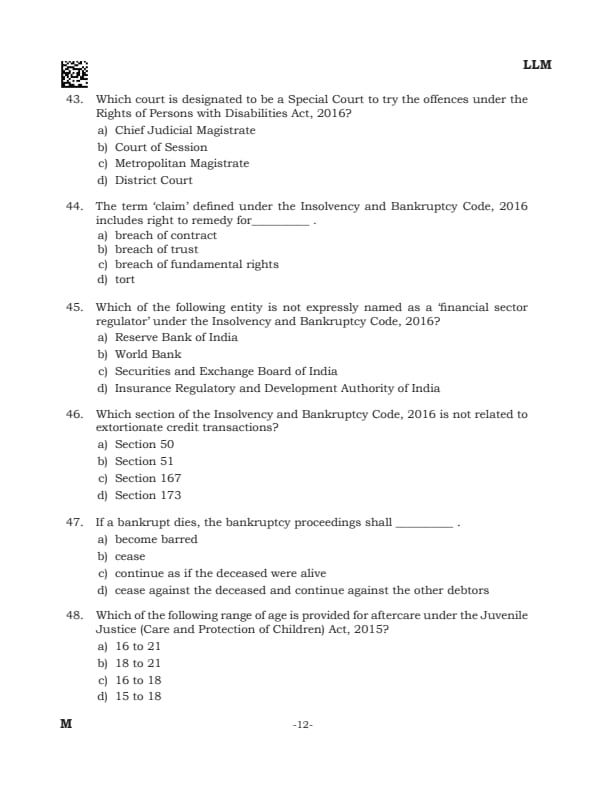
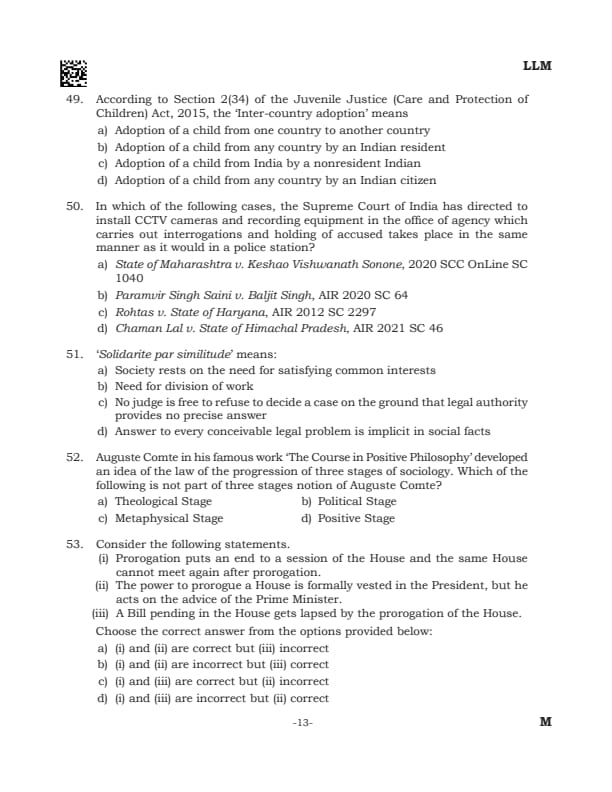
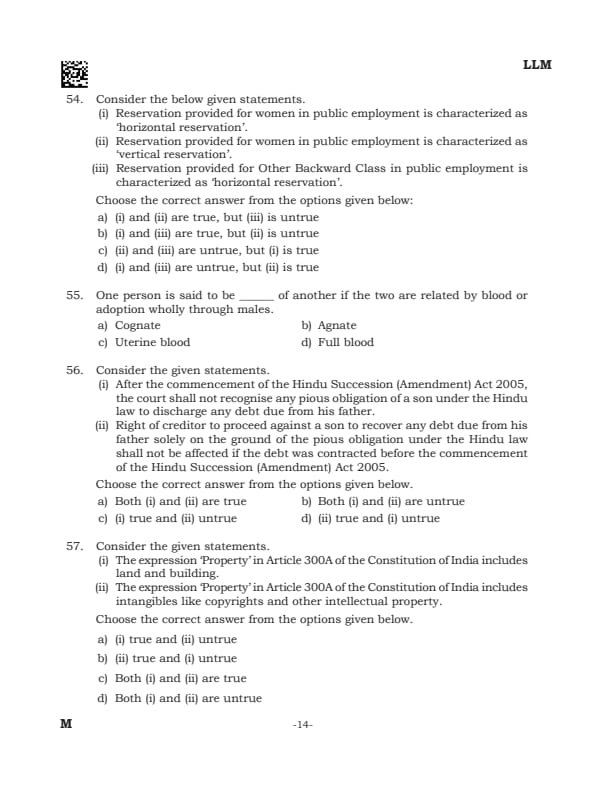
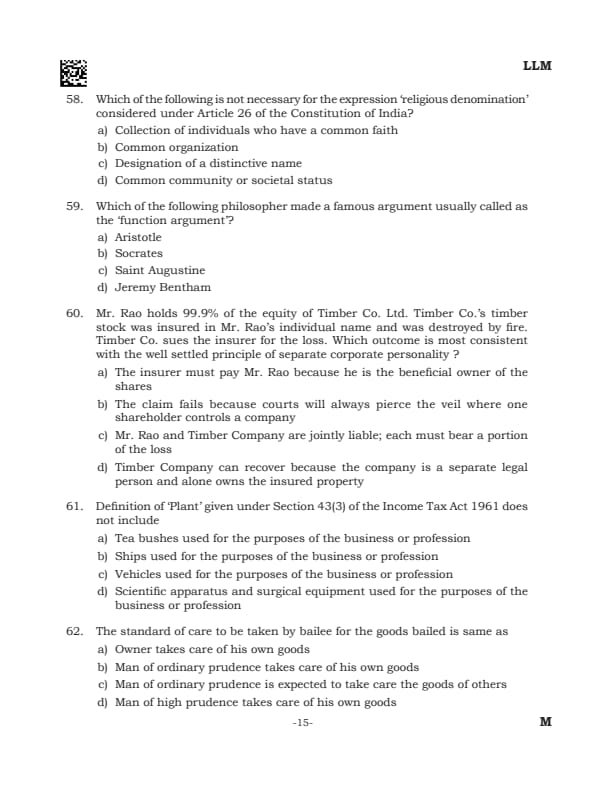
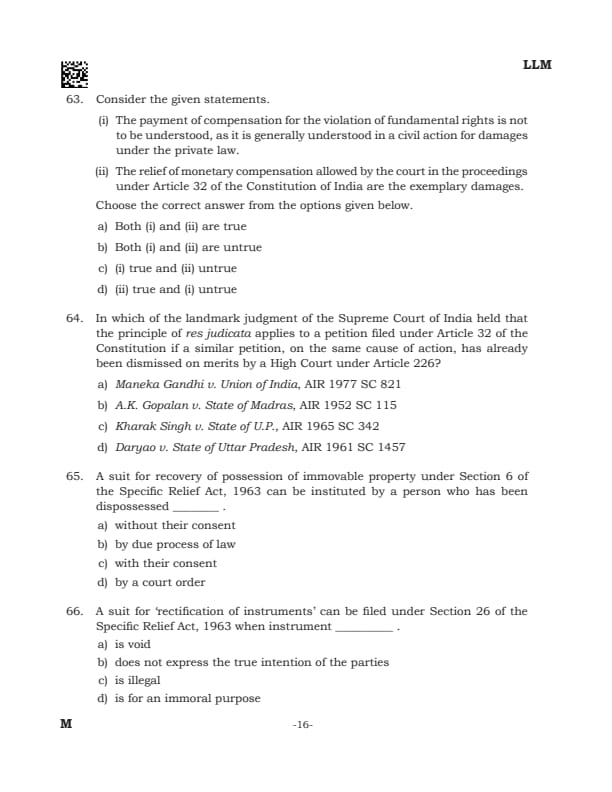
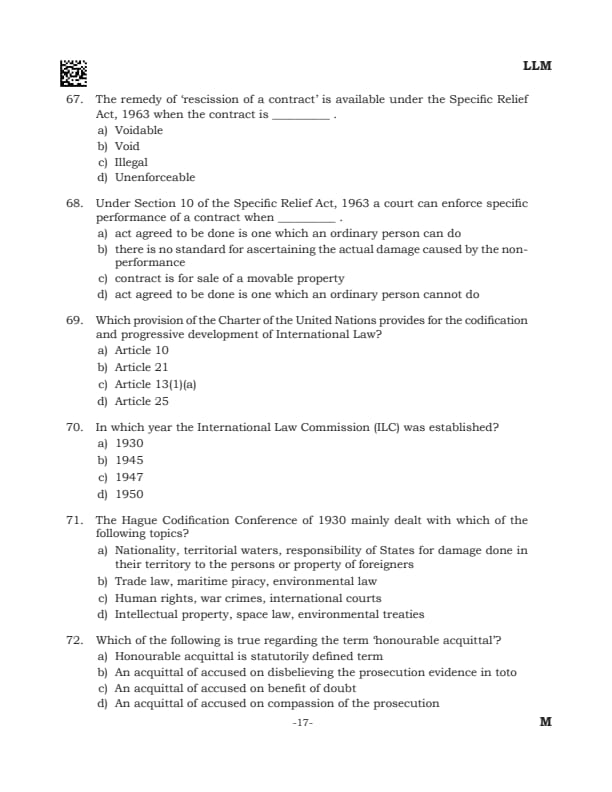
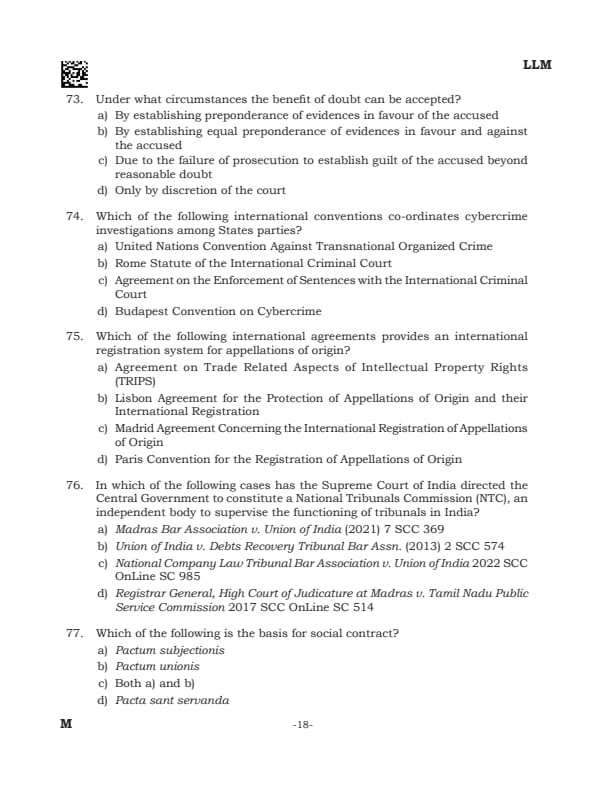
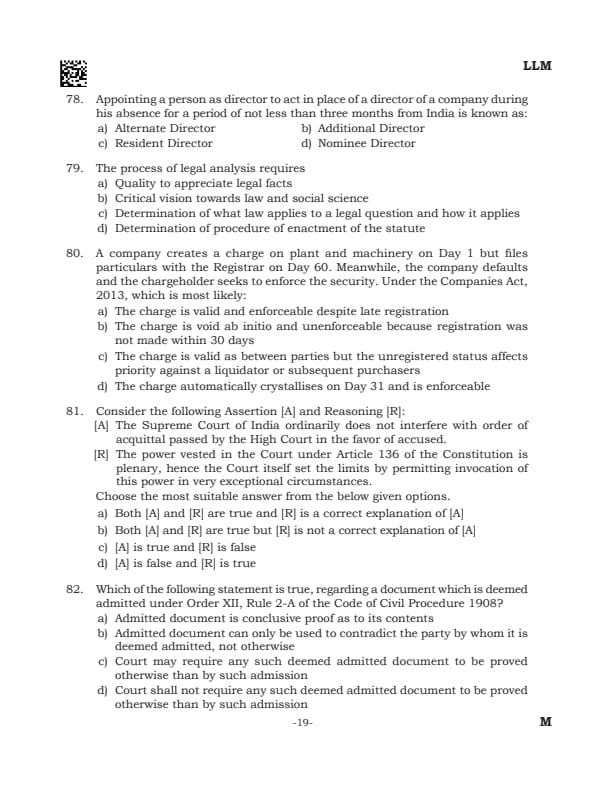
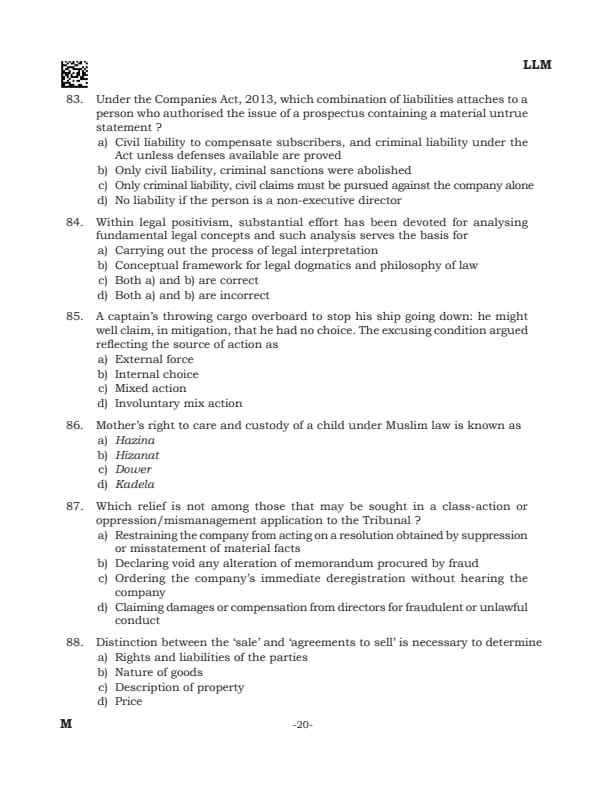
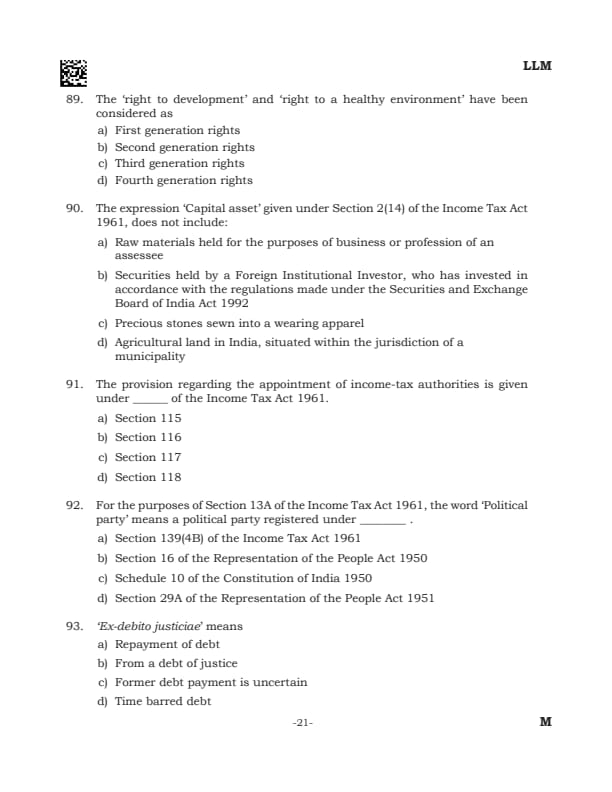
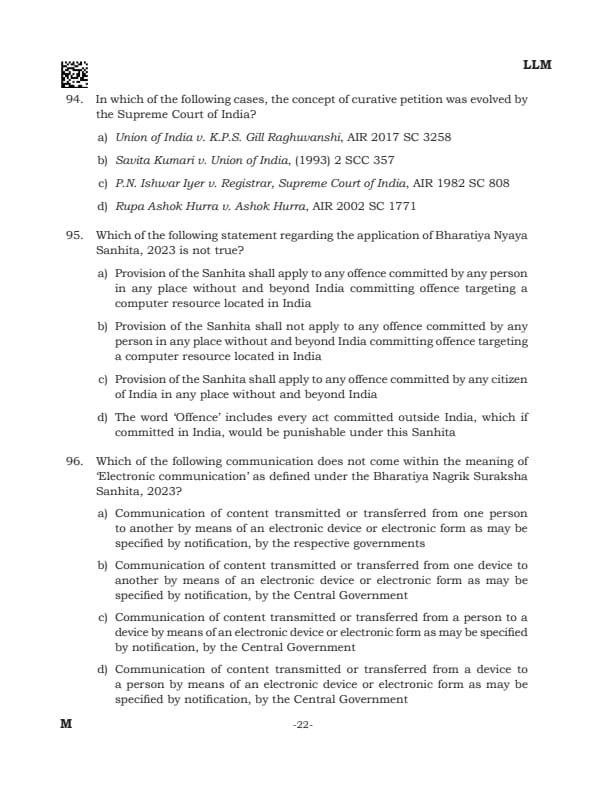
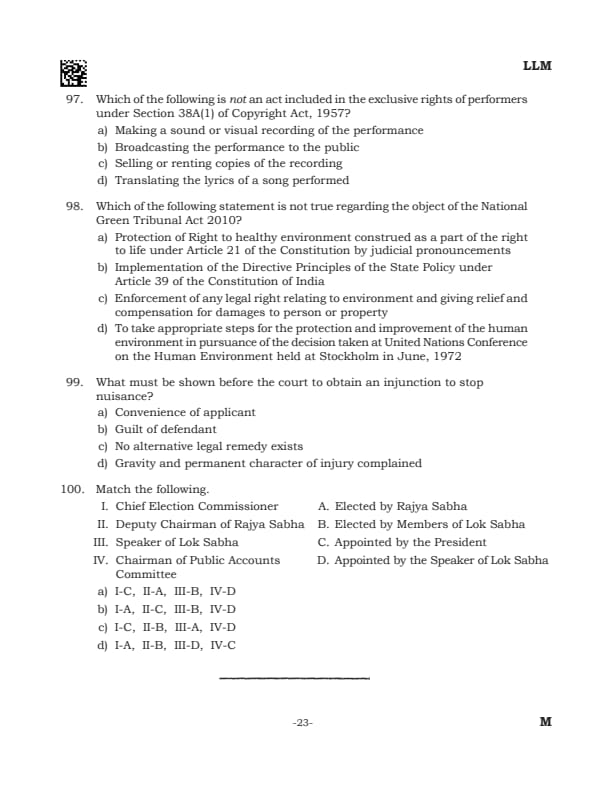

*The article might have information for the previous academic years, please refer the official website of the exam.