Content Curator | Updated On - Oct 22, 2026
Bachelor of Technology [B.Tech] (Mathematics and Computing) is a four-year undergraduate engineering degree. It combines mathematical reasoning, computer science, and practical problem solving. Students study algorithms, probability, numerical methods, and programming through lectures and laboratories. Entry requires the prescribed Class 12 subjects and admission qualifications. IIT admission uses JEE Advanced and JoSAA counselling. Graduates can pursue software, data analysis, quantitative finance, or research careers. Financial engineering content depends on the institute's curriculum.
| Key point | Course outcome |
|---|---|
| Mathematical reasoning | Use calculus, algebra, and probability to analyse technical problems. |
| Programming | Translate mathematical methods into working computer programs. |
| Algorithms | Compare approaches using correctness and computational efficiency. |
| Data analysis | Apply statistical reasoning to observations and uncertainty. |
| Numerical computing | Approximate solutions when exact mathematical answers are impractical. |
| Project work | Combine theory, computation, and clear technical communication. |
- B.Tech Mathematics and Computing Highlights and Electives
- B.Tech Mathematics and Computing Course Details
- B.Tech Mathematics and Computing Eligibility Criteria
- B.Tech Mathematics and Computing Admission Procedure
- B.Tech Mathematics and Computing Related Entrance Exams
- B.Tech Mathematics and Computing Syllabus Semester Wise
- B.Tech Mathematics and Computing Future Scope and Career Opportunities
- Top Government and Private B.Tech Mathematics and Computing Colleges
- B.Tech Mathematics and Computing Scholarships
- B.Tech Mathematics and Computing Frequently Asked Questions
B.Tech Mathematics and Computing Highlights and Electives
This branch combines abstract mathematics with computational applications. It is a subject variant of B.Tech. IITs operate under the Institutes of Technology Act, 1961. Their academic bodies prescribe the programme curriculum.
| Particular | Details |
|---|---|
| Full form | Bachelor of Technology in Mathematics and Computing |
| Level and duration | Undergraduate; four years, usually eight semesters |
| Academic focus | Mathematics, algorithms, statistics, and computing |
| Eligibility | Class 12 or equivalent with the subjects and marks required by the admission route |
| Entrance routes | JEE Main; JEE Advanced for IIT admission |
| Tuition examples | INR 1 Lakh per semester at the two IITs listed below, before applicable exemptions (2026-27) |
| Career directions | Software development, analytics, scientific computing, and quantitative modelling |
Electives and areas of interest
Electives deepen selected topics within the degree. They are not separate degrees or guaranteed specialisation titles. IIT Delhi lists options including financial mathematics, cryptography, and statistical learning.
| Elective area | Learning focus |
|---|---|
| Financial mathematics | Mathematical treatment of financial models |
| Cryptography | Mathematical foundations of secure information |
| Statistical learning | Methods for learning patterns from data |
B.Tech Mathematics and Computing Course Details
The course requires both proof-based reasoning and regular programming practice. Early study builds mathematical and engineering foundations. Later courses develop algorithms, analysis, and numerical computation. Laboratories and projects connect these ideas to working solutions.
IIT Guwahati describes mathematics, computing, and financial engineering as its three components. This describes that institute's programme; finance is not a universal third major.
Who should choose this course?
Choose this branch if you enjoy mathematical explanations and implementing them. Expect abstract concepts alongside coding assignments. Compare compulsory papers before choosing a college, especially for software or finance goals.
- Interest in proofs, probability, and algebra.
- Willingness to debug programs and test numerical results.
- Patience for modelling problems with explicit assumptions.
Mathematics and Computing vs Computer Science and Engineering
Compare this branch with B.Tech Computer Science and Engineering using the actual college syllabi.
| Point | Mathematics and Computing | Computer Science and Engineering |
|---|---|---|
| Duration | Four years | Four years |
| Main emphasis | Mathematical foundations and computational problem solving | Computer science, software, and computing systems |
| Shared areas | Programming, data structures, and algorithms | Programming, data structures, and algorithms |
| Decision factor | Choose for sustained interest in higher mathematics | Choose for sustained interest in computer science and systems |
B.Tech Mathematics and Computing Eligibility Criteria
| Admission route | Requirements |
|---|---|
| Class 12 foundation | Meet the chosen institution's subject requirements. Physics, Chemistry, and Mathematics are compulsory for the IIT route. |
| IIT board marks | At least 75% aggregate in the prescribed five subjects, or the category-wise top 20 percentile of successful candidates in the respective board. |
| IIT category relaxation | The aggregate threshold is 65% for SC, ST, and PwD candidates. The category-wise top 20 percentile alternative also applies. |
| IIT entrance qualification | Qualify JEE Advanced and meet its age, attempt, previous-admission, and Class 12 appearance conditions. |
| Other institutions | Use the institution's published eligibility and selection rules for this exact programme. IIT marks thresholds are not a universal rule. |
Eligibility to take an entrance examination differs from eligibility for admission. An entrance rank alone does not satisfy board marks or document requirements.
Official references: IIT admission criteria; JEE Advanced eligibility; NTA information bulletin; JoSAA business rules; IIT Delhi curriculum; IIT Guwahati programme; IIT Hyderabad curriculum; IIT Delhi prospectus 2026-27; IIT Hyderabad fee notice; Chanakya programme listing; IIT Delhi financial assistance; IIEST Shibpur programme brochure; Council of IITs.
B.Tech Mathematics and Computing Admission Procedure
Select the exact four-year degree before filling college choices. Similar subject names can belong to B.Sc., B.S., integrated, or dual-degree programmes.
| Step | What students should do |
|---|---|
| 1. Confirm the programme | Read the institution's programme listing, eligibility rules, and curriculum. |
| 2. Complete the entrance route | For the usual Indian IIT route, qualify through JEE Main shortlisting and then JEE Advanced. |
| 3. Register for counselling | Register with JoSAA for participating institutions and arrange choices by preference. |
| 4. Review allocation | Allocation considers rank, category, preferences, and available seats. |
| 5. Accept and verify | Pay the required seat acceptance fee, upload documents, and answer verification queries. |
| 6. Complete institute registration | Follow the allotted institution's reporting and fee instructions. |
Admission without an entrance examination
IIT admission to this programme requires the prescribed entrance qualification. For private universities, use the published selection policy for this exact branch. Do not assume that a university offers direct admission simply because it offers other engineering programmes.
Documents required
- Class 10 proof of date of birth and Class 12 marksheet.
- Entrance result and documents requested by the counselling portal.
- Category and disability certificates, where applicable.
- Medical certificate and other forms specified by the admission authority.
B.Tech Mathematics and Computing Related Entrance Exams
| Exam name | Conducting body | Relevant route |
|---|---|---|
| JEE Main | National Testing Agency | NIT+ admission where the programme is offered; IIEST Shibpur confirms this route. Also used for IIT entrance shortlisting. |
| JEE Advanced | IITs through the Joint Admission Board | IIT programmes through JoSAA allocation |
JEE Main: Paper 1 tests Physics, Chemistry, and Mathematics by computer. It includes multiple-choice and numerical-answer questions.
JEE Advanced: Candidates must satisfy all examination eligibility conditions. Qualifying candidates also need the admission qualifications and an allocated seat.
Understanding cutoffs
An examination qualifying cutoff and a branch closing rank serve different purposes. Compare closing ranks only within the same institution, programme, category, seat pool, quota, and counselling round. A previous closing rank is not a guaranteed admission score.
B.Tech Mathematics and Computing Syllabus Semester Wise
The outline below summarises selected papers from IIT Delhi's official MT1 curriculum. It is an institutional example, not a common syllabus for every college.
| Semester | Selected papers and course baskets |
|---|---|
| Semester 1 | Calculus; Introduction to Programming; electrodynamics and physics laboratory |
| Semester 2 | Linear Algebra and Differential Equations; Discrete Mathematical Structures; electrical engineering |
| Semester 3 | Optimization Methods and Applications; Probability and Stochastic Processes; Algebra; Programming with Data Structures |
| Semester 4 | Numerical Analysis and Computation; Analysis and Design of Algorithms; Introduction to Analysis; Introductory Data Science |
| Semester 5 | Partial Differential Equations and Applications; Numerical Analysis Computing Laboratory; flexible core and electives |
| Semester 6 | Flexible core; general engineering; basic science; humanities and departmental electives |
| Semester 7 | BTech Project; departmental electives; humanities and open-category study |
| Semester 8 | Departmental electives; humanities and open-category study |
Course baskets offer choices within stated academic rules. Follow the curriculum applicable to your admitted batch.
B.Tech Mathematics and Computing Future Scope and Career Opportunities
The mathematical and programming foundation supports several career directions. The roles below describe possible work areas, not placement promises. Build projects that demonstrate the skills needed for each role.
| Job direction | Typical work | Relevant preparation |
|---|---|---|
| Software developer | Develop and test software components | Programming, data structures, algorithms |
| Data analyst | Explore data and explain statistical findings | Probability, statistics, data handling |
| Quantitative analyst | Implement and examine mathematical financial models | Financial mathematics, stochastic processes, coding |
| Scientific computing professional | Implement numerical models and simulations | Numerical methods, linear algebra, computation |
| Optimisation analyst | Formulate and solve resource-allocation problems | Optimisation, modelling, algorithms |
Salary and placement evidence
The degree title alone does not establish a salary figure. Read placement reports for the exact institute, programme, graduating batch, and measure. Separate branch results from combined institute results, and median figures from highest offers.
Higher studies
Further study can focus on mathematics, computer science, statistics, or computational fields. Each postgraduate programme sets its own eligibility. Research-oriented students can build preparation through mathematical projects and supervised research.
Top Government and Private B.Tech Mathematics and Computing Colleges
Government institutes below have verified official programme curricula. The private university appears in Zollege's course listing and publishes this programme in its fee schedule. This is a verified shortlist, not a ranking.
| Government colleges | Private university |
|---|---|
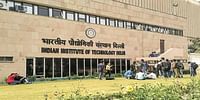
| IIT Delhi | Chanakya University |
| IIT Hyderabad | |
| IIT Guwahati |
Official tuition examples
| College | Tuition fee | Session and basis |
|---|---|---|
| IIT Delhi | INR 1 Lakh per semester | 2026-27 prospectus; standard B.Tech tuition before applicable exemptions |
| IIT Hyderabad | INR 1 Lakh per semester | 2026-27 entry; first-semester notice, regular GEN/OBC column |
These figures cover tuition, excluding hostel, mess, deposits, and other charges. Category exemptions and financial assistance affect the payable tuition. Do not treat these examples as an all-college fee range.
Compare institutions using Zollege's Mathematics and Computing college listing. Confirm the exact award and admission route for each choice.
B.Tech Mathematics and Computing Scholarships
IIT Delhi publishes the following undergraduate financial assistance options. These are institute schemes; their conditions do not automatically apply elsewhere.
| Scheme | Who is covered | Benefit |
|---|---|---|
| Merit-cum-Means scholarship | Eligible undergraduate engineering and technology students meeting income, merit, and allocation conditions | Scholarship support and tuition exemption |
| Institute Free Studentship | Students selected on financial need under the institute's allocation rules | Tuition waiver |
| SC/ST/PwD tuition exemption | Students in these categories under institute rules | Tuition fee exemption |
| Donor scholarships | Students meeting each donor's income, programme, rank, or academic criteria | Support defined by the individual award |
Applications and income documents are processed through the institute's academic system. Renewal requires the stated academic performance. Scholarship support does not automatically cover every living expense.
B.Tech Mathematics and Computing Frequently Asked Questions
Ques. What is the duration of B.Tech Mathematics and Computing?
Ans: The degree normally runs for four years across eight semesters. IIT Guwahati confirms this duration. Integrated and dual-degree programmes with similar subject names need separate comparison.
Ques. Which IITs offer B.Tech Mathematics and Computing?
Ans: IIT Delhi, IIT Hyderabad, and IIT Guwahati publish this B.Tech programme. This is a verified shortlist. Read the exact degree title before comparing other institutions with mathematics-based programmes.
Ques. How is Mathematics and Computing different from CSE?
Ans: Mathematics and Computing places sustained emphasis on mathematical reasoning and computational methods. B.Tech Computer Science and Engineering focuses on computer science and systems. Compare compulsory subjects, electives, and projects at your shortlisted colleges.
Ques. What eligibility is required for IIT admission?
Ans: The IIT route requires Physics, Chemistry, and Mathematics in Class 12. Meet the prescribed aggregate marks or category-wise top 20 percentile condition, qualify JEE Advanced, and complete the required seat allocation process.
Ques. Can I join Mathematics and Computing without JEE Advanced?
Ans: Yes, the examination route depends on the institution. IIEST Shibpur specifies JEE Main for its programme. IIT admission requires JEE Advanced. Private institutions use their own published selection policies.
Ques. Is there a lot of coding in Mathematics and Computing?
Ans: The course includes programming and algorithms alongside higher mathematics. IIT Hyderabad lists computing subjects such as operating systems and databases. Read the actual curriculum to assess the balance between mathematical and computing papers.
Ques. Can graduates work in software or quantitative finance?
Ans: Software and quantitative modelling are possible career directions. They require relevant coding, mathematical, and domain skills. Financial engineering forms part of IIT Guwahati's programme, but the degree does not guarantee a finance job.
Ques. What are the fees and average salary for this course?
Ans: IIT Delhi lists standard B.Tech tuition of INR 1 Lakh per semester for 2026-27, before exemptions. Other costs are separate. No verified course-wide average salary is available in the sources used here.