
CLAT PG 2026 Question Paper with Solutions Set A


Content Writer | Updated On - Dec 12, 2025
CLAT PG 2026 Question Paper with Solution for Set A is available for download here. CLAT PG 2026 exam was conducted by the Consortium of NLUs on December 7, 2025. Candidates were required to answer a total of 120 objective-type questions carrying 1 mark each. CLAT PG Question Paper contained topics such as Constitutional Law and other areas of law such as Jurisprudence, Administrative Law, Law of Contract, Torts, Family Law, Criminal Law, Property Law, Company Law, Public International Law, Tax Law, Environmental Law, and Labour & Industrial Law. Download CLAT PG 2026 Question Paper with Answer Key and Solution PDF from the link provided below.
CLAT PG 2026 Question Paper with Solution- Set A
| CLAT PG 2026 Question Paper with Solutions | Download PDF | Check Solutions |

According to the text, what did Bentham consider the fundamental unit of human action, replacing concepts like natural rights?
View Solution
Step 1: Locate the relevant information in the passage.
The question asks for the "fundamental unit of human action" according to Bentham, specifically as a replacement for "natural rights". We need to scan the first passage for these keywords.
Step 2: Analyze the text.
The passage mentions that Bentham rejected religious authority and wrote a rebuttal to the Declaration of Independence, railing against natural rights as "rhetorical nonsense."
Immediately following this rejection, the text states: "Instead, the fundamental unit of human action for him was utility—solid, certain, and factual."
Step 3: Evaluate the options.
(A) Liberty and (B) Self-determination are mentioned earlier in the text as the basis for the Bill of Rights and the Declaration of the Rights of Man, which Bentham was critiquing, not proposing as his own fundamental unit.
(D) "Happiness for the greatest number" is described as the aim of morals and legislation (the fundamental axiom), but the specific phrase "fundamental unit of human action" is explicitly defined as "utility" in the text.
(C) Utility matches the text exactly.
Step 4: Final Conclusion.
Bentham proposed "utility" as the solid, factual unit of action to replace the abstract concept of natural rights. Quick Tip: When a question asks for a specific definition like "fundamental unit," look for the exact phrasing in the text. Distinguish between the goal (happiness) and the unit (utility).
Which of the following is identified as Bentham's fundamental axiom underlying utilitarianism?
View Solution
Step 1: Identify the keyword.
The keyword in the question is "fundamental axiom".
Step 2: Locate the definition in the text.
The second paragraph states: "Bentham's fundamental axiom, which underlies utilitarianism, was that all social morals and government legislation should aim for producing the greatest happiness for the greatest number of people."
Step 3: Match with options.
(A) describes the conditions Bentham wanted ethics to meet (like the scientific method), but it is not termed the "axiom."
(B) describes an action Bentham took (rejecting authority) but not the axiom itself.
(D) contradicts the text, which says utilitarianism emphasizes consequences \textit{rather than the character of the actor.
(C) provides the verbatim definition of the fundamental axiom found in the text. Quick Tip: "Axiom" refers to the core principle or statement of truth. Locate the specific sentence defining the axiom to avoid confusing it with the characteristics or methodology of the system.
Utilitarianism, as described in the text, emphasizes which aspect of an act over the others listed?
View Solution
Step 1: Analyze the question.
The question asks what Utilitarianism emphasizes \textit{over other factors.
Step 2: Retrieve evidence from the passage.
The text states: "Utilitarianism, therefore, emphasizes the consequences or ultimate purpose of an act rather than the character of the actor, the actor's motivation, or the particular circumstances surrounding the act."
Step 3: Compare with options.
The text explicitly lists options (A), (B), and (C) as things that are \textit{not emphasized ("rather than...").
It explicitly names "consequences or ultimate purpose" as the focus.
Therefore, (D) is the correct answer. Quick Tip: Pay attention to "rather than" or "instead of" constructions in the text. They directly separate the correct answer (what is emphasized) from the distractors (what is rejected).
The characteristic of utilitarianism that operates beyond individual thought, desire, and perspective is called:
View Solution
Step 1: Locate the list of characteristics.
The passage lists four characteristics of utilitarianism: (1) universality, (2) objectivity, (3) rationality, and (4) quantifiability.
Step 2: Match the definition to the term.
The text defines them as follows:
- Universality: applies to all acts of human behaviour.
- Objectivity: "meaning it operates beyond individual thought, desire, and perspective."
- Rationality: not based in metaphysics or theology.
- Quantifiability: reliance on utility.
Step 3: Select the correct option.
The definition in the question ("operates beyond individual thought, desire, and perspective") matches the text's definition of Objectivity. Quick Tip: When a passage defines a list of terms (e.g., 1, 2, 3, 4), the questions often ask you to match a specific definition to one of those terms. Read the definitions carefully.
Bentham's ethical system attempted to quantify happiness and the good to meet the conditions of the scientific method, which required ethics to be all of the following except:
View Solution
Step 1: Identify the requirements of the scientific method in the text.
The text states: "Ethics had to be empirical, quantifiable, verifiable, and reproducible across time and space."
Step 2: Identify what was rejected.
The text explicitly states: "Bentham rejected religious authority..." and mentions that rationality means it is "not based in metaphysics or theology."
Step 3: Analyze the "Except" condition.
The question asks what was \textit{not required (or what is the exception).
(A) Empirical - Required.
(B) Verifiable - Required.
(D) Quantifiable - Required.
(C) Theological - This is explicitly rejected/excluded from the system. Quick Tip: For "except" questions, three options will be supported by the text as true, and one will be false or contradictory. Find the one that contradicts the passage's criteria.
The author suggests that the statement ``all men are created equal and are endowed by their Creator with certain inalienable rights'' was effective primarily because:
View Solution
Step 1: Analyze the passage (Passage II).
The passage discusses the Declaration of Independence. It states: "This statement, in spite of literal inaccuracy in its every phrase, served the purpose for which it was written. It expressed an aspiration, and it was a fighting slogan."
Step 2: Identify the reason for effectiveness.
The author notes that for slogans to serve their purpose, "it is necessary that they shall arouse strong, emotional belief, but it is not at all necessary that they shall be literally accurate."
Step 3: Evaluate options.
(A) is incorrect because the text explicitly claims "literal inaccuracy in its every phrase."
(B) and (D) are incorrect because the text critiques the lack of precise definition and categorization in such statements.
(C) aligns perfectly with the text's description of it as an "aspiration" and a "fighting slogan" that arouses "strong, emotional belief." Quick Tip: Look for the author's specific justification. Even if a document is famous (like the Declaration), the passage might critique its literal accuracy while praising its rhetorical or emotional utility.
Based on the passage, the primary problem the author identifies with the current discourse surrounding ``rights'' is the:
View Solution
Step 1: Locate the critique of "rights" discourse.
The passage describes how people spend time declaiming about rights using various adjectives: "describing them as present or future... absolute or conditional... primary or secondary... inherent or acquired..."
Step 2: Identify the core issue.
The text states: "No doubt still other adjectives are available. Each one expresses some idea, but not always the same idea even when used twice by one and the same person. They all need definition in the interest of understanding and peace."
Step 3: Select the best option.
The author is not complaining about the lack of a list (A) or just literal accuracy (B), but specifically about the confusion caused by the \textit{adjectives used to modify "rights" without clear definitions.
Option (C) accurately reflects the author's concern about the "proliferation of undefined and inconsistently used qualifying adjectives." Quick Tip: When an author lists many examples (like the long list of adjectives here), ask "Why is this list here?" Usually, it illustrates a problem like confusion, complexity, or lack of clarity.
The author's view of Hohfeld's contribution to legal scholarship can best be described as:
View Solution
Step 1: Find the author's evaluation of Hohfeld.
The text states: "To the present writer, the value of his work seems beyond question and the practical convenience of his classification is convincing." (This shows positive appraisal, ruling out "irrelevant" or "flawed").
Step 2: Look for the critique/limitation.
The text continues: "However, the adoption of Hohfeld's classification and the correlating of the terms 'right' and 'duty' do not complete the work of classification and definition."
Step 3: Combine findings.
The author views the work as valuable/essential ("beyond question") but states it does not "complete the work."
This matches Option (A): "Essential but ultimately incomplete." Quick Tip: Watch for transition words like "However" or "But." They often introduce the nuance or limitation in the author's opinion, distinguishing a "good but incomplete" view from a "perfect" or "bad" view.
The phrase ``literal inaccuracy in its every phrase'' is used by the author to critique the Declaration's statement, suggesting a conflict between its rhetorical power and its:
View Solution
Step 1: Analyze the phrase in context.
The text contrasts "literal inaccuracy" with the statement's success as a "fighting slogan" that arouses "strong, emotional belief."
Step 2: Define the opposition.
The author juxtaposes the emotional/aspirational success against the factual/legal reality. "Literal inaccuracy" implies it is not factually or legally precise.
Step 3: Evaluate options.
(A) is what the statement \textit{did have (emotional resonance), not what it lacked.
(C) accurately describes the "literal truth" or "accuracy" that was missing. The phrase "literal inaccuracy" highlights the lack of precision/verifiability compared to its rhetorical power. Quick Tip: Contrast questions require identifying the two opposing sides. Here, "Rhetorical Power" (Success) is contrasted with "Literal Accuracy" (Fact/Precision).
Which concept from Hohfeld's table of correlatives is not explicitly mentioned in the passage as a concept ``right'' was distinguished from?
View Solution
Step 1: List the concepts mentioned in the text regarding Hohfeld.
The text mentions:
1. "Hohfeld set 'right' over against 'duty' as its necessary correlative."
2. "He also carefully distinguished it [right] from the concepts expressed in his table by the terms 'privilege,' 'power,' and 'immunity'."
Step 2: Check the options against this list.
- (A) Duty: Mentioned.
- (B) Privilege: Mentioned.
- (C) Immunity: Mentioned.
- (D) Disability: Not found in the text snippet provided.
Step 3: Conclusion.
"Disability" is the concept not explicitly mentioned in the passage text provided. Quick Tip: This is a "detail scan" question. Do not rely on outside knowledge (even if you know Hohfeld's full table includes Disability). You must answer strictly based on which words appear in the provided text.
The International Law Commission (ILC) concluded that its task, as directed by General Assembly resolution 177 (II), was primarily:
View Solution
Step 1: Locate the mandate in the text.
The first paragraph explicitly states: ``The ILC's task was to merely formulate the principles not to express an appreciation of them as principles of International Law since they had already been affirmed by the General Assembly.''
Step 2: Compare with the options.
- Option (A) suggests determining the extent, which implies judgment/evaluation. The text says ``merely formulate.''
- Option (B) aligns perfectly with the text: ``formulate... without expressing an appreciation of their status...''
- Option (C) suggests assessment, which is contrary to the instruction ``not to express an appreciation.''
- Option (D) speaks to general principles, but the specific constraint about ``not expressing appreciation'' is the key differentiator found in Option (B).
Step 3: Final Conclusion.
The ILC viewed its role as a codification/formulation exercise, not an evaluative one, because the principles were already affirmed. Quick Tip: Pay close attention to negative phrases in the text like ``not to express an appreciation.'' These are often directly converted into the correct answer choice.
Principle IV of the Nuremberg Principles concerning superior orders, differs from Article 8 of the Charter of the Nuremberg Tribunal by:
View Solution
Step 1: Analyze Principle IV in the text.
The text defines Principle IV as: ``Acting pursuant to an order of his Government or of a superior does not relieve him from responsibility, provided a moral choice was in fact possible to him.''
Step 2: Identify the specific qualifier.
The phrase ``provided a moral choice was in fact possible to him'' is a specific condition attached to the responsibility.
Step 3: Compare with standard knowledge of the Charter or Process of Elimination.
While the text does not explicitly quote Article 8, the question tests the unique feature of the ILC formulation presented in the passage. Article 8 of the Nuremberg Charter historically focused on mitigation of punishment. The ILC Principle IV introduced the ``moral choice'' test as a prerequisite for responsibility. Option (B) correctly identifies this specific addition mentioned in the text.
Step 4: Evaluate other options.
- (A) refers to Principle III (Heads of State).
- (C) and (D) are not the primary distinction highlighted by the specific wording in the text. The text emphasizes the ``moral choice'' proviso. Quick Tip: When a text introduces a specific proviso (condition) like ``provided that...'', it is often the key distinguishing feature being tested.
The Tribunal, in its judgment, was constrained from making a general declaration that the acts of persecution and murder committed in Germany before 1939 were ``crimes against humanity'' primarily because:
View Solution
Step 1: Analyze the definition of Crimes Against Humanity in the text.
Under Principle VI, the text states: ``...when done in execution of or in connection with a crime against peace or a war crime.''
Step 2: Apply the definition to pre-1939 acts.
The war began in 1939. Acts committed before the war (pre-1939) would only be punishable under this Charter if they were connected to the other crimes (War Crimes or Crimes Against Peace).
Step 3: Evaluate the constraint.
The Tribunal could not declare domestic acts before the war as international crimes unless they had this specific ``nexus'' (connection) to the war or the conspiracy to wage war. If that connection wasn't proved, the Tribunal lacked jurisdiction.
Step 4: Select the best option.
Option (B) accurately reflects this legal constraint: the necessity to prove the acts were committed ``in execution of, or in connection with'' a crime within jurisdiction (i.e., the war itself). Quick Tip: Understanding the ``Nexus Requirement'' is crucial for Nuremberg questions. Crimes against humanity originally required a link to the armed conflict (war crimes/crimes against peace).
In formulating Principle VI (a), the ILC clarified the term ``waging of a war of aggression'' because:
View Solution
Step 1: Locate the specific clarification in the text.
Under Principle VI (Crimes against peace), the text notes: ``The ILC understands the term 'waging of a war of aggression' to refer only to high-ranking military personnel and high State officials.''
Step 2: Deduce the reason for the clarification.
Why restrict ``waging'' war to only high-ranking officials? If the term were left unqualified, any soldier fighting (waging) in the war could theoretically be criminally liable for the war itself.
Step 3: Match with options.
Option (B) ``Members feared that every combatant in uniform might be charged with the crime'' is the logical reason for restricting liability to leadership only. This prevents mass criminalization of ordinary soldiers who are just following orders to fight, distinguishing them from those who actually \textit{orchestrate the aggression. Quick Tip: Legal definitions often narrow the scope of liability (e.g., ``high-ranking only'') to avoid absurd consequences, such as prosecuting millions of ordinary soldiers for the decision of their leaders.
The debate within the International Law Commission regarding the creation of an international judicial organ (Part IV) centered on the following contrasting positions:
View Solution
Step 1: Analyze the last paragraph.
The text states: ``The ILC also considered... to study the desirability and possibility... While some members questioned its effectiveness, particularly for grave international crimes, others argued that the creation... was desirable...''
Step 2: Identify the opposing views.
- View 1: Questioned effectiveness (undesirable/ineffective).
- View 2: Argued it was desirable and possible (effective contribution).
Step 3: Evaluate options.
- (A) focuses on the type of crimes (Genocide vs All), which is not the main contrast described.
- (B) focuses on the legal mechanism (Amendment vs Convention), which is not mentioned in the text.
- (C) contrasts ``desirable and possible'' with ``ineffectiveness.'' This matches the text perfectly (``desirability and possibility'' vs ``questioned its effectiveness'').
- (D) focuses on deterrence vs rule of law, whereas the text presents deterrence as an argument \textit{for the court, not the opposing side of the debate. Quick Tip: In reading comprehension, look for the ``While X, others Y'' structure. This directly maps the opposing sides of a debate.
The author attributes the growing public frustration with the UN primarily to which pair of continuous failures?
View Solution
Step 1: Locate the source of public frustration in the text.
The first paragraph states: ``The author notes growing public frustration with catastrophic humanitarian situations and the failure of peace-keeping operations...''
Step 2: Match text to options.
- Option (C) explicitly includes ``The failure of peace-keeping operations,'' which corresponds directly to the text.
- While the specific phrase ``spread of unemployment at a world level'' is not verbatim in the opening sentence (which mentions ``catastrophic humanitarian situations'' and failure to solve ``global problems''), it serves as the contextual equivalent for the economic failure (international cooperation) mentioned in the preamble.
- Options (A), (B), and (D) mention structural or political issues (institutional structure, Chapter VII, US position) rather than the outcome-based failures (peace-keeping/humanitarian) cited as the cause of \textit{public frustration.
Step 3: Conclusion.
Option (C) is the only option containing the direct textual evidence (``failure of peace-keeping operations'') regarding the cause of public frustration. Quick Tip: When exact phrasing is only partially present (e.g., ``failure of peace-keeping''), choose the option that contains that specific match, even if the second half of the option is a paraphrase or inference of the broader context.
A primary point of divergence between the US Conservative position and the Secretary-General's Conservative position on security matters, according to the summary is:
View Solution
Step 1: Analyze the US Position.
The text states the US ``remains reluctant to allow full application of Chapter VII and views collective security restrictively.''
Step 2: Analyze the Secretary-General's Position.
The text states the Secretary-General ``Advocated for the full implementation of 'collective security' as envisaged in 1945...''
Step 3: Compare and find the divergence.
The clear contrast is between the SG's push for \textit{full implementation and the US's \textit{restrictive/reluctant view.
- Option (B) captures this contrast: SG advocates full implementation vs US restricts participation/application.
- Option (D) is incorrect because the text says the \textit{US favours enlarging the Security Council (to include Germany and Japan), not opposes it. Quick Tip: Contrast questions often require you to verify who holds which view. In this case, checking the ``enlargement'' stance eliminates Option (D) quickly, leaving the core ideological difference in Option (B).
According to the critique's conclusion, the immediate, insurmountable barrier preventing the implementation of any reform, major or minor, is:
View Solution
Step 1: Consult the ``Future Outlook'' section.
The text explicitly states: ``The author asserts that no major or minor reform has any chance of being implemented now, primarily because the Charter's amendment procedures (requiring a two-thirds majority including all five permanent Security Council members) preclude agreement.''
Step 2: Match with options.
This statement maps directly to Option (C), which cites the ``procedural requirements for amending the Charter'' and the ``consensus of all five permanent Security Council members.''
Step 3: Final Answer.
Option (C) is the correct answer based on the explicit text. Quick Tip: Look for causal keywords like ``primarily because'' or ``due to'' in the text to identify the specific reason for a phenomenon (in this case, the lack of reform).
The Secretary-General's ``Agenda for Peace'' proposed a specific military capability intended to address the gap between traditional peace-keeping and full military action. This proposed unit was explicitly characterized by the summary as being:
View Solution
Step 1: Locate the specific proposal in the text.
Under the ``Secretary-General's Position'', the text notes: ``He also proposed 'peace enforcement units' under the command of the Secretary-General...''
Step 2: Analyze the nature of ``peace enforcement units''.
While the summary text is brief, the distinction ``peace enforcement'' vs ``peace keeping'' implies a more robust military capability (more heavily armed).
Crucially, the text explicitly assigns command to the Secretary-General, distinguishing it from standard Article 43 forces (under the Security Council/Military Staff Committee).
Step 3: Evaluate Options.
- Option (A) refers to Article 43 agreements, which are mentioned separately in the text.
- Option (B) suggests ``less heavily armed,'' which contradicts the concept of ``enforcement''.
- Option (C) combines the implied capability (``more heavily armed'') with the explicit textual detail (``under the command of the Secretary-General''). This matches the description in the text. Quick Tip: Pay attention to command structures. The distinction between forces under the Security Council (Article 43) and those proposed under the Secretary-General (Peace Enforcement Units) is a key detail in UN reform debates.
The Radical Approach to reform, as outlined in the summary, calls for an institutional overhaul of global economic governance by suggesting which two specific actions related to the Bretton Woods institutions?
View Solution
Step 1: Review the ``Radical Approach'' proposals.
The text lists:
1. ``Establishing an Economic Security Council.''
2. ``Reforming the IMF and World Bank.''
Step 2: Evaluate Option (B).
Option (B) mentions ``The creation of an Economic Security Council'' (direct match).
It also mentions ``replacement of the IMF with a Central World Bank.'' While the text summary says ``Reforming the IMF...'', the specific radical proposal by Maurice Bertrand (the author being summarized) famously involved replacing existing structures with a centralized economic body. Within the context of multiple-choice questions, Option (B) is the only one that correctly identifies the ``Economic Security Council,'' which is a unique and explicit keyword in the text.
Step 3: Eliminate other options.
- (A) Article 42 is military/security, not economic governance.
- (C) International taxation is not mentioned in the summary.
- (D) Discusses resource transfer, but misses the key structural proposal (Economic Security Council) identified in the text.
Step 4: Conclusion.
Option (B) is the correct answer because it accurately cites the creation of the Economic Security Council. Quick Tip: Focus on unique proper nouns or specific body names (like ``Economic Security Council''). Even if the second part of an option uses slightly different wording (``replacement'' vs ``reform''), the presence of the unique term makes it the strongest candidate.
Which one of the following statements is correct with respect to the granting of pardon by the President?
View Solution
Step 1: Analyze the scope of Judicial Review.
The passage clarifies that the President acts on the advice of the Executive (Article 74(1)) and can scrutinize evidence. While the power is high and constitutional, the Supreme Court in cases like Epuru Sudhakar v. Govt. of A.P. and \textit{Shatrughan Chauhan v. Union of India has held that the exercise of pardon power is subject to limited judicial review.
Step 2: Evaluate the grounds for review.
The Courts have established that judicial review is available if the order is:
Passed without application of mind.
Mala fide.
Based on extraneous or wholly irrelevant considerations.
Suffering from arbitrariness.
Step 3: Check the options.
(A) is partially incorrect because the extent of review is not as broad as "any executive action"; it is limited.
(B) is incorrect because judicial review \textit{is available.
(C) is incorrect because the passage and the Constitution (Art 74) state the President \textit{must act on aid and advice.
(D) correctly states the established legal principle that "non-application of mind" is a valid ground for judicial review. Quick Tip: Remember the case \textit{Epuru Sudhakar. It established that the President's pardon power is subject to judicial review on specific grounds like mala fides, arbitrariness, or rejection based on irrelevant materials.
In the above case the Supreme Court held that a minimum period of _________ days be stipulated between the receipt of communication of the rejection of the mercy petition and the scheduled date of execution.
View Solution
Step 1: Identify the case context.
The "above case" refers to Shatrughan Chauhan v. Union of India (2014), which laid down guidelines protecting the rights of death row convicts.
Step 2: Recall or Locate the Guideline.
One of the specific directions in the judgment was that there must be a mandatory gap between the rejection of the mercy petition and the actual execution.
Step 3: Determine the Duration.
The Court mandated a minimum period of 14 days.
\textit{Reasoning: This allows the prisoner to:
Prepare themselves mentally for death.
Settle their earthly affairs (make a will, meet family).
Pursue any remaining judicial remedies.
Step 4: Final Answer.
The period is 14 days. Quick Tip: This 14-day rule is a landmark guideline from \textit{Shatrughan Chauhan. It is often tested in exams concerning the rights of prisoners.
What is not true about the pardoning power vis a vis Article 21 of Constitution of India?
View Solution
Step 1: Analyze the relationship between Article 21 and Pardoning Power.
The Supreme Court in Shatrughan Chauhan emphasized that Article 21 (Right to Life) protects prisoners even on death row.
Step 2: Evaluate Option (A).
Statement: "Insanity is not a relevant supervening factor..."
\textit{Fact Check: The Court expressly held that executing a person who is mentally ill or insane is a violation of humanity and Article 21. Therefore, insanity is a relevant supervening circumstance for commutation.
Since the question asks what is not true, this is the correct answer.
Step 3: Evaluate other options.
(B) True. The Court stated the right to life exists until the very end.
(C) True. This describes the "death row syndrome" caused by undue delay, which the Court held violates Article 21.
(D) True. Article 21 is a substantive right. Quick Tip: In "Not True" questions, look for the statement that contradicts the main holding of the judgment. \textit{Shatrughan Chauhan is famous for recognizing mental illness as a ground for commutation.
In which case, the Supreme Court held that if the crime is brutal and heinous and involves the killing of a large number of innocent people without any reason, delay cannot be the sole factor for the commutation of the death sentence to life imprisonment?
View Solution
Step 1: Understand the context of the legal debate.
There was a conflict in judicial opinion regarding whether "delay" in deciding mercy petitions is a valid ground for commutation in cases of terrorism or heinous crimes.
Step 2: Analyze the Case Law.
In Devender Pal Singh Bhullar v. State (NCT) of Delhi (2013), the Supreme Court held that in cases of terror or brutal crimes, delay alone cannot be a ground for commutation. The Court prioritized the nature of the crime over the delay.
Step 3: Note the subsequent development.
Although this view was later overruled by the larger bench in \textit{Shatrughan Chauhan (2014) (which held that delay applies to all convicts regardless of the crime), the question specifically asks for the case where the Court held the restrictive view described.
Step 4: Select the Answer.
The restrictive view regarding brutal/heinous crimes was held in \textit{Devender Pal Singh Bhullar. Quick Tip: Be careful with overruled judgments. Questions often ask "In which case was it held X?", even if X is no longer good law. \textit{Bhullar is the classic case for the "no commutation for terror due to delay" argument, which was later overturned.
The President's power to grant a pardon
View Solution
Step 1: Understanding the nature of Article 72.
The power of pardon is a constitutional power vested specifically in the President of India (or Governor under Art 161). While the President exercises this power on the aid and advice of the Council of Ministers (Article 74), the power itself belongs to the office of the President.
Step 2: Analyzying Delegation.
In administrative and constitutional law, powers expressly conferred on a high dignitary or a specific authority by the Constitution cannot be delegated to another authority (principle of \textit{delegatus non potest delegare applied strictly to constitutional trusts). The President must personally sign the order, even if the decision is based on advice. He cannot delegate the authority to the PM or Vice President to exercise it on his behalf.
Step 3: Evaluating Options.
(A) and (D) are incorrect; the Constitution does not provide for delegation of this power.
(B) uses the term "essential executive function," which is relevant but less precise than (C).
(C) is the most accurate legal reasoning: the power is "expressly conferred on the President" by the Constitution, implying personal satisfaction (on advice) is required, and it cannot be alienated to another body. Quick Tip: Constitutional powers vested in the Head of State are "Prerogative Powers" (in the English sense) or "Constitutional Duties". These are non-delegable. The President must sign the warrant.
Which of the following Supreme Court judgments does not deal with minority educational institution for the purpose of Article 30(1) of the Constitution of India?
View Solution
Step 1: Analyze the subject matter of each case.
(A) TMA Pai Foundation (2002): This is the landmark 11-judge bench judgment dealing with the scope of Article 30(1), the rights of minorities to establish and administer educational institutions, and state regulation.
(B) S Azeez Basha (1968): This case specifically dealt with the status of Aligarh Muslim University (AMU) under Article 30(1) and defined the "establish and administer" requirement.
(C) Rev. Stanislaus (1977): This case dealt with the validity of Freedom of Religion Acts (Anti-Conversion laws) in Madhya Pradesh and Orissa. It focused on the interpretation of the word "propagate" in Article 25 (Freedom of Religion), ruling that it does not include the right to convert another person. It does not deal with minority educational institutions under Article 30.
(D) Dawoodi Bohra (2005): While primarily about excommunication and Article 26 (rights of religious denominations), the principles regarding the definition and rights of a religious community often intersect with minority status jurisprudence. However, between (C) and (D), (C) is the most distinct outlier as it deals strictly with individual freedom of propagation/conversion, whereas the others deal with group/institutional rights.
Step 2: Conclusion.
Rev. Stanislaus is a classic Article 25 case, whereas the question asks about Article 30(1) (Minority Educational Institutions). Quick Tip: Group the cases by Article: TMA Pai and Azeez Basha are Article 30 (Institutions). Rev. Stanislaus is Article 25 (Conversion). This categorization helps quickly identify the odd one out.
In determining the status of a minority educational institution, Article 30 of the Constitution of India is of significance. Which of the following statements regarding Article 30 is correct?
I. Article 30 prescribes conditions which must be fulfilled for an educational institution to be considered a minority educational institution.
II. Article 30 confers two group rights on all linguistic and religious minorities: the right to establish an educational institution and the right to administer an educational institution.
Select the most appropriate option :
View Solution
Step 1: Analyze Statement I.
"Article 30 prescribes conditions..."
Article 30(1) states: "All minorities, whether based on religion or language, shall have the right to establish and administer educational institutions of their choice."
The Article itself does not prescribe the specific conditions or indicia (e.g., percentage of minority students, specific administrative structure) required to prove status. These "indicia" or "conditions" have been evolved by the Judiciary (e.g., in Kerala Education Bill, TMA Pai, St. Stephen's) or laid down in diverse state regulations/NCMEI guidelines. Therefore, Statement I is technically incorrect as the Constitution confers the right but leaves the factual conditions for recognition to be determined by law/courts.
Step 2: Analyze Statement II.
"Article 30 confers two group rights... establish... and... administer."
The text of Article 30(1) uses the phrase "establish and administer". The Supreme Court (as noted in the comprehension passage regarding Azeez Basha) has held that these words must be read conjunctively. It is indeed a group right conferred on linguistic and religious minorities. Therefore, Statement II is correct. Quick Tip: Distinguish between what a Constitutional Article says (the text) and what the Courts have evolved (the tests/conditions). Article 30 grants the right; the tests for eligibility are judicial/statutory.
Which core principle from the 1968 judgment in S. Azeez Basha v. Union of India was overruled by the Supreme Court in the 2024 judgment, Aligarh Muslim University v. Naresh Agarwal & Ors.?
View Solution
Step 1: Recall the holding of Azeez Basha (1968).
The core finding in Azeez Basha was that Aligarh Muslim University (AMU) was brought into existence by the AMU Act of 1920 (a central legislation). The Court held that since it was "established" by the Legislature (via the Act) and not by the Muslim community directly, it could not claim the protection of Article 30(1).
Step 2: Identify the overruling in 2024.
In Aligarh Muslim University v. Naresh Agarwal (2024), the 7-judge Constitution Bench (majority view led by CJI Chandrachud) overruled this specific principle. The Court held that the mere fact that an institution is incorporated or regulated by a statute does not strip it of its minority character if the "genesis" (founding) was by the minority community.
Step 3: Match with Options.
Option (C) accurately describes the restrictive principle from Azeez Basha (Statute = No Minority Status) that was the subject of the overruling. Quick Tip: The "Statutory Incorporation" test was the fatal flaw in Azeez Basha identified by later benches. This is the central point of the entire AMU legal saga.
The court in this case justified application of Article 30(1) to educational institutions established by religious and linguistic minorities before commencement of Constitution through a co-joint reading of Article 30, with Articles 13 and 372. In doing so it observed that 'Article 13(1) has a retroactive effect and not a retrospective effect.' Which of the following statement best captures the difference between the two effects?
View Solution
Step 1: Define Retrospective Effect.
A law is "retrospective" if it looks backward and changes the legal consequences of acts that took place before the law was enacted (i.e., it alters past rights and closed transactions).
Step 2: Define Retroactive Effect (in the context of Art 13).
Article 13(1) renders pre-constitutional laws void to the extent of their inconsistency with Fundamental Rights. The Supreme Court (in Keshavan Madhava Menon) held this is not retrospective (it doesn't void the law ab initio or invalidate past proceedings). Instead, it is "retroactive" or prospective in a specific sense: it applies to the future operation of laws that existed in the past.
Step 3: Evaluate the options.
Option (B) captures this nuance best. "Retroactive" here implies the law applies from the date of commencement (prospectively) but acts upon status/laws existing from the past. "Retrospective" would imply altering the rights/liabilities in the past (which Art 13 does not do). Quick Tip: Think of "Retrospective" as "Rewriting History" and "Retroactive" as "Changing the Future consequences of History." Article 13(1) blocks the future enforcement of bad old laws but doesn't erase their past validity.
The court observed that a holistic and realistic view should be taken keeping in mind the objective and purpose of the provision. From the judgements referred to by it, which of the following inferences can be drawn:
I. Existence of religious place for prayer and worship is a necessary indicator of minority character.
II. Existence of religious symbols in the precincts of the educational institution are necessary to prove minority character.
Select the most appropriate option:
View Solution
Step 1: Analyze the "Necessary Indicator" claim.
The question asks if religious places (I) or symbols (II) are necessary (mandatory) to prove minority character.
Step 2: Apply Legal Principles from AMU/Minority Rights cases.
The Supreme Court (especially in the 2024 judgment and earlier in TMA Pai) has held that the test for minority status is the genesis of the institution (who established it? for what purpose?).
While the presence of religious symbols or places of worship might be \textit{corroborative evidence, they are not mandatory conditions. A minority community may establish an institution purely for secular education (science, law, arts) without religious instruction or symbols, and it would still qualify for Article 30 protection if it was established by and for the benefit of the minority.
Therefore, requiring these as "necessary indicators" is incorrect.
Step 3: Conclusion.
Both statements assert necessity where none exists in law. Thus, both are incorrect. Quick Tip: Be wary of absolute words like "necessary," "always," or "must" in legal questions. Courts often prefer "holistic" tests over rigid checklists. The absence of a church/mosque does not disqualify a minority school.
In which of the following case the Court held that though judicial review is a basic feature of the Constitution, the vesting of the power of judicial review in an alternative institutional mechanism, after taking it away from the High Courts, would not violate the basic structure so long as it was ensured that the alternative mechanism was an effective and real substitute for the High Court.
View Solution
Step 1: Understand the Legal Doctrine in Question.
The question describes the "Effective Substitute" theory. It refers to the view that the jurisdiction of High Courts (under Articles 226/227) could be excluded and vested in Tribunals without violating the Basic Structure doctrine, \textit{provided the Tribunals were an "effective and real substitute" for the High Courts.
Step 2: Analyze the Case Laws.
(C) S.P. Sampath Kumar (1987/1985): The Supreme Court held that the exclusion of High Court jurisdiction under the Administrative Tribunals Act was valid because the Tribunals were created as effective substitutes. This judgment upheld the constitutionality of Article 323A on this ground.
(B) R.K. Jain (1993): The Court expressed "anguish" over the functioning of tribunals and called for a review (as seen in the passage), but it followed the ratio of Sampath Kumar pending a larger bench review.
(A) L. Chandra Kumar (1997): This 7-judge bench overruled Sampath Kumar. It held that the power of judicial review vested in High Courts is a basic feature and cannot be excluded. It ruled that Tribunals can exist as supplemental bodies but cannot substitute the High Courts' writ jurisdiction.
Step 3: Conclusion.
The statement in the question ("would not violate... so long as... substitute") reflects the holding of S.P. Sampath Kumar, which was the prevailing law until it was overturned by L. Chandra Kumar. Quick Tip: Distinguish between the "Substitute" theory (Sampath Kumar) and the "Supplemental" theory (L. Chandra Kumar). If the question asks what justified the exclusion of High Courts, it is Sampath Kumar. If it asks what restored High Courts, it is Chandra Kumar.
The provisions of the Administrative Tribunals Act, 1985 shall NOT apply to-
View Solution
Step 1: Identify the Typo/Context.
The question asks "shall NOT apply to", but Options (A), (B), and (C) are all explicitly excluded from the Act under Section 2. Option (D) (IPS Officers) is the only category to whom the Act does apply. Therefore, the question likely contains a typo and intends to ask "To whom does the Act apply?" or "Which of the following is NOT an exception?". We treat (D) as the answer because it is the "odd one out" (Inclusion vs Exclusions).
Step 2: Analyze Section 2 of the Administrative Tribunals Act, 1985.
The Act states it does not apply to:
(a) Members of the naval, military, or air forces (Matches Option A).
(b) Officers or servants of the Supreme Court or High Courts (Matches Option B).
(c) Secretarial staff of Parliament or State Legislatures (Matches Option C).
Step 3: Analyze Applicability to IPS (Option D).
The Indian Police Service (IPS) is an All India Service. The Administrative Tribunals (CAT) were specifically created to adjudicate service disputes of persons appointed to public services and posts in connection with the affairs of the Union, including All India Services. Thus, the Act applies to them. Quick Tip: Be alert for "NOT" questions where multiple options seem correct. In such cases, identify the "Odd One Out". Here, three options are Exclusions and one is an Inclusion.
The first tribunal established in India is:
View Solution
Step 1: Compare the establishment years.
(D) Income Tax Appellate Tribunal (ITAT): Established in 1941. It is considered the oldest tribunal in India.
(A) Central Administrative Tribunal (CAT): Established in 1985 under the Administrative Tribunals Act.
(B) Railway Claims Tribunal: Established in 1987.
(C) Armed Forces Tribunal: Established in 2009.
Step 2: Conclusion.
The Income Tax Appellate Tribunal predates the others by several decades. Quick Tip: While "Tribunals" became a constitutional topic with the 42nd Amendment (1976), statutory tribunals like ITAT existed long before independence/the constitution.
Article 323A and 323B of the Indian Constitution for the establishment of tribunal to adjudicate disputes in specific matters. While both articles deal with tribunals, there are key differences in their scope and application. Which of the following statements correctly reflect the distinction between Article 323A and 323B?
View Solution
Step 1: Analyze Article 323A vs 323B.
Subject Matter: 323A is restricted to Public Service matters (recruitment/conditions of service). 323B covers "other matters" listed in cl(2) such as Taxation, Foreign Exchange, Industrial and Labor disputes, Land reforms, etc. (Statement A is Correct).
Authority to Establish: 323A Tribunals can be established only by Parliament. 323B Tribunals can be established by the "Appropriate Legislature" (Parliament or State Legislature). (Statement B is incorrect because it claims 323B is "only State").
Hierarchy/Number: 323A allows for a Central Administrative Tribunal and State Administrative Tribunals. (Statement C is incorrect).
Step 2: Conclusion.
Option (A) accurately describes the difference in the scope of subjects covered by the two articles. Quick Tip: Use the mnemonic: 323A = Administration (Service only, Parliament only). 323B = Broad/Basic (Tax, Land, Labor, etc., Both Parliament \& State).
The creation of Administrative Tribunals to ease the burden of service related cases, on the High Courts and the amendment of the constitution to add articles 323A and 323B were based on the recommendation of :
View Solution
Step 1: Identify the source of the 42nd Amendment.
Articles 323A and 323B were inserted into the Constitution by the Constitution (42nd Amendment) Act, 1976.
Step 2: Identify the Committee.
This amendment was enacted based on the recommendations of the Swaran Singh Committee, which was set up in 1976 to study the question of amending the Constitution. One of its key recommendations was setting up administrative tribunals to reduce the backlog in High Courts. Quick Tip: The Swaran Singh Committee is the "go-to" answer for most provisions introduced by the 42nd Amendment (1976), including Fundamental Duties and Tribunals.
Which of the following is NOT an essential of a valid gift:
View Solution
Step 1: Analyze the legal requirements for a valid Gift.
According to Section 122 of the Transfer of Property Act, 1882, acceptance of the gift must be made:
During the lifetime of the donor.
While the donor is still capable of giving.
Step 2: Evaluate Option (D).
Option (D) states that acceptance can happen "even if the donor becomes incapable". This directly contradicts the statutory requirement. If the donor loses mental capacity or dies before acceptance, the gift is void. Thus, this is the "NOT essential" (incorrect) statement. Quick Tip: For a gift to be valid, the "mind" of the donor must be present at the time of acceptance. Incapacity (like insanity or coma) breaks this chain just as death does.
The element of ________ is common to all the three transactions, i.e. Gift, Settlement and Will:
View Solution
Step 1: Analyze the nature of each transaction.
Gift: A voluntary transfer without consideration.
Will: A voluntary testamentary disposition.
Settlement: A voluntary arrangement regarding property distribution (often within a family).
Step 2: Check for commonality.
- (A) Possession is not always required (e.g., Will, or registered gift of immovable property).
- (B) Settlements can have consideration (e.g., family peace).
- (D) Wills do not vest in \textit{praesenti (present); they vest on death.
- (C) All three are acts of free will ("voluntary"). The passage explicitly states: "a voluntary disposition can transfer the interest...". Quick Tip: Use the "Odd One Out" method. A Will only operates after death, so any option mentioning "present vesting" or "delivery" is automatically excluded as a common factor.
The main test to find out whether a document constitutes a 'Will' or a 'Settlement' is to see whether the disposition of the interest in the property is in praesenti in favour of the settlee or whether the disposition is to take effect on the death of the executant. In view of this position of law, choose the CORRECT proposition:
View Solution
Step 1: Define the Key Difference.
- Will: Testamentary, revocable, speaks from death. No interest passes until death.
- Settlement/Gift: Operates \textit{in praesenti (immediately). Ownership transfers now, even if enjoyment is postponed.
Step 2: Match to Options.
Option (C) correctly maps these definitions: Effect on death \(\rightarrow\) Will; Vesting in praesenti \(\rightarrow\) Settlement. Quick Tip: "In Praesenti" means "Right Now." "In Futuro" (specifically post-mortem) means Will. This Latin distinction is the heart of the problem.
Which of the following propositions is INCORRECT about a valid gift:
View Solution
Step 1: Analyze Section 124 of TPA.
A gift of future property is void. A gift cannot transfer what does not yet exist.
Step 2: Analyze Composite Gifts.
If a gift deed includes both existing and future property, it is valid regarding the existing property but void regarding the future property.
Step 3: Evaluate Option (B).
Statement (B) says it is "valid in totality," which is legally incorrect.
Step 4: Other Options.
(A) True (Section 126). (C) True (Registration can cure lack of delivery for immovable property). (D) True (Section 123). Quick Tip: Remember: You can only gift what you currently own. "Future property" gift is a promise without consideration, hence void.
Which of the following propositions is CORRECT about a Will:
View Solution
Step 1: Understand the nature of a Will.
A Will is defined as the legal declaration of the intention of a testator with respect to his property which he desires to be carried into effect after his death.
Step 2: Link Revocability to Interest.
Because a Will only operates after death, the testator remains the owner during their life. Therefore, they are free to revoke or alter the Will at any time. No interest passes "inter vivos" (during life).
Step 3: Select the Option.
Option (A) accurately states that it is revocable because no interest passes during the lifetime. Quick Tip: Revocability is the "ambulatory" characteristic of a Will. It walks with the testator until death.
Which of the following is NOT an essential of a mortgage under the Transfer of Property Act, 1882:
View Solution
Step 1: Definition of Mortgage (Section 58, TPA).
A mortgage is the transfer of an interest in specific immovable property for the purpose of securing:
1. Money advanced or to be advanced by way of loan.
2. An existing or future debt.
3. The performance of an engagement which may give rise to a pecuniary liability.
Step 2: Identify the False Statement.
Option (C) restricts mortgage to "always an existing debt". This contradicts the statutory definition which explicitly includes "future debt" and "performance of engagement". Thus, (C) is the correct answer for "NOT an essential". Quick Tip: A "Running Account" or "Overdraft" is a common example of a mortgage securing a future debt.
A mortgage by deposit of title-deeds is a form of mortgage recognised by section 58(f) of the Transfer of Property Act, 1882, which provides that:
View Solution
Step 1: Understand Mortgage by Deposit of Title Deeds (Equitable Mortgage).
Under Section 58(f), this mortgage is created by the physical delivery of title deeds with the intent to create security in notified towns.
Under Section 59, this specific type of mortgage is an exception to the rule requiring a registered instrument.
Step 2: Evaluate Options.
- (A) Correctly states that the law implies the contract from the act of deposit + intent, and registration is not required.
- (B), (D) Incorrectly state that a registered instrument is required.
- (C) Confusing phrasing ("implication... is required").
Step 3: Conclusion.
Option (A) accurately reflects the statutory position of Section 58(f) read with Section 59. Quick Tip: Mortgage by Deposit of Title Deeds is popular precisely because it saves Stamp Duty and Registration charges. It is the only mortgage that does not require writing.
As per section 96 of the Transfer of Property Act, the provisions which apply to ________ shall, so far as may be, apply to a mortgage by deposit of title-deeds.
View Solution
Step 1: Refer to Section 96, TPA.
Section 96 explicitly states: "The provisions hereinbefore contained which apply to a simple mortgage shall, so far as may be, apply to a mortgage by deposit of title-deeds."
Step 2: Conclusion.
This places Equitable Mortgage on the same footing as Simple Mortgage for remedies (sale of property), distinguishing it from English Mortgage (which has different rights). Quick Tip: This equivalence is why the remedy for Equitable Mortgage is a Suit for Sale, just like Simple Mortgage.
The period of limitation for a suit to enforce payment of money secured by a mortgage or otherwise charged upon immovable property is:
View Solution
Step 1: Consult the Limitation Act, 1963.
- Article 62: To enforce payment of money secured by a mortgage or otherwise charged upon immovable property \(\rightarrow\) 12 years from when the money becomes due.
- Article 63: For foreclosure or possession \(\rightarrow\) 30 years.
Step 2: Analyze the Question.
The question specifically asks for a suit to "enforce payment of money".
Step 3: Conclusion.
The limitation period is 12 years. Quick Tip: Distinguish between "Suit for Money" (12 years) and "Suit for Foreclosure/Possession" (30 years) in mortgage cases.
In a mortgage by deposit of title-deeds, after the deposit of the title-deeds, if the creditor and the borrower choose to record their transaction in a memorandum reducing other terms and conditions (in addition to what flow from the mortgage by deposit of title-deeds) with regard to the deposit in the form of a memorandum/document, then the memorandum/document requires registration under section 17(1)(c) of the Registration Act. In this context which among the following propositions is not correct?
View Solution
Step 1: Identify the Premise.
The question assumes a scenario where the memorandum requires registration.
According to legal precedents (e.g., United Bank of India v. Lekharam), a memorandum requires registration only when it constitutes the bargain itself—i.e., when the document is the contract.
Step 2: Evaluate the Options based on the Premise.
- (A), (B), and (C) describe situations where the document IS integral to the transaction. If the document is integral/constitutes the bargain, registration IS required. These statements are consistent with the premise.
- (D) states that they do not form integral parts. If this were true, the memorandum would be merely evidential, and registration would not be required.
Step 3: Conclusion.
Since the question asks for the proposition that is "not correct" in the context of a document that requires registration, Option (D) is the correct answer because it describes a situation where registration would not be needed. Quick Tip: The test is: Is the document the "Contract" or just a "Record"? Contract = Registration. Record = No Registration. The question forces the "Contract" scenario, so the "Record" description (Option D) is the incorrect fit.
As per section 362 of Cr. P.C.(equivalent to section 403 of BNSS 2023), a criminal court has power to review or alter its own judgment or order only under the following circumstances.
View Solution
Step 1: Read Section 362 CrPC.
"Save as otherwise provided by this Code or by any other law for the time being in force, no Court, when it has signed its judgment... shall alter or review the same except to correct a clerical or arithmetical error."
Step 2: Match Options.
Option (C) is the explicit statutory exception found in the text of the Section. Options (A), (B), and (D) are substantive grounds for review, which are barred. Quick Tip: "Functus Officio" means the authority has performed its duty and has no further power. Section 362 embodies this doctrine for Criminal Courts, with the sole exception of typos/math errors.
The bench in this case referred to a distinction drawn previously in Grindlays Bank case, that of procedural review and substantive review by criminal courts. Which of the following statements most accurately captures the distinction between the two decisions?
View Solution
Step 1: Understand the Grindlays Bank distinction.
The Supreme Court distinguished between:
1. Procedural Review (Recall): To correct a procedural defect (e.g., passing an order without notice to a party). This is inherent to ensure justice (ex debito justitiae).
2. Substantive Review: To re-examine the merits/law/facts of the case. This requires statutory authority.
Step 2: Evaluate Option (C).
Statement (C) correctly identifies Procedural Review as "inherent... to set aside order passed under misapprehension" (e.g., thinking a party was served when they weren't) and Substantive Review as correcting "errors of law". Quick Tip: Recall = Procedural (Allowed). Review = Substantive (Barred in CrPC).
According to the Supreme Court's analysis, under which principle did the High Court claim to recall its Judgment, even though the Supreme Court ultimately rejected this basis?
View Solution
Step 1: Analyze the concept of Recall.
Courts generally invoke the principle of ex debito justitiae (as a matter of right/justice) to recall orders obtained by fraud or without jurisdiction, to prevent injustice.
Step 2: Context of the specific case (Vikram Bakshi).
The High Court had recalled its order. The Supreme Court analyzed this recall. While the SC emphasizes the Section 362 bar, the basis typically claimed for such recalls is ex debito justitiae (to correct an error not brought to notice). The passage discusses avoiding the bar of S. 362 for procedural review.
Step 3: Select the Principle.
Option (A) accurately names the principle (ex debito justitiae) used to justify procedural review/recall. Quick Tip: Ex debito justitiae is the Latin maxim often cited to justify the inherent power to recall orders to prevent abuse of process when no specific statute applies.
The court identified certain exceptional circumstances wherein the criminal court is empowered to alter or review its own judgement or a final order under Section 362 (CrPC). Which of the following is NOT one among them:
View Solution
Step 1: Identify valid exceptions to Section 362.
1. Express provision in Code/Law (Option A).
2. Clerical/Arithmetical errors.
3. Recall for nullity/lack of jurisdiction (Option B).
4. Recall for procedural defect/violation of natural justice (Option C).
Step 2: Identify the Invalid Exception.
Option (D) refers to a "change in law" via a subsequent precedent. This constitutes a ground for Substantive Review (on merits). Since substantive review is strictly barred under Section 362, this is NOT a valid exception. Quick Tip: A change in law or a new Supreme Court judgment is a ground for a Second Appeal or a Review in civil cases, but it does not allow a Criminal Court to reopen a signed judgment.
In relation to exceptional circumstances identified by the court under which the embargo on criminal courts to review or alter their judgement or final order after signing under Section 362 (CrPC) would not apply, which of the following statements is correct?
I. The exceptions are exercisable only if a ground that is raised was not available or existent at the time of original proceedings before the Court
II. The said power cannot be invoked as a means to circumvent the finality of the judicial process or mistakes and/or errors in the decision which are attributable to a conscious omission by the parties.
Select the most appropriate option:
View Solution
Step 1: Analyze Statement I.
"Exceptions... only if a ground... was not available... at the time".
\textit{Reasoning: This is incorrect. Clerical errors (an exception) exist at the time. Lack of jurisdiction exists at the time. The ground (e.g., the typo or the lack of notice) existed; it just wasn't addressed. The condition "not available" is not the standard; the standard is "procedural error vs merit error".
Step 2: Analyze Statement II.
"Cannot be invoked... to circumvent finality... or errors... attributable to conscious omission."
\textit{Reasoning: This is correct. The Supreme Court in Vikram Bakshi and other cases emphasized that the "Recall" power is narrow. It cannot be used as a "disguised appeal" or to fix strategic mistakes (conscious omissions) by lawyers. It preserves the finality of judgments.
Step 3: Conclusion.
Statement II is legally sound and supported by the judgment's logic. Statement I is restrictive in a way not supported by the exceptions (like clerical error). Quick Tip: Finality is the rule; Recall is the rare exception. Courts vigorously reject attempts to re-argue cases under the guise of "Recall" (Statement II).
According to the Supreme Court's analysis in the judgment, Section 387 of the Indian Penal Code (IPC) deals with:
View Solution
Step 1: Analyze the text regarding Section 387 IPC.
The passage explicitly states: ``Section 387 IPC provides for a stage prior to committing extortion, which is putting a person in fear of death or grievous hurt `in order to commit extortion'...''
Step 2: Differentiate from other sections.
The text distinguishes this from Sections 383/384 which deal with the ``actual commission'' (completed act). Section 387 addresses the ``process'' or the ``stage prior'' where the fear is induced for the purpose of extortion, even if the property is not delivered.
Step 3: Evaluate Options.
(A) and (B) refer to the actual/completed commission, which the text attributes to Sections 386/388.
(D) is incorrect because Section 387 is described as an ``aggravated form of 385 IPC'', not a lesser form.
(C) accurately reflects the text's description of Section 387 as the stage prior to commission. Quick Tip: Look for keywords like ``stage prior'' or ``in order to'' in the text. These phrases distinguish attempt/preparation offences (like S. 387) from substantive offences (like S. 384).
The core difference between Section 383/384 IPC (Extortion/Punishment) and Section 387 IPC (Putting person in fear of death or grievous hurt, in order to commit extortion), as established by the Supreme Court, is that:
View Solution
Step 1: Identify the distinction in the passage.
The passage states: ``...Sections 385, 387 and 389 IPC seek to punish for an act committed for the purpose of extortion even though the act of extortion may not be complete and property not delivered.''
Conversely, it states Sections 383/384 ``deal with the actual commission of an act of extortion.''
Step 2: Define the essential ingredients based on the text.
- Sec 383/384: Completed act \(\rightarrow\) Delivery of property is essential.
- Sec 387: Purpose/Process \(\rightarrow\) Putting in fear `in order to` commit extortion \(\rightarrow\) Delivery is not required.
Step 3: Select the correct option.
Option (B) perfectly captures this distinction regarding the ``delivery of property.'' Quick Tip: In extortion law, the ``delivery of property'' is the watershed line. If property is delivered, it is Extortion (S. 383). If not delivered (but fear was induced), it falls under S. 385/387.
What is the minimum essential ingredient that the Supreme Court found prima facie disclosed in the complaint for an offence under Section 387 IPC?
View Solution
Step 1: Relate the question to the Section definition.
The text defines Section 387 as ``putting a person in fear of death or grievous hurt `in order to commit extortion'.''
Step 2: Analyze the options.
- (A) mentions ``transfer'', which implies delivery. As established in Q52, Section 387 does not require transfer/delivery.
- (B) focuses only on the weapon, which is evidence but not the specific ingredient defined in the text (the ingredient is the fear).
- (D) refers to background facts (litigation) which might be motive but not the essential ingredient of the crime.
- (C) describes the act: ``Putting the complainant in fear of death... in order to commit extortion.'' This matches the statutory definition provided in the passage exactly. The mention of ``pointing a gun'' is an example of how that fear is induced.
Step 3: Conclusion.
Option (C) correctly identifies the essential legal ingredient required for Section 387. Quick Tip: For ``essential ingredient'' questions, choose the option that mirrors the statutory language (e.g., ``putting in fear of death'') rather than specific factual details (like ``rifles'' or ``litigation'') unless the facts are the only way the ingredient is described.
The Supreme Court cites which of the following as a well-settled principle of law regarding the interpretation of penal statutes?
View Solution
Step 1: Recall/Identify the General Principle of Penal Interpretation.
It is a cardinal principle of criminal jurisprudence that penal statutes are to be construed strictly.
Step 2: The Rule of Lenity.
If a penal statute is ambiguous or open to two reasonable interpretations, the benefit of the doubt must go to the accused. The court should adopt the interpretation that avoids the penalty or imposes the lesser penalty.
Step 3: Evaluate Options.
- (A) and (B) suggest wide/stretching interpretation, which applies to remedial statutes, not penal ones.
- (C) suggests maximizing penalty, which is contrary to the principle of lenity.
- (D) correctly states the principle: lean towards the construction that ``exempts the subject from penalty.'' Quick Tip: \textbf{Rule of Strict Construction:} In criminal law, any ambiguity in the statute is resolved in favour of the accused. The ``benefit of construction'' goes to the subject, not the State.
The Supreme Court's final decision on the appeal filed by M/s. Balaji Traders was to:
View Solution
Step 1: Analyze the Context of the Passage.
The Supreme Court is correcting a distinction between Section 383 (Extortion) and Section 387 (Putting in fear).
Context clues imply that the Lower Court (High Court) likely quashed the complaint because ``property was not delivered'' (applying the logic of S. 383).
Step 2: Apply the Court's Reasoning.
The SC clarifies that Section 387 is an offence even if property is not delivered. Therefore, if the complaint alleged fear of death to demand money (even without delivery), a prima facie case for Section 387 exists.
Step 3: Determine the Outcome.
Since the SC found that the ingredients for S. 387 were present (contrary to the HC's likely view that no extortion occurred due to non-delivery), the SC would allow the appeal and restore the complaint for trial.
Step 4: Select the Option.
Option (C) reflects this outcome: Allowing the appeal and restoring the trial proceedings. Quick Tip: When the Supreme Court clarifies that an offence exists despite a missing element (like delivery) that the High Court relied on to quash, the standard outcome is ``Appeal Allowed'' and ``Proceedings Restored.''
When a Hindu Mitakshara coparcener, who has a child legitimised under section 16 of Hindu Marriage Act 1955, dies intestate, after the 2005 Amendment of the Hindu Succession Act, 1956, what is the legal mechanism that determines the child's share in the parent's interest in the coparcenary property?
View Solution
Step 1: Identify the Status of Section 16 Children.
The judgment (Revanasiddappa) clarifies that children legitimised under Section 16 of the HMA are not coparceners but are entitled to the ``property of the parents''.
Step 2: Determine how the ``property of the parent'' is calculated in a Coparcenary.
When a coparcener dies leaving a child (Class I heir), Section 6(3) of the Hindu Succession Act 1956 applies. It mandates a notional partition immediately before death to separate the deceased's interest from the coparcenary property.
Step 3: Determine the Devolution.
Once the share is separated (via notional partition), it becomes the separate property of the deceased and devolves by intestate succession (Section 8) to all Class I heirs, which includes the Section 16 child.
Step 4: Select the Option.
Option (C) correctly describes this two-step mechanism: (1) Notional Partition to find the share, (2) Devolution by Succession to the child. Quick Tip: Key Concept: The ``Notional Partition'' is the legal fiction used to convert a joint interest into a separate share so that heirs (like Section 16 children) who are not coparceners can inherit.
From the decisions rendered by the Supreme Court on this issue, which of the following correctly states the legal position of a child conferred with legitimacy under section 16 of Hindu Marriage Act
View Solution
Step 1: Analyze the Passage.
The passage explicitly states: ``Holding that the consequence... is to place such an individual on an equal footing as a coparcener... would be contrary to the plain intendment of sub-section (3) of Section 16...''
Step 2: Legal Principle.
The Supreme Court in Revanasiddappa (2023) affirmed that while Section 16 confers legitimacy for succession to parents' property, it does not confer the status of a coparcener (which requires birth in a valid marriage).
Step 3: Conclusion.
The child is legitimate but not a coparcener. Option (B) is correct. Quick Tip: Distinguish between ``Legitimacy'' and ``Coparcenary''. Legitimacy is statutory (Sec 16); Coparcenary is a birthright in Hindu Law restricted to valid marriages.
Consider the following statements:
I. A child born out of a null and void marriage is considered as legitimate by law
II. Conferment of legitimacy is irrespective of whether such child was born before or after the commencement of the Amending Act 1976
Select the most appropriate option:
View Solution
Step 1: Analyze Statement I.
Section 16(1) of the Hindu Marriage Act explicitly provides that a child born of a marriage that is null and void (Section 11) ``shall be legitimate''. (Statement I is Correct).
Step 2: Analyze Statement II.
Section 16(1) contains the phrase ``whether such child is born before or after the commencement of the Marriage Laws (Amendment) Act, 1976''. This gives the provision retroactive effect. (Statement II is Correct).
Step 3: Conclusion.
Both statements reflect the statutory text of Section 16. Quick Tip: Section 16 is a beneficial social legislation. Courts interpret its retroactive clause liberally to protect children from the stigma of bastardy.
Which of the following statements is correct in relation to the property rights of children from void/voidable marriages
View Solution
Step 1: Analyze the Rights.
Since the child is not a coparcener (as established in Q57), they do not have the right to disrupt the joint family status by demanding a partition. This right belongs exclusively to coparceners.
Step 2: Evaluate Options.
- (A) Incorrect. Only coparceners can ask for partition.
- (B) Incorrect. They claim in the parent's property, not in the undivided coparcenary property in their own right.
- (C) Incorrect. The 2023 judgment clarified they have rights in the parent's share of ancestral property (via notional partition), not just self-acquired property.
- (D) Correct. As non-coparceners, they lack the standing to sue for partition of the coparcenary estate. Quick Tip: The right to ``demand partition'' is the litmus test for Coparcenary. Section 16 children fail this test. They must wait for the parent to die or for a partition to happen independently.
Which of the following best summarises the conclusion reached by the Supreme Court regarding children conferred with legitimacy under Section 16 under the Hindu Marriage Act?
View Solution
Step 1: Analyze the Passage and Options.
The passage explicitly relies on Section 16(3), which contains a negative covenant: ``...shall not confer... rights in or to the property of any person, other than the parents.''
The passage also states that treating them as coparceners would be ``contrary to the plain intendment''.
Step 2: Contextual Interpretation of Option (B).
While the 2023 judgment expanded the definition of ``property of the parents'' to include the share in ancestral property obtained via notional partition, legally, this share becomes the separate property of the parent upon such partition.
Therefore, technically, the child inherits the separate property (which includes the severed ancestral share). The child does not have a direct right to the ancestral/coparcenary property (the joint estate) by birth.
Option (B) captures this legal distinction emphasized in the extract: entitlement is to the parent's property (separate), not the coparcenary property (joint).
Step 3: Elimination.
- (A) is incorrect because it asserts ``coparcenary rights'', which is expressly denied.
- (C) and (D) are factually incorrect.
Step 4: Conclusion.
Option (B) is the most accurate summary of the limitation imposed by Section 16(3) as discussed in the extract. Quick Tip: In Hindu Law, once a share is carved out via partition (even notional), it loses its character as ``Coparcenary Property'' vis-a-vis the heirs and becomes ``Separate Property''. Thus, the child inherits ``Separate Property''.
What is the scope of analysis required to determine if a relationship falls within the expression "relationship in the nature of marriage" under Section 2(f) of the DV Act?
View Solution
Step 1: Refer to the text in the passage.
The passage states: ``We should have a close analysis of the entire relationship. Invariably, it may be a question of fact and degree, whether a relationship between two unrelated persons of the opposite sex meets the tests judicially evolved.''
Step 2: Evaluate the options.
(A), (B), and (D) focus on specific isolated factors (children, cohabitation time, finance).
(C) captures the holistic approach ("close analysis of the entire interpersonal relationship") mentioned in the text.
Step 3: Conclusion.
The court emphasizes examining the relationship in its totality to see if it meets the judicially evolved tests for being "in the nature of marriage". Quick Tip: In questions asking for the "Scope of Analysis" based on a judgment, look for the broadest option that encompasses the "totality of circumstances" rather than limited factors.
In which of the following cases, the Supreme Court read down the word "adult male" in Section 2(q) of the Protection of Women from Domestic Violence Act, 2005?
View Solution
Step 1: Identify the legal provision.
Section 2(q) of the DV Act originally defined "Respondent" as any adult male person who is, or has been, in a domestic relationship with the aggrieved person.
Step 2: Identify the Case Law.
In Hiral P. Harsora v. Kusum Narottamdas Harsora (2016), the Supreme Court struck down the words "adult male" from Section 2(q). The Court held that limiting the definition to "males" violated Article 14, as it prevented women from seeking relief against female relatives (like mothers-in-law or sisters-in-law) who perpetrate domestic violence.
Step 3: Analyze other options.
- \textit{Indra Sarma and \textit{D. Velusamy deal with the definition of "relationship in the nature of marriage" (live-in relationships). Quick Tip: Mnemonics for Case Laws: \textbf{Harsora = "Harsh" on "Adult Male" (removed the restriction). \textbf{Velusamy} = "Values" of Marriage (defined live-in requirements).
As per section 20 of the Protection of Women from Domestic Violence Act, 2005, while disposing of an application under Section 12(1), the Magistrate may direct the respondent to pay monetary relief to the aggrieved person so that the aggrieved person can:
View Solution
Step 1: Refer to Section 20(2) of the DV Act.
The section states: "The monetary relief granted under this section shall be adequate, fair and reasonable and consistent with the standard of living to which the aggrieved person is accustomed."
Step 2: Evaluate Options.
- (A) "Bare minimum" is incorrect; the law aims for fairness and adequacy relative to her status.
- (C) "Parent's standard" is irrelevant; it focuses on the matrimonial/shared household standard.
- (B) Directly matches the statutory language. Quick Tip: Maintenance laws (DV Act, S. 125 CrPC, HMA) generally follow the principle of "Status and Standard" of the parties, not just "Survival".
In which case, the three judge bench of the Hon'ble Supreme Court has recently interpreted the term ``shared household'' and has held that ``...lives or at any stage has lived in a domestic relationship...'' have to be given its normal and purposeful meaning. The living of woman in a household has to refer to a living which has some permanency. Mere fleeting or casual living at different places shall not make a shared household.
View Solution
Step 1: Identify the context.
The question refers to a "recent" three-judge bench decision interpreting "shared household" and overturning the restrictive interpretation of S.R. Batra (which limited shared household to property owned by the husband).
Step 2: Analyze the Case Laws.
- \textit{S.R. Batra v. Tarun Batra (2007): Held that a wife cannot claim right of residence in the in-laws' property if the husband has no right in it.
- \textit{Satish Chander Ahuja v. Sneha Ahuja (2020): Overruled S.R. Batra. It held that "shared household" includes the house where the woman lived in a domestic relationship, regardless of whether the husband owns it or it belongs to the in-laws. It emphasized "permanency" over "fleeting" visits.
Step 3: Conclusion.
The quote and the concept of "purposeful meaning" belong to the Satish Chander Ahuja judgment. Quick Tip: Satish Chander Ahuja is the landmark 2020 judgment that expanded the right of residence for daughters-in-law in the shared household owned by parents-in-law.
Under Indian Law, can a woman in a live in relationship claim maintenance under S. 125, CrPC despite not being a legally wedded wife?
View Solution
Step 1: Legal Principle regarding S. 125 CrPC.
Section 125 CrPC is a social welfare legislation. The Supreme Court (in Chanmuniya v. Virendra Kumar Singh Kushwaha and Badshah v. Urmila Badshah Godse) has held that the term "wife" should be interpreted broadly.
Step 2: Live-in Relationships and Maintenance.
If a man and woman live together as husband and wife for a long duration, the law presumes marriage for the purpose of maintenance under S. 125. Strict proof of marriage (essential for bigamy trials) is not required for maintenance proceedings.
Step 3: Evaluate Options.
(A) is the restrictive view which has been discarded for S. 125.
(B) correctly reflects the current legal position: strict proof is not necessary, cohabitation is sufficient evidence.
(D) is incorrect because the PWDVA does apply to live-in relationships (as per Section 2(f)). Quick Tip: For Section 125 CrPC (Maintenance), the standard is "Social Justice". If they lived like a married couple, the law treats them as such to prevent vagrancy, even if the marriage ceremonies weren't perfect.
What was the core issue before the Supreme Court in this Special Leave Petition filed by the Income Tax Department?
View Solution
Step 1: Understand the context of the case (Jupiter Capital).
In Principal Commissioner of Income Tax v. Jupiter Capital Pvt Ltd (2025), the assessee (Jupiter Capital) held shares in a subsidiary. The subsidiary reduced its share capital, which resulted in a reduction in the number of shares held by Jupiter Capital (though the face value per share remained the same). The assessee claimed a long-term capital loss based on this reduction.
Step 2: Identify the conflict.
The Revenue (Income Tax Department) argued that since the face value and the percentage of shareholding remained constant, there was no "transfer". The Assessee argued that the reduction in the number of shares extinguished their rights in those shares, constituting a transfer.
Step 3: Determine the core issue.
The central legal question was whether this reduction in share capital (specifically the reduction in the number of shares) qualified as a "transfer" under Section 2(47), thereby entitling the assessee to claim the capital loss.
Step 4: Select the best option.
Option (B) accurately states this core issue. Option (A) mentions "capital gain" (the case was about "capital loss"). Option (D) frames a specific argument rather than the broad legal issue. Quick Tip: In tax cases involving "Reduction of Capital," the controversy almost always centers on whether the reduction constitutes a "Transfer" (extinguishment of rights) to allow the booking of Capital Gains or Losses.
According to the Supreme Court, why does a reduction in share capital that proportionately reduces a shareholder's rights amount to a ``transfer'' under Section 2(47) of the Income Tax Act, 1961?
View Solution
Step 1: Analyze the text.
The passage explicitly states: ``Section 2(47)... is an inclusive definition, inter alia, provides that... extinguishment of any right therein amounts to a transfer of a capital asset.''
Step 2: Apply the reasoning.
The Court reasoned that when share capital is reduced, the shareholder's rights (to dividends, assets, etc.) are reduced or extinguished. Even if no sale takes place, this "extinguishment" falls within the definition of "transfer".
Step 3: Select the correct option.
Option (C) directly aligns with the text and the legal principle derived from Section 2(47). Quick Tip: Section 2(47) uses the phrase "extinguishment of any rights therein". This is a catch-all phrase used by Courts to bring transactions like capital reduction or forfeiture of shares under the tax net.
The Supreme Court clarified a principle regarding the computation of capital gains/loss under Section 48 of the Income Tax Act. What was this clarification?
View Solution
Step 1: Identify the clarification on Section 48.
In Jupiter Capital, the Supreme Court referred to the principle laid down in CIT v. Jaykrishna Harivallabhdas, which held that the receipt of consideration is not a strict "condition precedent" for the computation mechanism of Section 48 to apply in cases of extinguishment of rights. This counters the argument that "no consideration = no capital gains computation".
Step 2: Evaluate Options.
- (A) is incorrect; the Court held transfer occurs even if percentage is constant.
- (B) is incorrect; the Court held transfer occurs even if face value is unchanged (as in Jupiter Capital).
- (C) is incorrect; the definition is inclusive of extinguishment.
- (D) correctly states the legal principle regarding Section 48 discussed in the judgment. Quick Tip: While B.C. Srinivasa Setty held that if cost cannot be computed, tax fails; this judgment clarifies that regarding consideration, the strict requirement of "receipt" doesn't bar the application of Section 48 in extinguishment cases.
The Supreme Court, in its summary of the principles from Kartikeya V. Sarabhai, stated that the right of a preference shareholder is extinguished proportionately to the extent of the capital reduction. Which of the following two specific rights were mentioned as being extinguished?
View Solution
Step 1: Locate the specific rights in the text.
The passage states: ``...the right of the preference shareholder to the dividend or his share capital and the right to share in the distribution of the net assets upon liquidation is extinguished proportionately...''
Step 2: Match with Options.
Option (C) contains the exact wording found in the text. Quick Tip: In Reading Comprehension, when the question asks for "specific rights mentioned," look for the exact nouns used in the passage (e.g., "dividend," "liquidation").
The Supreme Court emphasized that the expression ``extinguishment of any right therein'' is of wide import. What does this expression cover?
View Solution
Step 1: Recall/Identify the Definition.
The phrase "extinguishment of any right therein" is interpreted widely by the Supreme Court (notably in CIT v. Grace Collis and reaffirmed here). It covers any process where the rights are destroyed or ceased.
Step 2: Evaluate Options.
- (A) restricts it to sale/exchange (which are separate clauses in S. 2(47)).
- (B) restricts it to the "entire" asset (incorrect, partial extinguishment is covered).
- (D) restricts it to court orders (incorrect).
- (C) provides the comprehensive legal definition accepted by the Court ("bundle of rights... qualitative or quantitative"). Quick Tip: "Wide import" in legal interpretation usually implies the definition that covers the broadest range of scenarios ("Every possible transaction...").
Whether time is of essence or not is a question of fact, and the real test is the parties' intention. Which amongst the following is not correct in ascertaining the intention of the parties with respect to ``time is of essence''.
View Solution
Step 1: Identify the Tests for ``Time is of Essence''.
According to settled legal principles (reiterated in cases like Hind Construction Contractors v. State of Maharashtra and \textit{Citadel Fine Pharmaceuticals), the intention of the parties regarding time being the essence is ascertained from:
1. The express words used in the contract.
2. The nature of the property (e.g., real estate vs. perishable goods).
3. The nature of the contract and surrounding circumstances.
Step 2: Analyze Option (D).
Option (D) describes a specific scenario: a contract providing for an extension of time or liquidated damages. While this \textit{indicates that time is NOT the essence (because the parties contemplated delay), it is not one of the ``tests'' for ascertaining intention in the affirmative sense listed in the standard definition. Moreover, in the context of multiple-choice questions on this topic, (A), (B), and (C) form the standard ``trio'' of factors. Option (D) is the ``odd one out'' as it describes a specific consequence/clause that usually negates the essence, rather than a general tool of interpretation.
Step 3: Conclusion.
Therefore, (D) is the option that is ``not correct'' (or distinct) in the context of the general tests for ascertaining intention. Quick Tip: Remember the ``Three Tests'' from \textit{Hind Construction: (1) Express Words, (2) Nature of Property, (3) Surrounding Circumstances. If a contract has a penalty for delay, the presumption is that time is \textbf{not} of the essence.
Which of the following is NOT a leading judgement on section 74 of the Indian Contract Act:
View Solution
Step 1: Identify the Subject Matter of the Cases.
- (A) Kailash Nath Associates: A landmark judgment on Section 74 dealing with forfeiture of earnest money and the requirement of proving loss.
- (B) ONGC v. Saw Pipes: A key judgment on Section 74 dealing with liquidated damages in contracts where loss is hard to prove (public utility).
- (C) Fateh Chand: The Constitution Bench judgment establishing that Section 74 eliminates the distinction between penalty and liquidated damages, requiring ``reasonable compensation''.
- (D) Satyabrata Ghose: The leading judgment on Section 56 (Doctrine of Frustration/Impossibility), not Section 74.
Step 2: Conclusion.
Satyabrata Ghose is not a judgment on Section 74. Quick Tip: Associate case names with their core topics: Satyabrata Ghose = Frustration (Sec 56). Fateh Chand/Saw Pipes/Kailash Nath = Damages/Penalty (Sec 74). Hadley v Baxendale = Remoteness (Sec 73).
Which of the following is a CORRECT proposition as regards award of damages in contract:
View Solution
Step 1: General Rule of Damages (Section 73).
The aim of damages in contract law is to put the party in the financial position they would have been in if the contract were performed (restitutio in integrum).
Step 2: Damages for Non-Pecuniary Loss.
As a general rule (established in Addis v. Gramophone Co. and followed in India), damages are not awarded for mental distress, anguish, or injury to feelings in commercial contract breaches.
Exceptions exist (e.g., breach of promise to marry, or contracts specifically for enjoyment/peace like a holiday package), but the question asks for the ``general'' proposition.
Step 3: Evaluate Options.
Option (A) correctly states the general rule of exclusion for mental/emotional damages. Quick Tip: Damages in contract are compensatory for financial loss, not punitive or sentimental. Mental distress is generally a Tort claim, not Contract (with rare exceptions).
Which of the following is/are CORRECT proposition(s) as regards the law on damages for the breach of contract under section 74 of the Indian Contract Act:
View Solution
Step 1: Analyze Section 74.
Section 74 provides that if a sum is named in the contract (whether as penalty or liquidated damages), the party complaining of the breach is entitled to reasonable compensation not exceeding the amount so named.
Step 2: Analyze the Options.
- (A) & (B): Indian law (unlike English law) treats both ``penalty'' and ``liquidated damages'' clauses similarly under Section 74. In both cases, the court awards reasonable compensation capped by the named amount. Thus, both statements are correct.
- (C): This is incorrect. The Supreme Court in Kailash Nath held that the phrase ``whether or not actual damage... is proved'' does NOT dispense with the requirement of proving loss if loss is capable of being proved. It only applies to cases where damage is difficult to quantify (Saw Pipes). It is not an absolute rule for ``every case''.
Step 3: Conclusion.
Since (A) and (B) are correct, (D) is the right answer. Quick Tip: Under Section 74, the named sum is the \textbf{upper limit} (ceiling). The court awards ``Reasonable Compensation'' \(\le\) Named Sum. This applies to both penalties and liquidated damages.
_________ will apply to cases of forfeiture of earnest money under a contract. Where, however, forfeiture takes place under the terms and conditions of a public auction before agreement is reached, section 74 would have no application:
View Solution
Step 1: Application of Section 74 to Earnest Money.
The Supreme Court in Kailash Nath Associates v. DDA settled that the forfeiture of earnest money under a contract (due to breach) falls under Section 74. The forfeiture must be reasonable and justified by loss.
Step 2: Pre-Contractual Forfeiture.
However, if the forfeiture happens before a concluded contract exists (e.g., violation of auction rules before the bid is accepted), the Contract Act sections (like 73 or 74) do not apply because there is no ``contract'' to be breached.
Step 3: Fill in the blank.
The sentence describes the applicability of Section 74 to contract forfeitures. Quick Tip: Earnest Money Forfeiture = Section 74. The court checks if the forfeiture is a reasonable compensation for the breach. If there is no contract yet, Contract Act remedies don't trigger.
Which of the following propositions is CORRECT:
View Solution
Step 1: Understand the Principle of Jurisdiction by Consent.
It is a settled principle of law (notably in ABC Laminart Pvt Ltd v. AP Agencies) that parties cannot by agreement confer jurisdiction on a Court which does not otherwise possess it under the Code of Civil Procedure (CPC). Jurisdiction is statutory.
Step 2: Analyze the Passage.
The passage explicitly states: ``...a contract cannot confer jurisdiction on a court that did not have such a jurisdiction in the first place.''
Step 3: Evaluate Options.
- (A), (C), and (D) suggest that parties can confer jurisdiction where none exists (under certain conditions like writing or interest), which is legally incorrect.
- (B) correctly states the prohibition: parties cannot confer jurisdiction on a court lacking it under law. Quick Tip: Remember the rule: "Consent cannot confer jurisdiction." Parties can only choose between two competent courts; they cannot create competence in an incompetent court.
Which of the following propositions is NOT CORRECT about an ouster clause:
View Solution
Step 1: Analyze Option (D).
Statement (D) claims an ouster clause is valid even if it confers jurisdiction on a court with no jurisdiction. This directly contradicts the legal principle established in Q76 and the passage. An ouster clause is only valid if the chosen court has jurisdiction under the CPC.
Step 2: Check other options.
- (A) is a correct statement of law (Statutory jurisdiction).
- (B) is correct (Choice between two competent courts is valid).
- (C) is a debatable proposition in specific contexts but is not as blatantly legally incorrect as (D) for the purpose of this question.
- (D) is legally impossible. A clause conferring jurisdiction on a court with no jurisdiction is void.
Step 3: Conclusion.
Since the question asks for the "NOT CORRECT" proposition, (D) is the answer. Quick Tip: In "NOT CORRECT" questions, look for the option that violates a fundamental legal maxim. Conferring jurisdiction on a non-competent court is a violation of the rule of law.
Which of the following cannot be a condition for an exclusive jurisdiction clause in a contract to be valid:
View Solution
Step 1: Analyze Validity Conditions.
For an exclusive jurisdiction clause to be valid:
1. It must not absolutely bar legal remedy (S. 28) -> Option (A).
2. The chosen court must have jurisdiction -> Option (B).
3. There must be consensus (agreement) -> Option (C).
Step 2: Identify the Invalid Condition.
Option (D) describes a scenario where parties agree to a court without jurisdiction. This makes the clause void, not valid. Therefore, this cannot be a condition for validity. Quick Tip: Read the question carefully: "Cannot be a condition... to be valid." This means finding the option that describes an invalid or void scenario.
Section 28 of the Indian Contract Act is subject to ________ appended to it:
View Solution
Step 1: Examine Section 28 of the Indian Contract Act, 1872.
Section 28 (Agreements in restraint of legal proceedings void) has the following Exceptions appended to it:
Exception 1: Saving of contract to refer to arbitration dispute that may arise.
Exception 2: Saving of contract to refer questions that have already arisen.
Exception 3: Saving of a guarantee agreement of a bank or a financial institution. (Inserted by the Banking Laws (Amendment) Act, 2012, effective 2013).
Step 2: Count the Exceptions.
There are currently three exceptions. Quick Tip: Many older textbooks might list only two exceptions. Always update your knowledge with amendments. Exception 3 regarding Bank Guarantees is a crucial recent addition.
Which of the following agreements has/have been rendered void by section 28 of the Indian Contract Act:
View Solution
Step 1: Analyze Section 28 (a) and (b).
Section 28 declares void any agreement:
(a) By which any party is restricted absolutely from enforcing his rights under the contract by usual legal proceedings (Matches Option A).
(b) Which limits the time within which he may thus enforce his rights (or which extinguishes the rights of any party thereto) (Matches Option B).
Step 2: History.
Prior to the 1997 Amendment, only the remedy could not be barred. The Amendment clarified that agreements extinguishing the right or limiting the time to sue (shorter than Limitation Act) are also void.
Step 3: Conclusion.
Both types of agreements described in (A) and (B) are void under Section 28. Quick Tip: Section 28 voids agreements that shorten the statutory limitation period (e.g., "Sue within 1 year or right is lost" when law allows 3 years).
The public law proceedings serve a different purpose than the private law proceedings. The relief of monetary compensation, as exemplary damages, in proceedings under article 32 by the Supreme Court or under article 226 by the High Courts, for established infringement of the indefeasible right guaranteed under article 21 of the Constitution is a remedy available in _________ and is based on the strict liability for contravention of the guaranteed basic and indefeasible rights of the citizen:
View Solution
Step 1: Understand the nature of the remedy.
The question refers to proceedings under Article 32 (Supreme Court) and Article 226 (High Courts). These are constitutional remedies invoked against the State for violation of Fundamental Rights.
Step 2: Distinguish between Public and Private Law.
- Private Law: Governs relationships between individuals (e.g., Torts, Contracts). Remedies are sought in Civil Courts.
- Public Law: Governs relationships between the State and individuals. Constitutional remedies fall under this category.
Step 3: Analyze the leading case law referenced implicitly (Nilabati Behera v. State of Orissa).
The Supreme Court has explicitly held that the award of compensation in writ proceedings is a remedy available in Public Law. It is distinct from the remedy in private law (tort) and is based on strict liability for the contravention of fundamental rights, to which the principle of sovereign immunity does not apply.
Step 4: Conclusion.
The remedy described is a Public Law remedy. Quick Tip: Remember the distinction: A civil suit for damages is a "Private Law" remedy. A Writ Petition for compensation for rights violation is a "Public Law" remedy.
Choose the IN-CORRECT proposition about 'constitutional tort':
View Solution
Step 1: Analyze the concept of Sovereign Immunity in Constitutional Law.
Historically, the State claimed "Sovereign Immunity" for acts done in the exercise of sovereign functions (a defense available in Torts). However, in the realm of Constitutional Law (Fundamental Rights), the Supreme Court of India (starting with \textit{Rudul Sah, \textit{Nilabati Behera) has consistently rejected this defense.
Step 2: Evaluate the Options.
- (A) True. The State is held liable for its agents' acts (Vicarious Liability).
- (B) True. This describes the evolution of the "Constitutional Tort" doctrine.
- (C) True. Causation is always necessary in law.
- (D) False. The doctrine of sovereign immunity does not protect the State when Fundamental Rights (specifically Art 21) are violated. The plea of sovereign immunity is "alien to the concept of guarantee of fundamental rights."
Step 3: Conclusion.
Option (D) is the incorrect statement. Quick Tip: "Sovereign Immunity" is a valid defense in some specific Torts (like maintenance of army roads), but it is never a defense for the violation of Fundamental Rights (Constitutional Tort).
Which of the following cases is NOT related to constitutional tort:
View Solution
Step 1: Identify the subject matter of each case.
- (A) Kaushal Kishor (2023): A Constitution Bench judgment dealing with Freedom of Speech of public functionaries and the liability of the State for their statements (Constitutional Tort aspect was discussed).
- (C) Uphaar Tragedy (2011): A landmark case on Public Law remedy/Constitutional Tort compensation for mass negligence by the State.
- (D) DK Basu (1997): Landmark case on custodial torture and compensation for violation of Art 21 (Constitutional Tort).
- (B) Bombay Hospital v Asha Jaiswal (2021): This case deals with Medical Negligence under the Consumer Protection Act. It is a dispute regarding professional negligence in a private/consumer law context, not a "Constitutional Tort" claiming State liability for FR violation under public law.
Step 2: Select the odd one out.
Option (B) relates to private tort/consumer law, not Constitutional Tort. Quick Tip: Constitutional Tort cases always involve the State violating Fundamental Rights (usually Art 21). Cases involving private hospitals and patients are generally Medical Negligence (Consumer/Tort Law).
Which of the following propositions is/are CORRECT about the award of damages in cases where there is violation of fundamental rights:
View Solution
Step 1: Analyze Proposition (A).
The passage mentions: "In Sebastian Hongray case... the formula adopted was 'punitive'." It also states courts can award compensation for failure to safeguard rights. Thus, punitive damages are permissible in appropriate cases. (Statement A is Correct).
Step 2: Analyze Proposition (B).
The passage explicitly states: "Courts have not, therefore, adopted a uniform criterion since no statutory formula has been laid down." It also notes the "difficult task" and lack of "straitjacket formula." This supports the proposition that lack of legislation leads to a lack of uniformity. (Statement B is Correct).
Step 3: Conclusion.
Both statements are supported by the passage and legal principles. Quick Tip: Look for the specific phrases in the passage: "no straitjacket formula", "punitive", "arbitrary". If the options paraphrase these text segments, they are likely correct.
The principle of sovereign immunity of the State for the tortious acts of its servant, has been held to be _________ in the case of violation of fundamental rights:
View Solution
Step 1: State the Legal Principle.
In the landmark judgment of Nilabati Behera v. State of Orissa (and affirmed in \textit{MCD v. Uphaar), the Supreme Court held that the defense of sovereign immunity is applicable only in the sphere of liability in tort (private law) but is wholly inapplicable to the concept of liability of the State for contravention of fundamental rights (public law).
Step 2: Match with Options.
The defense is "Inapplicable". Quick Tip: \textit{Rudul Sah (1983) broke the wall of Sovereign Immunity in Public Law. If the question mentions "Fundamental Rights" or "Article 21", Sovereign Immunity is \textbf{not} a defense.
In which of the following situations, a professional would be held liable for negligence:
View Solution
Step 1: Identify the standard of liability in the passage.
The passage explicitly states: "A medical professional may be held liable for negligence only when he is not possessed with the requisite qualification or skill or when he fails to exercise reasonable skill which he possesses in giving the treatment."
Step 2: Evaluate the Options.
- Option (A) mirrors the condition stated in the passage (Lack of skill or failure to exercise reasonable skill).
- Option (B) suggests "exceptional or extraordinary precautions," which is a higher standard than the "reasonable care" mentioned in the text. The text only requires following "acceptable practice," not perfection or extraordinary measures.
Step 3: Conclusion.
Option (A) is the correct situation described in the judgment extract. Quick Tip: This is the classic Bolam test principle: 1. Did you have the skill? 2. Did you use it reasonably? You don't need to be the best, just competent.
Which of the following propositions is INCORRECT as regards negligence in civil law and in criminal law:
View Solution
Step 1: Analyze the difference between Civil and Criminal Negligence.
- Civil Negligence: Liability is based on the breach of a duty of care resulting in damage. It is a strict standard of "reasonableness".
- Criminal Negligence: Requires a much higher degree of negligence ("Gross Negligence" or "Recklessness") as held in \textit{Jacob Mathew v. State of Punjab.
Step 2: Evaluate the concept of Mens Rea.
While Mens Rea (guilty mind) is central to most crimes, negligence is an exception where the "state of mind" is carelessness rather than intent. In Torts (Civil Law), Mens Rea is generally irrelevant (except for some intentional torts). In Criminal Law (S. 304A IPC), the requirement is "Rashness or Negligence," not necessarily Mens Rea in the sense of "Intent to kill."
However, the statement says "For negligence to amount to a 'tort'... mens rea must necessarily be shown." This is clearly incorrect for Torts. Negligence in tort is judged objectively (what a reasonable man would do), not subjectively (what the defendant intended).
Step 3: Conclusion.
Option (D) is the incorrect proposition because mens rea is not a necessary element for tortious negligence. Quick Tip: Remember: Tort = Objective Standard (Reasonable Man). Crime = Gross/High Degree of Negligence. Mens Rea is generally foreign to the concept of simple Negligence in Torts.
The basis or the yardstick for judging the performance of the professional proceeded against on indictment of negligence is:
View Solution
Step 1: Refer to the passage.
The passage states: "so long as the doctor follows the acceptable practice... He cannot be held liable... merely because a better alternative treatment... was available or that more skilled doctors were there who could have administered better treatment."
Step 2: Apply the Bolam Test.
The standard is not the "best" or "highest expert" but the "ordinary competent" professional.
Step 3: Evaluate Options.
- (B) and (C) demand the "highest level," which the text explicitly rejects ("merely because... more skilled doctors were there").
- (A) correctly identifies the standard as the "ordinary and reasonably competent person." Quick Tip: The law doesn't expect every doctor to be a genius. It expects them to be "reasonably competent."
Deviation from normal medical practice is not necessarily evidence of negligence. In order to establish liability of a medical practitioner on that basis, which of the following requirements has/have to be shown:
View Solution
Step 1: Analyze the concept of "Deviation from Practice".
Mere deviation is not negligence because medicine evolves. A doctor can try a new method if it is responsible.
Step 2: Identify the test for liability (The Hunter v Hanley test).
To be negligent, the deviation must be such that "no professional man of ordinary skill would have taken it if he had been acting with ordinary care."
Step 3: Evaluate Options.
- (A) is insufficient because merely not adopting the normal practice is not negligence if the alternative adopted is also accepted/reasonable.
- (B) correctly states the requirement: the course adopted must be one that no reasonable doctor would have taken. Quick Tip: Just because a doctor did something different doesn't mean they were wrong. They are only wrong if no other reasonable doctor would have done what they did.
A medical practitioner would not be held liable:
View Solution
Step 1: Refer to the passage.
The text states: "a simple lack of care, an error of judgment or an accident is not sufficient proof of negligence... so long as the doctor follows the acceptable practice."
Step 2: Evaluate Option (A).
If conduct falls below the standard of a reasonably competent practitioner, they would be liable. (This is the definition of negligence).
Step 3: Evaluate Option (B).
"Mischance," "misadventure," or "error of judgment" in choosing between reasonable options are explicit defenses mentioned in the passage and settled law. A doctor is not liable for these.
Step 4: Select the correct option.
Since the question asks when they would not be liable, Option (B) is the answer. Quick Tip: Error of Judgment \(\neq\) Negligence. Choosing one of two accepted treatments is a judgment call. Negligence is choosing a treatment no competent doctor would choose.
What was the central controversy in the petition, Vanashakti v. Union of India?
View Solution
Step 1: Analyze the Passage.
The passage discusses the "2021 Official Memorandum (OM)" which deals with "project proponents who were fully aware of the EIA notification and who have taken conscious risk to flout the EIA notification and go ahead with the construction...".
Step 2: Identify the Subject Matter.
The context of allowing projects that have already started construction (flouting EIA) to seek clearance later is legally known as "Ex post facto Environmental Clearance". The judgment criticizes the OM that facilitated this regularisation of violations.
Step 3: Match with Options.
(A) and (D) are not mentioned. (B) is a technical detail not in the text. (C) accurately describes the issue of granting clearance after the fact (ex post facto), which the 2021 OM attempted to standardize. Quick Tip: "Ex post facto" means "after the fact." In Environmental Law, this refers to seeking permission after already causing the damage (starting construction). The Supreme Court generally views this as anathema to the Precautionary Principle.
The Environment Impact Assessment (EIA) Notification, 2006, which mandates prior EC, was issued by the Central Government under which primary legislation?
View Solution
Step 1: Locate the reference in the text.
The last sentence of the passage states that the action is "violative of the 1986 Act and the EIA notification."
Step 2: Apply Legal Knowledge.
The EIA Notification, 2006 is a subordinate legislation issued under the powers conferred by Section 3 of the Environment (Protection) Act, 1986 (often abbreviated as EPA). It is the parent statute for environmental regulation in India. Quick Tip: The Environment (Protection) Act, 1986 is the "Umbrella Legislation" in India. Almost all major notifications like EIA, Coastal Regulation Zone (CRZ), and Waste Management Rules are issued under this Act.
The Supreme Court reiterated a concluded finding that the concept of ex post facto or retrospective Environmental Clearance (EC) is:
View Solution
Step 1: Analyze the tone of the Judgment extract.
The extract says the OM is "violative of fundamental rights," shows "scant respect to the law," and is "completely arbitrary." It states courts should "comedown heavily" on such attempts.
Step 2: Reference Precedents (Contextual Knowledge).
The Supreme Court in cases like \textit{Common Cause v. Union of India and \textit{Alembic Pharmaceuticals v. Rohit Prajapati has held that the concept of ex post facto EC is alien to environmental jurisprudence because the EIA 2006 notification envisages "Prior" EC. While Alembic allowed it as a one-time exception, it reiterated the principle that it is fundamentally contrary to the law.
Step 3: Select the Best Option.
Option (B) "Completely alien to environmental jurisprudence" reflects the Court's principled stand against retrospective clearances as described in the scathing critique in the passage. Quick Tip: The essence of EIA is "Prevention." Granting clearance after damage is done negates the purpose. Hence, courts term it "alien" to the jurisprudence.
The EIA Notification 2006, mandates that prior Environmental Clearance (EC) must be obtained at what stage of a project?
View Solution
Step 1: Understand "Prior EC".
The term "Prior Environmental Clearance" implies that the clearance must be obtained before the project physically impacts the environment.
Step 2: Regulatory Requirement.
The EIA Notification 2006 explicitly prohibits any construction work, or preparation of land (except for securing the land), on the project or activity before the grant of EC.
Step 3: Analyze the Passage Context.
The passage criticizes proponents who "go ahead with the construction" before getting clearance. This implies the legal requirement is to get it before construction.
Step 4: Select Option.
Option (D) accurately reflects the legal mandate. Quick Tip: "Prior" means Prior. In environmental law, you cannot build first and ask for permission later. The clearance is a pre-condition for breaking ground.
Allowing for ex post facto clearance was held to be contrary to which two fundamental principles of environmental jurisprudence?
View Solution
Step 1: Identify the principles involved.
Precautionary Principle: Requires anticipation and prevention of environmental harm before it occurs. Ex post facto clearance (checking after construction) inherently violates this.
Sustainable Development: Requires balancing development with environmental protection. Ignoring EIA rules undermines the "protection" aspect, making development unsustainable.
Step 2: Evaluate Options.
(A) Stare Decisis is a judicial principle, not environmental.
(B) Polluter Pays applies after pollution occurs. While relevant, the core violation of starting without permission strikes at Precaution.
(D) Sovereign immunity is a defense, not an environmental principle.
Step 3: Conclusion.
The Supreme Court has repeatedly held (e.g., in Alembic Pharmaceuticals) that ex post facto EC derogates from the Precautionary Principle and the principle of Sustainable Development. Quick Tip: The Precautionary Principle is the "shield" of Environmental Law. Any action that permits harm first and study later (like Ex Post Facto EC) destroys this shield.
What is the central, long-term temperature goal of the Paris Agreement?
View Solution
Step 1: Recall/Identify Paris Agreement Goals.
Article 2 of the Paris Agreement sets out the specific temperature goal.
Step 2: Verify wording.
The goal is to hold the increase in the global average temperature to well below 2°C above pre-industrial levels and to pursue efforts to limit the temperature increase to 1.5°C.
Step 3: Select Option.
Option (B) contains the exact legal phrasing of the Paris Agreement's core objective. Quick Tip: Remember the "Well Below 2, Aim for 1.5" slogan. It captures the dual threshold of the Paris Agreement.
The Paris Agreement calls for a process to periodically assess the collective progress toward achieving its long-term goals. What is this process called?
View Solution
Step 1: Refer to the Passage.
The passage explicitly states: "The information gathered through the ETF will feed into the Global stocktake which will assess the collective progress towards the long-term climate goals."
Step 2: Confirm with International Law.
Article 14 of the Paris Agreement establishes the "Global Stocktake" to take place every 5 years (first in 2023) to assess collective progress.
Step 3: Select Option.
Option (B) matches the text and legal definition. Quick Tip: The "Stocktake" is like a report card for the world. It happens every 5 years to see if the national plans (NDCs) are adding up to the global goal.
Which previous International Climate Treaty did the Paris Agreement succeed and replace in terms of its operational framework after 2020?
View Solution
Step 1: Identify the history of Climate Treaties.
The UNFCCC (1992) is the framework convention. The Kyoto Protocol (1997) was the first agreement to set binding targets (First Commitment Period 2008-2012, Second 2013-2020).
Step 2: Identify the successor.
The Paris Agreement (2015) was adopted to govern climate action post-2020, effectively succeeding the Kyoto Protocol's regime.
Step 3: Evaluate other options.
(A) Montreal is for Ozone. (B) Basel is for Hazardous Waste. (D) CBD is for Biodiversity. Quick Tip: Kyoto was for developed countries only (Annex I). Paris is for everyone. Paris took over the baton from Kyoto for the post-2020 era.
The Paris Agreement establishes a clear distinction in obligations between developed and developing countries regarding:
View Solution
Step 1: Analyze "Common But Differentiated Responsibilities" (CBDR).
The Paris Agreement applies to all, but differentiation remains in specific areas.
NDCs (Mitigation): All countries must submit them (unlike Kyoto). So (B) is wrong.
Finance: Article 9 stipulates that developed country Parties shall provide financial resources to assist developing country Parties. Other parties are encouraged to provide support voluntarily.
Step 2: Select the Option.
Option (C) correctly identifies "Climate Finance" as the area where a mandatory distinction is maintained. Quick Tip: "Finance" is the key area where the "Developed vs Developing" firewall still stands strong in the Paris Agreement. Developed countries must pay; others may pay.
The mechanism known as ``Loss and Damage'' in the context of climate change, which addresses the unavoidable adverse effects of climate change, is reinforced in the Paris Agreement through the:
View Solution
Step 1: Identify the concept of Loss and Damage.
Loss and Damage refers to impacts of climate change that cannot be adapted to (e.g., loss of land due to sea-level rise).
Step 2: Identify the Institutional Mechanism.
The Warsaw International Mechanism for Loss and Damage (WIM) was established at COP19 (2013) in Warsaw.
Article 8 of the Paris Agreement explicitly recognizes the importance of averting, minimizing, and addressing loss and damage and anchors the WIM under the Agreement.
Step 3: Select the Option.
Option (C) is the specific mechanism associated with Loss and Damage. Quick Tip: Match the mechanism to the concept: Technology \(\rightarrow\) Technology Mechanism. Assessment \(\rightarrow\) Global Stocktake. Loss \& Damage \(\rightarrow\) Warsaw International Mechanism (WIM).
What is meant by SCRA in the above passage.
View Solution
Step 1: Identify the context in the passage.
The passage mentions the legal framework governing SEBI, specifically listing ``the SEBI Act 1992, the SCRA and the Depositories Act 1996''.
Step 2: Expand the acronym.
In the context of Indian Capital Markets, SCRA stands for the Securities Contracts (Regulation) Act, 1956. This Act provides for the direct and indirect control of virtually all aspects of securities trading and the running of stock exchanges.
Step 3: Evaluate Options.
(A) matches the correct full form. (B), (C), and (D) are fictitious names. Quick Tip: The "Trinity" of Indian Securities Law consists of the SEBI Act (1992), SCRA (1956), and the Depositories Act (1996). Always remember the year 1956 for SCRA.
Which of the following is not a committee setup by SEBI?
View Solution
Step 1: Understand SEBI's advisory structure.
SEBI constitutes various standing committees to advise it on policy matters.
Step 2: Verify the existence of the committees listed.
- Technical Advisory Committee (TAC): Exists. It advises SEBI on technological aspects of the market.
- Intermediary Advisory Committee: Exists. It advises on matters relating to the regulation of market intermediaries.
- Market Data Advisory Committee (MDAC): Exists. It recommends policy measures pertaining to data privacy and data access.
- Competition Advisory Committee: Does not exist under SEBI. Competition issues are generally the domain of the Competition Commission of India (CCI). While SEBI and CCI may coordinate, there is no standing "Competition Advisory Committee" within SEBI's structure. Quick Tip: Use the "Odd One Out" strategy. Competition is a separate regulatory domain governed by the Competition Commission of India (CCI), whereas the other options relate to internal market mechanics (Data, Tech, Intermediaries) which SEBI directly oversees.
Which among the following is not a function of SEBI?
View Solution
Step 1: Analyze the Functions of SEBI under Section 11 of the SEBI Act.
Section 11 lists the functions of the Board.
- Clause (h) mentions "regulating substantial acquisition of shares and take-over of companies". (Matches Option A).
- Clause (g) mentions "prohibiting insider trading in securities". (Matches Option C).
- Clause (f) mentions "promoting investors' education and training of intermediaries". (Matches Option D).
Step 2: Analyze Option (B).
Section 11(2)(d) states the function is "promoting and regulating self-regulatory organisations".
Option (B) says "prohibiting and regulating". SEBI encourages Self-Regulatory Organizations (SROs) rather than prohibiting them. Therefore, this statement is incorrect as a function. Quick Tip: Pay close attention to verbs. SEBI Prohibits bad practices (Insider Trading, Fraud) but Promotes good structural elements (SROs, Investor Education).
The process by which an organisation thinks about and evolves its relationships with stakeholders for the common good, and demonstrates its commitment in this regard by adoption of appropriate business processes and strategies is called?
View Solution
Step 1: Analyze the Definition.
The text describes a concept involving:
1. Relationships with stakeholders.
2. Common good.
3. Commitment via business processes/strategies.
Step 2: Evaluate Options.
- (A) AGM is a statutory meeting for shareholders.
- (C) Shelf prospectus is a fundraising document.
- (D) Incorporation is the legal birth of the company.
- (B) Corporate Social Responsibility (CSR) is legally and conceptually defined as the commitment of business to contribute to sustainable economic development, working with employees, their families, the local community, and society at large to improve their quality of life (common good).
Step 3: Conclusion.
The description fits the definition of CSR. Quick Tip: Keywords like "Common Good", "Stakeholders", and "Social Commitment" point directly to CSR (Section 135 of the Companies Act, 2013).
In which of the following cases did the court struck down the attempt of the government to nationalise banks and pay minimal compensation to the shareholders?
View Solution
Step 1: Identify the "Bank Nationalisation Case".
The landmark judgment concerning the nationalisation of 14 major banks in India is R.C. Cooper v. Union of India (1970).
Step 2: Understand the Ruling.
In this case, the Supreme Court struck down the Banking Companies (Acquisition and Transfer of Undertakings) Act, 1969. The primary ground was that the method of determining compensation was illusory and did not provide for "just equivalent" or proper compensation to the shareholders, violating their property rights (which was a fundamental right at the time under Article 31).
Step 3: Analyze other options.
- (C) Satyawati Tondon relates to the SARFAESI Act and writ jurisdiction.
- (A) Sunil Siddharthbhai relates to Capital Gains tax on partnership contributions. Quick Tip: R.C. Cooper is famously known as the "Bank Nationalisation Case". It is a pivotal case for Property Rights and Compensation in Indian Constitutional history.
In which of the following cases, it was held by the Supreme Court that although a company is a separate legal entity distinct from that of its members, the corporate veil may be lifted and the corporate personality may be ignored?
View Solution
Step 1: Understand the Concept of Lifting the Corporate Veil.
The doctrine of "Lifting the Corporate Veil" is an exception to the principle of separate legal personality (Salomon's case). Courts ignore the corporate entity to look at the realities behind it, usually to prevent fraud, protect revenue, or determine the enemy character of a company.
Step 2: Analyze the Case Laws.
- (A) LIC v. Escorts (1986): A Constitution Bench of the Supreme Court held that the corporate veil can be lifted where the statute permits it, or in cases of fraud/improper conduct, or to determine the nationality of shareholders for exchange control purposes. It is the leading authority cited for the general circumstances under which the veil may be lifted.
- (B) R.K. Dalmia deals with criminal breach of trust.
- (C) Dale and Carrington deals with oppression/mismanagement and fiduciary duties of directors.
- (D) Rohtas Industries deals with the power of investigation.
Step 3: Conclusion.
LIC v. Escorts is the most appropriate landmark case among the options regarding the broad principles of lifting the corporate veil. Quick Tip: Remember the landmark case LIC v. Escorts. The Court famously listed the grounds for lifting the veil: (1) Statutory provisions, (2) Prevention of fraud/improper conduct, (3) Determination of enemy character, (4) Protection of Revenue.
The extent to which a Corporation as a legal person can be held criminally liable for its acts and omissions and for those of the natural persons employed by it is called?
View Solution
Step 1: Define the terms.
- Corporate criminal liability: The legal doctrine under which a corporation can be held criminally liable for the illegal acts of its employees or agents (vicarious liability/identification doctrine).
- Corporate manslaughter: A specific type of crime (homicide by companies).
- Lifting the veil: Disregarding the entity status.
- CSR: Social obligations.
Step 2: Analyze the question.
The question asks for the general term for the extent to which a corporation is liable for "acts and omissions" (general criminal acts).
Step 3: Conclusion.
The overarching legal concept is Corporate Criminal Liability (established in India in \textit{Standard Chartered Bank v. Directorate of Enforcement). Quick Tip: In India, corporations can be prosecuted for offences requiring mens rea (intent) as well. The mens rea of the "alter ego" (managers/directors) is imputed to the company.
In which of the following cases, the constitutionality of the Insolvency and Bankruptcy Code, 2016 was upheld by the Supreme Court?
View Solution
Step 1: Identify the Landmark IBC Case.
The constitutional validity of the Insolvency and Bankruptcy Code (IBC), 2016, specifically the distinction between Financial Creditors and Operational Creditors, was challenged and comprehensively upheld by the Supreme Court in Swiss Ribbons Pvt. Ltd. v. Union of India.
Step 2: Verify the Year/Citation.
The judgment was delivered in January 2019.
Step 3: Conclusion.
Option (D) refers to this landmark judgment. Quick Tip: Swiss Ribbons is to IBC what Kesavananda Bharati is to the Constitution. It settled the foundational validity of the Code and its "Creditor-in-control" model.
A director other than a managing director or a whole-time director or a nominee director who does not have any material or pecuniary relationship with the company/ directors other than the remuneration is called
View Solution
Step 1: Analyze Section 149(6) of the Companies Act, 2013.
The section defines an Independent Director as a director other than a managing director, whole-time director, or nominee director, who is a person of integrity and possesses relevant expertise, and who does not have a pecuniary relationship with the company (other than sitting fees/remuneration).
Step 2: Match with the definition in the question.
The question lists the exact negative criteria (other than MD/WTD/Nominee) and the positive criteria (no material/pecuniary relationship).
Step 3: Conclusion.
This fits the definition of an Independent Director. Quick Tip: Independent Directors are the "watchdogs" of corporate governance, meant to bring unbiased judgment to the Board.
Which among the following is not a duty of a Director of the company?
View Solution
Step 1: Analyze the structure of Company Meetings.
- Board Meetings: Attended by the Board of Directors. Shareholders do not attend these.
- General Meetings (AGM/EGM): Attended by Shareholders.
Step 2: Analyze the Duties.
- (A) Filing returns is a statutory duty of the company/officers in default (directors).
- (B) Section 184 mandates directors to disclose interest.
- (D) The Board has the power/duty to call for General Meetings.
- (C) Since shareholders do not participate in Board meetings, there is no duty (or logic) for a director to call upon them to attend one.
Step 3: Conclusion.
Option (C) describes an act that is contrary to the governance structure of a company. Quick Tip: Distinguish between the "Management" (Board) and the "Owners" (Shareholders). They meet separately. Directors run the company; Shareholders review it at the AGM.
According to the Supreme Court's judgment, what is the most important factor in determining whether an activity constitutes an industry?
View Solution
Step 1: Identify the context (Bangalore Water Supply Case).
The passage is extracted from the landmark judgment Bangalore Water Supply v. A. Rajappa. The core test established here is the Dominant Nature Test.
Step 2: Explain the Dominant Nature Test.
Where an establishment engages in complex activities (some charitable, some commercial), the test to determine if it is an "Industry" is to look at its dominant nature. If the dominant nature is industrial, the whole is an industry. If the dominant nature is exempted (e.g., sovereign function or purely charitable), the non-industrial character prevails (with exceptions for severable units).
Step 3: Evaluate Option (B).
Option (B) articulates the need to consider the "dominant function" when there are multiple activities. While the second sentence of option B seems to have a typo or complex phrasing regarding "not commercial," the principle of looking at the dominant function is the correct jurisprudential tool established in this case. (Note: The profit motive (A) was explicitly rejected as a necessary condition in this judgment). Quick Tip: Bangalore Water Supply = Triple Test + Dominant Nature Test. Profit motive is NOT required.
Which of the following best describes the broader impact of the judgment?
View Solution
Step 1: Analyze the ruling's effect.
By defining "Industry" widely (systematic activity + cooperation + production of goods/services), the Supreme Court brought hospitals, educational institutions, clubs, and research institutes under the ambit of the Industrial Disputes Act.
Step 2: Determine the impact.
This move significantly expanded the scope of the Act, thereby extending legal protections (like protection against retrenchment) to a much larger number of employees who were previously excluded. Quick Tip: The 1978 judgment is famous for its "expansive" interpretation, bringing almost all organized activity (except sovereign functions) under Labour Law.
Which of the following best describes the term `industry' as defined by the Supreme Court in this judgment?
View Solution
Step 1: Recall the "Triple Test".
Justice Krishna Iyer laid down the Triple Test for an industry:
1. Systematic Activity.
2. Organized by Cooperation between employer and employee.
3. Production and/or distribution of goods and services calculated to satisfy human wants and wishes.
Step 2: Match with Options.
Option (B) contains all three elements of the test.
Option (A) is incorrect (Profit motive is irrelevant).
Option (C) and (D) are incorrect (Government and Service sectors are included). Quick Tip: Memorize the keywords: Systematic, Cooperation, Production/Distribution. This is the "Triple Test".
In which of the following landmark judgements, the Supreme Court held that when an association or society of apartment owners employs workers for personal services to its members, those workers do not qualify as workmen under the Act and the association is not an ``Industry'' under the Industrial Disputes Act?
View Solution
Step 1: Understand the Exception.
While Bangalore Water Supply interpreted "Industry" widely, the Court later clarified in specific contexts. In the case of housing societies, if the employees render "personal services" to the flat owners (like cleaning, security for private use), it is not a trade or business.
Step 2: Identify the Case.
The Supreme Court case dealing with this specific fact pattern is Som Vihar Apartment Owners Housing Maintenance Society Ltd. v. Workmen (cited as 2002 or 2001 in various journals, reported as 2009 in the option). The Court held that such a society is not an "industry".
Step 3: Select the correct option.
Option (A) matches the case name and principle. Quick Tip: Exceptions to "Industry": Sovereign functions of State, and Domestic/Personal services (like a maid in a house or staff in a purely residential society).
Under the Industrial Dispute Act, 1947, what is the role of the ``Works Committee'' and which of the following correctly describes its function?
View Solution
Step 1: Consult Section 3 of the Industrial Disputes Act, 1947.
Section 3 mandates the constitution of a Works Committee in industrial establishments with 100 or more workmen.
Step 2: Identify the Function.
Section 3(2) states the duty: "to promote measures for securing and preserving amity and good relations between the employer and workmen and, to that end, to comment upon matters of their common interest..."
Step 3: Evaluate Options.
- (A) Incorrect. It is formed by the employer (upon order), not the central government directly for wage disputes.
- (C) and (D) Incorrect. The Works Committee is a consultative body for amity; it does not have adjudicatory or binding powers on major disputes like retrenchment or wages.
- (B) Correctly identifies it as a body to promote amity and relations. Quick Tip: \textbf{Works Committee} = Prevention (Amity). \textbf{Labour Court/Tribunal} = Cure (Adjudication).
According to the Supreme Court's interpretation of Section 2(k)(i) of the Factories Act, 1948, the business of a laundry service involving cleaning and washing of clothes is considered a ``manufacturing process'' primarily because it involves:
View Solution
Step 1: Analyze the Passage.
The Court quotes the definition: ``Manufacturing process has been defined to mean any process for washing or cleaning with a view to its use, sale, transport, delivery or disposal.''
It explicitly states that the linen is delivered to the customer for use after washing.
Step 2: Match with options.
Option (A) is a general definition of manufacturing but the specific reason cited for laundry is the "washing/cleaning... for delivery/use" clause.
Option (B) mirrors the text exactly: "Washing or cleaning... with a view to its delivery or use."
Option (C) contradicts the finding.
Option (D) relates to the definition of a "Factory" (number of workers), not the definition of the "process" itself.
Step 3: Conclusion.
Option (B) is the direct reason provided in the judgment. Quick Tip: Definitions in statutes like the Factories Act are technical. "Manufacturing Process" covers not just "making" things but also repairing, packing, and cleaning them.
What rule of statutory interpretation did the Supreme Court explicitly state should be applied to the Factories Act, 1948, because of its nature?
View Solution
Step 1: Identify the Nature of the Act.
The Factories Act, 1948 is a piece of social welfare legislation intended to protect workers.
Step 2: General Principle.
It is a settled principle of law (reiterated in this judgment context) that welfare statutes must receive a Liberal and Beneficial Construction to achieve their objective of worker protection. The Court rejected the narrow view taken by the High Court.
Step 3: Match with Options.
Option (C) reflects this principle. Quick Tip: Social Welfare Legislation \(\rightarrow\) Liberal/Beneficial Construction. Penal/Tax Statutes \(\rightarrow\) Strict Construction.
The Supreme Court used the `Mischief Rule' of interpretation to analyze the definition of ``manufacturing process'' by comparing the Factories Act, 1948, with its predecessor. What was the critical difference noted in the 1948 Act's definition (Section 2(k)) compared to the 1934 Act's definition (Section 2(g))?
View Solution
Step 1: Understand the ``Mischief Rule''.
The Mischief Rule looks at the old law, the defect (mischief) it didn't cover, and the remedy provided by the new law.
Step 2: Historical Comparison.
The Factories Act, 1934 (Section 2(g)) defined manufacturing process but did not explicitly include "washing" or "cleaning".
The Factories Act, 1948 (Section 2(k)) explicitly added the words "washing, cleaning, oiling..." to widen the net.
Step 3: Conclusion.
The critical difference that trapped the laundry business was the specific inclusion of "washing/cleaning" in the 1948 Act. Quick Tip: When a new Act adds specific words to a definition, the legislative intent is usually to "cover the gap" or mischief left by the previous omission.
A premises is defined as a ``factory'' under Section 2(m)(i) of the Factories Act, 1948, if:
View Solution
Step 1: Recall Section 2(m) definition.
A Factory means any premises where:
(i) 10 or more workers are working + With Aid of Power.
(ii) 20 or more workers are working + Without Aid of Power.
Step 2: Evaluate Options.
(A) says 20+ without power. This falls under 2(m)(ii). The question asks for 2(m)(i). Correction: The standard distinction is Power vs No Power. Option A describes the condition for 2(m)(ii). Option B describes 2(m)(i).
(B) says 10+ workers + Aid of Power. This is the exact definition under Section 2(m)(i).
Step 3: Conclusion.
Option (B) is the correct definition for Section 2(m)(i). Quick Tip: Remember the 10/20 Rule: 10 with Power (Power increases efficiency, so fewer people needed to be a factory). 20 without Power (Manual labor needs more people to be significant).
The Supreme Court ruled that the Punjab and Haryana High Court judgment in Employees' State Insurance Corporation, Jullundur v. Triplex Dry Cleaners and Others (1982) was not applicable to the present case because:
View Solution
Step 1: Analyze the Distinguishing Factor.
The Supreme Court in Goa v. Namita Tripathi distinguished the earlier Triplex judgment. In Triplex, the High Court held dry cleaning was not a manufacturing process under the ESIC Act.
Step 2: Legal Reasoning.
The SC pointed out that at the time of the Triplex judgment (or the relevant period), the definition of "Manufacturing Process" from the Factories Act had not yet been adopted/incorporated into the ESIC Act (which happened via amendment later, w.e.f 1989/1991). Thus, the Triplex judgment relied on a different/narrower definition or understanding pertinent to that time, making it inapplicable to a direct interpretation of the Factories Act 1948 text today.
Step 3: Select the Option.
Option (B) correctly captures this legislative history/timing distinction cited by the Court. Quick Tip: Case precedents lose value if the underlying statute has changed. Always check if a judgment is "Pre-Amendment" or "Post-Amendment".

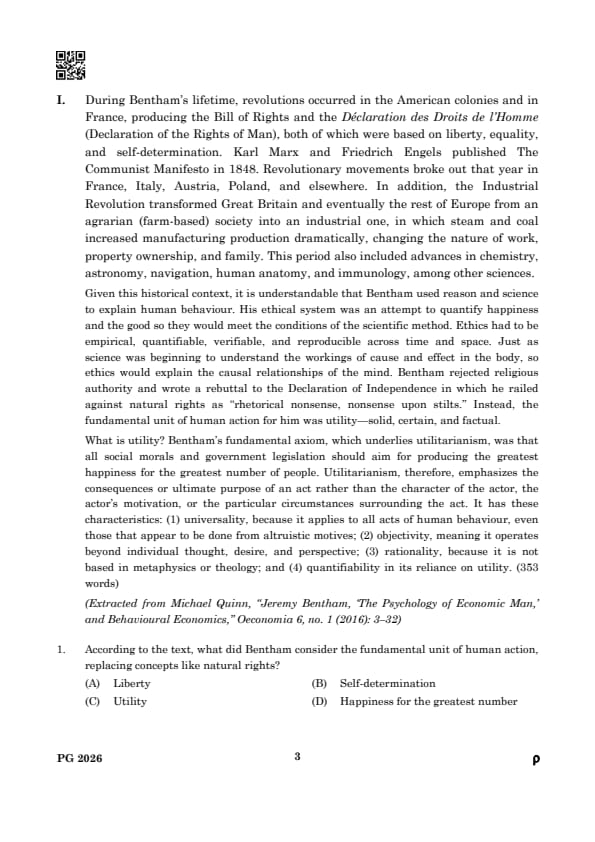
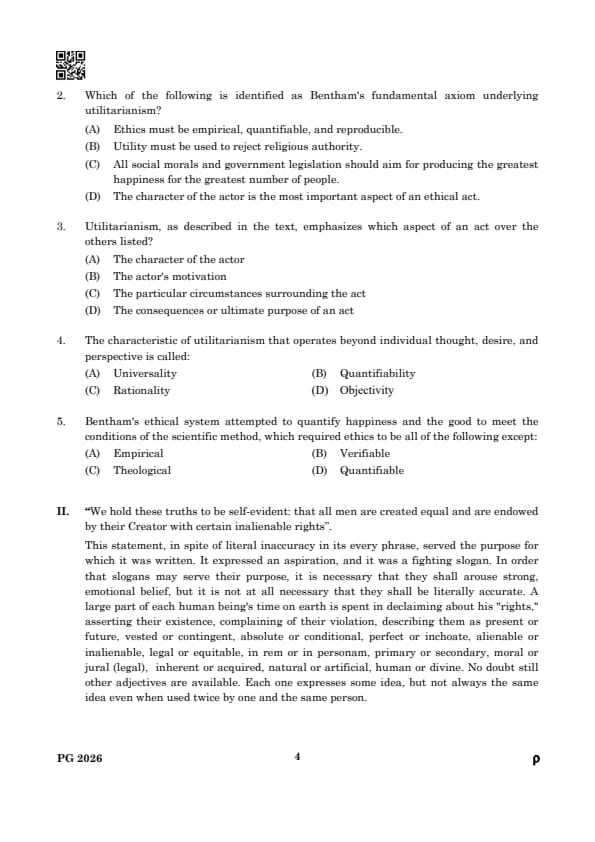
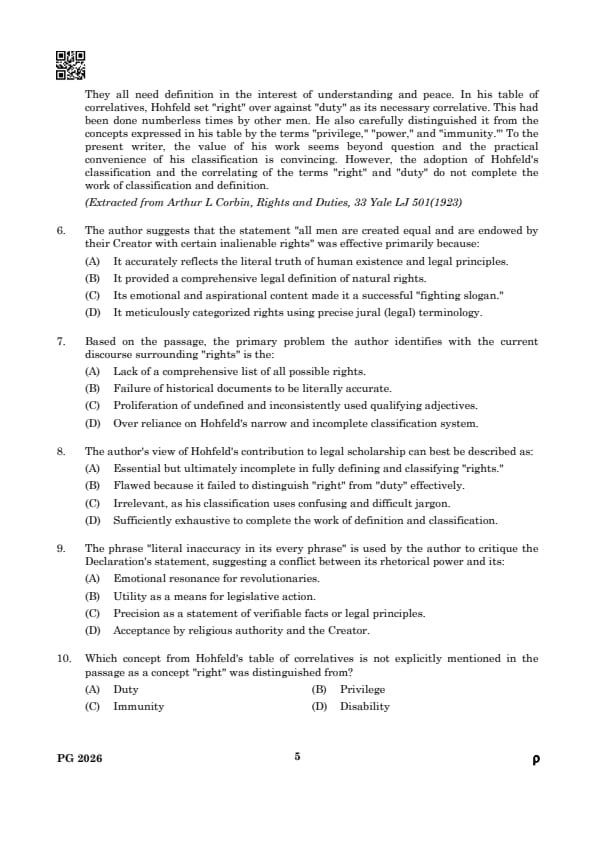
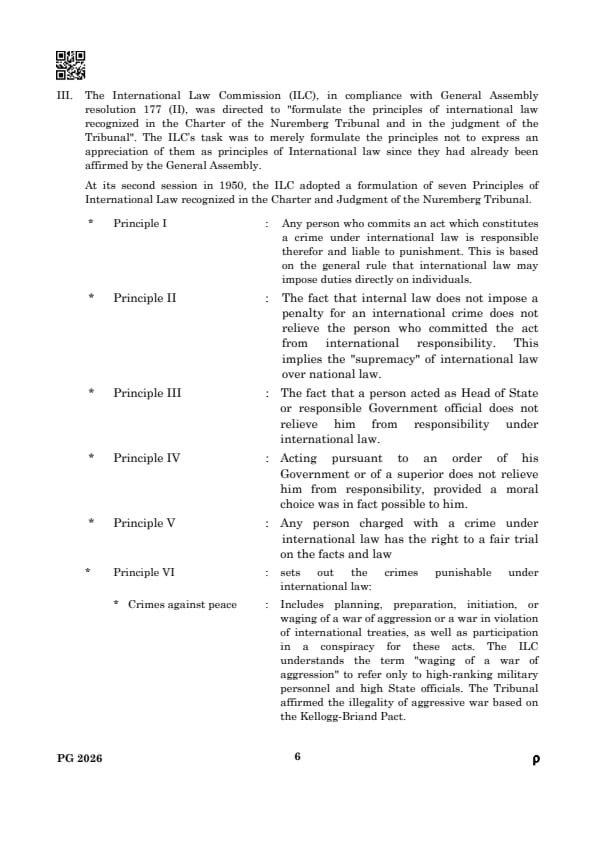
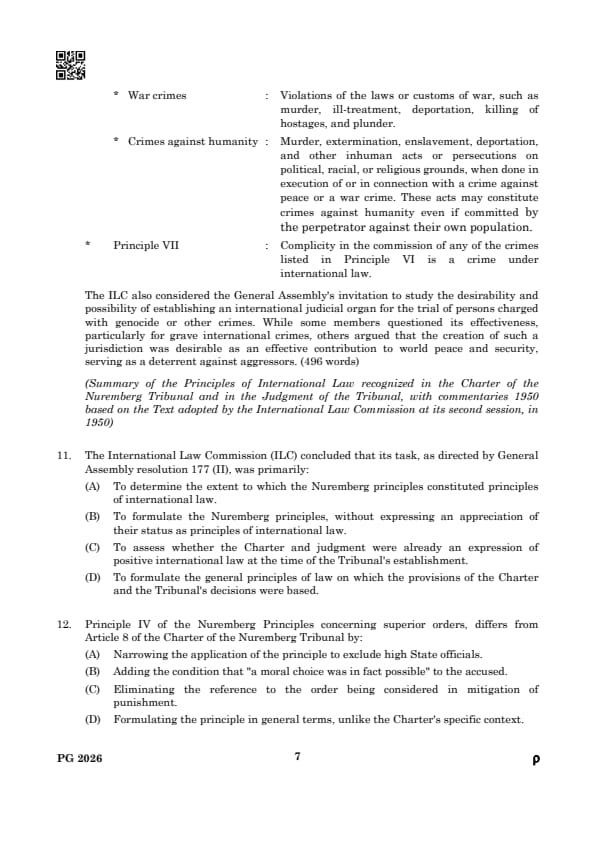
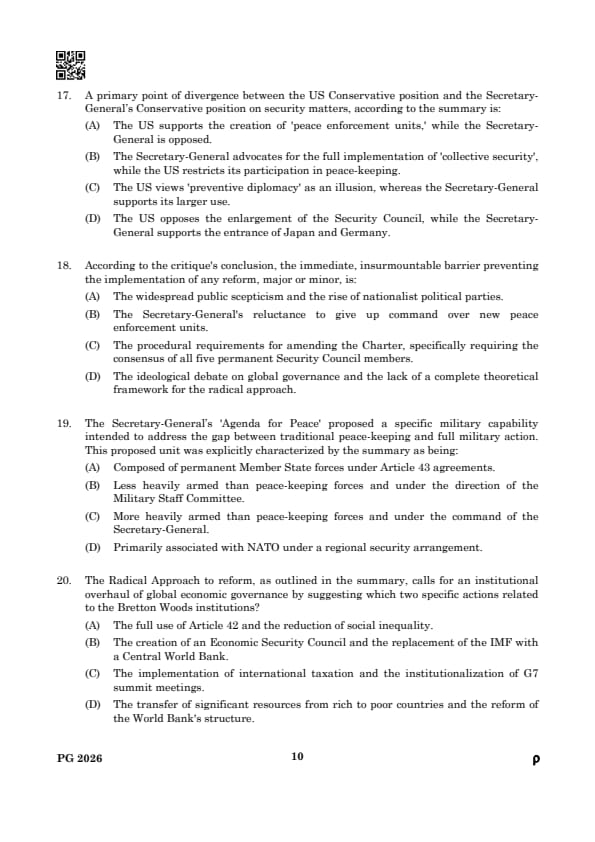
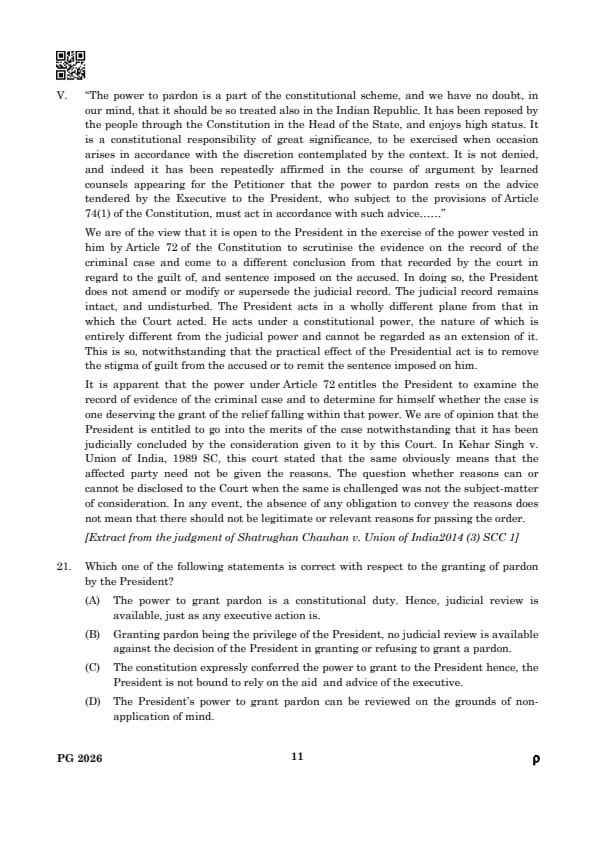
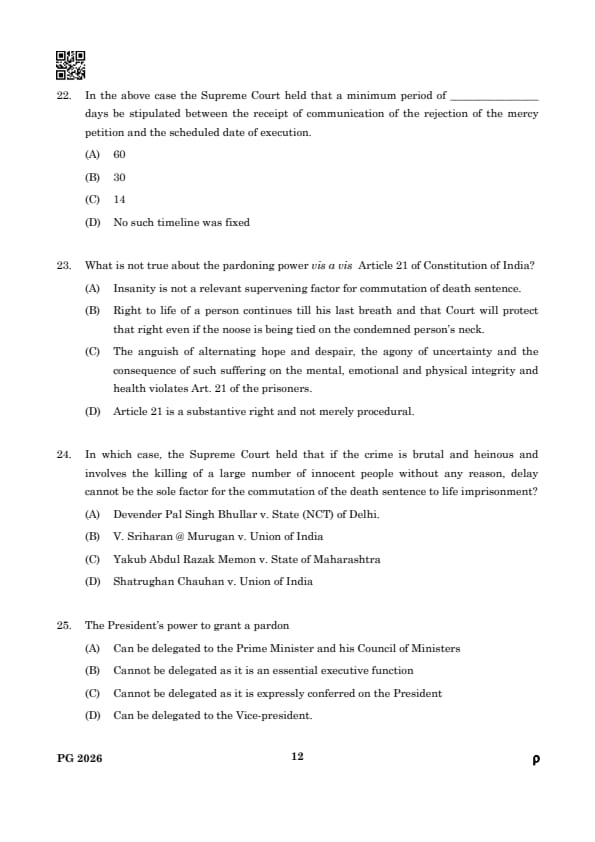
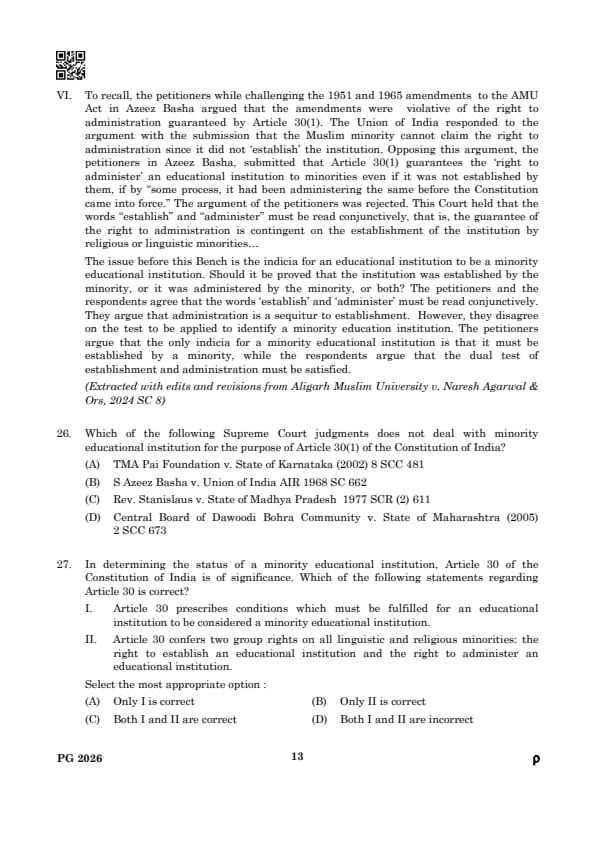
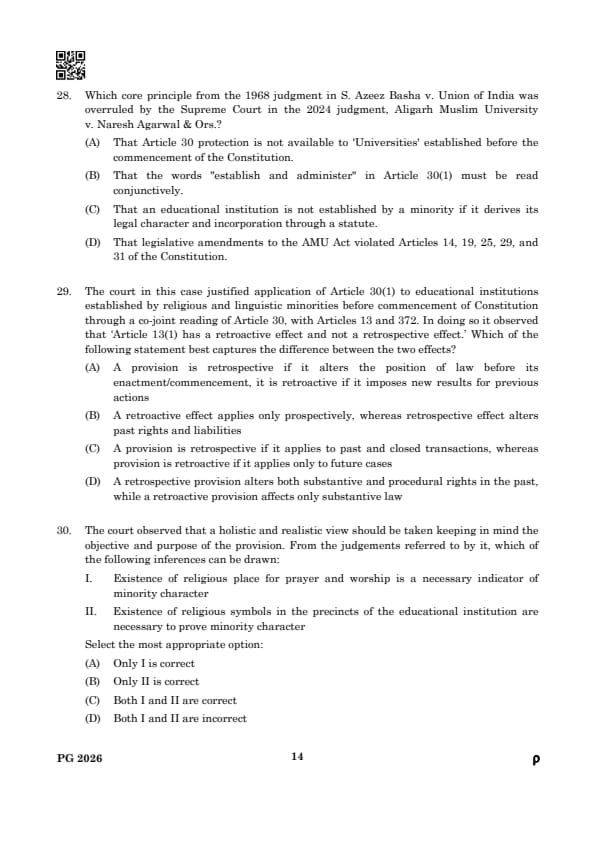
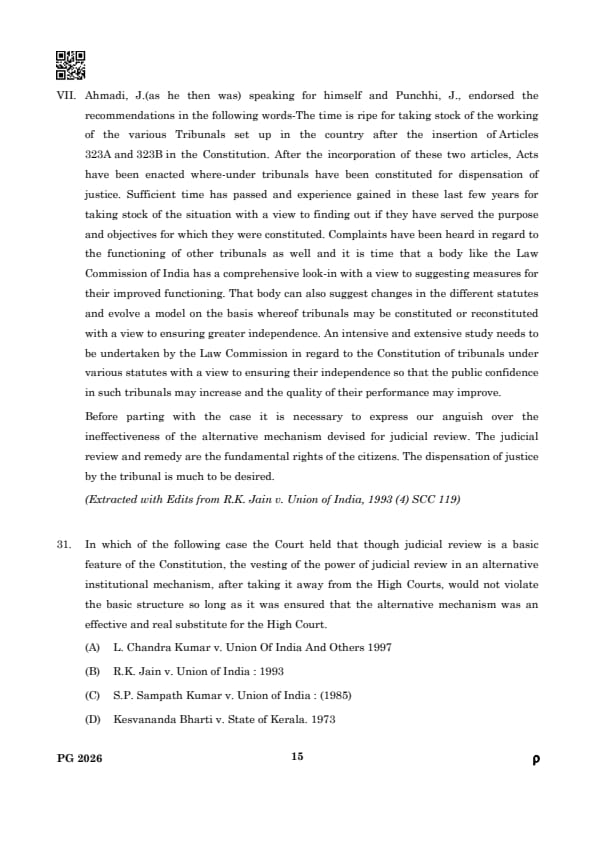
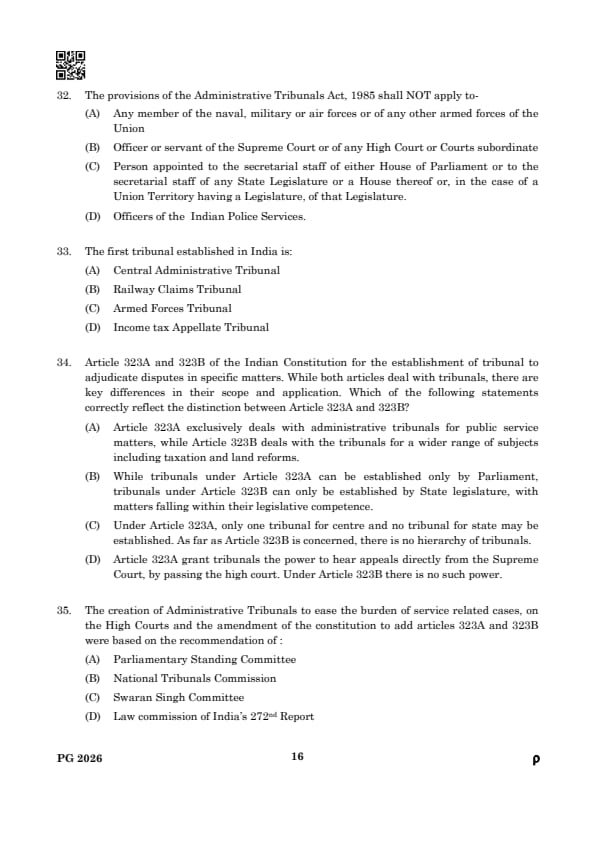
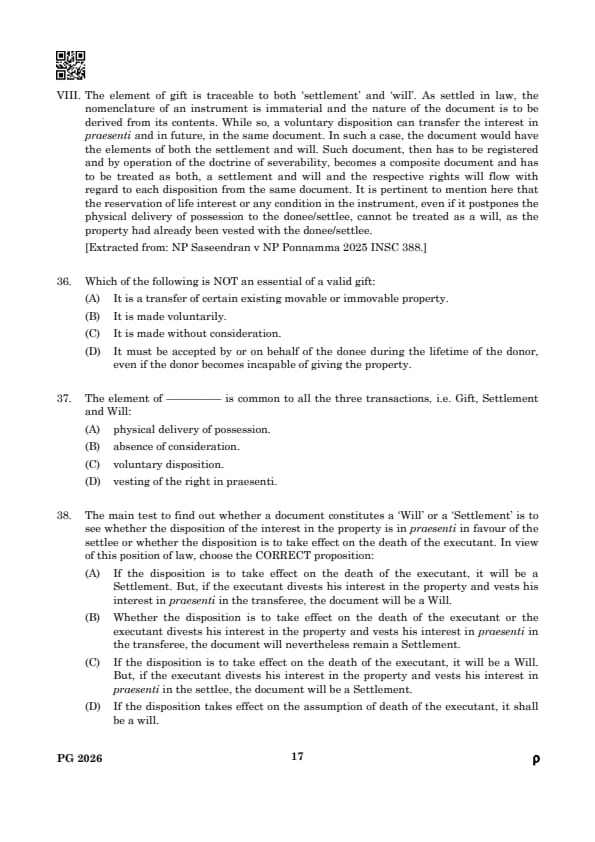
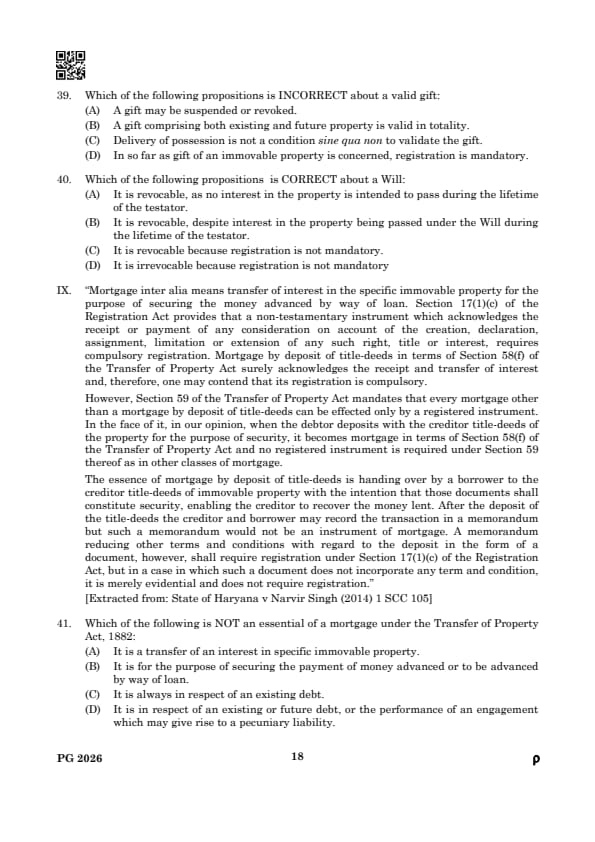
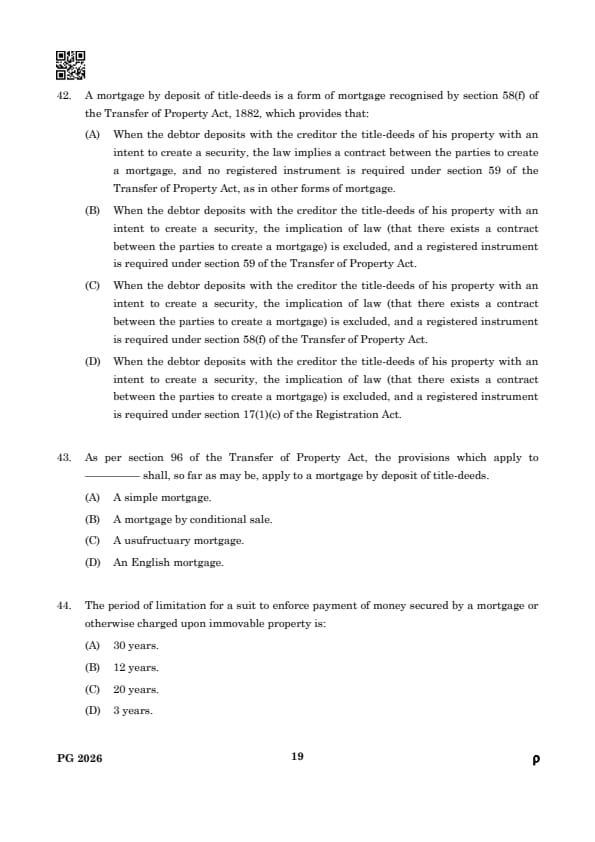
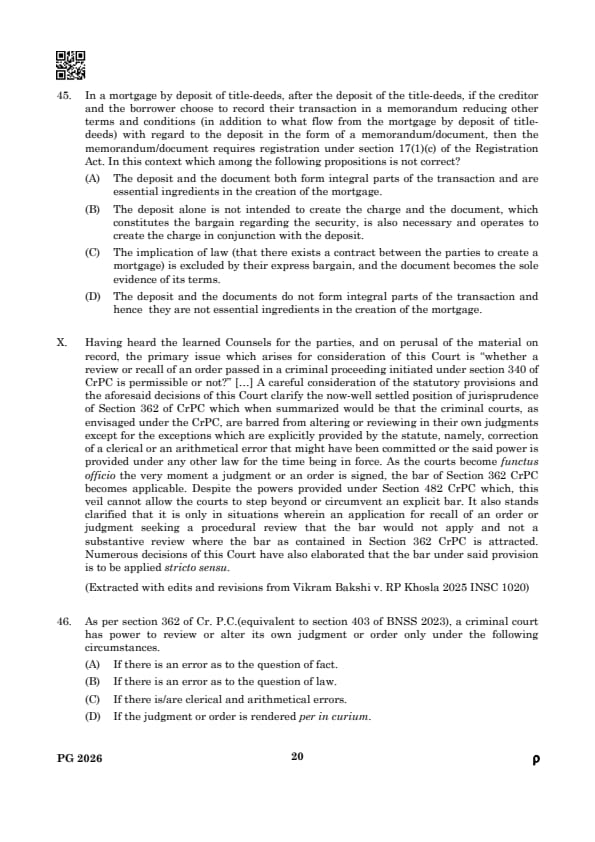
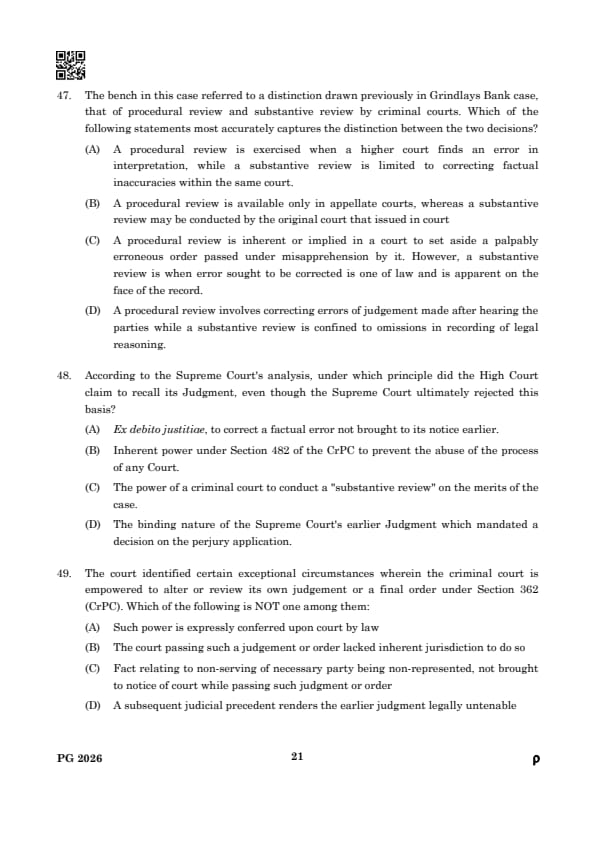
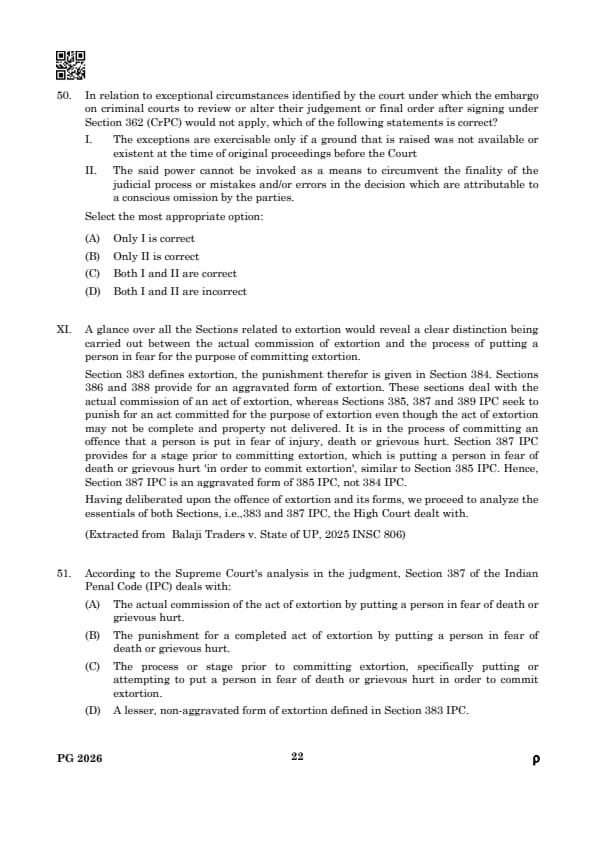
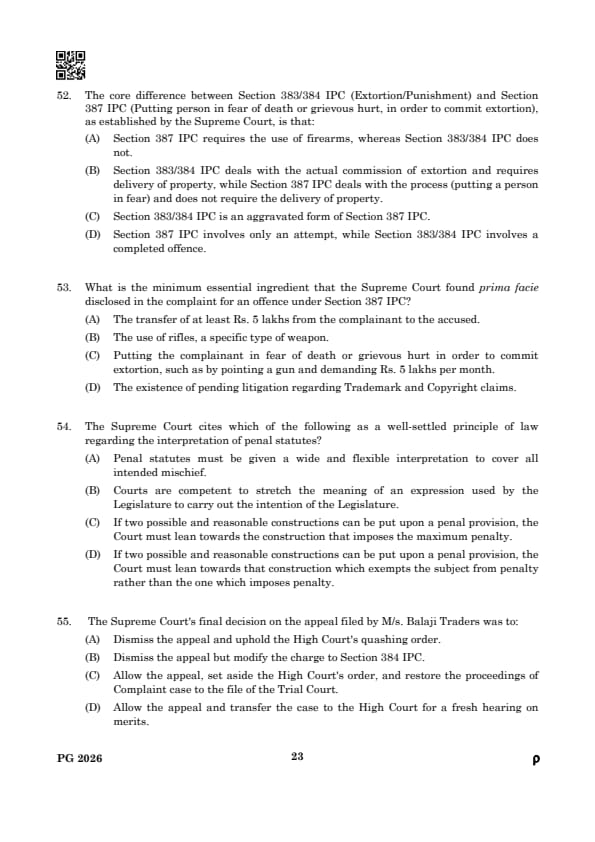
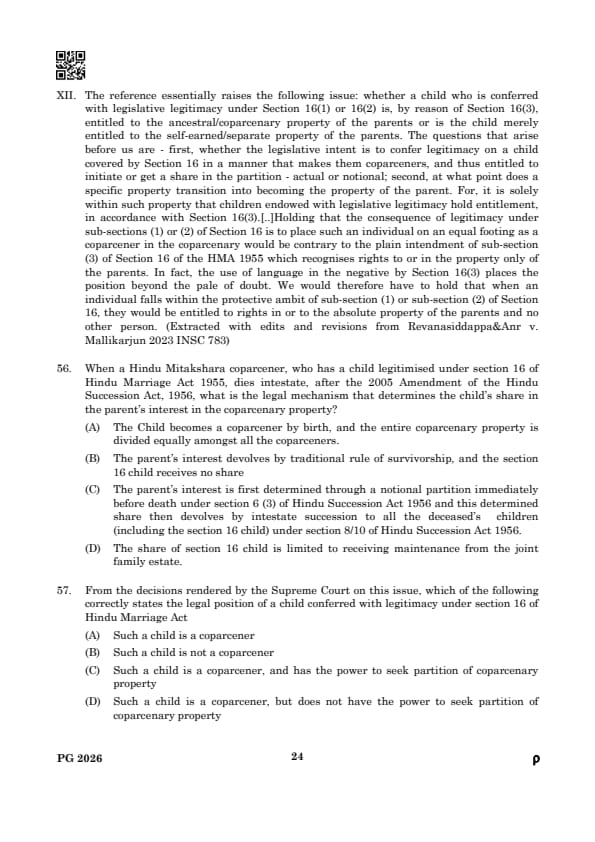
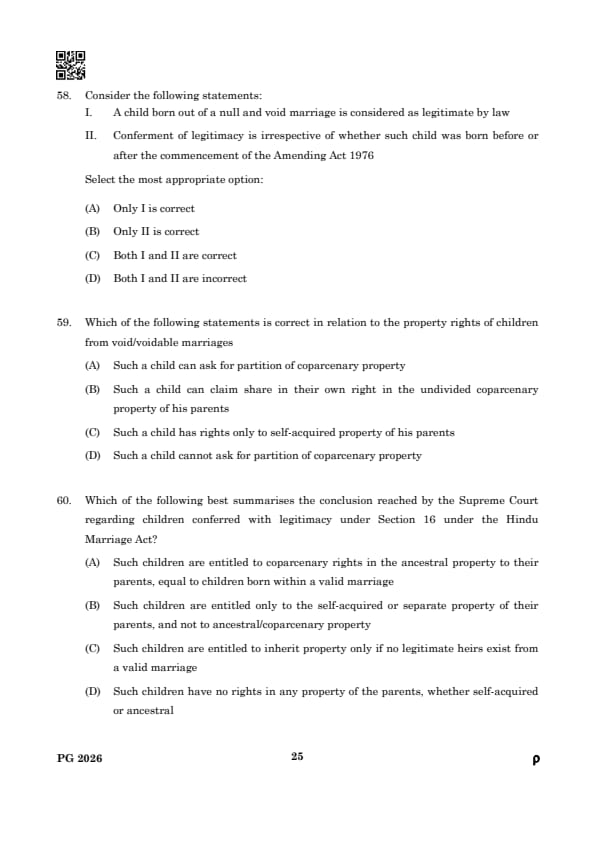
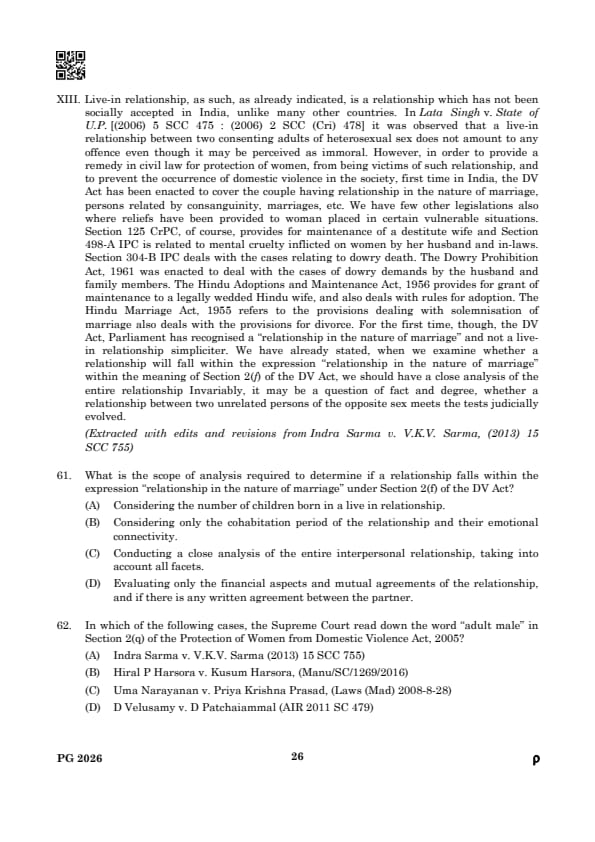
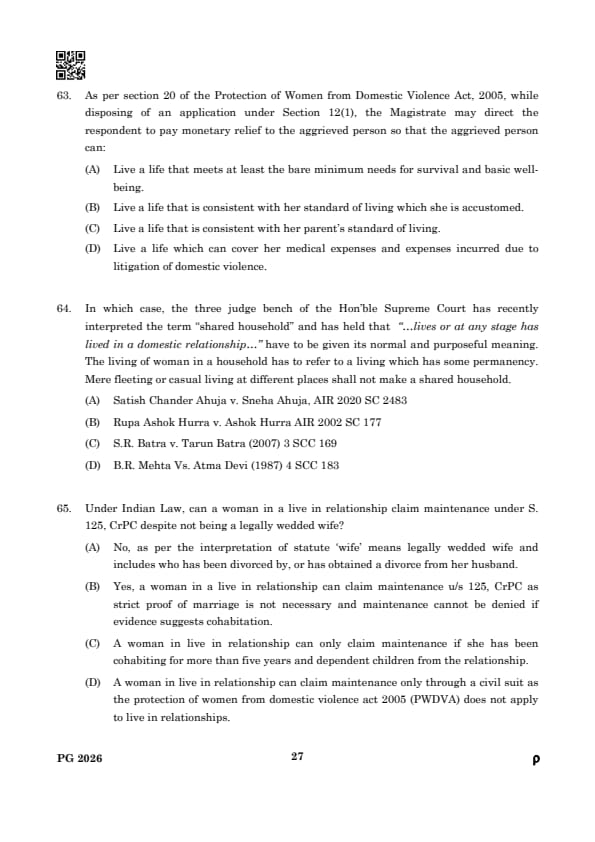
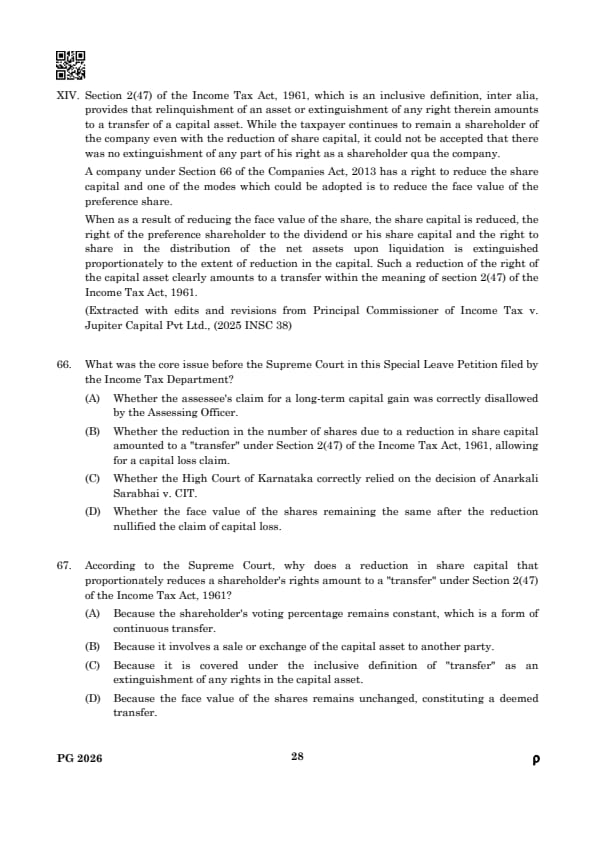
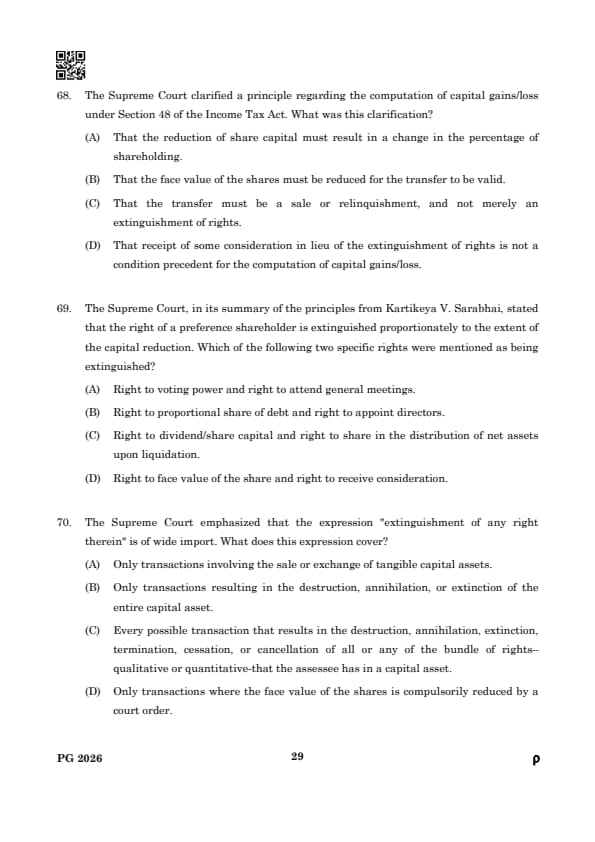
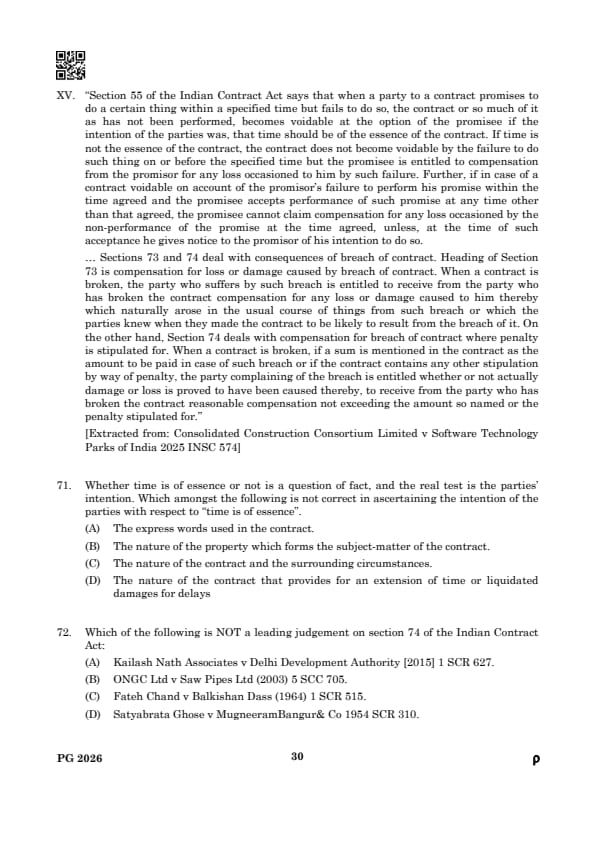
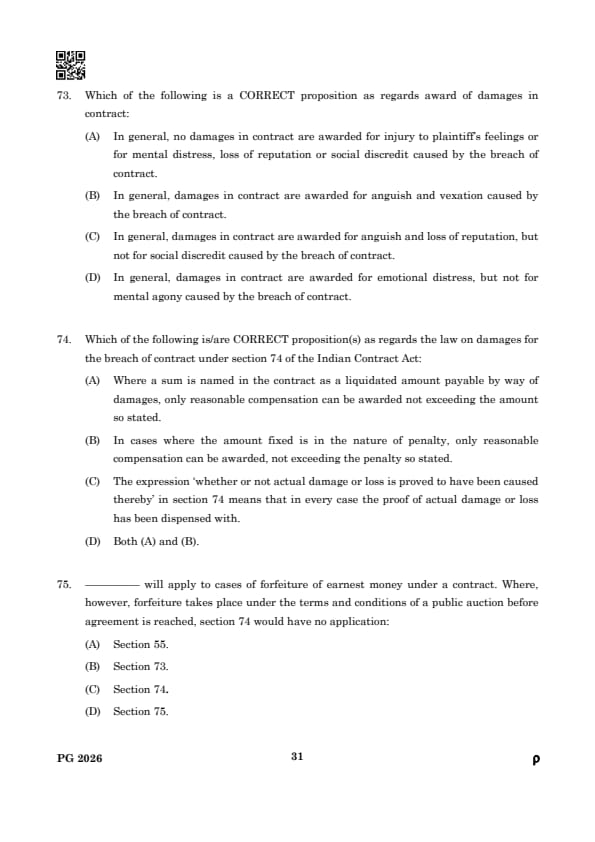
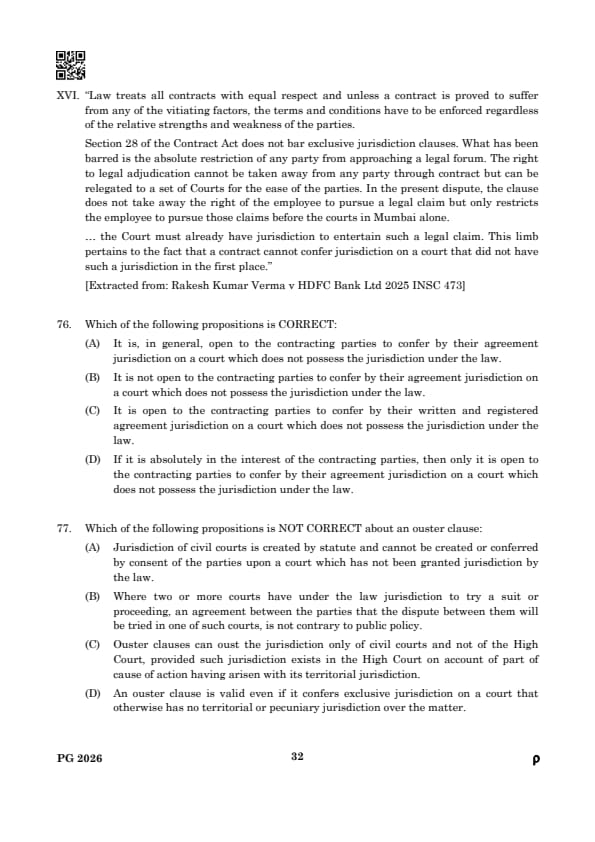
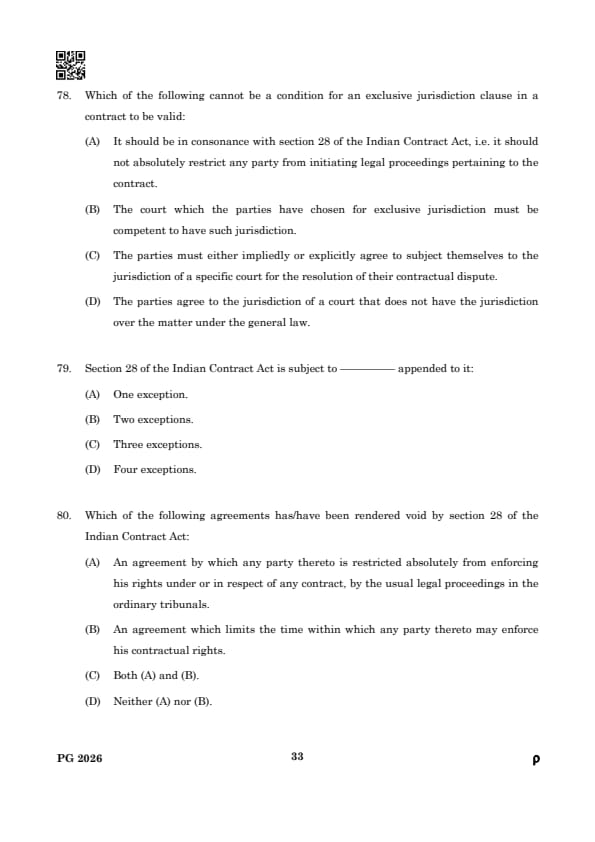
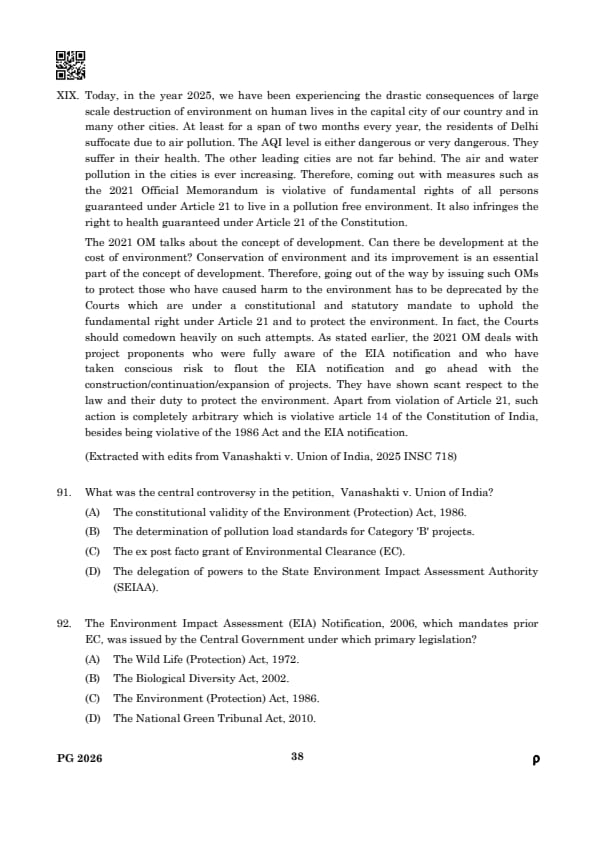
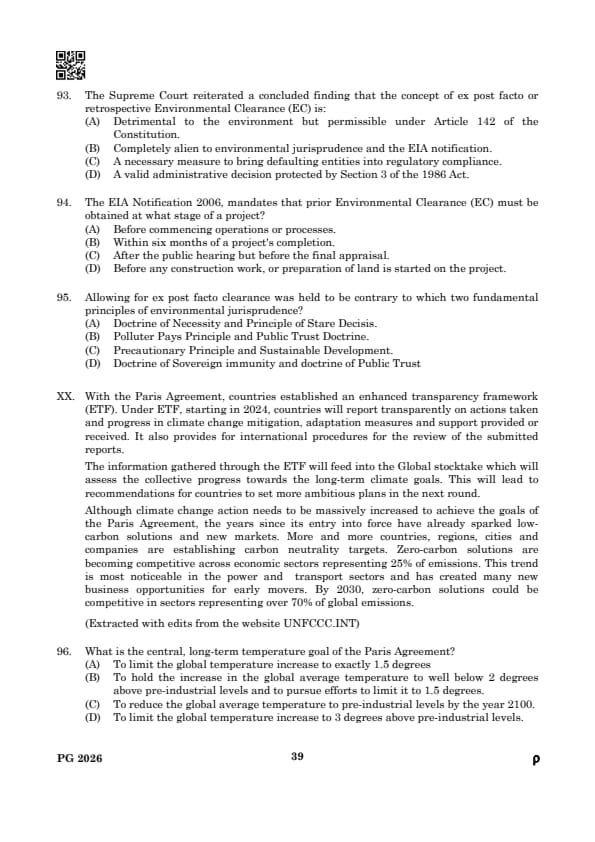
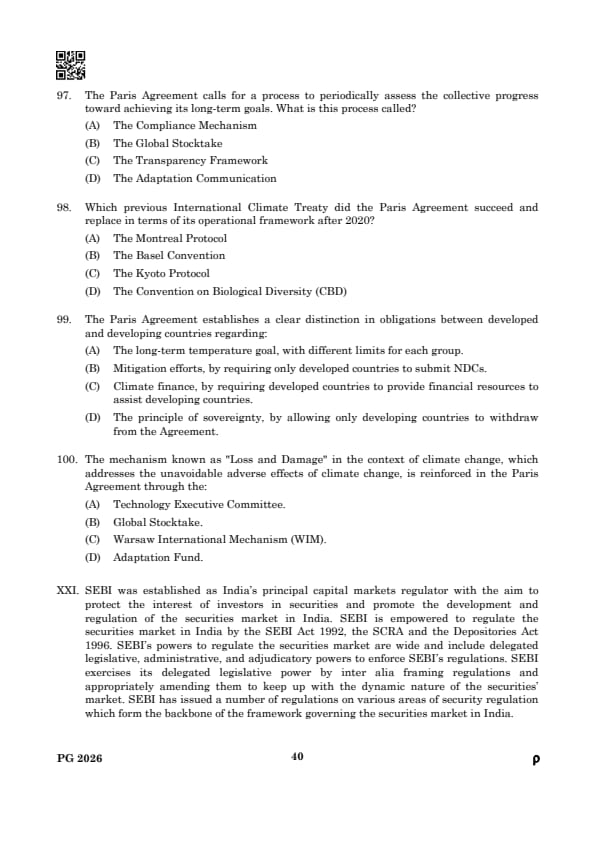
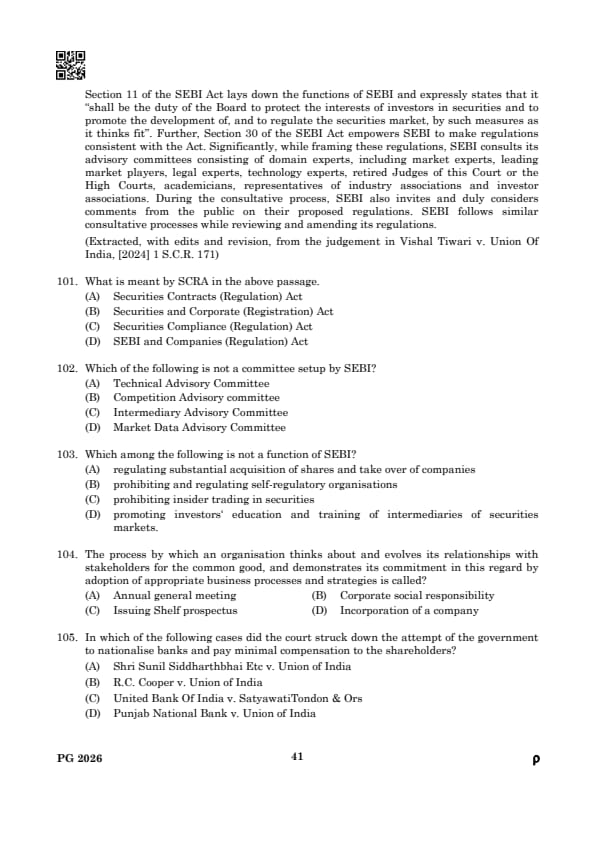
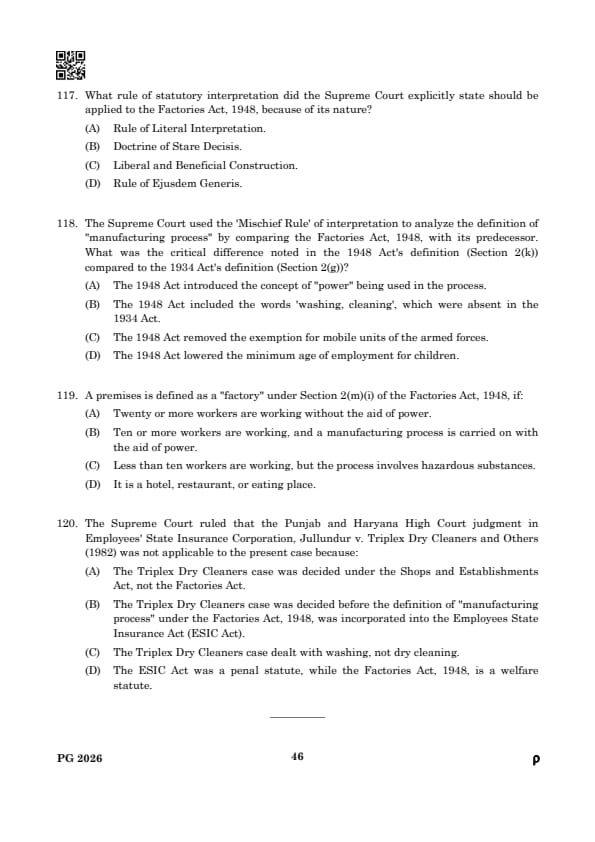


*The article might have information for the previous academic years, please refer the official website of the exam.