
CLAT PG 2026 Question Paper with Solutions Set B


Content Writer | Updated On - Dec 11, 2025
CLAT PG 2026 Question Paper with Solution for Set B is available for download here. CLAT PG 2026 exam was conducted by the Consortium of NLUs on December 7, 2025. Candidates were required to answer a total of 120 objective-type questions carrying 1 mark each. CLAT PG Question Paper contained topics such as Constitutional Law and other areas of law such as Jurisprudence, Administrative Law, Law of Contract, Torts, Family Law, Criminal Law, Property Law, Company Law, Public International Law, Tax Law, Environmental Law, and Labour & Industrial Law. Download CLAT PG 2026 Question Paper with Answer Key and Solution PDF from the link provided below.
CLAT PG 2026 Question Paper with Solution- Set B
| CLAT PG 2026 Question Paper with Solutions | Download PDF | Check Solutions |

Which of the following is NOT an essential of a valid gift:
View Solution
Step 1: Understand the essentials of a valid gift under the Transfer of Property Act, 1882.
Section 122 of the Transfer of Property Act defines a 'gift'. The essential elements are:
1. Transfer of ownership of property.
2. The property must be existing (movable or immovable).
3. The transfer must be made voluntarily.
4. The transfer must be without consideration.
5. There must be acceptance by or on behalf of the donee.
6. This acceptance must be made during the lifetime of the donor and while the donor is still capable of giving.
Step 2: Evaluate the options against these essentials.
- (A) is an essential element.
- (B) is an essential element.
- (C) is an essential element.
- (D) states that acceptance can be made "even if the donor becomes incapable of giving the property." This contradicts the legal requirement. If the donor dies or becomes incompetent (e.g., insane) before the gift is accepted, the gift is void. The acceptance must be completed while the donor is alive and capable.
Step 3: Conclude the answer.
The statement in option (D) is incorrect and therefore NOT an essential of a valid gift.
Quick Tip: The validity of a gift hinges on its completion before the donor's death or incapacity.
The phrase "while he is still capable of giving" is crucial. Any acceptance after the donor's death or after they become legally incapable of contracting is invalid.
The element of ________________ is common to all the three transactions, i.e. Gift, Settlement and Will:
View Solution
Step 1: Analyze the nature of each transaction.
- Gift: A transfer of property made voluntarily and without consideration.
- Settlement: As described in the passage, it is a form of disposition that can transfer an interest `in praesenti` (at the present time). It is a voluntary act.
- Will: A legal declaration of a person's intention with respect to their property which they desire to be carried into effect after their death. It is, by its very nature, a voluntary act.
Step 2: Evaluate the common elements based on the passage and legal principles.
- (A) Physical delivery of possession: This is not essential for any of them. The passage notes that for a settlement, physical delivery can be postponed. For a will, possession only transfers after death. For gifts of immovable property, delivery is not the mode of transfer; registration is.
- (B) Absence of consideration: This is true for a Gift and a Will. A settlement is also a form of disposition, often within a family, and is typically gratuitous, but the core element defining all three is not the lack of consideration but the nature of the act.
- (C) Voluntary disposition: A "disposition" is a transfer or conveyance of property. "Voluntary" means it is done out of free will. All three—a gift, a settlement, and a will—are acts where the owner disposes of their property out of their own free will, without compulsion. This element is fundamental to all three.
- (D) Vesting of the right in praesenti: This is true for a Gift and a Settlement, but not for a Will. In a Will, the interest vests only upon the death of the testator (executant).
Step 3: Conclude the answer.
The most accurate and universal element common to all three transactions is that they are voluntary dispositions of property.
Quick Tip: To find a common element, identify the most fundamental characteristic of each term.
A 'gift' is voluntary. A 'will' is the ultimate expression of free will regarding one's property after death. A 'settlement' is also a voluntary arrangement. The common thread is the voluntary nature of the disposition.
The main test to find out whether a document constitutes a 'Will' or a 'Settlement' is to see whether the disposition of the interest in the property is in praesenti in favour of the settlee or whether the disposition is to take effect on the death of the executant. In view of this position of law, choose the CORRECT proposition:
View Solution
Step 1: Understand the core distinction between a Will and a Settlement.
The question and the passage state the main test:
- If the transfer of interest happens immediately (`in praesenti`), even if possession is postponed, it is a Settlement. The executant loses their interest in the property at that moment.
- If the transfer of interest only happens after the death of the executant, it is a Will. A will is revocable during the executant's lifetime precisely because no interest has yet been transferred.
Step 2: Analyze the propositions in the options.
- (A) This option reverses the definitions. It incorrectly states that a disposition taking effect on death is a Settlement and a present transfer is a Will.
- (B) This option incorrectly claims that the document is always a Settlement, ignoring the definition of a Will.
- (C) This option correctly states both sides of the test:
- Disposition takes effect on death \(\rightarrow\) It is a Will.
- Executant divests interest `in praesenti` \(\rightarrow\) It is a Settlement.
This aligns perfectly with the legal position described.
- (D) This is a partial and less complete statement. While true that a disposition taking effect on death is a will, option (C) provides the full, comparative test for both document types as requested.
Step 3: Conclude the answer.
Option (C) provides the most accurate and complete description of the test to distinguish between a Will and a Settlement.
Quick Tip: The key difference between a will and a settlement (or gift) is the timing of the vesting of interest.
Will = Vests after death (post-mortem).
Settlement/Gift = Vests immediately (`in praesenti`).
Remember this fundamental distinction to solve such problems.
Which of the following propositions is INCORRECT about a valid gift:
View Solution
Step 1: Understand the legal provisions regarding gifts under the Transfer of Property Act, 1882.
We need to evaluate each proposition based on the Act.
Step 2: Analyze each proposition.
- (A) Section 126 of the TPA allows for the suspension or revocation of a gift under specific conditions agreed upon by the donor and donee at the time of the gift. So, a gift can be suspended or revoked. This proposition is correct.
- (B) Section 124 of the TPA states that a gift of future property is void. Therefore, if a single gift is made of both existing and future property, the gift is valid only with respect to the existing property and void with respect to the future property. The proposition that it is "valid in totality" is therefore incorrect.
- (C) `Sine qua non` means an essential condition. For a gift of immovable property, the essential condition is a registered instrument (as per Section 123). For a gift of movable property, it can be by delivery or by a registered instrument. The passage also mentions that postponement of physical delivery of possession does not invalidate a transfer if the right has vested. So, physical delivery is not always an essential condition. This proposition is correct.
- (D) Section 123 of the TPA explicitly states that a gift of immovable property must be effected by a registered instrument signed by the donor and attested by two witnesses. Registration is mandatory. This proposition is correct.
Step 3: Identify the incorrect proposition.
Proposition (B) is legally incorrect because a gift of future property is void.
Quick Tip: A key principle in property law is that one cannot transfer what one does not own.
Therefore, a transfer of "future property" (property that does not yet exist or is not yet owned by the transferor) is generally not valid. This is explicitly stated for gifts in Section 124 of the Transfer of Property Act.
Which of the following propositions is CORRECT about a Will:
View Solution
Step 1: Understand the fundamental nature of a Will.
A Will, by its very definition, is an ambulatory document. This means it is of a roaming or unfixed character until the death of the testator. It speaks from the death of the testator, not from the date it was executed. A core feature of a Will is that it can be changed or revoked by the testator at any time during their life.
Step 2: Analyze the reason for its revocability.
The reason a Will is revocable is because it does not transfer any right or interest in the property to the beneficiary (`in praesenti`). The property remains fully under the ownership and control of the testator. Since no rights have vested in anyone else, the testator is free to change their mind.
Step 3: Evaluate the options.
- (A) This proposition correctly states that a Will is revocable and provides the correct legal reason: no interest passes to the beneficiary during the testator's lifetime.
- (B) This is incorrect. If interest *had* passed during the testator's lifetime, the document would not be a Will; it would be a settlement or gift and would be irrevocable.
- (C) Revocability is an inherent quality of a Will, independent of whether it is registered or not. While registration is not mandatory for a Will, that is not the *reason* it is revocable.
- (D) This is incorrect. A Will is always revocable.
Quick Tip: Remember the Latin maxim for a Will: ambulatoria voluntas (a changeable will).
The defining characteristic of a Will is that it is revocable until the very last moment of the testator's life. This is because it only takes effect upon death.
Which of the following is NOT an essential of a mortgage under the Transfer of Property Act, 1882:
View Solution
Step 1: Understand the definition of a mortgage.
Section 58(a) of the Transfer of Property Act, 1882, defines a mortgage. The question asks what is NOT an essential element of this definition.
Step 2: Analyze the components of the definition.
A mortgage is:
1. A transfer of an interest.
2. In specific immovable property.
3. For the purpose of securing:
a. The payment of money advanced or to be advanced by way of loan (a future debt).
b. An existing debt.
c. The performance of an engagement which may give rise to a pecuniary liability.
Step 3: Evaluate the options against this definition.
- (A) "transfer of an interest in specific immovable property" - This is an essential element.
- (B) "securing the payment of money advanced or to be advanced" - This is part of the purpose, an essential element.
- (D) "in respect of an existing or future debt, or the performance of an engagement..." - This correctly and comprehensively states the purpose. This is an essential element.
- (C) "It is always in respect of an existing debt" - This is incorrect. The definition explicitly includes securing a "future debt" (money "to be advanced") and the performance of an engagement that might lead to a future pecuniary liability. Therefore, a mortgage is not *always* for an existing debt.
Step 4: Conclude the answer.
The statement that a mortgage is always for an existing debt is incorrect and thus NOT an essential of a mortgage.
Quick Tip: The definition of a mortgage is broad and specifically designed to cover not just current debts but also future advances and other financial obligations.
Remember that securing a "future debt" is a very common purpose of a mortgage, especially in cases like a line of credit secured by property.
A mortgage by deposit of title-deeds is a form of mortgage recognised by section 58(f) of the Transfer of Property Act, 1882, which provides that:
View Solution
Step 1: Understand the core concept of a mortgage by deposit of title-deeds (Equitable Mortgage).
This is a special type of mortgage created simply by the act of depositing the title documents of a property with a creditor as security for a loan. Its main feature is that it does not require a formal, registered mortgage deed.
Step 2: Analyze the passage for the legal position.
The passage explains this clearly:
- "Section 59 of the Transfer of Property Act mandates that every mortgage other than a mortgage by deposit of title-deeds can be effected only by a registered instrument."
- "...when the debtor deposits with the creditor title-deeds... it becomes mortgage in terms of Section 58(f)... and no registered instrument is required under Section 59 thereof..."
Step 3: Evaluate the options based on the passage and legal principles.
- (A) This option correctly states that the law implies a contract from the act of deposit and, crucially, that "no registered instrument is required under section 59". This perfectly aligns with the passage.
- (B), (C), and (D) all incorrectly state that a registered instrument is required. They also incorrectly state that the "implication of law" is excluded, whereas the mortgage is created precisely by this legal implication.
Quick Tip: The key feature of a mortgage by deposit of title-deeds is its exception to the general rule of registration.
While most mortgages require a registered instrument, this type is created by the simple act of depositing the deeds, making it a quick and common form of securing loans, especially from banks.
As per section 96 of the Transfer of Property Act, the provisions which apply to _____________ — shall, so far as may be, apply to a mortgage by deposit of title-deeds.
View Solution
Step 1: Understand the question.
The question asks which type of mortgage's legal provisions are made applicable to a mortgage by deposit of title-deeds, according to Section 96 of the TPA. This is a direct question on a specific statutory provision.
Step 2: Recall or look up Section 96 of the Transfer of Property Act, 1882.
Section 96, titled "Mortgage by deposit of title-deeds," states: "The provisions hereinbefore contained which apply to a simple mortgage shall, so far as may be, apply to a mortgage by deposit of title-deeds."
Step 3: Conclude the answer.
The statute explicitly equates a mortgage by deposit of title-deeds with a simple mortgage for the purpose of applying other provisions of the Act (like the right to a decree for sale).
Quick Tip: Certain sections of statutes create legal fictions or equivalences.
Section 96 of the TPA is a key example, treating an equitable mortgage (by deposit of title-deeds) as a simple mortgage for enforcement and other purposes. This is a crucial point to remember for property law.
The period of limitation for a suit to enforce payment of money secured by a mortgage or otherwise charged upon immovable property is:
View Solution
Step 1: Understand the question.
The question asks for the limitation period for a suit to enforce a mortgage, i.e., for a mortgagee (creditor) to file a suit to recover the debt by selling the mortgaged property.
Step 2: Recall the provisions of the Limitation Act, 1963.
The Schedule to the Limitation Act prescribes the time limits for filing various types of suits.
- Article 62 of the Schedule deals with suits "to enforce payment of money secured by a mortgage or otherwise charged upon immovable property."
- The period of limitation prescribed under this article is twelve years.
- The time from which the period begins to run is "when the money sued for becomes due."
- For a suit for foreclosure, the period is 30 years (Article 63).
Step 3: Select the correct option.
The correct period of limitation for a suit to enforce payment by selling the mortgaged property is 12 years.
Quick Tip: The Limitation Act is crucial for procedural law.
Remember the key limitation periods, especially in property law: 12 years for a suit to enforce a mortgage and for adverse possession of private land, and 30 years for a suit for foreclosure or for adverse possession of government land.
In a mortgage by deposit of title-deeds, after the deposit of the title-deeds, if the creditor and the borrower choose to record their transaction in a memorandum reducing other terms and conditions (in addition to what flow from the mortgage by deposit of title-deeds) with regard to the deposit in the form of a memorandum/document, then the memorandum/document requires registration under section 17(1)(c) of the Registration Act. In this context which among the following propositions is not correct?
View Solution
Step 1: Understand the scenario.
The question describes a situation where, after an equitable mortgage is created by depositing title deeds, the parties create a written memorandum that doesn't just record the deposit but also contains the "terms and conditions" of the mortgage. The premise is that such a document requires registration. The question asks which proposition is *not correct* in this specific context.
Step 2: Analyze the legal position from the passage.
The passage distinguishes two types of memoranda:
1. A simple memo that just records the fact of the deposit: "merely evidential and does not require registration."
2. A memo that "reduc[es] other terms and conditions... in the form of a document": This "shall require registration."
When the parties create the second type of document, they are choosing to define their rights and obligations in writing, rather than relying on the simple legal implication of the deposit.
Step 3: Evaluate the propositions in the context of a registrable memorandum.
- (A) If the document contains the terms and is registrable, it means the parties intended for the document to be part of the creation of the mortgage, making both the deposit and the document integral parts. This is a correct proposition in this context.
- (B) This states that the deposit *alone* is not enough, and the document containing the bargain is also necessary. This is correct when the parties choose to reduce their bargain to writing.
- (C) This correctly explains the legal effect. By creating an express written contract, the parties exclude the simple "implication of law" and the document becomes the primary or sole evidence of the mortgage terms.
- (D) This proposition states that the deposit and document do *not* form integral parts. This is the opposite of what is implied by making the document registrable. If the document contains the core terms and requires registration, it is by definition an integral part of the mortgage transaction. Therefore, this proposition is incorrect.
Quick Tip: The key distinction is whether a memorandum is a mere record of a past event (the deposit) or the very instrument that creates the rights and obligations of the mortgage.
If it contains the terms and conditions of the loan and security, it is the latter and requires registration. In that case, it is an integral part of the transaction.
As per section 362 of Cr. P.C.(equivalent to section 403 of BNSS 2023), a criminal court has power to review or alter its own judgment or order only under the following circumstances.
View Solution
Step 1: Understand the question.
The question asks for the specific circumstances under which a criminal court can alter or review its own signed judgment, according to Section 362 of the CrPC as described in the passage.
Step 2: Locate the relevant information in the passage.
The passage states: "...criminal courts... are barred from altering or reviewing in their own judgments except for the exceptions which are explicitly provided by the statute, namely, correction of a clerical or an arithmetical error that might have been committed or the said power is provided under any other law for the time being in force."
Step 3: Analyze the stated exceptions.
The passage clearly identifies one specific exception mentioned within Section 362 itself: correcting clerical or arithmetical errors. Reviewing for errors of fact or law, or because a judgment is `per incuriam` (given in ignorance of a binding precedent or statute), would constitute a substantive review, which the passage says is barred.
Step 4: Evaluate the options.
- (A), (B), and (D) represent grounds for substantive review or appeal, which are explicitly barred by Section 362.
- (C) "If there is/are clerical and arithmetical errors" is the exact exception mentioned in the passage and the statute.
Quick Tip: The principle of functus officio (task performed) is very strict in criminal law.
Once a judge signs a judgment, they have no further power to change it, except for the very narrow purpose of correcting minor clerical or mathematical mistakes. All other errors must be corrected by a higher court on appeal or revision.
The bench in this case referred to a distinction drawn previously in Grindlays Bank case, that of procedural review and substantive review by criminal courts. Which of the following statements most accurately captures the distinction between the two decisions?
View Solution
Step 1: Understand the core distinction from the passage.
The passage clarifies that the bar in Section 362 applies to "substantive review" but not to "procedural review". A substantive review is barred. A procedural review is allowed.
Step 2: Analyze the nature of these reviews from legal principles.
- Substantive Review: This involves re-examining the merits of the case, the evidence, and the legal principles applied to reach the conclusion. This is what an appeal does. Section 362 bars the original court from doing this. An "error of law apparent on the face of the record" is a ground for substantive review.
- Procedural Review: This deals with the process by which the judgment was reached, not the judgment's content. It is used to correct situations where a judgment was rendered due to a procedural mistake, such as not giving notice to a party, or deciding a case that was already settled. The court is not re-hearing the case, but recalling an order that should never have been passed in the first place due to a procedural flaw.
Step 3: Evaluate the options.
- (A) and (B) misstate the nature and jurisdiction of these reviews.
- (C) This option accurately captures the essence. "Procedural review" is an inherent power to correct an order passed by mistake or "misapprehension" (e.g., without hearing a party). "Substantive review" is about correcting an "error of law," which goes to the merits of the decision, and this is what Section 362 prohibits.
- (D) This option incorrectly defines the two terms.
Quick Tip: Remember the difference:
\textbf{Substantive Review} = Looking at the 'what' and 'why' of the decision (merits, evidence, law). This is barred by Section 362.
\textbf{Procedural Review} = Looking at the 'how' of the decision (process, notice, jurisdiction). This is not barred, as it's about correcting a procedural mistake.
According to the Supreme Court's analysis, under which principle did the High Court claim to recall its Judgment, even though the Supreme Court ultimately rejected this basis?
View Solution
Step 1: Understand the question.
The question asks on what basis the High Court in the case likely justified recalling its own judgment, a basis which the Supreme Court, as per the passage, found invalid.
Step 2: Analyze the passage for clues.
The passage explicitly states: "Despite the powers provided under Section 482 CrPC which, this veil cannot allow the courts to step beyond or circumvent an explicit bar."
Step 3: Interpret this statement.
This sentence means that even the inherent powers of the High Court under Section 482 cannot be used to get around the specific and explicit bar on review contained in Section 362. This implies that the argument to use Section 482 was likely made but was rejected by the Supreme Court. Section 482 is the source of the High Court's inherent power to "prevent the abuse of the process of any Court" or to secure the ends of justice.
Step 4: Evaluate the options.
- (A) `Ex debito justitiae` (as a matter of right) is a general principle, but the specific statutory power often invoked is Section 482.
- (B) This directly refers to the inherent power under Section 482, which the passage explicitly mentions as being insufficient to override Section 362. This is the most likely basis the High Court claimed and the Supreme Court rejected.
- (C) The High Court would not claim to conduct a "substantive review" as that is explicitly barred; it would use the language of inherent powers to justify its action.
- (D) This might be a fact of the case but is not the legal principle under which a court would claim the power to recall its own judgment.
Quick Tip: Section 482 of the CrPC, which saves the inherent powers of the High Court, is often invoked in arguments to justify actions not explicitly provided for in the code.
However, the Supreme Court has repeatedly held that this inherent power cannot be used to override an explicit statutory bar, such as the one in Section 362.
The court identified certain exceptional circumstances wherein the criminal court is empowered to alter or review its own judgement or a final order under Section 362 (CrPC). Which of the following is NOT one among them:
View Solution
Step 1: Understand the question and the passage's scope.
The passage states that the bar on review under Section 362 is not absolute and does not apply to "procedural review". The question asks us to identify a situation that is NOT a valid exception for a court to alter its own judgment. These exceptions are based on established case law beyond the provided passage.
Step 2: Analyze the nature of valid exceptions.
Valid exceptions are generally situations where the original order is a nullity or was passed in violation of natural justice, making it a procedural error.
- (A) The statute itself can provide a power of review. Section 362 itself says "save as otherwise provided by this Code or by any other law". This is a valid exception.
- (B) If a court lacks inherent jurisdiction, its order is a nullity (`void ab initio`). A court always has the power to recall an order that it had no power to pass in the first place. This is a valid exception.
- (C) Passing an order against a party who was not served notice and was not represented is a classic violation of the principles of natural justice (`audi alteram partem`). This is a procedural error, and the order can be recalled. This is a valid exception.
Step 3: Analyze the remaining option.
- (D) A subsequent judicial precedent making an earlier judgment legally untenable is a ground for appeal or review by a higher court. It is a change in the substantive law. Allowing a court to alter its own final judgment based on a later change in law would completely undermine the principle of finality (`res judicata`). This is a classic example of a substantive review, which is barred by Section 362.
Step 4: Conclude the answer.
A change in law due to a subsequent precedent is not a ground for a court to alter its own signed criminal judgment.
Quick Tip: The exceptions to Section 362 CrPC are narrowly construed and relate to procedural fairness and nullity.
They include lack of jurisdiction, violation of natural justice (like not hearing a party), or fraud played on the court. A change in substantive law after the judgment is not a valid ground.
In relation to exceptional circumstances identified by the court under which the embargo on criminal courts to review or alter their judgement or final order after signing under Section 362 (CrPC) would not apply, which of the following statements is correct?
I. The exceptions are exercisable only if a ground that is raised was not available or existent at the time of original proceedings before the Court
II. The said power cannot be invoked as a means to circumvent the finality of the judicial process or mistakes and/or errors in the decision which are attributable to a conscious omission by the parties.
Select the most appropriate option:
View Solution
Step 1: Understand the nature of the "exceptional circumstances."
These exceptions (procedural review) are meant to correct fundamental procedural errors that render a judgment invalid, not to give parties a second chance to argue the case.
Step 2: Analyze Statement I.
"The exceptions are exercisable only if a ground... was not available or existent at the time of original proceedings." This is generally incorrect. Many grounds for procedural review, such as a party not being served notice, *did* exist at the time of the proceeding (the lack of service happened then). The issue is that the *court* was unaware of it. So the ground was existent. This statement is not an accurate general rule.
Step 3: Analyze Statement II.
"The said power cannot be invoked as a means to circumvent the finality of the judicial process or mistakes and/or errors in the decision which are attributable to a conscious omission by the parties." This statement is correct. The power of procedural review is not a substitute for an appeal. If a party had an opportunity to make an argument and chose not to (a "conscious omission"), they cannot later come back and ask for a review on that ground. The power is not meant to correct errors of judgment or to bypass the finality of a decision. It is for correcting procedural flaws that the system itself is responsible for.
Step 4: Conclude the answer.
Statement I is incorrect, while Statement II accurately describes the limits of the power of procedural review. Therefore, only II is correct.
Quick Tip: The power of procedural review is a safeguard against gross procedural injustice, not a tool for litigants to correct their own mistakes or re-argue their case.
The courts are very strict in ensuring that this narrow exception is not used to undermine the important principle of finality in judgments.
According to the Supreme Court's analysis in the judgment, Section 387 of the Indian Penal Code (IPC) deals with:
View Solution
Step 1: Understand the question.
The question asks what Section 387 IPC deals with, according to the provided passage.
Step 2: Locate the description of Section 387 in the passage.
The passage draws a distinction between sections dealing with "actual commission" and sections dealing with acts for the "purpose of extortion". It then specifically discusses Section 387.
Step 3: Analyze the specific sentences about Section 387.
- "Sections 385, 387 and 389 IPC seek to punish for an act committed for the purpose of extortion even though the act of extortion may not be complete and property not delivered."
- "Section 387 IPC provides for a stage prior to committing extortion, which is putting a person in fear of death or grievous hurt 'in order to commit extortion'..."
Step 4: Evaluate the options based on this analysis.
- (A) and (B) talk about the "actual commission" or "completed act" of extortion. The passage explicitly states that Section 387 deals with a stage where the act may *not* be complete. These are incorrect.
- (C) This option perfectly summarizes the passage's description. It mentions the "process or stage prior to committing extortion" and the specific act of "putting a person in fear of death or grievous hurt in order to commit extortion."
- (D) The passage states that Section 387 is an "aggravated form," not a lesser one. This is incorrect.
Quick Tip: The Indian Penal Code often punishes not just the completed offence, but also preparatory acts or attempts.
The passage highlights this distinction for extortion. Sections 383/384 deal with the completed act, while sections like 385/387 deal with the preparatory act of putting someone in fear, even if no property is delivered.
The core difference between Section 383/384 IPC (Extortion/Punishment) and Section 387 IPC (Putting person in fear of death or grievous hurt, in order to commit extortion), as established by the Supreme Court, is that:
View Solution
Step 1: Identify the distinction made in the passage.
The passage begins by highlighting a "clear distinction... between the actual commission of extortion and the process of putting a person in fear for the purpose of committing extortion."
Step 2: Assign the relevant sections to each part of the distinction.
- The passage states that Sections 383 and 384 deal with the definition and punishment for the "actual commission of an act of extortion." The definition of extortion in Sec 383 involves dishonestly inducing the delivery of property.
- It then states that Section 387 "seek[s] to punish for an act committed for the purpose of extortion even though the act of extortion may not be complete and property not delivered."
Step 3: Synthesize the core difference.
The core difference is that Sec 383/384 requires the completed offence, including the delivery of property. In contrast, Sec 387 punishes the preparatory act of putting someone in fear of death or grievous hurt to commit extortion, regardless of whether any property was actually delivered.
Step 4: Evaluate the options.
- (A) is incorrect; the means of fear is specified as death or grievous hurt, not necessarily firearms.
- (B) perfectly captures the distinction: Sec 383/384 is about the completed act requiring delivery, while Sec 387 is about the process of putting in fear, without requiring delivery.
- (C) is incorrect; the passage states Sec 387 is an aggravated form of Sec 385, not that 383/384 is an aggravated form of 387.
- (D) is a good summary, but (B) is more detailed and precise as it includes the crucial element of "delivery of property."
Quick Tip: When a legal passage distinguishes between two offences, focus on the 'actus reus' (the guilty act) for each.
For extortion under 383, the actus reus is complete only upon delivery of property. For the offence under 387, the actus reus is complete merely by putting the person in fear of death/grievous hurt.
What is the minimum essential ingredient that the Supreme Court found prima facie disclosed in the complaint for an offence under Section 387 IPC?
View Solution
Step 1: Understand the question.
The question asks what essential ingredient for an offence under Section 387 was found in the complaint. This question seems to refer to the facts of the Balaji Traders case from which the passage is extracted, even though the facts are not detailed in the passage itself. It requires an inference based on the legal principles discussed.
Step 2: Recall the essential ingredient of Section 387 from the passage.
The passage defines the offence under Section 387 as "putting a person in fear of death or grievous hurt 'in order to commit extortion'".
Step 3: Evaluate the options based on this definition.
- (A) The transfer of money (delivery of property) is an ingredient of Section 383/384, not Section 387. The passage explicitly states Section 387 applies even if property is not delivered.
- (B) The use of a specific weapon is evidence, not the core legal ingredient itself. The ingredient is the "fear of death or grievous hurt," which can be caused by various means.
- (C) This option accurately describes the core ingredient of Section 387. It includes "putting the complainant in fear of death or grievous hurt" and the purpose, "in order to commit extortion." The example given ("pointing a gun and demanding Rs. 5 lakhs") is a classic illustration of this offence.
- (D) Pending civil litigation might be the motive or background, but it is not an essential ingredient of the criminal offence of extortion itself.
Quick Tip: To identify the essential ingredients of an offence, break down its definition into components.
For Section 387 IPC, the components are: (1) Putting a person in fear; (2) The fear must be of death or grievous hurt; and (3) This must be done with the intention ('in order to') of committing extortion.
The Supreme Court cites which of the following as a well-settled principle of law regarding the interpretation of penal statutes?
View Solution
Step 1: Understand the question.
The question asks for a well-settled principle of interpreting penal statutes. This is a general question on the interpretation of statutes, a core legal subject. The passage itself doesn't state the principle, so it relies on external legal knowledge.
Step 2: Recall the rules of statutory interpretation for penal laws.
The cardinal rule for interpreting penal (criminal) statutes is the rule of strict construction. This rule has several facets:
- The court must not extend the meaning of the words used to cover cases not clearly included in the language.
- The benefit of any ambiguity or doubt in the language of the statute must be given to the accused.
Step 3: Evaluate the options based on this rule.
- (A) and (B) suggest a wide or flexible interpretation ("mischief rule" or "purposive approach"). While used for some statutes, the primary rule for penal statutes is strict construction, not a wide one.
- (C) This is the opposite of the correct principle. The court leans towards leniency, not maximum penalty, in cases of ambiguity.
- (D) This statement accurately reflects the rule of strict construction. If a penal provision is ambiguous and can be interpreted in two reasonable ways, the court should adopt the interpretation that is more favorable to the accused, i.e., the one that exempts them from penalty or imposes a lesser penalty.
Quick Tip: The rule of strict construction for penal statutes is a fundamental principle of criminal jurisprudence, rooted in the idea of protecting individual liberty against the power of the state.
When in doubt, the law should err on the side of the accused.
The Supreme Court's final decision on the appeal filed by M/s. Balaji Traders was to:
View Solution
Step 1: Understand the question.
This question asks for the final outcome of the specific case from which the passage was extracted. This information is not available in the passage itself and requires external knowledge of the case of \textit{Balaji Traders v. State of UP.
Step 2: Ascertain the facts and holding of the case.
In the actual case of \textit{Balaji Traders vs State of U.P. \& Ors. (Criminal Appeal No. 782 of 2023), the Allahabad High Court had quashed the criminal proceedings against the accused. The complainant (Balaji Traders) appealed to the Supreme Court.
Step 3: Identify the Supreme Court's final decision.
The Supreme Court, after analyzing the ingredients of Section 387 IPC, found that the complaint did prima facie disclose the essential ingredients of the offence. It held that the High Court had erred in quashing the proceedings at a nascent stage. Therefore, the Supreme Court allowed the appeal, set aside the High Court's order, and restored the complaint case to the trial court to be decided on its merits.
Step 4: Match the decision with the options.
- Option (C) accurately describes the final order passed by the Supreme Court in this case.
Quick Tip: When questions refer to the final outcome of a specific case, and the information is not in the passage, you must rely on your knowledge of case law.
For CLAT PG, being aware of the final holdings of recent landmark Supreme Court judgments is crucial.
When a Hindu Mitakshara coparcener, who has a child legitimised under section 16 of Hindu Marriage Act 1955, dies intestate, after the 2005 Amendment of the Hindu Succession Act, 1956, what is the legal mechanism that determines the child's share in the parent's interest in the coparcenary property?
View Solution
Step 1: Understand the rights of a child under Section 16 of the HMA, as per the passage.
The passage clarifies the Supreme Court's holding in Revanasiddappa. It states that a child legitimized under Section 16 is entitled to rights "in or to the property only of the parents" and are not placed "on an equal footing as a coparcener in the coparcenary." This means they are not coparceners by birth but can inherit their parent's property.
Step 2: Understand the concept of "notional partition" under the Hindu Succession Act, 1956 (post-2005).
When a male Hindu coparcener dies intestate, his undivided interest in the Mitakshara coparcenary property does not pass by survivorship. Instead, a "notional partition" is deemed to have taken place immediately before his death. This legal fiction is used to calculate and separate the deceased's share from the joint property.
Step 3: Determine how this separated share devolves.
Once the deceased parent's share is determined through notional partition, it becomes their separate property for the purpose of succession. This property then devolves according to the rules of intestate succession under Section 8 of the Hindu Succession Act. The heirs under Section 8 include all of the deceased's children, whether legitimate or deemed legitimate under Section 16 of the HMA.
Step 4: Evaluate the options.
- (A) is incorrect; the passage states such a child is not a coparcener.
- (B) is incorrect; the rule of survivorship has been largely abrogated by the 2005 amendment.
- (C) This option accurately describes the two-step process: first, the notional partition to determine the parent's share, and second, the intestate succession of that share to all heirs, including the Section 16 child. This is the correct legal mechanism.
- (D) is incorrect; the child has a right to inherit, not just receive maintenance.
Quick Tip: The \textit{Revanasiddappa judgment is a landmark case. Its core finding is that children from void/voidable marriages are not coparceners but are entitled to inherit their parent's share in the joint family property.
This inheritance happens via a 'notional partition' followed by intestate succession, not by birthright.
From the decisions rendered by the Supreme Court on this issue, which of the following correctly states the legal position of a child conferred with legitimacy under section 16 of Hindu Marriage Act
View Solution
Step 1: Locate the specific holding of the Supreme Court in the passage.
The question asks for the legal position of a child legitimized under Section 16. The passage contains a direct statement on this.
Step 2: Analyze the key sentence.
The passage states: "Holding that the consequence of legitimacy under sub-sections (1) or (2) of Section 16 is to place such an individual on an equal footing as a coparcener in the coparcenary would be contrary to the plain intendment of sub-section (3) of Section 16..."
Step 3: Interpret the Court's conclusion.
The Court explicitly rejected the idea that these children become coparceners. A coparcener has a right by birth in the ancestral property. The Court limited their right to the property "of the parents" only, which they inherit upon the parent's death, but not a right by birth in the larger coparcenary.
Step 4: Evaluate the options.
- (A), (C), and (D) all incorrectly state that such a child is a coparcener.
- (B) "Such a child is not a coparcener" accurately reflects the conclusion of the Supreme Court as explained in the passage.
Quick Tip: Coparcenary is a narrow concept within Hindu joint family law, granting a right by birth.
The Supreme Court, in Revanasiddappa, was careful to grant inheritance rights to children from void/voidable marriages without expanding the traditional definition of a coparcener. Remember this key distinction.
Consider the following statements:
I. A child born out of a null and void marriage is considered as legitimate by law
II. Conferment of legitimacy is irrespective of whether such child was born before or after the commencement of the Amending Act 1976
Select the most appropriate option:
View Solution
Step 1: Analyze Statement I.
"A child born out of a null and void marriage is considered as legitimate by law." Section 16(1) of the Hindu Marriage Act, 1955, explicitly confers legitimacy on children born from marriages that are declared null and void. The entire passage is based on the premise of this "legislative legitimacy". Thus, Statement I is correct.
Step 2: Analyze Statement II.
"Conferment of legitimacy is irrespective of whether such child was born before or after the commencement of the Amending Act 1976." The original Section 16 only applied to children of voidable marriages. The Marriage Laws (Amendment) Act of 1976 substituted Section 16, extending the benefit of legitimacy to children of void marriages as well. The Supreme Court in several cases, including the recent \textit{Revanasiddappa judgment, has affirmed that the benefit of Section 16 is retrospective and applies to children born even before the 1976 amendment, as it is a remedial and social welfare legislation. Thus, Statement II is also correct.
Step 3: Conclude the answer.
Both Statement I and Statement II are correct propositions of law.
Quick Tip: Section 16 of the Hindu Marriage Act is a piece of social welfare legislation.
Courts generally interpret such laws retrospectively and with a broad and beneficial construction to ensure that the intended social benefit (in this case, removing the stigma of illegitimacy) is extended as widely as possible.
Which of the following statements is correct in relation to the property rights of children from void/voidable marriages
View Solution
Step 1: Synthesize the Supreme Court's ruling from the passage.
The passage establishes two key points from the \textit{Revanasiddappa judgment:
1. Children legitimized under Section 16 are not coparceners.
2. They are entitled to rights in the "property only of the parents." The judgment clarifies this includes the parent's share in ancestral/coparcenary property, which they take by inheritance, not by birth.
Step 2: Understand the right to seek partition.
The right to demand a partition of a Hindu Undivided Family's coparcenary property is a right that belongs exclusively to coparceners.
Step 3: Evaluate the options based on these principles.
- (A) Since such a child is not a coparcener, they cannot ask for a partition of the entire coparcenary property. This is incorrect.
- (B) This is incorrect. They do not have a right "in their own right" (i.e., by birth) in the undivided property. They have a right to inherit their parent's defined share after the parent's death.
- (C) This is incorrect. The Supreme Court in \textit{Revanasiddappa clarified that their right is not limited to self-acquired property, but extends to the parent's share in coparcenary property as well.
- (D) "Such a child cannot ask for partition of coparcenary property." This is correct. Because they are not a coparcener, they do not possess the right to initiate a partition of the joint family property during their parent's lifetime.
Quick Tip: Distinguish between the right to inherit and the right to partition.
All heirs inherit, but only coparceners can demand partition of ancestral property by birthright. The Supreme Court's ruling grants the former but not the latter to children of void/voidable marriages.
Which of the following best summarises the conclusion reached by the Supreme Court regarding children conferred with legitimacy under Section 16 under the Hindu Marriage Act?
View Solution
Step 1: Carefully analyze the passage's summary of the court's decision.
The passage states the issue is whether the child is entitled to "ancestral/coparcenary property" or "merely... self-earned/separate property". The Court held that making them a coparcener would be wrong. It concluded: "...when an individual falls within the protective ambit of sub-section (1) or sub-section (2) of Section 16, they would be entitled to rights in or to the absolute property of the parents and no other person."
Step 2: Interpret the court's holding in light of the Revanasiddappa judgment.
The provided passage from \textit{Revanasiddappa is dense. The crucial part of the actual judgment (which the passage attempts to summarize) is that while these children are not coparceners, they can inherit their parent's share of coparcenary property (determined by notional partition) *as if it were* the parent's separate property. However, the specific wording of the provided excerpt is more restrictive. It focuses on the phrase "property only of the parents" and contrasts it with coparcenary property. It says giving them coparcenary rights would be "contrary to the plain intendment of sub-section (3)".
Step 3: Evaluate the options strictly based on the provided text.
The text creates a strong dichotomy: coparcenary rights (which are denied) vs. rights in the "property only of the parents" or "absolute property of the parents" (which are granted).
- (A) is explicitly denied by the passage.
- (B) This option states entitlement is "only to the self-acquired or separate property of their parents, and not to ancestral/coparcenary property". While the full judgment has a more nuanced view, this option closely aligns with the simplified, restrictive reading presented in the provided excerpt, which emphasizes that they are not coparceners and their right is limited to the "property of the parents". Within the confines of the given text, this appears to be the intended summary.
- (C) and (D) are incorrect. They have rights, and their rights are not contingent on the absence of other heirs.
*(Note: This is a complex area. The actual Revanasiddappa ruling is that they can inherit the parent's share of ancestral property, but they don't get a right by birth. Option B is an oversimplification, but it's the closest summary based on the provided excerpt's language.)*
Quick Tip: Answer based on the provided text, even if it seems to oversimplify a complex legal issue.
The excerpt strongly contrasts "coparcenary property" with "property of the parents." The best summary will reflect that contrast as presented in the text.
What is the scope of analysis required to determine if a relationship falls within the expression "relationship in the nature of marriage" under Section 2(f) of the DV Act?
View Solution
Step 1: Locate the relevant part of the passage.
The question asks about the scope of analysis for a "relationship in the nature of marriage." The last two sentences of the passage address this directly.
Step 2: Analyze the specific instructions given in the text.
The passage states: "...when we examine whether a relationship will fall within the expression 'relationship in the nature of marriage'... we should have a close analysis of the entire relationship Invariably, it may be a question of fact and degree..."
Step 3: Evaluate the options based on this instruction.
- (A), (B), and (D) all suggest looking at only specific, limited aspects of the relationship (children, duration, finances).
- (C) "Conducting a close analysis of the entire interpersonal relationship, taking into account all facets" is a direct paraphrase of the comprehensive analysis required by the Court as mentioned in the passage.
Quick Tip: Legal tests that are a "question of fact and degree" usually require a holistic and multi-factored analysis, not a narrow, single-factor test.
The passage's use of phrases like "close analysis" and "entire relationship" points towards a comprehensive evaluation.
In which of the following cases, the Supreme Court read down the word “adult male" in Section 2(q) of the Protection of Women from Domestic Violence Act, 2005?
View Solution
Step 1: Understand the question.
The question asks to identify the Supreme Court case that "read down" the term "adult male" from the definition of "respondent" in Section 2(q) of the DV Act. "Reading down" is a judicial interpretation to make a provision constitutional. Initially, only an "adult male" could be a respondent.
Step 2: Recall or analyze the key cases related to the DV Act.
- (A) Indra Sarma: This case (from which the passage is taken) deals with defining a "relationship in the nature of marriage".
- (D) \textit{D Velusamy: This case also laid down tests for what constitutes a "relationship in the nature of marriage".
- (C) This is a Madras High Court judgment, not a Supreme Court one.
- (B) In \textit{Hiral P. Harsora v. Kusum Harsora (2016), the Supreme Court addressed the constitutionality of Section 2(q). It found that limiting the definition of "respondent" to only "adult male" persons was discriminatory and violated Article 14 of the Constitution. The Court struck down the words "adult male" from the section, thereby allowing women and non-adults to also be named as respondents in a domestic violence case. This is known as "striking down," which is more direct than "reading down," but for the purpose of the question, it's the correct case that removed the words.
Quick Tip: Knowing the specific legal issue decided in landmark cases is essential.
Indra Sarma and Velusamy = "relationship in the nature of marriage".
Hiral Harsora = definition of "respondent" (striking down "adult male").
Satish Chander Ahuja = definition of "shared household".
As per section 20 of the Protection of Women from Domestic Violence Act, 2005, while disposing of an application under Section 12(1), the Magistrate may direct the respondent to pay monetary relief to the aggrieved person so that the aggrieved person can:
View Solution
Step 1: Understand the question.
The question asks about the purpose or standard of "monetary relief" under Section 20 of the DV Act. This requires knowledge of the specific statutory provision.
Step 2: Recall the provision of Section 20 of the DV Act.
Section 20(1) empowers the Magistrate to direct the respondent to pay monetary relief to meet the expenses incurred and losses suffered by the aggrieved person and any child as a result of the domestic violence. The explanation to this section is crucial. The relief should be "adequate, fair and reasonable and consistent with the standard of living to which the aggrieved person is accustomed."
Step 3: Evaluate the options against this standard.
- (A) This describes a bare subsistence level, which is generally the standard under Section 125 CrPC, but the DV Act provides for a higher standard.
- (B) This correctly reflects the language and intent of the DV Act, which aims to allow the woman to maintain the standard of living she was used to before the violence.
- (C) The standard is based on the aggrieved person's own accustomed standard of living, not her parent's.
- (D) While monetary relief can cover these specific expenses, the overall standard for determining the amount is the one mentioned in option (B). Option (D) lists components of the relief, not the guiding principle for its quantum.
Quick Tip: The standard of maintenance or monetary relief can differ between laws.
Section 125 CrPC is aimed at preventing destitution ("bare minimum").
The DV Act and the Hindu Adoptions and Maintenance Act aim to allow the woman to live a life consistent with the standard of the matrimonial home. This is a key distinction.
In which case, the three judge bench of the Hon'ble Supreme Court has recently interpreted the term "shared household" and has held that "...lives or at any stage has lived in a domestic relationship...” have to be given its normal and purposeful meaning. The living of woman in a household has to refer to a living which has some permanency. Mere fleeting or casual living at different places shall not make a shared household.
View Solution
Step 1: Understand the legal question.
The question is about the interpretation of the term "shared household" under the DV Act, specifically the case that overruled a previous restrictive interpretation. The question itself quotes the key holding.
Step 2: Recall the landmark cases on "shared household".
- (C) In S.R. Batra v. Tarun Batra (2007), a two-judge bench gave a very restrictive meaning to "shared household," holding that it would only mean a house owned by the husband or taken on rent by him, or a house belonging to the joint family of which the husband is a member. It held that a wife had no right to claim a right of residence in a house owned by her mother-in-law.
- (A) In \textit{Satish Chander Ahuja v. Sneha Ahuja (2020), a larger three-judge bench of the Supreme Court overruled the decision in S.R. Batra. It gave a much wider and more purposeful interpretation to "shared household," holding that it means a household where the aggrieved person was living in a domestic relationship, irrespective of whether she or the respondent had any right, title, or interest in the said household. The quote in the question about permanency versus "fleeting or casual living" is from this judgment.
- (B) and (D) are not related to this specific issue.
Quick Tip: The evolution of the definition of "shared household" is a critical topic in Domestic Violence law.
Remember the sequence: the restrictive view in \textit{S.R. Batra was overruled by the expansive and currently authoritative view in Satish Chander Ahuja.
Under Indian Law, can a woman in a live in relationship claim maintenance under S. 125, CrPC despite not being a legally wedded wife?
View Solution
Step 1: Understand the scope of Section 125 CrPC.
Section 125 provides for maintenance to wives, children, and parents. The key issue is the interpretation of the word "wife" for the purpose of this section.
Step 2: Recall the judicial interpretation of "wife" under S. 125 CrPC.
The Supreme Court has consistently held that for the purpose of a summary proceeding under Section 125, strict proof of a valid legal marriage is not required. The object of the section is to prevent destitution. The Court has given a broad interpretation to the term "wife".
In cases like \textit{Chanmuniya v. Virendra Kumar Singh Kushwaha and \textit{D. Velusamy v. D. Patchaiammal, the Supreme Court has held that where a man and woman have cohabited for a long period of time as husband and wife, there is a strong presumption in favour of marriage. A woman in such a "relationship in the nature of marriage" can claim maintenance under Section 125, even if she is not a legally wedded wife, provided the relationship meets certain criteria (e.g., they must have held themselves out to society as being akin to spouses).
Step 3: Evaluate the options.
- (A) This presents a strict, literal interpretation which the courts have moved away from for this specific social welfare provision.
- (B) This correctly reflects the liberal interpretation adopted by the judiciary, emphasizing that evidence of long cohabitation is sufficient to grant maintenance under this section.
- (C) The law does not prescribe a specific duration like five years.
- (D) This is incorrect. The DV Act provides its own remedies, but women in such relationships can also claim maintenance under S. 125 CrPC.
Quick Tip: For maintenance laws, remember the distinction in judicial approach.
While for inheritance and other civil rights, strict proof of marriage is needed, for the summary remedy under Section 125 CrPC, courts take a more liberal view and accept long cohabitation as sufficient proof to prevent a woman's destitution.
What was the core issue before the Supreme Court in this Special Leave Petition filed by the Income Tax Department?
View Solution
Step 1: Understand the question.
The question asks for the core legal issue in the case from which the passage is extracted. This requires understanding the context of capital gains/loss and the definition of "transfer".
Step 2: Analyze the passage for the central legal conflict.
The passage revolves around whether a "reduction in share capital" qualifies as a "transfer" under Section 2(47) of the Income Tax Act. It explains that a reduction in the face value of a share leads to a proportionate "extinguishment" of the shareholder's rights. It then connects this extinguishment directly to the definition of transfer in Section 2(47).
Step 3: Infer the purpose of this analysis.
In tax law, an event is taxable as a capital gain or allowable as a capital loss only if it results from a "transfer" of a capital asset. An assessee (taxpayer) would want a reduction to be treated as a transfer if it resulted in a loss, so they can claim that capital loss against other gains. The Income Tax Department would argue it's not a transfer to deny the loss claim. The core issue is, therefore, whether this event is a "transfer" that can trigger a capital loss. The passage mentions "reduction in the number of shares" and "reduction in face value" as modes of capital reduction.
Step 4: Evaluate the options.
- (A) This is too general. The core issue is more specific.
- (B) This option precisely frames the central legal question: Did the reduction in share capital (leading to a reduction in share value/number) constitute a "transfer" under the Act, which would validate the assessee's claim for a capital loss? This perfectly aligns with the passage's focus.
- (C) This is a procedural aspect of the case, not the core substantive issue.
- (D) The passage discusses reducing the face value, so this option is factually inconsistent with the text.
Quick Tip: To find the core issue in a tax law case, look for the intersection of a specific transaction (here, reduction of share capital) and a key legal definition (here, "transfer" under Sec 2(47)).
The entire dispute revolves around whether the former falls within the latter to trigger tax consequences (gain or loss).
According to the Supreme Court, why does a reduction in share capital that proportionately reduces a shareholder's rights amount to a "transfer" under Section 2(47) of the Income Tax Act, 1961?
View Solution
Step 1: Find the Supreme Court's reasoning in the passage.
The passage provides a clear, step-by-step reasoning.
Step 2: Analyze the Court's logic.
1. Section 2(47) provides an inclusive definition of "transfer."
2. This definition includes "relinquishment of an asset or extinguishment of any right therein."
3. A reduction in share capital/face value causes a proportionate reduction in the shareholder's rights (to dividend, liquidation assets, etc.).
4. The Court concludes, "Such a reduction of the right... clearly amounts to a transfer" because it is an "extinguishment of any part of his right as a shareholder."
Step 3: Evaluate the options based on this reasoning.
- (A) and (D) are factually incorrect based on the passage's premise.
- (B) A reduction of capital is not a sale or exchange to another party; it's an internal corporate action.
- (C) This option accurately captures the Court's reasoning. The reduction of capital is a "transfer" because it fits within the specific part of the definition that includes the "extinguishment of any rights" in the asset (the share).
Quick Tip: Section 2(47) of the Income Tax Act defines "transfer" very broadly. It's not just a sale. It includes exchange, relinquishment, and, most importantly, the extinguishment of any rights in an asset.
This "extinguishment" clause is often the basis for bringing transactions that are not conventional sales under the ambit of capital gains tax.
The Supreme Court clarified a principle regarding the computation of capital gains/loss under Section 48 of the Income Tax Act. What was this clarification?
View Solution
Step 1: Understand the question.
The question asks about a specific clarification related to the computation of capital gains/loss under Section 48, in the context of the Jupiter Capital case. This requires external knowledge of the case, as the passage only establishes that a reduction of capital is a "transfer".
Step 2: Recall the mechanics of Section 45 (Charging Section) and Section 48 (Computation).
Section 45 makes capital gains taxable upon a "transfer". Section 48 provides the formula: Full Value of Consideration received (-) Cost of Acquisition = Capital Gain/Loss. A common legal question is whether a "transfer" can occur for tax purposes if no consideration is received.
Step 3: Analyze the Supreme Court's jurisprudence on this issue.
In several cases, including \textit{CIT v. B.C. Srinivasa Setty and others, the Supreme Court has held that the entire capital gains machinery fails if the consideration is not determinable. However, in the context of extinguishment of rights, the Court has also held that the term "transfer" can stand on its own. In the specific case of \textit{Kartikeya V. Sarabhai v. CIT, which was heavily relied upon in the \textit{Jupiter Capital case, the Court held that the extinguishment of rights itself is the "transfer," and the receipt of consideration is not a pre-condition for a transfer to occur. The computation part under Section 48 comes later. A capital loss can arise even if the consideration is zero.
Step 4: Evaluate the options.
- (A) and (B) are not the core principles of computation.
- (C) is incorrect; the passage confirms that "extinguishment" is a form of transfer.
- (D) correctly states the principle clarified in related jurisprudence: for an event to be a "transfer" (like extinguishment), the receipt of consideration is not a pre-requisite. The computation of gain or loss follows, and if the consideration is less than the cost (or zero), a loss can be computed.
Quick Tip: Understand the two-step process in capital gains taxation:
1. Is there a "transfer" of a "capital asset"? (Determined by Sec 2(47)).
2. If yes, how is the gain/loss computed? (Determined by Sec 48).
The courts have held that a "transfer" can happen even with zero consideration, leading to a capital loss.
The Supreme Court, in its summary of the principles from Kartikeya V. Sarabhai, stated that the right of a preference shareholder is extinguished proportionately to the extent of the capital reduction. Which of the following two specific rights were mentioned as being extinguished?
View Solution
Step 1: Locate the relevant sentence in the provided passage.
The question is about two specific rights of a preference shareholder that are extinguished. The last sentence of the passage addresses this directly.
Step 2: Analyze the sentence.
The sentence states: "When as a result of reducing the face value of the share... the right of the preference shareholder to the dividend or his share capital and the right to share in the distribution of the net assets upon liquidation is extinguished proportionately..."
Step 3: Match the rights mentioned with the options.
- The passage explicitly lists the "right to dividend/share capital" and the "right to share in the distribution of net assets upon liquidation."
- Option (C) contains these two exact rights.
- The other options list rights that are not mentioned in this specific context in the passage.
Quick Tip: For direct retrieval questions, the answer is often a word-for-word match from the source text.
Identify the keywords in the question ("preference shareholder," "rights extinguished") and scan the passage to find the sentence that contains them.
The Supreme Court emphasized that the expression "extinguishment of any right therein" is of wide import. What does this expression cover?
View Solution
Step 1: Understand the question.
The question asks for the scope of the expression "extinguishment of any right therein" as used in Section 2(47) of the Income Tax Act. This requires legal knowledge that expands upon the passage.
Step 2: Recall the judicial interpretation of "extinguishment."
The Supreme Court, in cases like \textit{Vania Silk Mills (P) Ltd. v. CIT and \textit{CIT v. Grace Collis, has interpreted this phrase very broadly. A capital asset is considered a "bundle of rights." The extinguishment of any of these rights, whether in whole or in part, qualitative or quantitative, is considered a "transfer."
Step 3: Evaluate the options based on this wide interpretation.
- (A) is too narrow; it applies to more than just tangible assets and more than just sale/exchange.
- (B) is too narrow; the passage itself clarifies that "extinguishment of any part of his right" is a transfer, not necessarily the entire asset.
- (C) This option provides a comprehensive and accurate definition that reflects the wide import given by the courts. It includes a wide range of words (destruction, termination, etc.) and specifies that the extinguishment can be of "all or any" of the rights, and can be "qualitative or quantitative." This is the correct legal position.
- (D) is too specific and narrow; the method of reduction is not the defining factor.
Quick Tip: In legal definitions, inclusive clauses like "extinguishment of any right therein" are intentionally broad.
Courts interpret such phrases widely to cover all possible scenarios and prevent tax avoidance. The best answer will reflect this breadth and scope.
In which of the following cases, it was held by the Supreme Court that although a company is a separate legal entity distinct from that of its members, the corporate veil may be lifted and the corporate personality may be ignored?
View Solution
Step 1: Understand the concept of "lifting the corporate veil."
This is a legal doctrine where a court disregards the separate legal personality of a company to hold the individuals (shareholders or directors) behind it responsible for its actions. This is an exception to the general rule established in Salomon v. Salomon.
Step 2: Analyze the landmark cases on this doctrine.
- (A) In \textit{LIC v. Escorts Ltd., the Supreme Court extensively discussed the principles of corporate personality and the circumstances under which the corporate veil may be lifted, such as for fraud, improper conduct, or where a statute requires it. The Court held that the veil should only be lifted in specific, compelling circumstances. This case is a key authority on the subject.
- (B) R.K. Dalmia dealt with criminal conspiracy and fraud, and while it involved corporate entities, it is not the primary case cited for the doctrine itself.
- (C) \textit{Dale and Carrington dealt with the oppression of minority shareholders and the powers of a company law board.
- (D) \textit{Rohtas Industries also dealt with corporate misconduct but \textit{LIC v. Escorts is considered the more foundational case that consolidated the principles in the modern Indian context.
Step 3: Select the most appropriate case.
\textit{LIC v. Escorts Ltd. is the landmark judgment where the Supreme Court systematically laid down the principles for lifting the corporate veil in India.
Quick Tip: For company law, it is essential to know the landmark cases for foundational principles.
\textit{Salomon v. Salomon = Separate Legal Entity.
LIC v. Escorts Ltd. = Lifting the Corporate Veil.
Foss v. Harbottle = Rule of Majority.
The extent to which a Corporation as a legal person can be held criminally liable for its acts and omissions and for those of the natural persons employed by it is called?
View Solution
Step 1: Analyze the definition provided in the question.
The question asks for the legal term that describes holding a corporation criminally liable for its actions and the actions of its employees.
Step 2: Define the terms in the options.
- (A) Corporate manslaughter is a specific criminal offence in some jurisdictions (like the UK) where a corporation's gross negligence leads to death. It is a part of corporate criminal liability, but not the general term.
- (B) Lifting the corporate veil is a doctrine to make the individuals behind the company liable, not the company itself. It is about disregarding the corporate personality.
- (C) Corporate criminal liability is the general legal doctrine that a corporation, as a legal person, can be held liable for criminal offences. This liability can be direct (based on the acts of its directing mind and will) or vicarious (based on the acts of its employees). This perfectly matches the question.
- (D) Corporate social responsibility (CSR) refers to a company's ethical and philanthropic obligations to society, not its criminal liability.
Quick Tip: Distinguish between concepts that make the company liable versus those that make the individuals behind it liable.
\textbf{Corporate Criminal Liability = The company itself is the defendant.
\textbf{Lifting the Corporate Veil} = The court ignores the company and goes after the shareholders/directors.
In which of the following cases, the constitutionality of the Insolvency and Bankruptcy Code, 2016 was upheld by the Supreme Court?
View Solution
Step 1: Understand the question.
The question asks to identify the landmark Supreme Court case that affirmed the overall constitutional validity of the Insolvency and Bankruptcy Code (IBC), 2016.
Step 2: Recall the key jurisprudence on the IBC.
- The IBC was a major legislative reform, and its constitutionality was challenged on various grounds, including alleged violations of Article 14 (Equality).
- (D) In the case of Swiss Ribbons Pvt. Ltd. v. Union of India (2019), the Supreme Court conducted a comprehensive review of the Code. It upheld the constitutional validity of the IBC in its entirety, finding that the classification between financial creditors and operational creditors was not arbitrary and had an intelligible differentia. The court lauded the IBC as a significant reform.
- The other cases listed deal with specific issues under the IBC or other laws, but Swiss Ribbons is the definitive judgment on the code's overall constitutionality. For example, the \textit{Moser Baer case (from the passage) deals with the rights of workmen under IBC versus the Companies Act.
Quick Tip: For major pieces of legislation like the IBC, there is usually one primary landmark case that upholds its overall constitutionality.
For the IBC, that case is \textit{Swiss Ribbons v. Union of India. Remembering this case is fundamental to understanding the legal foundation of the Code.
A director other than a managing director or a whole-time director or a nominee director who does not have any material or pecuniary relationship with the company/ directors other than the remuneration is called
View Solution
Step 1: Analyze the definition provided in the question.
The question describes a specific type of director with the following characteristics:
1. Is not a managing director or whole-time director.
2. Is not a nominee director.
3. Has no "material or pecuniary relationship" with the company, its promoters, or its directors, apart from their director's fee.
Step 2: Match this definition with the types of directors under the Companies Act, 2013.
- Section 149(6) of the Companies Act, 2013, provides the definition of an "Independent Director." The definition in the question is a direct paraphrase of the criteria laid out in this section. The core idea is that such a director is independent of the company's management and promoters, allowing them to provide objective oversight.
- (A) A Founding Director is one of the original directors who started the company.
- (B) A Promoter Director is a director who is also a promoter of the company.
- (D) An Associate Director is generally a title for a senior employee and not a formal category of director under the Act with this specific definition.
Quick Tip: The concept of an "Independent Director" is central to modern corporate governance.
The key attribute to remember is their independence from the company's management and financial interests, which allows them to protect the interests of minority shareholders and ensure corporate accountability.
Which among the following is not a duty of a Director of the company?
View Solution
Step 1: Understand the distinct roles of the Board of Directors and Shareholders.
- The Directors manage the company and meet at Board Meetings.
- The Shareholders (or members) own the company and meet at General Meetings (like the Annual General Meeting or Extraordinary General Meeting).
Step 2: Recall the general duties of a Director under the Companies Act, 2013.
Section 166 of the Companies Act lays out the duties of directors. These include acting in accordance with the company's articles, acting in good faith, exercising due care, avoiding conflicts of interest, etc. In addition to these, directors have various procedural duties under the Act.
Step 3: Evaluate the options.
- (A) Filing a return of allotment (Form PAS-3) with the Registrar of Companies after issuing new shares is a procedural responsibility of the company, managed by its directors and officers.
- (B) A director has a duty to disclose their personal interest (direct or indirect) in any contract or arrangement with the company (Section 184). This is a core fiduciary duty.
- (D) The Board of Directors has the power and duty to convene (call) general meetings of the shareholders.
- (C) "Duty to call upon the shareholders to attend the Board meetings". This is incorrect. Board meetings are for directors only. Shareholders do not have a right to attend board meetings. Therefore, a director cannot have a duty to call them to such meetings.
Quick Tip: A fundamental distinction in company law is between the Board of Directors and the Shareholders.
Shareholders attend Shareholder/General Meetings. Directors attend Board Meetings. Keeping this separation clear will help answer many questions about corporate procedure and governance.
According to the Supreme Court's judgment, what is the most important factor in determining whether an activity constitutes an industry?
View Solution
Step 1: Understand the core issue of the Bangalore Water Supply case.
This landmark judgment was about defining the scope of the term "industry" under the Industrial Disputes Act, 1947. The passage indicates the Court is trying to find an objective test and avoid "subjective notions".
Step 2: Recall the "triple test" laid down in the judgment.
While the passage does not state the full test, the actual judgment laid down a "triple test" to determine if an activity is an "industry":
1. There must be systematic activity.
2. It must be organized by cooperation between employer and employee.
3. For the production and/or distribution of goods and services calculated to satisfy human wants and wishes.
Crucially, the Court held that the profit motive is not essential.
Step 3: Recall the "dominant nature" test, also from the judgment.
For establishments with multiple activities, the Court held that the "dominant nature" of the overall activity must be considered. If the dominant nature is an "industry," then all employees, even those in non-industrial departments, would get the benefit. The Court rejected the idea that any minor commercial activity would make the whole establishment an industry, or vice-versa.
Step 4: Evaluate the options.
- (A) The Court explicitly held that profit motive is irrelevant. Incorrect.
- (B) This option correctly describes the "dominant function" test. It rightly states that this test is used for establishments with multiple activities. This is a key principle from the judgment.
- (C) This is too general.
- (D) This is the opposite of the dominant nature test. Incorrect.
Quick Tip: The Bangalore Water Supply case is famous for two things: the "triple test" for defining industry and the "dominant nature" test for complex organizations.
A key takeaway is that it massively expanded the scope of "industry" to include hospitals, universities, clubs, etc., by holding that profit motive is not necessary.
Which of the following best describes the broader impact of the judgment?
View Solution
Step 1: Understand the function of the Industrial Disputes Act, 1947.
The Act provides a mechanism for dispute resolution (e.g., strikes, lockouts, retrenchment) and offers various protections to workers who fall under its purview.
Step 2: Analyze the impact of the Court's definition of "industry".
The judgment in Bangalore Water Supply gave a very wide and expansive meaning to the term "industry". It brought many types of establishments that were previously not considered industries—such as universities, hospitals, research institutes, and professional firms—within the scope of the Act.
Step 3: Determine the consequence of this expansion.
By bringing more establishments under the definition of "industry," the judgment automatically made the workers employed in those establishments "workmen" for the purposes of the Act. This meant that millions of workers who previously had no statutory protection under the Industrial Disputes Act were now covered.
Step 4: Evaluate the options.
- (A) is the opposite of the judgment's effect.
- (B) "It extended labour protections to a broader spectrum of workers" is the most accurate description of the judgment's impact.
- (C) It had a massive, significant impact.
- (D) The judgment affected both public and private sector workers, as it brought entities like municipal corporations and government hospitals under the Act.
Quick Tip: Landmark judgments are often "landmark" because they significantly expand or contract the scope of a law.
The \textit{Bangalore Water Supply case is a classic example of judicial interpretation leading to a massive expansion of a welfare legislation's coverage.
Which of the following best describes the term 'industry' as defined by the Supreme Court in this judgment?
View Solution
Step 1: Understand the question.
The question asks for the definition of 'industry' as laid down in the Bangalore Water Supply case.
Step 2: Recall the "triple test" from the judgment.
The core of the judgment is the famous "triple test" for what constitutes an industry. An activity is an industry if it involves:
1. Systematic activity;
2. Organized by co-operation between an employer and employees;
3. For the production and/or distribution of goods and services calculated to satisfy human wants and wishes.
Step 3: Evaluate the options against the triple test.
- (A) The judgment explicitly held that profit-motive is irrelevant. Incorrect.
- (B) This option is a near-perfect summary of the triple test. It includes "systematic activity," "cooperation between an employer and employees," and the purpose of "producing or distributing goods and services."
- (C) The definition applies to both public and private enterprises. Incorrect.
- (D) The definition is very broad and not limited to manufacturing. Incorrect.
Quick Tip: The "triple test" from \textit{Bangalore Water Supply is one of the most important definitions in Indian Labour Law.
Memorizing its three components—(1) Systematic Activity, (2) Employer-Employee Cooperation, (3) Production of Goods/Services—is essential.
In which of the following landmark judgements, the Supreme Court held that when an association or society of apartment owners employs workers for personal services to its members, those workers do not qualify as workmen under the Act and the association is not an "Industry" under the Industrial Disputes Act?
View Solution
Step 1: Understand the legal issue.
The question concerns the application of the "industry" definition to a specific entity: a residential apartment owners' society. The issue is whether providing services (like cleaning, security) to its own members for their personal use constitutes an "industry."
Step 2: Recall the jurisprudence after Bangalore Water Supply.
While Bangalore Water Supply expanded the definition, subsequent judgments have carved out exceptions. The courts have distinguished between services rendered to the community at large (like a municipal corporation) and services rendered by a collective to its own members for their domestic/personal needs.
Step 3: Identify the relevant case.
- (A) In \textit{Som Vihar Apartment Owners' Housing Maintenance Society Ltd v. Workmen, the Supreme Court addressed this exact issue. It held that a residential society is a voluntary association for providing services to its own members. It is not engaged in trade or business and does not provide services to the general public. It distinguished this from clubs that are open to the public. The Court concluded that such a society is not an "industry."
- (B) and (C) are more recent cases that might have followed or distinguished this precedent, but Som Vihar is the foundational case on this specific point.
- (D) \textit{Reptakos Brett is a landmark case on the principles of wage fixation, not on the definition of industry.
Quick Tip: After learning a broad principle from a landmark case (like \textit{Bangalore Water Supply), it is important to also learn about the subsequent cases that create important exceptions or carve-outs.
The exception for domestic/personal service within a members-only society (Som Vihar) is a key exception to the broad Bangalore Water Supply definition.
Under the Industrial Dispute Act, 1947, what is the role of the “Works Committee” and which of the following correctly describes its function?
View Solution
Step 1: Understand the question.
The question asks for the role and function of a "Works Committee" under the Industrial Disputes Act, 1947.
Step 2: Recall the provision for Works Committees (Section 3 of the Act).
- A Works Committee is required to be constituted in industrial establishments with 100 or more workmen.
- It is a bipartite body, meaning it has an equal number of representatives from the employer and the workmen.
- Its statutory duty is "to promote measures for securing and preserving amity and good relations between the employer and workmen and, to that end, to comment upon matters of their common interest or concern and endeavour to compose any material difference of opinion in respect of such matters."
Step 3: Evaluate the options based on this statutory role.
- (A) is incorrect. It is constituted by the employer, not the government, and deals with general relations, not just wage disputes in the public sector.
- (B) This option accurately describes the Works Committee. It is constituted by the employer, its primary purpose is to "promote... amity and good relations," and it serves as a preliminary, internal grievance redressal body.
- (C) and (D) are incorrect. The Works Committee is a consultative and conciliatory body. It does not have adjudicatory powers to make binding decisions on major industrial disputes like layoffs, retrenchment, or wages. Those are handled by Labour Courts, Industrial Tribunals, or Conciliation Officers.
Quick Tip: The Industrial Disputes Act sets up a hierarchy of dispute resolution mechanisms.
The Works Committee is the most informal, internal, and preventive mechanism at the plant level.
Its goal is to resolve minor differences before they escalate into major industrial disputes that require formal adjudication by external bodies.
According to the Supreme Court's interpretation of Section 2(k)(i) of the Factories Act, 1948, the business of a laundry service involving cleaning and washing of clothes is considered a "manufacturing process" primarily because it involves:
View Solution
Step 1: Understand the question.
The question asks why, according to the passage, a laundry service is considered a "manufacturing process" under the Factories Act.
Step 2: Locate the definition of "manufacturing process" in the passage.
The passage provides the definition used by the Court: "'Manufacturing process' has been defined to mean any process for washing or cleaning any article or substance with a view to its use, sale, transport, delivery or disposal."
Step 3: Apply this definition to the laundry service.
The passage does exactly this: "The linen deposited with the launderer is, after washing and cleaning, delivered to the customer for use. The ingredients of the section are fully satisfied." The activity of washing clothes with the intention of delivering them back to the customer for their use fits the statutory definition perfectly.
Step 4: Evaluate the options.
- (A) The Court explicitly rejected the argument that a new product must be made.
- (B) This is the exact reason provided in the passage, directly quoting the relevant part of the legal definition.
- (C) The Court's entire point is that this service *is* legally considered a manufacturing activity, even if it isn't one in the conventional sense.
- (D) The number of workers is relevant for defining a "factory," not a "manufacturing process."
Quick Tip: Legal definitions in statutes can be very broad and sometimes counter-intuitive.
The definition of "manufacturing process" in the Factories Act is a classic example. It includes not just making new things but also altering, repairing, cleaning, or adapting existing articles. Always rely on the specific statutory definition.
What rule of statutory interpretation did the Supreme Court explicitly state should be applied to the Factories Act, 1948, because of its nature?
View Solution
Step 1: Understand the nature of the Factories Act, 1948.
The Factories Act is a piece of social welfare legislation. Its purpose is to protect the health, safety, and welfare of workers in factories.
Step 2: Recall the rules of interpretation for welfare legislation.
A well-settled principle of statutory interpretation is that welfare statutes should be given a liberal and beneficial construction. This means that if there is any ambiguity, the court should interpret the provision in a way that advances the object of the Act and extends the benefit to the intended class of people (in this case, workers). A strict or literal interpretation that would defeat the purpose of the Act should be avoided. The provided passage does not explicitly name the rule, but its reasoning (rejecting a narrow interpretation) reflects this principle. This question requires external knowledge.
Step 3: Evaluate the options.
- (A) The Court rejected a narrow, literal interpretation that dry cleaning isn't "manufacturing."
- (B) Stare decisis means following precedent, which is a general doctrine, not a specific rule of interpretation for this type of Act.
- (C) Liberal and Beneficial Construction is the specific rule applied to welfare legislation like the Factories Act to ensure its purpose is fulfilled. The Court's approach in the passage is a clear example of this.
- (D) Ejusdem Generis ("of the same kind") is a rule used to interpret general words that follow a list of specific words. It is not the overarching rule for the entire statute.
Quick Tip: Remember the different rules of interpretation for different types of statutes.
\textbf{Penal Statutes} \(\rightarrow\) Strict Construction (favouring the accused).
\textbf{Taxing Statutes} \(\rightarrow\) Strict Construction (favouring the taxpayer).
\textbf{Welfare Statutes} \(\rightarrow\) Beneficial/Liberal Construction (favouring the beneficiaries).
The Supreme Court used the 'Mischief Rule' of interpretation to analyze the definition of "manufacturing process" by comparing the Factories Act, 1948, with its predecessor. What was the critical difference noted in the 1948 Act's definition (Section 2(k)) compared to the 1934 Act's definition (Section 2(g))?
View Solution
Step 1: Understand the 'Mischief Rule' (Heydon's Case).
This rule of interpretation involves looking at the law before the Act was passed, identifying the "mischief" or defect that the old law did not provide for, and then interpreting the new Act in a way that "cures" that mischief. The question implies that the 1948 Act was intended to cure a defect in the 1934 Act.
Step 2: Analyze the question's premise.
The question asks for the "critical difference" between the two definitions that the court would have focused on to apply this rule. This requires external knowledge of the two Acts.
Step 3: Compare the definitions.
- The definition of "manufacturing process" in Section 2(g) of the Factories Act, 1934, was narrower and focused on processes like making, altering, repairing, ornamenting, finishing, etc. It did not explicitly include "washing" or "cleaning."
- Section 2(k) of the Factories Act, 1948, deliberately expanded this definition. Among other changes, it specifically added sub-clause (i) which includes "washing, cleaning... any article... with a view to its use, sale, transport, delivery or disposal."
Step 4: Conclude the critical difference.
The inclusion of "washing, cleaning" in the 1948 Act was a deliberate legislative change to broaden the scope of the Act and bring establishments like laundries under its purview. This was the "mischief" that the new Act cured. Therefore, this is the critical difference.
Quick Tip: The 'Mischief Rule' requires a historical analysis of the law. You need to ask:
1. What was the old law?
2. What was wrong with it (the mischief)?
3. How did the new law fix it (the remedy)?
Interpreting the new law in light of this remedy is the essence of the rule.
A premises is defined as a "factory" under Section 2(m)(i) of the Factories Act, 1948, if:
View Solution
Step 1: Recall the definition of "factory" under Section 2(m) of the Factories Act.
The definition has two main clauses based on the number of workers and the use of power.
- Section 2(m)(i): A premises is a factory whereon ten or more workers are working, or were working on any day of the preceding twelve months, and in any part of which a manufacturing process is being carried on with the aid of power.
- Section 2(m)(ii): A premises is a factory whereon twenty or more workers are working, or were working on any day of the preceding twelve months, and in any part of which a manufacturing process is being carried on without the aid of power.
Step 2: Evaluate the options against this definition.
- (A) "Twenty or more workers... without the aid of power" falls under Section 2(m)(ii), not 2(m)(i).
- (B) "Ten or more workers... with the aid of power" is the exact definition given in Section 2(m)(i). This is correct.
- (C) The Act has special provisions for hazardous processes, but this is not the primary definition of a factory under 2(m)(i).
- (D) Hotels, restaurants, and eating places are explicitly excluded from the definition of a factory by the Act.
Quick Tip: The numerical threshold for the definition of a "factory" is a frequently tested fact. Remember the simple rule:
- \textbf{With Power}: 10+ workers
- \textbf{Without Power}: 20+ workers
The Supreme Court ruled that the Punjab and Haryana High Court judgment in Employees' State Insurance Corporation, Jullundur v. Triplex Dry Cleaners and Others (1982) was not applicable to the present case because:
View Solution
Step 1: Understand the question.
The question asks why a previous High Court judgment under the ESIC Act was not considered applicable to the current case, which is under the Factories Act. This requires understanding the principles of statutory interpretation and how they differ based on the nature of the law. This information is not in the passage and requires external legal reasoning.
Step 2: Analyze the nature of the two statutes.
- Factories Act, 1948: As discussed earlier, this is a social welfare legislation designed to protect workers. Such statutes are given a liberal and beneficial construction.
- Employees' State Insurance Act (ESIC Act), 1948: This is also a social welfare legislation, providing medical and other benefits to employees. However, certain provisions related to non-payment of contributions can have penal consequences. If the High Court in the previous case was dealing with a provision that had penal consequences, it might have applied a stricter rule of interpretation.
Step 3: Evaluate the options based on legal reasoning.
- (A) Both the ESIC Act and the Factories Act are distinct from the Shops and Establishments Act. This is a plausible but not the most precise reason.
- (B) The ESIC Act has its own definitions, but it often cross-refers or uses analogous reasoning. The timing of incorporation is a possible but weak argument.
- (C) The distinction between washing and dry cleaning is a factual one, which the Supreme Court in the main passage rejected as irrelevant.
- (D) This option presents a strong reason based on principles of statutory interpretation. The rules of interpretation differ for a penal statute (strict construction) versus a welfare statute (liberal construction). The Supreme Court could distinguish the High Court's precedent by arguing that the HC was interpreting a quasi-penal provision in the ESIC Act strictly, whereas the current case involves the Factories Act, which must be interpreted liberally. This is a common method of distinguishing precedents. In the actual case of \textit{State of Goa v. Namita Tripathi, the Court did distinguish the HC judgment on the basis that the ESIC Act had different objectives and the precedent was not binding. The most legally sound reason among the choices is the difference in statutory nature leading to different interpretative approaches.
Quick Tip: Courts can distinguish a precedent (an earlier judgment) and hold it inapplicable to the current case if they can show a material difference between the two cases.
Common grounds for distinction include: different facts, different legal provisions being interpreted, or a different legal nature of the statutes involved (e.g., welfare vs. penal).
According to the text, what did Bentham consider the fundamental unit of human action, replacing concepts like natural rights?
View Solution
Step 1: Locate the relevant part of the passage.
The question asks what Bentham considered the "fundamental unit of human action." The end of the second paragraph addresses this directly.
Step 2: Analyze the specific sentence.
The passage states that Bentham railed against natural rights, calling them "rhetorical nonsense, nonsense upon stilts." It then provides his alternative: "Instead, the fundamental unit of human action for him was utility—solid, certain, and factual."
Step 3: Evaluate the options.
- (A) Liberty and (B) Self-determination were concepts associated with the revolutions and declarations that Bentham was critiquing.
- (C) "Utility" is the exact term used in the passage to describe the fundamental unit of human action according to Bentham.
- (D) "Happiness for the greatest number" is the goal or axiom of utilitarianism, but the passage identifies "utility" itself as the more fundamental unit of action.
Quick Tip: Pay attention to definitive statements in the text.
Phrases like "Instead, the fundamental unit was..." create a clear contrast and provide a precise answer to what a thinker proposed as an alternative to an existing idea.
Which of the following is identified as Bentham's fundamental axiom underlying utilitarianism?
View Solution
Step 1: Find where the passage defines Bentham's "fundamental axiom."
The third paragraph begins by asking "What is utility?" and then directly states the answer.
Step 2: Analyze the relevant sentence.
The text says: "Bentham's fundamental axiom, which underlies utilitarianism, was that all social morals and government legislation should aim for producing the greatest happiness for the greatest number of people."
Step 3: Compare this statement with the given options.
- (A) This describes the scientific method that Bentham wanted ethics to follow, but it is not the fundamental axiom itself.
- (B) This was a consequence of his rational approach, not the core axiom.
- (C) This is a direct and exact quote of the fundamental axiom as described in the passage.
- (D) The passage explicitly states that utilitarianism emphasizes the \textit{consequences of an act, *rather than* the character of the actor, making this statement the opposite of the utilitarian view.
Quick Tip: The "greatest happiness principle" is the cornerstone of Bentham's utilitarianism.
It is the ultimate test for judging the morality of any law or social custom. Remembering this core principle is key to understanding utilitarian philosophy.
Utilitarianism, as described in the text, emphasizes which aspect of an act over the others listed?
View Solution
Step 1: Locate the passage's description of what utilitarianism emphasizes.
The third paragraph explains the focus of utilitarianism.
Step 2: Analyze the specific sentence that draws this contrast.
The passage states: "Utilitarianism, therefore, emphasizes the consequences or ultimate purpose of an act rather than the character of the actor, the actor's motivation, or the particular circumstances surrounding the act."
Step 3: Evaluate the options based on this sentence.
- The sentence explicitly lists (A), (B), and (C) as the aspects that are *not* emphasized.
- It explicitly states that utilitarianism *does* emphasize (D) "The consequences or ultimate purpose of an act."
This makes utilitarianism a form of "consequentialism."
Quick Tip: Philosophical theories are often defined by what they prioritize.
Utilitarianism is a consequentialist theory, meaning the morality of an act is judged solely by its outcome (consequences). This is in contrast to deontological theories (which focus on duty and rules) or virtue ethics (which focus on the character of the actor).
The characteristic of utilitarianism that operates beyond individual thought, desire, and perspective is called:
View Solution
Step 1: Find the list of utilitarianism's characteristics in the passage.
The end of the third paragraph lists four characteristics of utilitarianism.
Step 2: Read the definition provided for each characteristic.
The passage states: "...(2) objectivity, meaning it operates beyond individual thought, desire, and perspective;..."
Step 3: Match the definition in the question with the correct term.
The question's description "operates beyond individual thought, desire, and perspective" is the exact definition given in the passage for the term "objectivity."
Quick Tip: When a text provides a numbered or itemized list of definitions, questions will often test your ability to match a specific definition to its correct term.
Carefully read each item in the list to ensure you select the right one.
Bentham's ethical system attempted to quantify happiness and the good to meet the conditions of the scientific method, which required ethics to be all of the following except:
View Solution
Step 1: Identify what Bentham required of ethics, according to the passage.
The second paragraph explains Bentham's approach. It states: "His ethical system was an attempt to quantify happiness and the good so they would meet the conditions of the scientific method. Ethics had to be empirical, quantifiable, verifiable, and reproducible..."
Step 2: Identify what Bentham rejected.
The passage also states: "Bentham rejected religious authority..." and the last paragraph notes that utilitarianism "is not based in metaphysics or theology." "Theological" means relating to the study of God and religious belief.
Step 3: Evaluate the options based on these findings.
- (A) Empirical, (B) Verifiable, and (D) Quantifiable are all explicitly listed as requirements for Bentham's scientific ethics.
- (C) Theological is explicitly mentioned as something Bentham's system rejected and was not based on. Therefore, this is the correct exception.
Quick Tip: "Except" questions require you to find the one option that does not fit with the information in the passage.
Create a mental list of the things that *are* mentioned in the text, and then find the option that is not on your list or is explicitly contradicted.
The author suggests that the statement "all men are created equal and are endowed by their Creator with certain inalienable rights" was effective primarily because:
View Solution
Step 1: Locate the author's analysis of the statement.
The second paragraph directly discusses the statement from the Declaration of Independence.
Step 2: Identify the reason given for its effectiveness.
The author states that despite its "literal inaccuracy," the statement "served the purpose for which it was written." The author explains this purpose: "It expressed an aspiration, and it was a fighting slogan." The passage continues, "In order that slogans may serve their purpose, it is necessary that they shall arouse strong, emotional belief, but it is not at all necessary that they shall be literally accurate."
Step 3: Synthesize the author's point.
The statement was effective not because it was a precise or literally true legal/factual claim, but because it was a powerful, emotionally resonant, and aspirational slogan that motivated people.
Step 4: Evaluate the options.
- (A) and (B) are directly contradicted; the author calls it "literally inaccurate" and not a comprehensive definition.
- (C) This option perfectly summarizes the author's point that its power came from its emotional and aspirational nature as a "fighting slogan."
- (D) The author's main point later is that the discourse on rights *lacks* precise terminology.
Quick Tip: When an author analyzes a famous quote, pay attention to the distinction they draw between its literal meaning and its rhetorical function.
Here, the author argues that the statement's power lies in its function as an inspiring "slogan," not its factual accuracy.
Based on the passage, the primary problem the author identifies with the current discourse surrounding "rights" is the:
View Solution
Step 1: Identify the author's criticism of the discourse on "rights."
The second paragraph details this criticism. The author gives a very long list of adjectives used to describe rights: "present or future, vested or contingent, absolute or conditional...".
Step 2: Analyze the author's comment on this list.
After providing the extensive list, the author says: "Each one expresses some idea, but not always the same idea even when used twice by one and the same person." The next paragraph begins: "They all need definition in the interest of understanding and peace."
Step 3: Formulate the primary problem.
The problem is not the existence of different types of rights, but the chaotic and inconsistent use of a huge number of adjectives to describe them, without clear and stable definitions. This leads to confusion.
Step 4: Evaluate the options.
- (A) The problem isn't the lack of a list, but that the existing terms are used poorly.
- (B) This is a criticism of the Declaration, but not the primary problem with the general discourse on rights.
- (C) "Proliferation of undefined and inconsistently used qualifying adjectives" is a precise summary of the problem identified by the author.
- (D) The author's view of Hohfeld is positive ("value seems beyond question"); the problem identified exists independently of Hohfeld's work.
Quick Tip: When an author provides a long, illustrative list, look for the summary statement that explains the point of the list.
Here, the long list of adjectives for "rights" is used to demonstrate the confusion and inconsistency in legal and philosophical language.
The author's view of Hohfeld's contribution to legal scholarship can best be described as:
View Solution
Step 1: Locate the author's comments on Hohfeld.
The third paragraph is dedicated to Hohfeld's work.
Step 2: Analyze the author's positive statements about Hohfeld.
The author praises Hohfeld's work:
- "He also carefully distinguished [right] from... 'privilege,' 'power,' and 'immunity.'"
- "To the present writer, the value of his work seems beyond question and the practical convenience of his classification is convincing."
This shows the author views Hohfeld's work as valuable and essential.
Step 3: Analyze the author's critical or qualifying statements about Hohfeld.
The final sentence provides a limitation: "However, the adoption of Hohfeld's classification and the correlating of the terms 'right' and 'duty' do not complete the work of classification and definition."
Step 4: Synthesize these two aspects.
The author believes Hohfeld's classification is brilliant, useful, and a major step forward, but it is not the final word on the subject. The work of defining rights is not finished.
Step 5: Evaluate the options.
- (A) "Essential but ultimately incomplete" perfectly captures this dual view.
- (B) is incorrect; the author praises Hohfeld's correlation of right and duty.
- (C) is incorrect; the author finds the classification convincing and convenient.
- (D) is incorrect; the author explicitly states that the work is not complete.
Quick Tip: Look for words of praise followed by words of contrast ("However," "But," "Nevertheless"). This structure often indicates a nuanced view where the author appreciates a contribution but also sees its limitations.
The phrase "literal inaccuracy in its every phrase" is used by the author to critique the Declaration's statement, suggesting a conflict between its rhetorical power and its:
View Solution
Step 1: Analyze the contrast set up by the author.
The author places two qualities in opposition:
1. The statement's effectiveness as a "fighting slogan" that arouses "strong, emotional belief" (its rhetorical power).
2. Its "literal inaccuracy in its every phrase."
Step 2: Understand what "literal inaccuracy" means.
"Literal accuracy" or precision means being factually correct in every detail. For example, the claim "all men are created equal" is not literally or empirically true; people are born with different abilities, into different circumstances, etc. The author argues that for a slogan, this accuracy is not necessary.
Step 3: Identify the conflict.
The conflict is between the statement's ability to inspire (rhetorical power) and its lack of factual or logical precision.
Step 4: Evaluate the options.
- (A) Emotional resonance is part of its rhetorical power, not in conflict with it.
- (B) Its utility for legislation is not the focus of the critique here.
- (C) "Precision as a statement of verifiable facts or legal principles" is the exact quality that "literal inaccuracy" is contrasted with. The statement is powerful but not precise.
- (D) Acceptance by religious authority is not the point of conflict being discussed.
Quick Tip: When an author critiques a statement, identify the two concepts being contrasted.
Here, the contrast is between a slogan's emotional effectiveness and its factual/logical rigor. The author argues that the former does not depend on the latter.
Which concept from Hohfeld's table of correlatives is not explicitly mentioned in the passage as a concept "right" was distinguished from?
View Solution
Step 1: Locate the sentence listing the concepts Hohfeld distinguished from "right."
The third paragraph contains the relevant sentence: "He also carefully distinguished it [right] from the concepts expressed in his table by the terms 'privilege,' 'power,' and 'immunity.'" The passage also mentions that Hohfeld set "right" over against "duty" as its correlative.
Step 2: Create a list of the mentioned Hohfeldian concepts.
The passage explicitly mentions:
- Duty (as the correlative of Right)
- Privilege
- Power
- Immunity
Step 3: Recall Hohfeld's full scheme of jural relations (or analyze the options against the list).
Hohfeld's analysis consists of four pairs of jural correlatives and four pairs of jural opposites. The eight concepts are: Right, Duty, Privilege, No-Right, Power, Liability, Immunity, Disability.
Step 4: Compare the options to the list from the passage.
- (A) Duty is mentioned.
- (B) Privilege is mentioned.
- (C) Immunity is mentioned.
- (D) Disability is one of Hohfeld's eight fundamental concepts, but it is not explicitly mentioned in the provided text.
Quick Tip: This is a close-reading question that requires careful checking of what is and is not present in the text.
Even if you know Hohfeld's full scheme, the question is only about what is "explicitly mentioned in the passage." Systematically check each option against the source text.
The International Law Commission (ILC) concluded that its task, as directed by General Assembly resolution 177 (II), was primarily:
View Solution
Step 1: Locate the description of the ILC's task in the passage.
The first paragraph clearly defines the mandate given to the ILC.
Step 2: Analyze the specific wording of the mandate.
The UN General Assembly directed the ILC to "formulate the principles of international law recognized in the Charter... and judgment...". The passage then clarifies this task: "The ILC's task was to merely formulate the principles not to express an appreciation of them as principles of International law since they had already been affirmed by the General Assembly."
Step 3: Evaluate the options based on this clear description.
- (A) and (C) suggest an evaluative or assessing role, which the passage explicitly says was *not* the ILC's task ("not to express an appreciation").
- (B) This option accurately captures the mandate: "To formulate... without expressing an appreciation of their status." This is a direct paraphrase of the text.
- (D) The task was more specific than formulating "general principles of law"; it was to formulate the specific principles from the Nuremberg Tribunal.
Quick Tip: Pay close attention to words that limit or define a task, such as "merely," "only," or "not."
Here, the passage makes a crucial distinction between "formulating" (which was the task) and "appreciating" or "evaluating" (which was not the task).
Principle IV of the Nuremberg Principles concerning superior orders, differs from Article 8 of the Charter of the Nuremberg Tribunal by:
View Solution
Step 1: Understand the question.
The question asks for the difference between the ILC's Principle IV and the original Article 8 of the Nuremberg Charter, on which it was based. This requires knowledge of both texts, as the passage only provides the ILC version.
Step 2: State the two provisions.
- ILC Principle IV (from passage): "Acting pursuant to an order of his Government or of a superior does not relieve him from responsibility, provided a moral choice was in fact possible to him."
- Article 8 of the Nuremberg Charter (external knowledge): "The fact that the Defendant acted pursuant to order of his Government or of a superior shall not free him from responsibility, but may be considered in mitigation of punishment if the Tribunal determines that justice so requires."
Step 3: Compare the two provisions.
- Both state that "superior orders" is not a defense.
- The original Article 8 allows superior orders to be considered for "mitigation of punishment." The ILC principle does not mention mitigation.
- The ILC's Principle IV adds a crucial new element: the defense is denied only if "a moral choice was in fact possible." This implies that if there was no moral choice (e.g., immediate threat of death to the soldier), the defense might apply. This condition was not explicit in the original Charter's Article 8.
Step 4: Evaluate the options.
- (A) is incorrect.
- (B) "Adding the condition that 'a moral choice was in fact possible'" is the most significant and explicit difference introduced by the ILC in its formulation.
- (C) While the ILC principle does omit the "mitigation" clause, the addition of the "moral choice" clause is a more fundamental change to the substance of the defense itself.
- (D) is too general.
Quick Tip: The "Nuremberg Defense" (or "superior orders" defense) is a key topic in international criminal law.
A crucial development was the addition of the "moral choice" element, which refined the absolute prohibition in the original Charter. It acknowledges the extreme duress soldiers can face.
The Tribunal, in its judgment, was constrained from making a general declaration that the acts of persecution and murder committed in Germany before 1939 were "crimes against humanity" primarily because:
View Solution
Step 1: Understand the question.
The question asks why the Nuremberg Tribunal could not prosecute crimes against humanity that occurred in Germany *before* the war began in 1939.
Step 2: Analyze the definition of "Crimes against humanity" provided in the passage.
The definition in Principle VI states: "Murder, extermination... or persecutions... when done in execution of or in connection with a crime against peace or a war crime."
Step 3: Interpret the "nexus" requirement.
This definition contains a crucial jurisdictional link, often called the "war nexus." For an act to be a crime against humanity under the Nuremberg Charter, it had to be connected to either a war crime or a crime against peace (i.e., the war of aggression). The Tribunal's jurisdiction was limited to crimes related to the war.
Step 4: Apply this to pre-1939 acts.
The atrocities committed by the Nazi regime against German citizens (e.g., political opponents, Jews) before the invasion of Poland in 1939 were horrific. However, because they occurred before the "war of aggression" (a crime against peace) began, and were not "war crimes," they could not be proven to be "in connection with" a crime within the Tribunal's jurisdiction. The Tribunal itself acknowledged this limitation in its judgment.
Step 5: Evaluate the options.
- (A) is incorrect; the concept was recognized in the Charter.
- (B) correctly identifies the problem: the lack of a proven connection (nexus) between the pre-war atrocities and the war-related crimes over which the Tribunal had jurisdiction.
- (C) is incorrect; the Charter did not have an explicit time exclusion, but the nexus requirement had that practical effect.
- (D) is incorrect; the very basis of the Nuremberg trials was to establish individual criminal responsibility under international law.
Quick Tip: The "war nexus" requirement for crimes against humanity was a major limitation of the Nuremberg Charter.
This limitation was later removed in modern international criminal law (e.g., the Rome Statute of the ICC), which allows for the prosecution of crimes against humanity even when they occur in peacetime.
In formulating Principle VI (a), the ILC clarified the term "waging of a war of aggression" because:
View Solution
Step 1: Locate the ILC's clarification in the passage.
Under Principle VI, "Crimes against peace," the passage mentions the ILC's understanding of a specific term.
Step 2: Analyze the clarification.
The passage states: "The ILC understands the term 'waging of a war of aggression' to refer only to high-ranking military personnel and high State officials."
Step 3: Infer the reason for this clarification.
Why would the ILC feel the need to explicitly limit the crime of "waging war" to only high-level leaders? The logical reason is to distinguish the leaders who decide to go to war from the ordinary soldiers who fight in it. Without such a clarification, the phrase "waging of a war" could potentially be interpreted to include every single soldier on the battlefield. This would be an absurd and unjust result. The crime of aggression is a "leadership crime."
Step 4: Evaluate the options.
- (A), (C), (D) are plausible but not the direct reason for this specific clarification.
- (B) "Members feared that every combatant in uniform might be charged with the crime" is the direct and logical reason for the ILC to clarify that the crime of "waging war" applies only to the leadership and not to every soldier.
Quick Tip: In international criminal law, there is a crucial distinction between 'Jus ad bellum' (the law governing the resort to war) and 'Jus in bello' (the law governing conduct in war).
The crime of aggression is a violation of 'Jus ad bellum' and is a leadership crime. War crimes are violations of 'Jus in bello' and can be committed by any soldier. The ILC's clarification maintains this important distinction.
The debate within the International Law Commission regarding the creation of an international judicial organ (Part IV) centered on the following contrasting positions:
View Solution
Step 1: Locate the section of the passage discussing this debate.
The final paragraph of the text describes the ILC's consideration of establishing an "international judicial organ."
Step 2: Identify the two opposing arguments mentioned.
The passage presents a clear contrast in views among the ILC members:
- One side: "some members questioned its effectiveness, particularly for grave international crimes..." This position suggests the organ would be ineffective and therefore undesirable.
- The other side: "others argued that the creation of such a jurisdiction was desirable as an effective contribution to world peace and security, serving as a deterrent..."
Step 3: Synthesize the central conflict.
The core of the debate was about the fundamental desirability and utility of such a court. One side argued it would be ineffective and thus not worth creating, while the other argued it was desirable and would be effective as a deterrent.
Step 4: Evaluate the options.
- (A) and (B) describe specific legal or jurisdictional debates, but the passage focuses on a more fundamental disagreement.
- (C) "Whether the establishment of the organ was desirable and possible versus being undesirable due to its likely ineffectiveness..." This option perfectly captures the two opposing positions described in the passage.
- (D) The deterrent effect was part of the argument *for* creating the court, not a position contrasted against the rule of law.
Quick Tip: When a passage describes a debate, identify the two core opposing arguments.
Often, the conflict is between the idealists who believe in the desirability and potential of an institution and the realists who question its practical effectiveness. This passage reflects that classic debate.
The author attributes the growing public frustration with the UN primarily to which pair of continuous failures?
View Solution
Step 1: Identify the direct cause of public frustration as stated in the passage.
The introductory paragraph explicitly states the reasons for public frustration. The relevant sentence is: "The author notes growing public frustration with catastrophic humanitarian situations and the failure of peace-keeping operations, leading to widespread scepticism about the possibility of 'revitalization'."
Step 2: Break down the two primary causes mentioned.
The two direct causes identified are:
1. Catastrophic humanitarian situations (related to the UN's failure to solve global problems).
2. The failure of peace-keeping operations (related to the UN's failure to maintain peace and security).
Step 3: Evaluate the options against these two causes.
The question asks for a "pair of continuous failures" that caused this frustration. We need to find the option that best matches the two points identified above.
- (A) This option is a poor match. While "spread of poverty" can cause humanitarian situations, the "inability to define a new structure" is a problem with reform, not a primary cause of public frustration.
- (B) and (D) These options list specific details from the reform debates, not the overarching failures that caused the initial public frustration.
- (C) This option lists "The failure of peace-keeping operations," which is an exact match for the second cause mentioned in the passage. The second part, "the spread of unemployment at a world level," is a major global problem that leads to the "catastrophic humanitarian situations" mentioned as the first cause. Although not a direct quote, it is a very plausible and fitting example of the kind of global problem the UN is failing to solve.
Step 4: Conclude the best option.
Option (C) is the strongest choice because it contains one of the two reasons verbatim from the text and provides a plausible example for the second reason, making it the best overall match.
Quick Tip: In reading comprehension questions, look for the option that is most directly supported by the text.
Even if no option is a perfect word-for-word match for all parts, the option with the most direct evidence is usually the correct one. Here, the explicit mention of "failure of peace-keeping operations" makes option (C) the clear frontrunner.
A primary point of divergence between the US Conservative position and the Secretary-General's Conservative position on security matters, according to the summary is:
View Solution
Step 1: Locate the descriptions of the US position and the Secretary-General's position.
The passage outlines both under the "Conservative Approach" section.
Step 2: Compare their views on 'collective security' and Chapter VII.
- Secretary-General's Position (Boutros Ghali): "Advocated for the full implementation of 'collective security' as envisaged in 1945, including the use of the Military Staff Committee (Article 47)..."
- US Position: "The US remains reluctant to allow full application of Chapter VII and views collective security restrictively." It "associates the UN with regional organizations like NATO for peace enforcement," implying a preference for not acting directly under the UN's full command structure.
Step 3: Identify the divergence.
The key difference is the SG wants to use the UN's collective security mechanism to its full potential as originally designed, while the US prefers a more limited, restrictive role for the UN, often deferring to regional alliances where it has more control.
Step 4: Evaluate the options.
- (A) is the opposite; the SG proposed 'peace enforcement units', while the US was reluctant.
- (B) accurately captures the divergence: the SG's push for full implementation versus the US's restrictive view and limited participation.
- (C) The SG supports "wider use of 'preventive diplomacy'," but the passage doesn't state the US views it as an "illusion." It just doesn't mention it as a US priority.
- (D) The US "favours enlarging the Security Council," it does not oppose it.
Quick Tip: When comparing two viewpoints, create a side-by-side mental table of their key positions on the same issue.
Here, the issue is "collective security." SG's position: Full implementation. US position: Restrictive implementation. The divergence is clear.
According to the critique's conclusion, the immediate, insurmountable barrier preventing the implementation of any reform, major or minor, is:
View Solution
Step 1: Locate the author's conclusion about the feasibility of reform.
The "Future Outlook" section contains the author's assertion on this topic.
Step 2: Identify the specific reason given for the lack of reform.
The passage states: "The author asserts that no major or minor reform has any chance of being implemented now, primarily because the Charter's amendment procedures (requiring a two-thirds majority including all five permanent Security Council members) preclude agreement."
Step 3: Analyze this reason.
The barrier is procedural. The rules for amending the UN Charter are extremely strict. Any one of the five permanent members (P5) can veto any proposed amendment. This makes achieving the necessary consensus for any significant reform nearly impossible.
Step 4: Evaluate the options.
- (A) and (D) are part of the broader context but not the specific, insurmountable barrier identified by the author.
- (B) is not mentioned in the text.
- (C) accurately describes the procedural barrier: the amendment process that requires the consensus of all P5 members.
Quick Tip: Pay attention to causal language like "primarily because," "the reason is," or "due to."
These phrases point directly to the cause that the author believes is most important, which is often the answer to a "why" question. The P5 veto over Charter amendments is the single biggest obstacle to UN reform.
The Secretary-General's 'Agenda for Peace' proposed a specific military capability intended to address the gap between traditional peace-keeping and full military action. This proposed unit was explicitly characterized by the summary as being:
View Solution
Step 1: Locate the description of the Secretary-General's proposal.
The section on the "Secretary-General's Position (Boutros Ghali)" describes his proposals. This question references his famous 1992 report, "An Agenda for Peace," which is the source of these ideas.
Step 2: Identify the specific units proposed.
The passage mentions two proposals:
1. Full implementation of collective security, including "the conclusion of special agreements (Article 43) for providing armed forces."
2. He "also proposed 'peace enforcement units' under the command of the Secretary-General".
Step 3: Synthesize the proposal.
The SG's 'Agenda for Peace' proposed the creation of 'peace enforcement units'. These were conceived as more heavily armed than traditional peacekeepers (who are lightly armed and act with consent) but less than a full-scale army. They would be used to enforce peace in situations where consent has broken down. The legal basis for creating such standby forces would be the "special agreements" mentioned in Article 43 of the UN Charter, where member states agree to make forces available to the Security Council.
Step 4: Evaluate the options.
- (A) "Composed of permanent Member State forces under Article 43 agreements" accurately describes the legal mechanism proposed for creating these units.
- (B) They were intended to be *more* heavily armed than peacekeepers, not less.
- (C) While they would be under SG command, option (A) provides the more specific and foundational characteristic of how they would be formed. The passage links the SG's proposal to the use of Article 43.
- (D) This is associated with the US position, not the SG's.
Quick Tip: Distinguish between different types of UN military operations.
\textbf{Peacekeeping}: Lightly armed, requires consent of parties, neutral.
\textbf{Peace Enforcement}: More heavily armed, does not require consent, takes sides to enforce a mandate (under Chapter VII).
The SG's proposal was for creating dedicated peace enforcement units.
The Radical Approach to reform, as outlined in the summary, calls for an institutional overhaul of global economic governance by suggesting which two specific actions related to the Bretton Woods institutions?
View Solution
Step 1: Locate the proposals of the "Radical Approach" in the passage.
The passage provides a bulleted list of "Radical proposals". The question asks for actions related to the "Bretton Woods institutions," which are the IMF and the World Bank.
Step 2: Identify the relevant proposal from the list.
One of the bullet points is "Reforming the IMF and World Bank." This is a key action. The list also includes "Establishing an Economic Security Council."
Step 3: Evaluate the options based on the text and its implications.
- (A) Article 42 is about military measures and is irrelevant to economic governance.
- (B) While the creation of an Economic Security Council is mentioned, the passage says "Reforming the IMF," not replacing it. So this option is inaccurate.
- (C) These actions are not mentioned in the list of radical proposals.
- (D) This option includes "the reform of the World Bank's structure," which is a direct paraphrase of the proposal to reform the Bretton Woods institutions. The other part, "transfer of significant resources from rich to poor countries," is a primary goal of reforming global economic governance to tackle the "rising inequality" that the author mentions as a driver for change. Thus, this option best captures the substance and objective of the radical overhaul of economic institutions.
Step 4: Conclude the best answer.
While not a verbatim list from the passage, Option (D) most accurately reflects the spirit and the stated components of the Radical Approach to reforming global economic governance, combining a listed action (reform of the World Bank) with its logical objective (addressing inequality through resource transfer).
Quick Tip: When options are not a perfect match with the text, choose the one that best captures the spirit and overall goal of the position described.
The "Radical Approach" aims to fix global inequality, so proposals involving resource transfers and reforming development banks like the World Bank are central to its agenda.
Which one of the following statements is correct with respect to the granting of pardon by the President?
View Solution
Step 1: Understand the nature of the pardoning power from the passage.
- It is a "constitutional responsibility," not a private act of the President.
- It is exercised on the "advice tendered by the Executive" (Council of Ministers).
- The President can "scrutinise the evidence" and go "into the merits of the case."
- The passage ends by saying, "the absence of any obligation to convey the reasons does not mean that there should not be legitimate or relevant reasons for passing the order."
Step 2: Synthesize the position on judicial review.
The passage suggests that while the President has wide powers to examine the merits and is not required to give reasons to the petitioner, the decision itself must be based on "legitimate or relevant reasons." This implies that the decision is not completely beyond judicial scrutiny. If the decision were based on irrelevant reasons, or no reasons at all (non-application of mind), it would be arbitrary.
Step 3: Recall the Supreme Court's jurisprudence on judicial review of the pardoning power (external knowledge).
In landmark cases like \textit{Maru Ram v. Union of India and \textit{Epuru Sudhakar v. Govt. of A.P., the Supreme Court has definitively held that the power of pardon under Articles 72 and 161 is subject to limited judicial review. While the court cannot substitute its own view on the merits, it can strike down a pardoning decision if it is found to be arbitrary, irrational, mala fide, or based on extraneous considerations (i.e., non-application of mind).
Step 4: Evaluate the options.
- (A) It is a constitutional power, not a duty in the mandatory sense. The scope of review is limited, not general.
- (B) This is incorrect. The Supreme Court has established that limited judicial review is available.
- (C) This is explicitly contradicted by the passage, which states the President "must act in accordance with such advice" from the executive.
- (D) "The President's power to grant pardon can be reviewed on the grounds of non-application of mind." This correctly states one of the established grounds for the limited judicial review of this power.
Quick Tip: Remember the key principle: No power under the Indian Constitution is absolute or unreviewable.
The power to pardon is an executive power, and like other executive powers, it is subject to judicial review on limited grounds to prevent arbitrariness, even though the court won't review the merits of the decision itself.
In the above case the Supreme Court held that a minimum period of ____________ days be stipulated between the receipt of communication of the rejection of the mercy petition and the scheduled date of execution.
View Solution
Step 1: Understand the question.
The question asks for a specific guideline laid down in the Shatrughan Chauhan case regarding the time gap between the rejection of a mercy petition and the execution. This information is not in the provided excerpt and requires external knowledge of the judgment.
Step 2: Recall the key guidelines from the Shatrughan Chauhan v. Union of India judgment.
The \textit{Shatrughan Chauhan case is a landmark judgment on the rights of death row convicts. The Supreme Court laid down several procedural safeguards to protect their right to life under Article 21. One of the most important guidelines was regarding the final meeting with family and the preparation for the end.
Step 3: Identify the specific timeline.
The Court held that to allow the prisoner to prepare themselves, make peace with their maker, and have a final meeting with their family, there must be a minimum period of 14 days between the receipt of the communication of the rejection of their mercy petition and the scheduled date of execution.
Step 4: Select the correct option.
The timeline stipulated by the Supreme Court was 14 days.
Quick Tip: The \textit{Shatrughan Chauhan judgment is crucial for understanding the procedural aspects of the death penalty in India.
Key takeaways include: inordinate delay in deciding a mercy petition is a ground for commutation, insanity is a ground for commutation, and the 14-day minimum period before execution.
What is not true about the pardoning power vis a vis Article 21 of Constitution of India?
View Solution
Step 1: Understand the question.
The question asks which statement is not true regarding the relationship between the pardoning power and Article 21 (Right to Life). This requires knowledge of the jurisprudence developed in cases like \textit{Shatrughan Chauhan.
Step 2: Evaluate each statement.
- (B) This is a well-established principle. The Supreme Court has repeatedly held that the right to life and dignity under Article 21 continues until the moment of execution, and the Court has a duty to protect it. This statement is true.
- (C) This describes the "death row phenomenon." The Supreme Court, particularly in \textit{Shatrughan Chauhan, has explicitly held that inordinate and unexplained delay in deciding a mercy petition causes immense mental agony that violates the prisoner's rights under Article 21 and can be a ground for commutation. This statement is true.
- (D) The Supreme Court in \textit{Maneka Gandhi v. Union of India held that Article 21 includes both substantive and procedural due process. The procedure for depriving someone of life must be just, fair, and reasonable. This statement is true.
- (A) In \textit{Shatrughan Chauhan, the Supreme Court explicitly held that if a death row convict becomes insane or mentally ill, they cannot be executed. Insanity is a relevant supervening factor that warrants commutation of the death sentence. Therefore, the statement that insanity is *not* a relevant factor is false.
Step 3: Conclude the answer.
The incorrect statement is (A).
Quick Tip: The jurisprudence around Article 21 for death row convicts has introduced several "supervening factors" that can arise after the final court judgment and can be grounds for commutation.
The main ones are: (1) Inordinate Delay in mercy petition disposal, and (2) Post-conviction Insanity/Mental Illness.
In which case, the Supreme Court held that if the crime is brutal and heinous and involves the killing of a large number of innocent people without any reason, delay cannot be the sole factor for the commutation of the death sentence to life imprisonment?
View Solution
Step 1: Understand the legal issue.
The question asks for the case where the Supreme Court carved out an exception to the general rule that "delay" in deciding a mercy petition is a ground for commutation. The exception was for cases of terrorism and waging war against the state.
Step 2: Recall the evolution of the jurisprudence on delay.
- For a long time, the Supreme Court held that inordinate delay was a ground for commutation.
- (A) In Devender Pal Singh Bhullar v. State (2013), a two-judge bench created an exception. It held that in cases involving terrorism and waging war against the country, the delay in disposal of the mercy petition could not be a ground for commutation. The reasoning was based on the gravity of the crime against the nation.
- (D) However, this position was short-lived. A larger three-judge bench in Shatrughan Chauhan v. Union of India (2014) expressly overruled the exception created in the Bhullar case. The Court in \textit{Shatrughan Chauhan held that the right to life under Article 21 is absolute, and the protection against the agony of delay applies to all convicts, irrespective of the nature of their crime.
Step 3: Answer the question as asked.
The question asks in which case the exception was *held*, not what the current law is. The exception was created in the \textit{Devender Pal Singh Bhullar case.
Quick Tip: It is crucial to know not just the current legal position but also the evolution of the law through overruling of precedents.
\textit{Bhullar created an exception for terror cases regarding delay.
Shatrughan Chauhan overruled Bhullar and removed that exception.
The President's power to grant a pardon
View Solution
Step 1: Understand the legal nature of the power to pardon.
The power to grant pardons, reprieves, etc., is conferred upon the President by Article 72 of the Constitution of India.
Step 2: Recall the principle of delegation of powers.
A well-established legal principle is \textit{delegatus non potest delegare, which means "a delegate cannot further delegate." When the Constitution (the principal) confers a specific power on a particular authority (the delegate, in this case, the President), that authority cannot sub-delegate the power to someone else unless the Constitution itself allows for it.
Step 3: Apply the principle to the power of pardon.
- Article 72 expressly vests the power in the "President."
- The passage notes that the power is "reposed by the people through the Constitution in the Head of the State."
- While the President acts on the aid and advice of the Council of Ministers, the final constitutional act of granting the pardon is that of the President. The power itself, having been specifically vested in the President, cannot be delegated by the President to the Prime Minister or any other authority.
Step 4: Evaluate the options.
- (A) and (D) are incorrect; the power cannot be delegated.
- (B) "Cannot be delegated as it is an essential executive function" is a good reason, but (C) is more precise.
- (C) "Cannot be delegated as it is expressly conferred on the President" provides the most accurate legal reason. The non-delegable nature stems from the fact that the Constitution itself specifically named the President as the repository of this power.
Quick Tip: Distinguish between acting on "aid and advice" and "delegation."
The President acts on the advice of the Council of Ministers, but the constitutional power is still exercised in the President's name and is not delegated.
Powers that are expressly conferred by the Constitution on a specific high office are generally non-delegable.
Which of the following Supreme Court judgments does not deal with minority educational institution for the purpose of Article 30(1) of the Constitution of India?
View Solution
Step 1: Understand the question.
The question asks to identify which of the listed Supreme Court cases does NOT primarily deal with the rights of minority educational institutions under Article 30(1).
Step 2: Analyze the subject matter of each case.
- (A) TMA Pai Foundation v. State of Karnataka is an 11-judge bench judgment and is the most authoritative and comprehensive decision on the scope of rights of minority educational institutions under Article 30. It is directly relevant.
- (B) S. Azeez Basha v. Union of India is the case discussed in the passage itself. It dealt with whether Aligarh Muslim University was a minority institution under Article 30. It is directly relevant.
- (D) Central Board of Dawoodi Bohra Community v. State of Maharashtra dealt with the power of the head of a religious denomination to excommunicate members and the interplay with fundamental rights, including the rights of religious minorities. It is relevant to minority rights in a broader sense. Let me re-verify. This case is more about Article 26.
- (C) Rev. Stanislaus v. State of Madhya Pradesh is the landmark case on the freedom of religion under Article 25. It specifically dealt with the question of whether the "right to propagate" religion includes the "right to convert" another person to one's own religion. The Court held that it does not. This case is about Article 25, not Article 30.
Step 3: Conclude the answer.
The Rev. Stanislaus case is primarily about the right to propagate religion under Article 25, not the right to establish and administer educational institutions under Article 30.
Quick Tip: For Constitutional Law, it's crucial to associate landmark cases with the specific Fundamental Right they primarily interpret.
\textit{TMA Pai \(\rightarrow\) Article 30.
Azeez Basha \(\rightarrow\) Article 30.
Rev. Stanislaus \(\rightarrow\) Article 25 (Right to Propagate vs. Convert).
In determining the status of a minority educational institution, Article 30 of the Constitution of India is of significance. Which of the following statements regarding Article 30 is correct?
I. Article 30 prescribes conditions which must be fulfilled for an educational institution to be considered a minority educational institution.
II. Article 30 confers two group rights on all linguistic and religious minorities: the right to establish an educational institution and the right to administer an educational institution.
Select the most appropriate option :
View Solution
Step 1: Analyze Statement I.
"Article 30 prescribes conditions which must be fulfilled for an educational institution to be considered a minority educational institution."
Article 30(1) reads: "All minorities, whether based on religion or language, shall have the right to establish and administer educational institutions of their choice." The article grants a right; it does not lay down conditions or definitions for what constitutes a "minority educational institution." The criteria (like who is a minority, what constitutes "establishment," etc.) have been developed through judicial interpretation over many cases. The article itself does not prescribe these conditions. Therefore, Statement I is incorrect.
Step 2: Analyze Statement II.
"Article 30 confers two group rights on all linguistic and religious minorities: the right to establish an educational institution and the right to administer an educational institution."
Article 30(1) grants minorities the "right to establish and administer educational institutions of their choice." This is a single, composite right, but it comprises two key components or powers: the right to establish and the right to administer. The passage itself focuses on the debate over whether these two components must be read together ("conjunctively"). The statement that the article confers these two group rights is accurate in substance. Therefore, Statement II is correct.
Step 3: Conclude the answer.
Statement I is incorrect, and Statement II is correct.
Quick Tip: Read constitutional articles carefully. Article 30(1) is a declaration of a right, not a definitional or conditional clause.
The conditions and tests for applying this right have been laid down by the judiciary, most notably in the TMA Pai case. The Constitution provides the right; the courts provide the tests for its application.
Which core principle from the 1968 judgment in S. Azeez Basha v. Union of India was overruled by the Supreme Court in the 2024 judgment, Aligarh Muslim University v. Naresh Agarwal \& Ors.?
View Solution
Step 1: Understand the core holding of Azeez Basha (1968).
In Azeez Basha, the Supreme Court held that Aligarh Muslim University (AMU) was not "established" by the Muslim minority. The reasoning was that AMU was brought into existence as a university by a Central Act of the British Indian legislature (the AMU Act, 1920). The Court held that "establish" means to bring an institution into existence, and if that existence is granted by a statute, it is the state that has established it, not the minority community, even if the community had founded the precursor college.
Step 2: Understand the issue in the 2024 AMU case.
The 2024 case (a 7-judge bench) was constituted to reconsider the correctness of the \textit{Azeez Basha judgment. The central question was whether a minority group's act of creating an institution, which is later given university status by a statute, disqualifies it from being considered as "established by the minority" for the purpose of Article 30.
Step 3: Identify the point of overruling.
The Supreme Court in the 2024 judgment overruled the reasoning in \textit{Azeez Basha. It held that the original act of founding the institution by the minority is the key factor. The subsequent incorporation through a statute is merely a legal recognition or a grant of a specific legal character (like university status) and does not take away the fact that the institution was "established" by the minority.
Step 4: Evaluate the options.
- (A) This was not the core principle of \textit{Azeez Basha.
- (B) Both the old and new judgments agree that the words must be read conjunctively, as stated in the passage.
- (C) This accurately describes the core reasoning of \textit{Azeez Basha that was overruled. The 2024 judgment held that establishment by statute does *not* negate establishment by a minority.
- (D) This was an argument made, not the core principle of the judgment itself.
Quick Tip: The 2024 AMU judgment is a major development in the interpretation of Article 30.
Its primary impact is the overruling of the 50-year-old precedent in \textit{Azeez Basha, specifically on the point that statutory incorporation negates minority establishment. The new ruling separates the act of 'founding' from the act of 'incorporation'.
The court in this case justified application of Article 30(1) to educational institutions established by religious and linguistic minorities before commencement of Constitution through a co-joint reading of Article 30, with Articles 13 and 372. In doing so it observed that 'Article 13(1) has a retroactive effect and not a retrospective effect.' Which of the following statement best captures the difference between the two effects?
View Solution
Step 1: Understand the legal concepts of "retrospective" and "retroactive".
These are complex terms in statutory interpretation, and their usage can sometimes overlap. However, a common distinction is as follows:
- Retrospective: A law is retrospective if it operates backwards and changes the law from a past date. It affects past transactions and closed cases as if the law had always been different. It changes the legal character of past acts.
- Retroactive: A law is retroactive if it operates forward, but its application is triggered by a past event. It applies to a present case, but the facts or events it operates on occurred in the past. It attaches new legal consequences to past events.
Step 2: Apply this to Article 13(1).
Article 13(1) states that all "laws in force" immediately before the commencement of the Constitution, in so far as they are inconsistent with the Fundamental Rights, shall be void.
- It does not go back in time to invalidate those laws from the date they were made (it is not retrospective). Transactions completed under those laws before 1950 remain valid.
- However, from January 26, 1950, onwards, it imposes a new consequence (voidness) on those pre-existing laws. It operates on past facts (the pre-existing law) to create a future result. This is a retroactive effect.
Step 3: Evaluate the options.
- (A) This provides a nuanced and generally accepted distinction. "Retrospective" alters the past law itself. "Retroactive" imposes new results on actions that occurred under the old law. This fits the effect of Article 13(1).
- (B) This is confusing and not entirely accurate. Retroactive effect is not just prospective.
- (C) This is a common way to explain it. Retrospective can reopen closed cases. Retroactive does not. Option A is more precise.
- (D) This distinction is not the standard one.
Quick Tip: Think of the distinction this way:
- \textbf{Retrospective} = Time travel. The law goes back and changes the past. (Affects past, closed acts).
- \textbf{Retroactive} = Looking back from the present. The law, from today, applies to situations or facts that originated in the past. (Affects present rights based on past events).
Article 13(1) doesn't change the past; it creates a new status for old laws from 1950 onwards.
The court observed that a holistic and realistic view should be taken keeping in mind the objective and purpose of the provision. From the judgements referred to by it, which of the following inferences can be drawn:
I. Existence of religious place for prayer and worship is a necessary indicator of minority character
II. Existence of religious symbols in the precincts of the educational institution are necessary to prove minority character
Select the most appropriate option:
View Solution
Step 1: Understand the question.
The question asks what can be inferred about the necessary indicators of minority character for an educational institution, based on the jurisprudence referred to by the Court. This requires external knowledge of cases like \textit{TMA Pai.
Step 2: Recall the Supreme Court's approach to determining minority character.
The Supreme Court has held that in determining whether an institution is a minority institution, a "holistic and realistic view" must be taken. There is no single litmus test. The court looks for a collection of factors, such as:
- Was it established by a minority community?
- Is it administered by the minority community?
- Does it serve the purpose of conserving the minority's language, script, or culture?
Step 3: Evaluate the specific indicators mentioned in the statements.
- Statement I \& II: The Court has held that while the presence of a place of worship or religious symbols can be contributing factors, they are not necessary or conclusive indicators. A minority institution may be purely secular in its curriculum and may not have any overt religious symbols or places of worship, yet it can still qualify for protection under Article 30(1) if it was established and is administered by the minority for the benefit of its community. The purpose could be to provide modern, secular education to uplift the community.
- Forcing an institution to have religious symbols or prayers as a pre-condition to get minority status could violate the secular principles of the Constitution.
Step 4: Conclude the answer.
Neither the existence of a place of worship nor the presence of religious symbols is a *necessary* condition to prove minority character. They are relevant factors but not mandatory requirements. Therefore, both statements are incorrect.
Quick Tip: The test for a minority institution is not about how "religious" the institution looks or acts.
It is about who established and administers it, and for what purpose (which can include providing secular education to its community). The view is holistic, not based on a checklist of religious symbols.
In which of the following case the Court held that though judicial review is a basic feature of the Constitution, the vesting of the power of judicial review in an alternative institutional mechanism, after taking it away from the High Courts, would not violate the basic structure so long as it was ensured that the alternative mechanism was an effective and real substitute for the High Court.
View Solution
Step 1: Understand the evolution of jurisprudence on tribunals and judicial review.
The question asks for the case that first permitted the ousting of High Court jurisdiction in favour of an "alternative institutional mechanism," provided it was an "effective substitute."
Step 2: Analyze the key cases in this timeline.
- (D) Kesavananda Bharati (1973) established the Basic Structure doctrine, identifying judicial review as a basic feature. It did not deal with tribunals.
- (C) In \textit{S.P. Sampath Kumar v. Union of India (1987, though often cited as 1985 for its start), a 5-judge bench upheld the validity of the Administrative Tribunals Act, 1985, which excluded the jurisdiction of High Courts under Article 226/227. The Court reasoned that this was permissible because the tribunals were intended to be an equally effective alternative forum. This case first articulated the "effective substitute" theory.
- (B) R.K. Jain v. Union of India (1993), the source of the passage, expressed dissatisfaction with the working of tribunals created under this model.
- (A) In \textit{L. Chandra Kumar v. Union of India (1997), a larger 7-judge bench overruled the decision in S.P. Sampath Kumar. It held that the jurisdiction of the High Courts under Articles 226/227 is part of the basic structure and cannot be ousted. It held that tribunals could be courts of first instance, but their decisions must be subject to the supervisory jurisdiction of the High Courts.
Step 3: Answer the question as asked.
The question asks which case *held* that an alternative mechanism would not violate the basic structure. That specific holding was made in \textit{S.P. Sampath Kumar, even though it was later overruled.
Quick Tip: The jurisprudence on tribunals has a clear timeline:
1. \textit{Sampath Kumar: Ousting HC jurisdiction is okay if the tribunal is an effective substitute.
2. R.K. Jain: Expresses doubt about the effectiveness of this substitute.
3. L. Chandra Kumar: Overrules Sampath Kumar and holds that HC jurisdiction under Art. 226/227 cannot be ousted.
The provisions of the Administrative Tribunals Act, 1985 shall NOT apply to-
View Solution
Step 1: Understand the question and identify the likely error.
The question asks which group the Administrative Tribunals Act, 1985, "shall NOT apply to." This means we must identify a group that is legally excluded from the jurisdiction of the Administrative Tribunals. However, a review of the options and the law reveals a likely flaw in the question's wording.
Step 2: Recall the statutory exclusions under Section 2 of the Act.
Section 2 of the Administrative Tribunals Act, 1985, explicitly lists the categories of persons to whom the Act does not apply. These include:
1. Members of the armed forces of the Union.
2. Officers and servants of the Supreme Court or any High Court.
3. Persons appointed to the secretarial staff of Parliament or any State Legislature.
Step 3: Evaluate the options against the statutory exclusions.
- Option (A) matches exclusion (1) above. The Act does not apply to them.
- Option (B) matches exclusion (2) above (partially). The Act does not apply to them.
- Option (C) matches exclusion (3) above. The Act does not apply to them.
- Option (D) refers to Officers of the Indian Police Services (IPS). IPS officers are members of the All India Services, and their service-related disputes fall under the jurisdiction of the Central Administrative Tribunal (CAT). Therefore, the Act *does* apply to them.
Step 4: Conclude based on the flawed question's probable intent.
As written, the question "shall NOT apply to" has three correct answers: (A), (B), and (C). This indicates an error. The question was likely intended to ask, "To which of the following groups *shall* the provisions of the Administrative Tribunals Act, 1985 apply?" or "Which of the following is NOT an excluded category?" Answering this intended question, the only group among the options that is covered by the Act is (D) Officers of the Indian Police Services.
Quick Tip: Section 2 of the Administrative Tribunals Act contains a specific list of exclusions. It's crucial to remember them:
1. Armed Forces personnel.
2. Supreme Court and High Court staff.
3. Parliament and State Legislature secretarial staff.
All other central government civil servants, including All India Service officers (IAS, IPS, IFS), are covered by the CAT.
The first tribunal established in India is:
View Solution
Step 1: Understand the question's scope.
The question asks for the "first tribunal" established in India. This refers to the earliest quasi-judicial body, separate from the ordinary courts, set up to adjudicate specific types of disputes.
Step 2: Recall the history of tribunals in India.
- (D) The Income Tax Appellate Tribunal (ITAT) was established on 25th January 1941. It was created to provide a specialized and expert forum for hearing appeals under the Income Tax Act. It predates the Constitution of India.
- (B) The Railway Claims Tribunal was established much later by the Railway Claims Tribunal Act, 1987.
- (A) The Central Administrative Tribunal (CAT) was established in 1985 under the Administrative Tribunals Act, 1985, following the insertion of Article 323A into the Constitution.
- (C) The Armed Forces Tribunal was established by the Armed Forces Tribunal Act, 2007.
Step 3: Compare the establishment dates.
Of the options provided, the ITAT (1941) is by far the oldest and is widely regarded as the first tribunal to be set up in India.
Quick Tip: While the constitutional framework for tribunals came with the 42nd Amendment (Articles 323A and 323B), the concept of tribunals existed in pre-independence India.
The Income Tax Appellate Tribunal (ITAT) of 1941 is the oldest and is often called the "mother tribunal" of India.
Article 323A and 323B of the Indian Constitution for the establishment of tribunal to adjudicate disputes in specific matters. While both articles deal with tribunals, there are key differences in their scope and application. Which of the following statements correctly reflect the distinction between Article 323A and 323B?
View Solution
Step 1: Understand the core distinction between Article 323A and 323B.
These two articles, added by the 42nd Amendment, create the framework for establishing tribunals. They have different scopes and procedural aspects.
Step 2: Analyze the key features of each Article.
- Article 323A:
- Subject Matter: Exclusively for disputes relating to recruitment and conditions of service of persons appointed to public services.
- Who can establish: Can be established only by Parliament.
- Number: Allows for one Central Administrative Tribunal and one for each state or for two or more states. It also allows for a hierarchy of tribunals.
- Article 323B:
- Subject Matter: Deals with tribunals for a wide range of other matters, including taxation, foreign exchange, industrial and labour disputes, land reforms, elections, etc.
- Who can establish: Can be established by both Parliament and State Legislatures with respect to matters within their legislative competence.
Step 3: Evaluate the options based on these features.
- (A) This statement accurately describes the difference in subject matter: 323A is only for public service matters, while 323B is for a wider range of subjects like taxation and land reforms. This is correct.
- (B) This is incorrect. Tribunals under 323B can be established by both Parliament and State Legislatures.
- (C) This is incorrect. Article 323A allows for tribunals at both the central and state levels.
- (D) This is incorrect. No tribunal can hear appeals *from* the Supreme Court. Post L. Chandra Kumar, tribunal decisions are subject to review *by* the High Courts.
Quick Tip: Remember the key differences between Articles 323A and 323B:
- \textbf{323A = \textbf{A}dministrative matters only. Established by \textbf{P}arliament only.
- \textbf{323B} = \textbf{B}eyond Administrative matters (many subjects). Established by \textbf{P}arliament or \textbf{S}tate Legislatures.
The creation of Administrative Tribunals to ease the burden of service related cases, on the High Courts and the amendment of the constitution to add articles 323A and 323B were based on the recommendation of :
View Solution
Step 1: Understand the question.
The question asks for the committee whose recommendations led to the 42nd Constitutional Amendment, specifically the part that added Articles 323A and 323B for establishing tribunals.
Step 2: Recall the context of the 42nd Amendment Act, 1976.
The 42nd Amendment, enacted during the Emergency, made widespread changes to the Constitution. This amendment was based on the recommendations of a specific committee set up for this purpose.
Step 3: Identify the committee.
- The Swaran Singh Committee was constituted by the Congress party in 1976 to suggest amendments to the Constitution.
- Its recommendations covered many areas, including the Preamble, Fundamental Duties (Part IVA), and the establishment of an all-India judicial service.
- Crucially, it also recommended the insertion of new provisions to allow for the creation of tribunals to adjudicate administrative and other disputes, which led to the enactment of Articles 323A and 323B.
Step 4: Evaluate the other options.
- (A) Parliamentary Standing Committees are a later development and review bills, but did not recommend this constitutional change.
- (B) A National Tribunals Commission has been proposed much more recently to manage tribunals, but it did not exist then.
- (D) The 272nd Law Commission Report (2018) dealt with the review of contempt of court provisions, not the creation of tribunals in 1976.
Quick Tip: The Swaran Singh Committee is inextricably linked to the 42nd Amendment (1976).
Whenever you see a question about the origins of the Fundamental Duties (Article 51A) or the Tribunal provisions (Articles 323A, 323B), the Swaran Singh Committee is almost always the correct answer.
Whether time is of essence or not is a question of fact, and the real test is the parties' intention. Which amongst the following is not correct in ascertaining the intention of the parties with respect to "time is of essence".
View Solution
Step 1: Understand the concept of "time is of the essence."
This legal doctrine means that the performance of the contract by a specified time is a crucial term. Failure to perform on time is considered a major breach, allowing the innocent party to terminate the contract (as it becomes "voidable"). The passage summarizes Section 55 of the Contract Act on this point.
Step 2: Recall the tests for determining if time is of the essence.
Courts look at the intention of the parties, which is gathered from:
1. The express words used in the contract (e.g., "time is of the essence").
2. The nature of the property (e.g., in contracts for the sale of perishable goods or property with fluctuating value, time is usually of the essence).
3. The nature of the contract and surrounding circumstances (e.g., a contract to supply materials for a specific event has a strict deadline).
Step 3: Evaluate the options against these tests.
- (A), (B), and (C) are all well-established factors that courts consider to ascertain the parties' intention. They are correct tests.
- (D) If a contract contains a clause that provides for an extension of time or specifies a penalty or liquidated damages for delay, it is a very strong indication that the parties contemplated the possibility of delay and did not intend for time to be of the essence. The presence of such a clause implies that the remedy for delay is compensation, not termination. Therefore, this is a factor that indicates time is *not* of the essence.
Step 4: Conclude the answer.
The factor listed in option (D) is used to show that time is NOT of the essence, making it the incorrect factor for *ascertaining* that time IS of the essence.
Quick Tip: The presence of a penalty or liquidated damages clause for delay is a strong indicator that time is *not* of the essence of the contract.
The contract itself provides the remedy for delay (compensation), so the promisee cannot also claim the right to terminate the contract.
Which of the following is NOT a leading judgement on section 74 of the Indian Contract Act:
View Solution
Step 1: Understand the scope of Section 74 of the Indian Contract Act.
The passage explains that Section 74 deals with "compensation for breach of contract where penalty is stipulated for," i.e., it governs liquidated damages and penalty clauses.
Step 2: Recall the landmark cases related to Sections 73, 74, and 56.
- (C) Fateh Chand v. Balkishan Dass (1963) is the foundational Constitution Bench judgment that interpreted Section 74. It held that the court must award reasonable compensation, and the stipulated sum is merely the upper limit.
- (B) ONGC Ltd v. Saw Pipes Ltd (2003) is a major judgment that elaborated on the principles of Section 74, especially in cases where actual loss is difficult to prove. It affirmed that the stipulated amount can be awarded if it is a genuine pre-estimate of loss.
- (A) Kailash Nath Associates v. DDA (2015) summarized and clarified the law laid down in both Fateh Chand and \textit{Saw Pipes. It held that even with a liquidated damages clause, the plaintiff must prove that they have suffered some loss before they can claim compensation.
- (D) \textit{Satyabrata Ghose v. Mugneeram Bangur (1954) is the landmark Indian case on the doctrine of frustration of contract under Section 56 of the Contract Act. It deals with impossibility of performance, not with liquidated damages under Section 74.
Step 3: Conclude the answer.
Satyabrata Ghose is a leading judgment on Section 56, not Section 74.
Quick Tip: For Contract Law, it is vital to associate leading cases with the correct section or doctrine.
\textit{Hadley v. Baxendale \(\rightarrow\) Remoteness of Damage (Sec 73).
Fateh Chand / Saw Pipes / Kailash Nath \(\rightarrow\) Liquidated Damages \& Penalty (Sec 74).
Satyabrata Ghose \(\rightarrow\) Frustration/Impossibility (Sec 56).
Which of the following is a CORRECT proposition as regards award of damages in contract:
View Solution
Step 1: Understand the purpose of damages in contract law.
The primary purpose of contractual damages is to compensate the innocent party for their financial or pecuniary loss. The goal is to put the plaintiff in the same financial position they would have been in if the contract had been performed (expectation interest). It is not to punish the breaching party or to compensate for emotional suffering.
Step 2: Recall the rule regarding non-pecuniary losses.
The general rule, established in cases like Addis v. Gramophone Co. Ltd., is that damages for non-pecuniary (non-financial) losses are not recoverable for a breach of contract. This includes things like:
- Mental distress, anguish, frustration, vexation.
- Injury to feelings.
- Loss of reputation.
There are some limited exceptions (e.g., contracts whose very purpose is to provide pleasure or peace of mind, like a holiday package), but the general rule is one of non-recovery.
Step 3: Evaluate the options.
- (A) This statement correctly articulates the general rule that damages for non-pecuniary losses like mental distress and loss of reputation are not awarded in contract law.
- (B), (C), and (D) all incorrectly state that damages are generally awarded for various forms of emotional distress, which contradicts the established principle.
Quick Tip: Remember the fundamental difference in the law of damages:
- \textbf{Contract Law: Primarily compensates for \textbf{financial/economic loss}. Non-pecuniary loss is generally not recoverable.
- \textbf{Tort Law}: Compensates for a wider range of harms, including physical injury, property damage, and often \textbf{non-pecuniary loss} like pain and suffering, emotional distress, etc.
Which of the following is/are CORRECT proposition(s) as regards the law on damages for the breach of contract under section 74 of the Indian Contract Act:
View Solution
Step 1: Analyze the text of Section 74 as explained in the passage.
The passage summarizes Section 74: "...if a sum is mentioned in the contract as the amount to be paid in case of such breach or if the contract contains any other stipulation by way of penalty, the party complaining of the breach is entitled... to receive... reasonable compensation not exceeding the amount so named or the penalty stipulated for."
Step 2: Evaluate propositions (A) and (B).
- The language of Section 74 makes no distinction between a "liquidated amount" (a genuine pre-estimate of loss) and a "penalty" (a sum meant to terrorize the other party). In both cases, the Indian law is the same: the court will only award "reasonable compensation" up to the maximum amount stipulated.
- Proposition (A) correctly states this for a liquidated amount.
- Proposition (B) correctly states this for a penalty.
- Therefore, both (A) and (B) are correct statements of the law. This makes (D) a strong candidate.
Step 3: Evaluate proposition (C).
- The proposition claims that the phrase "whether or not actual damage... is proved" means proof of loss is always dispensed with.
- This is an incorrect interpretation. The Supreme Court in \textit{Kailash Nath Associates v. DDA clarified this phrase. It held that the phrase only applies in two situations: (1) where damage is difficult or impossible to prove, or (2) where the amount stipulated is a genuine pre-estimate of loss. In all other cases, the party complaining of the breach must first prove that they have suffered some loss before the court can award reasonable compensation. The clause does not dispense with the requirement of proving loss in every case. Therefore, proposition (C) is incorrect.
Step 4: Conclude the answer.
Since propositions (A) and (B) are both correct, the most appropriate option is (D).
Quick Tip: A key feature of Indian contract law (unlike English law) is that it does not distinguish between liquidated damages and penalties.
Section 74 applies to both, and in either case, the plaintiff is entitled only to 'reasonable compensation' up to the stipulated amount, and must generally prove that some loss was suffered.
___________ will apply to cases of forfeiture of earnest money under a contract. Where, however, forfeiture takes place under the terms and conditions of a public auction before agreement is reached, section 74 would have no application:
View Solution
Step 1: Understand the legal nature of "earnest money."
Earnest money is a deposit given to show intent or seriousness in a contract. If the buyer defaults, the seller is generally entitled to forfeit this amount. The legal question is whether this forfeiture is subject to the rules of reasonableness under Section 74.
Step 2: Recall the Supreme Court's jurisprudence on forfeiture of earnest money.
- In Fateh Chand v. Balkishan Dass, the Supreme Court held that the principle of "reasonable compensation" under Section 74 applies to the forfeiture of earnest money as well. A seller can only forfeit a "reasonable" amount as earnest money. Any amount beyond that is considered a penalty and cannot be forfeited unless the seller proves actual loss.
- This was reaffirmed in Kailash Nath Associates v. DDA, which held that forfeiture of an unreasonable amount of earnest money is a penalty and is subject to Section 74.
Step 3: Fill in the blank based on this legal position.
The section that governs the forfeiture of earnest money (by treating it as a potential penalty) is Section 74.
Step 4: Analyze the second part of the statement.
The statement says that if forfeiture happens at an auction *before* a final agreement is reached, Section 74 does not apply. This is a nuanced point but does not change the answer to the first part. In such a pre-contractual stage, the rules of the auction might govern, and it may not be considered a breach of a concluded contract under Section 74. However, the primary rule for forfeiture of earnest money *under a contract* is Section 74.
Quick Tip: While it is common practice to forfeit earnest money, this right is not absolute.
The Supreme Court has clearly laid down that the forfeiture of earnest money is subject to the test of reasonableness under Section 74 of the Indian Contract Act. Only a reasonable amount can be forfeited without proof of loss.
Which of the following propositions is CORRECT:
View Solution
Step 1: Locate the relevant principle in the passage.
The last paragraph of the provided extract deals with this specific issue.
Step 2: Analyze the key sentence.
The passage states: "...the Court must already have jurisdiction to entertain such a legal claim. This limb pertains to the fact that a contract cannot confer jurisdiction on a court that did not have such a jurisdiction in the first place."
Step 3: Interpret this principle.
This is a fundamental principle of civil procedure. Jurisdiction of a court is conferred by statute (like the Code of Civil Procedure), not by agreement of the parties. Parties can choose one court among several that have jurisdiction, but they cannot give jurisdiction to a court that has none.
Step 4: Evaluate the options.
- (A), (C), and (D) all suggest that parties can confer jurisdiction on a court that otherwise lacks it. This is directly contradicted by the passage.
- (B) correctly states that parties cannot confer jurisdiction by agreement on a court that does not possess it under the law.
Quick Tip: Remember the maxim: ex dolo malo non oritur actio (no action arises from a bad cause), and by extension, parties cannot by agreement confer jurisdiction where none exists by law.
Parties can choose between competent courts, but they cannot create a competent court out of one that is not. This is a foundational rule of jurisdiction.
Which of the following propositions is NOT CORRECT about an ouster clause:
View Solution
Step 1: Understand an "ouster clause" (or Exclusive Jurisdiction Clause).
An ouster clause is a term in a contract where parties agree that disputes will be resolved in a specific court, thereby "ousting" the jurisdiction of all other competent courts.
Step 2: Analyze the legal principles governing such clauses from the passage and general law.
- Proposition (A) states that jurisdiction cannot be conferred by consent. The passage confirms this: "...a contract cannot confer jurisdiction on a court that did not have such a jurisdiction in the first place." So, (A) is a correct statement of law.
- Proposition (B) states that if multiple courts are competent, choosing one is valid. The passage confirms this: "...can be relegated to a set of Courts for the ease of the parties." The Supreme Court has repeatedly affirmed this principle. So, (B) is a correct statement of law.
- Proposition (C) deals with ousting High Court jurisdiction. While parties can choose between lower courts, they generally cannot oust the constitutional supervisory jurisdiction of a High Court under Article 226/227. This statement is arguably correct in its spirit.
- Proposition (D) states that an ouster clause is valid even if it picks a court with no jurisdiction. This is the direct opposite of the principle stated in the passage and in proposition (A). If a court has no territorial or pecuniary jurisdiction to begin with, the parties cannot give it jurisdiction through an agreement.
Step 3: Identify the incorrect proposition.
Proposition (D) is a fundamentally incorrect statement of the law of jurisdiction. Therefore, it is the answer to the question "Which of the following... is NOT CORRECT".
Quick Tip: The validity of an exclusive jurisdiction clause rests on one condition: the chosen court must be one of the courts that already has jurisdiction over the matter under the general law (e.g., the Code of Civil Procedure).
The clause is about choosing one from many, not creating jurisdiction out of thin air.
Which of the following cannot be a condition for an exclusive jurisdiction clause in a contract to be valid:
View Solution
Step 1: Understand the question.
The question asks which of the given options is NOT a valid condition for an exclusive jurisdiction clause. This means we have to find the statement that describes an invalid situation.
Step 2: Evaluate each condition.
- (A) Section 28 of the Contract Act voids agreements in absolute restraint of legal proceedings. An exclusive jurisdiction clause is valid only because it restricts the choice to one of several competent forums; it does not create an absolute bar. So, being in consonance with Section 28 is a necessary condition.
- (B) As established in the passage and the previous question, the chosen court must have jurisdiction under the law. This is a necessary condition.
- (C) There must be an agreement between the parties to confer exclusive jurisdiction on one court. This can be express ("Subject to Mumbai jurisdiction") or implied from the facts. This is a necessary condition.
- (D) "The parties agree to the jurisdiction of a court that does not have the jurisdiction over the matter under the general law." This is the very definition of what parties *cannot* do. As the passage states, parties cannot confer jurisdiction where none exists. Therefore, this cannot be a condition for a *valid* clause; in fact, it is a condition that makes the clause invalid.
Step 3: Conclude the answer.
The situation described in (D) would invalidate an exclusive jurisdiction clause, so it cannot be a condition for its validity.
Quick Tip: This question is a rephrasing of the core principle from the previous questions. The three conditions for a valid exclusive jurisdiction clause are:
1. It must not be an absolute restraint (violating Sec 28).
2. There must be an agreement (express or implied).
3. The chosen court must be a court that has jurisdiction in the first place.
Section 28 of the Indian Contract Act is subject to __________________ appended to it:
View Solution
Step 1: Understand the question.
The question asks for the number of statutory exceptions appended to Section 28 of the Indian Contract Act, 1872. This is a direct question about the structure of the statute.
Step 2: Recall the content of Section 28.
- The main provision of Section 28 declares agreements in absolute restraint of legal proceedings to be void.
- However, the section itself contains exceptions that save certain types of agreements from being declared void.
Step 3: List the exceptions to Section 28.
1. Exception 1: An agreement to refer any future disputes that may arise to arbitration is valid. The parties agree not to go to court but to resolve their dispute through arbitration.
2. Exception 2: An agreement to refer any existing disputes to arbitration is also valid.
3. Exception 3: An agreement by a bank or financial institution to have a guarantee that limits the right to sue after a specific time is valid (This was added by an amendment in 1997 and later substituted in 2013).
Step 4: Conclude the answer.
Based on the statutory text, there are three exceptions appended to Section 28.
Quick Tip: While exclusive jurisdiction clauses (choosing one court over another) are considered valid and not a violation of Section 28, the statutory exceptions written into the section itself primarily deal with arbitration agreements. Knowing that arbitration is the main exception to Section 28 is a key takeaway.
Which of the following agreements has/have been rendered void by section 28 of the Indian Contract Act:
View Solution
Step 1: Recall the full text and scope of Section 28.
Section 28 of the Indian Contract Act, 1872, has two distinct parts that render agreements void.
Step 2: Analyze the first part of Section 28.
The first part of the section states: "Every agreement, by which any party thereto is restricted absolutely from enforcing his rights under or in respect of any contract, by the usual legal proceedings in the ordinary tribunals... is void to that extent."
- This directly matches the description in option (A). So, (A) describes a void agreement.
Step 3: Analyze the second part of Section 28.
The second part of the section states: "Every agreement... which extinguishes the rights of any party thereto, or discharges any party thereto, from any liability, under or in respect of any contract on the expiry of a specified period so as to restrict any party from enforcing his rights, is void to that extent."
- Option (B) says "an agreement which limits the time within which any party thereto may enforce his contractual rights." The effect of this is the same as the second part of Section 28. The Limitation Act prescribes the time limit for enforcing rights. If a contract tries to prescribe a shorter period than the Limitation Act, it is attempting to limit the time and is held to be void under Section 28.
Step 4: Conclude the answer.
Both types of agreements—one that absolutely bars legal proceedings and one that reduces the time limit for enforcing rights—are rendered void by Section 28. Therefore, both (A) and (B) are correct.
Quick Tip: Section 28 strikes at two kinds of clauses:
1. Clauses that say "You cannot go to court at all." (Absolute restraint).
2. Clauses that say "You can only go to court within 6 months" when the law (Limitation Act) gives you 3 years. (Limiting the time).
Both are void because they interfere with the judicial process.
The public law proceedings serve a different purpose than the private law proceedings. The relief of monetary compensation, as exemplary damages, in proceedings under article 32 by the Supreme Court or under article 226 by the High Courts, for established infringement of the indefeasible right guaranteed under article 21 of the Constitution is a remedy available in _________________ and is based on the strict liability for contravention of the guaranteed basic and indefeasible rights of the citizen:
View Solution
Step 1: Understand the nature of the remedy.
The question describes monetary compensation awarded by the Supreme Court (under Article 32) or High Courts (under Article 226) for the violation of a fundamental right (Article 21) by the State.
Step 2: Distinguish between Public Law and Private Law remedies.
- Private Law: This governs relationships between private individuals. A "private law proceeding" for compensation would typically be a tort claim (e.g., for negligence) filed in a civil court. The passage notes that the yardsticks for private tort claims are not applicable here.
- Public Law: This governs the relationship between the individual and the State. It includes constitutional and administrative law. Proceedings under Articles 32 and 226 are quintessential public law remedies, as they are used to enforce fundamental rights against the State.
Step 3: Apply the distinction to the question.
The remedy of compensation for the violation of fundamental rights by the State, awarded by a constitutional court in writ jurisdiction, is a unique remedy developed as part of public law jurisprudence. It is distinct from a private law claim for damages. The passage itself contrasts the two.
Step 4: Conclude the answer.
The remedy is available in Public law.
Quick Tip: The remedy of awarding compensation for violation of fundamental rights in a writ petition is a judicial innovation and a hallmark of "Public Law".
It is famously known as the tort of "Constitutional Tort," which holds the State strictly liable for the actions of its officials that violate fundamental rights.
Choose the IN-CORRECT proposition about 'constitutional tort':
View Solution
Step 1: Understand the doctrine of 'constitutional tort'.
It is a legal doctrine that allows individuals to sue the State for monetary compensation when their fundamental rights are violated by the actions of state officials.
Step 2: Evaluate each proposition.
- (A) This is correct. The State is held vicariously liable for the actions of its employees that lead to a rights violation.
- (B) This is correct. The development of constitutional tort is a prime example of the creative merging of public law (constitutional rights) and private law (tort principles of damages) by the judiciary.
- (C) This is correct. As in any tort, a clear causal link must be established between the state's action/omission and the harm (the violation of the right).
- (D) This is incorrect. The entire doctrine of constitutional tort was developed to override the traditional defence of sovereign immunity in cases of fundamental rights violations. The Supreme Court in cases like \textit{Rudul Sah held that sovereign immunity cannot be a defence when a citizen's fundamental rights are breached by the State.
Step 3: Identify the incorrect proposition.
The statement that sovereign immunity absolutely protects the State in such cases is the very opposite of the principle of constitutional tort.
Quick Tip: The development of Constitutional Tort in India is a story of overcoming the old colonial doctrine of Sovereign Immunity.
The Supreme Court has consistently held that in the face of a violation of fundamental rights, especially Article 21, the State cannot hide behind the shield of sovereign immunity.
Which of the following cases is NOT related to constitutional tort:
View Solution
Step 1: Understand what constitutes a 'constitutional tort' case.
These are cases where the Supreme Court or a High Court awards compensation against the State for the violation of fundamental rights by its agents.
Step 2: Analyze the cases listed.
- (A) \textit{Kaushal Kishor is a landmark Constitution Bench case that held, among other things, that fundamental rights can be enforced even against non-state actors in certain situations. While it expands the scope of rights, its primary focus is not the award of damages against the state, but it is deeply related to the horizontal application of rights.
- (C) \textit{Uphaar Tragedy (the source of the passage) is a key case where the Court awarded enhanced compensation against the state and its instrumentalities for their failure to protect the right to life of the victims, a classic constitutional tort scenario.
- (D) \textit{D.K. Basu is a landmark case on custodial violence. The Court not only laid down guidelines to protect the rights of arrestees but also affirmed the principle of awarding monetary compensation against the state for such violations. It is a foundational case for constitutional tort.
- (B) \textit{Bombay Hospital v. Asha Jaiswal is a case of medical negligence against a private hospital. While it deals with compensation, it is a matter of private tort law between a patient and a private entity, not a constitutional tort claim against the State for the violation of fundamental rights.
Step 3: Conclude the answer.
The \textit{Bombay Hospital case is a private tort matter and is not related to the doctrine of constitutional tort, which involves state liability.
Quick Tip: The key feature of a 'constitutional tort' is the defendant: it must be the 'State' or its instrumentalities.
A tort claim against a private individual or a private entity (like a private hospital) is a 'private tort' and is adjudicated under the law of torts, not as a public law remedy for the violation of fundamental rights.
Which of the following propositions is/are CORRECT about the award of damages in cases where there is violation of fundamental rights:
View Solution
Step 1: Analyze Proposition (A) based on the passage.
The passage mentions the \textit{Sebastian Hongray case where "the expression used... was ‘exemplary' costs and the formula adopted was 'punitive'." "Exemplary" and "punitive" damages are awarded to punish the wrongdoer and deter similar conduct in the future, going beyond mere compensation. The passage thus confirms that the Court has awarded such damages in the past. So, proposition (A) is correct.
Step 2: Analyze Proposition (B) based on the passage.
The passage highlights the lack of a consistent method for calculating compensation. It states:
- "...there is no system or method to measure the damages..."
- "...there is no uniformity or yardstick followed in awarding damages..."
- "Courts have not, therefore, adopted a uniform criterion since no statutory formula has been laid down."
This directly supports proposition (B), which states that the lack of legislation leads to a non-uniform pattern and arbitrary fixation of compensation. So, proposition (B) is also correct.
Step 3: Conclude the answer.
Since both propositions (A) and (B) are directly supported by the text of the passage, the correct answer is (C).
Quick Tip: Break down multi-statement questions into individual parts.
Verify each statement separately against the source text before evaluating the combined options like "Both (A) and (B)." This methodical approach prevents errors.
The principle of sovereign immunity of the State for the tortious acts of its servant, has been held to be _________________ in the case of violation of fundamental rights:
View Solution
Step 1: Understand the question.
The question asks about the applicability of the sovereign immunity defence when the tortious act of a state servant also results in a violation of a citizen's fundamental rights.
Step 2: Synthesize the legal position from the passage and related jurisprudence.
The passage explains that constitutional courts award compensation for the state's failure to safeguard fundamental rights. This entire framework, known as constitutional tort, was developed by the Supreme Court precisely to overcome the state's traditional defence of sovereign immunity.
In landmark cases starting from \textit{Rudul Sah v. State of Bihar, the Supreme Court established that when a fundamental right (especially the right to life and liberty under Article 21) is violated, the State cannot claim sovereign immunity to escape its liability to pay compensation.
Step 3: Evaluate the options.
- (A), (C), and (D) all suggest that sovereign immunity is a valid defence to some extent. This is incorrect in the context of fundamental rights violations.
- (B) "Inapplicable" is the correct position. The Supreme Court has held that the defence of sovereign immunity is not available to the State in an action for compensation arising from the breach of fundamental rights.
Quick Tip: Remember the hierarchy of laws. Fundamental rights, as part of the Constitution, are supreme.
An old common law doctrine like sovereign immunity cannot be used as a defence against a claim for the violation of a fundamental right. The constitutional remedy will always prevail.
In which of the following situations, a professional would be held liable for negligence:
View Solution
Step 1: Locate the test for professional negligence in the passage.
The second paragraph of the passage clearly lays out the conditions for holding a medical professional liable.
Step 2: Analyze the specific wording of the test.
The passage states: "A medical professional may be held liable for negligence only when he is not possessed with the requisite qualification or skill or when he fails to exercise reasonable skill which he possesses in giving the treatment."
Step 3: Evaluate the options based on this test.
- (A) This option is a direct and accurate paraphrase of the two-pronged test mentioned in the passage. It covers both the lack of skill and the failure to use existing skill reasonably.
- (B) This suggests a very high standard of "exceptional or extraordinary precautions." The law, however, holds a professional to the standard of a reasonably competent practitioner, not the highest possible standard. The standard is one of "reasonable care," not exceptional care. This is incorrect.
- (C) and (D) are incorrect because (A) is correct and (B) is incorrect.
Quick Tip: The test for professional negligence, known as the Bolam test, does not require the professional to be perfect or to possess the highest level of skill.
They are judged by the standard of the ordinary, competent person exercising ordinary skill in that profession. A mere error of judgment is not negligence.
Which of the following propositions is INCORRECT as regards negligence in civil law and in criminal law:
View Solution
Step 1: Understand the difference between Civil and Criminal Negligence.
This question requires external legal knowledge, as the passage only deals with civil negligence.
- Civil Negligence (Tort): A failure to take reasonable care, which causes harm. The degree can be simple carelessness.
- Criminal Negligence: A much higher degree of negligence is required. It must be so gross in nature as to show a wanton or reckless disregard for the life and safety of others.
Step 2: Evaluate each proposition.
- (A) This is correct. The concepts differ, primarily in the degree of carelessness required.
- (B) This is correct. A simple lack of care might be civil negligence, but it would not be enough to attract criminal liability.
- (C) This is correct. Criminal negligence requires "gross" negligence, a standard much higher than the simple "lack of reasonable care" in torts.
- (D) This is incorrect. The very essence of negligence, both as a tort and as a crime, is that it is an exception to the requirement of a guilty mind (`mens rea`). Negligence is based on an objective standard of what a reasonable person would have done, not on the subjective state of mind of the defendant. The defendant is held liable not because they intended to cause harm, but because they failed to act with the required level of care. Therefore, showing `mens rea` (like intention or knowledge) is not necessary.
Quick Tip: Negligence is a unique concept in law because it generally does not require a guilty mind (mens rea).
Liability is based on conduct that falls below an objective standard of care.
The main difference between civil and criminal negligence is the degree of the departure from that standard of care (simple carelessness vs. gross recklessness).
The basis or the yardstick for judging the performance of the professional proceeded against on indictment of negligence is:
View Solution
Step 1: Understand the question.
The question asks for the standard of care to which a professional is held when accused of negligence.
Step 2: Analyze the passage for the relevant standard.
- The passage says, "a simple lack of care, an error of judgment or an accident is not sufficient proof of negligence... so long as the doctor follows the acceptable practice of the medical profession."
- It also says, "He cannot be held liable... merely because... more skilled doctors were there who could have administered better treatment."
- The passage refers to the failure to "exercise reasonable skill."
Step 3: Synthesize the standard.
The standard is not one of perfection or the highest possible skill. It is the standard of an ordinary, competent professional in that field. A doctor is judged by the standard of other reasonably competent doctors, not by the standard of the top specialist in the world.
Step 4: Evaluate the options.
- (A) This option accurately describes the standard of an "ordinary and reasonably competent person exercising ordinary skill." This is the correct legal standard (the \textit{Bolam test).
- (B) and (C) set the standard at the "highest level of expertise." The passage explicitly rejects this by stating that a doctor is not negligent just because a "more skilled" doctor existed.
- (D) is incorrect as both (B) and (C) are wrong.
Quick Tip: The standard of care for a professional is that of the "reasonable person" adapted to the specific profession.
A general physician is judged by the standard of a reasonable general physician, not a specialist. The law does not demand perfection.
Deviation from normal medical practice is not necessarily evidence of negligence. In order to establish liability of a medical practitioner on that basis, which of the following requirements has/have to be shown:
View Solution
Step 1: Understand the question.
The question asks what needs to be proven to show that a deviation from normal practice amounts to negligence. This requires knowledge of the Bolitho test, which qualifies the \textit{Bolam test.
Step 2: Recall the Bolam test and its qualification.
- \textit{Bolam Test (from the passage): A doctor is not negligent if they act in accordance with a practice accepted as proper by a responsible body of medical men skilled in that particular art. This means that if there are differing schools of thought, following one of them is not negligence.
- Bolitho Qualification: The Supreme Court and English courts later qualified this. The court must be satisfied that the practice supported by the body of medical opinion is reasonable and logical.
Step 3: Analyze the options in light of this jurisprudence.
- (A) This is the first part of the test: showing that there is a normal practice and the defendant deviated from it. This alone is not sufficient, as the deviation might be justified.
- (B) This is the second and crucial part. The plaintiff must also show that the chosen course of action was one that no reasonably competent professional would have taken. This proves that the deviation was not just different, but was unreasonable and fell below the standard of care.
- (C) To establish negligence based on deviation, a plaintiff must prove both parts: that the doctor deviated from the norm (A), AND that this deviation was unreasonable (B). Therefore, both requirements must be shown.
- (D) is incorrect.
Quick Tip: Establishing medical negligence is a two-step process:
1. Prove what the standard practice is and that the doctor deviated from it.
2. Prove that the deviation was not just a choice between two acceptable options, but was a course of action that no reasonable practitioner would have taken. This second step is crucial.
A medical practitioner would not be held liable:
View Solution
Step 1: Understand the question.
The question asks for a situation where a medical practitioner would not be held liable for negligence. We need to find the statement that describes a valid defense or a non-negligent situation.
Step 2: Analyze the passage for statements about non-liability.
The passage provides clear examples of what is *not* considered sufficient proof of negligence:
- "a simple lack of care, an error of judgment or an accident is not sufficient proof of negligence"
- "He cannot be held liable... merely because a better alternative treatment or course of treatment was available"
Step 3: Evaluate the options.
- (A) "Where his conduct fell below that of the standards of a reasonably competent practitioner" is the very definition of negligence. In this situation, the practitioner *would* be held liable. So, this is incorrect.
- (B) This option lists several scenarios: "mischance or misadventure" (accident), or "error of judgment in choosing one reasonable course of treatment in preference of another." The passage explicitly states that these situations are not sufficient to prove negligence. Therefore, a practitioner would not be held liable in these circumstances. This is correct.
- (C) and (D) are incorrect because (A) is the definition of liability and (B) is a definition of non-liability.
Quick Tip: Medicine is not an exact science, and the law does not demand perfection from doctors.
A doctor is not liable for a mere "error of judgment" in choosing between two or more accepted and reasonable methods of treatment. Liability arises only when the conduct falls below the standard of a reasonably competent doctor.
What was the central controversy in the petition, Vanashakti v. Union of India?
View Solution
Step 1: Analyze the passage for the subject of the controversy.
The passage critiques a "2021 Official Memorandum (OM)". It describes what this OM does:
- It is issued "to protect those who have caused harm to the environment."
- It "deals with project proponents who were fully aware of the EIA notification and who have taken conscious risk to flout the EIA notification and go ahead with the construction...".
Step 2: Interpret the nature of this OM.
The OM is a measure that provides a way for projects that have already started or completed construction without the legally required prior Environmental Clearance (EC) to get that clearance afterward. This process of granting clearance after the fact is known as "ex post facto" clearance. The passage strongly criticizes this as being violative of Articles 14 and 21.
Step 3: Evaluate the options.
- (A) The passage states the OM violates the 1986 Act; it does not question the validity of the Act itself.
- (B) and (D) are specific procedural issues, but the core controversy described is about legalizing a violation that has already occurred.
- (C) "The ex post facto grant of Environmental Clearance (EC)" perfectly describes the central issue: the legality and constitutionality of granting environmental clearance for projects that have already violated the law by not obtaining prior clearance.
Quick Tip: "Ex post facto" is a Latin term meaning "after the fact." In environmental law, it refers to the controversial practice of granting clearance to projects that have already started or completed work in violation of the requirement for *prior* clearance.
The Supreme Court has repeatedly held this practice to be illegal.
The Environment Impact Assessment (EIA) Notification, 2006, which mandates prior EC, was issued by the Central Government under which primary legislation?
View Solution
Step 1: Understand the question.
The question asks for the parent statute under which the EIA Notification, 2006 was issued. Notifications are a form of delegated legislation, and they derive their power from a primary Act of Parliament.
Step 2: Recall the key environmental laws of India.
- The Environment (Protection) Act, 1986 (EPA) is an "umbrella" legislation that gives the Central Government broad powers to take all measures it deems necessary to protect and improve the environment.
- Section 3 of the EPA specifically empowers the Central Government to take such measures, which includes requiring prior environmental clearance for certain projects. The EIA Notifications (including the first one in 1994 and its successor in 2006) were issued using the powers under this section.
Step 3: Evaluate the options.
- (A) and (B) are specific laws dealing with wildlife and biodiversity, not the general framework for environmental clearance.
- (C) The Environment (Protection) Act, 1986, is the correct parent Act.
- (D) The NGT Act, 2010, established the National Green Tribunal to hear environmental cases; it did not authorize the EIA notification.
Quick Tip: The Environment (Protection) Act, 1986, is the most important and powerful piece of environmental legislation in India.
It functions as an umbrella law, and many key rules and notifications, including the EIA Notification, Coastal Regulation Zone (CRZ) Notification, and various waste management rules, are issued under its authority.
The Supreme Court reiterated a concluded finding that the concept of ex post facto or retrospective Environmental Clearance (EC) is:
View Solution
Step 1: Understand the question.
The question asks for the Supreme Court's definitive finding on the legality of ex post facto EC. This requires external knowledge of the Court's jurisprudence on this topic.
Step 2: Recall the landmark judgments on ex post facto clearance.
The Supreme Court has addressed this issue in several cases, notably in Common Cause v. Union of India and \textit{Alembic Pharmaceuticals Ltd. v. Rohit Prajapati. The consistent position of the Court has been that the requirement of an EIA and a prior Environmental Clearance is fundamental to environmental law. The concept of granting clearance *after* the project has already caused environmental damage defeats the entire purpose of the EIA process, which is to predict and prevent harm *before* it happens.
Step 3: Identify the Court's characterization of the concept.
The Court has held that ex post facto EC is "detrimental to the environment and contrary to the precautionary principle." In \textit{Alembic Pharmaceuticals, the Court strongly stated that the concept is "completely alien to environmental jurisprudence."
Step 4: Evaluate the options.
- (A) The Court has never held it to be permissible, even under its extraordinary powers under Article 142.
- (B) This option uses language that closely reflects the strong condemnation of the practice by the Supreme Court. It is the correct legal position.
- (C) The government may argue this, but the Court has rejected this justification, prioritizing environmental protection over regularizing illegalities.
- (D) The Court has held that such a decision is contrary to the spirit of the 1986 Act, not protected by it.
Quick Tip: The requirement of \textit{prior environmental clearance is non-negotiable in Indian environmental law.
The Supreme Court has consistently struck down attempts by the government to introduce 'ex post facto' clearance windows, holding that you cannot cure a violation that has already happened by granting permission after the fact.
The EIA Notification 2006, mandates that prior Environmental Clearance (EC) must be obtained at what stage of a project?
View Solution
Step 1: Understand the meaning of "prior" Environmental Clearance.
The word "prior" means before. The question is, before what? The purpose of the EIA process is to assess the potential environmental impacts of a project *before* any irreversible changes are made to the environment.
Step 2: Analyze the stages of a project.
A project typically involves: (1) land preparation, (2) construction, and (3) operation. Environmental impacts can begin from the very first stage (e.g., clearing a forest to prepare the land).
Step 3: Determine the correct stage for obtaining clearance.
To be effective, the clearance must be obtained before any activity that could cause an environmental impact begins. This includes not just the final operation but also the initial construction and land preparation. The EIA Notification, 2006, explicitly states that no construction work, or preparation of land by the project management, can be undertaken without first obtaining prior environmental clearance.
Step 4: Evaluate the options.
- (A) This is too late. Significant environmental damage can occur during construction before operations even begin.
- (B) This is ex post facto clearance, which is illegal.
- (C) Public hearing is a step *within* the process of obtaining clearance; clearance is granted only after the final appraisal.
- (D) This is the correct stage. The clearance is "prior" to any physical work on the site, including construction or land preparation.
Quick Tip: Remember the word "prior" in "Prior Environmental Clearance."
It means clearance must be obtained before the first shovel hits the ground. Any work on the project site before obtaining EC is a violation of the EIA Notification.
Allowing for ex post facto clearance was held to be contrary to which two fundamental principles of environmental jurisprudence?
View Solution
Step 1: Understand the concept of ex post facto clearance.
It is the act of granting approval to a project after it has already started or completed its work without the legally required prior approval.
Step 2: Analyze how this contradicts key environmental principles.
- Precautionary Principle: This principle, central to environmental law, states that where there are threats of serious or irreversible damage, lack of full scientific certainty shall not be used as a reason for postponing cost-effective measures to prevent environmental degradation. It mandates taking precaution *before* harm occurs. Ex post facto clearance is the opposite of this; it deals with a situation *after* the risk has been taken and potential harm has already occurred.
- Sustainable Development: This principle advocates for balancing development and environmental protection. A key component of this is ensuring that development projects are environmentally viable *before* they are undertaken, which is the purpose of the EIA process. Allowing ex post facto clearance undermines this balance by prioritizing development that has already happened, regardless of its environmental cost.
Step 3: Evaluate the options.
- (A) and (D) are general legal doctrines not specific to environmental jurisprudence in this context.
- (B) The Polluter Pays Principle applies *after* pollution has occurred, to make the polluter pay for remediation. While related, it doesn't directly conflict with the *timing* of the clearance. The Public Trust Doctrine relates to the state's duty to protect natural resources.
- (C) The Precautionary Principle and the principle of Sustainable Development are the two most fundamental concepts that are directly violated by the practice of ex post facto clearance, as it bypasses the entire purpose of prior assessment and prevention of harm.
Quick Tip: The entire Environmental Impact Assessment (EIA) process is a manifestation of the Precautionary Principle.
Its purpose is to anticipate and prevent environmental harm before it happens. Ex post facto clearance fundamentally contradicts this preventive, precautionary approach.
What is the central, long-term temperature goal of the Paris Agreement?
View Solution
Step 1: Understand the question.
The question asks for the main temperature goal of the Paris Agreement. This is a factual question about a key provision of the treaty.
Step 2: Recall the specific language of Article 2 of the Paris Agreement.
Article 2(1)(a) of the Paris Agreement sets out its long-term temperature goal. It aims to strengthen the global response to the threat of climate change by:
"Holding the increase in the global average temperature to well below 2°C above pre-industrial levels and pursuing efforts to limit the temperature increase to 1.5°C above pre-industrial levels..."
Step 3: Evaluate the options against the actual goal.
- (A) is incorrect; 1.5 degrees is the aspirational target, not the only target.
- (B) accurately reflects the two-part goal: the primary commitment is to stay "well below 2 degrees," with a secondary, more ambitious goal of pursuing efforts to limit it to 1.5 degrees.
- (C) and (D) state incorrect temperature targets.
Quick Tip: The temperature goal of the Paris Agreement has two numbers: the legally binding target is "well below 2°C," and the aspirational target is "1.5°C."
It is important to remember both parts of this crucial climate goal.
The Paris Agreement calls for a process to periodically assess the collective progress toward achieving its long-term goals. What is this process called?
View Solution
Step 1: Locate information about assessing progress in the passage.
The second paragraph of the passage describes this process.
Step 2: Identify the specific term used.
The passage states: "The information gathered through the ETF will feed into the Global stocktake which will assess the collective progress towards the long-term climate goals."
Step 3: Match the term with the options.
- The passage explicitly names the "Global Stocktake" as the process for assessing collective progress.
- The "Transparency Framework" (ETF) is the process for gathering the information that *feeds into* the stocktake, but it is not the assessment process itself.
- The other options are different components of the Paris Agreement.
Quick Tip: The Paris Agreement works on a "ratchet mechanism."
1. Countries submit their plans (NDCs).
2. They report on progress via the Enhanced Transparency Framework (ETF).
3. Every five years, the \textbf{Global Stocktake} assesses collective progress.
4. This assessment informs countries to submit more ambitious NDCs in the next cycle.
Which previous International Climate Treaty did the Paris Agreement succeed and replace in terms of its operational framework after 2020?
View Solution
Step 1: Understand the history of international climate agreements.
The primary framework for global climate action is the United Nations Framework Convention on Climate Change (UNFCCC) of 1992. Under this framework, several key legal instruments have been adopted.
Step 2: Identify the predecessor to the Paris Agreement.
- The Kyoto Protocol, adopted in 1997, was the first major international treaty to set legally binding emission reduction targets for developed countries.
- Its commitment periods were designed to end in 2020.
- The Paris Agreement, adopted in 2015, was specifically designed to create the new legal framework for global climate action for the post-2020 period, succeeding the Kyoto Protocol's operational timeline.
Step 3: Evaluate the other options.
- (A) The Montreal Protocol (1987) deals with substances that deplete the ozone layer.
- (B) The Basel Convention (1989) deals with the control of transboundary movements of hazardous wastes.
- (D) The Convention on Biological Diversity (1992) deals with the conservation of biodiversity.
Quick Tip: Remember the main lineage of climate change treaties:
1. \textbf{UNFCCC (1992)}: The parent treaty, sets up the framework.
2. \textbf{Kyoto Protocol (1997)}: The first implementation protocol, with targets for developed countries until 2020.
3. \textbf{Paris Agreement (2015)}: The successor, with a different approach (NDCs) for all countries for the post-2020 era.
The Paris Agreement establishes a clear distinction in obligations between developed and developing countries regarding:
View Solution
Step 1: Understand the core principles of the Paris Agreement.
While the Paris Agreement moved away from the strict bifurcation of the Kyoto Protocol, it still operates on the principle of "Common But Differentiated Responsibilities and Respective Capabilities" (CBDR-RC). This means that while all countries must act, developed countries have a greater responsibility.
Step 2: Evaluate the options based on the Agreement's provisions.
- (A) The long-term temperature goal (below 2°C / 1.5°C) is a single, global goal applicable to all. Incorrect.
- (B) A key feature of the Paris Agreement is that all countries (both developed and developing) are required to submit Nationally Determined Contributions (NDCs) for mitigation. Incorrect.
- (C) This is a key area of differentiation. Article 9 of the Paris Agreement explicitly states that developed country Parties shall provide financial resources to assist developing country Parties with respect to both mitigation and adaptation. This is a clear and distinct obligation placed on developed nations. This is correct.
- (D) The right to withdraw from the Agreement is available to all parties, not just developing countries. Incorrect.
Quick Tip: The key difference in approach between the Kyoto Protocol and the Paris Agreement is on mitigation:
- \textbf{Kyoto: Binding targets ONLY for developed countries.
- \textbf{Paris}: ALL countries must submit mitigation plans (NDCs).
However, the principle of differentiation remains strong in the area of \textbf{Climate Finance}, where the obligation to provide funds rests firmly on developed countries.
The mechanism known as "Loss and Damage" in the context of climate change, which addresses the unavoidable adverse effects of climate change, is reinforced in the Paris Agreement through the:
View Solution
Step 1: Understand the concept of "Loss and Damage".
In climate negotiations, "Loss and Damage" refers to the impacts of climate change that are beyond what countries can adapt to. It is the third pillar of climate action, after Mitigation (reducing emissions) and Adaptation (coping with impacts).
Step 2: Recall the institutional framework for Loss and Damage.
- The process for addressing loss and damage was formally established at the Warsaw climate conference (COP 19) in 2013 with the creation of the Warsaw International Mechanism for Loss and Damage (WIM).
- The Paris Agreement, in its Article 8, formally recognized the importance of averting, minimizing, and addressing loss and damage and explicitly anchored the WIM under the Agreement, giving it a more permanent and powerful legal basis.
Step 3: Evaluate the options.
- (A), (B), and (D) are other important mechanisms within the climate framework, but they deal with technology, assessing progress, and financing adaptation, respectively.
- (C) The Warsaw International Mechanism (WIM) is the specific body created to deal with Loss and Damage, and it was formally incorporated into the Paris Agreement structure.
Quick Tip: Remember the three pillars of climate action:
1. \textbf{Mitigation}: Reducing the cause (emissions).
2. \textbf{Adaptation}: Coping with the effects.
3. \textbf{Loss and Damage}: Dealing with the effects you can't cope with.
The dedicated international body for this third pillar is the Warsaw International Mechanism (WIM).
What is meant by SCRA in the above passage.
View Solution
Step 1: Understand the context.
The passage states that SEBI is empowered to regulate the securities market by three key laws: the SEBI Act 1992, the SCRA, and the Depositories Act 1996.
Step 2: Identify the full name of the acronym SCRA.
In the context of Indian securities law, SCRA is the standard and universally recognized acronym for the Securities Contracts (Regulation) Act, 1956. This is a foundational piece of legislation that governs stock exchanges and contracts for securities.
Step 3: Evaluate the options.
- (A) "Securities Contracts (Regulation) Act" is the correct full form.
- (B), (C), and (D) are incorrect and not names of any actual legislation in this field.
Quick Tip: For capital markets law, it is essential to know the "big three" Acts that form the regulatory framework:
1. \textbf{SEBI Act, 1992}: Establishes the regulator, SEBI, and gives it its powers.
2. \textbf{Securities Contracts (Regulation) Act, 1956 (SCRA)}: Regulates stock exchanges and securities contracts.
3. \textbf{Depositories Act, 1996}: Governs the dematerialization of securities.
Which of the following is not a committee setup by SEBI?
View Solution
Step 1: Understand the question.
The question asks to identify which of the listed committees is not one of the advisory committees set up by the Securities and Exchange Board of India (SEBI).
Step 2: Recall the committee structure of SEBI.
The passage mentions that "SEBI consults its advisory committees consisting of domain experts". SEBI has several such committees to advise it on various aspects of market regulation. These include:
- Technical Advisory Committee
- Intermediary Advisory Committee
- Market Data Advisory Committee
- Corporate Bonds and Securitization Advisory Committee
- Secondary Market Advisory Committee
- And several others.
Step 3: Evaluate the options.
- (A), (C), and (D) are all actual advisory committees constituted by SEBI.
- (B) A "Competition Advisory Committee" would be associated with the Competition Commission of India (CCI), the statutory body that deals with competition law and anti-trust issues. It is not a SEBI committee.
Quick Tip: Regulatory bodies are often advised by expert committees.
It is useful to associate specific types of advisory committees with the correct regulator. Securities-related committees advise SEBI, while competition-related committees advise the CCI.
Which among the following is not a function of SEBI?
View Solution
Step 1: Understand the question and the functions of SEBI.
The question asks to identify which action from the list is NOT a function of SEBI. Section 11 of the SEBI Act, 1992, outlines the powers and functions of the Board.
Step 2: Evaluate each option against SEBI's known functions.
- (A) Regulating takeovers is a core function of SEBI, governed by the SEBI (Substantial Acquisition of Shares and Takeovers) Regulations. This is a function.
- (C) Prohibiting insider trading is a critical function of SEBI to ensure market integrity, governed by the SEBI (Prohibition of Insider Trading) Regulations. This is a function.
- (D) Promoting investor education and regulating market intermediaries are explicitly mentioned as key developmental and regulatory functions of SEBI. This is a function.
- (B) "prohibiting and regulating self-regulatory organisations". This is incorrect. SEBI's role is to promote and regulate self-regulatory organizations (SROs), such as stock exchanges. The idea is to encourage market bodies to regulate themselves, under SEBI's oversight. SEBI does not "prohibit" them; it empowers and oversees them. The wording "prohibiting and regulating" is contradictory in this context. Therefore, this is not a function of SEBI.
Quick Tip: SEBI's functions can be categorized into three types:
1. \textbf{Protective} (e.g., prohibiting insider trading, price rigging).
2. \textbf{Developmental} (e.g., investor education, promoting SROs).
3. \textbf{Regulatory} (e.g., regulating takeovers, intermediaries, mutual funds).
Understanding this three-fold role helps in identifying its various functions.
The process by which an organisation thinks about and evolves its relationships with stakeholders for the common good, and demonstrates its commitment in this regard by adoption of appropriate business processes and strategies is called?
View Solution
Step 1: Analyze the definition provided in the question.
The question describes a process with the following key elements:
- An organization's relationship with its "stakeholders".
- Acting for the "common good".
- Demonstrating commitment through "business processes and strategies".
Step 2: Define the terms in the options.
- (A) An Annual General Meeting (AGM) is a mandatory yearly meeting of a company's shareholders.
- (B) Corporate Social Responsibility (CSR) is a business model that helps a company be socially accountable—to itself, its stakeholders, and the public. By practicing CSR, companies can be conscious of the kind of impact they are having on all aspects of society, including economic, social, and environmental. This definition perfectly matches the description in the question.
- (C) A shelf prospectus is a type of prospectus for issuing securities.
- (D) Incorporation is the legal process of forming a company.
Step 3: Conclude the best fit.
The description of a company's commitment to its stakeholders and the common good is the textbook definition of Corporate Social Responsibility.
Quick Tip: Corporate Social Responsibility (CSR) is about a company's broader role in society, beyond just making a profit.
It involves considering the interests of a wide range of stakeholders (employees, customers, community, environment) and integrating social and environmental concerns into the company's business operations.
In which of the following cases did the court struck down the attempt of the government to nationalise banks and pay minimal compensation to the shareholders?
View Solution
Step 1: Understand the historical context of bank nationalization in India.
In 1969, the Government of India, under Prime Minister Indira Gandhi, nationalized 14 of India's largest commercial banks through an ordinance, which was later replaced by the Banking Companies (Acquisition and Transfer of Undertakings) Act, 1969.
Step 2: Recall the legal challenge to this nationalization.
The Act was immediately challenged before the Supreme Court. The main petitioner was Rustom Cavasjee Cooper, a shareholder and director of some of the nationalized banks.
Step 3: Identify the case and its landmark ruling.
- The case is famously known as the R.C. Cooper v. Union of India (AIR 1970 SC 564), also known as the Bank Nationalisation Case.
- A majority of the Supreme Court bench struck down the Act. One of the primary grounds for striking it down was that the compensation provided to the shareholders was "illusory" and not equivalent to the value of the property acquired, thus violating the fundamental right to property under the (then existing) Article 31(2) of the Constitution. The Court also held that the Act violated Article 14 by creating a hostile discrimination against the 14 named banks.
Step 4: Evaluate the options.
- (B) R.C. Cooper v. Union of India is the correct landmark case.
- The other options are not related to this specific historical event.
Quick Tip: The \textit{R.C. Cooper (Bank Nationalisation) case is a foundational case in Indian Constitutional Law.
It is significant for two main reasons: (1) its ruling on the right to property and the principle of adequate compensation, and (2) its rejection of the "pith and substance" test for fundamental rights, holding that the effect of the law on the right is what matters.

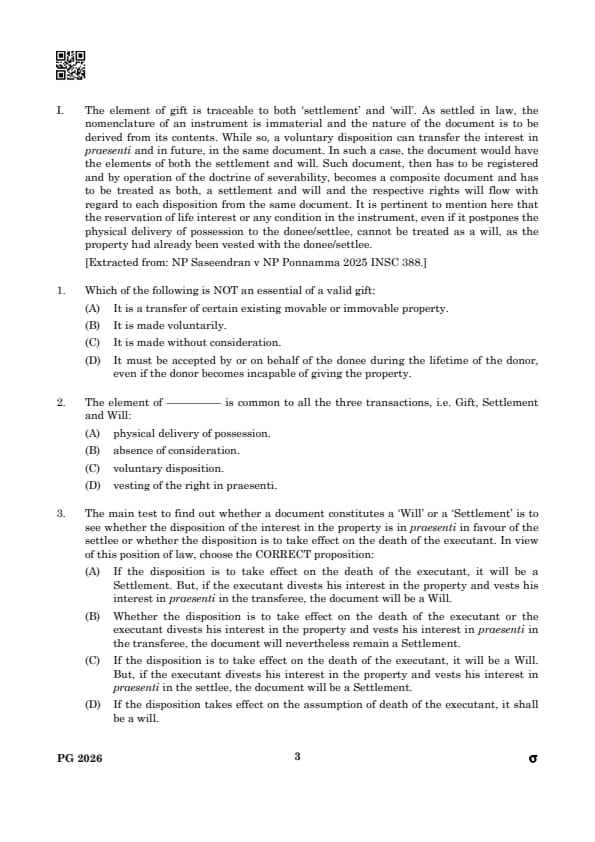
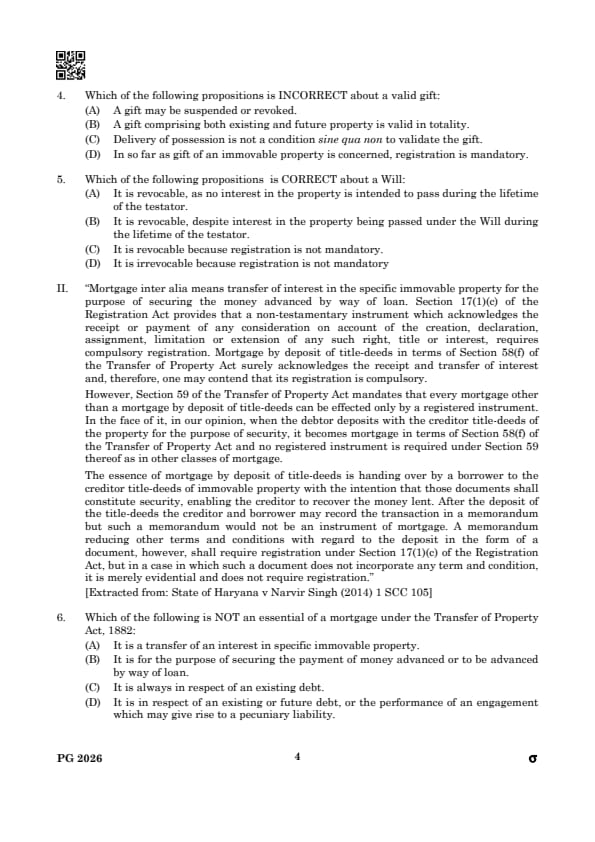
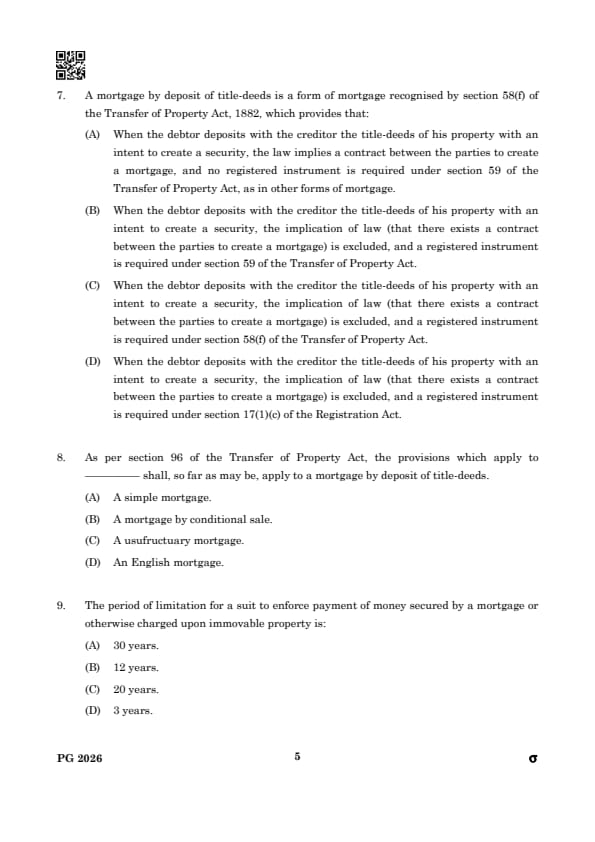
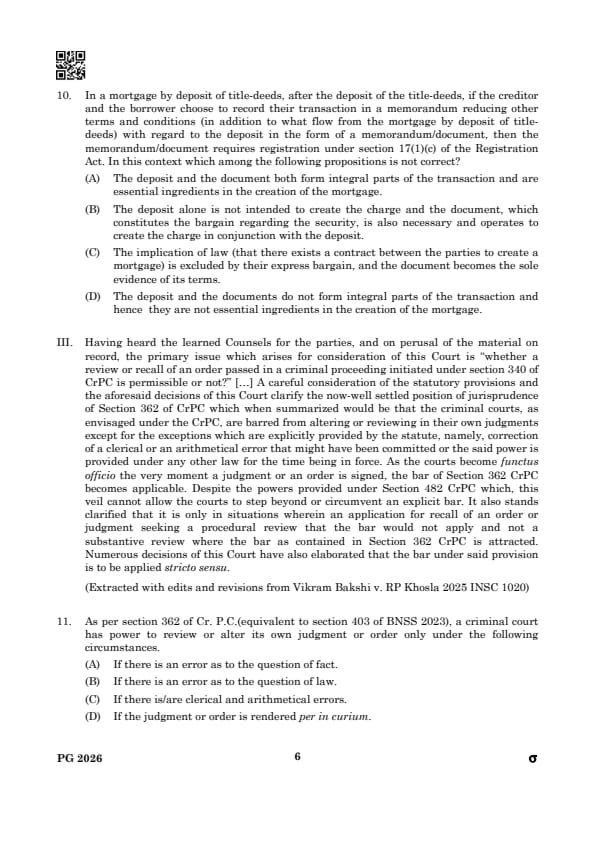
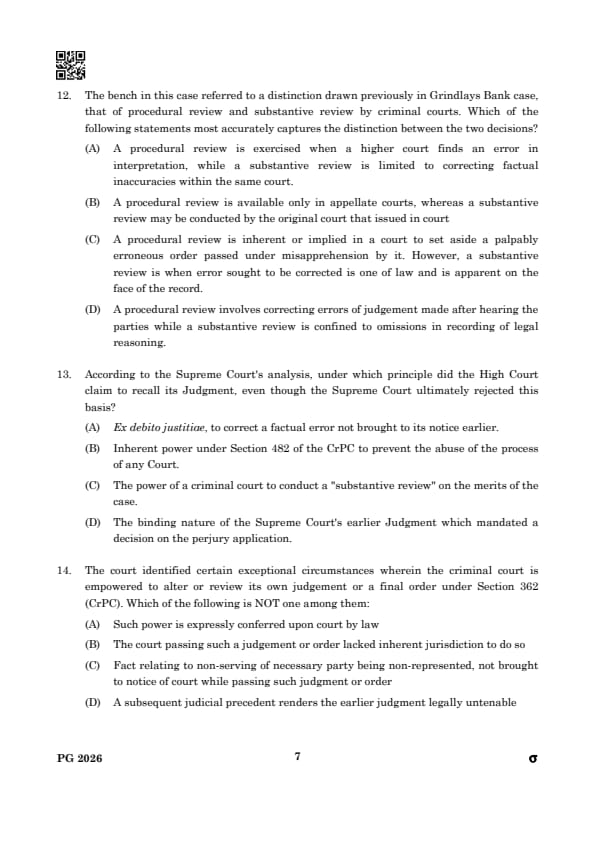
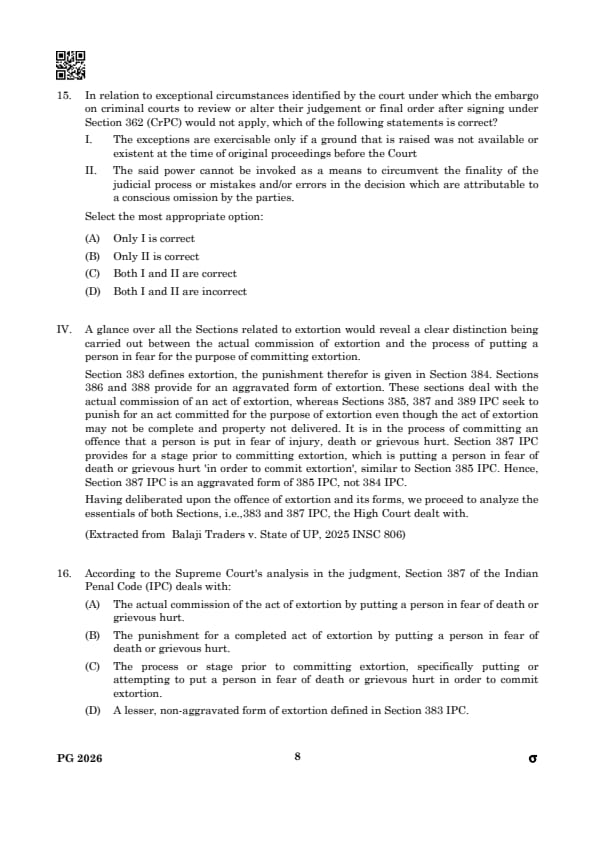
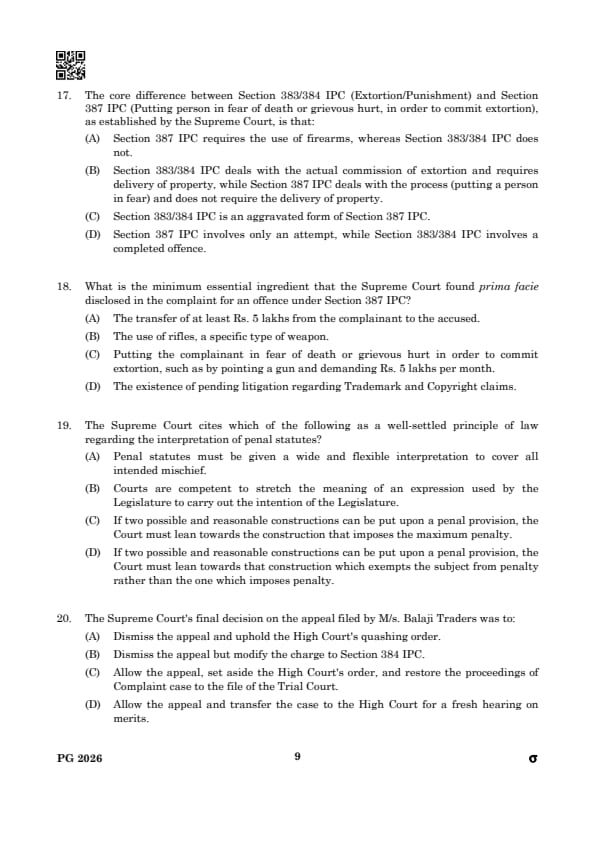
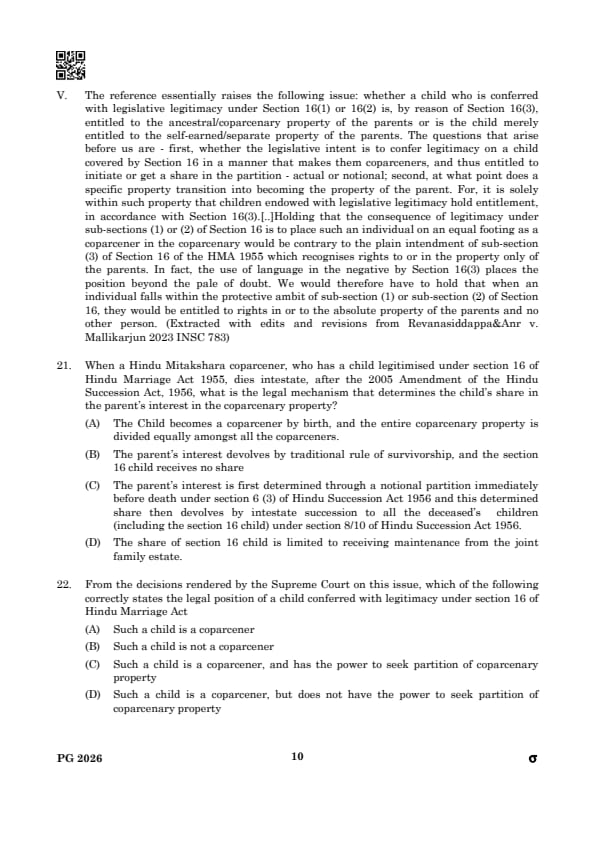
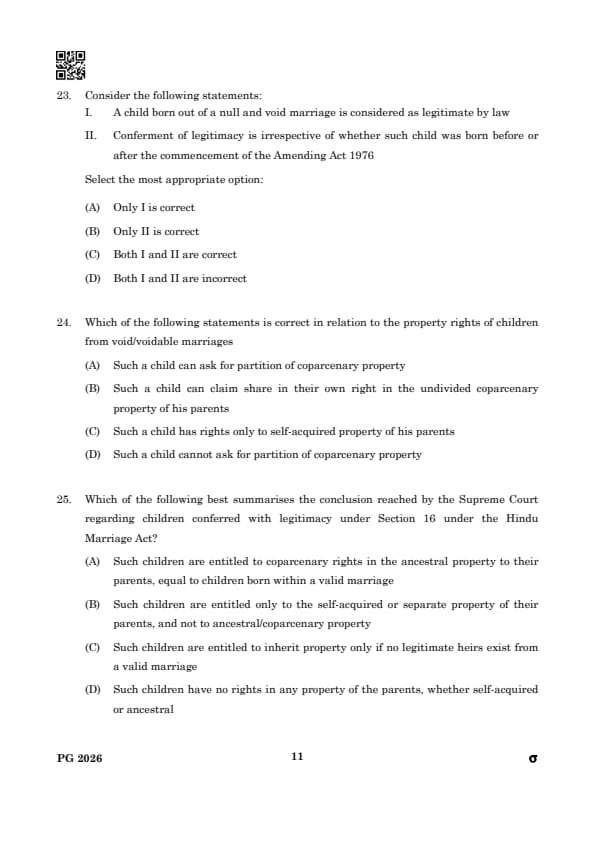
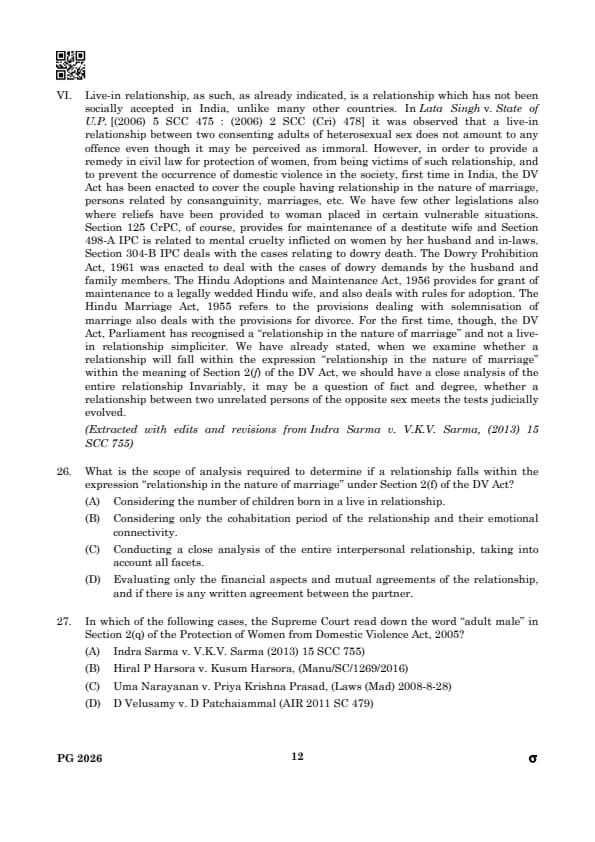
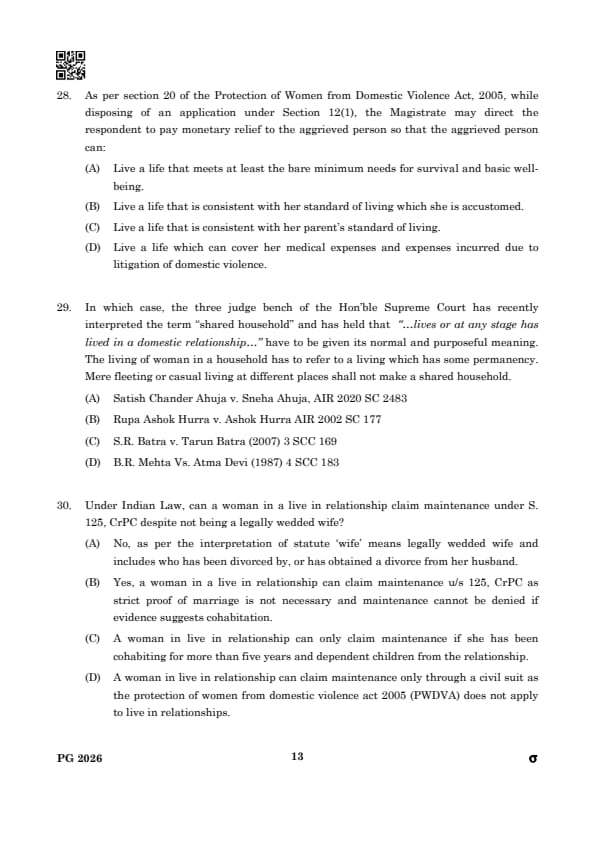
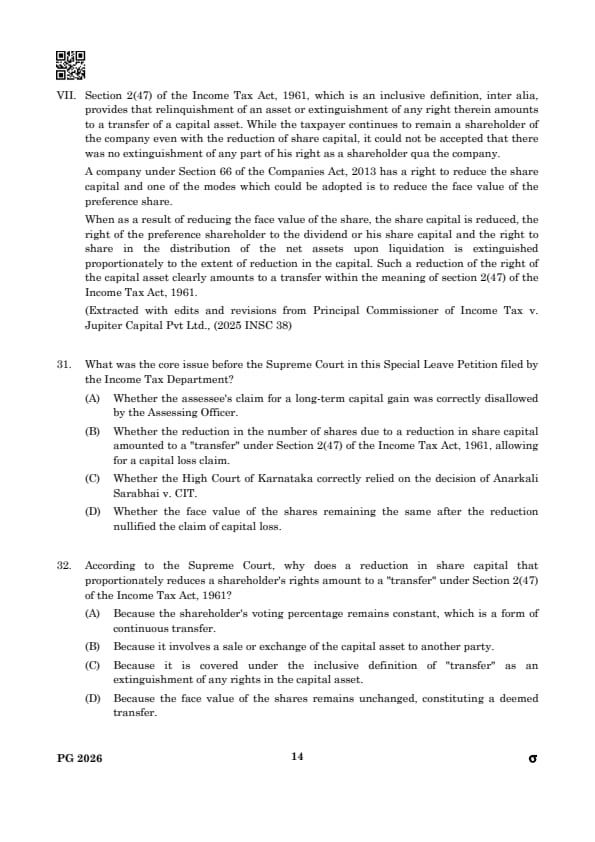
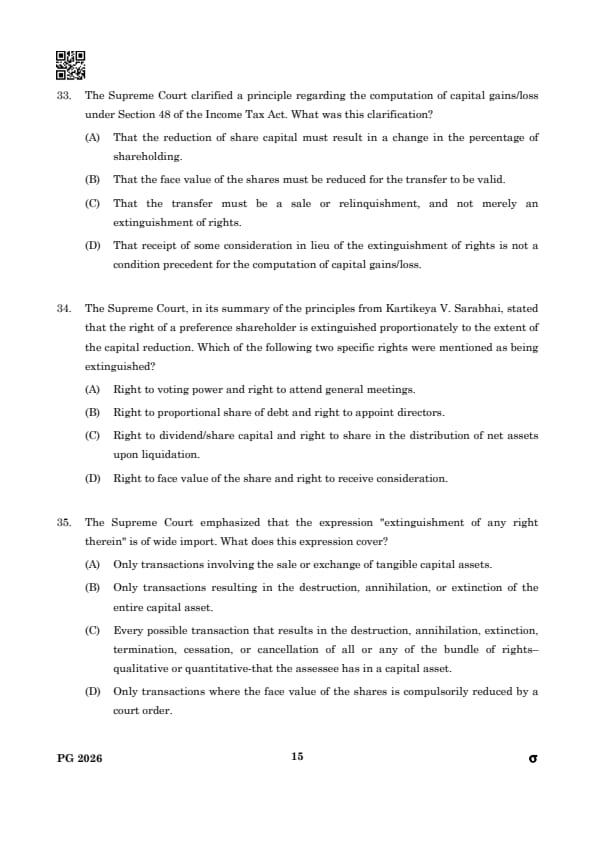
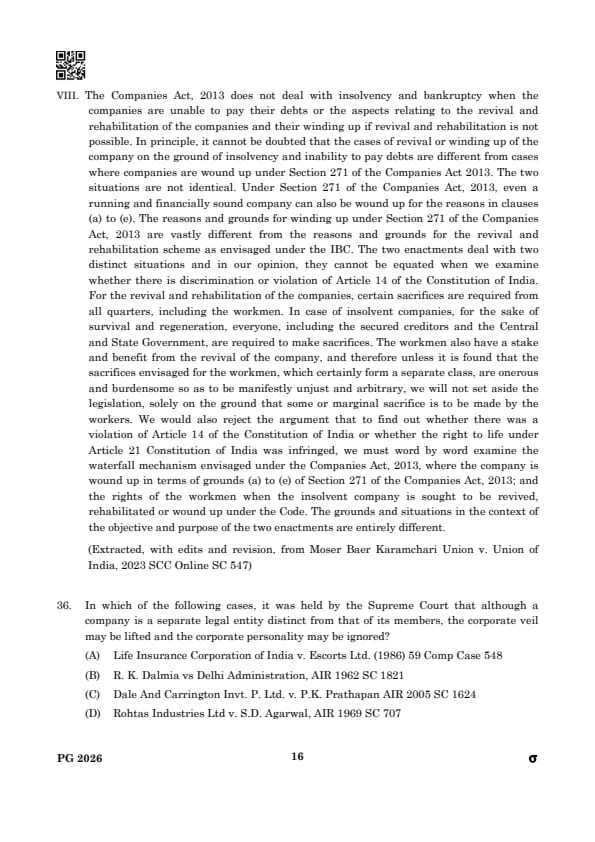
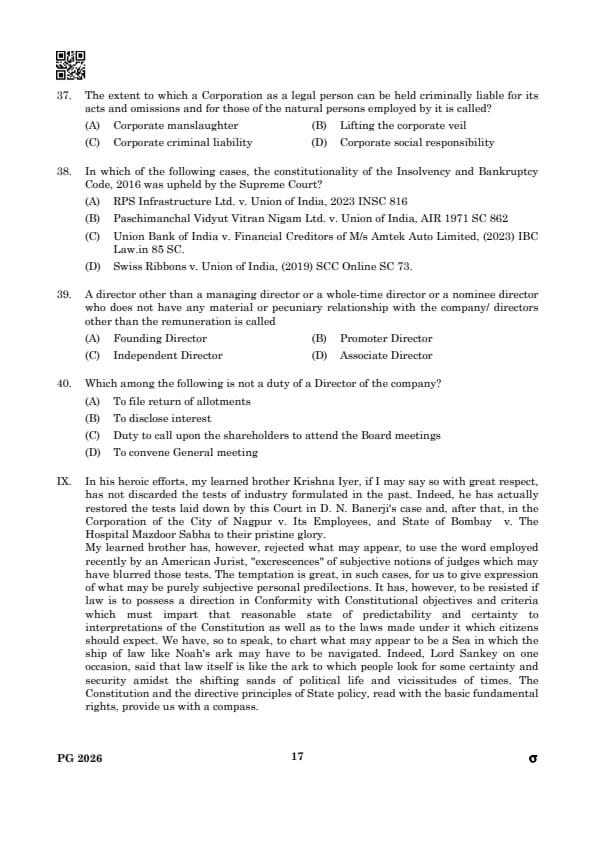
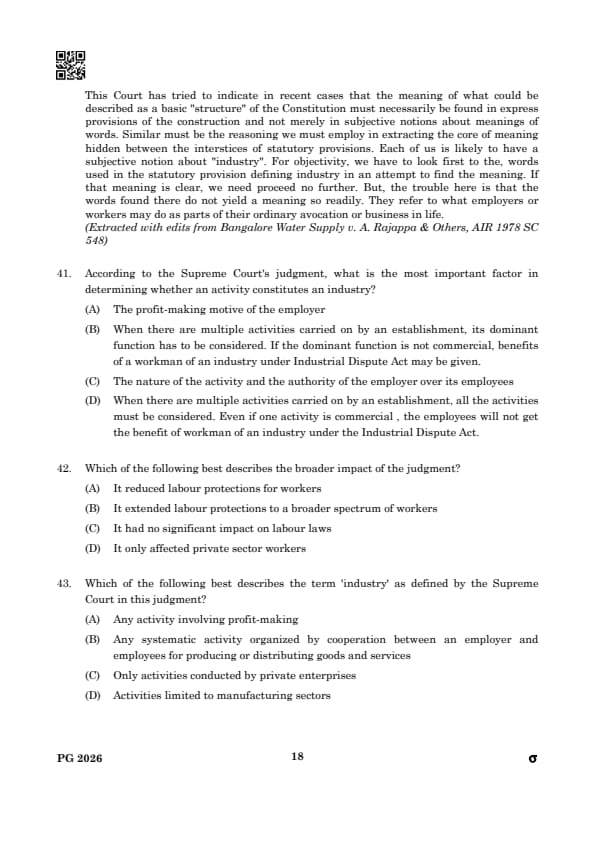
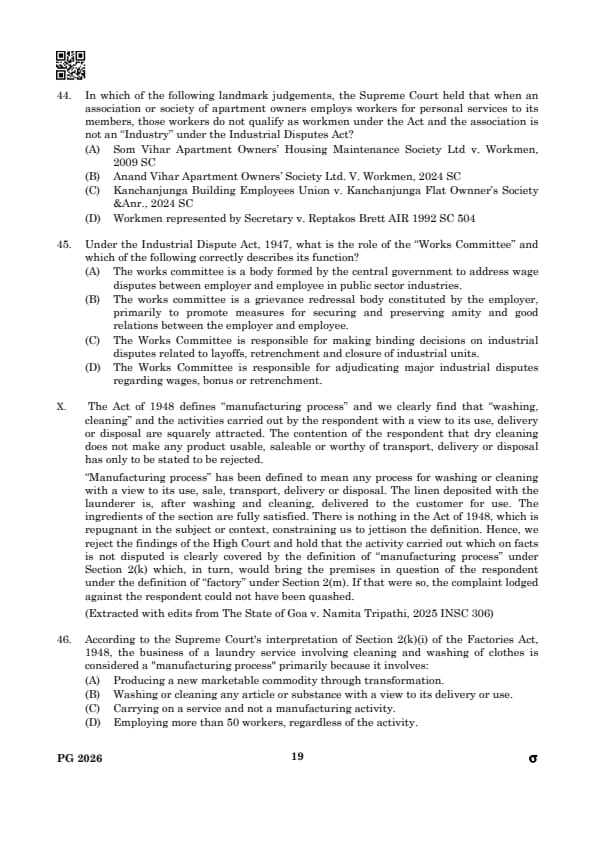
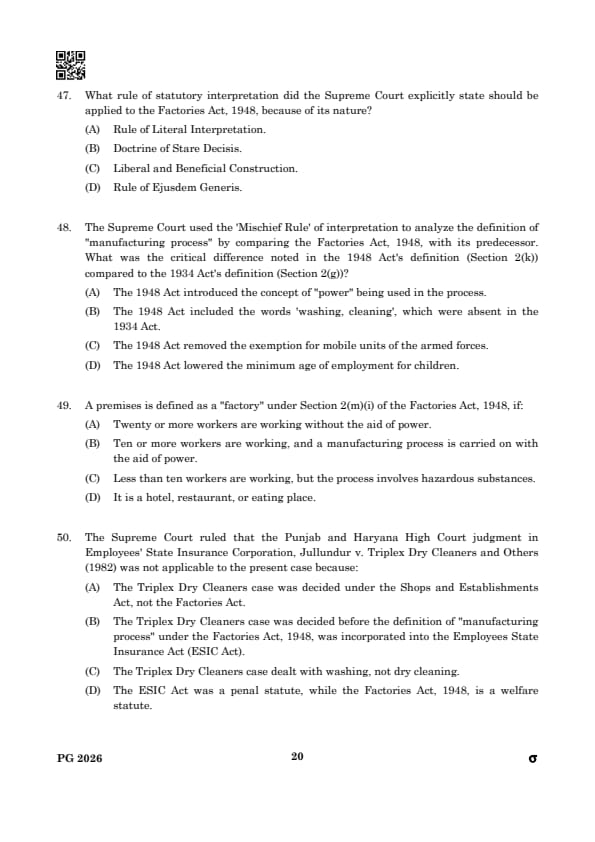
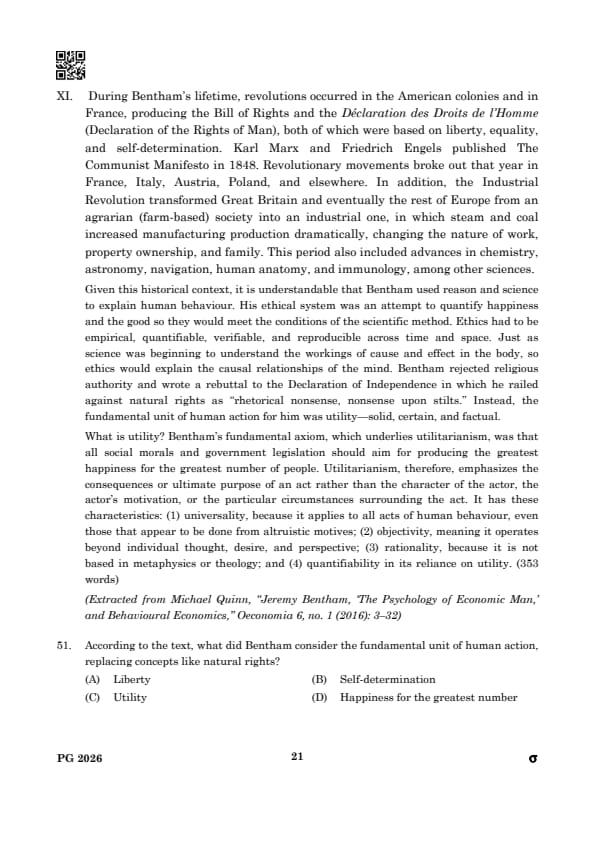
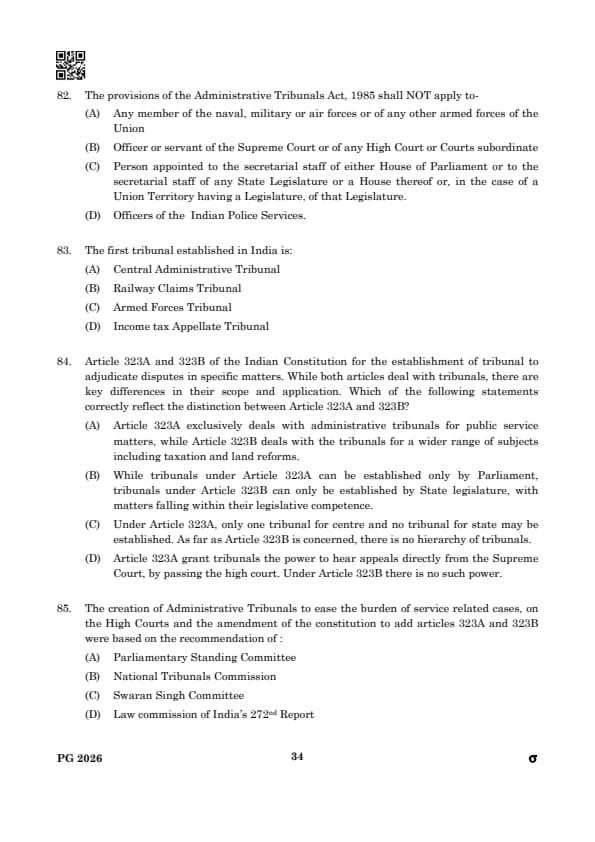
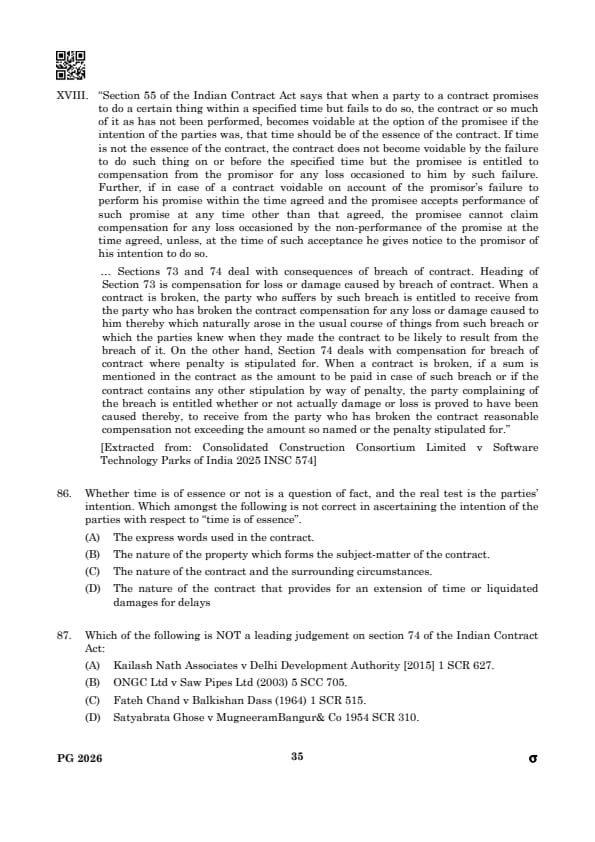
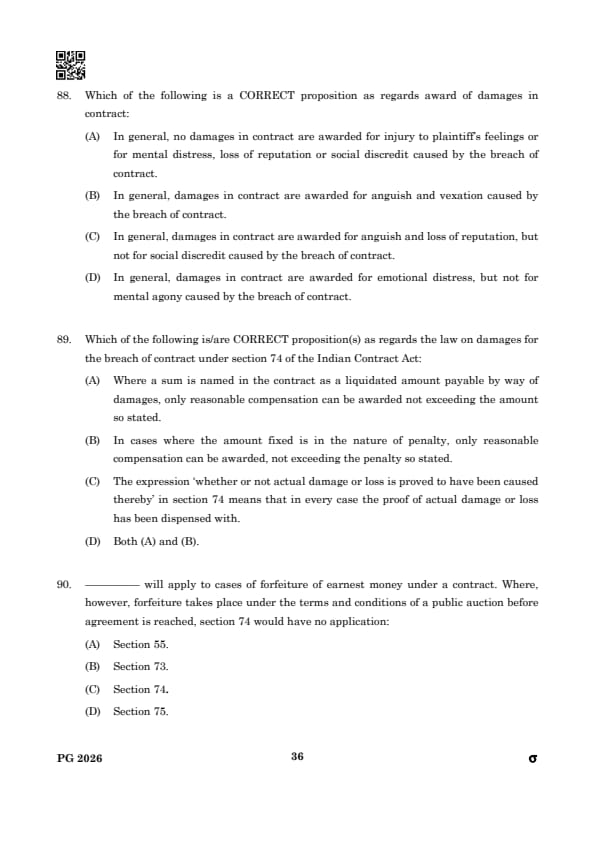
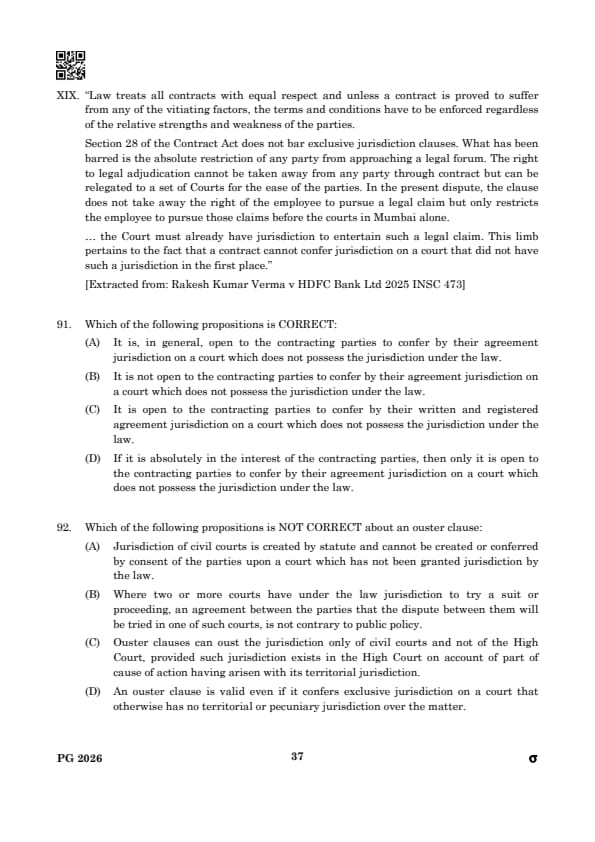
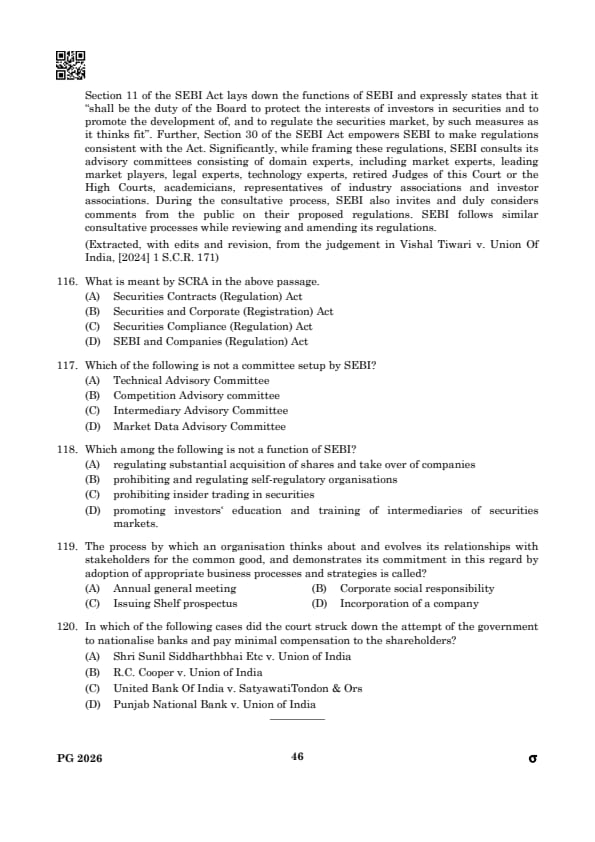


*The article might have information for the previous academic years, please refer the official website of the exam.