
Graduate students are intrigued by the career opportunities that MBA has to offer. If you want to build a career in the areas of marketing, management, business, or entrepreneurship, without preparing for GMAT, you are at the right place. MBA in Germany without GMAT is a 2 year course provided by top public German universities under various specializations. GMAC - the Graduate Management Admission Test — is a required prerequisite for admission to top MBA colleges worldwide. However, many MBA programs in Germany substitute GMAT results with a strong academic record, relevant professional experience, and exceptional LOR and SOP submissions. Hence, if you do not want to prepare for GMAT and want to pursue MBA in Germany without GMAT and work experience, you must excel in all other requirements.
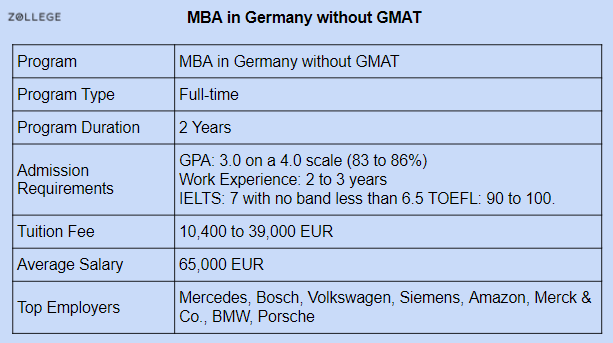
To pursue MBA without work experience, you must have an IELTS score of a minimum 6.5 and a TOEFL minimum score of 90. You must also have an excellent academic record with a GPA of 3 on a scale of 4 or above. Some top universities in Germany also require an experience of 2-3 years or a written test instead of the GMAT scores.
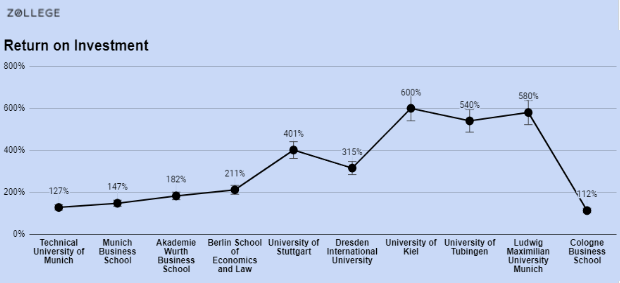
MBA top specializations of MBA are Finance, Entrepreneurship, and Human Resources Management. According to the survey, around 69.2% of international students prefer to remain in Germany after graduation. Many universities offer MBA in Germany without work experience as well. Candidates get an average salary of EUR 67,000 (INR 60,05,002) after pursuing MBA in Germany. Since German universities offer tuition fees at low prices, the return on investment is also higher for free MBA in Germany without GMAT. Some universities like the University of Kiel, University of Tubingen, Ludwig Maximilian University Munich has exceptionally high ROI because they do not charge any tuition fees.
Top Universities for MBA in Germany
Most MBA colleges in Germany without GMAT offer tuition for free. However, there are universities that charges tuition fees for MBA courses. MBA in Germany costs vary from EUR 8,000-39,000 as per different universities. MBA graduates earn a salary range from EUR 40,000 to EUR 90,000 in various jobs in Germany after MBA from India. You can get access to multiple MBA scholarships in Germany while studying at these universities.
| University Name | MBA Specialization | Annual Tuition Fees |
| Technical University of Munich | Executive MBA | EUR 39,000 |
| Munich Business School | Full Time MBA | 32,000 Euro |
| Akademie Wurth Business School | MBA | EUR 24.200 |
| Berlin School of Economics and Law | Full Time MBA | EUR 19,900 |
| University of Stuttgart’ | Master’s in Business Administration | EUR 1500 / semester |
| Dresden International University | Logistics Management (MBA) | 11004 euros |
| University of Kiel | Master of Science in Business Administration | No tuition fee |
| University of Tubingen | Master of Science in International Business | No tuition fee |
| Ludwig Maximilian University Munich | MBA | No Tuition Fees |
| Cologne Business School | MBA | EUR 47,000 |
Application Fees and Deadlines
You can check MBA in Germany eligibility before applying. Around 85% of international students get employed after pursuing MBA in Germany within 3 months of graduation. The table below will explain the admission deadlines, and you must apply before the deadlines. There are mostly no application fees for admission to Germany MBA without GMAT. You can apply via the university portal directly for MBA admissions.
| University Name | Application Fees | Application Deadline |
| Technical University of Munich | No Application fees | Rolling Admissions |
| Munich Business School | No Application fees | April 30th, 2024 |
| Akademie Wurth Business School | No Application fees | 1st of March 2024 |
| Berlin School of Economics and Law | No Application fees | Winter Semester: 15th May Summer Semester: 15th December |
| University of Stuttgart | No Application fees | Fall Semester: July 15, 2024 Summer Semester: January 15, 2024 |
| Dresden International University | No Application fees | 30 August for the following winter semester, 28 February for the following summer semester |
| University of Kiel | No Application fees | 15th July, 2024 |
| University of Tubingen | No Application fees | 15 March for summer semester 15 September for winter semester. |
| Ludwig Maximilian University Munich | No application Fees | Not yet Declared |
| Cologne Business School | No Application Fees | October 2024 session: 10 June 2024 |
MBA in Germany Score Requirement
Checking the deadlines is the first step for admission to Germany MBA colleges without GMAT. You also need to take English language proficiency test scores like IELTS, TOEFL, PTE or Duolingo. You must remember to check exams to study in Germany which the university is accepting. If the course is taught in German, only then the German language score is required. The best MBA colleges in Germany without GMAT and their score requirements are:
| University Name | ELP score Requirement | German Language Requirement |
| Technical University of Munich | IELTS: 6.5 TOEFL: 88 PTE overall score of at least 65 |
DSH passed with an overall result of at least DSH-2 TestDaF Level 4 |
| Munich Business School | TOEFL score of 85 IELTS min. level of 6.5 Duolingo English Test: Overall Score 115 or higher Pearson PTE Academic: Overall Score 56 |
NA |
| Berlin School of Economics and Law | TOEFL: 79 points IELTS: 6.5 points |
NA |
| University of Stuttgart | TOEFL IBT 80 points IELTS band 6.5 or better |
NA |
| Dresden International University | IELTS score 6.0 PTE 58 TOEFL 79 iBT |
NA |
| University of Kiel | IELTS: overall score of 6.5 TOEFL score of 90 |
NA |
| University of Tubingen | IELTS: 6.5 or more. TOEFL iBT: 79 |
NA |
| Ludwig Maximilian University Munich | TOEFL score 100 | NA |
| Cologne Business School | TOEFL score of at least 92 IELTS at least band 6.5 |
NA |
Documents Required
Since you will not be taking the GMAT, the university will ask for work experience or a written test before taking admission. Also, a strong previous academic performance must be displayed. The documents required for admission to universities in Germany for MBA without GMAT are:
- Two to three years of work experience.
- Bachelor’s degree from a recognized university or educational institution.
- Scores in English language proficiency tests like TOEFL or IELTS.
- GPA of 3.0 or higher in the Bachelor’s degree course.
- LOR (Letter of Recommendation).
- SOP (Statement of Purpose).
- CV or Resume.
- Written Essay or Video
MBA in Germany Cost of Living
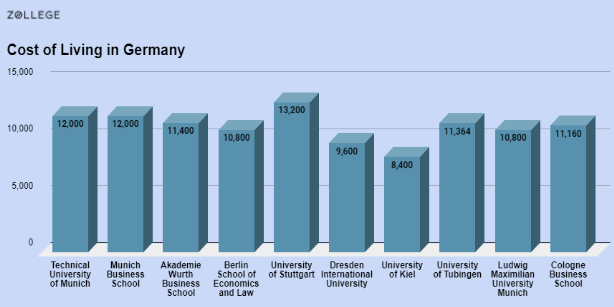
The Cost of living in Germany does not depend on the program that you opt for. It depends on your lifestyle and the place you are staying. Some places in Germany are costlier than others. Hence, the cost of living becomes more. The estimated cost of living in Germany is around € 1000 depending on the type of expense and your lifestyle. Germany is a great place to live with its great history, picturesque landscapes, and vibrant culture. Your cost of living will include accommodation, food and groceries, personal expenses and transport.
Scholarships for MBA without GMAT
Germany not only provides tuition at a very low cost but also helps students financially with scholarships. There are three types of scholarships that you can opt for in Germany. They are university scholarships, government-funded scholarships and outside scholarships. You also get a scholarship for an Executive MBA in Germany without GMAT. The list of scholarships in Germany for international students are:
| University Name | Scholarship Name | Scholarship Eligibility | Scholarship Amount |
| Technical University of Munich | TUM Graduate School Scholarship | Financially backward students | EUR 16,000 |
| Munich Business School | BAföG | employed for 5 years after age 18, or to have been employed for 3 years after a 3-year vocational training | 752 euros |
| Akademie Wurth Business School | DAAD Scholarships | International students with excellent academic records | Fully funded |
| Berlin School of Economics and Law | Deutschlandstipendium | talented and high-achieving students | 300 euros per month |
| University of Stuttgart | Beihilfe | Currently enrolled in at least their third or fourth semester (Bachelor's or Master’s degree) find themselves in a temporary situation of financial emergency | Depends on the emergency |
| Dresden International University | DAAD Study Scholarships | Must have completed bachelor’s or diploma degree at the latest by the time the funding period begins. | Fully funded |
| University of Kiel | Kiel University scholarships to study in Europe, Asia and North America | Required to participate in events where the scholarship will be discussed | Varies |
| University of Tubingen | Deutschlandstipendium | talented and high-achieving students | 300 euros per month |
| Ludwig Maximilian University Munich | SIST LMU Study Scholarship | academic excellence, demonstrable knowledge in the applicant’s field of study, and financial need. | Varies |
| Cologne Business School | Cologne Business School - CBS Scholarships | highly motivated international applicants A motivation letter explaining why CBS should sponsor you | EUR 3000 |
Jobs after MBA in Germany
You can opt for part-time jobs in Germany while looking for MBA jobs in Germany. It is not very difficult to get a job after doing an MBA in Germany. Most students land a job within 3 months of completing their MBA. The average salary is EUR 65,000.
| Job Titles | Average Salary |
| MBA Finance jobs in Germany: Investment banker, Budget Analyst, Financial Analyst, Portfolio Manager, Corporate Finance Manager | EUR 70,000 |
| MBA Marketing jobs in Germany: Marketing Officer, Marketing Strategist, Digital Marketing Manager, Product Manager | EUR 52,000 |
| MBA Business Analytics Jobs in Germany: Data Scientist, BI Analyst, Marketing Analyst, Financial Analyst, Risk Analyst, Management Consultant | EUR 62,000 |
| MBA Entrepreneurship Jobs in Germany: Founder, Product Manager, Dev Manager, VC Associate | EUR 71,000 |
| MBA HR jobs in Germany: Human Resource Manager, Employee Relations Manager, Executive Recruiter etc. | EUR 50,872 |
Top Recruiters for MBA in Germany
Germany is a country where most global leaders have set up their headquarters. Most companies hire students after completing their MBA degree. If you want to boost your career, MBA in Germany is the perfect degree for you. The salary also increases if you have completed your MBA.
- Accenture
- KPMG
- BMW
- Volkswagon
- Delloite
- Bosch
- Siemens
- Hays
Work Permit in Germany
Students seeking work permit visa in Germany after MBA need first apply for a work visa after completion of their degree. Applicants need to also have a specific job offer from an employer in Germany. A residence permit in Germany like the EU Blue Card is given for 4 years. You will be given a residence permit for the duration of your work contract plus three extra months if it is shorter than that. Applicants need to show an annual gross salary of EUR 56,400 (INR 5090494.80) per year to secure the residence permit.
FAQs
Ques: Can I study MBA in Germany without GMAT?
Ans: Yes, you can study MBA in Germany without GMAT. you must have to achieve a good academic record with a high undergraduate score. Having a GPA score of 3 to 3.5 will be recommended to take up an MBA college without GMAT
Ques: Is MBA free of cost in Germany?
Ans: The public universities in Germany for MBA do not require any tuition fee for admission to MBA in Germany. Instead, students need to pay a semester fee between 200 and 1,400 EUR
Ques: Which country is best for MBA without GMAT?
Ans: For international students seeking MBA programs without the GMAT requirement, several countries like the USA, Canada, the UK, and Australia offer excellent options. If you are looking for a cheaper MBA without GMAT, Germany is the best country.
Ques: Can I study MBA without GMAT?
Ans: Yes, you can study MBA without GMAt offered by various universities. Also, you need to have great academic records and work experience.
Ques: Can an Indian do an MBA in Germany for free?
Ans: Students have to pay only the semester fee of around 200-500 Euros per semester. For Indian students, there is no fee charged for studying MBA in Germany. Germany is the only country that provides free education to international students.
Ques: Is it easy to do an MBA in Germany?
Ans: No, it is not easy to do an MBA in Germany. Diverse entry criteria, dual enrollment, part-time jobs, and excellent infrastructure make Germany an appealing MBA destination.
Ques: Can a poor student crack GMAT?
Ans: An average student can easily crack the GMAT exam with a planned preparation, dedication, and practice. The key to score well on the GMAT exam is to develop a comprehensive study plan, understand the GMAT pattern and the GMAT exam syllabus
Ques: Which country MBA is most valued?
Ans: MBA has its roots in the United States, and the country's Harvard University Graduate School of Administration (now known as Harvard Business School) first introduced MBA in 1908. Since then, the country has been the first choice for many aspiring MBA students.
Ques: Is GMAT required for MBA programs in Germany?
Ans: No, many MBA programs in Germany do not require GMAT scores for admission. However, some may have their own admission tests or criteria.
Ques: What are the typical admission requirements for MBA programs in Germany?
Ans: Admission requirements often include a bachelor's degree, relevant work experience, language proficiency (usually in English), and sometimes a strong academic record or other standardized tests.
Ques: Are there any English-taught MBA programs available in Germany?
Ans: Yes, there are numerous MBA programs taught entirely in English at various universities and business schools across Germany.
Ques: How long does it take to complete an MBA in Germany?
Ans: The duration of MBA programs in Germany typically ranges from 12 to 24 months, depending on the program structure and whether it's full-time or part-time.
Ques: What is the cost of studying for an MBA in Germany?
Ans: The cost varies depending on the institution and program. However, compared to MBA programs in some other countries, Germany generally offers more affordable options, with tuition fees ranging from €10,000 to €30,000 on average.
Ques: Can international students work while studying for an MBA in Germany?
Ans: Yes, international students are allowed to work part-time for up to 20 hours per week during their studies and full-time during semester breaks.
Ques: Are there scholarships available for MBA students in Germany?
Ans: Yes, there are various scholarships offered by universities, government bodies, and private organizations to support MBA students, both domestic and international.
Ques: What are the career prospects for MBA graduates in Germany?
Ans: Germany has a strong economy and a high demand for skilled professionals, offering ample career opportunities for MBA graduates in various sectors such as finance, consulting, technology, and manufacturing.
Ques: Can I apply for a student visa for Germany to pursue an MBA?
Ans: Yes, once you receive admission to an MBA program in Germany, you can apply for a student visa, which typically requires proof of acceptance, financial means, and health insurance.
Ques: Are there any specific language requirements for international students applying to MBA programs in Germany?
Ans: Most MBA programs in Germany are taught in English, so proficiency in English (usually demonstrated through tests like TOEFL or IELTS) is typically required. However, some programs may also require basic knowledge of the German language, especially for interaction outside the classroom.

![Humboldt University of Berlin [HU]](https://static.zollege.in/public/college_data/images/studyabroad/logos/college_632_29-15:02_6.png?tr=w-50,h-50,c-force?tr=h-40,w-35,c-force)
![Technical University Munich [TUM]](https://static.zollege.in/public/college_data/images/studyabroad/logos/college_691_02-13:08_691.png?tr=w-50,h-50,c-force?tr=h-40,w-35,c-force)
![Ludwig Maximilian University of Munich [LMU]](https://static.zollege.in/public/college_data/images/studyabroad/logos/college_690_02-13:05_690.png?tr=w-50,h-50,c-force?tr=h-40,w-35,c-force)
![Free University of Berlin [FU]](https://static.zollege.in/public/college_data/images/studyabroad/logos/college_631_29-15:01_5.png?tr=w-50,h-50,c-force?tr=h-40,w-35,c-force)
.png?tr=w-50,h-50,c-force?tr=h-40,w-35,c-force)


