
Eligibility Criteria for NMAT 2026- Check Age Limit, Graduation Marks, Attempt Limit


| Updated On - Jul 29, 2026
NMAT eligibility criteria are released by GMAC on the official website. It includes the qualifying examination, marks requirement, limit on attempts, and gap between consecutive attempts.
-
There is no age limit criterion for appearing for the NMAT 2026 examination.
- Students must have completed a 3 or 4-year bachelor's degree from any recognized university.
- Students must have secured at least 50% marks in the qualifying examination.
Read More:
Key Summary:
|
|---|
NMAT Eligibility Criteria 2026-Overview
Students must meet the below-listed eligibility requirements to apply for the NMAT 2026 examination.
- Bachelor's degree in any discipline from any recognized university.
- 50% marks in the qualifying examination.
- Maximum of 3 attempts with a minimum of 15 days' gap between consecutive attempts.
Students who are in their final year of a bachelor's degree are also eligible to apply for the NMAT 2026 examination.
| Criteria | Requirement |
|---|---|
| Qualification | Bachelor’s degree in any discipline from a recognized university. |
| Minimum Marks | 50% aggregate in graduation. |
| Age Limit | No upper age limit. |
| Attempts | Up to 3 attempts per year (1 main + 2 retakes). |
| Gap Period | Mandatory 15-day gap between attempts. |
| Final-Year Students | Eligible to apply (subject to meeting institute admission deadlines). |
| Work Experience | Optional |
NMAT Eligibility Criteria 2026: Age Limit
GMAC has not mentioned any age limit as NMAT eligibility criteria 2026. Thus, there is no upper or lower age limit.
- Any student meeting the NMAT eligibility criteria 2026 with an educational qualification can apply.
- Some institutes accepting the NMAT score have age-specific preference as per the NMAT eligibility criteria 2026 for specific courses.
- If you opt for any program, check for the NMAT eligibility criteria 2026 for age, if any, on the institute page.
NMAT Eligibility Criteria 2026: Educational Qualification
Here are the educational NMAT eligibility criteria 2026 for Students who have completed their graduation and those who haven't yet.
- The NMAT eligibility criteria 2026 stand true for 3-year and 4-year graduation degrees.
- Foreign universities degree shuld be verified against the Indian university standard for NMAT eligibility criteria 2026.
| Criteria | Key Rule |
|---|---|
| Degree Duration | Both 3-year and 4-year bachelor’s degrees are eligible. |
| Foreign Degrees | Requires an AIU Equivalence Certificate for verification of Indian university standards. |
NMAT Eligibility Criteria 2026 For Final year students
- The NMAT eligibility criteria 2026 for female students require completion of the degree before the commencement of the programme
- 50% aggregate marks are set as the NMAT eligibility criteria 2026 for final-year students as well.
- You have to submit your final marks before the deadline mentioned in the offer letter of your chosen institute.
NMAT Eligibility Criteria 2026: Percentage of marks
The NMAT eligibility criteria 2026 are simple, with 50% marks in the entire degree and not individual subjects.
- A low score does not disqualify you as long as you meet the NMAT eligibility criteria 2026.
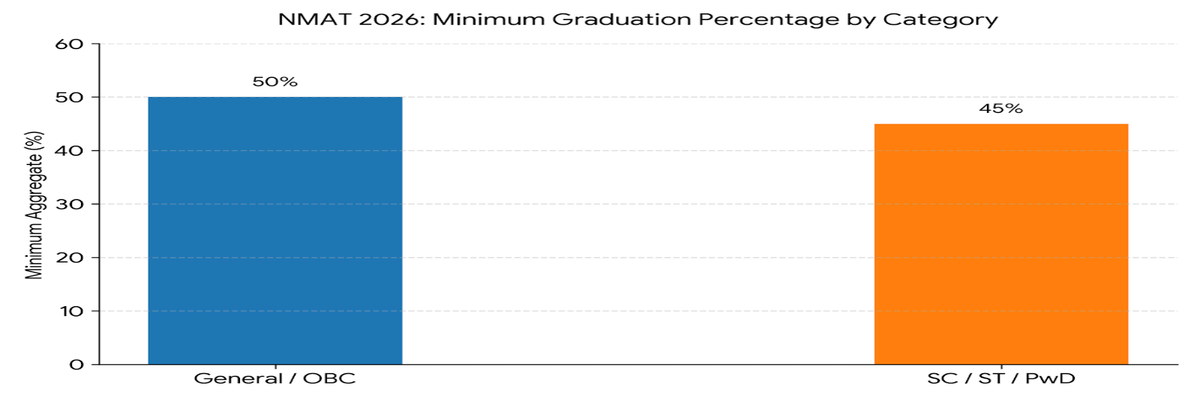
- The NMAT eligibility criteria 2026 for the reserved category require 45% for the degree.
| Category | Minimum Graduation Percentage |
|---|---|
| General / OBC | 50% aggregate |
| SC / ST / PwD | 45% aggregate |
NMAT Eligibility Criteria 2026-Registeration Fee
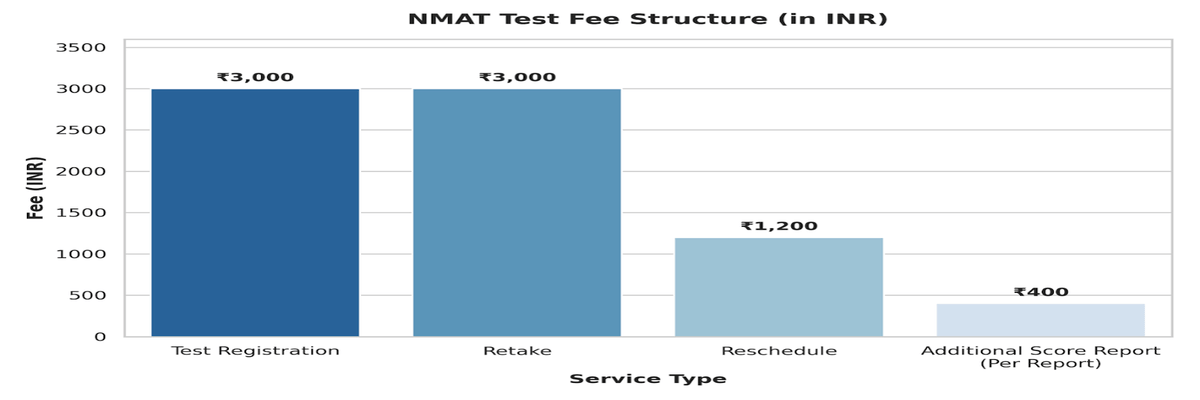
The NMAT registration fee is 3000 + applicable taxes and is the same for retaking the exam. In case you want to reschedule the date of your examination, the charge is ₹1,200 + applicable taxes.
| Service | Fee (INR) |
| Test Registration | ₹3,000 + applicable taxes |
| Retake | ₹3,000 + applicable taxes |
| Additional Score Reports (Beyond first five) | ₹400 per Score Report + applicable taxes |
| Reschedule | ₹1,200 + applicable taxes |
Source- YouTube
NMAT Eligibility Criteria 2026- Policy of Exam
Based on the NMAT eligibility criteria 2026, you will be able to give the exam 3 times in a year.
- The gap between exams based on the NMAT eligibility criteria 2026 should be a minimum of 15 days.
- Every retake will have a separate set of questions, and you can choose which score to send to the institutes.

Source: Official Site
NMAT Eligibility Criteria 2026 FAQs
Ques. Is 50% mandatory in graduation for NMAT?
Ans. A 50% score is actually not mandatory to register but is needed for getting into top colleges accepting NMAT. There is no such rigid rule for this. Some reserved categories will have 45% as a requirement for applying and getting admission. You can apply even if you are a final-year student but meet the final percentage criteria to secure your admission in the respective college.
Ques. Which graduation streams are eligible for NMAT?
Ans. Any graduation stream is eligible for NMAT. It can be Arts, Commerce, and Engineering as well, and any courses. The only minimum criteria is to have a bachelor's degree. The criteria are either 50% or 45% for some reserved institutions. The degree should only follow either 10+2+3 or 10+2+4 exam pattern. There is no restriction on stream, but specific institutes may need to have some specific background before applying.
Ques. Is a specific degree required to appear for NMAT?
Ans. There is no specific degree needed to register for NMAT. Candidates can hold any degree in any stream to be eligible for NMAT. The only minimum criteria is to have a bachelor's degree. It should be 50% aggregate marks or 45% for some, with provisional eligibility for final-year students. It should be either a 3- or 4-year bachelor's program and not a diploma-holder program.
Ques. Can diploma holders apply for NMAT?
Ans. No, you cannot apply if you have a diploma. The NMAT 2026 requires a full-time bachelor's degree and will not take students with an undergraduate degree. You must have a Bachelor's degree from a recognised board with a 10+2+3 or 10+2+4 exam pattern. There is no restriction on stream, but you won't be eligible with a diploma.
Ques. What is the minimum duration of graduation required for NMAT eligibility?
Ans. The minimum eligibility is to have a bachelor's degree of 3 or 4 years. You must have a Bachelor's degree from a recognised board that follows the 10+2+3 or 10+2+4 exam pattern. It will be 50% aggregate marks and 45% for reserved or specific institutes. If a final-year student, then they have to complete the course and submit their degree before the deadline of respective institutes.
Ques. What is the maximum number of attempts allowed in NMAT?
Ans. The maximum number of attempts is 3 per year. This will include 1 main exam and 2 retakes in a single year for a single candidate. You will have to take a test to qualify. The gap between the retakes should be a minimum of 15 days. If you register and do not appear or take the exam or will count as an official attempt.
Ques. Can I retake NMAT if I am not satisfied with my score?
Ans. Yes, you can take the NMAT again if you aren't satisfied with the score. The registration fee for the retake will be applicable, and the gap between the retakes should be a minimum of 15 days. There will be a maximum of 3 attempts in a single year for a single candidate. No show will count as a used attempt. You can choose the score you like to share with the institutes.
Ques. Is there a gap required between two NMAT attempts?
Ans. The gap between the retakes or 2 consecutive attempts should be a minimum 15 days. If you register and do not appear or take the exam or will count as an official attempt. There will be a maximum of 3 attempts in a single year for a single candidate. No show will count as a used attempt. You can choose the score you like to share with the institutes.
Ques. Is work experience required for NMAT eligibility?
Ans. CAT 2026 requires a minimum bachelor's degree to apply, and thus no work experience is needed. All freshmen and last-year students can apply provided they meet the eligibility criteria. However, if you have work experience, you will be required to put in the details. But this is definitely not mandatory for all. This work experience is not mandatory.
Ques. Can working professionals apply for NMAT?
Ans. Yes, working professionals can also apply for NMAT 2026. There is no age limit for application. Prior experience is not mandatory, but some institutes may also accept professional knowledge and exposure. The registration process requires a minimum bachelor's degree to apply, and thus no work experience is mandatory. All freshmen and last-year students can apply provided they meet the eligibility criteria.
Ques. What happens if I don't meet the eligibility criteria after clearing NMAT?
Ans. As the eligibility criteria should be followed, if you don't have the needful, you will be disqualified. The application will not hold true, and the admission offer will be cancelled with no refund policy. The institute will have to revoke the process at the time of final document verification. The seat will be vacant and offered to other candidates in the waiting list meeting the eligibility.
Ques. What documents are required to prove eligibility for NMAT?
Ans. To register and be eligible for NMAT 2026, you will have to have a government ID, a passport-size photograph, and your academic marksheet. You have to hold a bachelor's degree from a recognised board that follows the 10+2+3 or 10+2+4 exam pattern. 50 % aggregate marks are needed for admission, and 45% for the reserved category or specific institutes. Recent passport-size photographs and signatures will be needed during registration itself.
Ques. What is the difference between NMAT and CAT eligibility criteria?
Ans. The eligibility criteria for NMAT and CAT are quite similar. Both will need a bachelor's degree in any stream and have no age limit to follow. The difference lies in the minimum marks needed and the enforcement of institutes. CAT requires 50% marks and 45% for the reserved category, while NMAT requires a bachelor's degree only from a recognised university, with individual institutes accepting via their own set of criteria and marks.
*The article might have information for the previous academic years, please refer the official website of the exam.