
NMAT 2026 Syllabus: Check Syllabus for Language Skills, Quant, Logical Reasoning, Topic-Wise Weightage, Books


Content Curator | Updated On - Sep 1, 2026
NMAT syllabus 2026 is released by GMAC on the official website at mba.com/exam/nmat. As per the official website, NMAT syllabus has 3 sections, including Language Skills, Quantitative Skills, and Logical Reasoning.
- Language Skills section of NMAT 2026 includes topics like Reading Comprehension, Para Forming, Error Identification, Prepositions, Sentence Completion, and Analogies.
- In Logical Reasoning, NMAT 2026 syllabus includes topics such as Critical Reasoning, Analytical Puzzles, Deductions, and Other Reasoning.
- Syllabus for NMAT Quantitative Skills includes topics like Number Properties, Arithmetic, Algebra and Probability, Data Integration Caselets and Tables, Data Integration Graphs and Charts, and Data Sufficiency.
Related Articles:
- NMAT 2026 Topic Wise Weightage for Quantitative Skills
- NMAT 2026 Topic Wise Weightage for Language Skills
- Best Books for NMAT 2026 Preparation

Key Summary
|
NMAT Syllabus 2026- Section-Wise
NMAT syllabus is divided into 3 sections, including Language Skills, Quantitative Skills, and Logical Reasoning. You can check the syllabus for each section of NMAT 2026 below.
NMAT Syllabus for Language Skills
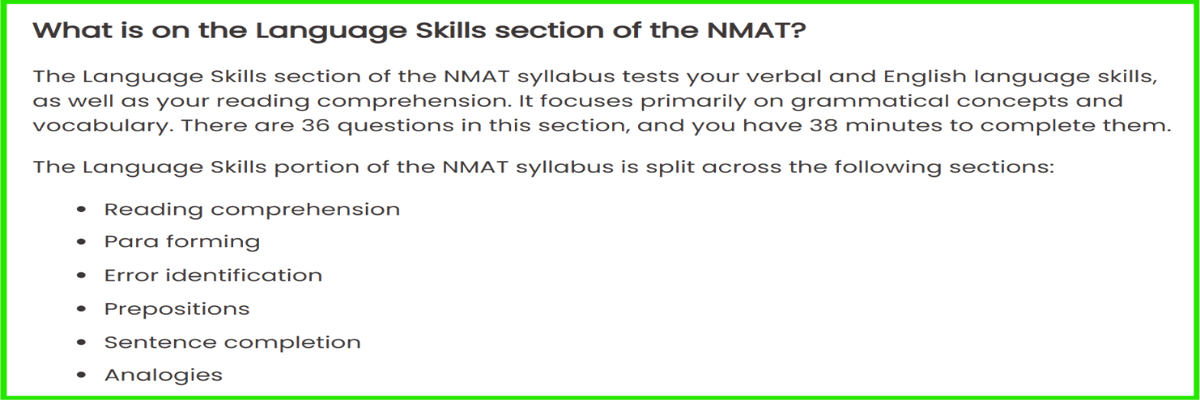
NMAT syllabus for Language Skills tests candidates for verbal and English language skills, and reading comprehension. Questions are asked based on grammatical concepts and vocabulary. A total of 36 questions will be asked from the NMAT Language Skills syllabus and must be solved in 38 minutes.
- Reading comprehension
- Para forming
- Error identification
- Prepositions
- Sentence completion
- Analogies
Source: NMAT by GMAC Official Website
NMAT 2026 Language Skills Books
| Book Name | Author/Publisher |
|---|---|
| Word Power Made Easy | Norman Lewis |
| High School English Grammar & Composition | Wren & Martin |
| Verbal Ability and Reading Comprehension for CAT | Arun Sharma and Meenakshi Upadhyay |
| Objective General English | S.P. Bakshi |
| 30 Days to More Powerful Vocabulary | Norman Lewis |

NMAT Syllabus for Quantitative Skills
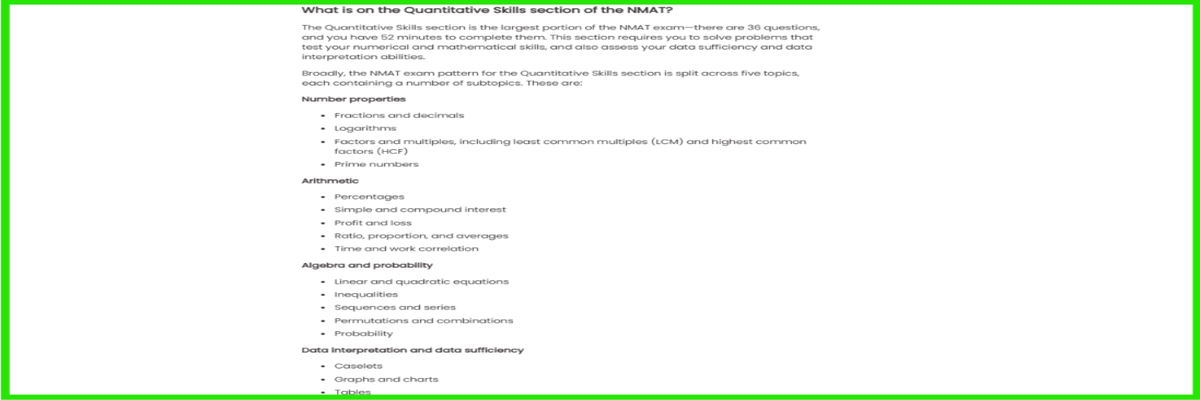
Quantitative Skills section of NMAT 2026 is the largest section, with 36 questions to be answered in 52 minutes.
- NMAT Quantitative Skills section tests students on numerical and mathematical skills.
- The section also tests students ' data sufficiency and data interpretation abilities of students.
- NMAT Quantitative Skills section has 5 chapters, and the syllabus for each chapter is mentioned in the table below.
| Chapter | Topics |
|---|---|
| Number properties |
|
| Arithmetic |
|
| Algebra and probability |
|
| Data interpretation and data sufficiency |
|
Source: NMAT by GMAC Official Website
NMAT 2026 Quantitative Skills Books
| Book Name | Author/Publisher |
|---|---|
| Quantitative Aptitude for Competitive Examinations | R. S. Aggarwal |
| How to Prepare for Data Interpretation for CAT | Arun Sharma |
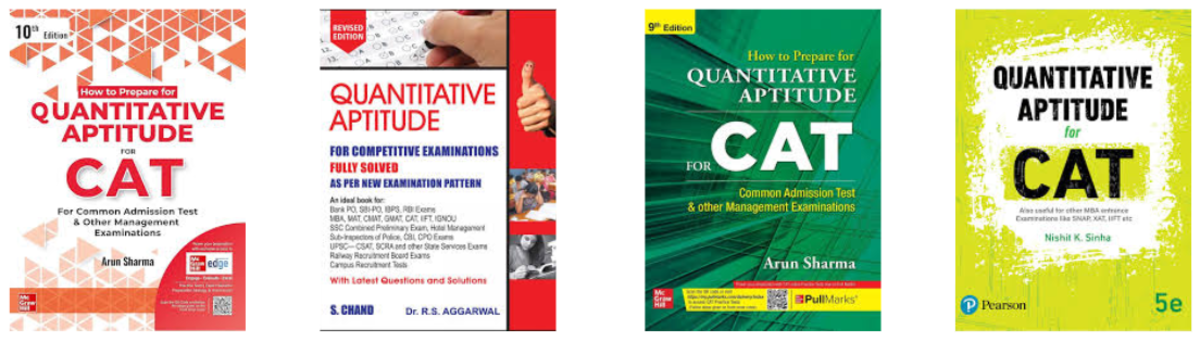
| Quantitative Aptitude for CAT | Arun Sharma |
| Quantitative Aptitude for CAT | Nishit K. Sinha |
| Hitbullseye’s MBA Math- 1 & 2 | Hitbullseye |
NMAT Syllabus for Logical Reasoning
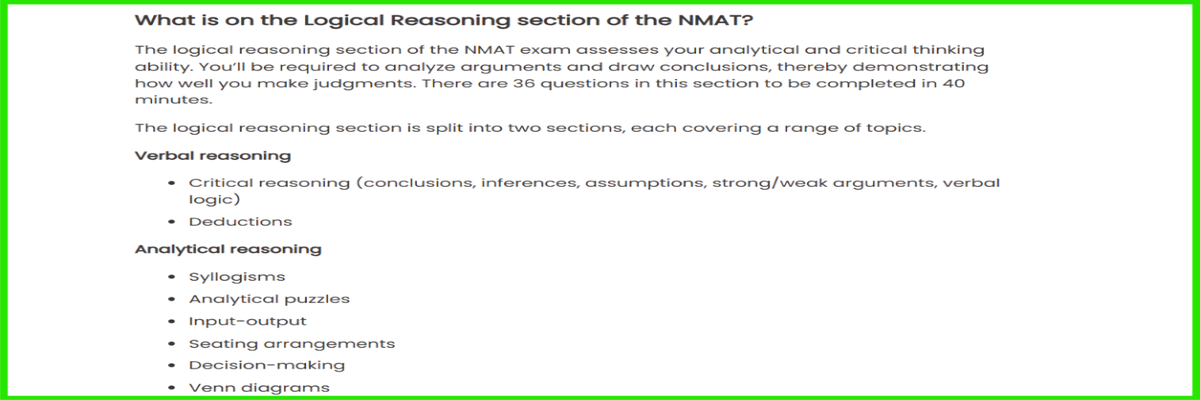
NMAT Logical Reasoning section tests the analytical and critical thinking abilities of students. The section will have 36 questions to be solved in 40 minutes.
- NMAT Logical Reasoning section has two subsections, including Verbal Reasoning and Analytical Reasoning.
- The section requires students to analyze arguments and draw conclusions and demonstrate how well they make logical judgements.
| Chapter | Topics |
|---|---|
| Verbal reasoning |
|
| Analytical reasoning |
|
Source: NMAT by GMAC Official Website
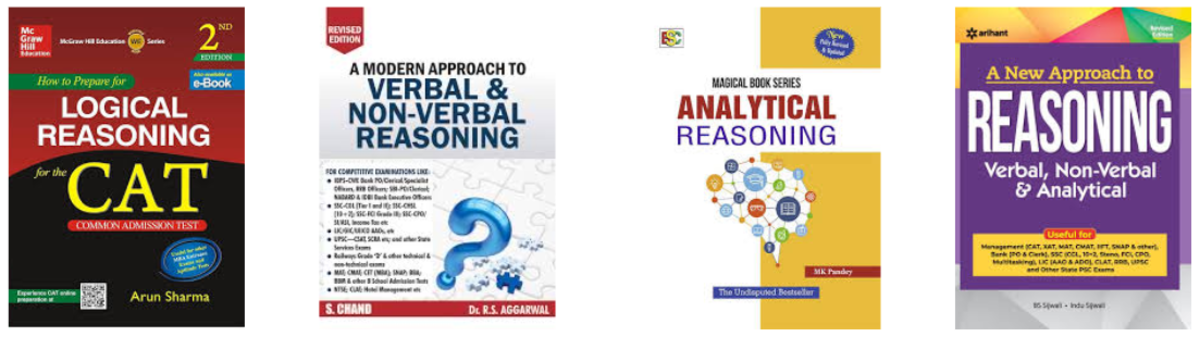
NMAT 2026 Logical Reasoning Books
| Book Name | Author/Publisher |
|---|---|
| A Modern Approach to Verbal & Non-Verbal Reasoning | R. S. Aggarwal |
| Analytical Reasoning | M.K. Pandey |
| Non-Verbal Reasoning | Arihant Publication |
| How to Crack Test of Reasoning | Arihant Experts |
NMAT 2026 Syllabus: Topic-Wise Weightage
“MBA Karo” experts on YouTube shared topic-wise weightage for each section of the NMAT 2026 syllabus. You can go through the tables below to check NMAT 2026 topic-wise weightage for Language Skills, Quantitative Skills, and Logical Reasoning.
NMAT Topic-Wise Weightage for Language Skills
In the NMAT Language Skills section, the highest weightage is given to Reading Comprehension with 8-12 questions.
- From Error Identification and Sentence Completion, students can expect around 6-8 questions each.
- You can expect 5-6 questions from Analogies and 4-6 questions from Para Forming and 3-5 questions from Prepositions.
| Topic | Weightage (Questions) |
|---|---|
| Reading comprehension | 8-12 |
| Error identification | 6-8 |
| Sentence completion | 6-8 |
| Analogies | 5-6 |
| Para forming | 4-6 |
| Prepositions | 3-5 |
NMAT Topic-Wise Weightage for Quantitative Skills
The high weightage topics in NMAT Quantitative Skills include Arithmetic (10-12 questions), Modern Maths (5-6 questions), and Data Interpretation (4-8 questions).
- Algebra is likely to carry around 4-5 questions in NMAT Quantitative Skills section.
- Data Sufficiency and Number System will carry around 4 questions each.
| Topics | Weightage (Questions) |
|---|---|
| Arithmetic | 10-12 |
| Modern Maths | 5-6 |
| Data Interpretation | 4-8 |
| Algebra | 4-5 |
| Data Sufficiency | 4 |
| Number System | 3-4 |
NMAT Topic-Wise Weightage for Logical Reasoning
Critical Reasoning in NMAT LR section will carry the highest number of questions, around 16-20.
- Arrangement Puzzles will carry 4-8 questions in the NMAT LR section.
- You can expect 4 questions in the NMAT LR section.
- From topics like Syllogism, Alphabet, Number Series, Order Ranking, Logical Puzzles, and Venn Diagram, you can expect around 1-2 questions.
| Topics | Weightage (Questions) |
|---|---|
| Critical reasoning | 16-20 |
| Arrangement Puzzles | 4-8 |
| Input-Output | 4 |
| Syllogism | 1-2 |
| Alphabet or Number Series | 1-2 |
| Order Ranking | 1-2 |
| Logical Puzzles | 1-2 |
| Venn Diagram | 1-2 |
Ques. What are the high-weightage topics in NMAT Language Skills?
Ans. High-weightage topics in the NMAT Language Skills syllabus include Reading comprehension, Error identification, and Sentence completion. The weightage of each topic is discussed below.
| Topic | Weightage (Questions) |
|---|---|
| Reading comprehension | 8-12 |
| Error identification | 6-8 |
| Sentence completion | 6-8 |
Ques. What are the high-weightage topics in NMAT Quantitative Skills?
Ans. In Quantitative Skills, topics like Arithmetic, Modern Mathematics, and Data Interpretation carry the highest weightage.
| Topics | Weightage (Questions) |
|---|---|
| Arithmetic | 10-12 |
| Modern Maths | 5-6 |
| Data Interpretation | 4-8 |
Ques. How many questions are asked in the Critical Reasoning topic of NMAT Logical Reasoning?
Ans. You can expect around 16-20 questions from critical reasoning in the NMAT 2026 Logical Reasoning syllabus.
NMAT 2026 Exam Pattern
| Section | No. of Questions | Scaled Score Range | Exam Duration |
|---|---|---|---|
| Logical Reasoning | 36 | 12-120 | 28 minutes |
| Language Skills | 36 | 12-120 | 40 minutes |
| Quantitative Skills | 36 | 12-120 | 52 minutes |
| Total | 108 | 36-360 | 120 minutes |
Also Check
NMAT by GMAC Official Guide
GMAC has made the NMAT by GMAC official guide available on the official website. Students can consider the NMAT by GMAC official guide to prepare for the examination.
Also Read:
NMAT 2026 Syllabus FAQs
Ques. Which is difficult, CAT or NMAT?
Ans. As per the expert analysis of CAT and NMAT syllabus and question papers, CAT exam is considered difficult that NMAT.
Ques. Is NMAT syllabus different from GMAT syllabus?
Ans. Yes, NMAT syllabus is different from the syllabus for GMAT 2026. NMAT syllabus incudes sections Language Skills, Quantitative Skills and Logical Reasoning. However, sections included in GMAT syllabus include Quantitative Reasoning, Verbal Reasoning, and Data Insights. You can check key differences between NMAT and GMAT syllabus and exam structure below.
| Feature | NMAT by GMAC | GMAT (Focus Edition) |
|---|---|---|
| Total Sections | 3 Sections | 3 Sections (Quantitative, Verbal, Data Insights) |
| Total Questions | 108 Questions | 64 Questions |
| Exam Duration | 120 Minutes | 135 Minutes |
| Marking & Scoring | Score range: 36–360; No negative marking | Score range: 205–805; Penalty for unattempted/wrong |
Ques. Is NMAT syllabus different from SNAP syllabus?
Ans. Yes, NMAT syllabus is different from the syllabus for SNAP 2026. Syllabus for NMAT 2026 incudes sections Language Skills, Quantitative Skills and Logical Reasoning. However, sections included in SNAP syllabus are General English, Quantitative, Data Interpretation & Data Sufficiency, Ethics, Morality and Values.
*The article might have information for the previous academic years, please refer the official website of the exam.


