
GMAT Algebra: Questions, Syllabus, Tips and Books


Content Curator | Updated On - Feb 8, 2024
GMAT Algebra assesses the arithmetic, mathematical and problem-solving skills of candidates. There are a total of 31 questions out of which 5-6 questions are for GMAT Algebra and geometry. While preparing for GMAT Algebra there are various important concepts including, linear equations, monomials, quadratic equations, inequalities and more.
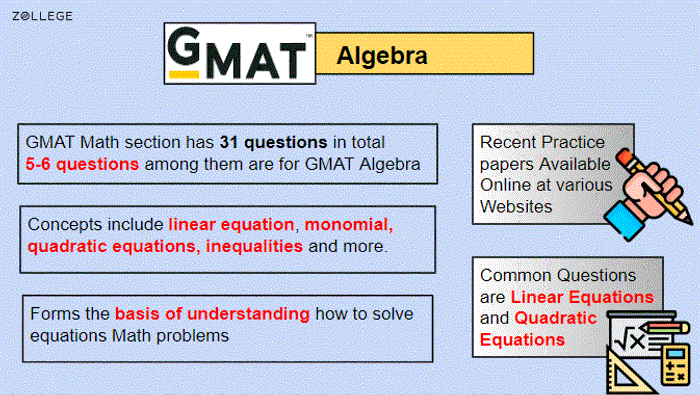
Some common questions in GMAT Algebra are Linear Equations and Quadratic Equations which is an algebra word problems. You are expected to translate what is given in words in the question into algebraic expressions and equations and solve them to arrive at the answer. You could get one to three questions focusing on equations in the GMAT math section of GMAT problem solving and data sufficiency.
Practice papers of previous years and mock tests available online can help candidates prepare for the GMAT Algebra portion. The terminology of GMAT Algebra forms the basis of understanding how to solve equations. Candidates must learn from basic algebra and move to the type of questions that can be asked related to GMAT Algebra.
| Table of Contents |
Candidates must practice for GMAT linear equation problems from online practice question papers or mock tests. There are several websites that provide questions as well as explanations for the correct answers. Candidates can practice the following provided GMAT exponent problems and data sufficiency problems for GMAT Algebra:
Question 1) A poultry farm has only chickens and pigs. When the manager of the poultry counted the heads of the stock in the farm, the number totaled up to 200. However, when the number of legs was counted, the number totaled up to 540. How many more chickens were there on the farm? Note: In the farm, each pig had 4 legs and each chicken had 2 legs.
- 70
- 120
- 60
- 130
- 80
Answer: C.60
Explanation:
Let the number of chicken 'x'
Let the number of pigs 'y'
So, the total number of heads counted for chicken and pig = 200
x+y = 200 (1)
The total number of legs counted were 540. Chicken have two legs (2x) and pigs have four legs (4x)
2x+4y = 540 (2)
Multiply 2 with equation (1)
2x+2y = 400 (3)
Subtract equation (2) with equation (3)
2x+4y = 540 - (2x+2y = 400)
2y= 140 or y = 70
So, the number of pigs were 70
Number of chicken will be x + 70 = 200
x = 200-70
x= 130
So, the number of chicken more left
130-70 = 60 chickens
Question 2) The basic one-way air fare for a child aged between 3 and 10 years costs half the regular fare for an adult plus a reservation charge that is the same on the child's ticket as on the adult's ticket. One reserved ticket for an adult costs $216 and the cost of a reserved ticket for an adult and a child (aged between 3 and 10) costs $327. What is the basic fare for the journey for an adult?
- $111
- $52.5
- $210
- $58.5
- $6
Answer: 3. $210
Explanation:
Step 1 of solving this GMAT Linear Equation Question: Assign variables and frame equations
Let the basic fare for the child be $X.
Information 1: Basic one-way air fare of a child costs half the regular fare for an adult.
Therefore, the basic fare for an adult = 2(basic one-way airfare for a child) = $2X.
Information 2: Reservation charge is the same on the child's ticket as on the adult's ticket.
Let the reservation charge per ticket be $Y
A child's ticket will cost (Basic fare + Reservation charges) = X + Y
Hence, an adult ticket will cost (Basic fare + Reservation charges) = 2X + Y.
Information 3: One reserved ticket for an adult costs $216. So, 2X + Y = $216 .... (1)
Information 4: The cost of a reserved ticket for an adult and a child (aged between 3 and 10) is $327.
So, the ticket for an adult and a child will cost (2X + Y) + (X + Y) = 3X + 2Y = $327 .... (2)
Step 2 of solving this GMAT Algebra Question: Solve the simultaneous equations and determine basic fare for an adult.
Multiply equation (1) by 2: 4X + 2Y = 432 .... (3)
Subtract equation (2) from equation (3):
4X + 2Y = 432
- (3X + 2Y = 327)
------------------------------
X = $105
------------------------------
The question is "What is the basic fare for an adult?"
The basic fare of an adult ticket = 2X = 2*105 = $210
Question 3) A children's gift store sells gift certificates in denominations of $3 and $5. The store sold 'm' $3 certificates and 'n' $5 certificates worth $93 on a Saturday afternoon. If 'm' and 'n' are natural numbers, how many different values can 'm' take?
- 5
- 7
- 6
- 31
- 18
Answer: 3. 6
Explanation:
You must understand Key Data to solve the question. They are:
-
Total value of all certificates sold = $93.
-
Certificates sold were in denominations of $3 and $5.
-
Both 'm' and 'n' are natural numbers.
Approach to solve this GMAT Algebra Word Problem
The value of all certificates sold, 93 is divisible by 3.
So, a maximum of 31 $3 certificates and no $5 certificates could have been sold.
However, the question states that both 'm' and 'n' are natural numbers.
Hence, at least 1 $5 certificate should have been sold.
Let us reduce the number of $3 certificates from theoretical maximum count of 31 by say 'x' and correspondingly increase $5 certificates by 'y'.
Evidently, 3x = 5y because the value of $3 certificates reduced should be the same as the value of $5 certificates increased.
It means that x has to be a multiple of 5 and y has to be a multiple of 3.
Or $3 certificates reduce in steps of 5 certificates.
Step 2 of solving this GMAT Algebra Question: List down possible values for 'm' and 'n'
The following combinations are possible.
-
m = 26, n = 3
-
m = 21, n = 6
-
m = 16, n = 9
-
m = 11, n = 12
-
m = 6, n = 15
-
m = 1, n = 18
The question is "How many different values can 'm' take?" Since only one value matches, m can take 6 values.
Question 4) What is the largest integral value of m such that the quadratic equation x2 – 10x + m Will there be two unique solutions?
- 23
- 24
- 25
- 26
- 27
Answer: B. 24
Explanation:
The equation given is x^2 - 10x + m
So, a= 1
b= -10
c = m
We have to find two unique solutions
D = b^2 – 4ac
D = (-10)^2 - 4(1)(m)
D= 100 - 4m
As we want two unique solutions D= 100 – 4m will be greater than 0
100 - 4m greater than 0
100 greater than 4m
25 greater than m
m is less than 25 but we want the largest integral value of m which is less than 25. So, the correct answer will be 24.
Question 5) Three years back, a father was 24 years older than his son. At present the father is 5 times as old as the son. How old will the son be three years from now?
- 12 years
- 6 years
- 3 years
- 9 years
- 27 years
Answer: D. 9 years
Explanation:
Let the age of son 3 years back 'x'
Father was 24 years older than the son
Age of father 3 years back : x + 24
Present age of son: x + 3
Present age of father : x + 24 + 3
Father is 5 times as old as the son at present
x + 24 + 3 = 5(x+3)
x + 27 = 5x + 15
5x – x = 27 – 15
4x= 12
x= 3
So, the age of the son, 3 years back, was 3 years old. Present age of the son is x + 3 = 3 + 3 = 6.
The age of my son after 3 years will be 9.
Question 6) The numbers a, b, and c are all positive. If b2 + c2 = 117, then what is the value of a2 + c2?
(1): a – b = 3
(2): a+b/a–b = 7
- Statement (1) ALONE is sufficient but statement (2) ALONE is not sufficient.
- Statement (2) ALONE is sufficient but statement (1) ALONE is not sufficient.
- BOTH statements TOGETHER are sufficient, but NEITHER statement ALONE is sufficient.
- EACH statement ALONE is sufficient.
- Statements (1) and (2) TOGETHER are not sufficient.
Answer: BOTH statements TOGETHER are sufficient, but NEITHER statement ALONE is sufficient
Explanation:
Let a^2 + c^2 'x'
Given: b^2 + c^2 = 117
By subtracting both equations we get
a^2 - b^2 = x – 117
If we find the value of a^2 - b^2, we can find the value of x.
Option (1) a – b = 3
It is not fulfilling to find the value of x or a^2 - b^2.
Option (2) a+b/a–b = 7
it is also not fulfilling to find the value of x or a^2 - b^2.
By multiplying both equations:
a – b × a+b/a–b = 7×3
a + b = 21
So, now we can find the value of x by using the difference of two square formulas a^2 – b^2 = (a-b) (a+b). Thus, both options are required to find the value of x.
GMAT Algebra Syllabus
GMAT algebra concepts involve some important concepts based on which questions are provided. GMAT syllabus for algebra includes, inequalities, algebraic expression, monomial and many more. You must remember three basic formulas for GMAT Algebra section. One is formula and two are algebraic equations.

Following is the GMAT Algebra Syllabus:
| Concepts | Meanings |
|---|---|
| Monomial | Monomial refers to a polynomial with one term. Mono means one. For example 12x ^ 2yz, 7x ^ 2y. |
| Exponents | Exponents refer to the expression of a big number in terms of its power. For example , to write 64 we can write it as 2 ^ 6 or it can be said as 2 to the power of 6. |
| Polynomial | A polynomial is a mathematical expression which only includes operations of subtraction, multiplication and total. A polynomial includes variables and coefficients. For example: 4y - 6y - 8, 67xy + 5xy - 7 etc. |
| Inequalities | It can be defined as a comparison between mathematical algebraic expressions. It is a comparison between two expressions which are not equal. It includes greater than, equal to or less than. |
| Linear Equations | A known variable and no exponents higher than one are present in a linear equation. It makes use of ideas like Number of Solutions and Linear Equations with Two Unknowns. |
| Quadratic equations | These equations include the highest exponential power of 2. It means that there is a degree of 2 and it is the highest power. For example: 3x + 6x^2 - 7x |
| Functions | Functions can be defined as each input having one output. Each number included in an operation receives output. For example b(x) where x is the input. |
| Permutation and combination | Permutation is arranging or putting all the numbers in a particular order. Combination is selected from this arrangement of numbers but in any order. It does not matter in which order the numbers are selected. |
| Arithmetic and geometric progression | In arithmetic progression the operation of addition is used. The common difference is added with the previous term and next term is calculated. While in geometric progression the common ratio is multiplied with the previous term to get the next term. |
| Algebraic expression | It includes three most important expression or equations which help in solving many GMAT Algebra questions:
|
GMAT Algebra Terminology
There are a few terms which are included everywhere in the GMAT linear equation problem. Candidates must understand the meaning of each of the following term to have a better interpretation of the GMAT quant question statement:
- Variable: a variable is a symbol or quantity included in mathematical expression which might change its power or it is not fixed. There are three common variables used in algebra :x,y and z.
- Constants: it is a number of power which does not change its value unlike a variable. For example, 66,49,19 etc.
- Terms: it is an integration of a combination of constant and variable. For example: 48x, 57xy
- Degree: it is the power of a variable. The variables hold their individual power or value. For example: 19x^3 or 5y^11
How to Prepare for GMAT Algebra
There are numerous tips and strategies which provide a way to prepare effectively for GMAT Algebra. These tips help candidates to manage time and increase their speed of GNAT Algebra problem solving. These tips are as stated below:
- Learn and memorize all the important GMAT Algebra formulas.
- Solve GMAT practice papers and mock tests.
- In solving linear equations, always consider what is not given and denote a variable to it.
- Read a question and interpret what is asked and what is already given. Find out which formula will be suitable to answer the questions.
- Use a timer to increase speed while calculations.
- Learn all the basic terminology of GMAT Algebra.
GMAT Algebra Preparation Books
Candidates can purchase and take help from several GMAT exponents problems exponents problems which are available online. These books provide the techniques and formulas for problem solving. Following are a few preparation books for GMAT Algebra:
- Higher Algebra by Hall and Knight
- GMAT Official guide
- GMAT Algebra strategy guide
- Barron's GMAT With online tests
- GMAT Math workbook by Kaplan
- GMAT Data sufficiency prep by NOVA's.
Candidates must focus and concentrate on GMAT Algebra equations. The quadratic equations and linear equations are complex as compared to other problems. Candidates can take help from online preparation courses or offline tutors to understand Algebra and formulas. Candidates must try to increase their solving pace because it might delay other questions.
FAQs
Ques: How important is algebra on the GMAT?
Ques: What are the most common algebra topics on the GMAT?
Ques: Do I need to be a math expert to ace the GMAT algebra section?
Ques: Where do I start if I have not practiced Algebra for years?
Ques: How do I solve for x in linear equations?
Ques: What's the difference between linear and quadratic equations?
Ques: How do I approach word problems involving algebra?
Ques: What are exponent properties I need to remember?
Ques: How do I solve ratio and proportion problems?
Ques: What are some common traps to avoid in GMAT algebra?
Ques: What are some time-saving tricks for solving GMAT algebra?
Ques: How do I handle absolute value equations and inequalities?
Ques: What are quadratic formula and completing the square?
Ques: How do I approach function questions on the GMAT?
Ques: What are some advanced inequalities tested on the GMAT?
Test-Taking Strategies:
Ques: Should I guess on algebra questions I'm unsure about?
Ques: How can I manage my time effectively in the algebra section?
Ques: What resources can I use to improve my GMAT algebra skills?
Ques: Is there a magic number of practice questions I should do?
Ques: What if I still feel confused by GMAT algebra?
*The article might have information for the previous academic years, please refer the official website of the exam.