
GMAT Data Sufficiency: Question Types, Tips and Sample Papers


Content Curator | Updated On - Feb 12, 2024
GMAT Data Sufficiency evaluates candidates based on skills like analyzing, data interpretation, quantitative evaluation, and more. In GMAT Quantitative Reasoning section, around 8-11 of the 31 questions are data sufficiency problems. Your performance on GMAT data sufficiency problems will account for roughly 25%–33% of your quant score, or 13%–17% of your overall GMAT score.
The remaining 20–23 questions in the quant part are all the more well-known "Problem-Solving" type. The 31 questions in the GMAT Quantitative Reasoning part will take 62 minutes to complete, or 2 minutes for each question. However, the majority of students take a little bit longer than usual to finish GMAT data sufficiency problems. This is especially valid for challenging, 700–800 level data sufficiency issues.
You can effectively practice GMAT Data Sufficiency by regularly solving sample papers. Always be critical, leverage harder, and always make sure your answer makes a different impact from the other people. It is really important to first understand GMAT exam pattern, and then master all the components of Data Sufficiency.
How to Solve GMAT Data Sufficiency Questions
Students might find it difficult to solve data sufficiency questions without having a GMAT Study plan for data sufficiency. There are certain steps which are important to derive out the answer from the question statement. Following steps dictate the correct way to solve GMAT Data sufficiency questions:
- Read the question statement thoroughly and understand the information provided. Solve the question if some calculations are required to answer the question.
- Read all the data sufficiency questions and answers them accordingly.
- Based on the conclusion, determine if statement (1) is sufficient or is dependent on the statement (2).
- Determine if statement (2) is alone sufficient or dependent on statement (1). There might be possibility that both statements are not sufficient alone as well as interdependent.
GMAT Data Sufficiency Syllabus
There are several important topics and concepts which constitute the data sufficiency section of the GMAT Quantitative reasoning. GMAT ds answer choices are based on an understanding of the question statement and doesn't demand full solving of the problem. Following table provide the Data sufficiency GMAT syllabus:
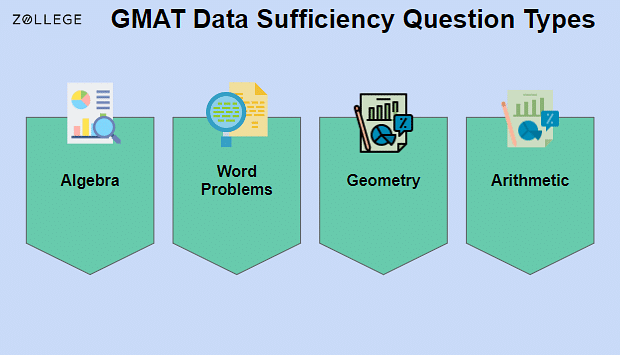
Algebra
GMAT Quantitative Data sufficiency concepts have Algebra types of questions. Algebra concepts include various topics like; Permutations and combinations, Equations, Inequalities, Functions, Algebraic expressions, Exponents, and Polynomials topics.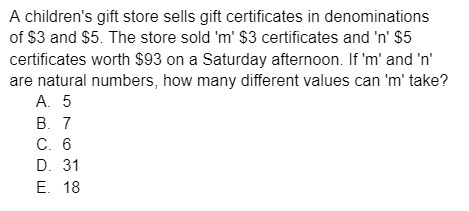
Word Problems
Word Problems are another type of question in GMAT Data Sufficiency part. This concept includes various types of topics like Profit and loss, Percentage, Interest, Ratio, Rate, Sets, and Mixture types.
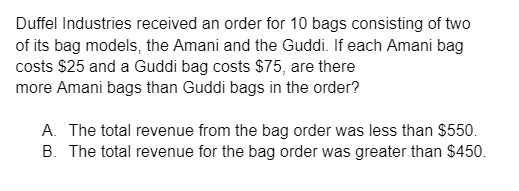
Geometry
Geometry types of questions are an important part of the Data Sufficiency section. GMAT Geometry includes Lines and angles, Circles, Coordinate geometry, Triangles, Volume, Surface, area, Polygons, and other shapes including cubes, cuboids, spheres, cones etc types of topics.
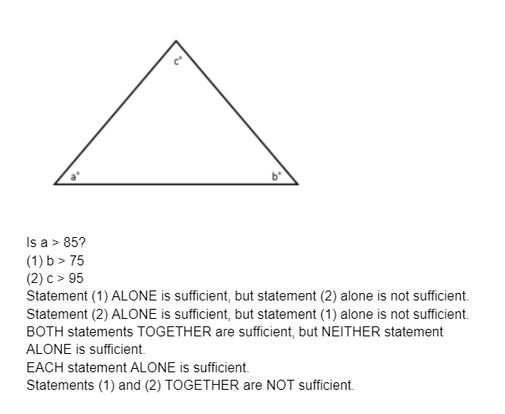
Arithmetic
GMAT Arithmetic type of questions include various types of topics. Real numbers, Probability integer properties, Decimals, Statistics, Number theory, Fractions, Power and root, and Percentage type of topics are included in the Arithmetic section.
GMAT Data Sufficiency Question Format
GMAT DS questions cover 25% to 33% out of total GMAT Quantitative reasoning questions. GMAT Data Sufficiency question contains two statements which might be correlated or not. There are five GMAT data sufficiency options which provide conclusion interpretation for the two question statements. Candidates have to analyze, interpret and select one of the five GMAT data sufficiency options. Following example shows the GMAT Data sufficiency question format along with GMAT data sufficiency answer choices:
- Luna bought a refrigerator and a cupboard at an auction and sold both items at her store. Her gross profit from the purchase and sale of the refrigerator was what percent greater than her gross profit from the purchase and sale of the cupboard?
Statement (1): Luna paid 10 percent more for the refrigerator than for the cupboard.
Statement (2): Luna sold the refrigerator for 20 percent more than she sold the cupboard.
- Statement (1) ALONE is sufficient but Statement (2) alone is not Sufficient.
- Statement (2) ALONE is sufficient but Statement (1) alone is not sufficient.
- BOTH statements TOGETHER are Sufficient, but NEITHER statement alone is sufficient.
- EACH statement ALONE is Sufficient.
- Statements (1) and (2) TOGETHER are NOT sufficient.
GMAT Data Sufficiency Options
GMAT DS questions always present the same five answer choices. To memorize these answer choices rather than read them each time you face a DS question. A helpful acronym is to memorize the answers is 12TEN.
(A) Statement (1) ALONE is sufficient, but statement (2) alone is not sufficient.
(B) Statement (2) ALONE is sufficient, but statement (1) alone is not sufficient.
(C) BOTH statements TOGETHER are sufficient, but NEITHER statement ALONE is sufficient.
(D) EACH statement ALONE is sufficient.
(E) Statements (1) and (2) TOGETHER are not sufficient.
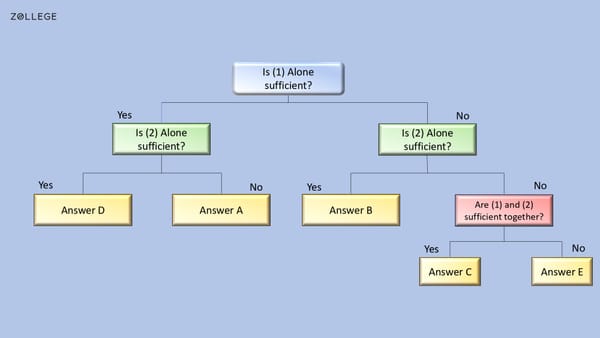
Candidates should first consider the data in (1) without taking the data in (2) into consideration when determining whether the assertions provide enough information. Then, while making sure to disregard the data in (1) that you just analysed, think about the information in (2). You should only use (1) and (2) in combination to determine sufficiency if (1) and (2) taken separately are both insufficient. Based on interpretation, select the correct option as depicted in the image following:
GMAT Data Sufficiency Scoring
GMAT Quantitative Reasoning is scored on a scale of 6 to 51 with 6 scores being the minimum and 51 as the maximum. The scores of data sufficiency are included in the quantitative reasoning of GMAT. Following determines and influence the scoring of GMAT data sufficiency answers:
- Total number of questions answered
- Total number of correct answers from overall answer questions.
- The difficult level of the GMAT data sufficiency question.
GMAT Data Sufficiency Tips and Tricks
Students who aim to score high in Quantitative reasoning must be able to solve all the data sufficiency maths questions. There are several tips and tricks which can be followed to effectively solve GMAT Data Sufficiency questions. Following are a few tips for GMAT Data Sufficiency:
- Solve data sufficiency mock test and GMAT data sufficiency practice test as much as possible.
- Understand and memorize data sufficiency options in GMAT.
- Take help from preparation books for GMAT Data sufficiency
- Try to solve as much as possible from the two statements. Avoid solving the whole question, just solve as much as needed.
- Do not use mathematical approaches rather try rational and reasoning.
- Increase solving speed through practice.
- Interpret what the question statement asks, says and provides.
GMAT Data Sufficiency Study Resources
Students aspiring to score high on GMAT can take help from online available study resources. There are several online Courses for GMAT and numerous GMAT club data sufficiency mock tests, Practice tests and books. Following are a few most recommended books for GMAT Data sufficiency:
- A complete book of data interpretation and analysis by Adda 247
- Arihant: Data Interpretation and Data Sufficiency
- Advanced math Workbook for GMAT
- Data Interpretation and Sufficiency by Integrity
- Manhattan Data sufficiency GMAT
GMAT Data Sufficiency Practice Questions
Students can improve solving speed and develop better understanding of questions through GMAT practicing questions. Following are a few practice questions for GMAT Data sufficiency:
| GMAT DS Practice Test 1 | GMAT DS Practice Test 2 |
| GMAT DS Practice Test 3 | GMAT DS Practice Test 4 |
| GMAT DS Practice Test 5 | GMAT DS Practice Test 6 |
| GMAT DS Practice Test 7 | GMAT DS Practice Test 8 |
There are five DS options GMAT which are selected based on the question statement. GMAT Data sufficiency is a combination of mathematics, analytical, reasoning interpretation and solving skills. Candidates must practice the sample questions and mock tests for better performance. GMAT Data interpretation holds 13% of the total questions of GMAT.
FAQs
Ques. How many data sufficiency questions on GMAT?
Ques. How to improve data sufficiency GMAT?
Sufficient (S)
Insufficient (I)
Answer is 1 (E1)
Answer is 2 (E2)
Answer is Neither 1 nor 2 (N)
Ques. How many Data Sufficiency questions are in the GMAT?
Ques. How are Data Sufficiency questions structured?
Ques. How much time do I have for each Data Sufficiency question?
Ques. What are the answer choices in Data Sufficiency questions?
Statement (1) ALONE is sufficient, but statement (2) is not sufficient.
Statement (2) ALONE is sufficient, but statement (1) is not sufficient.
BOTH statements TOGETHER are sufficient, but NEITHER statement ALONE is sufficient.
EACH statement ALONE is sufficient.
Statements (1) and (2) TOGETHER are NOT sufficient.
Ques. Can I solve Data Sufficiency questions using trial and error?
Ques. Is the Data Sufficiency section harder than Problem Solving?
Ques. How should I approach Data Sufficiency questions?
Ques. Is there a specific order to solve Data Sufficiency questions?
Ques. How can I improve my performance in Data Sufficiency?
Ans. Practice regularly with official GMAT prep materials and other reputable resources. Focus on understanding the underlying concepts, identify patterns in the questions, and use strategic thinking to solve them efficiently.
Ques: How to solve data sufficiency questions in GMAT?
Ques: What is data sufficiency on the GMAT?
Ques: How easy is to score 750 in GMAT?
Ques: Is 47 a good GMAT quant score?
Ques: Is GMAT focus harder than GMAT?
Ques: How many questions can you miss on the GMAT to get a 750?
Ques: Will a 750 GMAT get me into Harvard?
Ques: Is 590 a bad GMAT score?
Ques: Can an average guy crack GMAT?
*The article might have information for the previous academic years, please refer the official website of the exam.