
GMAT Quantitative Reasoning: Check the Recent Updates, Syllabus, and Scores


Content Curator | Updated On - May 14, 2024
Highlights
- GMAT focus edition has removed Data sufficiency from the quant section and is considered a separate part of the GMAT test.
- GMAT quant section focuses only on problem-solving questions for algebra and arithmetic,
- Problem-solving questions cover 50% of the quant section.
- GMAT quantitative section is scored from 60 to 90, instead of 6 to 51.
GMAT Quantitative Reasoning is a section of GMAT exam that evaluates your logical ability that will be suitable for a graduate business degree. GMAT has a total of 64 questions, out of which 21 questions come from GMAT quantitative section. GMAT quantitative section covers basic concepts like arithmetic and problem-solving questions. To get into a top-ranking business school, getting a high GMAT score is important. How do you approach the GMAT quantitative practice questions? GMAT quantitative section requires a lot of critical and logical thinking, so be prepared to encounter a lot of trick questions. But you need not worry about that if you prepare well in advance.
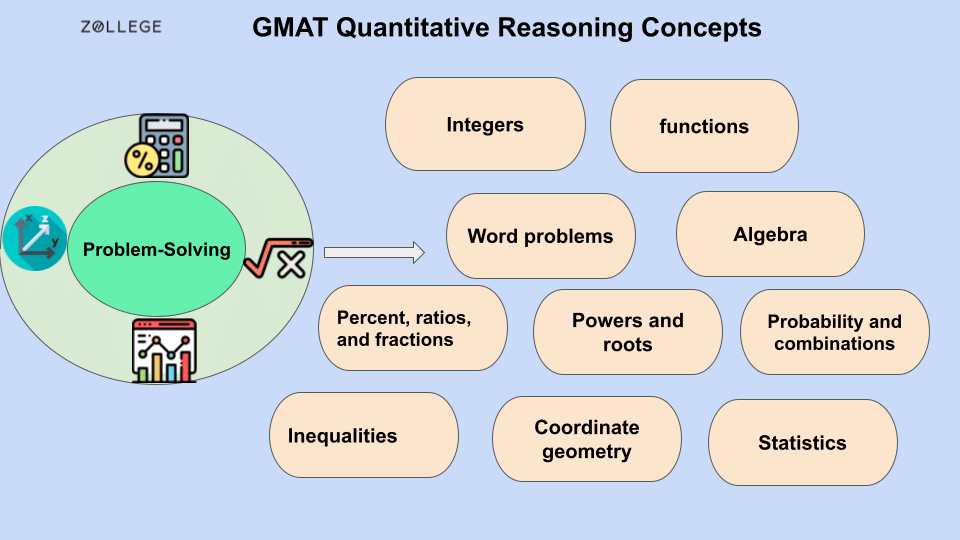
Do you know the recent changes adopted by GMAT focus edition? GMAT quantitative questions will now consist of 21 questions. You need to answer all the questions within 45 minutes. GMAT quantitative syllabus now has multiple-choice questions on problem-solving, focusing only on arithmetic and algebra.
- You must know that GMAT focus edition has removed the geometry section from the GMAT quantitative topics.
- Data insights, which was initially Data sufficiency, has been eliminated from the GMAT quantitative syllabus and is now a separate part of the GMAT test.
- GMAT previous edition quant section was scored from 6 to 51.
- However, since February 2023, GMAT focus edition has updated the scoring range. GMAT quant scores sales from 60 to 90.
- GMAT verbal and quantitative sections are adaptive.
GMAT Quantitative Reasoning Syllabus
As you must know the GMAT focus edition has updated the GMAT syllabus, now it only consists of problem-solving questions. Geometry has been eliminated from the syllabus and only focuses on arithmetic and algebra.
Problem-solving
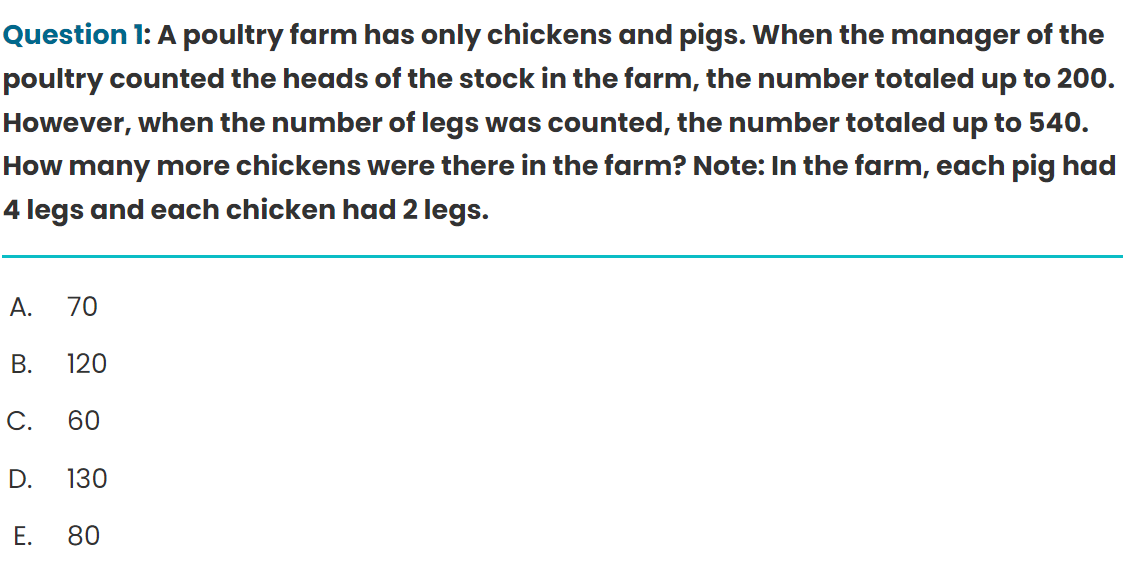
Quantitative reasoning GMAT contains problem-solving questions that measure your logical thinking abilities to apply them in real-life scenarios. GMAT math questions for the problem-solving questions account for only arithmetic and GMAT algebra. Example GMAT math questions are attached below for your reference-
| Arithmetic | Algebra |
|---|---|
| Number theory and systems | Permutation and combination |
| Multiples and factors | Monomials and polynomials |
| fractions | GMAT Algebraic expressions and equations |
| decimals | functions |
| Percentages | exponents |
| Powers and roots | GMAT Arithmetic and geometric progressions |
| Profit and loss, compound and simple interest | Quadratic equations |
| Speed, time, and distance | Inequalities and basic statistics |
| Pipes, cisterns, and work time | - |

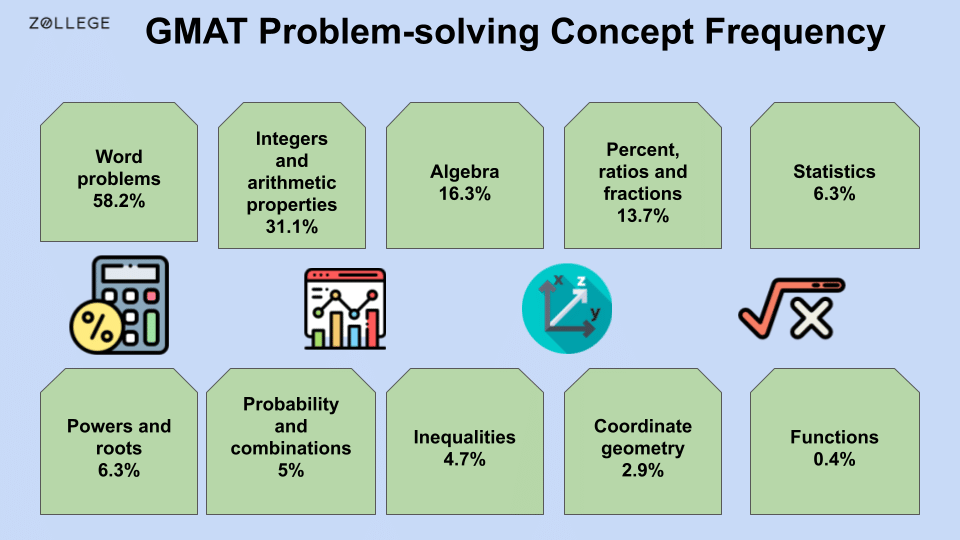
Quantitative concepts by Frequency
GMAT quantitative section has several sub-parts that you need to know about. You must keep in mind that GMAT geometry is no longer included in the problem-solving The table below shows the sub-parts of the problem-solving sections and their respective percentage that they cover in the section –
GMAT Quantitative Score
GMAT score scale ranges from 205 to 805. GMAT quantitative score scale now ranges from 60-90. The scores are reported based on how difficult the questions were, the number of questions you were able to answer correctly, and the total number of questions you have answered.
| Quantitative scores | Median score | Percentile rankings |
|---|---|---|
| 90 | 77.71 | 100% |
| 85 | 89% | |
| 80 | 66% | |
| 75 | 35% | |
| 70 | 14% | |
| 65 | 4% | |
| 60 | 1% |
GMAT Quantitative Preparation
A good score considered for GMAT Quantitative Reasoning section goes all the way up to 90. To get the perfect score of Q90, you have to get every quant question right. You need to prepare for your GMAT quantitative reasoning section in detail with the help of practice papers, remembering the formulas, etc. Below are some GMAT preparation tips for you to get a good score in this section-
- To improve your score, you need to get your basic math concepts clear in your head.
- Learn to use the number effectively
- Do not jump to conclusions, and read the questions carefully.
- Focus on the GMAT Quant question types.
- Make a proper GMAT study plan
- Regularly practice solving papers from GMAT guidebooks and other official resources available on the website.
GMAT Quantitative Preparation Books
GMAT quantitative practice tests can be done by referring to GMAT prep books. The books offer many comprehensive mock tests and strategic tips. Some of the best-recommended books are given below -
- Official Guide for GMAT Quantitative Review:
- GMAT Advanced Quant By Manhattan Prep: Check PDF
- Manhattan Prep GMAT foundation for Maths: Check PDF
- KaplanQuantitative's GMAT Math Workbook: Check PDF
GMAT Quantitative Sample Papers
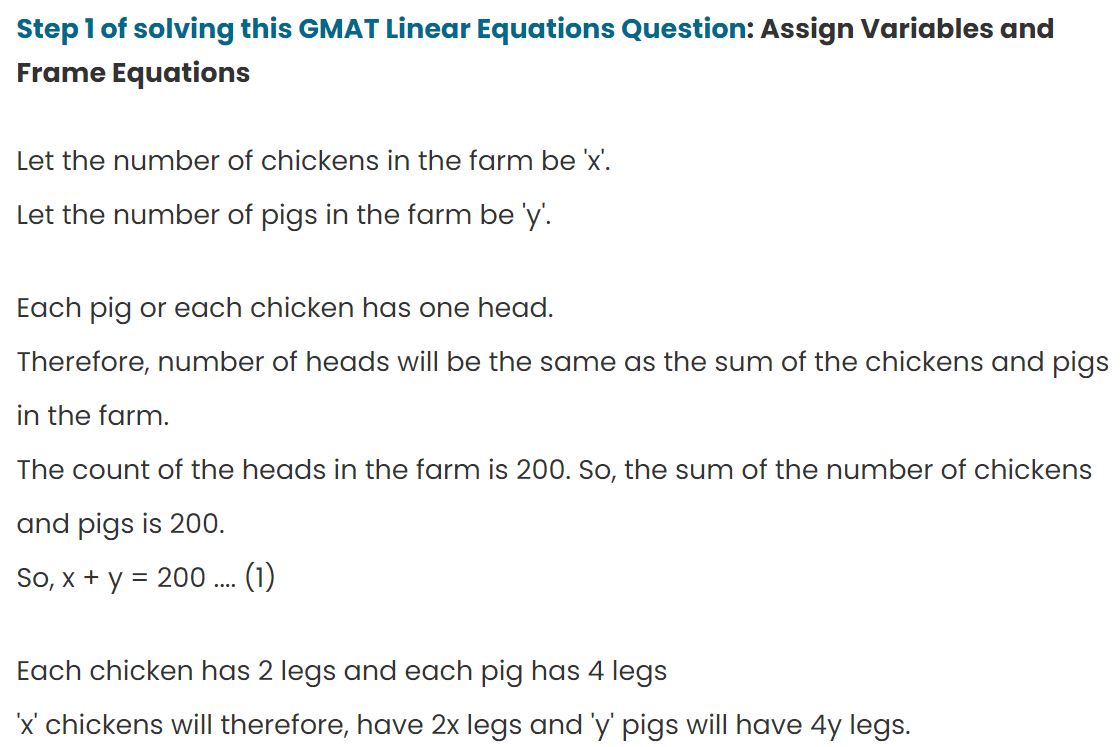
Sample GMAT math questions are one of the best hacks to get a high score in this section. It helps you to get familiar with the test format, and the type of quant questions that usually come in GMAT test and boosts your confidence as well. It gives you an overall idea of what to expect on the actual test day. Some of the sample GMAT quant questions are mentioned below -
GMAT quantitative reasoning can seem complex if you are not familiar with the basic mathematical concepts. However, if you practice enough of the math questions using online apps and reference books, you can surely achieve a higher GMAT score.
FAQs
Ques. What is the purpose of the GMAT Quantitative Reasoning section?
Ans. The GMAT Quantitative Reasoning section evaluates your abilities in solving mathematical problems and analyzing quantitative data.
Ques. What is the structure of the Quantitative Reasoning section?
Ans. The section comprises only one section -: Problem-Solving, focusing on algebra and arithmetic.
Ques. Which specific topics are included in the GMAT Quantitative Reasoning syllabus?
Ans. The syllabus covers arithmetic, algebra, and word problems.
Ques. What are some of the best study materials for GMAT Quantitative Reasoning preparation?
Ans. Recommended study materials include "The Official Guide for GMAT Quantitative Review" by GMAC and "GMAT Quantitative Strategy Guide Set" by Manhattan Prep.
Ques. How is the GMAT Quantitative Reasoning section scored?
Ans. The section is scored on a scale ranging from 60 to 90, based on the number of correct responses and the difficulty level of questions.
Ques. What strategies can I use to approach Problem-Solving questions effectively?
Ans. Effective strategies involve understanding the problem, identifying relevant information, and memorizing mathematical formulas.
Ques. How are Data Sufficiency questions different from Problem-Solving questions?
Ans. Data Sufficiency questions require you to determine whether the provided information is adequate to solve the problem, rather than solving it directly, whereas, problem-solving questions ask you to solve basic math questions.
Ques. What methods can I use to increase my speed and accuracy in solving Quantitative Reasoning questions?
Ans. Consistent practice, time management techniques, and using of fundamental mathematical concepts are important in improving your speed and accuracy.
Ques. What are some of the common errors I should avoid in the Quantitative Reasoning section?
Ans. Common errors include misinterpretation of questions, and overlooking critical information.
Ques. Are there any specific approaches recommended for solving Geometry questions?
Ans. Recommended approaches include diagram representation, identification of geometric properties, and application of relevant formulas to solve them.
Ques. How should I manage my time during the GMAT Quantitative Reasoning section?
Ans. Time management involves prioritizing questions based on difficulty and ensuring adequate time is given for each question.
Ques. Are there any online resources available for GMAT Quantitative Reasoning preparation?
Ans. Various online platforms offer additional practice materials and support for GMAT Quantitative Reasoning preparation.
Ques. Is it essential to memorize mathematical formulas for the GMAT Quantitative Reasoning section?
Ans. Memorizing mathematical formulas is very essential to solving the questions correctly by using relevant methods.
Ques. What steps should I take when I find any of the questions tough in the Quantitative Reasoning section?
Ans. You should use strategies such as eliminating answer choices and managing time effectively to solve difficult problems
*The article might have information for the previous academic years, please refer the official website of the exam.