
GMAT Geometry: Syllabus, Questions, Tips, and Books


Content Curator | Updated On - Mar 1, 2024
GMAT geometry examines the data sufficiency and problem-solving capabilities of the aspirants. The portion covers under a quarter of GMAT quantitative syllabus. There will be 21 one questions in the quantitative section as per the GMAT. Effective geometry formulas for GMAT help the candidates to give proper answers on the quantitative section. You can review your GMAT geometry mistakes by analyzing your mistakes, understanding why the answer is incorrect, and identify the thought process that led you to the correct solution.
GMAT has recently updated its exam pattern, and you need to understand each of the sections for a better score. GMAT focus edition is now shorter, and the scores are ranges on 205 to 805 scale. You have to answer 64 questions in total, which cover all the syllabus of focus edition. Solving GMAT geometry questions properly will help you to achieve a higher score on the quantitative section. Candidates are allocated 2 hours and 15 minutes to complete GMAT focus edition.
GMAT only covers a fraction of the geometry that probably covered in the high school syllabus. You must have a good understanding and knowledge about geometry concepts for GMAT quantitative to understand the question types. On the quantitative section, you need to know how to apply geometry formulas for GMAT quantitative questions. The best way to handle GMAT geometry questions by paying close attention to keywords, identifying the relevant geometric information, and try to translate the problem into a visual representation before attempting calculations.
| Table of Contents |
GMAT Geometry Syllabus
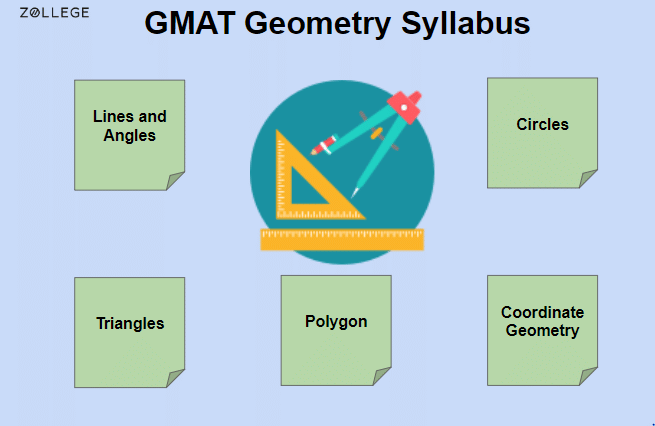
GMAT Geometry syllabus comprises basic mathematical concepts of high school syllabus. GMAT does not provide any hint or mention formula to be used while solving problems of geometry. The Geometry GMAT syllabus and Concepts include:
- Triangles
- Lines and Angles
- Quadrilateral's
- Parabolic coordinate geometry
- Area
- Perimeter
- Circles
Lines and Angles
There are several types of line and other geometry concepts for GMAT including different angles and lines. Following is the terminology and meaning of basic concepts a candidate must know regarding lines and angles to prepare for the GMAT geometry problems.
- Definition of Line: A line is a uni-dimensional straight figure which has no thickness and it keeps on moving indefinitely in both directions.
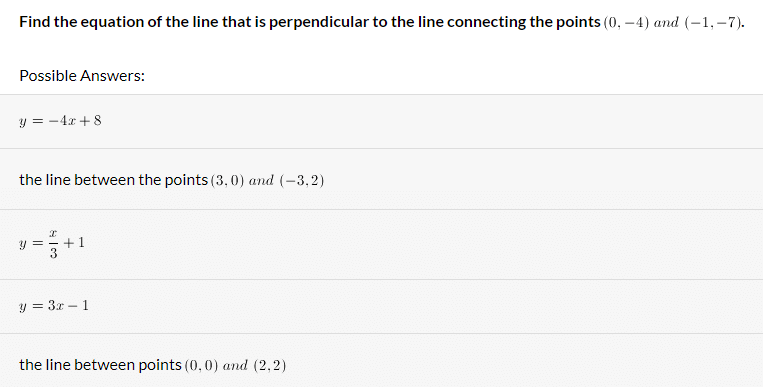
- Line Segment: A line segment is a line which has two endpoints and does not extend further.
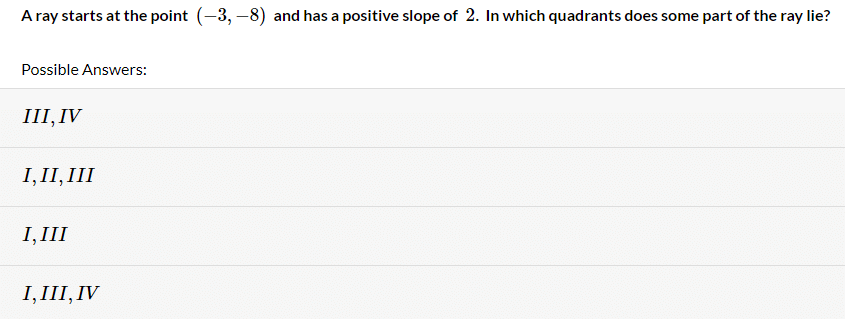
- A Ray: A ray is a line which has one endpoint and extends further from one direction.
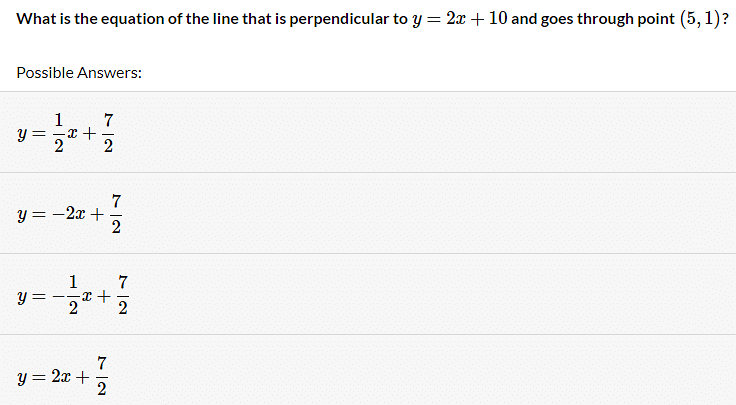
- Parallel Lines: Parallel lines are a pair of lines which move at a uniform distance and never intersect.
- Perpendicular Line: This is a pair of lines that form a 90° angle at the point of intersection.
- Acute Angle: It is an angle that is smaller than 90°.
- Right Angle: It is an angle which is of 90°
- Obtuse Angle: It is an angle exceeding 90°
- Straight angles: it is formed on a straight line with an angle of 180°.
- The sum of Angles: The total sum of angles surrounding a point is 360°.
- Supplementary Angles: if two angles sum up to 180°, it is called supplementary angles.
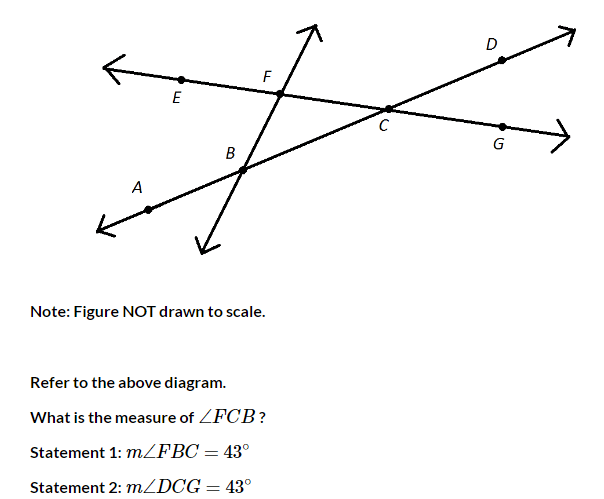
- Complementary angle: two angles that add up to 90° are called complementary angles.
- When a line is drawn in the middle of an angle and divides the angle into two equal parts, it is called a directing line.
- Two angles drawn vertically are always equal in degree and measurement.
Triangles
There are numerous types of triangles and a few basic concepts related to triangles that are important for GMAT Geometry are provided below:
- A triangle is defined as a closed figure which includes three straight lines and three angles at the point of intersection.
- The total of all the angles of a triangle lying inside is 180°.
- The sum of an exterior angle which is adjacent to an interior angle is 180° and is supplementary.
- Right angle triangle: it has one angle measuring 90°.
- Isosceles Triangle: it has two sides equal in measurement while the third one is different and unequal.
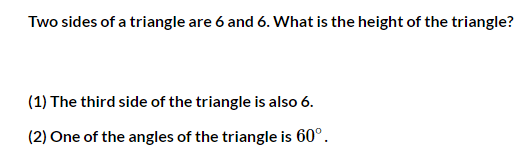
- Equilateral triangle: it has all three sides equal in measurement.
- If the measure of corresponding angles of two triangles is the same, then the triangle is identical.
- If the measure of the corresponding angles and sides of two triangles correspond, the triangles are identified as congruent.
Circles
Many questions of GMAT include problems related to the circle. Basics of circle is provided in below points in regards to GMAT geometry review:
- A circle is a closed figure with indefinite points and line segments.
- A line passing through the middle point of the circle and connecting the two sides is called a diameter.
- The outer measurement of a circle is called its circumference.
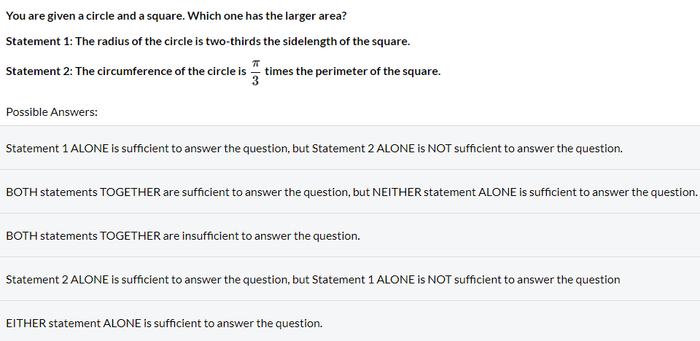
- A circle cut in half is called semi circled.
- Half of the diameter or a line connected to the center of the circle and joined with any point in the circle is called radius.
Polygon
Polygon is an important figure which has many important formulas that are required to be memorized for GMAT Geometry. The basics of polygon are stated below:
- Polygon is a slanting closed figure formed by 4 straight line segments.
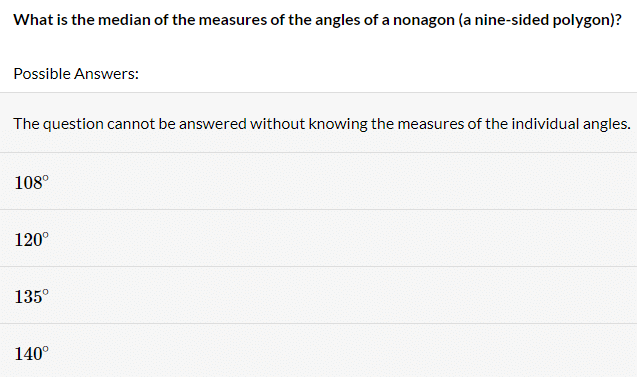
- The total of the four angles of a polygon is 360°.
- Unlike a circle the outer surface or outline of polygon is called its perimeter
Coordinate Geometry
Coordinate geometry is also called analytical geometry which is performed on a graph or a cartesian plane divided into 4 parts.
- The 4 divided parts are called quadrants with names:
Quadrant I (x, y)
Quadrant II (-x, y)
Quadrant III (-x, -y)
Quadrant IV (x, -y)
- The x and y denotes the lines intersecting each other from the middle. Vertical line is the y axis and the horizontal line is the x axis.
- There are positive and negative values on both the axes.
GMAT Geometry Formulas
Several significant formulas must be remembered and learned to know which formula will be used to solve different problems. The following table covers all the important geometry formulas GMAT:
| Category | Shape | Formula | Meaning of the alphabets used in formula |
|---|---|---|---|
Perimeter Formula | Square | 4×s | s= sides |
| Rectangle | 2×l + 2×w | l= length, w= width | |
| Parallelogram | 2×l + 2× w | l= length, w= width | |
| Trapezium or Trapezoid | s(1) + s(2) + b(1) + b(2) | s(1,2)= Side 1 and 2, b(1,2)= base 1 and 2 | |
| Triangle | s(1) + s(2) + b | s(1,2)= Side 1 and 2, b= base | |
| Rhombus | 4×l | l= length | |
Area Formula | Triangle | 1/2×b×h | b= base h= vertical height |
| Square | a^2 | a= length of side | |
| Rectangle | w×h | h= height, w= width | |
| Parallelogram | b×h | b= breadth, h= vertical height | |
| Trapezium | 1/2×(a+b)×h | a and b= length of two sides h= vertical height | |
| Circle | πr^2 | r= radius | |
| Ellipse | πa×b | a= long radius and b= short radius | |
| Sector of circle | 1/2×r^2 theta | r= radius Theta= angle in radian | |
| Rectangular n-polygon | 1/4×n×a^2× cotπ/n | n= number of sides a= length of sides | |
Surface Area Formula | Cuboid | 2×l×h + 2×w×h + 2×w×l | l= length h= height w= width |
| Cube | 6×s^2 | s= sides of cube | |
| Right circular cylinder | 2π×rh + 2πr^2 | r= radius of the base h= vertical height of cylinder | |
| Right circular cone | πr^2 + πrh | r= radius h= height | |
| Sphere | 4×πr^2 | r= radius | |
| Torus | π^2 × (R^2 - r^2) | R= Radius of larger base r= radius of smaller base | |
Volume Formula | Cuboid | l×w×h | l= length h= height w= width |
| Cube | s^3 | s= sides | |
| Cylinder | π×r^2×h | r= radius of the base h= vertical height | |
| Sphere | 4/3×πr^3 | r= radius | |
| Cone | 1/3×πr^2×h | r= radius of the base h= vertical height | |
| Square or Rectangular pyramid | 1/3×l×w×h | For square the l=length and w= width will be same. h= height | |
| Circumference of circle | Circle | πd | d= diameter |
| Area of circle | Circle | πr^2 | r= radius |
| Pythagoras theorem | Square and triangle | a^2 + b^2 = c^2 | a,b,c = sides |
GMAT Geometry Practice Questions
The best way to prepare for the GMAT Geometry section is to practice as many questions as possible. It increases the speed of the candidates and the formula usage and concept gets clear. Several GMAT Geometry question and answer pdf can be downloaded from online websites for practice. Following are a few Geometry GMAT Practice questions:
GMAT Triangle Practice Problems
Question 1) An equilateral triangle intersects a circle (not shown). The possible number of distinct intersection points could be the following:
- 3
- 4
- 5
- I only
- II only
- I and II only
- II and III only
- I, II, and III
Answer: E. I, II and III
Explanation: all the options are possible because it's an equilateral triangle with an equal number of sides. Also, the point of intersection can be of any number between 0 to 6.
Question2) Triangle STV (not shown) has sides ST = TV = 17, and SV = 16. What is the area?
- 85
- 100
- 120
- 136
- 165
Answer: C. 120
Explanation: Given:- ST=TV= 17
SV= 16
To find: Area of the triangle
Area of triangle = 1/2×base×hypotenuse or height
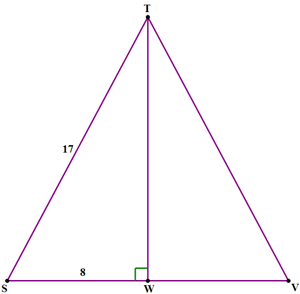
In the above triangle, we know that it's an isosceles triangle because two of its sides are equal. To find the area we must know the base. The base can be easily calculated by drawing a line segment bisecting SV which is of measurement 16. The half of 16 is 8. So the bisecting has been named as 'w'. The base is 8. Now, we must find the measurement of TW to find Area. This can be found by using Pythagorean triple= 8-15-17. So, the TW is 15
Area= 1/2×b×h
= 1/2×16×15
=1/2×240
=120
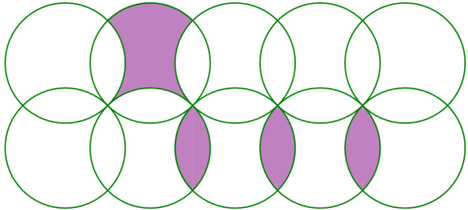
Question 3) Ten circles of radius r=6 are equally spaced in a regular pattern as suggested by the diagram. What is the total area of the shaded regions?
- 34π
- 36π
- 39π
- 40π
- 42π
Answer: B. 36π
Explanation: There is no need to calculate the area for all circles and then calculate the shaded part. As per the question statement all circles are of the same radius of 6 with equal spaces. So the shaded portion forms a circle. Calculating the area of one circle will be equal to the area of the shaded circle.
Are of circle= πr^2 = π6^2
=36π
GMAT Geometry Tricks
There are a few tips and tricks which benefit candidates in better preparation for GMAT geometry section. These tips can be followed during the preparation period and while attempting the exam. Following are a few importants tips:
- Practice questions related to each concept of geometry.
- Memorize the formulas and try to write them and practice.
- Do not consider the diagram given in the paper of accurate measurement mentioned in the question statement. The diagram provided a rough idea about what the question statement demands.
- Draw your own diagram and understand the question in which the diagram is not provided.
- Manage time and try to solve as much as it is needed to answer the question.
- Solve as many practice papers as possible.
GMAT Geometry Preparation Material
There are many resources available online that can guide candidates in preparation for GMAT Geometry section. These resources include sample papers, mock tests, and several books. Practice papers help the candidates to understand difficult concepts and increase their pace of solving the questions. Following are a few important and recommended books for GMAT geometry preparation:
- The official guide for GMAT review- Check PDF
- GMAT math Prep course- Check PDF
- Manhattan GMAT geometry pdf- Check PDF
- Veritas prep geometry pdf- Check PDF
Candidates must prepare for GMAT Geometry with the help of GMAT geometry formulas pdf. To learn the formulae candidates can download GMAT geometry formulas pdf from online. The most important concept for GMAT geometry is triangles and GMAT Triangle questions are often asked in the GMAT. Candidates can prepare from GMAT Geometry question pdf which includes several previous year questions and solutions.Candidates can download GMAT geometry questions pdf for appropriate practice.
FAQs
Ques: What specific topics in geometry are covered in the GMAT?
Ans: GMAT geometry covered various types of questions like; lines and angles, polygons, circles, areas and perimeters, and coordinate geometry type.
Ques: How important is the geometry section in the GMAT exam?
Ans: GMAT geometry accounts almost 20 to 25% of the quantitative section, and you need to do effective practice to achieve a higher score.
Ques: Are there specific types of geometric figures that frequently appear on the GMAT?
Ans: There are mainly three types frequently accepting figures; triangles, circles, rectangles and squares.
Ques: Do I need to memorize geometric formulas for the GMAT, or are they provided during the exam?
Ans: Remembering GMAT geometric formulas help the candidates solve the quantitative sections. Having a better understanding of the concepts of formulas will help you to give the answers properly.
Ques: What strategies can I use to approach geometry questions on the GMAT more efficiently?
Ans: The main strategies to approach GMAT geometry answers by visualize the questions, identifying key information, use estimation and eliminate the answer choices.
Ques: Are there any particular theorems or rules in geometry that are commonly tested on the GMAT?
Ans: The commonly tested theorems on GMAT geometry are; Pythagorean theorem, properties of special triangles, and parallel line properties.
Ques: How many geometry questions can I expect in the quantitative section of the GMAT?
Ans: There are in total 21 questions on the Quantitative section of GMAT. You can expect 4 to 6 questions of GMAT geometry on the quantitative section.
Ques: Are there specific GMAT prep materials or resources focused on improving geometry skills?
Ans: The best way to prepare for GMAT geometry equations from; official GMAT study guide, online courses, reading prep books, and by regularly solving sample papers.
Ques: Can I expect geometry questions to be integrated with other math concepts on the GMAT?
Ans: GMAT geometry questions sometimes involve combinations like algebra or data analysis concepts.
Ques: Are there certain geometric concepts that are more challenging and may require additional preparation?
Ans: Coordinate geometry, and word problems are some of the common challenging equations on GMAT geometry questions.
Ques: Is three-dimensional geometry commonly tested on the GMAT?
Ans: Three-dimensional geometry are rarely tested on GMAT. MAT geometry mainly covers questions based on high school level.
Ques: What role does visualization play in solving geometry questions on the GMAT?
Ans: Visualizations are very important to understanding the relationship between geometric elements and solving problems visually.
Ques: Are there any specific strategies for tackling geometry word problems on the GMAT?
Ans: To answer GMAT questions properly, you need to identify the geometric figure, translate the problems, and to solve and interpret.
Ques: How does the GMAT test concepts like angles, triangles, and circles in geometry questions?
Ans: GMAT geometry questions include calculating angles, side lengths, areas, and other properties of the context.
Ques: Are calculator tools allowed for the geometry section of the GMAT?
Ans: Calculators are allowed, but not necessary, for most of the GMAT geometry questions. You need to do regular practice to achieve a high score on the quantitative section.
Ques: How should I allocate my time when working on geometry questions during the GMAT?
Ans: GMAT quantitative section, includes 21 questions and candidates are allocated 64 minutes to complete. That means that candidates are allocated around 2 to 3 minutes to answer Geometry questions.
Ques: What are the most common mistakes test-takers make when approaching geometry questions on the GMAT?
Ans: Misunderstanding of the diagram, applying incorrect formulas, and calculation mistakes are some of the common mistakes done by students on the GMAT geometry section.
Ques: Can practicing with GMAT geometry questions from previous exams significantly improve my performance?
Ans: Solving previous year's GMAT geometry question papers help the candidates to effectively practice, and provide a better understanding of the concepts.
Ques: Are there specific GMAT study plans or courses that focus on mastering geometry concepts?
Ans: Many online and offline coaching classes in India provide effective GMAT courses. Candidates can opt for official GMAT preparation materials for updated study resources.
Ques: How to handle GMAT geometry questions?
Ans: The best way to handle GMAT geometry questions by paying close attention to keywords, identifying the relevant geometric information, and try to translate the problem into a visual representation before attempting calculations.
*The article might have information for the previous academic years, please refer the official website of the exam.