
GMAT Integrated Reasoning: Questions, Pattern, Tips, and Sample Papers


Content Curator | Updated On - Feb 12, 2024
GMAT Integrated Reasoning combines verbal and quantitative elements involving graphical representations. GMAT IR has 30 minutes to solve 12 questions of four types: Multi-Source Reasoning, Table Analysis, Graphics Interpretation, and Two-Part Analysis. Integrated Reasoning score GMAT ranges from 1 to 8 with 1 point increment and no partial credit scoring.
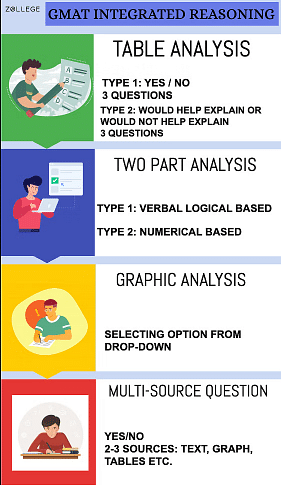
To solve Integrated Reasoning questions, an online basic calculator with simple calculations is available to each candidate. The total time duration of GMAT is 3 hours and 7 minutes, out of which 30 minutes is for GMAT Integrated Reasoning questions. There are a total of 80 questions out of which 12 questions are related to integrated reasoning with four different types of GMAT IR questions.
Candidates first need to understand the exam pattern to achieve their desired GMAT score. The Integrated Reasoning score GMAT is not included in the overall GMAT score of 200 to 800 and does not affect scores of other sections. The average Integrated Reasoning score is 4.5 out of 8. Effective preparation under expert mentorship helps candidates to solve the answers effectively.
GMAT Integrated Reasoning Sections
IR section GMAT contains four types of questions: table analysis, two-part analysis, graphics interpretation, and multi source reasoning GMAT. Integrated reasoning examines a candidate's ability to analyze data presented in a case study. The GMAT syllabus for integrated reasoning is the same as quantitative reasoning and verbal reasoning.
Table Analysis
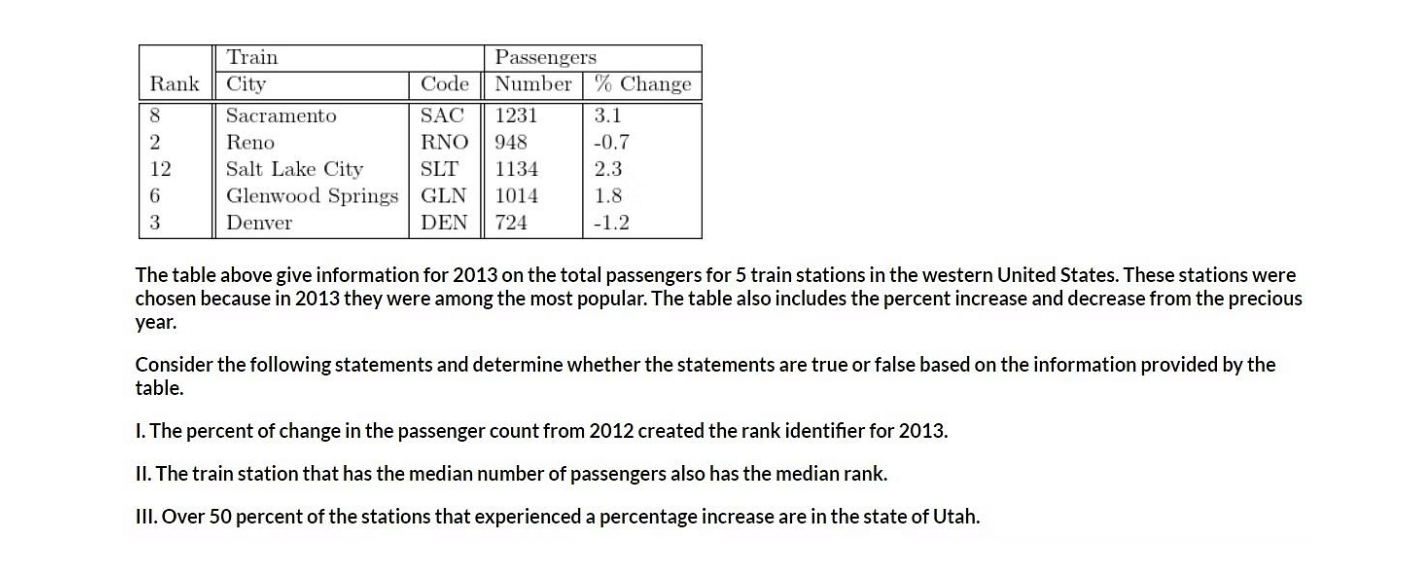
This section of GMAT integrated reasoning test measures a candidate’s ability to sort and analyze a table of data.
- There are a total of three questions in table analysis.
- The questions may be in the format of yes or no, or there may be options if the statement would help explain or not help explain.
- There is a table given on the left side of the computer screen with 4 to 5 columns and can be sorted by the candidate.
Example:
Two-Part Analysis
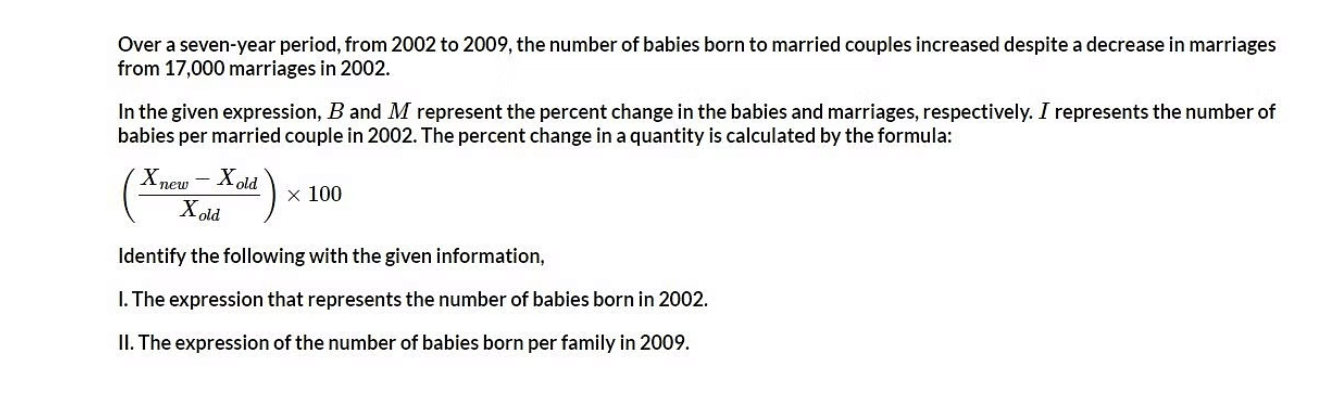
Two-part analysis of GMAT integrated reasoning measures a candidate's ability to solve complex problems. The questions could be quantitative, verbal, or some combination of both.
- In a two-part analysis question there is information provided and below information is a table given. From the tables, students have to select a combination from two columns.
- The question might be a verbal logical question or a numerical data-based table.
Example:
Graphics Interpretation
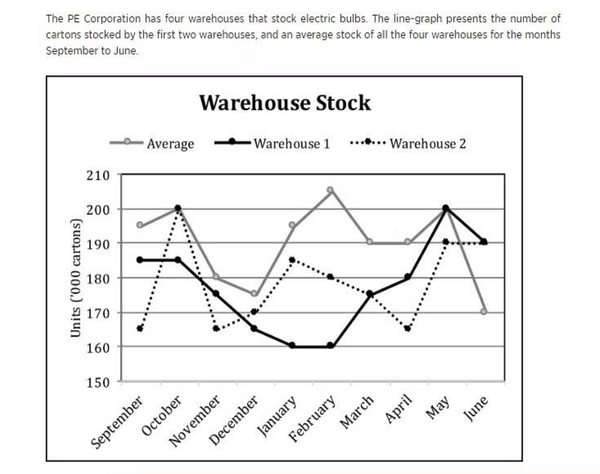
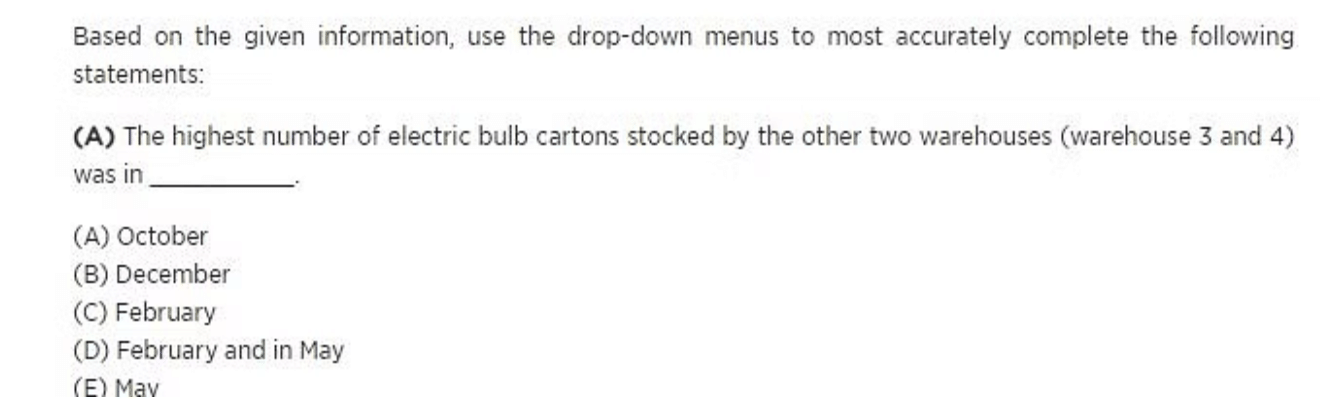
This section measures the aspirant's ability to explain the information presented in a graph or graphical image. Candidates are asked to discern relationships, and make inferences.
- Graphic interpretation questions contain a graph pie chart table or any graphical representation regarding the data.
- There are two or three questions with a drop-down option to select the answer.
- The graphical representation contains all the important information required to answer the question.
Example:
Multi-Source Reasoning
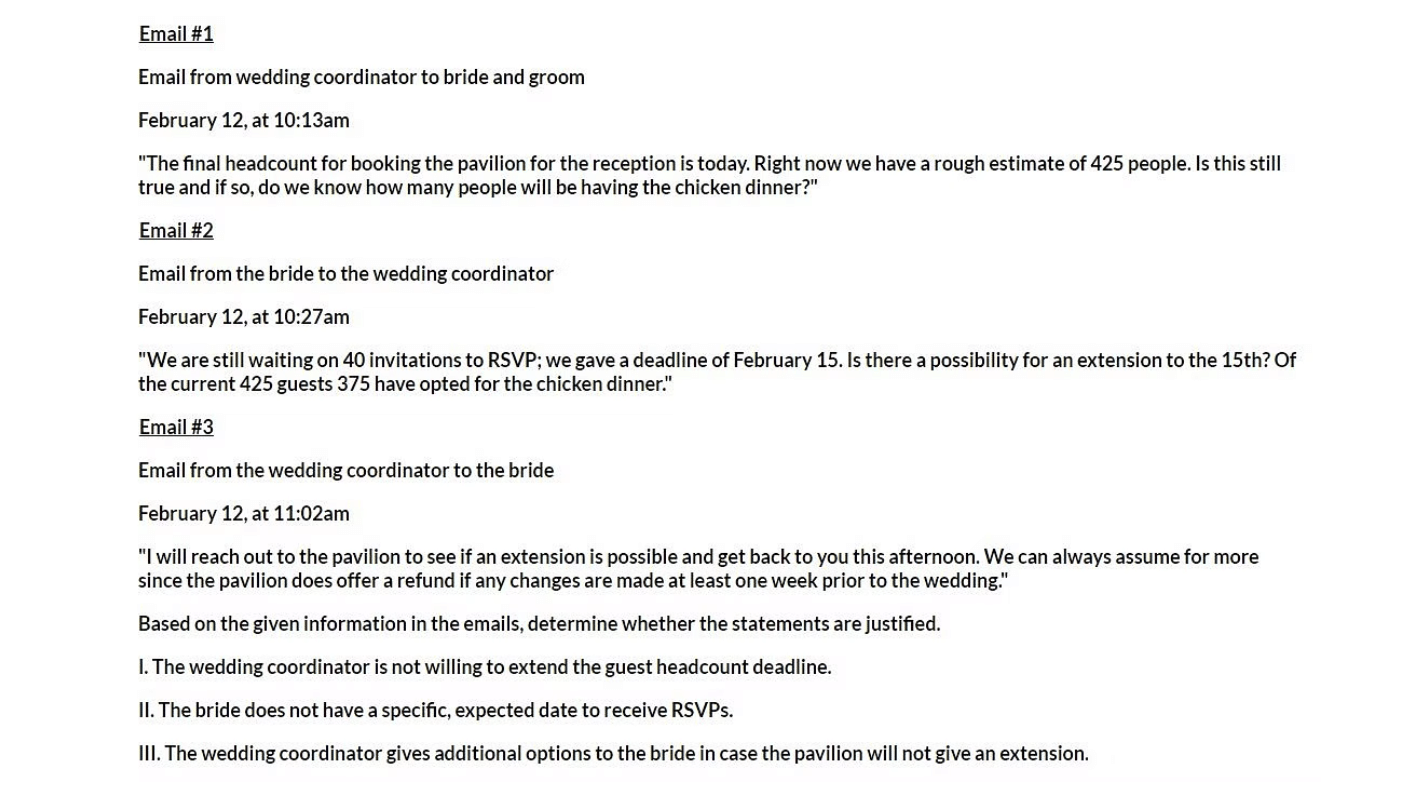
Multi source reasoning GMAT questions measure a candidate’s ability to examine data from multiple sources. Multi source reasoning questions GMAT include text passages, tables, graphics, or some combination of the three. Candidates need to analyze each source of data carefully to answer multiple questions.
- In multi-source-based questions, there are 2 to 3 sources in the form of a table graph or any text information.
- Based on the multi source information provided, there are two to three questions in the yes or no format.
- The questions remain the same for each source, and answers might be driven from any of the sources.
GMAT Integrated Reasoning Preparation Tips
Integrated Reasoning GMAT requires skills like interpretation, analysis, reasoning, graphical interpretation, and more. There are a few GMAT preparation tips and tricks that help students score high on GMAT integrated reasoning. Candidates need to practice with GMAT integrated reasoning practice questions, to familiar with the exam pattern. Following are a few tips for IR practice GMAT:
- The answer choices for a single question are presented on the same screen.
- Candidates must submit responses to all parts before moving on to a new question.
- Candidates must answer all parts of a single question correctly to receive credit. No partial credit is given.
- Once the answer is given, candidates are not able to go back and change the answer.
- Question based on the same graphic or data.
- The questions may be based on quantitative elements, it is not a test of quantitative skills. An online basic calculator will be available, but not necessary for this section.
GMAT Integrated Reasoning Books
GMAT books help candidates through GMAT IR questions, preparation techniques, and time-management practices. The books help candidates understand the test strategies and achieve a good GMAT integrated reasoning score. GMAT preparation books also contain GMAT integrated reasoning sample questions and answers, which can help candidates to ace the exam preparation.
- Manhattan GMAT Integrated Reasoning and Essay GMAT Strategy Guide (Guide 9)-Check PDF
- GMAT Official Guide 2022 Bundle-Check PDF
- Kaplan GMAT Prep Plus -Check PDF
- Veritas Prep Complete GMAT Course Set -Check PDF
GMAT Integrated Reasoning Sample Questions
Integrated reasoning practice questions help candidates to improve their analyzing and reasoning skills. Regular practice with GMAT sample papers, candidates can achieve their desired GMAT results. Following are a few practice questions for GMAT integrated reasoning questions:
GMAT integrated reasoning questions test a candidate’s ability to solve complex problems. GMAT IR section involves both quantitative and verbal reasoning. Candidates must answer all responses to a question correctly. A GMAT IR score of 6 or above is suitable for the integrated reasoning GMAT.
FAQs
Ques - Is integrated reasoning difficult in GMAT?
Ans - Most of the candidates consider GMAT integrated reasoning as the difficult section.
Ques - What is integrated reasoning on the GMAT?
Ans - GMAT IR section evaluates relevant data from different sources and organizes data to see relationships and to solve multiple, interrelated problems.
Ques - Where can I practice integrated reasoning for GMAT?
Start practicing with free GMAT sample papers, and understand the structure of the exam.
Ques - What is the maximum score on the GMAT IR?
Ans - The maximum score on the GMAT IR is 8.
Ques - Can I crack GMAT with self-study?
Ans - With expert guidance, and regular practice candidates can crack GMAT with self-study.
Ques - How do I prepare for integrated reasoning?
Ans - Brush up on graph reading skills, notice where math and verbal skills overlap, develop a test-taking rhythm with practice tests, and answer realistic sample questions.
Ques - What is a good GMAT integrated reasoning score?
Ans - A score of 6 or higher is considered a good GMAT score.
Ques - What GMAT score do I need for Harvard?
Ans - Candidates need at least a 700+ score to get admission to Harvard.
Ques - Can I pass GMAT without coaching?
Ans - With regular practice and proper dedication, candidates can pass GMAT without coaching.
Ques - What GMAT score is required for IIM?
Ans - A minimum score of 715 is required for admission to the top 10 IIM colleges in India.
Ques: How to prepare for integrated reasoning in GMAT?
Ques: Where can I practice IR for GMAT?
Ques: Can I skip integrated reasoning?
Ques: Can I crack GMAT with self-study?
Ques: What is a good GMAT IR score?
Ques: What is the average GMAT IR score?
Ques: Does integrated reasoning affect GMAT score?
Ques: Can a weak student crack GMAT?
Ques: Can I get 700 in GMAT without coaching?
Ques: What is syllabus for GMAT exam?
*The article might have information for the previous academic years, please refer the official website of the exam.