
GMAT Study Plan: Preparation for Beginners and Advanced Students


Content Curator | Updated On - May 17, 2024
Highlights:
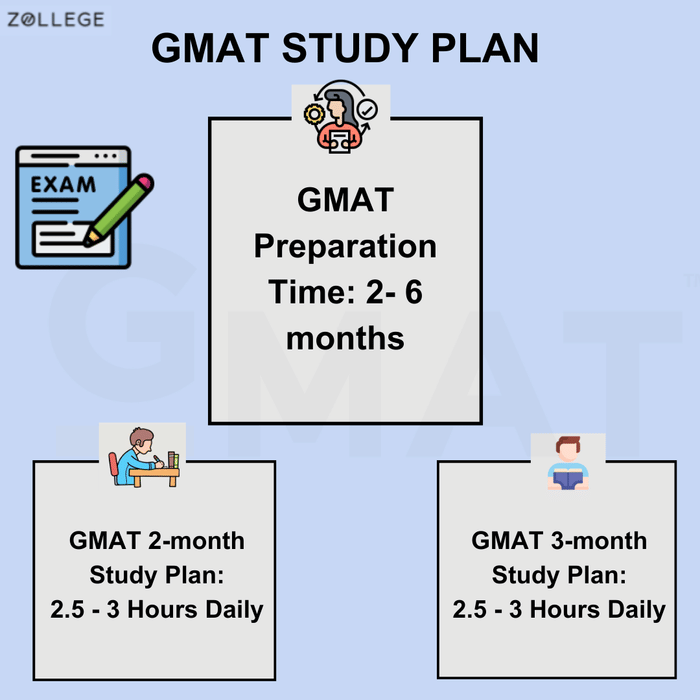
- The preparation for GMAT exam can be 2 – 6 months.
- GMAT popular study plans include 2 month study plan and 3 month study plan.
- GMAT focus edition has 64 questions and is divided into 3 sections
- The four important GMAT sections include Quantitative, Verbal, Integrated Reasoning and Maths.
GMAT study plan is a strategic study roadmap to achieve the targeted score for abroad MBA universities. GMAT preparation plan can range from 2 to 6 months, depending on your knowledge and the available time to study. Creating a best GMAT study plan will help them utilize the available time effectively for GMAT preparation. Studying for at least 10 hours a week increases the chances of acing the GMAT exam. The most common is the three months study plan. During the first 2 months, we need to focus on mastering the strategic approaches of GMAT exam. During the next month, we can practice and solve multiple GMAT practice tests to reach their targeted score. Beginners can opt for 2 months study plan to understand the GMAT exam and the types of questions in the first month. However, before beginning preparation, it is essential to know the updated GMAT syllabus.
GMAT Exam Pattern
The new GMAT Exam pattern will be available from January 31st, 2024. The syllabus of the new GMAT focus edition consists of 64 questions and is divided into 3 sections. Candidates taking the test before that will focus on the older version of GMAT. This will help you to prepare a GMAT study schedule effectively.
| GMAT Sections | Time Limit | Number of questions | Score Range |
|---|---|---|---|
| Quantitative Reasoning | 45 minutes | 21 questions | 6–51 |
| Verbal Reasoning | 45 minutes | 23 questions | 6–51 |
| Integrated Reasoning | 30 minutes | 12 questions | 1–8 |
| Analytical Writing Assessment | 30 minutes | 1 question | 0–6 |
| Total | 3 hours 7 minutes | 80 questions | 200–800 |
GMAT 2 Month Study Plan
The GMAT Study plan helps to cover the entire GMAT syllabus on time. It can be considered as a beginner’s study plan. A 2-month GMAT self study plan also gives ample time to practice GMAT question papers. A 2-month study plan for GMAT can be enough if you are dedicated and consistent. The GMAT study calendar or study plan is provided below:
| Study Time : 2.5 - 3 hours Daily | ||
|---|---|---|
| Week | Day | Study Plan |
| Week 1 (GMAT Quant) | Day 1 | Learn the GMAT Exam pattern |
| Day 2 | Go through the syllabus, number of questions and marking criteria | |
| Day 3 | Take a test on GMAT Quant and GMAT Arithmetic | |
| Day 4 | Analyze the test and work on weak areas | |
| Day 5 | Practice GMAT Quantitative questions | |
| Day 6 | Retake 2 mock tests for GMAT Quantitative section | |
| Day 7 | Review the results of the mock tests | |
| Week 2 (GMAT Verbal) | Day 1 | Learn the GMAT Verbal Reasoning section |
| Day 2 | Understand GMAT Reading Comprehension, Sentence Correction and Critical Reasoning | |
| Day 3 | Take a test on GMAT verbal topics | |
| Day 4 | Analyze the test and work on weak areas | |
| Day 5 | Practice GMAT Verbal questions, Review sample questions and answers | |
| Day 6 | Retake 2 mock tests for GMAT verbal section | |
| Day 7 | Review the results of the mock tests | |
| Week 3 (GMAT AWA) | Day 1 | Learn the GMAT AWA concepts and check question types |
| Day 2 | Know the strategies and tips for GMAT AWA section | |
| Day 3 | Practice with AWA prompts and Mock tests | |
| Day 4 | Write sample GMAT essays | |
| Day 5 | Read Sample answers of previous years | |
| Day 6 | Check the writing, spelling or grammatical mistakes | |
| Day 7 | Take 2 or more GMAT AWA mock test | |
| Week 4 | All Days | Check your progress Practice Mock tests for all sections Review the results Understand the areas to focus on Keep a note |
| Week 5 | GMAT Verbal review (2 days) | Build your knowledge on Comprehension and GMAT Critical reasoning Practice Mock tests |
| GMAT Quant review (2 days) | Build your knowledge on basic Math and GMAT Data Sufficiency Practice full length mock tests | |
| GMAT AWA review (2 days) | Review the GMAT AWA Topics Build Vocabulary Practice Mock Tests | |
| Week 6 (GMAT Integrated reasoning) | Day 1 | Learn about GMAT IR questions and the overall structure |
| Day 2 | Practice real GMAT Integrated Reasoning questions | |
| Day 3 | Review and understand the mistakes | |
| Day 4 | Read more about GMAT IR section and understand the question format | |
| Day 5 | Practice 2-3 mock tests | |
| Day 6 | Go through Official GMAT Study Guides for integrated reasoning | |
| Day 7 | Prepare Tips and Tricks for all sections to decrease the time and increase efficiency | |
| Week 7 | Whole Week | Review GMAT Verbal concepts Review GMAT Quant concepts Review GMAT AWA concepts Review GMAT Integrated Reasoning |
| Week 8 | Whole Week | Practice full length GMAT exam sample papers Check the progress and record the marks Review all sections and practice more mock tests |
3 Month GMAT Study Plan
The GMAT 3 month study plan is the ideal plan for most students. Since most GMAT aspirants are working professionals, getting time out for studies can be tough. This 3 month GMAT study plan will help them. However, make sure to check the GMAT cutoff of previous years before starting your preapration. The GMAT planner as per week are:
| Study Time - 2 hours Daily | ||
|---|---|---|
| Month 1 | Week 1 | Understand the GMAT Exam Pattern and GMAT score Know the GMAT exam Syllabus Learn about all sections and question types |
| Week 2 | Practice mock tests to understand the question pattern | |
| Week 3 | Review the scores and understand the weak points Go through the GMAT Quant section | |
| Week 4 | Review the GMAT AWA, Verbal reasoning and Integrated Reasoning | |
| Last Day of Month 1: Learn Time Management Skills | ||
| Month 2 | Week 1 | Learn the basic Math Solve GMAT Math practice papers Review and work on the mistakes |
| Week 2 | Learn the GMAT AWA section Solve GMAT AWA practice papers Review and work on the mistakes | |
| Week 3 | Gain knowledge on Integrated Reasoning and Verbal reasoning Practice GMAT IR and GMAT Verbal reasoning mock tests | |
| Week 4 | Increase logical knowledge and vocabulary Follow the template Solve GMAT verbal practice papers | |
| Last Day of Month 2: Learn Tips and Tricks to solve GMAT questions | ||
| Month 3 | Week 1 | Revise all sections of the GMAT Exam |
| Week 2 | Solve GMAT Verbal and GMAT Quant practice papers | |
| Week 3 | Solve GMAT AWA and GMAT IR practice papers | |
| Week 4 | Take full GMAT mock test and score yourself | |
GMAT Study Plan Requirements
A GMAT study plan alone is not sufficient to help you prepare for GMAT. GMAT study plan for working professionals will require multiple helping accessories like Books, sample papers and many more. Few essentials to prepare for GMAT are:
- Full-Length Practice Tests - It is very important to understand what the real question format in GMAT looks like.
- Preparation Books - Candidates can study about the question types and their sources from the books. The GMAT prep books also contain practice papers
- Online Coaching Classes - If you are stuck anywhere in between, the GMAT Online classes will help to solve the problem.
- Experience Tutors: Learning from experienced teachers helps to learn about the most popular questions.
The point of preparing a study plan is to never waste time wondering what you should do next. GMAT study plan helps the candidate to trust the process of preparation. Candidates can increase or decrease the study time as per their feasibility and GMAT preparation schedule.
GMAT Sample Papers
GMAT Quant Practice Tests
| GMAT Quant Practice test 1 | GMAT Quant Practice test 2 |
| GMAT Quant Practice test 3 | GMAT Quant Practice test 4 |
GMAT Verbal Practice Test
| GMAT Verbal Practice test 1 | GMAT Verbal Practice test 2 |
| GMAT Verbal Practice test 3 | GMAT Verbal Practice test 4 |
GMAT AWA Practice Test
GMAT Integrated Reasoning Practice Test
| GMAT Integrated Reasoning Practice - Paper 1 | GMAT Integrated Reasoning Practice - Paper 2 |
| GMAT Integrated Reasoning Practice - Paper 3 | GMAT Integrated Reasoning Practice - Paper 4 |
FAQs
Ques: How long do you need to study for the GMAT?
Ans: Studying for GMAT takes time if around 2-3 months minimum. The maximum time might vary from 6-8 months. Candidates should practice more to make the time shorter.
Ques: What is a good GMAT study plan?
Ans: A good GMAT study plan is 2-3 hours on GMAT preparation during the workday and 4 hours on weekend. Students can divide this into 7 days. 2 hours per day.
Ques: Is 700 in GMAT tough?
Ans: Yes, getting 700 in GMAT is tough because only 20% of candidates achieve this score. Some people who have studied math or verbal topics before preparing for the GMAT find the GMAT Quant or Verbal section relatively easy.
Ques: Is 750 GMAT easy?
Ans: No, it is not easy to get 750 in GMAT. To achieve 750, candidates must answer all the medium-difficulty questions in the Quant and Verbal sections of the test correctly. They must also solve a few hard questions correctly.
Ques: Can I score 700 in GMAT in 3 months?
Ans: Yes, scoring 700 in GMAT in 3 months practice is possible. The study hours must contain 120 which is almost 3 months of study.
Ques: Is 650 GMAT difficult?
Ans: Getting 650 and above is difficult in GMAT. More than 70% of the candidates receive a score below 650. Hence, students must be among the top 30-35% to score a 650 in GMAT.
Ques: What are the GMAT exam fees in India?
Ans: The GMAT exam fee is USD 275 for the Test Center. The fee for Online exam is USD 300. Candidates can pay via credit cards and debit cards to pay GMAT exam fees.
Ques: Can I score 750 in GMAT in 2 months?
Ans: Scoring 750 in GMAT in 2 months is very difficult. Students will need at least 4 hours of daily study time. Along with this, they need dedication and lots of practice.
Ques: Which is easier: GRE or GMAT?
Ans: The quantitative section on the GRE is a bit easier than GMAT. The GRE Math section typically has more geometry, while the GMAT has more logical reasoning questions. The GRE verbal section, on the other hand, tends to feature more difficult vocabulary than the GMAT.
Ques: Can I get into Harvard with 700 GMAT?
Ans: It is difficult to get into Harvard with a score of 700. The university usually accepts candidates with a score of 750 and above with sufficient work experience.
*The article might have information for the previous academic years, please refer the official website of the exam.