
GMAT Critical Reasoning: Question Types, Preparation Tips, and Books


Content Curator | Updated On - Apr 26, 2024
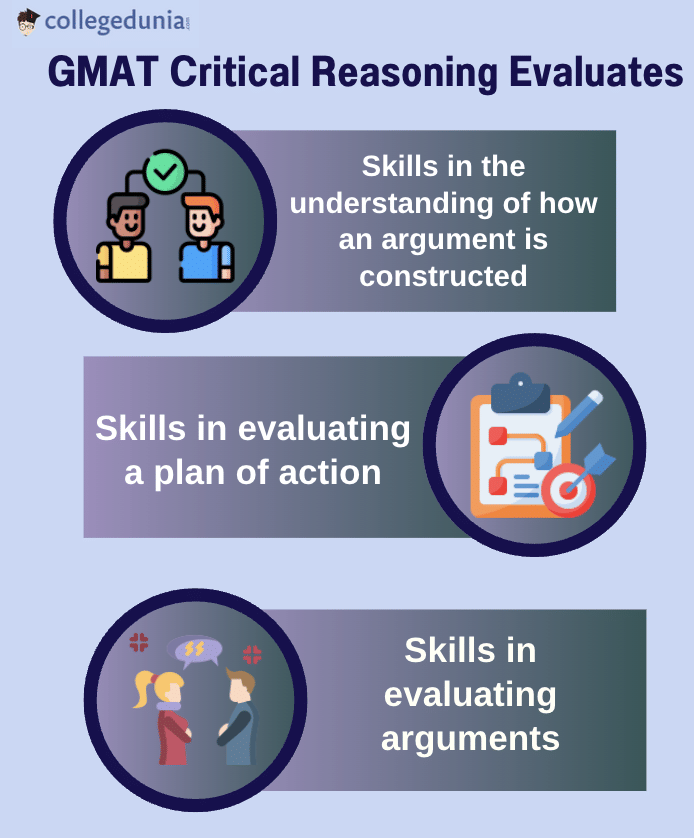
GMAT Critical Reasoning is the subdivision of the Verbal Reasoning section. Your ability to make arguments, evaluate arguments, and formulate or evaluate a plan of action is measured on the critical reasoning section. GMAT critical reasoning questions are based on a short reading passage, usually fewer than 100 words. Solving these types of questions require two fundamental skills, which are Strong logic and Precise reading. It is difficult to develop and needs lots of practice and concentration. The questions on GMAT critical reasoning section contain complicated arguments that are difficult to comprehend. You should be logical and know how to present the ideas in an argument and make strategies according to the customers' needs and demands.
| Table Of Contents |
GMAT Critical Reasoning Skills
GMAT critical reasoning skills are divided into four categories. It consists of logical reasoning questions that cover about one-third of a candidate's GMAT Verbal score. You should give proper time to practicing GMAT critical reasoning questions.
- Analysis - In this, candidate need to analyse the argument and understand the relationship between various parts of the arguments
- Construction - It tests the constructing ability to upload the information whether the argument is true or not.
- Critique - it tests our ability to critique an argument, it questions the validity of arguments.
- Plan - It tests our ability to construct and critique arguments related to a plan of action.
GMAT Critical Reasoning Questions Types
Critical reasoning questions are usually 80-100 words with a question stem also known as the stimulus. Types of critical reasoning questions GMAT provides information that has both stated information: premises and a defined main conclusion. Five answer choices of which four choices are potentially confusing alternatives. Having a better understanding of the question types will helps the candidates to achieve a higher GMAT score. The most typical questions that are asked in Critical Reasoning are consists of three different types that include -
- Type 1: Questions have several subtypes: Strengthening an argument, Weakening an argument, identifying the assumption of an argument, evaluating an argument and explaining the paradox.
- Type 2: Questions are based on methods of reasoning questions that are usually boldfaced questions. Taken from various topics such as arts, science, literature, politics and psychology. So candidates should not need specific knowledge in a particular domain. Candidates simply need to have general overview knowledge, strong logic and concentrate on reading.
- Type 3: Questions are based on interference and conclusion based.
GMAT Critical Reasoning Sample Questions
Regularly solving GMAT critical reasoning practice questions will helps you candidates achieve a higher score on the examination. GMAT Focus edition made a few changes to the verbal reasoning section, so always practice critical reasoning with the most updated study materials.
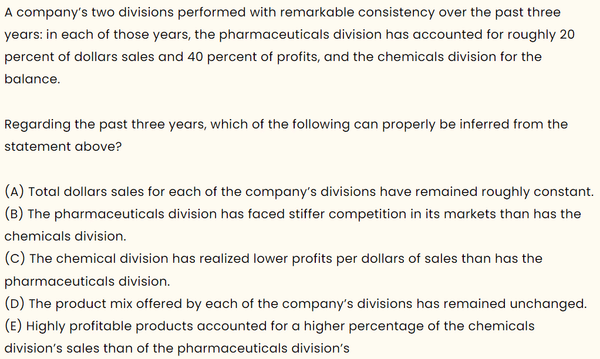
- Inference: In this type of question, find a statement that can be logically concluded as certainly true based on the given information.
SAMPLE:
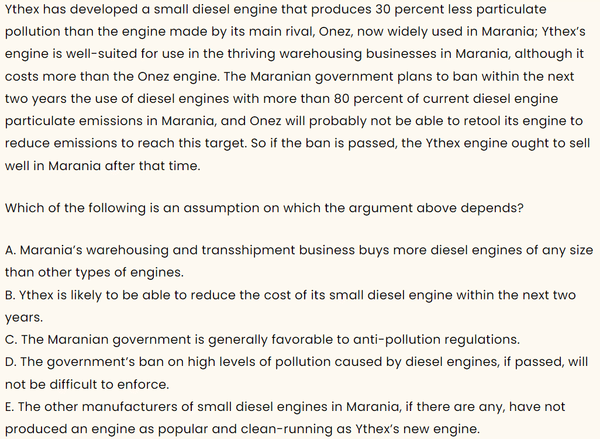
- Assumption: In critical reasoning assumption questions type of question, the author of the argument claims something and the candidate has to make an assumption based on the given stated premise. The author's conclusion depends on the assumption statement being true. If the assumption is not true, the author can't make that conclusion anymore.
SAMPLE:
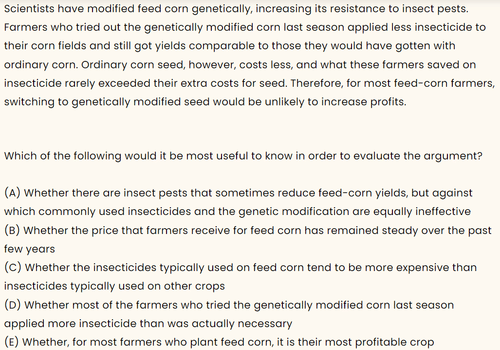
- Evaluate: In this type of question, the validity and strength of an argument are evaluated. candidates have to identify among the answer choices to evaluate whether the argument is logical correct or not.
SAMPLE:
- Strength: In this type of question, candidates have to identify the statement that brings new information that strengthens the conclusion of an argument.
SAMPLE:
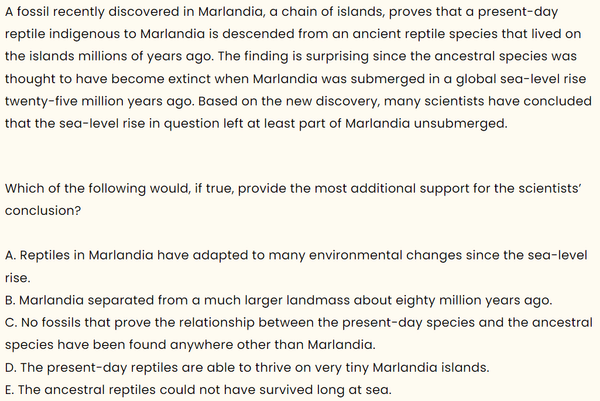
- Weaken: In this type of question, candidates have to identify the statement that brings new information which creates doubt over the conclusion of the argument.
SAMPLE:
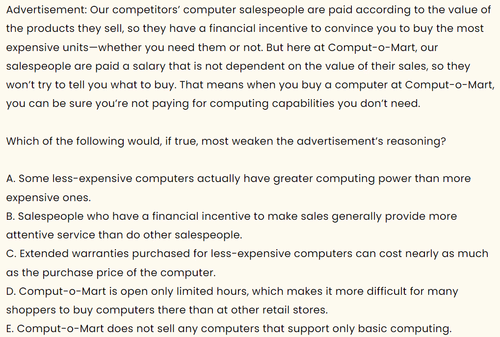
- Logically completes: In this type of question, candidates have to fill in the blanks in the argument logically.
SAMPLE:
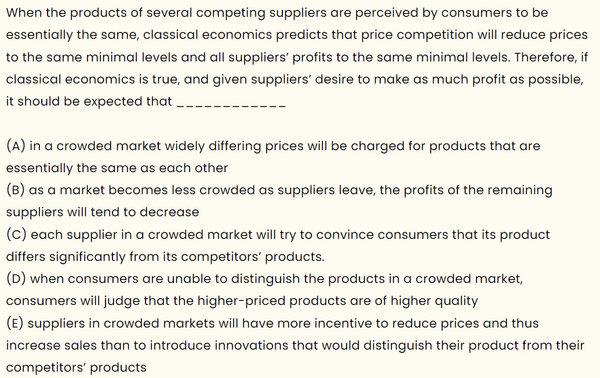
- Paradox: In this type of question, candidates have to find the paradoxical situation and resolve it through logical explanation.
SAMPLE:
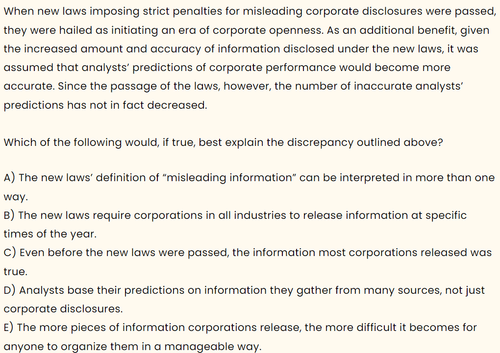
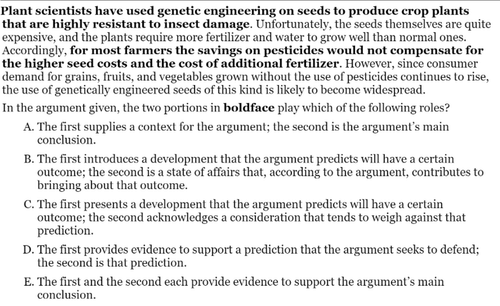
- Boldface: In this type of question, candidates have two bold statements and have to identify the functions of both statements.
SAMPLE:
GMAT Critical Reasoning Preparation Tips
GMAT critical reasoning preparation is important to achieve a higher score in the verbal section. There are in total 23 verbal reasoning questions in GMAT, divided into critical reasoning, and reading comprehensive types. Critical reasoning GMAT preparation includes reading updated study materials, solving sample papers, and taking feedback from experts. Here are some GMAT preparation tips to ace the critical reasoning section:
- The approach to solving passages should be simple, precise, and fruitful. This is because the question writers purposefully make this task difficult to consume the candidate's time.
- Read the Question carefully instead of jumping to answer choices. GMAT preparation for assumption questions are essential to read the question and identify what type of question is asked.
- Master the art of deconstructing arguments that will help understand the passage. Don't waste time on unnecessary and additional information.
- Consistency is the key to decoding Critical Reasoning, so spend time on practice and so on solving high-quality materials with proper explanations.
- Developing strong logic skills and reasoning efficiency because it helps in understanding the logic behind the keywords of the passage.
- Analyzing the answers is the last step, after understanding and deconstructing the argument candidate must know how to crack the question with the correct answer. Stay focused because question writers added Wordplay, and word shifts in the answers to confuse the candidates in the last process of the
- Learn how to solve or deal with difficult tricks and traps of Wordplay, able to find the flaws efficiently. Don't waste time on the difficult questions and avoid the elimination trick while solving critical reasoning because it doesn't work on these questions.
GMAT Critical Reasoning Books
Two books for GMAT critical reasoning are attached in the pdf format below with pricing and availability. GMAT Books have sufficient materials for the preparation of GMAT critical reasoning but the price is on the higher end. GMAT Critical Reasoning Bible and Manhattan GMAT Strategy Guide will help candidates in recognizing the question type. It helps candidates in the breakdown of the argument.It will increase candidate's accuracy and speed.
- GMAT Critical Reasoning Bible [EnglishOnlineClub.com] - Check PDF
This Book is available on Amazon for 2988 INR. - Manhattan GMAT Strategy Guide 6 Critical Reasoning - Check PDF
To score between a score range of 700-800 candidates must know how to deal with the particular section and sub-topics of the section. Many of the candidates don't focus on the critical reasoning portion and take it lofty, resulting in a poor GMAT Score range. So candidates must focus and spend an ample amount of time practising logical reasoning that will help candidates in GMAT. It is mandatory to identify the question type and answer according to it. Don't waste time on the same question which has tricks and traps to consume the candidate's time.
FAQs
Ques: Is GMAT Critical Reasoning hard?
Ques: How many critical reasoning are there in GMAT?
Ques: What is GMAT Critical Reasoning?
Ques: What are the different types of GMAT Critical Reasoning questions?
Ques: How is a GMAT Critical Reasoning passage structured?
Ques: What is the structure of GMAT Weaken question?
Ques: How do I approach a GMAT Critical Reasoning question?
Ques: How do I identify the conclusion in a GMAT CR argument?
Ques: How do I deal with long or complex GMAT CR arguments?
Ques: How do I avoid careless mistakes on GMAT Critical reasoning?
Ques: How do I manage my time on GMAT Critical Reasoning section?
Ques: How do I prepare for GMAT Critical Reasoning?
Ques: What official GMAT study materials are available for Critical Reasoning?
Ques: What GMAT prep books would you recommend for Critical Reasoning?
Ques: How do I improve my Critical Reasoning skills for the GMAT?
Ques: What are some common types of arguments tested on the GMAT CR?
Ques: How do I handle reasoning questions on the GMAT?
Ques: What is on GMAT Syllabus?
Ques: Is critical reasoning difficult?
Ques: Is getting 750 in GMAT tough?
*The article might have information for the previous academic years, please refer the official website of the exam.