
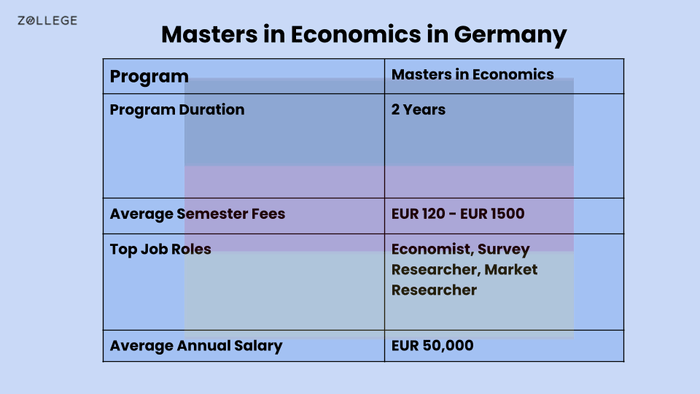
Masters in Economics in Germany is a 2-year full-time program. It is a course in the study of micro and macroeconomics, game theory, international economics, quantitative techniques, etc. The average semester fees charged for a masters in economics in Germany range around EUR 120 (INR 10,777.76) - EUR 1500 (INR 1,34,721.99) per semester. All how to do masters in Germany queries include if German is required for the course. Well, most universities do require German during the admission process. You can apply in the private and public universities of Germany in summer and winter intakes.
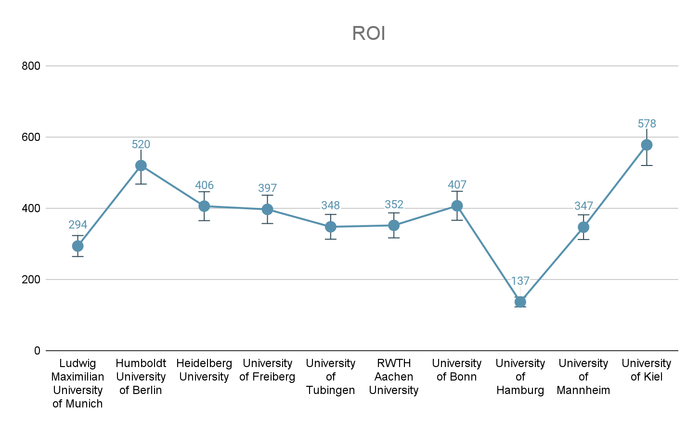
We have given above an ROI graph. To explain it, ROI or Return of Investment is the monetary return value that you receive after studying in Germany. It is calculated in percentage value. The cost of studying in Germany along with your living expenses is your total value. In return for the expenses, the average salary you receive is your benefit. From the above graph we can see that University of Kiel provides the maximum return on investment equal to 578%. On the other hand, the University of Hamburg provides the least amount of return, 137%.
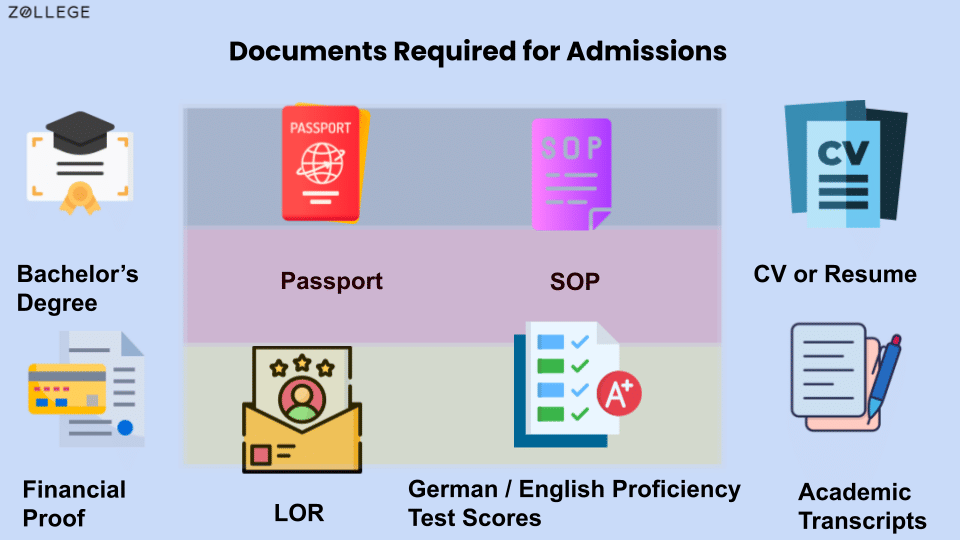
Now let us consider what are the requirements for masters in Germany. To study in the top universities in Germany for masters in economics, a bachelor degree is required. Moreover, the English Language Proficiency test scores of IELTS, TOEFL, PTE are also mandatory. The universities in Germany also require evidence of German Language Proficiency, such as TestDaf, DSH, Goethe, etc.
Why Study Masters in Economics in Germany?
To study in Germany, for masters in economics, you must enrol in the top universities of Germany. The universities in Germany provide many specializations in economics courses. We suggest that before applying, you must check the course page of a particular university. The below given points show why Germany is best for masters in economics:
- The universities in Germany such as University of Mannheim, LMU Munich, University of Bonn and others rank in the top 100 of the Times Higher Education World Rankings for Economics.
- It is reported that the demand and salary of economists in Germany increase by 16% every year.
- Germany has a growing economy, hence the rate of unemployment here is very low. The rate of unemployment is just 3.1%.
Top Universities in Germany for Masters in Economics
Best universities in Germany for masters in economics do not charge any tuition fees. A nominal semester fee is charged from the candidates. The universities in Germany accept applicants in two intakes of Germany, which are the summer and winter terms. The table given below shows the universities in Germany for masters in economics courses:
| University | Semester Fees | Deadline 2024 |
| Ludwig Maximilian University of Munich | EUR 129 (INR 11,586.09) per semester | April 30 |
| Humboldt University of Berlin | EUR 307 (INR 27,573.10) per semester | May 31 |
| Heidelberg University | EUR 151.05 (INR 13,566.50) per semester | September 30 |
| University of Freiberg | EUR 1500 (INR 1,34,721.99) per semester | Summer Semester: May 15 Winter Semester: September 30 |
| University of Tubingen | EUR 1500 (INR 1,34,721.99) per semester | May 15 |
| RWTH Aachen University | EUR 303.49 (INR 27,257.85) per semester | September 1 |
| University of Bonn | EUR 320 (INR 28,740.69) per semester | March 31 |
| University of Hamburg | EUR 11,000 (INR 9,87,961.29) per year | March 31 |
| University of Mannheim | EUR 1500 (INR 1,34,721.99) per semester | May 15 |
| University of Kiel | EUR 120 (INR 10,777.76) per semester | Summer Semester: January 15 Winter Semester: July 15 |
EUR 1 = INR 89.81 as on March 29th 2024
How to Apply for Admissions?
To know how to do a masters in Germany, then the most important part is to acknowledge the correct application process. Some universities even charge an application fee from the candidates to apply to German Universities. The universities in Germany also recommend every applicant to pay any kind of fee through their official payment's portal. Given below are the application step for master's in economics in Germany:
- Select a university
- Visit the official website of the university
- Fill up the application form
- Provide the academic personal and professional details
- Mention the English language and German Language Proficiency test scores\
- Provide the supporting documents as required
- Pay the application fee if required
- Submit the application
Eligibility Criteria for Admissions
The eligibility criteria for pursuing courses of MS in Germany may depend on the university you are applying for. Pursuing economics in Germany would require the proper evidence of English and German Language Proficiency test scores. Some universities may also ask for a GPA score. The below-mentioned are some points to know what are the requirements for masters in Germany:
- A bachelor’s degree in a related field is preferred
- Minimum GPA score of 3.0
- Proper scores of English and German Language Proficiency tests
- Work experience may be required in some universities
Documents Required for Admissions
The documents required for admissions may vary according to your place of residence. A valid passport and German student visa are mandatory for admissions. Documents as required in a university must be submitted along with the application form. Given below are the important documents required at the best universities in Germany for masters in economics:
Masters in Economics in Germany Score Requirements
Apart from the general eligibility criteria, you would also be required to submit scores of certain exams to study in Germany. If you are worried about what are the requirements for masters in Germany, then let us inform you that scores of IELTS, TOEFL, TestDaf, DSH are required. Attach your test score report along with your admission form. The below-mentioned table shows the master degree in economics in Germany score requirements:
| University | English Language Proficiency Test Scores | German Language Proficiency Test Scores |
| Ludwig Maximilian University of Munich | TOEFL Score: 80 IELTS Score: 6.5 |
TestDaf, DSH, Goethe scores required |
| Humboldt University of Berlin | TOEFL Score: 72 IELTS Score: 5.5 |
DSH: Score required TestDaF: Level 4 Goethe: Official score required |
| Heidelberg University | TOEFL Score: 79 IELTS Score: 6.5 |
Scores required are TestDaF Goethe certificate B2 or C1 Deutsch C1 Hochschule |
| University of Freiberg |
TOEFL Score: 70 |
DSH 1 TestDaF 3 or 4 Goethe certificate B2 or C1 |
| University of Tubingen | IELTS Score: 6.5 or more TOEFL Score: 79 or more |
DHS Certificate: B2-C1 TestDaF Certificate or Telc C1 scores required |
| RWTH Aachen University | TOEFL Score: 100 IELTS Score: 7.0 PTE Score: 70 |
TestDaf, DSH, Goethe scores required |
| University of Bonn | TOEFL Score: 72 IELTS Score: 6.0 PTE Score: 59 |
Goethe Certificate B1 (min. 75% in the overall result) Telc Certificate B1 (min. 75% in the overall result) TestDaF Certificate showing the minimum level of TDN 3 |
| University of Hamburg | TOEFL Score: 70 IELTS Score: 5.5 |
Test Deutsch: 16 points Goethe-Certificate C2 TestDaF Deutsch C1 Hochschule |
| University of Mannheim | TOEFL Score: 80 IELTS Score: 6.5 |
TestDaf: Level 4 DSD: Level 2 DSH: Level 2 |
| University of Kiel | TOEFL Score: 90 IELTS Score: 6.5 |
DSH - 2 TestDaF scores required Telc C1 scores required |
Cost of Attendance in Germany
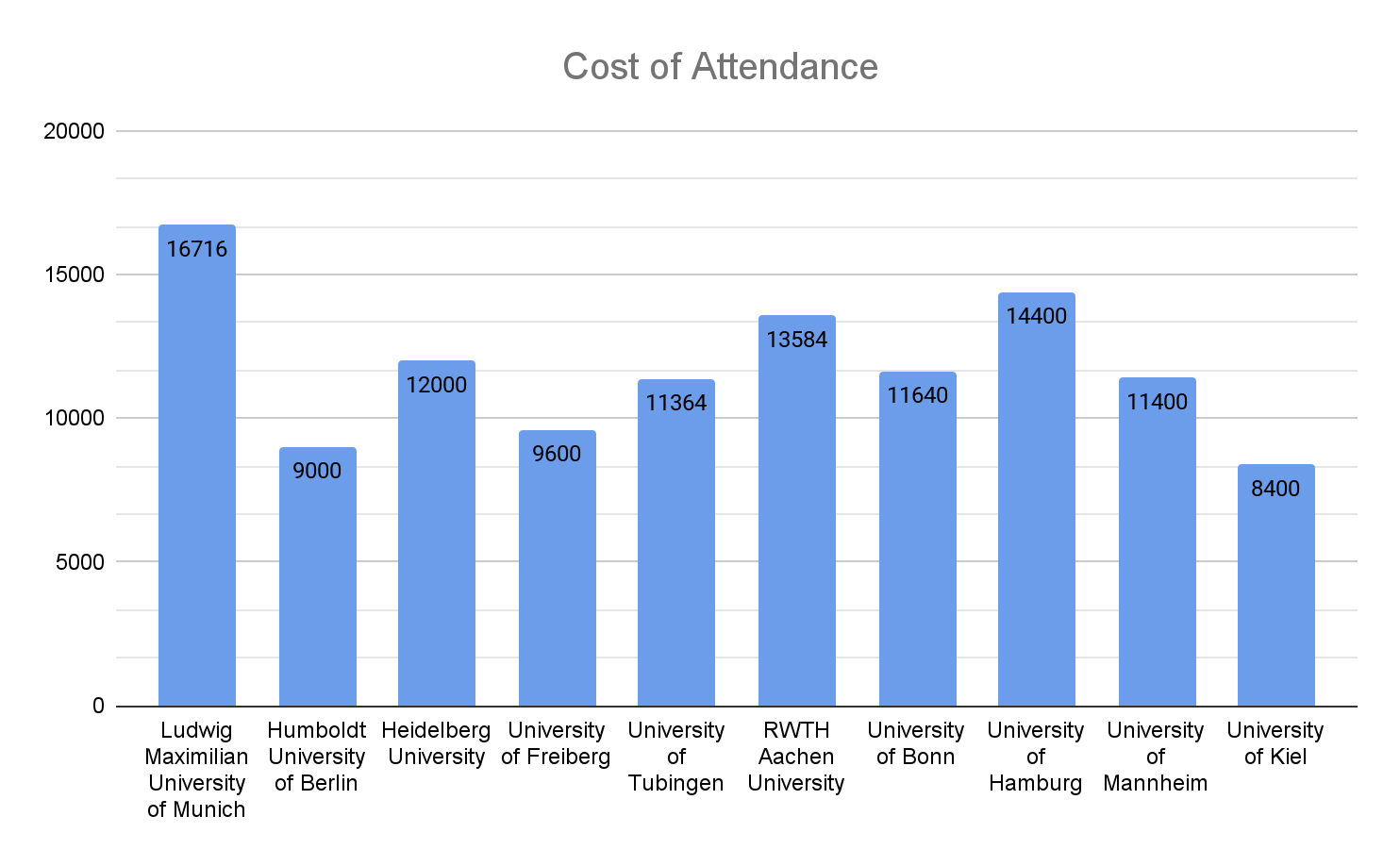
Besides the cost of studying, other costs include the expenses of accommodation, food, books and supplementary materials, utilities, etc. The actual costs may vary depending on the location of the university and type of accommodation you are choosing. From the below graph, we can see that Ludwig Maximilian University of Munich is the most expensive, equal to EUR 16,716 (INR 15,01,341.90). As compared to it, the University of Kiel cost the least, equal to EUR 8,400 (INR 7,54,443.16) and is really affordable for students. The cost of living in Germany at the best universities in Germany for masters in economics are given below:
EUR 1 = INR 89.81 as on March 29th 2024
Scholarships for Economics in Germany
Foreign students can apply to a number of scholarships to study abroad. The scholarships available in the public universities in Germany for masters in economics are mostly awarded on merit basis. You can apply for all these scholarships in Germany for international students from the official website of a university. Master degree in economics in Germany scholarships are given below:
| University | Scholarship Eligibility | Amount |
| Ludwig Maximilian University of Munich | Must be enrolled in a full-time program at the university Awarded on merit basis | Varies |
| Humboldt University of Berlin | Awarded to international students on their academic merit | EUR 725 to cover the expenses of student accommodation in Germany |
| Heidelberg University | Merit basis and financial need basis | Varies |
| University of Freiberg | Awarded to international students pursuing a masters program in the university | EUR 300 (INR 26,944.40) |
| University of Tubingen | Must have good academic records and a competitive GPA score | EUR 300 (INR 26,944.40) |
| RWTH Aachen University | GPA of 2.0 or higher Awarded on merit basis | EUR 300 (INR 26,944.40) as monthly stipend |
| University of Bonn | Available to all international candidates who have strong academic records | Varies |
| University of Hamburg | Must be enrolled in the university for a full-time graduate program Awarded on merit basis | EUR 850 (INR 76,342.46) |
| University of Mannheim | Must have good academic records Also awarded on financial need basis | Varies |
| University of Kiel | Academic excellence and past grades | EUR 300 (INR 26,944.40) |
EUR 1 = INR 89.81 as on March 29th 2024
Work Permit for Germany
For undertaking any full-time or part-time employment in Germany, a work permit is required. A valid work permit visa Germany cost is around EUR 75 (INR 6,736.10). The different types of work permit available are general work permit, highly skilled work permit, EU blue card for Germany, etc. You must apply on the official website of the German Embassy for a work permit. The minimum processing time is 1–3 months. Given below are some important documents for a successful work permit:
- An updated passport for candidates who immigrate to Germany
- Offer letter of employment
- Health insurance certificate
- Updated CV
- Financial Proof
- University or college degree
Job Outcomes for Masters in Economics in Germany
The universities in Germany provide attractive career opportunities to students of economics. The average salary for a master’s degree in Germany, economics is approximately EUR 50,000 (INR 44,90,733.12). The jobs in Germany roles offered after masters in economics are survey researcher, market researcher, policy analyst, economist, etc. The below given table shows the master's degree in economics salary along with the job profiles:
| Job Profile | Average Salary |
| Economist | EUR 45,000 (INR 40,41,659.80) |
| Survey Researcher | EUR 61,000 (INR 54,78,694.40) |
| Market Researcher | EUR 40,000 (INR 35,92,586.49) |
| Policy Analyst | EUR 42,000 (INR 37,72,215.82) |
| Data Analyst | EUR 62,000 (INR 55,68,509.06) |
EUR 1 = INR 89.81 as on March 29th 2024
Top Recruiters for Masters in Economics in Germany
The major recruiters that offer full-time or part-time jobs in Germany to candidates may vary according to the particular year. We recommend that you must maintain an updates CV at the placement of these companies. The interviewers may also check your past academic record and achievements. The top recruiters masters in Economics in Germany are given below:
- Deloitte
- Deutsche Bank
- EY
- Vodafone
- Sonae
The universities in Germany advise all students to apply to the courses as early as possible. Some universities accept applicants on a first come first served basis. However, cross-check all your documents as fraud and old documents may result in the rejection of your application. Information average salary for Masters degree in Germany has also been added for reference.
FAQs
Ques. How long is a Master in economics course in Germany?
Ans. Masters in Economics in Germany is a 2-year full-time program. To study in Germany, for masters in economics, you must enrol in the top universities of Germany.
Ques. What is a Master in Economics in Germany?
Ans. Master in Economics in Germany is the course in study of micro and macroeconomics, game theory, international economics, quantitative techniques, etc.
Ques. What is the average semester fee for a Master in economics in Germany?
Ans. The average semester fees charged for a masters in economics in Germany range around EUR 120 (INR 10,777.76) - EUR 1500 (INR 1,34,721.99) per semester.
Ques. When can I apply for a Masters in economics?
Ans. As international students, you can apply in the private and public universities of Germany in summer and winter terms.
Ques. Why study for Masters in Economics in Germany?
Ans. The universities in Germany such as University of Mannheim, LMU Munich, University of Bonn and others rank in the top 100 of the Times Higher Education World Rankings for Economics.
Ques. What are the tuition fees for Masters in Economics in Germany?
Ans. Best universities in Germany for masters in economics do not charge any tuition fees. A nominal semester fee is charged from the candidates.
Ques. Can I apply for a Masters in Economics in Germany?
Ans. To know how to do a masters in Germany, then the most important part is to acknowledge the correct application process. Some universities even charge an application fee from the candidates to apply to German Universities.
Ques. Where should I pay the semester fees and registration fees in German Universities?
Ans. The universities in Germany recommend every applicant to pay any kind of fee through their official payment's portal.
Ques. What is the eligibility criteria for Masters in Economics in Germany?
Ans. The eligibility criteria for pursuing MS courses in Germany may depend on the university you are applying for.
Ques. What exam scores are required for Masters in Economics in Germany?
Ans. The English Language Proficiency test scores of IELTS, TOEFL, PTE are also mandatory. The universities in Germany also require evidence of German Language Proficiency, such as TestDaf, DSH, Goethe, etc.
Ques. What documents are required for admission in Germany?
Ans. The documents required for admissions may vary according to your place of residence. A valid passport and German student visa are mandatory for admissions.
Ques. What is the cost of attendance for German Universities?
Ans. Besides the cost of studying, other costs include the expenses of accommodation, food, books and supplementary materials, utilities, etc.
Ques. Are scholarships available for Masters in Economics in Germany?
Ans. Foreign students can apply to a number of scholarships to study abroad. The scholarships available in the public universities in Germany for masters in economics are mostly awarded on merit basis.
Ques. What are the career prospects of Masters in Economics in Germany?
Ans. The jobs in Germany roles offered after masters in economics are survey researcher, market researcher, policy analyst, economist, etc.
Ques. What is the average salary for an economist in Germany?
Ans. The average salary for a masters degree in Germany, economics is approximately EUR 50,000 (INR 44,90,733.12).
Ques. How many types of work permits are available in Germany?
Ans. The different types of work permit available are general work permit, highly skilled work permit, EU blue card for Germany, etc.
Ques. What is the cost of a work permit in Germany?
Ans. For undertaking any full-time or part-time employment in Germany, a work permit is required. A valid work permit visa Germany cost is around EUR 75 (INR 6,736.10).
Ques. Where should I apply for a work permit in Germany?
Ans. You must apply on the official website of the German Embassy for a work permit. The minimum processing time is 1 - 3 months.
Ques. Is economics a good degree in Germany?
Ans. Yes. It is reported that the demand and salary of economists in Germany increase by 16% every year.
Ques. Can I do a Masters in Germany for free?
Ans. The universities in Germany for masters in economics do not charge any tuition fees. A nominal semester fee is charged from the candidates.

![Humboldt University of Berlin [HU]](https://static.zollege.in/public/college_data/images/studyabroad/logos/college_632_29-15:02_6.png?tr=w-50,h-50,c-force?tr=h-40,w-35,c-force)
![Technical University Munich [TUM]](https://static.zollege.in/public/college_data/images/studyabroad/logos/college_691_02-13:08_691.png?tr=w-50,h-50,c-force?tr=h-40,w-35,c-force)
![Ludwig Maximilian University of Munich [LMU]](https://static.zollege.in/public/college_data/images/studyabroad/logos/college_690_02-13:05_690.png?tr=w-50,h-50,c-force?tr=h-40,w-35,c-force)
![Free University of Berlin [FU]](https://static.zollege.in/public/college_data/images/studyabroad/logos/college_631_29-15:01_5.png?tr=w-50,h-50,c-force?tr=h-40,w-35,c-force)
.png?tr=w-50,h-50,c-force?tr=h-40,w-35,c-force)


