
Germany is an attractive destination among the international students. The country is widely known for excellent academic standards, developed economy and diverse culture. You can choose to pursue an undergraduate or postgraduate program to study in Germany. A Masters in English in Germany is a 2 years program, consisting of 4 semesters. Though it is not a very popular program, the ROI of the top universities in Germany for Masters in English are given below
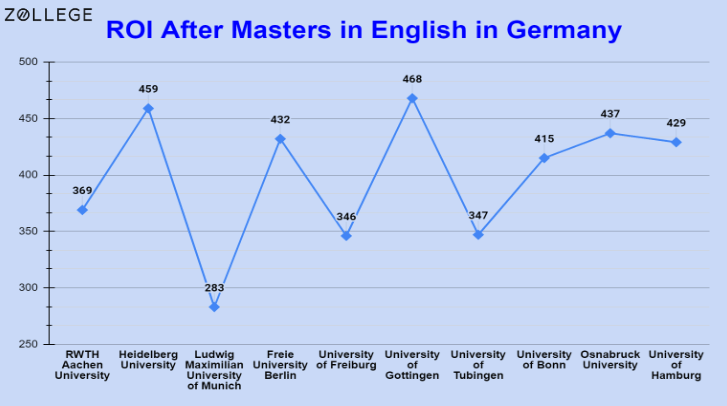
As you can see, all the universities are offering high ROI. At the University of Gottingen, you can get a maximum ROI of 468%. Heidelberg University, Freie University of Berlin, University of Bonn, Osnabruck University all are offering more than 400% return.
For admission to masters in English Literature in Germany, you need to have English language proficiency level C2. This proficiency level consists of IELTS score of 8.0 or higher, PTE score of 85-90. Most universities in Germany accept international students in summer and winter intakes in Germany. For summer semester, the deadline is in January and for winter semester the deadline is in June/ July. You can study masters in Germany in English for free. Most public universities do not charge any tuition fees. You just need to pay semester fees and living expenses.
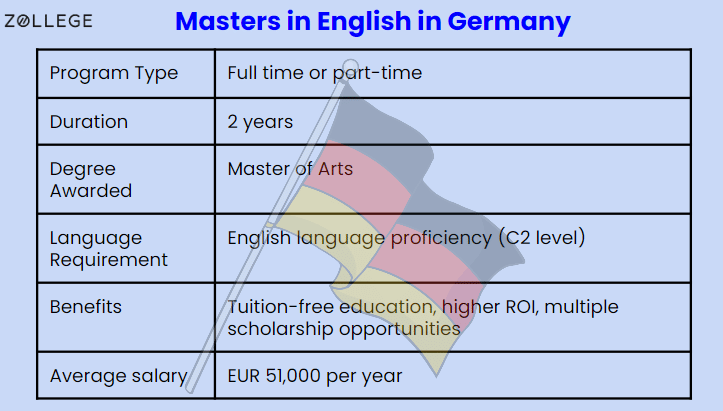
The job market after graduation is highly competitive. Though it is a study in the field of Arts, you can earn EUR 51,000 per year on average. Comparatively, after an Engineering degree, you can earn EUR 58,000 per year. So, the pay gap is not that high. You’ll also have the opportunity to learn German, an important skill that can help you land jobs in Germany as well as Austria, Belgium, Liechtenstein, or at many international corporations all over the world.
Why Study Masters in English in Germany
A master degree from Germany opens up multiple opportunities and options for candidates. A master of arts in English in Germany is a highly valued and globally accepted degree. Make sure to understand the exact cost of MS in Germany for international students before applying. Is it good to do Masters in Germany? Below, we have added some reasons that you can consider while choosing to study a master degree in Germany in English.
- Affordable tuition fees, starting from as low as EUR 151 per semester
- Germany has some globally top-ranked universities, allowing you to access a high quality education
- Wide range of scholarships allow you to pay timely tuition fees
- Lower cost of living than other European countries
- Low unemployment rate of around 3.5%, so job opportunities are high. Currently, there are 7,07,000 notified job vacancies in Germany.
Top Universities in Germany for Masters in English
RWTH Aachen University, Heidelberg University, Ludwig Maximilian University are some public universities in Germany that offer this course. You can choose any of these universities to get maximum return on your investment. Now let us take a close look at the annual program fees and entry requirements for masters in English Literature Germany.
| University | Annual program fees | Entry requirements |
| RWTH Aachen University | EUR 607 (INR 54,598) | Undergraduate degree from a recognized university IELTS: 6.5 TOEFL: 95 |
| Heidelberg University | EUR 302 (INR 27,164) | Completed Bachelor degree IELTS: 8.0 PTE: 85-90 |
| Ludwig Maximilian University of Munich | EUR 6000 (INR 5,39,688) | Bachelor degree with a 2.5 GPA TOEFL iBT: 100 IELTS: 7.0 Selection interview |
| Freie University Berlin | EUR 591 (INR 53,159) |
Completed bachelor degree |
| University of Freiburg | EUR 3,360 (INR 3,02,225) | Undergraduate degree in subject IELTS: 4.0 PTE: 43 TOEFL: 42 |
| University of Goettingen | EUR 688.50 (INR 61,929) | BA or equivalent degree Unicert 2 IELTS: 7.0 TOEFL: 93 PTE academic: 76 |
| University of Tubingen | EUR 3,333.6 (INR 2,99,851) | Any undergraduate or equivalent degree IELTS: 6.5 TOEFL: 79 |
| University of Bonn | EUR 647.92 (INR 58,279) | Undergraduate degree IELTS for Germany: 6.0 TOEFL: 72 Unicert II PTE: 59 |
| Osnabruck University | EUR 665 (INR 59,815) | Completed a bachelor program or equivalent English proficiency level C2 |
| University of Hamburg | EUR 664 (INR 59,725) | Undergraduate degree IELTS for Germany 4.0 to 5.5 TOEFL score 42 to 70 |
Note: EUR 1= INR 89.81 as of March 29, 2024
Masters in English in Germany Eligibility Criteria
To be eligible for admission to MA in Germany, you need to meet certain eligibility criteria. However, the eligibility criteria varies from university to university. The general eligibility criteria for master degree in Germany English language is as follows
- A bachelor degree from a recognized university
- Minimum GPA of 2.5
- English language proficiency in exams to study in Germany
- German language proficiency (if needed)
Documents Required for MA in English in Germany
German universities require you to submit some documents with your online application. These documents prove that all the information provided in the application is true and correct. Check out the documents you need to submit to apply to German universities
- Academic transcripts
- Graduation certificate
- Updated CV
- Letter of motivation or SOP for Germany
- Passport
- Work experience (if needed)
- Essay in English
- German student visa
Masters in English in Germany Application Details
How can I apply for Masters in Germany? You need to apply online for the same. German universities have winter and summer seasonal intakes. The application deadline for Summer intake is around January end. The application deadline for winter intake in Germany is between June and August. If the university requires direct application, there is no application fee. However, you may have to pay an evaluation fee. If the universities are accepting applications via Uni Assist, then you need to pay an application fee of EUR 75 (INR 6,746). The application details for masters in English language in Germany are tabulated below.
| University | Application deadline | Application fee |
| RWTH Aachen University | Winter: July 15, 2024 | No application fee |
| Heidelberg University | Summer: March 31, 2024 Winter: September 30, 2024 |
Not required |
| Ludwig Maximilian University of Munich | Winter: July 1, 2024 | No application fee |
| Freie University Berlin | Winter: May 31, 2024 | Not needed |
| University of Freiburg | June 30, 2024 | No application fee |
| University of Goettingen | Winter: April 30, 2024 Summer 2025: October 31, 2024 |
Evaluation fee of EUR 65 (INR 5,847) |
| University of Tubingen | Winter: July 15, 2024 | No application fee |
| University of Bonn | Winter: July 15, 2024 | No application fee |
| Osnabruck University | August 1, 2024 | EUR 75 (INR 6,746) |
| University of Hamburg | Winter: July 15, 2024 | EUR 75 (INR 6,746) |
Note: EUR 1= INR 89.81 as of March 29, 2024
Cost of Living in Germany
Germany is known for having lower living costs than other European countries. Rent will be the biggest chunk of your expenses. Cities like Berlin, Munich, Hamburg may have higher rent than Leipzig, Dresden, and Halle. The cost of living in Germany is an important part of your study abroad experience. So, if you have an estimate of how much money is required, it will be easy for you to manage your expenses. The estimated cost of living of the universities for Germany master degree in English is presented below.
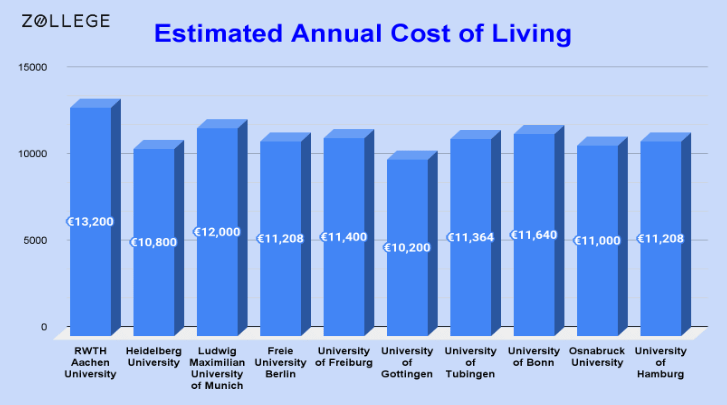
Note: EUR 1= INR 89.81 as of March 29, 2024
Scholarships for Masters in English in Germany
You can avail various scholarships in Germany for international students while pursuing a English master degree. These scholarships are mainly need-based or merit-based and vary from EUR 300 to 1,000 per month, depending on your eligibility. Some scholarships to study Master in Germany in English are given below.
| University | Scholarship | Eligibility | Award |
| RWTH Aachen University | Best of Class Award | Outstanding academic achievements in Master’s degree | Varies |
| Heidelberg University | Hans-Peter Wild Talent Scholarships | Prospective students of all nationalities who want to pursue a degree (BA/MA) at Heidelberg University, for the first time | EUR 1,000 (INR 89,948) until the standard end of your course |
| Ludwig Maximilian University of Munich | SIST LMU Study Completion Scholarship | Applicants must earn their first academic degree at LMU within one year and provide evidence for their financial need. | Varies |
| Freie University Berlin | SBW Berlin Scholarship | Available to students from East Europe, Asia, Africa, and South America and awarded on financial need basis | EUR 550 (INR 49,471) per month |
| University of Freiburg | Deutschland Stipendium program | Students enrolled in bachelor and master programs | EUR 300 (INR 26,984) per month |
| University of Gottingen | Heinrich Böll Scholarship | Students enrolled in graduate and undergraduate courses with outstanding academic grades | EUR 934 (INR 84,011) per month |
| University of Tubingen | DAAD Scholarships | Students must enroll in academic programs at the university | Varies |
| University of Bonn | Ließem scholarship | Talented students who have lived in the Bonn/Rhein-Sieg region for at least five years, will not be older than 27 | EUR 3,600 (INR 3,23,813) per year |
| Osnabruck University | DAAD scholarships | International students enrolled to bachelor or master programs | Varies |
| University of Hamburg | Merit scholarships | Have been enrolled in your subject at Universität Hamburg for at least 2 semesters and are pursuing a degree | EUR 850 (INR 76,456) |
Note: EUR 1= INR 89.81 as of March 29, 2024
Jobs After Masters in English in Germany
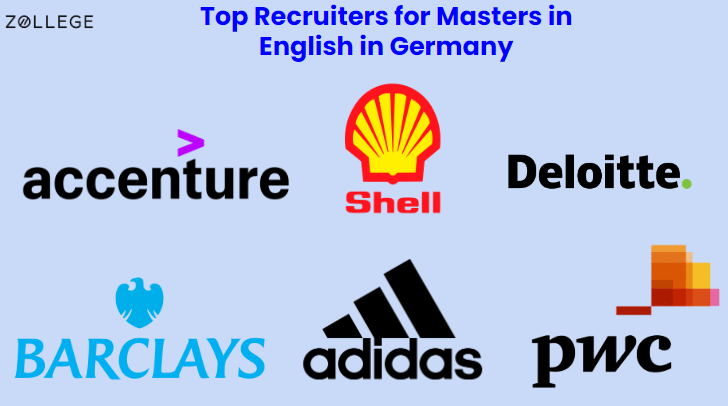
After an MA in English in Germany, candidates can get a lot of job opportunities in Germany. If you are proficient in German language, the chances of getting a job are increased. After you find a job you like, with a minimum of a one-year contract, you should apply for an EU Blue Card, which is the main residence permit for university graduates from non-EU countries of origin who have graduated from German universities and would like to stay and work in Germany. Apply for a work permit visa in Germany to get into jobs. The average annual salary of English graduates is EUR 51,000 (INR 45,87,348). Some of the top recruiters for masters in English in Germany are as follows
Work Permit in Germany
You can live and work in Germany even if you are not an EU citizen, provided that you meet the set eligibility criteria. To be allowed to live and work there legally, you must have a German work and residence permit. If you choose to immigrate to Germany, then working there becomes seamless. You can obtain both your German work permit and residence permit simultaneously by submitting a single application at the German Immigration Authority Office (Ausländerbehörde). Additionally, most non-EU workers will need to obtain a visa from a German Embassy or Consulate abroad. The four categories of work permit in Germany are
- General Work Permit – You can apply for this type of German work permit if you have found a job in Germany.
- Highly Skilled Worker Permit – You can apply for this type of work permit if you are a highly skilled worker with a lot of experience and a high income.
- The EU Blue Card for Germany – You can apply for an EU Blue Card if your salary will be at least €56,400 per year or €43,992 per year if you are in a shortage occupation.
- Work Permit for Freelancers – You can apply for this type of permit if you are a freelancer or self-employed individual and you can prove you have prospective clients.
MA in English literature in Germany is a good option to get into the German education system. But how to study in English in Germany? For this, you have to check the universities offering masters programs in English. You can consider the above-mentioned details while looking to apply for Masters in English in Germany.
FAQs
Ques: Can you do a Masters in Germany in English?
Ans: Majority of the universities in Germany taught most of the programs in German language. However, there are some universities offering some masters programs in English. Check with your desired university before applying.
Ques: Which university in Germany offers Masters in English?
Ans: RWTH Aachen University, Ludwig Maximilian University of Munich, University of Bonn, University of Freiburg are some of the universities that offer Masters in English in Germany.
Ques: Is Germany cheap for Masters?
Ans: Not only masters, Germany is cheap for any program as public universities do not require tuition fees. You just only have to pay semester fees and living expenses.
Ques: Can I do 1 year Masters in Germany?
Ans: The Technical University of Munich is considered one of the top universities in Germany and has a very good ranking. TUM offers many one year master's programs, across various fields like engineering, computer science, business, and natural sciences. So yes, you can study a 1 year masters in Germany.
Ques: Is IELTS required for Germany?
Ans: The German government requires an IELTS score as part of the visa application process for non-EU students. However, some English taught academic programs may also require an IELTS score.
Ques: Is English in demand in Germany?
Ans: There is a demand for English teachers in Germany, but not in all areas equally. German business schools and international schools are the ones in need of English teachers at the moment
Ques: Which country is best for English Masters?
Ans: The UK is the best country for English masters. Universities in the UK emphasize more in English taught programs than others. UK is home to global top universities like Oxford University, University of Cambridge that offer world class education.
Ques: Is German Masters accepted in India?
Ans: Yes German masters is accepted and valid in India. The German system of higher education is quite different from the Indian system. At a German university you can study for one of the degrees (UG, PG or PhD), the level varying according to the disciplines
Ques: Is English enough to live in Germany?
Ans: Like most of Western European countries, Germans have very good English skills. One in two Germans are fluent in English (56%) — if you're living in a major city like Berlin or Munich, that figure's going to be closer to 90%. But only English will not be enough as Germans love to speak in their own language.
Ques: Is it necessary to be fluent in German to pursue a Masters in English in Germany?
Ans: While German language proficiency is not always mandatory for English-taught programs, it can greatly enhance your experience and opportunities in Germany. Some universities may require basic proficiency or offer language courses alongside the program.
Ques: What are the typical admission requirements for a Masters in English program in Germany?
Ans: Admission requirements can vary by university, but generally, you'll need a bachelor's degree in a related field, proof of English proficiency (like TOEFL or IELTS), letters of recommendation, a statement of purpose, and sometimes GRE scores.
Ques: Are there scholarships available for international students pursuing a Masters in English in Germany?
Ans: Yes, there are various scholarships available for international students, both from the German government and other organizations. Research scholarship opportunities offered by DAAD (German Academic Exchange Service) and specific universities.
Ques: What is the cost of studying for a Masters in English in Germany for international students?
Ans: Many public universities in Germany offer tuition-free education, even for international students. However, you'll still need to cover living expenses, which can vary depending on the city you're living in. Additionally, there might be administrative fees, health insurance costs, and visa expenses.
Ques: What are the job prospects like after completing a Masters in English in Germany?
Ans: Germany has a strong job market for skilled professionals, including those with English language skills. Career opportunities may include teaching English, working in publishing, translation, journalism, international relations, or pursuing further academic research.
Ques: Can I work part-time while studying for my Masters in English in Germany?
Ans: Yes, international students in Germany are allowed to work part-time during their studies. However, there are restrictions on the number of hours you can work per week (usually up to 20 hours) during term time, and full-time during semester breaks.
Ques: How long does it take to complete a Masters in English program in Germany?
Ans: Most Masters programs in Germany typically last for two years (four semesters). However, some programs may vary in duration depending on the university and specific requirements.
Ques: Are there any specific visa requirements for international students pursuing a Masters in English in Germany?
Ans: Yes, international students from non-EU/EEA countries will need to apply for a student visa to study in Germany. You'll also need to obtain a residence permit upon arrival. Make sure to check the specific requirements and application process with the German embassy or consulate in your home country.
Ques: What are the housing options for international students in Germany?
Ans: Housing options for international students in Germany include university dormitories, private apartments, shared flats (WG), and student residences. It's advisable to start your housing search early and explore different options based on your preferences and budget.
Ques: Can I extend my stay in Germany after completing my Masters to look for employment?
Ans: Yes, after completing your Masters in Germany, you can apply for an extended residence permit of up to 18 months to search for employment related to your field of study. During this time, you're allowed to work without restrictions.
Ques: How can I adapt to the cultural differences while studying for my Masters in English in Germany?
Ans: It's essential to be open-minded and proactive in immersing yourself in German culture. Joining student organizations, participating in language exchange programs, and exploring the local community are great ways to adapt and make the most of your experience in Germany.

![Humboldt University of Berlin [HU]](https://static.zollege.in/public/college_data/images/studyabroad/logos/college_632_29-15:02_6.png?tr=w-50,h-50,c-force?tr=h-40,w-35,c-force)
![Technical University Munich [TUM]](https://static.zollege.in/public/college_data/images/studyabroad/logos/college_691_02-13:08_691.png?tr=w-50,h-50,c-force?tr=h-40,w-35,c-force)
![Ludwig Maximilian University of Munich [LMU]](https://static.zollege.in/public/college_data/images/studyabroad/logos/college_690_02-13:05_690.png?tr=w-50,h-50,c-force?tr=h-40,w-35,c-force)
![Free University of Berlin [FU]](https://static.zollege.in/public/college_data/images/studyabroad/logos/college_631_29-15:01_5.png?tr=w-50,h-50,c-force?tr=h-40,w-35,c-force)
.png?tr=w-50,h-50,c-force?tr=h-40,w-35,c-force)


