
Germany is the king in the automobile industry. BMW, Skoda, Volkswagen are the pioneers in keeping up this fame. Sounds interesting, right? Automobile engineering comes under the umbrella of vehicle engineering. While automotive engineering is focused on movable vehicles, automobiles are focused mainly on cars. It deals with the designing of cars, operations in production of cars, designing of engines and fuel management. Thus, automobile engineering can be considered as a sub-branch of automotive engineering. To know more, a masters in automobile engineering in Germany is all you need to study in Germany. It is a 2-year-long postgraduate degree program. This program can get you EUR 58,806 average annual salary with better returns. Where an automobile engineer in India earns around INR 6 lakhs average annual salary, masters automobile courses in Germany can get you around INR 53 lakhs per year. The ROI after masters in automotive engineering in Germany is given below
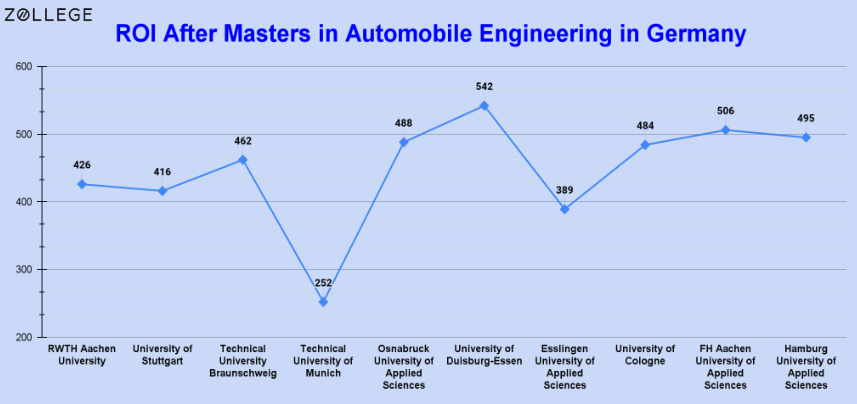
All the universities are offering more than 400% ROI except Technical University of Munich and Esslingen University of Applied Sciences. University of Duisburg-Essen is offering the maximum ROI of 542%. What are you waiting for? Apply for a Masters in Automobile engineering in Germany today to enjoy maximum returns and get hired by car manufacturers like Audi, BMW, Continental, Daimler, Volkswagen Škoda, Opel and others. Apply for a German student visa at the earliest.
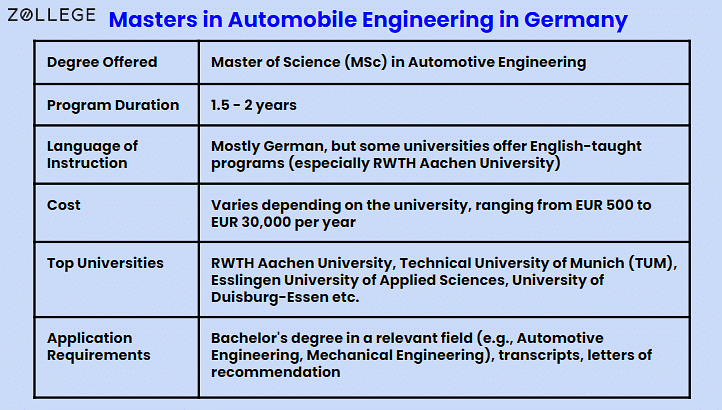
How to study automobile engineering in Germany? There are many public universities in Germany that offer this course. You need to apply online to one of them. All you need to apply is a bachelor degree in the related field and German language proficiency. There are some masters in automobile engineering in Germany in English, in which German proficiency is not mandatory. But the majority of universities require it. TestDaf, DSH, Telc, Goethe Certificate are some exams to study in Germany in which you can show your German language skills. Besides, IELTS or TOEFL scores can be submitted for English proficiency. You need to apply by January 15 (for Summer intake) or July 15 (for Winter intake) to get into masters in automobile engineering in Germany for Indian students.
Why Study Masters in Automobile Engineering in Germany
Germany is known for its high quality of education as well as the automobile sector. A degree in this discipline allows you to work and immigrate to Germany. The Automotive industry accounts for one-third of the R&D expenditure in Germany. Below are the reasons behind choosing automobile engineering masters in Germany
- Tuition fee free education at public universities. However, international aspirants are required to pay semester fees and living expenses
- Option to study both in German and English language
- More than 800,000 people are employed directly and almost 2 million people are indirectly employed by the Automotive industry
- Salary increase of approximately 9% every 15 months.
- Chances of full-time and part-time jobs in Germany
- Numerous scholarship opportunities
- Excellent return on investment up to 542%
Top Universities for Masters in Automobile Engineering in Germany
RWTH Aachen University. University of Cologne, Osnabrück University of Applied Sciences are some of the top universities that offer this course. Masters in automobile engineering in Germany cost range from EUR 662 to 3,000 per year. It is important to check the cost of MS in Germany before applying to any course. Annual program fees and entry requirements for masters in automobile engineering Germany are tabulated below.
| University | Annual program fees | Entry requirements |
| RWTH Aachen University | EUR 607 (INR 54,665) | Undergraduate degree in related field TestDaF level 4 DSH- Level 2 Goethe Certificate C1 or higher TOEFL score- 90 PTE- 60 IELTS - 6.0 |
| University of Stuttgart | EUR 3,328 (INR 2,99,714) | TestDaF level 4 DSD II |
| Technical University Braunschweig | EUR 728 (INR 65,562) | Bachelor degree in the same or close field TestDaF 4 telc C1 DSH 2 Goethe Certificate C2 |
| Technical University of Munich | EUR 12,170 (INR 10,96,008) | Bachelor degree in a related field DSH-2 DSD II Telc German C1 TestDaF level 4 |
| Osnabruck University of Applied Sciences | EUR 660 (INR 59,438) | Bachelor degree in a related field Goethe-Certificate C2 TELC C1 DSH level 2 |
| University of Duisburg-Essen | EUR 648 (INR 58,358) | Bachelor degree with 2.6 grade point average DSH 2 Telc C1 certificate TestDaF certificate- TDN 4 |
| Esslingen University of Applied Sciences | EUR 3,760 (INR 3,38,618) | Undergraduate degree from a recognized university DSH- 2 TestDaf- TDN 4 Telc C1 Hochschule |
| University of Cologne | EUR 500 (INR 45,029) | Bachelor degree in related field TOEFL- 95 IELTS- 7 PTE- 76 DSH- Level 2 or 3 TestDaF- TDN 4 to TDN 5 |
| FH Aachen University of Applied Sciences | EUR 621 (INR 55,926) | Undergraduate degree in related field TOEFL- 92 IELTS- 6.6 Zertifikat Deutsch level A2 |
| Hamburg University of Applied Sciences | EUR 662 (INR 59,619) | Undergraduate degree or equivalent Goethe- certificate C1 A minimum score of 16 points in TestDaf |
Note: EUR 1= INR 90.06 as of March 30, 2024
Masters in Automobile Engineering in Germany Admissions
You can apply for admission to this program in two intakes in Germany. The application period for Summer semester usually ends in January and winter semester in May-July. Few universities accept direct applications, while some accept via Uni Assist. For the applications made through Uni Assist require an application fee of EUR 75. The deadlines and application fees for automobile engineering in Germany in English are tabulated below.
| Universities | Application deadlines | Application fee |
| RWTH Aachen University | Winter Semester: July 15 of every year | Not required |
| University of Stuttgart | Winter semester: July 15, 2024 | Not Required |
| Technical University Braunschweig | Winter semester: July 15, 2024 | EUR 75 (INR 6,754) |
| Technical University of Munich | Winter semester: May 31, 2024 | No fee required |
| Osnabruck University of Applied Sciences | Winter semester: July 15, 2024 | Not required |
| University of Duisburg-Essen | Winter semester: July 15, 2024 | Not required |
| Esslingen University of Applied Sciences | Winter semester: July 15, 2024 | Not required |
| University of Cologne | Winter semester: June 15, 2024 | Not required |
| FH Aachen University of Applied Sciences | Winter semester: May 15, Summer semester: November 15, 2024 |
Not required |
| Hamburg University of Applied Sciences | Winter semester: 15 July, 2024 | Not Required |
Note: EUR 1= INR 90.06 as of March 30, 2024
Eligibility and Documents Required for MEng in Automobile Engineering
Candidates need to have undergraduate or equivalent degree to be eligible for admission. Few universities also require a minimum GPA of 2.5. To apply to German universities, you need to have the following criteria
- A bachelor's degree in Automotive Engineering, mechanical Engineering, or a related field of study.
- German language proficiency
- English language proficiency
- Valid passport
- Previous student visa (if any)
Check out which documents you need to submit with your application for admission to masters in automobile engineering in Germany for Indian students
- Copy of academic transcripts from all educational institutions with their English and German translations
- Language proficiency scores- German or TOEFL or IELTS for Germany or equivalent
- CV/ Resume
- Financial proof
- Letter of Motivation or statement of purpose for Germany
- Preliminary Documentation (VPD) (for required universities)
- Additional documents such as internship certificates, job references, recommendation letters for Germany (if required)
- Copy of passport
- Student visa
Cost of Living in Germany
You might be thinking: where should I stay? How much is the rent? Which place is safe? Right? You can choose to stay in student accommodation in Germany to be in a safe and affordable place. These are shared accommodation options. Besides, you can also choose to stay in private accommodations at higher rents. However, the cost of private accommodation differs from city to city. As an example, rent of a 1 bedroom apartment in Berlin is EUR 1,263 per month and EUR 764 in Dresden. In the cost of living in Germany, rent, meals, transportation, miscellaneous costs are included. But how much is it? It is tough to calculate the exact cost of living as it varies from person to person. Hence, the below-mentioned estimated graph will help you to understand the annual cost of living in Germany.
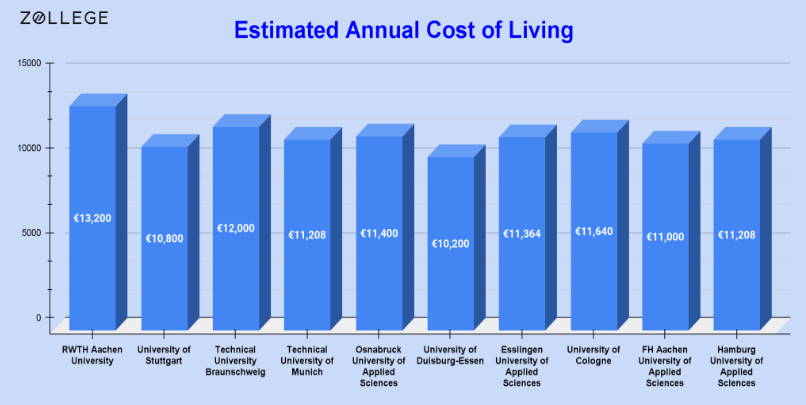
Note: EUR 1= INR 90.06 as of March 30, 2024
Scholarships for Masters in Automobile Engineering in Germany
There are multiple scholarship options available for masters engineering courses in Germany. DAAD, Deutschlandstipendium programs are the two major scholarship programs that allow you to get scholarships in Germany for international students. From need based scholarships to merit based scholarships, one time stipend scholarships, you can apply for any of them according to your requirement. Scholarships allow you to pay timely tuition fees or bear other living and emergency expenses. The list of scholarships available for Masters in Automobile Engineering in Germany are given below.
| Universities | Scholarships | Eligibility | Reward |
| RWTH Aachen University | DAAD scholarships | These scholarships are targeted towards international students at RWTH Aachen | EUR 300 (INR 27,017) each month |
| University of Stuttgart | DAAD scholarships | Highly committed international degree and doctoral students | Varies |
| Technical University Braunschweig | Deutschlandstipendium | Given to talented students on the basis of merit | EUR 300 (INR 27,017) per month |
| Technical University of Munich | Scholarships for International Students | Students who are not eligible for BAföG due to their nationality | EUR 500 to 1,800 (INR 45,029 to 1,62,105) |
| Osnabruck University of Applied Sciences | DAAD Scholarship | For international students enrolled at Osnabrück University | Varies |
| University of Duisburg-Essen | Friedrich Ebert Foundation | For application for MA before 1st semester. | EUR 300 - 735 (INR 27,017 to 66,193) |
| Esslingen University of Applied Sciences | Deutschland Stipendium program | Students applying at Esslingen University of Applied Sciences can apply | Varies |
| University of Cologne | Sozialstipendium | Student with financial need | EUR 300 (INR 27,017) per month |
| FH Aachen University of Applied Sciences | BAFoG | For international students in need of financial help | Up to EUR 10,000 (INR 9,00,582) one-time payment |
| Hamburg University of Applied Sciences | Academic Excellence scholarships | HAW Hamburg international Master's students in the second subject semester. | EUR 1,800 (INR 1,62,105) |
Note: EUR 1= INR 90.06 as of March 30, 2024
Jobs After Masters in Automobile Engineering in Germany
A Masters in Automobile Engineering in Germany is a worthy degree. It opens doors to some awesome jobs. Here in Germany, you've got the big players like Audi, BMW, and Mercedes all looking for fresh talent to give jobs in Germany. Masters in Automobile Engineering in Germany salary is pretty high at EUR 58,806 per year. On the other hand, an automotive engineer at the senior level (8+ years of experience) makes an average earning of EUR 97,326. With your Master's, you could be designing cutting-edge car parts, working on self-driving vehicles (trending right now), or even specializing in sustainable tech to make cars greener. Check out some popular job roles and average annual salaries from the below table
| Job roles | Average annual salary |
| Automotive Manufacturing | 53.33 lakhs |
| Automotive Engineer | 45.71 lakhs |
| Automotive Test Engineer | 43.74 lakhs |
| Technical Advisor | 40.21 lakhs |
| Automotive Service Technician | 32.17 lakhs |
| Automobile Mechanic Salary | 25.83 lakhs |
| Motor Vehicle Inspector | 21.41 lakhs |
Top Recruiters for Masters in Automobile Engineering in Germany
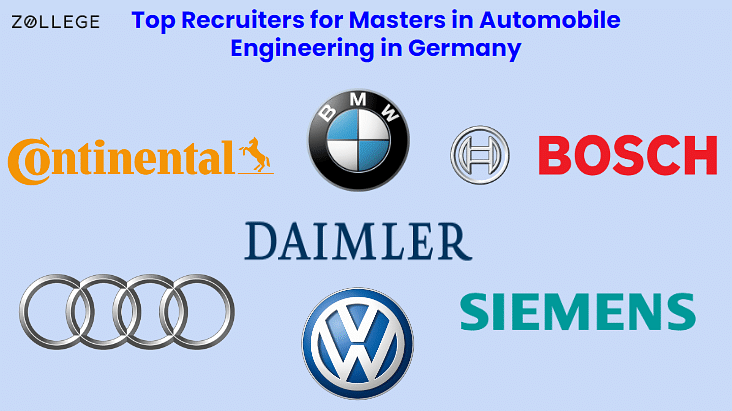
The German car industry is a powerhouse, and guess who comes knocking on recent graduates' doors? Big names like Volkswagen, BMW, and Daimler are always on the hunt for fresh talent. Not only this, parts giants like Bosch and Continental are also major players looking for bright minds and giving part-time jobs in Germany.
Work Permit in Germany
German allows you to stay if you have a job offer. There are mainly 4 types of work permit visas in Germany that you can apply for. The general work permit visa allows you to immigrate with a secured job. You can also apply for an EU Blue Card if their salary scale is above EUR 56,400 per year. This EU Blue card is the main residence permit if you wish to stay in Germany after completing your university studies. Applicants need to have the listed documents below to avail work permit visa Germany.
- Passport
- Passport-size pictures
- The application form for a residence permit
- Declaration on the Employment Relationship
- Work contract or offer
- Certificate of Registration (Meldebescheinigung)
- The housing lease along with a written confirmation letter of residency from your landlord
- Your university or college diploma
- Proof of health insurance
- CV
- Bank statements
- SOP for Work Permit Visa
In Europe, automotive profits based on consumer spending will nearly double from EUR 850 billion in 2016 to EUR 1,400 billion in 2030, according to the MMR study report. In the same time frame, the percentage of total automotive revenues devoted to data-enabled services and shared mobility will increase from 0.2 to 27%. So, the scope of automobile engineering in Germany is increasing. Consider the above-mentioned details and apply for masters automobile courses in Germany today.
FAQs
Ques: Which university is best for Masters in automobile engineering in Germany?
Ans: Germany has some globally recognized and top ranked universities. RWTH Aachen University, University of Duisburg-Essen, Hamburg University of Applied Sciences are some better universities for masters in automobile engineering in Germany.
Ques: Is automobile engineering in demand in Germany?
Ans: Automobile engineering is one of the most in-demand industries in Germany. Global car conquerors like BMW, Audi, Skoda, are some of the companies that have kept the pace of demand.
Ques: How much does a Masters in Automotive Engineering make in Germany?
Ans: A masters in automotive engineering makes EUR 58,806 per year in Germany. This is considered to be one of the highest paid industries in Germany. On the other hand, an automotive engineer at the senior level (8+ years of experience) makes an average earning of EUR 97,326 per year.
Ques: Which country is best for Masters in Automotive Engineering?
Ans: Germany is the best for Masters in Automotive Engineering, undoubtedly. Then comes the US, UK, Japan, South Korea and others.
Ques: Which Engineer has the highest salary in Germany?
Ans: Pharmaceutical and Chemical sector engineers earn EUR 73,225 per year, which is considered to be the highest. Then comes Electronics sector engineers, who earn EUR 63,988 per year.
Ques: Which MSc course has the highest salary in Germany?
Ans: MSc in Engineering has the highest salary in Germany. Be it automobile, pharmaceutical, electrical: these MSc programs are proven to be the best in terms of career prospects and ROI offerings.
Ques: Which intake is best for Masters in Germany?
Ans: Germany has two main intakes for international students. The common intake in Germany is the winter intake which starts in September/October and runs till February/March. Most students who study a Masters in Germany apply for the winter intake.
Ques: How much does automotive engineering cost in Germany for Indian students?
Ans: The total program fee for a Master's in Automotive Engineering at top German universities ranges from as low as 500 EUR to as high as 30,000 EUR. It depends on the university, location of the university and study mode.
Ques: Which master course is in demand in Germany?
Ans: A Management Masters in Germany is popular among both home and international students. You can opt for general management subjects or go for a specific area or industry like Engineering or Human Resources.
Ques: Who is eligible for Masters in Germany?
Ans: Candidates having a bachelor degree from a recognized university with German language proficiency are eligible for Masters in Germany. Some universities may require previous work experience. Thoroughly check with the desired university for the same.
Ques: Is Germany cheap for Masters?
Ans: Be it bachelors or masters, Germany is cheap for any program you want as public universities do not charge hefty tuition fees. Only a nominal semester fee of EUR 300 to 500 per semester is required, which is comparatively cheaper than UK, US or Canada.
Ques: Is it hard to get accepted in Masters in Germany?
Ans: German universities hold high regard for your previous academic performances. Varied between universities, you need at least 80% marks in your previous academics to get accepted for Masters in Germany.
Ques: When can I apply for Masters in Germany?
Ans: Majority of German universities accept international students in summer and winter intakes. The application process for summer intake ends in January and for winter intake application period ends in June/July. Check the entry requirements, and apply for admissions now.
Ques: Are there scholarships available for international students pursuing a Master's in Automobile Engineering in Germany?
Ans: Yes, there are various scholarships available for international students, both from German institutions and external organizations. Some prominent ones include DAAD scholarships, Erasmus Mundus scholarships, and scholarships offered by specific universities or companies. It's essential to research and apply for these scholarships well in advance.
Ques: What are the career prospects after completing a Master's in Automobile Engineering in Germany?
Ans: Germany is a hub for the automotive industry, offering abundant career opportunities for graduates. Career paths include roles in automotive design, research and development, manufacturing, consulting, and management. Graduates can work for renowned companies like BMW, Volkswagen, Daimler, or pursue research opportunities in academic institutions.
Ques: How long does it take to complete a Master's in Automobile Engineering in Germany?
Ans: Most Master's programs in Germany have a duration of 2 years, consisting of four semesters. However, some universities offer accelerated programs that can be completed in 18 months, while part-time options may take longer.
Ques: What are the language requirements for a Master's in Automobile Engineering in Germany?
Ans: While German language proficiency is not always mandatory, it's beneficial for daily life in Germany. However, most programs are taught in English, and proficiency in English is required. Some universities may offer language courses alongside the program to help students adapt to the local language.
Ques: What are the areas of specialization within a Master's in Automobile Engineering in Germany?
Ans: Specializations can vary between universities, but common areas include automotive electronics, powertrain engineering, vehicle dynamics, autonomous driving, materials science, and sustainable mobility. Students can choose electives and research topics aligned with their interests and career goals.
Ques: How competitive is admission to Master's in Automobile Engineering programs in Germany?
Ans: Admission can be competitive due to the high quality of education and the reputation of German universities. It's essential to have a strong academic background, relevant work experience or internships, and a well-crafted application, including a compelling statement of purpose and letters of recommendation. Meeting deadlines and fulfilling all requirements is crucial for a successful application.
Ques: Can international students work while studying for a Master's in Automobile Engineering in Germany?
Ans: Yes, international students in Germany are allowed to work part-time while studying. Typically, students from non-EU countries are permitted to work up to 20 hours per week during the semester and full-time during semester breaks. Working alongside studies not only provides additional income but also offers valuable practical experience and networking opportunities within the automotive industry.

![Humboldt University of Berlin [HU]](https://static.zollege.in/public/college_data/images/studyabroad/logos/college_632_29-15:02_6.png?tr=w-50,h-50,c-force?tr=h-40,w-35,c-force)
![Technical University Munich [TUM]](https://static.zollege.in/public/college_data/images/studyabroad/logos/college_691_02-13:08_691.png?tr=w-50,h-50,c-force?tr=h-40,w-35,c-force)
![Ludwig Maximilian University of Munich [LMU]](https://static.zollege.in/public/college_data/images/studyabroad/logos/college_690_02-13:05_690.png?tr=w-50,h-50,c-force?tr=h-40,w-35,c-force)
![Free University of Berlin [FU]](https://static.zollege.in/public/college_data/images/studyabroad/logos/college_631_29-15:01_5.png?tr=w-50,h-50,c-force?tr=h-40,w-35,c-force)
.png?tr=w-50,h-50,c-force?tr=h-40,w-35,c-force)


