
Masters in Industrial Engineering in Germany is a 3 or 4 semester program lasting 1.5 to 2 years. Develop your technical skills to plan and execute socio-technical projects based on industrial engineering and management through this coursework. Industrial engineering universities in Germany charge around EUR 3000-10,800 (INR 2,71,119-9,76,030) per year. Admission requirements for this program suggest holding a 2.7 GPA in a bachelor degree in industrial engineering or related fields. The striking part is that you can seek Masters in Industrial Engineering in Germany in English language. You must have German proficiency skills at the B2 level to apply for the program. English language proficiency like IELTS for Germany is required to pursue the program.
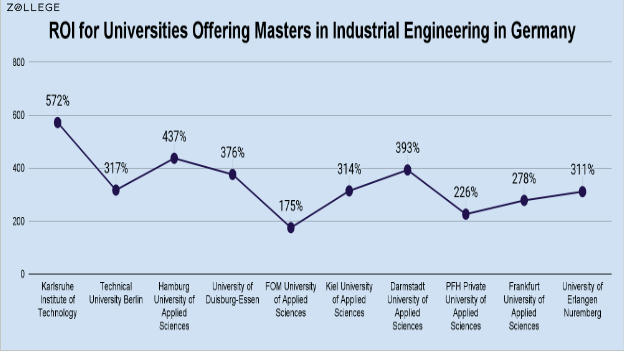
We must draw attention to the ROI section to select the best universities for industrial engineering courses in Germany. ROI is estimated by calculating the net profit divided by total expenditure. As given in the graph, Karlsruhe Institute of Technology shows the highest ROI level. You can pursue the program at KIT at low annual costs of EUR 3000 (INR 2,71,119) as tuition fee and EUR 5301.60 (INR 4,79,122) as living costs. The lowest ROI is at FOM University of Applied Sciences. To study in Germany at this university, you must spend EUR 27,108 (INR 24,49,835) per year, relatively highly expensive.
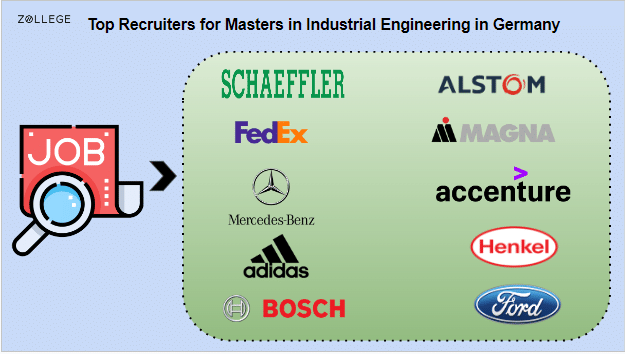
You can immigrate to Germany to get remarkable career prospects. Industrial Engineering Master in Germany opens broad professional fields in logistics, corporate management and marketing sectors. Industrial Engineering salary in Germany is around EUR 47,520 (INR 42,94,531) per year. Top employers like FedEx, Mercedes Benz and Adidas recruit graduates as Industrial Engineers and Product Managers.
Why Choose to Study Masters in Industrial Engineering in Germany?
What is MS in Industrial Engineering? MS in Industrial Engineering covers various areas of specialization like Production engineering, Process engineering, Logistics etc. Masters in Industrial Engineering in Germany is better than in India. In India, you can earn INR 3,16,158 per annum while in Germany, your annual average salary will be around EUR 47,520 (INR 42,94,531). You must apply to German universities for MSc Industrial Engineering for the following reasons:
- You can study free in Germany at top universities. A semester fee of EUR 288-678.56 (INR 26,027-61,323) is required to seek Industrial Engineering Master Degree in Germany.
- The job opportunities in Germany for Industrial Engineering will expand by 8% by 2028.
- Engineering sectors in Germany are projected to earn EUR 62.44 billion by 2025.
- Industrial Engineer freshers in Germany earn EUR 29,000 (INR 26,20,821) per year as basic pay. At the senior level, you can earn an average salary of EUR 69,000 (INR 62,35,746) per year.
- You can earn a bonus of around EUR 2000-10,000 (INR 1,80,746-9,03,731) each year as industrial engineers in Germany.
Top Universities for Masters in Industrial Engineering in Germany
Industrial engineering in Germany universities in English is pursued at Karlsruhe Institute of Technology and FOM University of Applied Sciences. The main mode of learning is in German language. You must have German language skills to pursue Masters Industrial Engineering, Germany. Annual cost for MS in Germany for Industrial Engineering may range between EUR 3000 (INR 2,71,119) and EUR 10,800 (INR 9,76,030). The table states the fees and requirements for Masters Industrial Engineering Germany:
| Top Universities | Programs Offered | Annual Tuition Fees | Score Requirements |
| Karlsruhe Institute of Technology | Masters in Industrial Engineering and Management in Germany | EUR 3000 (INR 2,71,119) | IELTS: 5.5 TOEFL: 90 DSH 2 TestDAF 4x4 |
| Technical University Berlin | MSc Industrial Engineering and Management | EUR 580.88 (INR 52,496) | IELTS: 6.5 TOEFL: 87 DSH 2 Goethe Certificate C2 DSD 2 TestDAF 4 Telc C1 |
| Hamburg University of Applied Sciences | MSc Industrial Engineering | EUR 664 (INR 60,008) | IELTS: 5.5 TOEFL: 70 DSH 2 or 3 TestDAF 4 Goethe Certificate C1 Telc C1 |
| University of Duisburg-Essen | M.Sc. Industrial Engineering | EUR 640 (INR 57,839) | TOEFL score: 61 IELTS score: Band 3 DSH 2 TestDAF 4 DSD II |
| FOM University of Applied Sciences | MSc Industrial Engineering | EUR 10,380 (INR 9,38,073) | TOEFL: 83 IELTS: 5.5 Duolingo English Test: 105 German language skills of B2 level are required |
| Kiel University of Applied Sciences | MSc Industrial Engineering | EUR 4,950 (INR 4,47,347) | TOEFL: 78 IELTS: 5 DSH 2 or 3 TestDAF 4 Goethe Certificate C2 Telc C1 |
| Darmstadt University of Applied Sciences | MSc Industrial Engineering | EUR 674 (INR 60,911) | TOEFL score: 80 IELTS: 6 DSH 2 Telc C1 DSD II TestDAF 4 Goethe Certificate C1 |
| PFH Private University of Applied Sciences | MSc Industrial Engineering | EUR 10,800 (INR 9,76,030) | TOEFL: 75 IELTS: 5.5 German language skills of B2 level or Goethe Certificate B1 are required |
| Frankfurt University of Applied Sciences | Master Industrial Engineering and Management | EUR 678.56 (INR 61,323) | IELTS: 6.0 TOEFL: 87 DSH 2 or 3 DSD II TestDAF 4x4 Telc C1 Goethe Certificate C2 |
| University of Erlangen Nuremberg | Master of Science in Industrial Engineering and Management | EUR 288 (INR 26,027) | IELTS: 5.0 TOEFL: 85 DSH 2 TestDAF 4 Goethe Certificate C2 DSD II Telc C1 |
EUR 1 = INR 90.37 as dated on 6th April 2024
Entry Requirements
To get into Industrial Engineering Universities in Germany, maintain a 2.7 GPA in bachelor degree. Apply for a German student visa after the entire application process ends. A C2 level English language skills is required to obtain a German visa. Present in person to apply for the visa at your local embassy. Violation of rules may lead to German Student Visa Rejection. The entry requirements for Masters in Industrial Engineering German:
- Bachelor's degree in business, engineering or computer science
- Letters of reference
- Transcripts
- 1-1.5 years of relevant professional experience
- German language proficiency scores
- APS Certificate
- English language proficiency scores
- Resume
- Statement of purpose
Masters in Industrial Engineering in Germany Application Details
Masters in Industrial Engineering universities have two intakes in Germany: winter and summer. For application, log in through the university's official portal or uni-assist. Most universities like Technical University Berlin, HAW Hamburg, Kiel University of Applied Sciences etc. accept applications via Uni-assist. While applying, upload your transcripts, resume, language scores and SOP. Pay the application fee of EUR 75 (INR 6,778) to process the application through Uni-assist Germany. The university has no application fee if applied directly. The table below highlights the deadlines and fees for Masters in Industrial Engineering in Germany:
| Top Universities | Application Deadline | Application Fee |
| Karlsruhe Institute of Technology | 15 July 2024 (winter) 15 January 2025 (summer) |
Not required |
| Technical University Berlin | 1 June 2024 (winter) 1 December 2024 (summer) |
EUR 75 (INR 6,778) |
| Hamburg University of Applied Sciences | 15 July 2024 | EUR 75 (INR 6,778) |
| University of Duisburg-Essen | 15 September 2024 (winter) 15 March 2024 (summer) |
EUR 75 (INR 6,778) |
| FOM University of Applied Sciences | 15 July 2024 (winter) 20 December 2024 (summer) |
Not required |
| Kiel University of Applied Sciences | 15 July 2024 (winter) 15 January 2025 (summer) |
EUR 75 (INR 6,778) |
| Darmstadt University of Applied Sciences | 15 July 2024 (winter) 15 January 2025 (summer) |
EUR 75 (INR 6,778) |
| PFH Private University of Applied Sciences | Rolling | Not required |
| Frankfurt University of Applied Sciences | 15 July 2024 (winter) | Not required |
| University of Erlangen Nuremberg | 31 May 2024 (winter) 15 January 2025 (summer) |
Not required |
EUR 1 = INR 90.37 as dated on 6th April 2024
Cost of Living in Germany
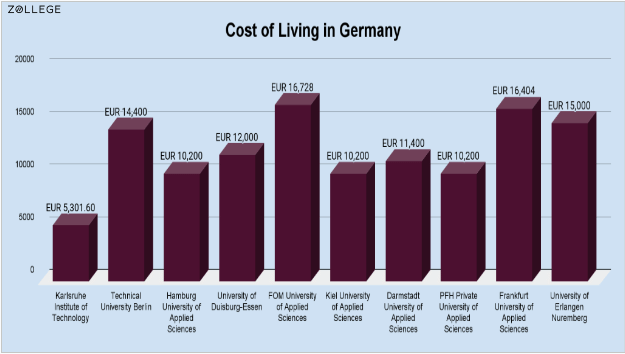
Cost of living needs to be estimated before planning to travel in Germany. You need an average approximate living cost of EUR 11,601 without rent to study in Germany. As shown in the graph, Karlsruhe Institute of Technology has the lowest living costs of EUR 5301.60 (INR 4,79,122). The affordability of Karlsruhe in Germany is for its cheap accommodation of around EUR 355 per month. FOM University of Applied Sciences has the highest cost of attendance. Accommodation in Germany at Essen (campus of FOM University) is highly costly, varying from EUR 598–1,047 per month. The graph represents the cost of living for pursuing MSc in Industrial Engineering, German:
Scholarships for Masters in Industrial Engineering in Germany
Scholarships are there to provide partial discounts on expenses to pursue Industrial Engineering courses in Germany. Outstanding results and strong merits are required to get the scholarship. At least, you must have a GPA of 2.2 or better to apply for scholarships in Germany. The table highlights the popular scholarships to attend German universities for Masters in Industrial Engineering:
| Top Universities | Scholarship Name | Eligibility | Award |
| Karlsruhe Institute of Technology | Friedrich Ebert Foundation | Strong educational merit grades are required | EUR 850 (INR 76,817) |
| Technical University Berlin | Heinrich Böll Stiftung | Good marks in academic studies are required | Varies |
| Hamburg University of Applied Sciences | Academic excellence scholarships | You must have an average GPA of 2.2 or higher | EUR 1,800 (INR 1,62,672) |
| University of Duisburg-Essen | UDE-Stipendium | High academic skills and strong achievements are required | EUR 300 (INR 27,112) per month |
| FOM University of Applied Sciences | DAAD scholarships | Strong merits in academic studies are required | Varies |
| Kiel University of Applied Sciences | Deutschlandstipendium | Students having excellent grades are eligible | EUR 300 (INR 27,112) per month |
| Darmstadt University of Applied Sciences | DAAD scholarships | You should have good marks in academic studies | Varies |
| PFH Private University of Applied Sciences | DAAD Prize | Aspirants having great educational performance can apply | EUR 1,000 (INR 90,373) |
| Frankfurt University of Applied Sciences | Deutschlandstipendium | You must secure amazing grades | EUR 300 (INR 27,112 per month |
| University of Erlangen Nuremberg | Konrad-Adenauer-Stiftung | Talented students with good merits can apply | Varies |
EUR 1 = INR 90.37 as dated on 6th April 2024
Masters in Industrial Engineering in Germany Job Outcomes
What can I do with a Masters in Industrial Engineering in Germany? - is our prime concern. Potential career fields after Masters in Industrial Engineering in Germany are logistics, marketing, consulting and corporate management. German universities allow students to attend part-time jobs in Germany during the study break or weekends. You can work as blogger, research assistant, courier service, waiter etc. with an hourly pay of EUR 12.41. After MSc Industrial Engineering, you can get assigned as Innovation Manager and Product Manager. The table below states the job outcomes after Masters in Industrial Engineering in Germany:
| Job Roles | Average Annual Salary |
| Industrial Engineer | EUR 47,520 (INR 42,94,531) |
| Innovation Manager | EUR 96,313 (INR 87,04,108) |
| Product Manager | EUR 61,266 (INR 55,36,800) |
| Strategic Planner | EUR 67,316 (INR 60,83,558) |
| Sales Engineer | EUR 58,625 (INR 52,98,125) |
EUR 1 = INR 90.37 as dated on 6th April 2024
Top Recruiters for Masters in Industrial Engineering in Germany
Various technology-driven industrial sectors offer jobs in Germany after MSc Industrial Engineering. Your salary may range between EUR 47,520 (INR 42,94,531) and EUR 96,313 (INR 87,04,108) per year. Top employers to hire MSc in Industrial Engineering graduates are detailed below:
Work Permit
Apply for a General work permit visa Germany to enjoy job prospects post-MSc in Industrial Engineering. Visit your local embassy to get the visa. Register your address for staying in Germany at the embassy office. You can choose to apply for another visa option like EU Blue Card visa. EU Blue Card visa demands a minimum wage of EUR 43,800 (INR 39,58,343) per year. Submit the required documents as follows to obtain the visa:
- Transcripts
- Passport
- Passport size pictures
- Bank statement
- Offer letter from Employer
- Resume
- SOP for work permit visa
- Proof of Health insurance
Masters in Industrial Engineering in Germany is focused on making graduates ideal leaders in various fields. You may develop your career in technical or management roles in marketing, and consulting industries. You may pursue further doctoral studies after completing the coursework. To apply for Industrial Engineering master's, you must have minimum requirements like German and English language skills. You can apply for scholarships to sort out the daily expenses easily.
FAQs
Ques: Why study Masters in Industrial Engineering in Germany?
Ans: You can study MSc in Industrial Engineering in Germany to enjoy immense career prospects. Job opportunities for Industrial Engineering in Germany will expand by 8% by 2028.
Ques: Are industrial engineers in demand in Germany?
Ans: Industrial Engineers are in great demand in Germany. There will be an 8% rise in job growth in Germany's industrial and marketing sectors by 2028.
Ques: How long is a Masters in Industrial Engineering in Germany?
Ans: Masters in Industrial Engineering in Germany is 1.5-2 years of coursework. It deepens your technical knowledge in planning and executing socio-technical projects on industrial engineering and management.
Ques: What is the main purpose of industrial engineering?
Ans: Industrial engineering aims to develop effective manufacturing systems to control time and automate warehouse facilities to increase productivity. You can pursue Masters in Industrial Engineering to explore vast career opportunities with lucrative salaries.
Ques: What is the field of study of industrial engineering?
Ans: Industrial engineering is focused on various specialization courses like Production engineering, Process engineering, Logistics etc. It is a part of Engineering Management that develops your knowledge in managing and executing cutting-edge manufacturing systems.
Ques: How good is Masters in Industrial Engineering in Germany?
Ans: Masters in Industrial Engineering is a good choice for aspirants wishing to develop their career in technical backgrounds. Germany expects to observe 8% of job growth in the Industrial Engineering sectors by 2028.
Ques: Where can I study MSc in industrial engineering in Germany?
Ans: You can study MSc in Industrial Engineering free of cost in various German universities like TU Berlin, Haw-Hamburg, University of Duisburg-Essen etc. You can also attend Karlsruhe Institute of Technology, FOM University of Applied Sciences etc. with fees ranging from EUR 3000-10,800 per year.
Ques: Which engineering is most demanded in Germany?
Ans: The most demanding engineering fields in Germany are Mechanical Engineering, Electrical Engineering, Civil Engineering, Industrial Engineering etc. You must hold a GPA of 2.7 in bachelor degree to pursue these programs.
Ques: What is the scope of MS in Industrial Engineering in Germany?
Ans: You can get assigned as Innovation Manager, Product Manager, Industrial Engineer etc. after MS in Industrial Engineering in Germany. Various top companies hired Industrial Engineering graduates like FedEx, Mercedes Benz and Adidas.
Ques: Is Masters in Industrial Engineering in Germany difficult?
Ans: Yes, Masters in Industrial Engineering in Germany is quite difficult. You must have strong knowledge of mathematics, business, engineering or computer science to pursue the program.
Ques: Does Masters in Industrial Engineering in Germany have a future?
Ans: Masters in Industrial Engineering in Germany presents immense career prospects to graduates. You can enjoy job roles like Innovation Manager, Product Manager, Industrial Engineer etc. after completing the program.
Ques: What is the highest package for Industrial Engineering in Germany?
Ans: At the senior level, Industrial Engineers in Germany earn an average salary of EUR 69,000 per year. The average salary of Industrial Engineer graduates is EUR 47,520 per year.
Ques: What company pays industrial engineers in Germany the most?
Ans: The top high-paying companies for Industrial Engineers in Germany are Bosch, Adidas, Accenture, Mercedes Benz etc. These companies pay around EUR 47,520- 96,313 per year as average salaries in Germany.
Ques: How many subjects are there in Masters in Industrial Engineering in Germany?
Ans: Masters in Industrial Engineering in Germany is based on various subjects like Production engineering, Process engineering, Logistics etc. It teaches you to design and manage socio-technical projects based on industrial engineering and management.
Ques: Which country is best for Masters in Industrial Engineering in Germany?
Ans: Masters in Industrial Engineering in Germany is best in various countries like USA, Canada and Germany. To apply for the program in these countries, hold a bachelors degree in industrial engineering or related fields.
Ques: Do industrial engineers in Germany need a Masters?
Ans: The minimum prerequisite to get a job in Germany for industrial engineers is a bachelor degree in engineering. Yet, a Masters degree in Industrial Engineering will add extra value to your resume to get more career opportunities in Germany.
Ques: How many semesters are there in Masters in Industrial Engineering in Germany?
Ans: Masters in Industrial Engineering in Germany is a 3-4 semester program as per different universities. The program lasts for 1.5-2 years focusing on developing technical skills in manufacturing segments.
Ques: How many intakes are there for Masters in Industrial Engineering in Germany?
Ans: Masters in Industrial Engineering in Germany is offered in two intakes: Summer and Winter. The application for summer intake is now closed. You can apply for the winter intake until July 2024.
Ques: What are the eligibility criteria for Masters in Industrial Engineering in Germany?
Ans: To pursue Masters in Industrial Engineering in Germany, we must have bachelor degree in engineering or related fields. You require a minimum GPA of 2.7 to get into the program.
Ques: Do I need to know German to do a Masters in Industrial Engineering in Germany?
Ans: Yes, you must know German to pursue Masters in Industrial Engineering in Germany. You require a DSH level 2 or TestDAF 4 points to seek the degree.?

![Humboldt University of Berlin [HU]](https://static.zollege.in/public/college_data/images/studyabroad/logos/college_632_29-15:02_6.png?tr=w-50,h-50,c-force?tr=h-40,w-35,c-force)
![Technical University Munich [TUM]](https://static.zollege.in/public/college_data/images/studyabroad/logos/college_691_02-13:08_691.png?tr=w-50,h-50,c-force?tr=h-40,w-35,c-force)
![Ludwig Maximilian University of Munich [LMU]](https://static.zollege.in/public/college_data/images/studyabroad/logos/college_690_02-13:05_690.png?tr=w-50,h-50,c-force?tr=h-40,w-35,c-force)
![Free University of Berlin [FU]](https://static.zollege.in/public/college_data/images/studyabroad/logos/college_631_29-15:01_5.png?tr=w-50,h-50,c-force?tr=h-40,w-35,c-force)
.png?tr=w-50,h-50,c-force?tr=h-40,w-35,c-force)


