
Masters of Engineering in Germany is a 2-year course available for engineering and science students. If you have completed your bachelor's in engineering and are looking to continue studies for a master's in engineering, it is the perfect opportunity for you. You can opt for multiple specializations like Aerospace Engineering, Computer Engineering, Electrical Engineering, Robotic Systems Engineering, Mechanical Engineering and many more. You can also get the option for online study in Germany provided by very few universities. One of the biggest reasons to select Germany mechanical engineering masters is that most public universities in Germany do not accept tuition fees. You need to spend only on your living expenses which is around EUR 1000 per month. Hence, the expense is much less if compared to other countries. This helps to improve the return on investment for every university.
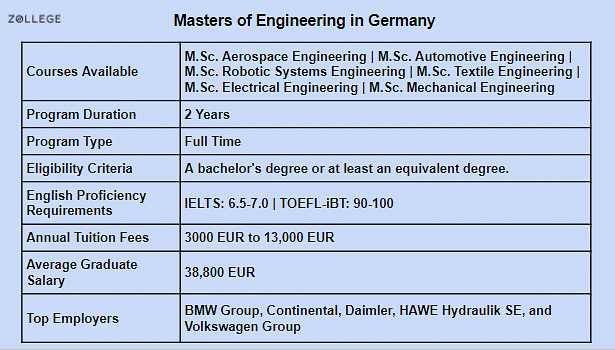
In Germany, admission to Masters in Engineering usually happens in 2 intakes, which are Winter and Summer. Hence, you should be prepared with all the required documents before admission for Germany mechanical engineering masters opens. If the course is in English, you will require a minimum IELTS and TOEFL score of 6.5 and 90 respectively. The admission for Winter semester is frequently closed in the month of May or June. The deadline for the Summer semester is in the month of January for most universities. You can also check exams to study in Germany for German language test scores.
If you want to work in Germany after completing your studies in MS engineering in Germany, you can stay for 18 months with a German work Visa. You are most likely to get jobs in Germany within 6 months since there is a shortage of skilled labor in Germany. The top companies that hire masters in engineering graduates are BMW Group, Continental, Daimler, HAWE Hydraulik SE, and Volkswagen Group.
Why Study Masters of Engineering in Germany
Germany is one of those countries where you get free tuition. The public universities in Germany do not charge any tuition fees. You just need to pay for the semester fee which is very minimal around EUR 200-EUR 400 every 6 months. The other benefits of studying masters in Engineering in Germany and immigrate to Germany are:
- An engineering specialist roughly makes 46,126 Euros per year.
- Germany has a lower cost of living than many other European countries. Students in certain small German localities have a monthly spending of 630–850 euros
- In Germany, foreign students are allowed to work up to 720 hours a year, or 90 full days.
Top Universities for Masters of Engineering in Germany
Once you have decided to pursue your studies in the master of engineering in Germany, you must look for a specialization. You can study in any specialization like masters in mechanical engineering in Germany provided by the university if you meet the requirements. Though most universities do not charge tuition fees, some universities charge fees. You must check if you need to pay the fees or how to study for free in Germany. The details of the specialization and fees are:
| University Name | Subjects | Annual Fees |
| Technical University of Munich | M.Sc. Aerospace Engineering | M.Sc. Mechanical Engineering | 6,000 euros per semester |
| Technical University of Berlin | Biomedical Engineering | Electrical and Civil Engineering | No tuition fees |
| Karlsruhe Institute of Technology | M.Sc. Electrical Engineering | M.Sc. Mechanical Engineering | EUR 1,500 per semester |
| University of Hamburg | Industrial Engineering and Management | No tuition fees |
| University of Stuttgart | M.Sc. Aerospace Engineering | M.Sc. Automotive Engineering | 1500 EUR / semester |
| RWTH Aachen University | M.Sc. Robotic Systems Engineering, M.Sc. Textile Engineering | No tuition fees |
| GISMA University of Applied Science | Computer Science Master of Engineering | 60 credits: € 15,500 120 credits: € 11,575 |
| Technical University of Darmstadt | MSc.Aerospace Engineering | MSc.Biomolecular Engineering | No tuition fees |
| University of Hannover | Civil Engineering and Computer Engineering | No tuition fees More than 6 semester: 500 euros per semester |
| University of Freiburg | MSc. Sustainable Systems | 1,500 euros per semester |
Application Process
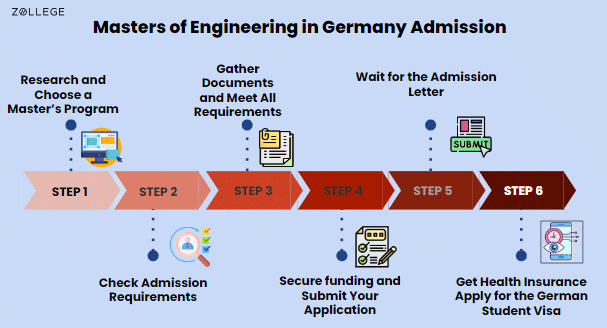
The application process for a master degree in mechanical engineering in Germany can be usually done via two ways - the University portal and UniAssist. UniAssist is a portal where you can apply to German universities. They will then send your application to the university directly.
Application Deadline and Fees
The application fees and the application deadline or intakes in Germany are the major steps to apply. If you are not aware of the deadline, you might miss the admissions. Also, there are application fees involved with very few universities in Germany. You must check the official website before applying for masters for mechanical engineering in Germany.
| University Name | Application Fees | Application Deadline |
| Technical University of Munich | No application fees | Winter semester: 31st May, 2024 Summer semester: 15th January, 2024 |
| Technical University of Berlin | EUR 75 | Winter Semester: June 1, 2024 Summer semester: December 1, 2024 |
| Karlsruhe Institute of Technology | No application fees | Winter term: July 15 Summer term: January 15 |
| University of Hamburg | EUR 75 | Winter semester: 31 March Summer semester:15 January |
| University of Stuttgart | No application fees | Winter Semester: January 15 Summer semester: July 15 |
| RWTH Aachen University | No application fees | Winter Semester: March 1 Summer Semester: September 1 |
| GISMA University of Applied Science | No application fees | September 2024 session: June 30, 2024 |
| Technical University of Darmstadt | No application fees | 15th March, 2024 (Closed) |
| University of Hannover | UniAssist: EUR 75 No fees for the University website | July 15th of the year for the winter semester January 15th of the year for the summer semester |
| University of Freiburg | No application fees | Rolling Admission |
Score Requirement for Masters in Engineering
If you have decided to apply to German university, you must take a few exams to study in Germany. These include English proficiency tests like IELTS, TOEFL PTE or German language tests like TestDAF or DSH. You can register for the exams online for engineering master in Germany. However, make sure that the subject is taught in English or German so that you can take the appropriate test.
| University Name | German Requirement | ELP Score Requirement |
| Technical University of Munich | DSH passed with an overall result of at least DSH-2 TESTDAF Level 4 |
TOEFL: 88 IELTS Academic with a minimum overall band score of 6.5 PTE: 65 |
| Technical University of Berlin | DSH passed with an overall result of at least DSH-2 TESTDAF Level 4 |
|
| Karlsruhe Institute of Technology | DSH2 certificate or an accepted equivalent | TOEFL IBT 80 points IELTS score 6.5 or better |
| University of Hamburg | TestDAF overall score of 15 points DSH level 2 |
|
| University of Stuttgart | TestDaF level 4 or better | TOEFL IBT 80 points IELTS band 6.5 or better |
| RWTH Aachen University | TestDaF (in all four sections at level 4 minimum) | TOEFL of at least 90 points IELTS test with a score of at least 5.5 |
| GISMA University of Applied Science | NA | IELTS 6.0 overall, no less than 5.5 in any component |
| Technical University of Darmstadt | TestDaF: TDN 16 Deutsches Sprachdiplom der Kultusministerkonferenz – Zweite Stufe” (DSD-II) – Level C1 | IELTS 7.0 PTE Academic 76 TOEFL (includes Special Home Edition) 95 |
| University of Hannover | DSH with a result of at least DSH 2 TestDaF with a result of at least 4 x TDN 4 |
TOEFL with a result of at least 95 points IELTS with a result of at least 7.0 PTE score of at least 76 points |
| University of Freiburg | DSH 2 or 3, TestDaF 4 or 5, Goethe Certificate C2 | IELTS Academic 5.5-6.5 points PTE Academic 59-75 points TOEFL score 72-94 |
Documents Required for Masters in Engineering
The documents required for admission to universities in Germany are almost similar to any other universities abroad. Most universities require similar types of documents like academic transcripts, SOP, German Student visa etc. There are some universities that might request some exceptional documents for MS in automobile engineering in Germany.
- Bachelor's degree certificate
- Academic transcripts
- Proof of English language proficiency
- Secondary School Certificate
- Curriculum vitae or resume
- LOR for Germany
- Letter of motivation
- Copy of your passport/ID
- Proof of German language
- Receipt for payment of your assessment fee (if applicable)
- Statement of Purpose
Cost of Living
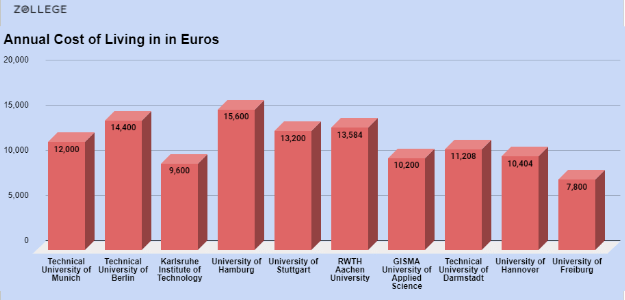
The cost of living in Germany is cheaper than other countries like the USA or Canada. Not only that but since most German universities do not charge tuition fees, you need to only pay for the cost of living. You can also get scholarships which will provide funds for living costs in Germany. International students usually need around EUR 1000 to live in any part of Germany. The details of the student accommodation in Germany are:
Scholarships for Masters of Engineering in Germany
The scholarships for international students in Germany can cover your accommodation, travel fare, research expenses, living costs and many more. The DAAD (German Academic Exchange Service) offers a range of scholarships for international students. There are emergency funds and scholarships which can help you when you need it. The university also provides scholarships for masters in aeronautical engineering in Germany separately.
| University Name | Scholarship Name | Scholarship Eligibility | Scholarship Amount |
| Technical University of Munich | Scholarships for International Students | 2nd semester in masters program Good academic records | Between €500 and €1,800 per semester |
| Technical University of Berlin | The Friedrich Ebert Stiftung funds | Outstanding merit and social and political commitment. | Varies |
| Karlsruhe Institute of Technology | DAAD Scholarship | Completed bachelor's degree Academic achievements | 934 euros a month payments towards health, accident and personal liability insurance cove |
| University of Hamburg | Merit Scholarship program | Enrolled in your subject at Universität Hamburg for at least 2 semesters and are pursuing a degree (students in 2-year master’s degree programs and doctoral researchers can apply after 1 completed semester); do not hold German citizenship; are not eligible for the federal student loan scheme. | €1,200 per month |
| University of Stuttgart | Emergency Funds | Suddenly experiencing financial difficulties. | Varies |
| RWTH Aachen University | DAAD program, STIBET | Studied for at least two semesters at RWTH Aachen and have good to very good academic performance thus far | monthly stipend of 300 Euro |
| GISMA University of Applied Science | Siblings & Spouse Scholarship | Siblings & Spouse of the student | 35% discount on all programmes for siblings and spouses of enrolled students. |
| Technical University of Darmstadt | Erasmus+ International scholarship | The participating partner universities carry out the application and selection procedures independently | Travel allowance depends on distance |
| University of Hannover | Emergency Grant ("Notfall-Beihilfe") | Temporarily in an acute financial emergency through no fault of their own can apply | amount of the emergency grant depends on the type of emergency |
| University of Freiburg | Deutschlandstipendium | Outstanding achievements in their studies and career | 300 euros per month |
Jobs after Masters of Engineering
Germany has a very high employability rate due to the shortage of skilled laborers. You are expected to get a job within 6 months of completing your graduation. MS in civil engineering in Germany is one of the top subjects taught in Germany and hence, the job opportunities are also higher. You can also try part-time jobs in Germany while looking for engineering jobs. Germany is constantly upgrading their old roads, bridges, and public transportation systems. The annual salary is around EUR 41,000.
| Profession | Salary Per Month |
| Biochemical Engineer | 35,000 |
| Chemical Engineer | 40,800 |
| Civil Engineer | 39,720 |
| Electrical Engineer | 44,160 |
| Robotics Engineer | 42,120 |
| Biochemical Engineer | 34,920 |
Work Permit after MS in Germany
If you want to stay and work in Germany after completion of MS in Germany, you will require a work permit. Your German student visa does not come with an associated work visa. Hence, applying for it separately is mandatory. After you graduate, you have the right to stay in Germany for 1.5 years. After working for two years, you will also be eligible to apply for a settlement permit (permanent residence). You will require the following documents for a work visa in Germany.
- Offer of employment letter
- A bank statement
- SOP for a work permit resume
- Health insurance records
- Passport Size Photographs Transcripts
- LOR
Master’s in Engineering is a postgraduate course for 2 years. You can opt for part-time or online courses depending on the university for engineering management master in Germany. You also must make a note of the tuition fees since all universities do not require fees.
FAQs
Ques: Is Germany good for Masters in engineering?
Ans: Yes, Germany is good for master's in engineering. International students are often drawn to studying in Germany because it has numerous exciting cities to explore, and tech hubs, and it offers a great base to travel around Europe.
Ques: How much is the fee for a master in engineering in Germany?
Ans: The fees for a master’s in Engineering in Germany is on the lower side. Most universities do not charge any tuition fees. Some universities charge around EUR 3000 annually as tuition fees.
Ques: How long is an engineering Masters in Germany?
Ans: The study duration of an M. Eng. degree offered by an engineering school is usually between 1-2 years. The Master of Engineering is academically equal to the Master of Science and Master of Arts.
Ques: What is the salary of an MS Engineer in Germany?
Ans: The average salary after MS in Germany for the engineering sector is 46,000 EUR per year. MS in Chemical Engineering, MS in Electrical Engineering, MS in Mechanical Engineering, and MS in Automotive Engineering are some renowned profiles after MS in Engineering.
Ques: Which engineer has the highest salary in Germany?
Ans: The Highest-Paying Engineering Jobs in Germany are in the Energy sector, Electronics, Pharmaceutical and Chemical sector and Construction sector. The energy sector engineers earn EUR 60,372 per year. The electronics sector engineers earn EUR 63,988 per year. The pharmaceutical and chemical sector engineers earn EUR 73,225 per year and construction sector engineers earn EUR 52,340 per year.
Ques: Which engineer is most in demand in Germany?
Ans: Engineers are highly in demand in Germany, especially electrical, mechanical and civil engineers. The high demand for engineers is due to the shortage of skilled labor, a flourishing automobile and machinery industry.
Ques: Who is eligible for MS in Germany?
Ans: Candidates looking to pursue MS in Germany at world-class universities are required to have a CGPA of 8.5 and above and also score well on the English language proficiency test
Ques: How much bank balance is required for a German student visa?
Ans: You must show the German Embassy you have at least EUR 11,208 per year to apply for a student visa. In most cases, you must open a blocked bank account in a German bank and transfer the money there. The other most common method is if you win a scholarship.
Ques: Can I complete MS in 1 year in Germany?
Ans: Yes, you can complete MS in Germany in 1 year for some universities. The universities like Technical University of Munich offer 1 year master's courses. You must check the validity of the course before applying.
Ques: Is MS in Germany expensive?
Ans: No, MS in Germany is not expensive since most universities do not charge any tuition fees. You need to pay a semester fee which is within EUR 500 for 6 months. Hence, it is cheaper to study in Germany if compared to other countries.
Ques: Can I get a job after MS in Germany?
Ans: Job market in Germany is abundant with demand for skilled workers. Due to the advanced MS degrees, Germany's job market is prominent for MS degree holders with in-demand jobs in various sectors such as IT, Engineering, Data Science, and other specializations.
Ques: Which engineer is most in demand in Germany?
Ans: Engineers are highly in demand in Germany, especially electrical, mechanical and civil engineers. The high demand for engineers is due to the flourishing automobile and machinery industry.
Ques: Who is eligible for MS in Germany?
Ans: Students with an average score of 70% and above are eligible for MS in Germany. You also need to have the minimum requirements for English language proficiency test scores like IELTS and TOEFL.
Ques: Is Germany or the UK better for MS?
Ans: The UK has more universities compared to Germany. Regarding the quality of education, the UK, and Germany stand in a similar position. It will depend on you if you want to study in Germany or the UK.
Ques: Is German Masters valid in India?
Ans: Yes, German masters are valid in India. The Association of Indian Universities (AIU) recognizes international degrees, making them valuable and recognized in India. If AIU recognizes your degree, you will receive an Equivalence Certificate.

![Humboldt University of Berlin [HU]](https://static.zollege.in/public/college_data/images/studyabroad/logos/college_632_29-15:02_6.png?tr=w-50,h-50,c-force?tr=h-40,w-35,c-force)
![Technical University Munich [TUM]](https://static.zollege.in/public/college_data/images/studyabroad/logos/college_691_02-13:08_691.png?tr=w-50,h-50,c-force?tr=h-40,w-35,c-force)
![Ludwig Maximilian University of Munich [LMU]](https://static.zollege.in/public/college_data/images/studyabroad/logos/college_690_02-13:05_690.png?tr=w-50,h-50,c-force?tr=h-40,w-35,c-force)
![Free University of Berlin [FU]](https://static.zollege.in/public/college_data/images/studyabroad/logos/college_631_29-15:01_5.png?tr=w-50,h-50,c-force?tr=h-40,w-35,c-force)
.png?tr=w-50,h-50,c-force?tr=h-40,w-35,c-force)


