
GRE Arithmetic: Syllabus, Question Types, Books, and Samples
- GRE Grammar Preparation
- GRE Coaching In Hyderabad
- GRE Coaching In Kolkata
- GRE Online Coaching
- GRE Classes In Pune
- GRE Coaching In Delhi
- GRE Coaching In Bangalore
- Best GRE Coaching India
- Best Book For GRE Verbal
- GRE Preparation Books
- GRE Study Plan
- GRE Prep
- GRE Preparation Time
- GRE Verbal Tips
- GRE Self Preparation
- GRE AWA Books


Content Curator | Updated On - Jun 3, 2024
Highlights:
Syllabus: You need to cover the Integers, arithmetic operations, and some core concepts
Time duration: You will get 35 minutes to answer the quantitative section.
Number of questions: The number of questions will be 20 in each segment
Secure cut-off mark: For a better band score, you need to secure above 160+
Resources for GRE arithmetic: You will get the required resources from the official websites of McGraw, Princeton Review, and others.
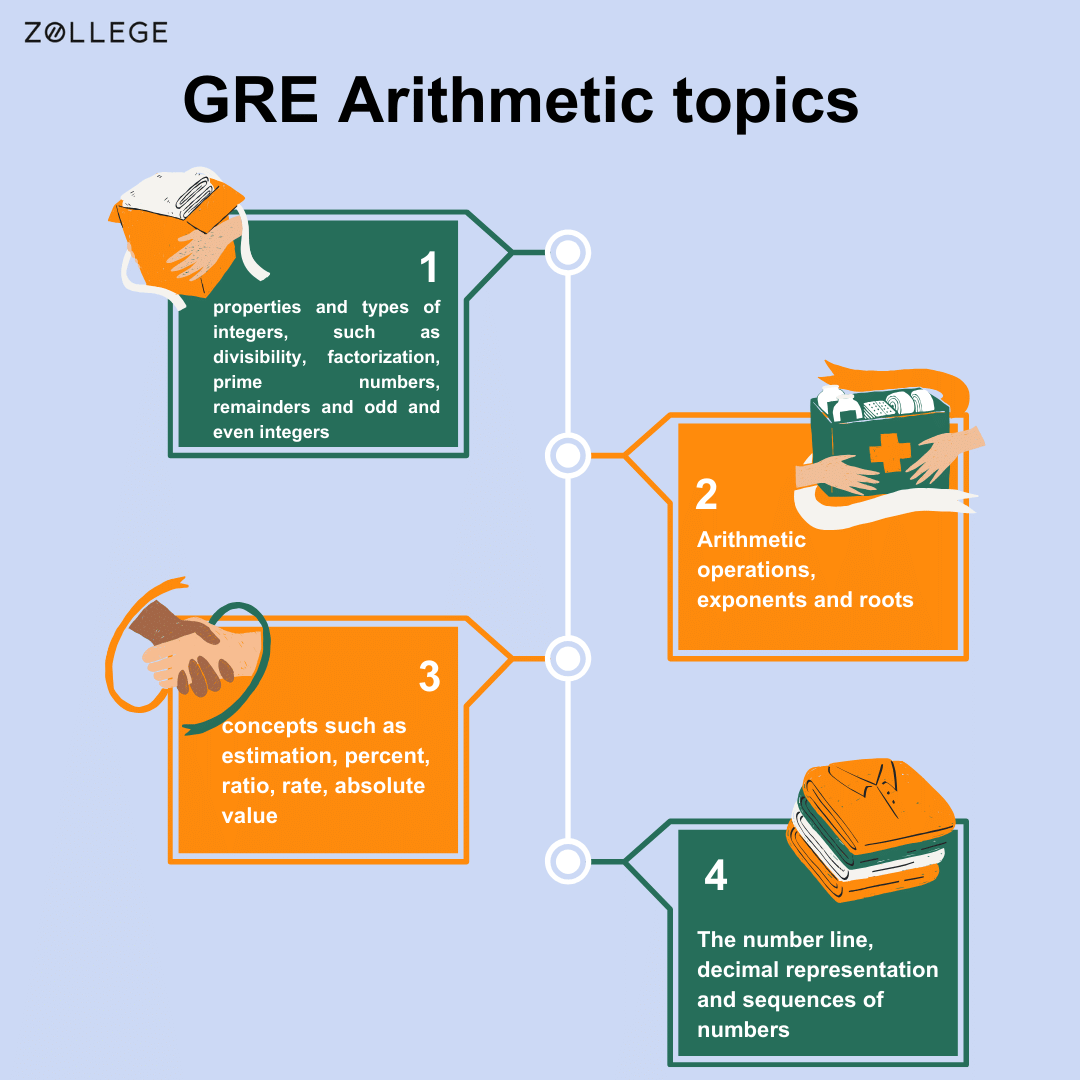
GRE arithmetic is one of the integral parts of the quantitative section. The key arithmetic topics for GRE include properties and types of integers, arithmetic operations, roots, and exponents. Other, core concepts such as ratio, percentage, number line, decimal representation, and number sequence, need to be considered for the exam. You will find Arithmetic GRE in the numeric entry segment and MCQ part. Out of two segments, you will get 20 arithmetic questions. The maximum time will be 35 minutes for each section. If you want to score 160+ in the quantitative section, you must pay attention to GRE arithmetic practice questions. The details trick to score high in the quant section is listed in the below sections.
| Table Of Contents |
GRE Arithmetic Syllabus
Candidates must be aware of the GRE Arithmetic syllabus and the contents to solve the GRE arithmetic practice questions. The GRE syllabus sections include:
- Quantitative Comparison: This section has word problems. Candidates need to solve those word problems in mathematical terms.
- Multiple Choice Questions: The arithmetic for GRE questions will carry multiple choices with options. The instructions will be provided and candidates need to select the correct option by following the instructions.
- Numeric Entry: This section includes 2 boxes. Candidates must enter numerical entries such as integers and decimals in the mentioned box.
GRE Arithmetic Questions
To excel in the GRE arithmetic section, candidates must have a solid grasp of several fundamental mathematical concepts. Arithmetic questions can appear in different formats on the GRE. GRE preparation for arithmetic includes topics like percentage calculations for problem-solving, exponent and root concepts for quantitative comparison questions, and data analysis questions.
Numbers and their Properties
Numbers like 3, 6, 9, 12, and 15… are said to be multiples of 3. Similarly, they are divisible by 3. The numbers that are only divided by the number itself and 1, are called prime numbers. For eg, 2, 3, 5, 7, 11, 13, 17, and 19. One must also take care of the concepts of prime factorization of whole numbers, least common multiples (LCM), and greatest common factor (GCF).
Example 1:
Consider an integer to be divisible by both 12 and 27. Then the integer must be divisible by
(A) 48
(B) 54
(C) 81
(D) 108
(E) 324
Answer: (D)
Explanation: We need to do LCM of 12 and 27 to get the answer.
The LCM needs to be done first.
12= 22×3
27=33
Since the integer is divisible by both 12 and 27, then it must have at least two factors of 2 and three factors of 3. The LCM is 22×3= 4×27 = 108.
Candidates can also eliminate answer choices (A), (B), and (C) because each of them cannot be divisible by one of two numbers, 12 or 27.
Example 2:
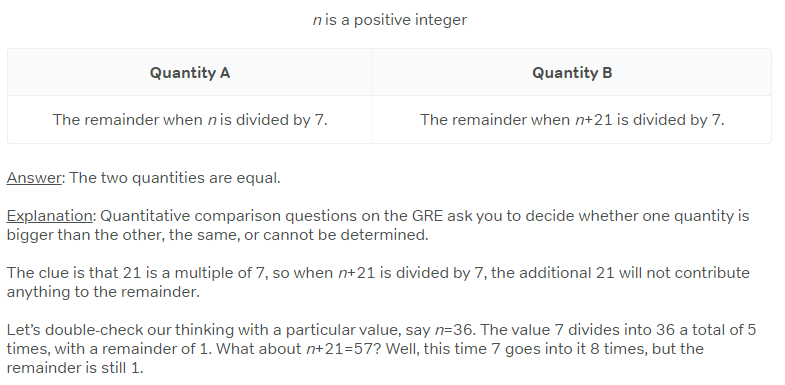
Operations with Numbers
When candidates start looking at number operations, it can seem like there are a lot of formulas to remember. There are only a few basic arithmetic formulas and properties of the GRE to master.
Integer
Integers are real numbers that have no fractional part (which includes negatives and zeros). Integers are whole numbers on the number line and can be negative or positive. There are negative integers for all the positive integers. Zero is a special integer and is neither positive nor negative. Examples-3, -2, -1, 0, 1, 2, 3. All numbers on the number line to the left of zero are negative integers, while all numbers to the right of zero on the number line are positive integers. A sample quantitative consecutive integer question is:
- How many consecutive integers are larger than -5 and smaller than 6?
Fractions
Fraction is represented as x/y, where x is the numerator and y is the denominator. If we divide the fraction by the same number, It does not change the value of the fraction.
Example:
What will be the answer to 28+(-3)5+(-4)2?
(A) 5
(B) 7
(C) 11
(D) 12
(E) 14
Answer: (C)
Explanation: 28+(-3)5+(-4)2 = 256 – 243 + 16 = 29.
Add the digits to get the correct answer 11.
Roots
The concept of roots is closely related to the topic of exponents and appears frequently on medium and difficult GRE math questions. The formal definition of a root is as follows:
The nth root of the number x is the number r, which after powering n is equal to x
Example:
If √a=4 and ∛b=a, what is the value of b?
Answer: 4096
Explanation: √a=4 means "the square root of a number is 4". You can guess and check, or better yet, translate the equation to a=42, which is 16.
Then add a to the second equation: ∛b=16=16 and rewrite it as b = 163 = 4096.
Example:
- Square root of 9 =√9 = 3, because 3x3=9
- Cubed root of 8 = ∛8=2, because 2x2x2=8
Decimals
This is used to indicate a number that is not a whole number. For example, in the decimal number 4.56, the decimal component is ".56". The whole number is "4". Few types of questions are:
- What is the sum of 1.324, 3.765, -4.986 and 68
- What is 7.701 divided by 2.55
Fractions
The questions in fractions are straight forward. There are two numbers in a fraction. It is denoted by:, x/y
- x is the numerator
- y is the denominator
The fraction x/y can also be defined as 'x divided by y.'
Example:
Solve 2/6 + 3/21
Answer:
There is a strategic approach to this:
The two denominators are 6 and 21. Thus, the prime factors of 6 are 2 and 3, and the prime factors of 21 are 3 and 7.
So the unique denominators are 2, 3 and 7.
Now, we need to Multiply the denominators to get the LCD which is 42.
Rewrite both fractions so that the denominator is the LCD, and so 2/6 = 14/42, and 3/21 = 6/42. All that we've done is rewrite both fractions so they have the same denominator, the LCD.
Now, the addition of the two fractions is easy: 14/42 + 6/42 = 20/42.
Ratios, percentages, and proportions
It is the ratio of two numbers expressed as a division problem. For example, x is to y is written as x/y, and this proportional relationship can be stated in one of several ways, including:
- x to y
- Ratio of x to y
- x is y
- x : y
There are many ways to express a ratio. On the GRE test, candidates may be given a math problem that requires them to find a relationship between two given quantities. Candidates then need to use that relationship to arrive at an answer.
Example:
| N is a positive real number | |
|---|---|
| Quantity A | Quantity B |
| The result of a 20% increase of N, followed by a 20% decrease | N |
Answer: The amount of B is greater.
Explanation: The quantities are not equal: N+0.20N=1.2N. Call the result M.
Now calculate the percentage decrease: M-0.2M=0.8M
This indicates that M is less than N.
Example:
Stacy needs to drive 75 miles on a highway with a speed limit of 65 mph. If she starts at 3:00pm, and drives the speed limit, at what time can she expect to arrive at her destination?
(A) 3:56
(B) 4:03
(C) 4:07
(D) 4:09
(E) 4:13
Answer: (D)
Explanation: Use (distance)=(speed)(time).
D=RT
75 miles = (65 mph)T
T=75/65=1.1538 hours
So that's an hour plus a fraction of another hour. In order to find the minutes, the fractional part is to be multiplied by 60.
0.1538)(60)=9.2
The closest answer choice is 4:09, which is one hour and 9 minutes past 3:00 p.m.
Sequence
There aren't many sequence problems on the GRE - you might get one in the math section, but there might not be one! So don't waste too much time worrying about all the formulas, techniques, and heavy theory in this topic.
Example:
A sequence is defined by the rule, t1=3, t2=2, and for n≥3, tn=tn-1+2tn-2. What is the value of t5?
(A) 6
(B) 5
(C) 8
(D) 12
(E) 28
Answer: (E)
Explanation: You have to work out t3 and t4 first.
t3=t2+2t1=(2)+2(3)=8
t4=t3+2t2=(8)+2(2)=12
t5=t4+2t3=(12)+2(8)=28
GRE Arithmetic Resources
Candidates can get many free arithmetic GRE practice test online. Practicing more GRE arithmetic practice problems will help candidates get a knowledge of the types of arithmetic GRE questions. There are GRE Arithmetic books available for students. Few of them are:
- McGraw-Hill Education Conquering GRE Maths
- Maths Workout for the GRE by Princeton Review
- GRE Math Strategies by Manhattan Prep
GRE Arithmetic is an important part of the GRE Examination. Candidates should prepare themselves to get a chance of admission in their dream college. Creating a plan and practicing more GRE Arithmetic questions will enable the student to excel on the exam day.
FAQs
Ques: What is arithmetic on the GRE?
Ques: What maths are mostly on the GRE?
Ques: What level of maths on the GRE?
Ques: Is GRE maths hard?
Ques: Is GRE easier than GMAT?
Ques: Is a 162 GRE maths good?
Ques: Is GRE tough for Indian students?
Ques: Is 300 a bad GRE score?
Ques: Why is GRE so expensive?
Ques: Is GRE 2 hours now?
*The article might have information for the previous academic years, please refer the official website of the exam.