
GRE Geometry: Questions, Tips, Formula, and Books
- GRE Grammar Preparation
- GRE Coaching In Hyderabad
- GRE Coaching In Kolkata
- GRE Online Coaching
- GRE Classes In Pune
- GRE Coaching In Delhi
- GRE Coaching In Bangalore
- Best GRE Coaching India
- Best Book For GRE Verbal
- GRE Preparation Books
- GRE Study Plan
- GRE Prep
- GRE Preparation Time
- GRE Verbal Tips
- GRE Self Preparation
- GRE AWA Books


Content Curator | Updated On - Apr 20, 2024
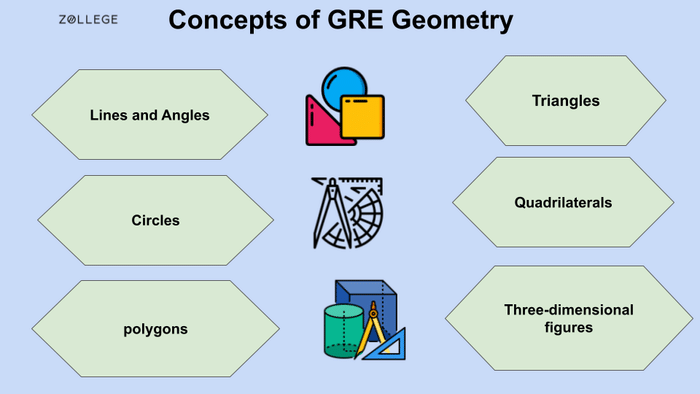
Must be eager to know about the syllabus and tips for GRE geometry. GRE geometry is an important part of the quantitative reasoning section. It is one of the four sections in GRE quantitative reasoning section, apart from arithmetic, algebra, and data analysis. GRE geometry problems cover almost 15% of the quantitative reasoning section. GRE geometry consists of concepts like Lines and angles, polygons, triangles, quadrilaterals, circles, and three-dimensional figures. What types of questions does GRE geometry have? This section of the GRE quantitative section comes in numerous forms like numeric data entry, and quantitative comparisons, and some come with diagrams.
How many questions are there in the GRE geometry section? Geometry GRE questions contain 20 questions in 2 sections, and you need to complete the test in 35 sections. The GRE Geometry syllabus and question types include solving perpendicular and parallel lines, triangles including isosceles, equilateral, and 30°-60°-90° triangles, and similar figures. How can you prepare for GRE geometry? You need to get clear of the base of geometry to solve the elementary geometric problems. The book The 5 lb book by Manhattan is one such recommendation. The number of geometry-based questions provided in the book would suffice to build a solid base on the topic. Regular self-training, making flashcards, and memorizing key geometric formulas can help you to solve problems. You must know that coordinate geometry is a part of the GRE algebra section.
What is taught in the high school geometry that is not in the GRE geometry section? Almost half of the geometry concepts that are taught in high school are not in the GRE syllabus. However, GRE geometry problems only cover the basic concepts. What is the importance of GRE geometry? Geometry improves your spatial cognition, which may be important in professions like engineering, physics, and architecture if you plan to pursue them. GRE Geometry questions are designed to help you apply the geometry concepts in real-life situations. Memorizing geometry GRE formulas is a must for solving all the problems. The average GRE score for the quant section is 152 out of 170.
| Table Of Contents |
Importance of GRE Geometry
GRE geometry is a significant subject on the Quantitative Reasoning part. The ability to grasp geometric ideas is fundamental to excelling in a wide range of disciplines. GRE self-preparation for the quant section is important as it assesses your capabilities better. This includes not limited to mathematics, physics, engineering, architecture, and computer science. GRE Geometry is very useful for the following reasons:
- Increases your ability to think critically and reason logically: GRE math geometry practice is great for honing these abilities, which are crucial when it comes to addressing any kind of difficulty. Students may develop transferable problem-solving abilities useful in many disciplines by working through challenging geometry problems.
- Improved spatial understanding: This is one of the many benefits students get from studying geometry. This improves their spatial cognition, which may be important in professions like engineering, physics, and architecture.
- Provides a springboard for further study: Calculus and linear algebra owe a great deal to geometry's role as a building block in the development of advanced mathematics. Students that do well in geometry often find that they have an easier time with other, more complex areas of mathematics.
- Enhances the ability to think critically and logically since solving geometry issues often requires pupils to partition larger problems into simpler ones. As a result, they become more analytical and adopt a more methodical strategy while tackling problems.
- Prepares for standardized tests: GRE Geometry questions are designed to test a student's ability to understand and apply geometry concepts. Students may boost their scores on admissions exams like the GRE by studying with these questions.
GRE Geometry is a foundational concept that test-takers and future professionals alike should have a firm grasp of. Learning geometry helps strengthen their analytical, mathematical, and problem-solving abilities, which will serve them well in college and beyond.
GRE Geometry Preparation
Knowing the fundamentals and putting them into practice with a wide range of problems is the best way to GRE preparation for the the geometry section. The following are some suggestions for studying for the GRE Geometry section:
- You should review the fundamentals of geometry, including the relationships between points, lines, angles, triangles, and circles. Read a textbook or other internet resource to refresh your memory on these ideas.
- Learn the fundamental theorems and formulae, including the Pythagorean theorem, area and perimeter formulas, and the circumference formula for circles.
- Take official GRE practice exams to get a feel for the many sorts of geometry problems that might arise on test day. Examine your results and figure out what you can do better.
- Sharpen your ability to analyze and solve problems. Get some reps in by tackling a wide range of GRE math geometry puzzles. Get started with simple issues and work your way up to the more challenging ones. Think carefully about the issue at hand, and then figure out how to tackle it methodically.
- Make diagrams and make use of other visual aids to better grasp geometry concepts. You may use this to picture intricate three-dimensional things better, too.
- Don't be hesitant to ask for assistance from a teacher, tutor, or internet resource if you're having trouble understanding a topic.
- You may improve your comprehension and your performance by reviewing important ideas and formulae on a regular basis and by continuing to practice a wide range of tasks.
Finally, in order to succeed on the special triangles GRE, you need to strengthen your problem-solving abilities and conceptual knowledge of the subject. You can do better on the GRE if you put in the time and effort to do so.
GRE Geometry Formulas
For the GRE Quantitative Reasoning component, below are some of the most important geometric formulae that test takers should commit to memory:
- Area of a triangle = 1/2 * base * height
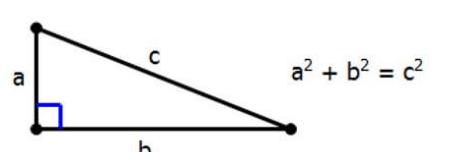
- Pythagorean Theorem: a² + b² = c², where a and b are the lengths of the two shorter sides of a right triangle, and c is the length of the hypotenuse.
- Volume of a cylinder = π * radius² * height
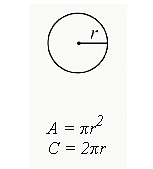
- Circumference of a circle = 2 * π * radius or π * diameter
- Area of a circle = π * radius²
- Volume of a sphere = (4/3) * π * radius³
- Surface area of a sphere = 4 * π * radius²
- Slope-intercept form of the equation of a line: y = mx + b, where m is the slope and b is the y-intercepts.
- Distance formula: √ ((x2 - x1) ² + (y2 - y1) ²), where (x1, y1) and (x2, y2) are the coordinates of two points in a coordinate plane.
- Midpoint formula: (x1 + x2)/2, (y1 + y2)/2), where (x1, y1) and (x2, y2) are the coordinates of two points in a coordinate plane.
To do well on the GRE geometry problems, you need more than just memorization of formulae. Candidates should not only know the formulae, but also how to use them to answer a variety of geometry questions in the test. In order to become comfortable with the style and degree of difficulty of the problems on the real GRE triangle questions. Test takers should practice with questions from previous exams.
GRE Geometry Syllabus
Here's a general overview of the topics typically covered in a high school geometry GRE syllabus:
- Basics of Geometry
- Points, Lines, and Planes
- Measuring Lengths and Angles
- Using Tools to Construct Geometric Figures
- Identifying Basic Geometric Shapes
- Reasoning and Proof
- Understanding and Writing Proofs
- Properties of Congruent Triangles
- Properties of Similar Triangles
- Properties of Quadrilaterals
- Proofs Involving Parallel and Perpendicular Lines
- Using Coordinate Geometry to Prove Geometric Theorems
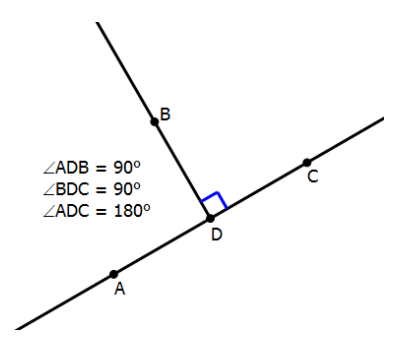
- Lines and Angles
- Relationships Between Lines and Angles
- Parallel Lines and Transversals
- Angles in Triangles and Polygons
- Angle Properties of Circles
- Triangles GRE
- Classifying Triangles by Sides and Angles
- Congruence and Similarity of Triangles
- Special Lines and Points in GRE triangle problems
- Pythagorean Theorem and its Converse
![IMG4]()
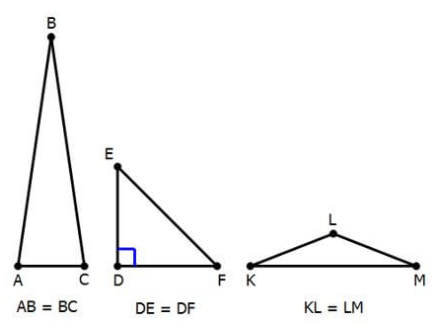
- Quadrilaterals and Other Polygons
- Classifying Quadrilaterals by Sides and Angles
- Properties of Trapezoids and Kites
- Properties of Regular Polygons
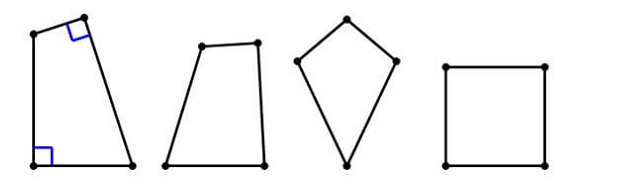
- Circles
- Properties of circles and cylinders GRE and Their Parts
- Tangents, Secants, and Chords
- Inscribed Angles and Arcs
- 3D Geometry
- Surface Area and Volume of Basic Shapes
- Congruence and Similarity of 3D Figures
- Transformations
- Reflections, Rotations, and Translations
- Glide Reflections and Dilations
- Coordinate Geometry
- Graphing Points and Lines in the Coordinate Plane
- Distance and Midpoint Formula
- Equations of Lines and Circles
- Trigonometry
- Ratios of Sides in Right Triangles
- Solving Right Triangles
- Applications of Trigonometry
Note that this is just a general outline and may vary depending on the specific course and curriculum.
GRE Geometry Fomula's Rules
Geometry formulas for GRE are one of the most significant parts of the preparation for GRE geometry preparation. Following the fuels for applying the formula can aid in a high score. You need to have a proper GRE preparation time is very necessary as it will enable you to have an organized preparation and enough time.
- The Pythagorean Theorem states that the length of the hypotenuse (the side opposite the right angle) squared is equal to the sum of the squares of the other two sides. where c is the hypotenuse and a, b, and c are the side lengths of the triangle.
- What is the area of a triangle? The area of a triangle is equal to half the product of its base and height. A = 1/2 bh.
- The formula for the surface area of a circle is r2, where it is around 14, for a given radius r.
- The formula for the circumference of a circle is 2r, where r is the radius.
- The formula for a cylinder's volume is (r2) (h2), where r and h are the cylinder's radius and height, respectively.
- The volume of a sphere with radius r is equal to 4/3r3.
- When the right angles and the right sides of two triangles are equal, we say that the triangles are comparable.
- It is said that two triangles are congruent if and only if their respective angles and sides are also congruent.
- A polygon with n sides with interior angles that, when added together, equal (n-2) x 180 degrees.
- All the outside angles of a polygon add up to 360 degrees, regardless of the number of sides it has.
- Angles formed by the intersection of a transversal with a pair of parallel lines are congruent. So, if and only if they are on the same side of the transversal and have the same corresponding interior and exterior angles.
- Angles that add up to 90 degrees are considered right angles.
- Angles that are added to others make a whole, called a supplementary angle, which is always 180 degrees.
- When two right angles are added together, they form a right angle.
Keep in mind that although memorizing these formulae and principles is helpful for the GRE geometry portion, geometry GRE practice questions are more critical.
GRE Geometry Preparation Books
Some GRE books carry preparation tips and questions that can help in preparing for the coordinate geometry GRE. Some of the recommendations are mentioned below:
- The Official Guide To The GRE General Test, Third Edition- Check PDF
- Manhattan Prep 5 lb. Series, Third Edition – Check PDF
Triangles, circles, cylinders, and coordinate geometry are only a few of the subjects tested on the GRE Geometry portion. Candidates may strengthen your knowledge and problem-solving abilities with the aid of GRE Geometry practice questions and problems.
FAQs
Ques. What geometry is on the GRE?
Ans. GRE geometry contains lines and angles, triangles, quadrilaterals, circles, and three-dimensional figures.
Ques. What is the formula for triangles?
Ans. The third side of the triangle is greater than the difference between the other two sides and less than the sum of the other two sides. Area of triangle = (1 / 2) * base * height. In a right-angle triangle, hypotenuse2 = base2 + perpendicular2. [Pythagoras theorem]
Ques. What are the properties of a rhombus for the GRE?
Ans. The properties of a rhombus are all sides of the rhombus are equal, the opposite sides of a rhombus are parallel, Opposite angles of a rhombus are equal, and In a rhombus, diagonals bisect each other at right angles.
Ques. What types of geometric concepts should I focus on for the GRE?
Ans. The GRE primarily tests basic geometric principles such as lines, angles, triangles, circles, polygons, and solid geometry like cubes and spheres.
Ques. Do I need to memorize geometric formulas for the GRE?
Ans. While memorizing formulas can be helpful, the GRE usually provides the necessary formulas in the test questions. However, being familiar with common formulas can save time during the exam.
Ques. How many geometry questions can I expect on the GRE?
Ans. Geometry questions typically account for around 15% of the GRE Quantitative Reasoning section.
Ques. Do I need to know advanced geometry concepts like trigonometry for the GRE?
Ans. No, the GRE focuses on fundamental geometry concepts. Trigonometry is not tested in the Quantitative Reasoning section.
Ques. What strategies can I use to approach geometry questions efficiently?
Ans. Break down the problem, draw diagrams if possible, and apply basic geometric principles. Sometimes, plugging in numbers or considering special cases can simplify complex problems.
Ques. Are there any common pitfalls to avoid in GRE geometry questions?
Ans. Misinterpreting diagrams, overlooking special cases, and assuming additional information is not provided are the common mistakes you should avoid. . Always carefully read the question and all given information.
Ques. Should I use the calculator for geometry questions?
Ans. The GRE provides an on-screen calculator.
Ques. Can I expect geometry questions involving coordinate geometry on the GRE?
Ans. Coordinate geometry is included in the GRE algebra section.
Ques. Are there any specific theorems I should review for GRE geometry?
Ans. Reviewing basic theorems like the Pythagorean theorem, properties of angles and triangles, and circle properties can be helpful.
Ques. How should I prepare for GRE geometry questions if I struggle with visualizing shapes and spatial relationships?
Ans. Practice drawing diagrams and visualizing geometric shapes in three dimensions. There are also many online resources and GRE prep books with geometry practice questions and explanations.
Ques. Should I guess if I'm unsure about a geometry question?
Ans. Guessing is better than leaving a question unanswered since there is no penalty for incorrect answers on the GRE.
Ques. Are there any shortcuts or tricks for solving geometry questions quickly?
Ans. Learning common geometric patterns and shortcuts, such as special right triangles or the properties of similar triangles, can help you solve problems more efficiently.
*The article might have information for the previous academic years, please refer the official website of the exam.