
GRE Vocabulary: GRE Word Lists, Flashcard, Books, and Apps
- GRE Grammar Preparation
- GRE Coaching In Hyderabad
- GRE Coaching In Kolkata
- GRE Online Coaching
- GRE Classes In Pune
- GRE Coaching In Delhi
- GRE Coaching In Bangalore
- Best GRE Coaching India
- Best Book For GRE Verbal
- GRE Preparation Books
- GRE Study Plan
- GRE Prep
- GRE Preparation Time
- GRE Verbal Tips
- GRE Self Preparation
- GRE AWA Books


Content Curator | Updated On - May 2, 2024
Highlights:
- GRE vocabulary can be improved by using flashcards and playing vocabulary word games.
- There are multiple books available especially designed for GRE vocabulary.
- GRE Vocabulary Flashcards by Magoosh, and GRE Practice, Prep, Flashcards by Varsity Tutors are some of the best vocabulary apps.
- There are certain GRE vocabularies that you must memorize to inculcate them in your answers.
How do you tackle the GRE vocabulary? GRE vocabulary is an essential part of the GRE verbal exam. If you have a good grasp of the English vocabulary, GRE verbal will seem much easier for you. GRE test words help you to implement them in graduate-level communication. Knowing all the major GRE words can save you from, being lost in a communication or a lecture. Now coming to the preparation part, you can use Magoosh vocab builder to learn and memorize the word lists. Remember that memorizing all the GRE vocab not only gets you high scores but also makes you a confident speaker, writer, and reader.
How a GRE Vocabulary List has been Compiled?
Candidates can compile a GRE verbal word list by carefully studying top-rated prep courses and understanding which all words are missing. Those missing words are useful for GRE vocabulary preparation. The list might not be comprehensive or cover all the words but it will be a good start to improving your GRE vocabulary.
Essential GRE Vocabulary List
In the list, a word will be introduced along with its definition. A word can have more than one definition and the most frequent version of GRE has been chosen in order to avoid confusion. You must also follow the GRE verbal tips that includes steps to improve your vocabulary.
| Word | Meaning | Example |
|---|---|---|
| Prosaic: (adj.) | commonplace, dull or unimaginative | The prosaic life of a hardworking student. |
| Quotidian: (adj.) | daily, customary or usual occurrence of something | Mobile has become part of our quotidian existence. |
| Restive: (adj.) | uneasy or restless | The audience was becoming restive as they waited for the Badsah’s performance to begin. |
| Pernicious: (adj.) | causing gradual or subtle type of harm | The cuts in government funding have had a pernicious effect on local health services. |
| Diffident: (adj.) | lacks self-worth or confidence | She felt diffident about speaking to police about domestic violence. |
| Equivocal: (adj.) | allowing the possibility of multiple meanings | His equivocal response has been done to bring the situation under control. |
| Erudite: (adj.) | showing or having great knowledge | R. Ramalingam is a well-respected and erudite scholar. |
| Prodigal: (adj.) | extravagant or wasteful recklessly | A prodigal person spends money recklessly rather than an ideal person. |
| Laudable: (adj.) | something or someone deserving commendation or praise | Enhancing the development of schools for children's education is a laudable act. |
| Laconic: (adj.) | using a few words to explain everything in the process which can be shortened to concise | Laconic situation made him do the drama. |
| Enervate: (v.) | weaken or sap energy | Using my phone is definitely going to enervate me for the rest of the day. |
| Ambivalence: (n.) | having mixed feelings or uncertainty | She viewed her balcony plants with ambivalence. |
| Agog: (adj.) | very excited about something with curiosity, anticipation or eagerness | The news about the chemists agog the market. |
| Artless: (adj.) | without any kind of greed, guilt or deceit | Artless is a very positive word. |
| Gossamer: (adj.) | delicate, light or thin like a veil | This dress appears to be gossamer fabric as it is sheer. |
| Harangue: (n.) | ong, vehement or angry | He kept his harangue about someone. |
| Insipid: (adj.) | lack of enthusiasm or interest | Insipid at times is confused with the word insidious but they are two different words with different meanings. |
| Maudlin: (adj.) | someone who is tearful or weakly emotional | Maude Latour was an emerging artist and Colombian philosophy major who wrote some peppy tracks with whom you can associate the word maudlin. |
| Nonplussed: (adj.) | being completely puzzled or perplexed | He got nonplussed with her behavior. |
| Urbane: (adj.) | refined and courteous | Urbane is a person who is refined and courteous in terms of mannerisms |
| Ersatz: (adj.) | substitute for a specific product, mostly of inferior quality | He can eat ersatz chocolate made from carob beans. |
| Anodyne: (adj.) | bland and weakened | He is an anodyne and will not cause controversy. |
| Euphony: (n.) | pleasing sound to the ear | Poetry and euphony goes hand in hand. |
| Extant: (adj.) | surviving and still in existence | The extant animals must be kept in the biosphere reserve. |
| Lachrymose: (adj.) | sad, tear-inducing and mournful | Losing her father made her lachrymose all day. |
| Munificent: (adj.) | very generous in an unusual way | The word should not be confused with maleficent which means working to produce evil or harm. |
| Nadir: (n.) | lowest point, a point of great despair or adversity | He was at his nadir when she left her. |
| Pellucid: (adj.) | understood or lucid | The Atlantic ocean water is pellucid. |
| Philistine: (n.) | person who is hostile towards arts and lacks culture | Lots of pseudo philistine are gaining social media attention these days. |
| Polemic: (n.) | written or verbal attack on something or someone | The news reports throw a polemic on celebrities. |
| Puerile: (adj.) | trivial or very silly | Band organizers branded the group's actions as puerile. |
| Quixotic: (adj.) | exceedingly impractical, unrealistic and idealistic | She was extensively quixotic from the real world. |
| Raconteur: (n.) | gifted and skilful in storytelling | The guy was a raconteur. |
| Soporific: (adj.) | tending or causing sleep | Taking soporific medicines can be harmful to health. |
| Belligerent: (adj.) | quick or eager to argue and fight | He was belligerent, when the case went to trial. |
| Tyro: (n.) | novice or someone new to learning something | The new team members are tyro to the work environment. |
| Auspicious: (adj.) | favourable, success promising and opportune | It is a very auspicious day for the beginning of his new career. |
| Capricious: (adj.) | something whimsical or unpredictable | His actions were capricious. |
| Inculpate: (v.) | accusation or charges of wrongdoing against someone | Prakash, unwilling to inculpate maintains an obstinate silence. |
| Specious: (adj.) | an argument which is wrong or incorrect but superficially plausible | some specious excuse about failing to recognize her made her escape the situation. |
| Banal: (adj.) | obvious and boring or lacking in originality | Tom wrote banal but the story was good. |
| Hegemony: (adj.) | dominance or leadership over a group or country | Only Cruise can bring hegemony in his state. |
| Paucity: (n.) | lacking something | This curry has a paucity in taste. |
| Innocuous: (adj.) | something which will not produce any ill effects and is harmless | This might seem innocuous until he got it precisely. |
| Alacrity: (n.) | an eager willingness to do something | Alacrity word is very positive in nature although it gives a negative connotation. |
GRE Flashcards
Candidates who want to ace the GRE vocab flashcards are a great way to do so. They can go for Magoosh Flashcards for GRE vocabulary app. The app can help you in mastering 100 to 1,000 gre high frequency words. In addition to this, if you are looking for a review course which will help in improving your score or acing the exam, try Magoosh GRE words. You can also refer to books for Verbal GRE prepatation to memorise the words from them.
How to Improve GRE Vocabulary?
Apart from using flashcards and review courses, there are many other ways to help in GRE vocabulary preparation. Some of them are:
- Read challenging material from various sources in good frequency. In case you come across an unfamiliar word, note them and look up for their definitions. Resources like Barrons GRE word list, Magoosh GRE vocabulary helps candidates in preparing for GRE.
- A mobile flashcard app like AnkiApp to keep a track of words you have discovered yourself. The app helps in making your flashcard decks easy and quick. It also has a spaced repetition algorithm to improve recalling hard gre words. These decks can help in the standard vocabulary study routine.
- If you are studying alone, try saying aloud the vocab words with their definitions. Enroll Yourself in GRE online classes as they help you to be in a competttive enrionment and you can converse in English.
- Make your own visualizations and make-up anecdotes to help you in remembering the words you continuously miss. The weird and individualized visualizations are much better.
- A well-structured review course with an emphasis on GRE important words like Achievable. It is the best way to learn tough GRE important words.
GRE Vocabulary Books
Here is a list of the top GRE preparation books for helping the candidates during GRE preparation:
- The Official Guide to the GRE® General Test, Third Edition- Check PDF
- Kaplan’s GRE Verbal Workbook- Check PDF
- Manhattan 5 lb. Book of GRE Practice Problems- Check PDF
- Manhattan Prep GRE Verbal Strategies- Check PDF
- The Vocabulary Builder Workbook- Check PDF
-
GRE Verbal Grail- Check PDF
-
The Official Guide to the GRE Revised General Test- Check PDF
Best Apps to Improve GRE Vocabulary
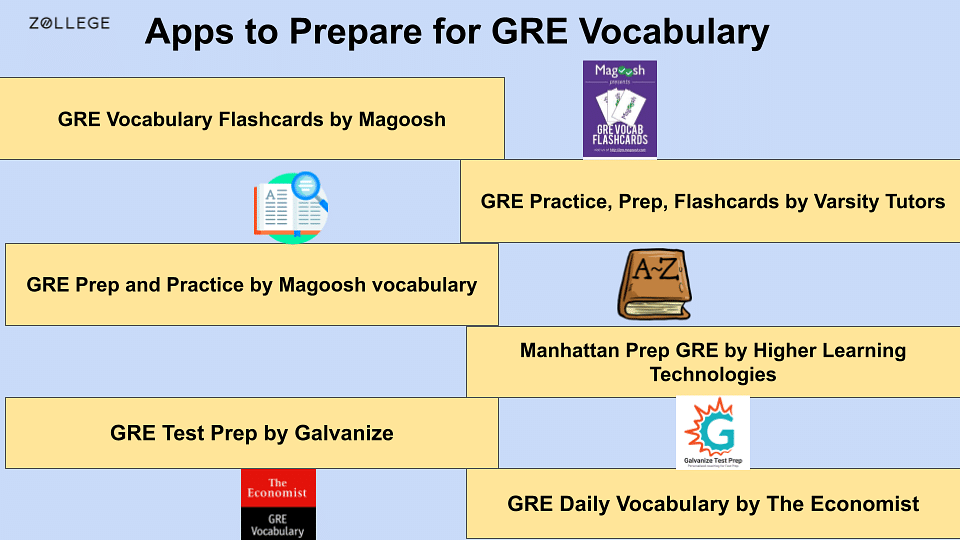
GRE vocabulary preparation depends on the knowledge and difficulty level of GRE vocabulary. To learn more words in less time, the best apps to improve GRE preparation for vocabulary are listed below:
- GRE Vocabulary Flashcards by Magoosh
- GRE Practice, Prep, Flashcards by Varsity Tutors
- GRE Prep and Practice by Magoosh vocabulary
- Manhattan Prep GRE by Higher Learning Technologies
- GRE Test Prep by Galvanize
- GRE Daily Vocabulary by The Economist
This article will surely help you in understanding all about GRE root words and learn all gre english words with ease. A GRE vocabulary book like Barrons wordlist is also useful along with gre words with pictures which will help you in analyzing GRE important words.
FAQs
Ques. What is the best way to prepare for GRE vocabulary?
Ques. How many words should I learn for the GRE?
Ques. Are there any shortcuts to learning GRE vocabulary?
Ques. Should I focus on memorizing definitions or understanding word usage?
Ques. What are some resources for GRE vocabulary practice?
Ques. Is it necessary to learn every word on GRE vocabulary lists?
Ques. How should I approach learning word roots, prefixes, and suffixes?
Ques. Should I memorize synonyms and antonyms for GRE vocabulary words?
Ques. How can I retain GRE vocabulary words long-term?
Ques. How can I improve my ability to infer the meaning of unfamiliar words from context?
Ques. Is it beneficial to learn GRE vocabulary through thematic groups or categories?
Ques. Should I use GRE vocabulary words in my writing and speaking practice?
Ques. How can I track my progress in learning GRE vocabulary?
Ques. Are there any tips for tackling vocabulary questions on the GRE?
Ques. What should I do if I encounter unfamiliar vocabulary words on the GRE?
*The article might have information for the previous academic years, please refer the official website of the exam.