
GRE Subject Test: Registration process, Subject-wise Syllabus, and Scores
- GRE Grammar Preparation
- GRE Coaching In Hyderabad
- GRE Coaching In Kolkata
- GRE Online Coaching
- GRE Classes In Pune
- GRE Coaching In Delhi
- GRE Coaching In Bangalore
- Best GRE Coaching India
- Best Book For GRE Verbal
- GRE Preparation Books
- GRE Study Plan
- GRE Prep
- GRE Preparation Time
- GRE Verbal Tips
- GRE Self Preparation
- GRE AWA Books


Content Curator | Updated On - Apr 24, 2024
Wondering about which subject test to take for GRE? GRE subject tests are made to measure your knowledge and skill level in a particular subject. They are intended for those who have an undergraduate major or an extensive background in physics, mathematics, or psychology. GRE subject tests are used by the admission panel of the university to supplement your undergraduate records, recommendation letters, and other graduate-level study. Do you know about the recent changes made in the GRE subject test? GRE subject test has been shifted to the computer-delivered format. GRE exam subject tests now will be offered in more locations. In addition to that, physics and psychology tests will be reduced to 2 hours.
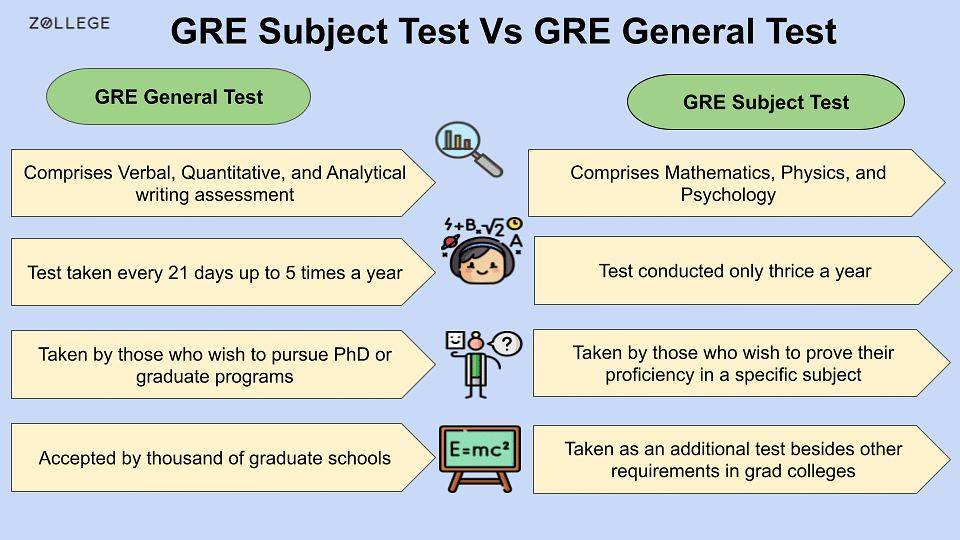
Want to know more about the test content? The duration of the test for Mathematics is 2 hours and 50 minutes. There are no separate times sections. GRE mathematics subject test contains 66 questions which are taken mostly from the undergraduate level. Almost 50% of the questions come from calculus and their application. GRE maths subject exam consists of three areas that are covered - calculus, algebra, and additional topics. GRE physics test consists of 70-75 choice-based questions. The areas covered in GRE physics are classical mechanics, electromagnetism, optics and wave phenomena, quantum mechanics, special relativity, etc. For GRE psychology, you need to attempt 144 multiple-choice questions. You need to prepare for Biological, cognitive, social, and clinical psychology. GRE subject test is different from GRE general test as the latter measures your verbal, quantitative, and analytical abilities.
Is it a must to write the GRE subject test if I clear the GRE general test? GRE subject test may not be really necessary for MS or PhD admissions. However, you can contact the admissions offices of colleges you are interested in. But GRE subject test can be an extra qualification for you. GRE subject score, if good, can set your profile to stand out from others. If you're majoring in — or have extensive background in — a specific area, you might want to take a Subject Test in addition to the GRE revised General Test. But, GRE Subject Tests are a great way to distinguish yourself. What about the GRE subject test scores? Graduate record examinations subject test GRE scores range from 200 to 990 scale, in 10-point increments. For physics and psychology tests scores are reported on a 0-100 score scale, in 1 -point increments.
- Test Exam Pattern
- Subject Test Syllabus
2.1 Maths Syllabus
2.2 Physics Syllabus
2.3 Psychology Syllabus - Subject Test Registration
3.1 Registration Process
3.2 Subject Test Dates - Good GRE Subject Test Score
- Score Validity
5.1 How Many Times Subject Test Can Be Attempted - Preparation Tips
6.1 Study Resources - FAQs
GRE Subject Test Exam Pattern
GRE exam subjects are conducted for a duration of 2 hours for GRE physics and GRE psychology exam. For GRE mathematics the time duration is 2 hours and 50 minutes. Students can appear for GRE in paper based mode or computer based. Earlier GRE chemistry was also available but ETS has recently discontinued Chemistry. Following chart shows the GRE Subject test exam pattern:
GRE Subject Test Syllabus
The syllabus for GRE Subject test includes different topics for different subjects. GRE subjects for Ms include math, Psychology and physics. GRE subject test computer science, GRE english syllabus, GRE biology and GRE in economics all have been discontinued by ETS. The syllabus for GRE subject Test and GRE quantitative reasoning syllabus can be downloaded from the official website of ETS. Following is the syllabus for different subjects of GRE Subject test:
GRE Maths Syllabus
There are a total 66 GRE maths questions in the form of multiple choice questions. GRE Mathematics include three main topics of Calculus, Algebra and geometry along with a few additional topics. The table given below provide the topics included in the GRE math subject test:
| Category | Syllabus |
|---|---|
Algebra |
|
| Calculus |
|
Additional Topics |
|
GRE Physics Syllabus
GRE physics question papers include 100 multiple choice questions with 5 different choice options.For begininng your physics preparation, you can consider enrolling in GRE coaching classes in India that pffers comprehensive mock tests and study materials. The questions have to be solved in 2 hours. The major topics of physics and concepts have been given in the table below:
| Category | Syllabus |
|---|---|
| Specialized Topics |
|
| Thermodynamics and Statistical Mechanics |
|
| Electromagnetism |
|
| Laboratory Methods |
|
| Atomic Physics |
|
| Optics and Wave phenomena |
|
| Classical Mechanics |
|
| Special Relativity |
|
| Quantum Mechanics |
|
GRE Psychology Syllabus
GRE Psychology Syllabus contains a total 205 multiple choice questions. To start you Psychology prepration for GRE subject test,setting a target GRE preparation time is very necessary. The questions include topics of cognitive, developmental, social, biology etc Psychology topics. Following table provide detailed syllabus for GRE Subject test psychology:
| Category | Syllabus |
|---|---|
| Developmental |
|
| Cognitive | Learning
Language
Memory
Thinking
|
| Biological | Sensation and Perception
Physiological/Behavioral Neuroscience
|
| Measurement, methodology and other | General
Measurement and Methodology
|
| Clinical | Personality
Clinical and Abnormal
|
| Social |
|
GRE Subject Test Registration
Registration process for GRE Subject test is the same as that of GRE General test. ETS conducts GRE Subject test three times in a year: April, September and October. In India, GRE Subject test is conducted in the month of October. Earlier, students have to appear for GRE Subject test from a nearby test center through paper based mode. But now students can register for the computer based GRE Subject test. The registration for 2024 GRE Subject test has not been updated yet.
GRE Subject Test Registration Process
Students can follow the following given steps to register for GRE Subject test for any domain subjects:
- Visit the official ETS GRE Website and create an account
- Register for GRE Subject test by filling and submitting the application form.
- Select the GRE Test date and nearby test center.
- Pay the application fees and submit.
- Candidates will receive a message for the registration confirmation.
GRE Subject Test Dates
GRE Subject test is conducted on different dates and thrice in a year. Students can appear for one particular subject on a single date. You must choose your nearest GRE exam centres to avoid being late on the test day. Following table provide dates for GRE Subject Test 2024:
| Exam | Dates |
|---|---|
| GRE Subject Test 1 | September 25,2023 to October 8,2023 |
| GRE Subject Test 2 | October 24,2023 to November 6,2023 |
| GRE Subject Test 3 | April 7,2024 to April 20,2024 |
What is a Good GRE Subject Test Score?
GRE subject test scores range from 200 to 990 for each domain subject. Students can only appear for one subject on a single date. The average score for GRE subject test mathematics is 664. The average GRE physics score is 714 and for psychology it is 619. You can use the GRE score calculator your raw score to percentile which will help you to assess your preparation. Students scoring above this average score are considered to be eligible for admission. A score of 600 or above is considered a good GRE subject test score.
GRE Subject Test Score Validity
GRE subject test and GRE general test have the same score validity of 5 years. The validity of GRE scores is counted from the day of examination and not from the day of result. GRE subject test scores are released on the official website of ETS and students are notified through mail. GRE subject test results are generally declared within 5 weeks after appearing for GRE subject exam.
How Many Times GRE Subject Test Can be Attempted?
GRE subject test is required by some universities for domain specific courses. Students can submit GRE subject test scores directly from ETS website to the university application. In case of expiration of scores, students will have to reappear for GRE subject test. Students can appear for GRE Subject tests after a 14 days gap between two consecutive exams. To avoid taking the test multiple times, you must have have an organised GRE study plan for the preparation.
GRE Subject Test Preparation Tips
Students must try to achieve more than 600-650 GRE Subject test scores to secure chances of admission. There are a number of tips and strategies which help students to score high in GRE Subject Test. Following are a few tips which help students to prepare for GRE Subject Test:
- Be aware about the GRE Subject test pattern and syllabus.
- Enroll into online subject specific courses and certificate programs.
- Make notes for the topics.
- Take help from subject specific GRE books
- Revise the topics which are difficult to learn and memorize.
- Increase speed in solving and interpreting answers.
- Study according to a well structured study plan.
- Practice and solve mock tests
GRE Subject Test Study Resources
Students can take help from online available study resources including GRE maths practice test, mock tests, books and more. These resources help candidates to GRE score high and provide an understanding of the concepts. Following table provide most recommended books for GRE subject test:
| GRE Subject Test | Books |
|---|---|
| GRE Physics Book |
|
| GRE Mathematics Book |
|
| GRE Psychology Book |
|
GRE in English and many other subjects were discontinued by ETS due to the less effective approach of such subjects. GRE CS syllabus can be viewed from ETS Official website. Students can prepare for GRE from online available study materials and books. Students can register for GRE from July 2023 and select preferred test centers from the list of test centers available.
FAQS
Ques. What is the GRE Subject Test?
Ques. Which subjects are covered by the GRE Subject Tests?
Ques. How many GRE Subject Tests are there?
Ques. Who should take the GRE Subject Test?
Ques. How is the GRE Subject Test different from the GRE General Test?
Ques. What is the format of the GRE Subject Test?
Ques. When are the GRE Subject Tests offered?
Ques. How long is the GRE Subject Test?
Ques. How is the GRE Subject Test scored?
Ques. How should I prepare for the GRE Subject Test?
Ques. Are calculators allowed on the GRE Subject Test?
Ques. Can I take multiple GRE Subject Tests on the same day?
Ques. How long are GRE Subject Test scores valid?
Ques. Can I retake the GRE Subject Test?
Ques. Do all graduate programs require GRE Subject Test scores?
*The article might have information for the previous academic years, please refer the official website of the exam.