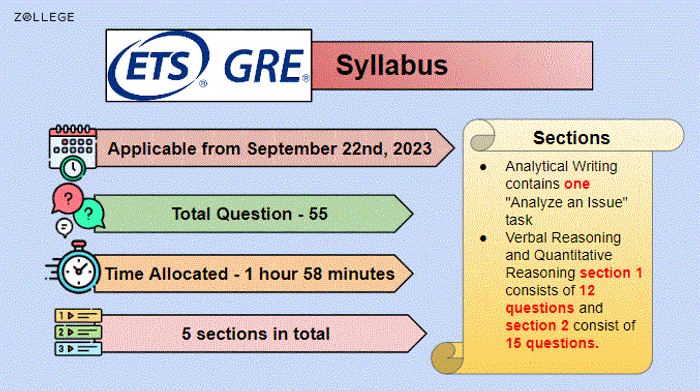
GRE Syllabus has been divided into three subsections of GRE Analytical Writing, GRE Verbal Reasoning and GRE Quantitative reasoning. GRE Exam Syllabus makes certain evaluations based on creative writing, analyzing, drawing out conclusions and deducing the solution from numerical data. The overall test time is about 1 hour and 58 minutes. There are five sections in the new GRE test format which has been applicable after September, 2023. Analytical Writing has one section, Verbal Reasoning and Quantitative Reasoning has two sections each.
The Analytical Writing contains one "Analyze an Issue" task. The Verbal Reasonin and Quantitative Reasoning section 1 consists of 12 questions and section 2 consist of 15 questions. The time allocated for "Analyze an Issue" task is 30 minutes. You will get 18 minutes and 23 minutes to solve section 1 and 2 of Verbal Reasoning. The Quantitative Reasoning section 1 must be completed within 18 minutes and section 2 within 26 minutes.
The syllabus has provided specific topics for GRE preparation for both GRE general test and GRE Subject test. The important difference between both the tests is that GRE general test evaluates general skills of Analyzing, interpreting, reasoning and evaluating. GRE subject tests assess the knowledge and skills of candidates for specific subjects like, psychology, physics and more. GRE exam pattern dictates about question type, duration, number of questions etc.
GRE General Test is attempted within a time period of 1 hour and 58 minutes. In this time duration there are three sections to be attempted and different questions of each section. Following is the syllabus for each section of GRE General Test.
The analytical writing section includes one task with a time duration of 30 minutes. GRE Analytical writing includes:
- Analyze an Issue: In this task candidates are provided a topic based on general issue or situation. The candidates have to use creative Analytical skills and consider all the facts and examples related to this issue. The analysis must be within a word limit of 500-600 words.
The verbal reasoning of the GRE is 41 minutes. There are a total 2 sections with 12 questions in first and 15 questions in 2nd section. The topics covered under GRE Verbal syllabus includes:
- Nouns
- Pronouns
- Adjectives
- Tenses
- Active and passive voice
- Idioms and expressions
- Parallelism
- Subject verb agreement
- Pronouns agreement
- Modifiers
There are three different types of questions provided in the verbal reasoning of GRE. These questions are based on the assessment of above mentioned topics and skills. The question type is: Reading passages, sentence equivalence or synonyms and sentence completion.
The Quantitative reasoning GRE Portion includes the quantitative data and the candidates are required to solve and deduce solutions for this. The section contains 27 questions with three question types: multiple choice, numerical entry and comparison questions. 47 minutes is provided to solve this section. GRE Maths Syllabus for quantitative reasoning is provided in the table below:
| Category | Syllabus |
Arithmetic Syllabus | - Exponential operations
- Algebraic expression factoring and simplifying
- Variables, constants, terms, degrees, coefficient
- Monomials
- Polynomials
- Inequalities
- Linear equations and quadratic equations
- Functions
- Permutation and combination
- Geometric and arithmetic progression
|
Geometry Topics | - Lines and Angles
- Triangles
- Circles
- Square rectangle
- Cube, cuboid, sphere, cone and cylinder
- Rhombus
- Polygon
- Parallelogram
- Trapezium
- Area, perimeter, circumference, surface area and volume
|
Data analytics | - Counting methods: venn diagram, permutations and combinations
- Statistics: mean, median and mode
- Range
- Inter quadratic range and standard deviations
- Percentiles and quartiles
- Data interpretation of graph and tables
- Line graph, bar graph, pie chart, box plots, scatter plots and frequency distribution
- Probability of independent events and compound events
- Random variables and probability distribution
|
There are a total four subjects available for GRE Subject tests: Math, chemistry, physics and psychology. The syllabus and number of questions is different for each of these subjects. The total time duration is 2 hours and 50 minutes. The type of questions varies for each subject. It is used to assess the special abilities of candidates for a particular course of one of these subjects. Following is the GRE Exam details for each subject and number and type of questions.
The total number of questions provided is 66 in the multiple choice format. There are three concepts for GRE Maths which include Algebra, calculus, GRE Goemetry and some additional topics. The following table provides the syllabus for each of these topics and the percentage of questions included from these topics:
| Category | Syllabus |
GRE Algebra (25%) | - Elementary algebra
- basic algebraic techniques and manipulations
- Linear algebra
- Matrix algebra
- Systems of linear equations
- Vector spaces
- Linear transformations
- Characteristic polynomials, and eigenvalues and eigenvectors
- Abstract algebra and number theory
- Group theory
- Theory of rings
- Modules, field theory, and number theory
|
| Calculus (50%) | - Differential and integral calculus of one and of several variables
- Calculus-based applications and connections with coordinate geometry
- Trigonometry
- Differential equations
|
Additional Topics (25%) | - Introductory real analysis
- Sequences and series of numbers and functions
- Continuity, differentiability and integrability
- Elementary topology of R and R
- Discrete mathematics: logic, set theory
- Combinatorics, graph theory, and algorithms
- General topology
- Geometry, complex variables
- Probability and statistics
- Numerical analysis
|
The chemistry subject syllabus of GRE includes a total 130 Multiple choice questions. These questions are based on analytical chemistry, inorganic and organic chemistry and physical chemistry. The following table provides information regarding different topics of the chemistry and percentage of question coverage:
| Category | Syllabus |
| Physical Chemistry (30%) | - Thermodynamics — First, second, and third laws
- Thermochemistry, ideal and real gasses and solutions
- Gibbs and Helmholtz energy
- Chemical potential
- Chemical equilibria
- Phase equilibria
- Colligative properties
- Statistical thermodynamics
- Quantum Chemistry and Applications
- Spectroscopy
- Classical experiments
- Principles of quantum mechanics, atomic and molecular structure
- Molecular spectroscopy
- Dynamics
- Experimental and theoretical chemical kinetics
- Solution and liquid dynamics
- Photochemistry
|
| Inorganic chemistry (25%) | - General Chemistry, Periodic trends, oxidation states, nuclear chemistry
- BIonic Substances, Lattice geometries, lattice energies, ionic radii and radius/ratio effects
- Covalent Molecular Substances, Lewis diagrams, molecular point groups, VSEPR concept, valence bond description and hybridization, molecular orbital description, bond energies, covalent and van der Waals radii of the elements, intermolecular forces
- Metals and Semiconductors, Structure, band theory, physical and chemical consequences of band theory
- Concepts of Acids and Bases, Bronsted-Lowry approaches, Lewis theory, solvent system approaches
- Chemistry of the Main Group Elements, Electronic structures, occurrences and recovery, physical and chemical properties of the elements and their compounds
- Chemistry of the Transition Elements, Electronic structures, occurrences and recovery, physical and chemical properties of the elements and their compounds, coordination chemistry
- Special Topics, Organometallic chemistry, catalysis, bioinorganic chemistry, applied solid-state chemistry, environmental chemistry
|
| Analytical Chemistry (15%) | - Data Acquisition and Use of Statistics, Errors, statistical considerations
- Solutions and Standardization, Concentration terms, primary standards
- Homogeneous Equilibria, Acid-base, oxidation-reduction, complexometry
- Heterogeneous Equilibria, Gravimetric analysis, solubility, precipitation titrations, chemical separations
- Instrumental Methods,Electrochemical methods, spectroscopic methods, chromatographic methods, thermal methods, calibration of instruments
- Environmental Applications
- Radiochemical Methods, Detectors, Applications
|
| Organic chemistry (30%) | - Structure, Bonding, and Nomenclature, Lewis structures, orbital hybridization, configuration and stereochemical notation, conformational analysis, systematic IUPAC nomenclature, spectroscopy
- Functional Groups, Preparation, reactions, and interconversions of alkanes, alkenes, alkynes, dienes, alkyl halides, alcohols, ethers, epoxides, sulfides, thiols, aromatic compounds, aldehydes, ketones, carboxylic acids and their derivatives, amines
- Reaction Mechanisms — Nucleophilic displacements and addition, nucleophilic aromatic substitution, electrophilic additions, electrophilic aromatic substitutions, eliminations, Diels-Alder and other cycloadditions
- Reactive Intermediates — Chemistry and nature of carbocations, carbanions, free radicals, carbenes, benzynes, enols
- Organometallics, Preparation and reactions of Grignard and organolithium reagents, lithium organocuprates, and other modern main group and transition metal reagents and catalysts
- Special Topics, Resonance, molecular orbital theory, catalysis, acid-base theory, carbon acidity, aromaticity, antiaromaticity, macromolecules, lipids, amino acids, peptides, carbohydrates, nucleic acids, terpenes, asymmetric synthesis, orbital symmetry, polymers
|
The syllabus for GRE Physics consists of 100 multiple choice questions. This includes different topics of physics and the percentage of questions that are derived from these sections. The following table provide details about the topics:
| Category | Syllabus |
| Electromagnetism (18%) | - Electrostatics
- Currents and DC circuits
- Magnetic fields in free space
- Lorentz force
- Induction
- Maxwell’s equations and their applications
- Electromagnetic waves
- AC circuits, magnetic and electric fields in matter
|
| Thermodynamics and Statistical Mechanics (10%) | - The laws of thermodynamics
- Thermodynamic processes
- Equations of state
- Ideal gases
- Kinetic theory
- Ensembles
- Statistical concepts and calculation of thermodynamic quantities
- Thermal expansion and heat transfer
|
| Atomic Physics (10%) | - Properties of electrons
- Bohr model
- Energy quantization
- Atomic structure
- Atomic spectra
- Selection rules
- Black-body radiation
- X-rays, atoms in electric and magnetic fields
|
| Laboratory Methods (6%) | - Data and error analysis
- Electronics
- Instrumentation
- Radiation detection
- Counting statistics
- Interaction of charged particles with matter, lasers and optical interferometers
- Dimensional analysis
- Fundamental applications of probability and statistics
|
| Classical Mechanics (20%) | - Kinematics
- Newton’s laws
- Work and energy
- Oscillatory motion
- Rotational motion about a fixed axis
- Dynamics of systems of particles
- Central forces and celestial mechanics
- Three-dimensional particle dynamics
- Lagrangian and Hamiltonian formalism
- Non-inertial reference frames
- Elementary topics in fluid dynamics
|
| Optics and Wave phenomena (9%) | - Wave properties
- Superposition, interference
- Diffraction
- Geometrical optics
- Polarization
- Doppler effect
|
| Quantum Mechanics (12%) | - Fundamental concepts
- Solutions of the Schrödinger equation
- Square wells, Harmonic oscillators and hydrogenic atom
- Spin, angular momentum
- Wave function symmetry
- Elementary perturbation theory
|
| Special Relativity (6%) | - Time dilation
- Length contraction
- Simultaneity, energy and momentum
- Four-vectors and Lorentz transformation
- Velocity addition
|
| Specialized Topics (9%) | - Nuclear and Particle physics
- Nuclear properties
- Radioactive decay
- Fission and fusion, reactions
- Fundamental properties of elementary particles
- Condensed Matter, crystal structure, x-ray diffraction, thermal properties, electron theory of metals, semiconductors, superconductors
- Miscellaneous, astrophysics, mathematical methods, computer applications.
|
There are a total 205 multiple choice questions in the psychology section of GRE. These questions are based on cognitive, biological, developmental, social, clinical and methodological Psychology. The following table holds the information regarding the topics from these disciplines and the percentage of question coverage:
| Category | Syllabus |
| Cognitive (17-24%) | - Learning (3-5%)
- Classical Conditioning
- Instrumental Conditioning
- Observational Learning, Modeling
- Theories, Applications and Issues
- Language (3-4%)
- Phonemes, morphemes, phrases
- Syntax
- Meaning
- Speech Perception and Processing
- Reading Processes
- Verbal and Nonverbal Communication
- Bilingualism
- Theories, Applications and Issues
- Memory (7-9%)
- Working Memory
- Long-term Memory
- Types of Memory
- Memory Systems and Processes
- Theories, Applications and Issues
- Thinking (4-6%)
- Representation, Categorization, Imagery, Schemas, Scripts
- Problem Solving
- Judgment and Decision-Making Processes
- Planning, Metacognition
- Intelligence
- Theories, Applications and Issues
|
| Developmental (12-14%) | - Nature-Nurture
- Physical and Motor
- Perception and Cognition
- Language
- Learning, Intelligence
- Social, Personality
- Emotion
- Socialization, Family and Cultural
- Theories, Applications and Issues
|
| Measurement, methodology and other (15-19%) | - General (4-6%)
- History
- Industrial-Organizational
- Educational
- Measurement and Methodology (11-13%)
- Psychometrics, Test Construction, Reliability, Validity
- Research Designs
- Statistical Procedures
- Scientific Method and the Evaluation of Evidence
- Ethics and Legal Issues
- Analysis and Interpretation of Findings
|
| Biological (17-21%) | - Sensation and Perception (5-7%)
- Psychophysics, Signal Detection
- Attention
- Perceptual Organization
- Vision
- Audition
- Gustation
- Olfaction
- Somatosenses
- Vestibular and Kinesthetic Senses
- Theories, Applications and Issues
- Physiological/Behavioral Neuroscience (12-14%)
- Neurons
- Sensory Structures and Processes
- Motor Structures and Functions
- Central Structures and Processes
- Motivation, Arousal, Emotion
- Cognitive Neuroscience
- Neuromodulators and Drugs
- Hormonal Factors
- Comparative and Ethology
- States of Consciousness
- Theories, Applications and Issues
|
| Social (12-14%) | - Social Perception, Cognition, Attribution, Beliefs
- Attitudes, and Behavior
- Social Comparison, Self
- Emotion, Affect, and Motivation
- Conformity, Influence, and Persuasion
- Interpersonal Attraction and Close Relationships
- Group and Intergroup Processes
- Cultural or Gender Influences
- Evolutionary Psychology, Altruism and Aggression
- Theories, Applications and Issues
|
| Clinical (15-19%) | - Personality (3-5%)
- Theories
- Structure
- Assessment
- Personality and Behavior
- Applications and Issues
- Clinical and Abnormal (12-14%)
- Stress, Conflict, Coping
- Diagnostic Systems
- Assessment
- Causes and Development of Disorders
- Neurophysiological Factors
- Treatment of Disorders
- Epidemiology
- Prevention
- Health Psychology
- Cultural or Gender Issues
- Theories, Applications and Issues
|
There are several tips and tricks which can help students to prepare effectively for GRE Exam syllabus. The following are a few important tips to keep in mind while GRE Preparation:
- Attempt as many GRE Practice papers as possible which are available online.
- Use score calculators for practice tests to keep a record of progress.
- Try to retain mathematical formulas.
- Go through the high school books to get a basic knowledge of concepts
- Take as much time as required and then apply for GRE.
- Take help from preparation books.
- Enroll into online GRE Preparation courses.
- Time management techniques
There are a number of online paid and free courses for GRE Preparation. The following are a few recommended courses to help in GRE Preparation:
- Udemy
- Jamboree India
- UpGrad Abroad
- Cambridge Coaching
- Magoosh
Candidates can also take help from preparation books which give an insight about syllabus as well as study material. The following are a few recommended study books for GRE:
- The official guide to GRE
- GRE Prep 2023
- Barron's Essential words for GRE
- Manhattan GRE Practice Problems
- GRE Prep by Magoosh
Candidates can visit the official website of GRE and can download the GRE Syllabus pdf. The syllabus of GRE Subject test includes the normal topics and concepts which are taught at school level. Time management is important while attempting the GRE General or GRE Subject test. The GRE Syllabus for CSE and GRE syllabus for ms is similar as per GRE Exam syllabus pdf. Candidates must lay out a well organized plan for preparation of GRE.
Ques: How many sections are there in GRE test?
Ans: There are 5 sections in total for the GRE test. The sections are 1 Analytical Writing, 2 Verbal Reasoning sections and 2 Quantitative Reasoning sections. There is also 1 unscored research section that doesn't affect your score. Hence, you need to focus on the five sections.
Ques: How long is the GRE test?
Ans: The GRE test new format is of 1 hour and 58 minutes after the amendment in 2023. It was 2 hours 30 minutes before September 2023. You must complete all the sections within the specific time.
Ques: Are the sections adaptive in GRE?
Ans: Yes, the sections are adaptive in GRE test. The Verbal and Quant sections adjust difficulty based on your performance on the previous section of the test. If you answer incorrectly, the next section will be easier and vice versa.
Ques: What type of questions are there in GRE verbal test?
Ans: There are multiple types of questions in the GRE verbal test. These include Reading Comprehension, Text Completion, Sentence Equivalence. You need to read the sentences correctly and understand the meaning before answering.
Ques: What vocabulary level is tested in GRE Verbal?
Ans: You will be tested on your Advanced academic vocabulary, not obscure words. Hence, you must improve your vocabulary to excel the GRE verbal reasoning section. You can read newspaperes, lern new words and magazines to improve vocabulary.
Ques: Is there a reading list in GRE verbal section?
Ans: No, there is no specific reading list for the GRE verbal section. You must focus on general reading comprehension skills and building vocabulary.
Ques: What math topics are covered in GRE test?
Ans: The topics that are covered in GRE test includes basic algebra, geometry, statistics, probability. You can revise the 12th Maths to clear your basics before starting the GRE Quantitative section.
Ques: Do I need calculus for GRE Quantitative test?
Ans: No, you do not need calculus for the GRE Quantitative test. However, understanding basic calculus concepts can be helpful. Hence, you can go through all the sections of the GRE maths to up your skills and perform well on the test day.
Ques: Are there calculators allowed in GRE test?
Ans: Yes, you will be provided with a basic on-screen calculator. Any electronic items like phone, watches and others are not allowed. The on screen calculator is provided for assistance to solve the math equations.
Ques: What are the essay prompts like in GRE Analytical Writing?
Ans: The GRE Analytical Writing consist of one task which is Analyze an issue. You need analyze the topic given and answee the question. You will be allocated 30 minutes to complete the task.
Ques: How are GRE essays scored?
Ans: GRE essays are scored on a 0-6 scale for both analytical thinking and writing skills. The better you write and cover all the points asked in the question, the chances of scoring better increases. The examiner will check grammar, vocabulary and understanding in GRE essay.
Ques: Is there a word count requirement?
Ans: ETS, the conducting body for GRE has not specified any word count. You must focus on quality over quantity. hence, you should write by covering all points and do not unnecessarily extend the topic.
Ques: What is a good GRE score?
Ans: A good GRE score depends on your target graduate program and the university you are applying for. ETS has no specific pass or fail marks in GRE. However, anytrhing generally above 300 is considered good.
Ques: How often can I take the GRE?
Ans: You can take the GRE test once per month, up to 5 times within 12 months. The scores are valid for 5 years and every time you take the test, you must pay the registration fees.
Ques: When should I register for the GRE?
Ans: You must register for GRE at least 3 months before your target test date. This will allow you time for preparation which is very important to ace the GRE test. Early registration will allow you get your preferable location and seats.
Ques: What are some good GRE resources?
Ans: There are many good GRE resources to help you with GRE preparation. ETS Official Guide, practice tests, online prep courses. You can also follow other websites which provides practice papers and mock tests along with study materials.
Ques: Is the new GRE shorter?
Ans: Yes, the new GRE format after September 2023 is about 2 hours compared to the previous 3 hours 45 minutes. It is much shorter and the number of questions are also less.
Ques: How many questions are there in the GRE new format?
Ans: There are 55 questions instead of 66 in Verbal, Quant sections and Analytical writing section. The Analytical Writing contains one "Analyze an Issue" task. The Verbal Reasonin and Quantitative Reasoning section 1 consists of 12 questions and section 2 consist of 15 questions..
Ques: The GRE Analytical Writing section contains only one essay now?
Ans: Yes, the GRE ANanytical Writing section contains only one essay now. It is called Analyze an Issue task and the time allocated is 30 minutes.
Ques: Is the difficulty level of new GRE format different?
Ans: No, the overall difficulty remains similar to that of the previous GRE format. The conly change has been made in the exam format but the syllabus and the difficulty level is the same as before.