
GRE Score Sending: Check Score Sending Process and Cost
- GRE Grammar Preparation
- GRE Coaching In Hyderabad
- GRE Coaching In Kolkata
- GRE Online Coaching
- GRE Classes In Pune
- GRE Coaching In Delhi
- GRE Coaching In Bangalore
- Best GRE Coaching India
- Best Book For GRE Verbal
- GRE Preparation Books
- GRE Study Plan
- GRE Prep
- GRE Preparation Time
- GRE Verbal Tips
- GRE Self Preparation
- GRE AWA Books


Content Curator | Updated On - Apr 6, 2024
GRE score sending process can be simply done through your ETS account. GRE test scores sending can be done for free up to four universities while completing your registration. After receiving your result, you can send your score report to as many universities as you want to. You will receive your GRE score report within 8 to 10 days after your test date. The cost of sending additional GRE scores is INR 2,915.40 (US$ 35) per university.
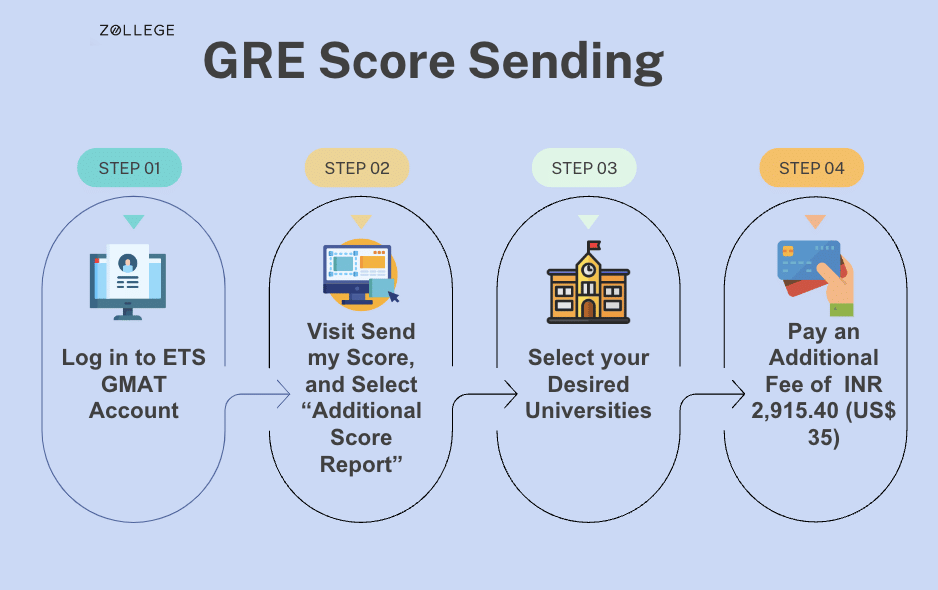
The process of sending your scores to universities is managed by the exam conducting body, ETS. You can send GRE scores to universities within the valid 5-year time frame. GRE score sending takes approximately 5 business days to process. GRE score requirements for universities have their requirements. Before completing your GRE registration, must check the cut-off requirements from the university’s official website.
GRE score report includes your quantitative, verbal, and analytical writing scores. Most of the top universities require an overall GRE score of 310+ for the master's programs. You can complete GRE test scores sending process through online, by mail, and by fax. Now you can send your GRE scorecard from one OR as many test administrations as you like from the last 5 years.
Why is GRE Score Sending Important?
If candidates are planning to pursue a graduate degree program in the United States or some other countries, candidates may be required to take the GRE. The GRE is a standardized test that assesses a candidate's skills in areas like verbal reasoning, quantitative reasoning, and GRE analytical writing.
- Admissions Requirements
Sending candidate's GRE scores to the schools candidate are interested in is often a requirement for admission. Most graduate schools have a list of application requirements that include GRE scores. Along with other factors like candidate's GPA, letters of recommendation, and personal statement. Failing to send a candidate's GRE scores could result in the candidate's application being rejected or not considered.
- Funding Opportunities
Many graduate programs offer financial aid and scholarships to students who have high GRE scores. Sending candidates scores to the schools candidates are interested in. it helps candidates are demonstrating the candidate's commitment to the application process and the candidate's interest in their program. This can help candidates stand out from other applicants and increase candidate's chances of receiving funding.
- Program Fit
Sending a candidate's GRE scores to the schools the candidate is interested in can also help the candidate. It determines if a particular program is a good fit for the candidate. Graduate programs often have specific score requirements that candidates must meet in order to be considered for admission. By reviewing the average score of GRE syllabus of admitted students, candidates can get a sense of how competitive the program is and whether or not a candidate's scores are in the range needed for acceptance.
- Application Strategy
Sending candidate's GRE scores to the schools the candidate is interested in can also be part of the candidate's application strategy. By sending candidates scores early in the application process, candidates are demonstrating the candidate's interest in the program and candidate's commitment to the admissions process. This can help candidates stand out from other applicants and increase candidate's chances of being accepted.
- Time-Saving
Finally, sending candidate's GRE scores to the schools the candidate is interested in can save the candidate time and money in the long run. Many schools have a deadline for receiving GRE scores, and sending them early can ensure that they are received in time for consideration. Additionally, some schools offer free score reporting if the candidate sends the candidate's scores when the candidate takes the test. It can save the candidate money compared to sending them later.
How to Send GRE Scores to Universities?
If a candidate is applying to graduate school, the candidate will likely need to take GRE (Graduate Record Examination) as part of the application process. Once a candidate has taken GRE, the candidate will need to send the their GRE scores to the universities. Here's a step-by-step guide on how to send GRE scores to universities.
- Know where to send candidate's scores
Before a candidate can send GRE scores, the candidate will need to know which universities the candidate wants to send them to. Make a list of all the universities candidates are considering applying to and double-check their admission requirements to make sure they require GRE score range. Candidates can find this information on the university's website.
- Select the recipients
Once candidates know which universities require GRE scores, candidates will need to select them as recipients on the ETS (Educational Testing Service) website. A candidate can select up to four universities to receive a candidate's scores for free when the candidate takes the test. If a candidate needs to send scores to additional universities, the candidate will need to pay an additional fee for each recipient.
- Choose a delivery method
There are several ways to send candidate's GRE scores to universities. The most common methods include:
Electronic delivery: Candidates can send candidate's scores electronically to universities by selecting the electronic delivery option when the candidate registers for the test. This is the fastest and most reliable method of delivery.
Postal mail: Candidates can also choose to have candidate's scores sent to universities via postal mail. This option takes longer than electronic delivery and can be less reliable.
Fax: Some universities may allow candidates to fax candidate's scores directly to them. However, this option is less common and can be less reliable than electronic delivery.
- Pay any fees
If a candidate needs to send scores to additional universities beyond the four included in the candidate's test fee. The candidate will need to pay an additional fee for each recipient. Fees for sending scores vary depending on the delivery method and the number of recipients.
- Verify delivery
Once a candidate has sent the candidate's scores to universities, the candidate will want to verify that they have been received. Most universities will send a candidate an email or letter confirming that they have received the candidate's scores. If a candidate doesn't receive confirmation within a few weeks, the candidate may want to follow up with the university to make sure they have received the candidate's scores.
Sending GRE scores to universities is an important step in the graduate school application process. By following these steps, candidates can ensure that candidate scores are sent to the universities. Candidates are interested in attending in a timely and reliable manner.
Cost to Send GRE Scores
The cost to send GRE scores to additional universities varies depending on the country candidates are sending candidates scores to. In the United States, GRE fee is $27 per recipient. However, if candidates are sending candidate scores to a country outside of the United States, the fee may be higher. It is important to note that the fee is per recipient, so if candidates are sending candidate scores to multiple universities. Candidates will need to pay the fee for each university.
GRE Free Score Reporting
As mentioned earlier, when a candidate takes the GRE, the candidate can select up to four universities to send the candidate's scores to for free. This is known as GRE free score reporting. If a candidate does not select any universities to send the candidate's scores to at the time of the test. The candidate will have to pay a fee to send the candidate's scores later.
It is important to note that if a candidate chooses to use GRE free score reporting, the candidate should select the universities carefully. Once candidates have selected the universities, candidates cannot change them or add any additional universities for free.
Sending GRE Scores Before Applying
Some students may choose to send their GRE scores to universities before applying. This can be beneficial for several reasons. First, it can give the universities an idea of a candidate's academic abilities and potential before they receive a candidate's application. Second, it can help candidates to stand out from other applicants who may not have sent their scores yet.
However,there are some potential drawbacks to sending GRE scores before applying. If a candidate's scores are not competitive, it could negatively impact a candidate's chances of admission. Additionally, if a candidate sends the candidate's scores before applying. The universities may not be able to match candidates scores with the candidate's application if the candidate uses different names or identifying information.
It is important to weigh the pros and cons before deciding whether or not to send candidate's GRE scores before applying.
How to Send My GRE Scores?
To send candidate's GRE scores for universities, candidate can follow these steps:
- Create an ETS account: If candidates haven't already, create an ETS account on the ETS website.
- Select the universities the candidate wants to send candidate's scores to: candidate can select up to four universities to send candidate's scores to for free at the time of the test. If a candidate wants to send the candidate's scores to additional universities, the candidate will need to pay a fee.
- Pay the fee (if necessary): If a candidate needs to send the candidate's scores to additional universities, the candidate will need to pay a fee. The fee varies depending on the country the candidate is sending candidates scores to.
- Send candidate's scores: Once a candidate has selected the universities and paid the fee (if necessary), the candidate can send the candidate's scores online or by mail.
It is important to note that it can take up to 10 business days for the universities to receive candidate's scores after they are sent.
Send Official GRE Scores
When candidates send thier GRE scores to universities, they are sending official scores. Official scores are those that are sent directly from ETS to the universities. Unofficial scores are those that are sent to candidates or printed from the ETS website. Universities only accept official scores. If a candidate needs to submit unofficial scores for any reason, the candidate should check with the universities to see if they will accept them.
GRE score sending is an important part of the graduate school application process. When a candidate takes the GRE, the candidate can select up to four universities to send the candidate's scores to for free. If a candidate wishes to send the candidate's scores to additional universities, the candidate will need to pay a fee. It is important to carefully consider which universities to send candidate's scores to and to make sure that candidates scores are matched.
FAQs
Ques. How can I send my GRE scores to universities?
Ans. You can send your GRE scores to universities electronically through the ETS website or by selecting recipient institutions during your exam day.
Ques. Are there charges for sending GRE scores to universities?
Ans. There's a fee for sending GRE scores to universities. The amount is based on the number of recipients you select.
Ques. How many universities can I send my GRE scores to?
Ans. You can send your GRE scores to up to four universities or programs for free on your exam day. Additional score reports may have fees.
Ques. Can I send my GRE scores to universities after completing the exam?
Ans. You can send your GRE scores to universities after the exam. However, there might be an additional fee for each score report requested.
Ques. How long does it take for universities to receive my GRE scores?
Ans. It takes about 10–15 days for universities to receive your GRE scores after your delivery request.
Ques. Can I pick which GRE scores to send if I've taken the exam multiple times?
Ans. You can choose which GRE scores to send if you've taken the exam multiple times. Only the scores you select will be sent to the universities.
Ques. Do universities consider all my GRE scores or just the highest ones?
Ans. University policies vary. Some consider only your highest GRE scores, while others may review all scores from your test history.
Ques. Is it possible to cancel or withhold my GRE scores from being sent to universities?
Ans. You can cancel or withhold your GRE scores from being sent to universities, but it must be done within a certain period after completing the exam, and fees may apply.
Ques. How can I verify if universities have received my GRE scores?
Ans. You can check your GRE score report's status through your ETS account. Once sent, you'll receive confirmation and can track its delivery.
Ques. Are there any special instructions for sending GRE scores to international universities?
Ans. The process for sending GRE scores to international universities is similar to domestic ones. However, it's wise to verify any specific requirements or instructions with individual universities.
Ques. Can I speed up the delivery of my GRE scores to universities for faster processing?
Ans. ETS offers a score rush service for an additional fee, speeding up the processing and delivery of GRE scores to universities within 5 business days.
Ques. What if I mistakenly select the wrong universities to send my GRE scores to?
Ans. If you make an error in selecting recipient universities for your GRE scores, you can request additional score reports to be sent to the correct institutions for an additional fee.
Ques. Will universities receive my GRE scores if I haven't finalized my application?
Ans. Universities will receive your GRE scores upon delivery, even if your application isn't finalized, but, they won't review your scores until you submit a complete application.
Ques. Can I send unofficial GRE score reports to universities for initial consideration?
Ans. While some universities may accept unofficial score reports for initial review, most require official score reports directly from ETS for verification.
Ques. How long are the GRE scores valid?
Ans. GRE scores are valid for up to five years from the exam date. Universities generally accept scores within this time for admissions consideration.
*The article might have information for the previous academic years, please refer the official website of the exam.