
GRE Verbal Reasoning: Check Scores, Question Pattern, and Section-wise Preparation Tips
- GRE Grammar Preparation
- GRE Coaching In Hyderabad
- GRE Coaching In Kolkata
- GRE Online Coaching
- GRE Classes In Pune
- GRE Coaching In Delhi
- GRE Coaching In Bangalore
- Best GRE Coaching India
- Best Book For GRE Verbal
- GRE Preparation Books
- GRE Study Plan
- GRE Prep
- GRE Preparation Time
- GRE Verbal Tips
- GRE Self Preparation
- GRE AWA Books


Content Curator | Updated On - Apr 22, 2024
What do you need to know about GRE verbal reasoning? GRE verbal is a part of the general test that tests your ability to conclude discourses; reason from incomplete data; identify the author’s assumptions and understand the multiple layers of meaning. What are the relevant changes in the GRE syllabus that you should be aware of? The new updated GRE exam, duration is for 1 hour and 58 minutes, instead of the 3 hours and 45 minutes long duration before September 22, 2023. GRE verbal now consists of two sections - section 1 has 12 questions for 1: 18 minutes and section 3 has 15 questions for 2:23 minutes. How can you crack the GRE verbally? You must rigorously practice the GRE verbal sample test. GRE verbal preparation includes learning vocabulary from books like Word Power by Norman Lewis, taking down notes, etc.
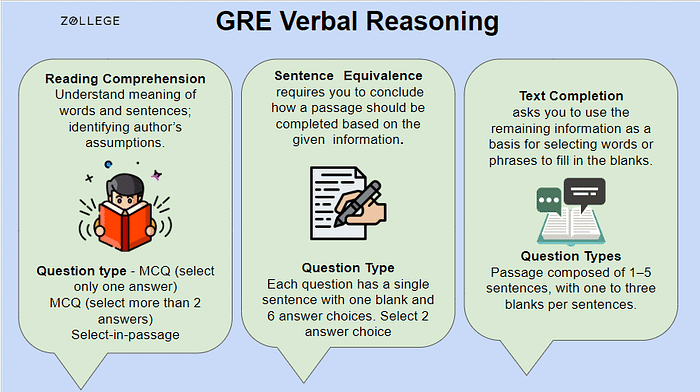
GRE verbal has three sections that are evaluated in the test-Reading comprehension, text completion, and sentence equivalence. GRE verbal reasoning and GRE Quantitative Reasoning sections are adaptive. What does it mean? It means that the first section of each measure is of average difficulty. The difficulty level of the second section of each measure depends on your overall performance in the first section. Let me give you an example - if you do very well on the first verbal section, the second section of the ets official GRE verbal reasoning will be higher in difficulty. What is the scoring format of the GRE verbal section? The spring of GRE English takes into consideration the total number of questions you have answered correctly in two sections and the difficulty level of the questions. The scoring range for GRE verbal is 130-170, with 1-point intervals. How important are the GRE verbal reasoning and analytical writing scores for top CS and maths PhD programs? PhD, being a high-level educational degree focusing on specializing in a particular topic, GRE verbal scores are important. If you don't know the basics of English writing and reading and get a decent GRE verbal score, pursuing a PhD can be difficult for you.
Wondering about the GRE verbal reasoning contents? GRE verbal syllabus has three types of questions - Reading comprehension. Text completion and sentence equivalence. About half of the questions require you to read passages and answer accordingly. The remaining part asks you to interpret and complete the existing paragraphs, and groups of sentences. Reading comprehension measures your skills to understand the meaning of individual words and sentences, summarise a passage, understand the structure of the test, and identify the perspective of the author. Text completion tests your ability to omit crucial words from short passages and asks you to use the remaining information as a basis for selecting words or phrases. The last question, Sentence equivalence, requires you to conclude how a passage should be completed based on the given partial information. What is the best GRE verbal preparation software? You can do your GRE verbal practice test from ETS or Magoosh.
GRE Verbal Syllabus
The GRE Verbal section is a computer adaptive test. GRE verbal pattern consists of two subsections, each of 20 questions. The total time allotted for each section is 30 minutes. So the total time allotted for Verbal reasoning is one hour. Each sub-section consists of three types of questions. They are GRE Text completion, Sentence equivalence, and Reading comprehension. The marks for each type of question are 6,4, and 10 respectively. You must check for the GRE exam Pattern for getting familiar with the test content and structure.
GRE Text Completion
The text completion is to test a skilled reader, who can interpret the overall sense of the passage without every word. Now, the readers will have to complete the text using crucial words. The sections will have passages in a maximum of 5 sentences, each sentence having two to three blanks. In GRE Text completionThere will be three or five options for each blank. The answers to each blank are not dependent on the other answers. The main intention is not only to fill in with correct GRE verbal words, but remember that the passage should remain stylistically and logically correct.
GRE Verbal Tips for Text Completion
You shuould start your GRE preparation on time to have enough time for revising. below are some GRE verbal tips that you should follow –
- One must read the passage thoroughly, and get the complete sense.
- Identify the words that emphasize the structure or the central understanding of the passage.
- Try to fill the words with your own words and check if it is fitting it correctly.
- Then choose the correct answer from the options given for each blank
- At last check for the last time, whether the sentence is correctly framed.
Sample
| Even when faced with continuing (i) _________ , the recalcitrant graduate student persisted in her spendthrift ways; she abjured any thought of self-(ii) _________ and spent prodigally. Blank (i) Blank (ii) (A) lucre (D) adumbration (B) penury (E) aggrandizement (C) avarice (F) abnegation |
GRE Sentence Equivalence
GRE verbal preparation for GRE Sentence equivalence type of question tests the candidate's ability to form a conclusion from a partial sentence. It has single sentences with one blank. There will be six options for each blank, the sentences must be grammatically correct. The candidates have to select two ways of completing the sentences. Both sentences must be correct and no credit will be given if one correct answer is selected.
GRE Verbal Tips for Sentence Equivalence
- Remember that the correct answer choices need not have words that have the same meaning. set a targeeted GRE preparation time before staring it. The meaning of a complete sentence must have the same meaning.
- Make sure to consider all options presented before deciding on the correct answers.
- You can use the root words, prefixes, and suffixes to derive the meaning of words you may be unfamiliar with.
- Look for English words and phrases that suggest a contrast or comparison being made.
- Try to fill in the blank with your own words, before you look at the options provided.
- Always double-check by reading the complete sentence with your selected option to ensure that the sentence is coherent.
- Also, consider slight variations in the meaning of each word.
Sample
| Cora was not known for her reticence; regardless, she only _________ acquiesced to calls to speak at the conference. [A] jejunely [B] exuberantly [C] willfully [D] grudgingly [E] candidly [F] timidly |
GRE Reading Comprehension
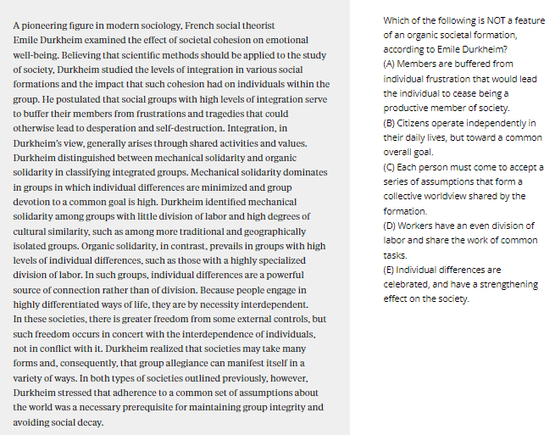
GRE English preparation via reading comprehension tests the candidate’s understanding of the meanings of words and sentences, summary, and infer the meaning. Additionally it also tests, analyzes the argument and identifies the strengths and weaknesses and develops alternative GRE verbal vocabulary, etc. GRE reading comprehension passages have 10 passages. They are mainly taken from Physical science, arts and humanities, biological science, social science, and everyday topics.
GRE Verbal Tips for Reading Comprehension
Reading comprehension need some strategic tips and tricks to ace the section. Having an organised GRE study plan will enable you have a comoprehensive preparation.
- Start by reading the questions, this primes you to identify answers while reading the passage.
- Identify the topic, scope, and purpose of the passage while reading it. Isolate topic words where possible.
- Distinguish between factual details and opinions.
- Paraphrase, if needed, to better understand the text – including the questions and answer choices.
- Consider all the options presented as some questions may have more than one correct answer.
- Do not let your opinion or outside knowledge color your reading of the text presented. Work within the context presented.
Sample
GRE Verbal Score
The score of the GRE Verbal depends on the scoring pattern of that year. The candidates who have applied in the current year can estimate the score of the current year by looking at the GRE Verbal score of the last five years. It is suggested to practice GRE Verbal, in order to score good marks in the final. GRE verbal score range is 130 to 170.
GRE Verbal Percentile
GRE percentiles helps you to understand how much better have you done from the rest of the candidates who had appeared for the exam. Based on the last few years, average verbal scores corresponding to different GRE percentiles are as below:
| Percentile | Scaled GRE Verbal Score |
|---|---|
| Top 10% of all test takers | 162 |
| Top 25% of all test takers | 157 |
| Top 50% of all test takers | 151 |
| Below the 50th percentile of all test takers | 150 |
GRE Verbal Score for Universities
The GRE score is determined by the program into which the candidate wishes to be admitted. A GRE score of 160 or higher is considered ideal for the majority of applicants. Even with a score of more than 150, candidates can gain admission to prestigious universities. The following universities are listed, along with the average GRE verbal score of the candidates accepted:
| Name of the University | Average GRE Verbal Score |
|---|---|
| San Diego State University | 150 |
| University of Arizona | 152 |
| NYU | 153 |
| Arizona State University | 155 |
| University of Buffalo | 157 |
| University of North Carolina | 159 |
| University of Florida | 163 |
| Georgia Institute of Technology | 165 |
| University of Utah | 165 |
GRE Verbal Books
Here are some reliable best books for GRE verbal:
- Barron's GRE Verbal Workbook: Barron's is a company that specializes in GRE exam preparation. This GRE verbal workbook is an excellent tool for GRE preparation because it contains over 380 examples of questions. It also contains a GRE dictionary with the most common GRE verbal word list found on the test.
- Kaplan's GRE Verbal Workbook: Kaplan's GRE Verbal Workbook contains hundreds of real GRE verbal questions and drills, as well as six full-length GRE verbal mock tests. This book can be a valuable resource for students who want to learn how to effectively tackle the verbal section of the GRE in order to save time and score higher.
- Manhattan Prep GRE Verbal Strategies: GRE Verbal Strategies by Manhattan Prep provides detailed guidance for preparing for the GRE Verbal section. The emphasis in this book is on understanding the various strategies for dealing with verbal questions. It rather than simply listing the different types of questions and explaining how to deal with them.
GRE verbal reasoning questions ask the candidates to analyze and answer about the passage. Additionally, it asks to fill in the blanks on a sentence or a paragraph by using appropriate words provided as options. Check out official GRE verbal practice test questions available online, which will help you get a high GRE Verbal Reasoning score.
FAQs
Ques. What is the purpose of the Verbal Reasoning section in the GRE?
Ques. How many types of questions are there in the GRE Verbal Reasoning section?
Ques. What skills are tested in the Text Completion questions?
Ques. What is the format of Sentence Equivalence questions?
Ques. How should I approach Text Completion questions during the GRE?
Ques. Are there any specific strategies for Sentence Equivalence questions?
Ques. What is the purpose of the Reading Comprehension questions in the Verbal Reasoning section?
Ques. How can I solve Reading Comprehension passages during the GRE?
Ques. Is it necessary to read all the answer choices for each Verbal Reasoning question?
Ques. Can I use the process of elimination in the Verbal Reasoning section?
Ques. How should I manage my time during the GRE Verbal Reasoning section?
Ques. What should I do if I get any unfamiliar words in the Verbal Reasoning section?
Ques. Are there any specific vocabulary skills I should focus on for the GRE Verbal Reasoning
section?
Ques. How can I improve my performance in the GRE Verbal Reasoning section?
Ques. What is the score range for GRE verbal reasoning?
*The article might have information for the previous academic years, please refer the official website of the exam.