
GRE Quantitative Reasoning: Syllabus, Score, Tips and Sample Papers
- GRE Grammar Preparation
- GRE Coaching In Hyderabad
- GRE Coaching In Kolkata
- GRE Online Coaching
- GRE Classes In Pune
- GRE Coaching In Delhi
- GRE Coaching In Bangalore
- Best GRE Coaching India
- Best Book For GRE Verbal
- GRE Preparation Books
- GRE Study Plan
- GRE Prep
- GRE Preparation Time
- GRE Verbal Tips
- GRE Self Preparation
- GRE AWA Books


Content Curator | Updated On - Apr 10, 2024
GRE quantitative reasoning section is designed to evaluate your basic mathematical skills. To achieve a good GRE quantitative, you need to understand elementary mathematical concepts. The total GRE quantitative reasoning section scored on a scale of 130 to 170, and achieving a score of 155 is considered a good score. Each subsection contains with arithmetic, algebra, geometry and data analysis topics.
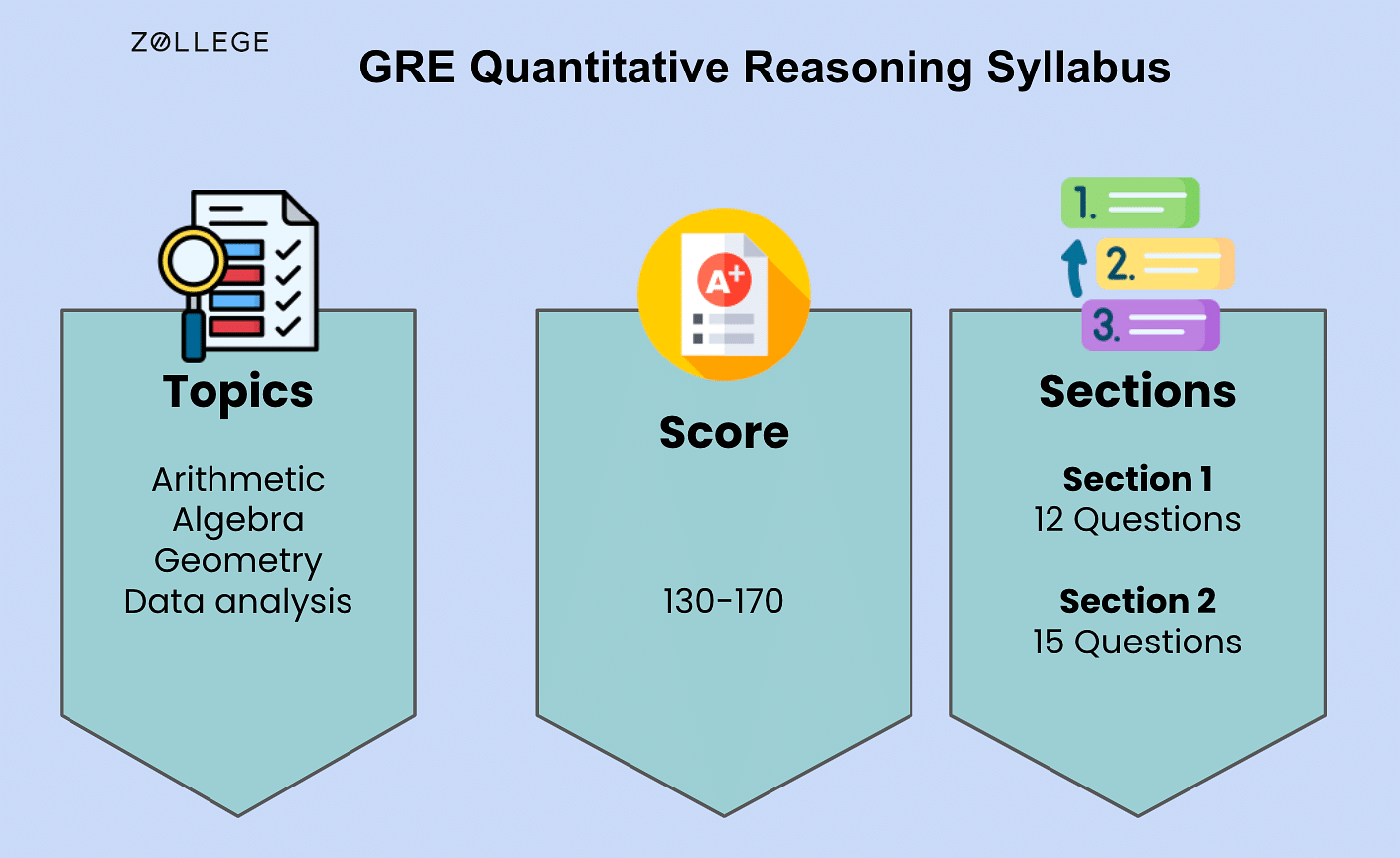
There are mainly 4 types of GRE quantitative questions, divided into 2 sections. The new quantitative reasoning GRE exam pattern now includes 27 questions, and you will be allocated 47 minutes to complete the test. GRE quantitative reasoning section 1, and section 2 consist of 12, and 15 questions respectively. ETS, the conducting body, recently updated the exam pattern.
GRE quantitative reasoning questions examine your ability to reason quantitatively and to model and solve problems with the quant method. Some of the GRE quantitative questions include real-life settings and word problems. Regularly solving GRE quantitative practice questions will help you to understand the updated question pattern and topics.
GRE Quantitative Reasoning Overview
Here is the GRE syllabus for GRE quantitative sections:
| GRE Quant | Section 1 | Section 2 | Total |
|---|---|---|---|
| Syllabus | arithmetic, algebra, geometry and data analysis | arithmetic, algebra, geometry and data analysis | - |
| No. of Questions | 12 | 15 | 40 |
GRE Quantitative Reasoning Syllabus
The GRE quant syllabus is tabulated below followed by ETS quantitative reasoning:
| Chapter | Percent Covered | Topics |
|---|---|---|
| GRE Arithmetic | 50% | Properties, Integers, Divisibility, Factorization, Prime numbers, Remainders, and Odd and even integers. Sequences of numbers. Decimal representation. Number line, Absolute value, Rate, Ratio, Arithmetic operations, Exponents and roots, Estimation, Percent |
| GRE Algebra | 15-20% | Exponents, Factoring, Simplifying algebraic expressions, Relations, Function, Functions, Intercepts and slopes of lines, Equations and inequalities, Simultaneous equations and inequalities, Equations to solve word problems, Coordinate geometry, Graphs of Functions, Equations and inequalities, Linear and quadratic equations and inequalities |
| GRE Geometry | 10-20% | Parallel and perpendicular lines, Circles, Triangles — including isosceles, equilateral and 30°-60°-90° triangles, Quadrilaterals and other polygons, Congruent and similar figures, Three-dimensional figures, area, perimeter, and volume, Pythagorean theorem, Angle measurement in degrees |
| GRE Data Analysis | 15-20% | Descriptive statistics - mean, median, mode, range, standard deviation, interquartile range, quartiles, and percentiles, Interpretation of data in tables and graphs, Elementary Probability Counting methods - combinations, permutations, Venn diagrams |
GRE Arithmetic
The GRE arithmetic comprises integer properties, divisibility, factorization, roots, percents, rates, ratios, and exponents. Coordinate geometry includes graphs, functions, equations, intercepts, slopes, and equations and inequalities.
Sample:
| Neither x nor y is equal to 0. xy = 4y/x Quantity Ans: x Quantity B: 2 Possible Answers: Quantity A is greater. Quantity B is greater. The relationship cannot be determined from the information given. The two quantities are equal. |
GRE Algebra
GRE algebra has 25 percent of questions from elementary algebra, linear algebra, abstract algebra, and number theory. GRE algebra consists of one or more variables. These are a few examples of quantitative reasoning GRE Algebric expression examples for better understanding.
Sample:
| What is the value of t if: 3x2 + tx - 21 = (3x - 3)(x + 7)? Possible Answers: 18 21 -18 -3 24 |
GRE Geometry
In the GRE geometry lines and angles, triangles – right angle triangles, isosceles, and equilateral, polygons, circles, multiple figures, three-dimensional figures, area, perimeter, and volume are there. GRE Geometry comprises 15 percent of the questions.
Sample:
|
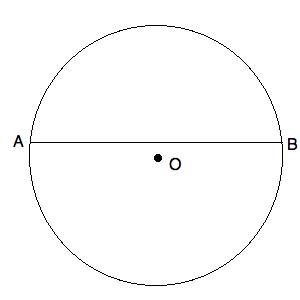
O is the center of the circle above. The length of AB is 14. Quantity Ans: The area of the circle. Quantity B: 49π Which of the following is true? Possible Answers: Quantity B is greater. The relationship cannot be determined. Quantity A is greater. The two quantities are equal. |
GRE Data Analysis
GRE data analysis consists of questions related to a table or graph. Official GRE quantitative reasoning practice questions have quality examples of such questions. The applicants shall be asked to put the appropriate angles to the statistical pie charts.
Sample:
| In a class, there are 15 students who like chocolate. 13 students like vanilla. 10 students like neither. If there are 35 people in the class, how many students like chocolate and vanilla? Possible Answers: 10 13 25 2 3 |
GRE Word Problems
The GRE word problems are interlinked and found in the data interpretation section also. These problems are related to topics like mixtures, work rates, interest, and more. These problems are statistics word problems, arithmetic word problems, geometry word problems, etc. The most common ones are word problems and algebra problems. GRE quantitative reasoning questions are Symbols, terminology, conventions and assumptions
The mathematical symbols, terminology, conventions and assumptions used in the Quantitative Reasoning measure are of high school standard. Some of GRE quantitative test questions are given below:
- All numbers are real numbers.
- All figures are assumed to lie in a plane.
- Geometric figures, such as lines, circles, triangles, and quadrilaterals may not be drawn to scale.
- Lines shown as straight are straight
- Points on a line are in the order as presented.
- All geometric objects are in the relative positions as shown
- Answers geometric questions on geometric reasoning only.
- Coordinate systems are on XY-planes and number lines
- Graphical data is presented in the form of bar graphs, circle graphs and line graphs
GRE Quantitative Questions Pattern
GRE quant questions are chiefly of four kinds as tabulated below:
| Question type | Instruction | Sample Question | Answer Type |
|---|---|---|---|
| Quantitative comparison questions | Compare two quantities and then figure out which statement answers the comparison | Quantity Ans: The least prime number greater than 24 Quantity B: The greatest prime number less than 28 | Quantity A is greater. Quantity B is greater. The two quantities are equal. The relationship cannot be determined from the information given. |
| Multiple Choice Questions – Select One Answer Choice | Choose one correct answer from the options given below | If 5x+32=4-2x, What is the value of x?
| Five options to choose from. |
| Multiple Choice Questions – Select One or More Answer Choices | Select more than one correct answer from the options given below | Which two of the following numbers have a product that is between –1 and 0? Indicate both of the numbers.
| Among 5 answer options, choose one or all - no marks for partially correct answers |
| Numeric entry | Calculate and write your answer | A merchant made a profit of $5 on the sale of a sweater that cost the merchant $15. What is the profit expressed as per cent of the merchant's cost? Give your answer to the nearest whole per cent. | No answer choices |
GRE Quantitative Reasoning Scoring Pattern
The performance on the two scored sections of the GRE is first converted to a raw score. This is based on The number of right and wrong answers. The raw score is converted to a scaled score. The scale score ranges from 130 to 170 in single-point increments. If all the Quant questions are wrong, The minimum GRE score the candidate gets is 130. Scoring 165 on GRE Quant represents the 89th percentile. That means the top 11 per cent of all students. A score of 170 represents the 100th percentile.
GRE Quant Preparation Tips
GRE quant requires regular preparation. Here are a few tips too add in GRE study plan to ace the quant section:
- Go through the GRE exam pattern
- Take full length mock tests to know the weakness
- Work on the error part to improve the section
- Practice time management
- Read the rules and memorize the formulae
- Religious practice to ace the quantitative section
GRE Quant Preparation Books
GRE Preparation requires hard-work and determination to score high on different skills. GRE exam preparation demands an adequate time period for practice of various sections included. GRE quant books are important resources for candidates preparing for GRE. Here are the list of GRE preparation books for quant:
- The Official Guide to GRE Revised General Test, 3rd Edition – Check PDF
- GRE Mathematics Test Practice Book – Check PDF
- GRE Prep by Magoosh - Check PDF
- Cracking the GRE Mathematics Subject Test-Princeton Review - Check PDF
- Kaplan’s GRE Math Book - Check PDF
GRE Quantitative Reasoning Practice Questions
For a better knowledge of the question format, it is recommended to go through the official GRE quantitative reasoning practice question sets. The practice test for GRE quantitative are given in the following table:
GRE quantitative reasoning is based on mathematical problems. Regular GRE quantitative practice questions can be helps candidates to secure desired GRE scores.
FAQs
Ques: What is GRE Quantitative Reasoning?
Ans: GRE Quantitative Reasoning is a section of the Graduate Record Examination (GRE) that assesses your ability to understand, interpret, and analyze quantitative information. It tests your skills in math and problem-solving relevant to graduate-level programs.
Ques: What topics are covered in the GRE Quantitative Reasoning section?
Ans: The GRE Quantitative Reasoning section covers arithmetic, algebra, geometry, and data analysis. Topics include percentages, equations, ratios, geometry concepts, statistics, and more.
Ques: How many questions are in the GRE Quantitative Reasoning section?
Ans: The GRE Quantitative Reasoning section consists of 40 questions, divided into two sections with 20 questions each. The section includes both multiple-choice and quantitative comparison questions.
Ques: Is a calculator allowed during the GRE Quantitative Reasoning section?
Ans: Yes, you are provided with an on-screen calculator for the GRE Quantitative Reasoning section. However, it's important to note that the calculator has limitations and may not be available for all questions.
Ques: What is the scoring range for the GRE Quantitative Reasoning section?
Ans: The GRE Quantitative Reasoning section is scored on a scale of 130 to 170, in one-point increments. The average score varies across disciplines and programs.
Ques: How can I prepare for the GRE Quantitative Reasoning section?
Ans: Effective preparation involves studying foundational math concepts, practicing with official GRE practice questions, taking timed practice tests, and considering supplemental study resources like prep books or online courses.
Ques: Are there strategies to manage time during the GRE Quantitative Reasoning section?
Ans: Time management is crucial. Allocate around 1.5 minutes per question. If a question is taking too long, consider skipping it and returning later. Focus on accuracy and efficiency.
Ques: Can I skip questions or go back to review my answers?
Ans: Within each section of GRE Quantitative Reasoning, you can freely navigate between questions, skip, and return to them. You can also change your answers within the section.
Ques: How does the GRE Quantitative Reasoning section impact my overall GRE score?
Ans: The GRE Quantitative Reasoning section contributes to your total GRE score along with the Verbal Reasoning section. Graduate programs may weigh these scores differently based on their admission criteria.
Ques: Can I retake the GRE if I'm not satisfied with my Quantitative Reasoning score?
Ans: Yes, you can retake the GRE. However, it's important to be aware of testing policies, including how often you can retake the exam and how scores are reported to institutions.
*The article might have information for the previous academic years, please refer the official website of the exam.