
GRE Text Completion: Question Type, Rules, Tips and Sample Questions
- GRE Grammar Preparation
- GRE Coaching In Hyderabad
- GRE Coaching In Kolkata
- GRE Online Coaching
- GRE Classes In Pune
- GRE Coaching In Delhi
- GRE Coaching In Bangalore
- Best GRE Coaching India
- Best Book For GRE Verbal
- GRE Preparation Books
- GRE Study Plan
- GRE Prep
- GRE Preparation Time
- GRE Verbal Tips
- GRE Self Preparation
- GRE AWA Books


Content Curator | Updated On - Jan 22, 2024
GRE Text Completion is part of the GRE verbal reasoning section. Your comprehension skills and vocabulary knowledge in a real-world setting will be tested in this part. The GRE Text completion section requires you to answer 12 text completion questions in total with 6 text-completion questions in each section. Short passages with one to three blanks will be provided in the text completion questions. Choose the word or phrase from a list that best completes the sentence so that it makes sense. You need a wide range of vocabulary and the ability to recognize nuances of words used to answer these questions well.
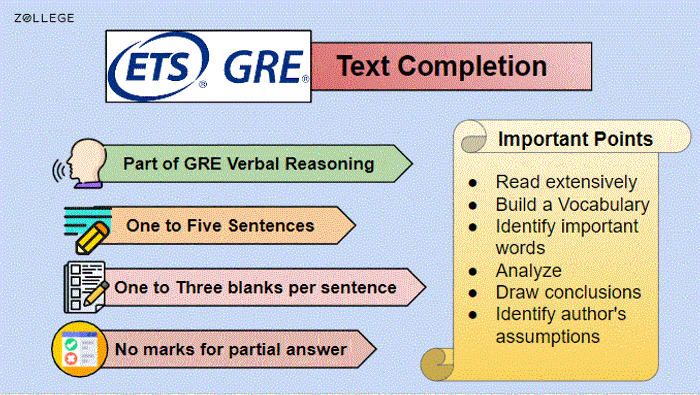
It is essential to read extensively and build a sizable vocabulary. Reading complex works of literature or scholarly research is one great approach to push you in this direction. You need to analyze and draw conclusions, reason from incomplete data and identify author's assumptions and/or perspective.
Each passage of GRE Text completion in GRE Verbal is composed of one to five sentences, with one to three blanks per sentence. Each blank has a single correct answer and you will not be awarded marks for partially correct answers. You need to identify the important words and understand the meaning to answer the questions.
GRE Text Completion Question Types
The following table provides an overview of the GRE exam pattern for the GRE text completion section:
| Question Type | Description | Number of Questions |
|---|---|---|
| Single Blank | These questions have a single blank to be filled up. For sentences or passages with a single blank, you will have to choose the right option from five given words | 2 in each section |
| Double Blank | Double-blank text completion questions have two blanks to be filled up. You will have to choose the right answer from the three given options. | 2-3 in each section |
| Triple Blank | Triple-blank text completion passages have three blanks which need to be filled. Three options will be given, from which you will have to pick up the right word | 1-2 in each section |
GRE Text Completion Sample Questions
The GRE Text Completion part comprises a wide range of question types designed to assess your vocabulary, logic, and comprehension of the chapter. If you know what to expect from the GRE in terms of question kinds, you may better prepare for the GRE and get better GRE text completion scoring.
GRE Text Completion Double Blank
The GRE Text Completion portion has questions in which you will be asked to complete a text by filling in one, two, or three blanks. GRE fill in the blanks questions are meant to evaluate both your vocabulary and your comprehension of more advanced written content. A few examples of the kinds of Text Completion questions you could see on the GRE are included below.
Questions testing your knowledge of words and phrases you'll need to fill in blanks with. Words among the options might be similar to or completely different from the word(s) in the paragraph. Vocabulary and understanding of context are put to the test by these GRE text completion questions.
| The _______ of the tale, for instance, has been _______ by the passage of time. A) History, background |
GRE Text Completion Single Blank
Word Choice Questions Requiring Logic and Reasoning: In GRE syllabus fill in the blank questions, you'll be asked to choose the best word(s) to fill in a blank space. Words that make sense in the given context may be used as alternatives to the ones listed as possible answers. Even if they are not exact matches to the passage's original terms.
| A shortage of _______ hampered the company's expansion efforts, despite the fact that it was experiencing fast growth. A) money B) labourers C) earnings D) physical facilities E) rivalry |
GRE Text Completion Triple Blank
Text completion in GRE questions of this kind ask for a single word or phrase that stands in sharp contrast to another word or phrase in the text. The response option must be the antonym of the relevant text word(s) in terms of meaning or tone.
| Choose the word or set of words that, when inserted into the sentence, best completes the sentence. The nanny __________ the little boy after she found him climbing __________ on a __________ balanced pile of boulders, completely unaware of the danger in which he was putting himself.
|
Vocabulary and reading comprehension are put to the test on the GRE's Text Completion (TC) and GRE Sentence Equivalence (SE) portions. For this reason, test takers who have trouble with vocabulary or reading comprehension may not do as well on these questions.
- Non-native English speakers who are not yet fluent in the language may have a disadvantage in several areas. It may also be difficult for readers unfamiliar with academic or formal writing to make sense of the portions included within.
- Those who have trouble concentrating on the written content or who have trouble reading may also have a harder time on these questions.
- Candidates taking standardized tests may not perform at their peak if they have not had enough time to prepare. They are not already comfortable with the content and methods used to solve the questions that will appear.
- Non-native English speakers, students who have not effectively studied for the test might get lower GRE scores. Students who have difficulties with vocabulary, reading comprehension, or attention may have lower scores on the TC and SE parts.
Rules for GRE Text Completion
To do well on the GRE Text Completion and GRE sentence completion parts, you need to have a wide range of vocabulary words. For GRE sentence completion tips provide a solid grasp of grammar, and the ability to think strategically. In order to do better on these parts of the test, follow these three guidelines.
- It is essential that you work on expanding your vocabulary in order to do well on the TC and SE parts of the test. Start by reading often and extensively, paying close attention to the meaning of unknown terms in their context. Learn new words by heart with the use of flashcards or other memory aids, and then put them to work in context by writing and rewriting phrases.
- While the passages in the TC and SE portions may be lengthy and complicated, it is important to practice good comprehension skills. Before looking at the answers, try reading the piece on its own to get a feel for its structure and purpose. Finally, after rereading the piece, pay close attention to the gaps and use contextual, stylistic, and grammatical cues to choose the best possible response.
- Mastering the TC and SE portions requires extensive practice with realistic questions. The best way to prepare for the GRE is to use official study guides and other credible GRE resources to obtain sample questions that are similar to those on the actual test. Keep an eye out for trends and recurring methods as you put in time at the range and make any necessary adjustments to your strategy.
Reasons for Low Scores
There are several potential causes of poor performance on the GRE's Text Completion (TC) and Sentence Equivalence (SE) parts. Several potential causes of poor grades are listed below.
- Weak Vocabulary: The TC and SE portions aim to evaluate the examinee's ability to understand and use complex words and phrases. Examinees who haven't thoroughly studied for the examination may struggle to choose the right response options. So, when confronted with a large number of new terms in the reading passages.
- Disadvantaged Reading Comprehension: Both the TC and SE parts have reading passages that may be rather lengthy and difficult to grasp if you don't have the proper reading comprehension abilities. A test-taker who has trouble understanding the passages may not understand what is being asked of them or may misinterpret the passage's tone.
- The GRE exam is a timed examination that involves strategic thinking and time management abilities. Many students take it unprepared because they are unfamiliar with the test format. Participants who are unfamiliar with the TC and SE portions may feel rushed or spend time on questions that are above their skill level.
- Not Practicing Enough: The more a test-taker GRE practice tests the TC and SE portions, the more comfortable they will get with the structure. The different sorts of questions, and the techniques for answering them. Students may not do well in an exam if they have not prepared enough.
- The stress of taking the GRE might affect a student's performance. Anxious test takers may answer questions too quickly, lose their train of thought, or be unable to recollect relevant details.
GRE Text Completion Tips
Having a large vocabulary and a methodical approach to the problems are both necessary for success on the GRE Text Completion exam. If you want to do better on this part of the exam, consider the following methods and recommendations.
- Work on your vocabulary: As was noted before, you will need a robust vocabulary to do well in the Text Completion phase. Vocabulary development strategies include reading extensively, making use of flashcards, and investigating word origins and prefixes.
- Before trying to fill in the gaps, make sure you read the full section to get a feel for the author's tone and intent. This may guide your word choice so that it better expresses the intended idea of the section.
- Find terms that can serve as clues to the answers you're looking for. Words like "although," "nevertheless," and "in comparison," as well as the overall topic and tone of the chapter, are examples of such contextual indicators.
- If you can't decide between many possible solutions, utilize the method of elimination to zero in on the best one. Get rid of the answers that are obviously wrong or don't make sense in light of the passage's context.
- Pay close attention to word order, ensuring that the words you pick to put in the spaces make sense in the larger context of the phrase. Make sure the sentences flow smoothly by paying attention to word order.
- Do many practice problems to become used to the different sorts of Text Completion questions and the tactics needed to solve them. You may find out what you need to work on by taking practice exams and then reviewing your answers.
In conclusion, the GRE Text Completion practice evaluates your contextual reading comprehension and vocabulary knowledge. You'll need a wide range of words at your disposal, an ear for subtleties in the English language. Added with the ability to pick up on the author's intent from the words on the page.
FAQs
Ques: What are GRE Text Completion questions?
Ques: How many types of Text Completion questions are there?
Ques: How many answer choices are there?
Ques: Will I get partial credit for filling in some blanks correctly?
Ques: What strategies can I use to tackle GRE text completion questions?
Ques: Are single-blank questions easier than double- or triple-blank?
Ques: Should I guess if I'm unsure about an answer?
Ques: Are there common types of vocabulary tested in Text Completion?
Ques: Should I memorize vocabulary lists for Text Completion?
Ques: How much time should I spend on each question?
Ques: What resources are available for practicing Text Completion?
Ques: Are there any specific grammar rules I should know for Text Completion?
Ques: How can I improve my reading comprehension for Text Completion?
Ques: Does Text Completion have a significant impact on the GRE score?
Ques: When should I start practicing Text Completion?
Ques: Is it possible to score well on Text Completion without a strong vocabulary?
Ques: Should I focus on specific topics or themes for Text Completion practice?
Ques: Will using test-taking strategies guarantee a high score?
Ques: What else I can do to improve my Text Completion skills?
*The article might have information for the previous academic years, please refer the official website of the exam.