
Are you interested in innovation and Engineering? Then Germany is the best location for you for your Masters. If MS in Electrical Engineering in Germany is your goal then know that as an engineering student, it is a top course for you. This course is offered to both international students like you and domestic students during the winter and summer semesters. In Germany, the majority of universities allow international students like you to study without paying tuition. Many search for ways how to study free in Germany. The top 10 universities in Germany for MS in Electrical Engineering include Technical University of Munich, Karlsruhe Institute of Technology, Ulm University, University of Bremen, etc. During the admissions process, we suggest you also submit DSH/TestDaf certificates in addition to IELTS/PTE/TOEFL score certificates.
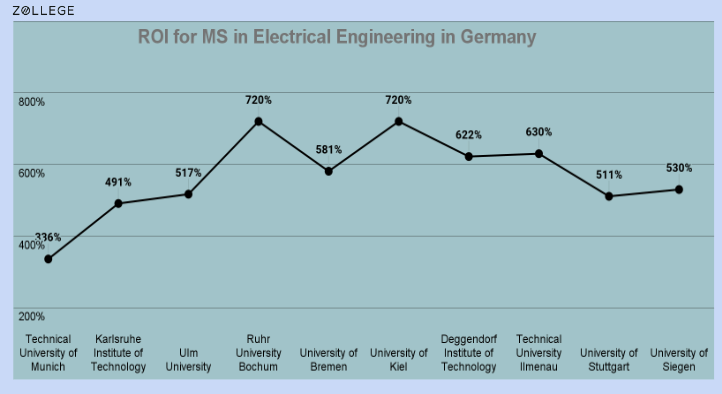
ROI is highest at 720% offered by Ruhr University Bochum and University of Kiel for you as an international applicant. The ROI is highest in most universities, as nearly all university have no tuition fees for international students. A high ROI helps students immigrate to Germany without much worry about financial conditions and restraints of living in Europe. The lowest ROI is from universities that have tuition fees for international students, like Technical University of Munich.
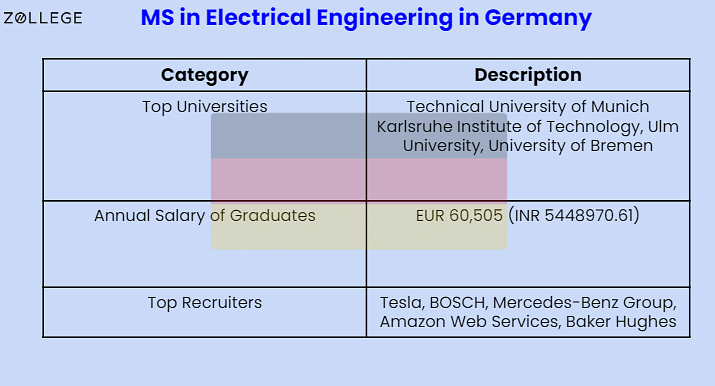
Germany Masters in Electrical Engineering provides international students like you the chance to get recruited by top companies like Siemens Energy, Tesla, and BOSCH. The average annual salary is EUR 60,505 (INR 5448970.61) of Electrical Engineers. German student visa will be offered to you during the course of your study in Germany. Students who secure a good job and have an annual salary above EUR 56,400 (INR 5090494.80) can opt for a German Blue Card.
Reasons to Study MS in Electrical Engineering in Germany
Masters in Electronics Engineering in Germany universities offer students the chance to immigrate and study in Germany. The universities are mostly tuition-free and the graduates get the chance to opt for good jobs post-degree completion. All other major reasons why students choose to study Masters in Electrical Engineering in Germany are shared below:
- Tuition-free universities offering MS in Electrical Engineering in Germany
- Subsidized transportation facilities for students for easy travel in Germany
- Students can choose from specializations like Automation and Robotics, Bioengineering and Neuroengineering, Communications Engineering, Electromagnetics, Microwave Engineering and Measurements, Electronic Circuits and Systems, etc
- Top recruiters for MS in Germany include Tesla, BOSCH, Mercedes-Benz Group, Amazon Web Services, Baker Hughes, etc
- Scholarships like DAAD, Deutschlandstipendium, etc offered up to EUR 1,800 (INR 162104.74) per semester
- Annual starting level salary of EUR 60,505 (INR 5448970.61)
- Affordable student accommodation in Germany for international students
Top Universities for MS in Electrical Engineering in Germany
Top universities for MS in Electrical Engineering in Germany include names like Technical University of Munich, Karlsruhe Institute of Technology, Ulm University, University of Bremen, etc. The tuition fee range is between EUR 1,500 (INR 135087.28) and EUR 6,000 (INR 540349.12) per semester. Most universities do not have a provision for tuition fees and only a semester fee of EUR 146.23 (INR 13169.21) and EUR 572 (INR 51513.28) per semester is charged to students. All other relevant information about tuition fees and score requirements of top universities in Germany offering MSc Electrical Engineering in Germany are tabulated below.
| Top Universities | Average Tuition Fees | Score Requirements |
| Technical University of Munich | EUR 6,000 (INR 540349.12) per semester | DSH-2 DSD II Telc German C1 University TestDaF- TDN 4 GMAT with a score higher than 600 IELTS Academic with a minimum overall band score of 6.5 TOEFL- 88 |
| Karlsruhe Institute of Technology | EUR 1,500 (INR 135087.28) per semester | DSH2 Test DaF Level 4 Goethe Certificate C2 DSD II |
| Ulm University | EUR 1,500 (INR 135087.28) per semester | DET score: 100 TOEFL: 79 IELTS score: 6.5 TestDaF: Level 4 in all four parts of the examination Deutsch C1: Score required |
| Ruhr University Bochum | No Tuition Fee Semester Fee- EUR 350 (INR 31520.37) per semester | TestDaF with at least 16 points within an examination DSH (level 2 or 3) Deutsches Sprachdiplom - DSD - II ZOP or Goethe-Zertifikat C2 from the Goethe-Institut KDS or GDS from the Goethe-Institut ÖSD language certificate C1 telc Deutsch C1 Hochschule |
| University of Bremen | No Tuition Fee Semester Fee- EUR 350 (INR 31520.37) per semester | DSD II DSH-2 TestDaF TDN 4 or 5 TELC C1 Hochschule Goethe-Zertifikat C1 |
| University of Kiel | No Tuition Fee Semester Fee- EUR 267 (INR 24045.54) per semester | IELTS: overall score of 6.5 TOEFL iBT (Internet-based test): overall score of 90 |
| Deggendorf Institute of Technology | No Tuition Fee Semester Fee- EUR 572 (INR 51513.28) per semester | DSH 2 TELC B2 TestDaf Level 4 |
| Technical University Ilmenau | No Tuition Fee Semester Fee- EUR 146.23 (INR 13169.21) | DSH 2 DSD II Telc C1 Hochschule Goethe-Zertifikat C1 Feststellungsprüfung am Studienkolleg TestDaF 3x4 1x3 ÖSD Zertifikat C1 |
| University of Stuttgart | EUR 1500 (INR 135087.28) | TestDaF level 4 DSD II |
| University of Siegen | No Tuition Fee Semester Fee- EUR 320.40 (INR 28854.64) per semester | TOEFL score: 72 IELTS: A minimum of 6 APS document at the time of application |
EUR 1 = INR 90.06 as dated on 30th March 2024
MS in Electrical Engineering in Germany Application Deadline and Fees
Universities in Germany for MS in Electrical Engineering are offered in both Winter and Summer semesters for the academic year of 2024/2025. These two are the only intakes in Germany. It is Uni Assist that charges the EUR 75 (INR 6754.36) application fee, not the universities listed below. An organization called Uni Assist evaluates applications from students. Masters in Electrical Engineering in Germany application deadlines and fees are tabulated below for student reference.
| Top Universities | Application Deadline 2024 | Application Fee |
| Technical University of Munich | Winter semester: 1 April to 31 May Summer semester: 1 October to 30 November |
Uni Assist Fee- EUR 75 (INR 6754.36) |
| Karlsruhe Institute of Technology | Summer Semester- January 15, 2024 Winter Semester- July 15, 2024 |
Not Required |
| Ulm University | Summer Semester- January 2024 | Uni Assist Fee- EUR 75 (INR 6754.36) |
| Ruhr University Bochum | For the winter semester: from the beginning of June to 15 July For the summer semester: from the beginning of December to 15 January |
Not Required |
| University of Bremen | The application for the April 2024 intake is closed There are no intakes in the winter semester |
Uni Assist Fee- EUR 75 (INR 6754.36) |
| University of Kiel | Applications for the winter semester: from May until 15 July of the year Applications for the summer semester from the beginning of November until 15 January of the following year |
Uni Assist Fee- EUR 75 (INR 6754.36) |
| Deggendorf Institute of Technology | Winter semester (entry in October): 15 April - 15 July Summer semester (entry in March): 15 November - 15 January |
Uni Assist Germany Fee- EUR 75 (INR 6754.36) |
| Technical University Ilmenau | Winter semester: January 16 to May 15 Summer semester: August 16 to November 15 |
Uni Assist Fee- EUR 75 (INR 6754.36) |
| University of Stuttgart | Winter semester: May 15 - July 15 Summer semester: December 1 - January 15 |
Not Required |
| University of Siegen | Application Deadline- 30 Apr | Not Required |
EUR 1 = INR 90.06 as dated on 30th March 2024
Cost of Living in Germany
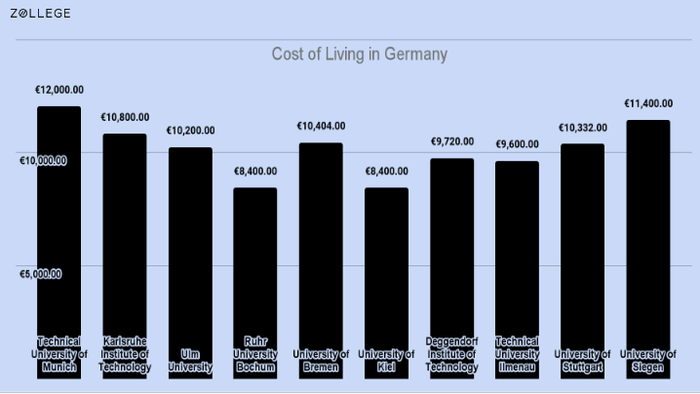
For students wishing to pursue the course at the top 10 universities in Germany for MS in Electrical Engineering should know that the cost of living in Germany is not very high. The average annual expense that students incur will be around EUR 9,600 (INR 862220.76) and EUR 12,000 (INR 1077775.95). Germany offers international students the opportunity to study for free as well as live cheaply while enrolled in the course. The cost of living for an MS in Electrical Engineering in Germany is shown in the infographic below.
EUR 1 = INR 90.06 as dated on 30th March 2024
Scholarships for MS in Electrical Engineering in Germany
Students have a great opportunity to avail scholarships in Germany for international students, like DAAD, Deutschlandstipendium, etc while studying Masters in Electrical Engineering in Germany. The award value is between EUR 100 (INR 9005.82) and EUR 1,800 (INR 162104.74) per semester. Most of these scholarships for MS Electronics in Germany are given to students with exceptional academic performance. All other relevant information is shared in the table below.
| Top Universities | Scholarship Name | Eligibility | Award |
| Technical University of Munich | Scholarships for International Students | Students who are not eligible for BAföG due to their nationality | EUR 500 (INR 45029.09)- EUR 1,800 (INR 162104.74) per semester |
| Karlsruhe Institute of Technology | Deutschlandstipendium | Awarded to exceptional students | EUR 300 (INR 27017.46) per month |
| Ulm University | STIBET Scholarship | International students of Ulm University, who are nearing graduation, can apply for a scholarship to finish a university degree. | Varies |
| Ruhr University Bochum | Deutschlandstipendium | Since 2011, RUB has been providing outstanding students who show social commitment with funding for a maximum duration of 12 months. | EUR 300 (INR 27017.46) per month |
| University of Bremen | DAAD | Students can apply if they have completed their studies with a first degree (e.g. bachelor's degree, diploma) by the time they start the scholarship at the latest. | EUR 934 (INR 84114.35) per month |
| University of Kiel | DAAD | For students enrolled at the University of Kiel | EUR 934 (INR 84114.35) per month |
| Deggendorf Institute of Technology | Fond International Scholarship Fund | Applicants are selected based on academic credentials, personal qualifications, experience, need, and other relevant factors. | EUR 100 (INR 9005.82)- EUR 615 (INR 55385.79) |
| Technical University Ilmenau | Deutschlandstipendium | Students in diploma, bachelor's, and master's degree programs at the TU Ilmenau | EUR 300 (INR 27017.46) per month |
| University of Stuttgart | DAAD | Priority is given to qualified, highly committed international degree and doctoral students with demonstrated potential for completing their studies at the University of Stuttgart. | Varies |
| University of Siegen | HYT Young Academy Scholarship | The House of Young Talents (HYT), the postgraduate center of the University of Siegen, announces up to five doctoral and up to five master's scholarships within the framework of the HYT Young Academy scholarship program. | EUR 400 (INR 36023.27)- EUR 750 (INR 67543.64) |
EUR 1 = INR 90.06 as dated on 30th March 2024
Job Outcomes for MS in Electrical Engineering in Germany
Applicants can find several MS Electronics in Germany job options, in organizations like Siemens Energy, Tesla, BOSCH, etc. The annual salary offered to students starts from EUR 53,500 (INR 4818113.01). This is a high salary range for entry-level graduates in Germany. Although Germany pays the most to engineers who have an M.Sc. Electrical Engineering in Germany. The top jobs in Germany in the field and their respective salaries are noted below for help.
| Job Roles | Average Annual Salary |
| Electrical Engineering Manager | EUR 80,000 (INR 7204654.97) |
| Project Manager | EUR 53,500 (INR 4818113.01) |
| Electrical Engineer | EUR 60,505 (INR 5448970.61) |
| Energy Engineer | EUR 60,000 (INR 5403491.23) |
EUR 1 = INR 90.06 as dated on 30th March 2024
Top Recruiters for MS in Electrical Engineering in Germany
Graduates with an MS Electronics in Germany are required by many prestigious organizations in both the public and private sectors. Most companies hire graduates in both full-time and part-time jobs in Germany. Top recruiters who provide great job options to Masters in Electronics Engineering in Germany students are listed below for student reference.
- Siemens Energy
- Tesla
- BOSCH
- Mercedes-Benz Group
- Amazon Web Services
- Baker Hughes
- McDermott
- Lufthansa Technik
- Rösberg Engineering
Work Permit in Germany
MSc Electrical Engineering in Germany is a top course offered by some of the best universities in Germany. Naturally, students with a degree in the field would try to seek a job after course completion, as Germany offers high-paying jobs in the sector. Students have various work permit visa Germany options to apply for. Some options are a Freelancer work permit, Job Seeker visa, Working Holiday Visa, etc. Apart from these applicants if eligible for a High Skilled Employee Visa can get a much more permanent visa in Germany, which can be later changed to an EU Blue Card. The EU Blue Card is a permanent residence card for Germany that applicants can get if they have an annual income over EUR 56,400 (INR 5090494.80). The PR card has to be renewed every 4 years. Some Document requirements for Visa application in Germany includes:
- LOR for Germany
- Submission of Academic Records
- Submission of German Language Proficiency Certificate
- SOP for Germany
- Financial Records
- Health Insurance
Masters in Electrical Engineering in Germany is a course offered to students who have a prior background in electrical engineering field. This course is offered by best universities in Germany for MS in Electronics like TUM, University of Stuttgart, Karlsruhe Institute of Technology, etc. All relevant information that students require about universities in Germany for MS in Electrical Engineering and score requirements are mentioned and highlighted in the tables above. MS in Electronics Engineering in Germany is a popular course and all its informations are highlighted in the article.
FAQs
Ques: Is Germany good for a Masters in Electrical Engineering?
Ans: Yes, Germany is good for a Master in Electrical Engineering as it offers top-notch courses to students at zero tuition fees. Moreover, the job opportunities are also huge.
Ques: What is the salary after MS in Germany in Electrical Engineering?
Ans: The salary range of graduates after their MS in Germany in Electrical Engineering would be between the ranges of EUR 53,500 (INR 4818113.01) and EUR 80,000 (INR 7204654.97).
Ques: How much does it cost to do a Master in Electrical Engineering in Germany for Indian students?
Ans: Most universities charge no tuition fees from international students in Germany for any course they offer. So, there is no such cost to do a Master in Electrical Engineering in Germany.
Ques: Which city in Germany is best for Electrical Engineering?
Ans: Cities like Munich and Stuttgart are the best places for Electrical Engineering in Germany. So, students can choose universities from these cities if they want the best ROI.
Ques: Which engineer is most in demand in Germany?
Ans: Engineers stemming from fields like electrical, mechanical, and civil engineers are the most in-demand in Germany.
Ques: Which engineering is highly paid in Germany?
Ans: Engineering degrees in Aerospace, Computer Science, Electrical, and Aeronautical fields are the fields where students get paid the most in Germany after graduation.
Ques: What is the cost of living in Germany?
Ans: The cost of living in Germany for international students would be in the range of EUR 12,000 (INR 1080698.25) per year. This can be less or can exceed.
Ques: Which country pays the highest salary to electrical engineers?
Ans: Countries like the USA, China, Japan, Germany, etc pay the highest salary to electrical engineers, as per their skill set.
Ques: Is German Masters accepted in India?
Ans: Yes, a German Master’s degree is valid in India, although students might have to get it accredited by UGC because of the language difference issue.
Ques: Which country is best for MS in Electrical Engineering?
Ans: Countries like Germany, the USA, the UK, Canada, and Australia are best for students opting for MS in Electrical Engineering.
Ques: Which job has shortages in Germany?
Ans: Healthcare jobs have the highest job shortages in Germany, and Germany is open to accepting foreign nationals in healthcare jobs to fix the situation.
Ques: Which field has the highest scope in Germany?
Ans: Medicine and Healthcare are the fields with the highest scope of jobs in Germany as there is a big shortage of healthcare workers in the nation.
Ques: What is Electrical Engineering called in Germany?
Ans: Electrical Engineering is called Elektrotechnik in Germany, and many international students enroll in top universities for the course.
Ques: Which country hires most electrical engineers?
Ans: Countries like Germany, the UK, the USA, Canada, and Australia hire the most number of engineers in the Electrical Engineering field.
Ques: How much is rent in Germany per month?
Ans: The rent in Germany is around the range of EUR 500 (INR 45029.09)- EUR 1000 (INR 90058.19) per month. This is the standard expense of the cost of living in Germany.
Ques: Is Masters free in Germany for Indians?
Ans: Most top universities in Germany actually offer both international and domestic students tuition-free master's degrees.
Ques: Who is eligible for a Master's in Germany?
Ans: All international candidates with a valid bachelor’s degree or equivalent degree are eligible to apply for a Master's in Germany.
Ques: Can I stay in Germany after my Masters?
Ans: Yes, any international student after completion of their Master's in Germany can stay back and opt for various work permit visas in Germany.
Ques: Is it easy to get a job in Germany?
Ans: Jobs are dependent on factors like shortages in the market or factors like industry, experience, and language skills. But it is not that easy to get jobs in Germany.
Ques: Can I get a job in Germany without speaking German?
Ans: Yes, there are many multinational organizations in Germany who need professionals fluent in English, and many immigrants are given English-speaking jobs in Germany.

![Humboldt University of Berlin [HU]](https://static.zollege.in/public/college_data/images/studyabroad/logos/college_632_29-15:02_6.png?tr=w-50,h-50,c-force?tr=h-40,w-35,c-force)
![Technical University Munich [TUM]](https://static.zollege.in/public/college_data/images/studyabroad/logos/college_691_02-13:08_691.png?tr=w-50,h-50,c-force?tr=h-40,w-35,c-force)
![Ludwig Maximilian University of Munich [LMU]](https://static.zollege.in/public/college_data/images/studyabroad/logos/college_690_02-13:05_690.png?tr=w-50,h-50,c-force?tr=h-40,w-35,c-force)
![Free University of Berlin [FU]](https://static.zollege.in/public/college_data/images/studyabroad/logos/college_631_29-15:01_5.png?tr=w-50,h-50,c-force?tr=h-40,w-35,c-force)
.png?tr=w-50,h-50,c-force?tr=h-40,w-35,c-force)


