
If are you looking to progress your career in engineering fields, go for MS in Mechanical Engineering in Germany. Ir deals with offering knowledge in physics, engineering and materials science. This is a 2-year program focusing on manufacturing engines, machines and other devices. What is most interesting, the program has no tuition fees for most public universities. MS in Mechanical Engineering in Germany cost ranges from EUR 900.93-12,000 (INR 81,077-10,79,700). MS in Mechanical Engineering in Germany requirements include a bachelor degree in mechanical engineering with 2.5 GPA. Attend TestDAF with at least 4 points or DSH 2 or DSD II as evidence of German language proficiency. You must secure a 4.5 IELTS for Germany as an English language proficiency score to get into the program.
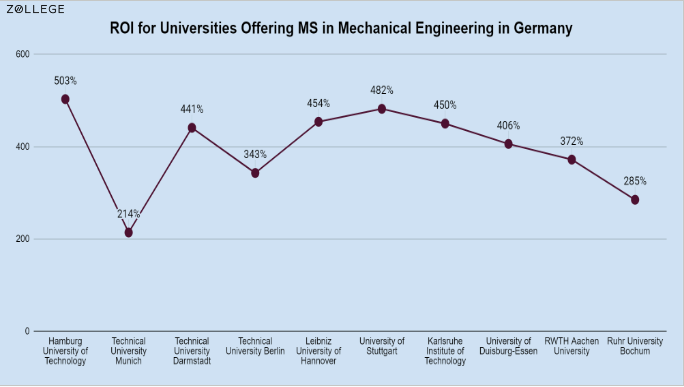
The most fascinating part is the ROI. Shortlist the best universities in Germany for MS in Mechanical Engineering by estimating the ROI value. ROI evaluates the profitability of investment over the annual salary of students. As shown in the graph, Hamburg University of Technology has a high ROI level of around 503%. This university requires the lowest expense of EUR 10,200 (INR 9,17,783) annually compared to other universities. Pursuing the program at Technical University Munich will enable you to attain 214% lowest ROI yet a high expense of EUR 24,000 (INR 21,59,675) per year. This ROI estimation enables students to study in Germany most satisfactorily with high returns.
MS in Mechanical Engineering in Germany is the right choice for students with excellent career goals. You can get jobs in manufacturing, automotive and industrial companies like TCS, Tesla, BMW Group etc. The average annual salary in Germany after MS in Mechanical Engineering is EUR 51,330 (INR 46,19,004). Applicants travel to Germany to attain these benefits of seeking Master degree in Mechanical Engineering.
Why Choose to Study MS in Mechanical Engineering in Germany?
Around 37% of students immigrate to Germany to pursue Engineering courses for various reasons. You can get boundless options of choosing 22 courses for MS in Mechanical Engineering in Germany. Here, detailed below are the most popular reasons for studying Master degree in Mechanical Engineering in Germany:
- As per the labor market report, Germany is expected to hire 3.2 million efficient workers by 2030.
- Germany is one of the countries that provides jobs to 8.2 lakh people worldwide in different automobile sectors like Mercedes, BMW Group etc.
- Manufacturing sectors in Germany are projected to earn revenue growth of 2.60% by 2028.
- You can study free in Germany without tuition fees at around 300 public universities. Top public universities in Germany for MS in Mechanical Engineering without tuition fees are TU Hamburg, TU Darmstadt, TU Berlin etc.
Top Universities for MS in Mechanical Engineering in Germany
MS in Mechanical Engineering is taught in most universities in the German language. Masters in Mechanical Engineering in Germany in English is offered at Ruhr University Bochum and University of Duisburg-Essen. Both public and private universities in Germany for MS in Mechanical Engineering require German and English language proficiency skills for admission. You need to attain DSH or TestDAF and IELTS or TOEFL exams to study in Germany. MS in Mechanical Engineering in Germany fees vary from EUR 900.93-12,000 (INR 81,077-10,79,700). You require a semester fee of EUR 440-700 (INR 39,589-62,990) to pursue the coursework in most public universities in Germany. The table below states the score requirements and fees for the best universities for Masters in Mechanical Engineering in Germany:
| Top Universities | Programs Offered | Annual Tuition Fees | Score Requirements |
| Hamburg University of Technology | Masters in Mechanical Engineering and Management in Germany | EUR 600 (INR 53,985) | IELTS: 6.5 TOEFL: 90 TestDAF 16 Telc C1 DSH 2 Goethe Certificate C2 |
| Technical University Munich | MS in Mechanical Engineering | EUR 12,000 (INR 10,79,700) | IELTS: 6.5 PTE: 65 TOEFL: 88 DSD 2 DSH 2 Telc C1 TestDAF 4 Goethe Certificate C2 |
| Technical University Darmstadt | MS in Mechanical Engineering - Mechanical and Process Engineering | EUR 440 (INR 39,589) | IELTS: 5.5 PTE score: 59 TOEFL: 72 DSH 1 TestDAF 4 Goethe Certificate B2 Telc B2 DSD 2 |
| Technical University Berlin | MS in Mechanical Engineering | EUR 580.88 (INR 52,275) | IELTS: 6.5 TOEFL: 87 DSH 2 Goethe Certificate C2 DSD 2 TestDAF 4 Telc C1 |
| Leibniz University of Hannover | MS in Mechanical Engineering | EUR 900.93 (INR 81,077) | TOEFL: 53 IELTS score: 4.5 PTE: 43 DSH 1 TestDAF 4 Goethe CertificateB1 Telc B1 |
| University of Stuttgart | MS in Mechanical Engineering | EUR 3000 (INR 2,69,979) | IELTS: 6 TOEFL: 79 TestDAF 4x4 DSD 2 Goethe Certificate C2 |
| Karlsruhe Institute of Technology | MS in Mechanical Engineering | EUR 3000 (INR 2,69,979) | TOEFL: 90 IELTS: 6.5 DSH 2 TestDaF 4x4 DSD 2 Goethe Certificate C2 Telc C1 |
| University of Duisburg-Essen | MS in Mechanical Engineering | EUR 640 (INR 57,591) | TOEFL score: 61 IELTS: Band 3 DSD 2 DSH 2 Telc C1 TestDAF 4 |
| RWTH Aachen University | MS in General Mechanical Engineering | EUR 606.98 (INR 54,620) |
IELTS: 6.5 |
| Ruhr University Bochum | MS in Mechanical Engineering | EUR 700 (INR 62,990) | TestDAF 16 DSH 2 or 3 DSD 2 Goethe Certificate C2 Telc C1 |
EUR 1 = INR 89.99 as dated on 28th March 2024
Entry Requirements
You must have a German student visa to apply for MS in Mechanical Engineering in Germany. To get the visa, score at least C2-level language proficiency. MS courses in Germany for mechanical engineers require minimum eligibility criteria. You must have minimum 2.5 GPA or better in undergraduate degree to pursue the program. Visit your nearest embassy physically to avoid any discrepancies for German Student Visa Rejection. Here, given below are the entry requirements for Masters in Mechanical Engineering in Germany for Indian students:
- Bachelor's or equivalent degree in mechanical engineering
- Transcript
- Statement of purpose
- Updated Resume
- Passport
- German language proficiency scores
- Proof of Professional Experience or Internships (if applicable)
- English language proficiency score
- Letters of reference
- APS Certificate
MS in Mechanical Engineering in Germany Application Details
How to do MS in Germany for Mechanical Engineering is the focus of concern. You can apply for MS in Mechanical Engineering in Germany via Uni Assist Germany or official portal of university. Uni-assist is a common application portal accepted by various top colleges like TUM, TU Berlin, Leibniz University of Hannover etc. The table below states the deadlines and fees to apply to German universities for MS in Mechanical Engineering in Germany:
| Top Universities | Application Deadline | Application Fee |
| Hamburg University of Technology | 1 March 2024 | Not required |
| Technical University Munich | 31 May 2024 (winter) 31 December 2024 (summer) |
EUR 75 (INR 6,749) |
| Technical University Darmstadt | May 2024 (winter) November 2024 (summer) |
Not required |
| Technical University Berlin | 1 June 2024 (winter) 1 December 2024 (summer) |
EUR 75 (INR 6,749) |
| Leibniz University of Hannover | 31 May 2024 (winter) 30 November 2024 (summer) |
EUR 75 (INR 6,749) |
| University of Stuttgart | 15 July 2024 (winter) 15 January 2024 (summer) |
Not required |
| Karlsruhe Institute of Technology | 30 September 2024 (winter) 31 March 2024 (summer) |
Not required |
| University of Duisburg-Essen | 15 July 2024 (winter) 15 March 2024 (summer) |
EUR 75 (INR 6,749) |
| RWTH Aachen University | 1 March 2024 (winter) 1 September 2024 (summer) |
Not required |
| Ruhr University Bochum | 15 July 2024 (winter) 15 January 2024 (summer) |
Not required |
EUR 1 = INR 89.99 as dated on 28th March 2024
Cost of Living in Germany
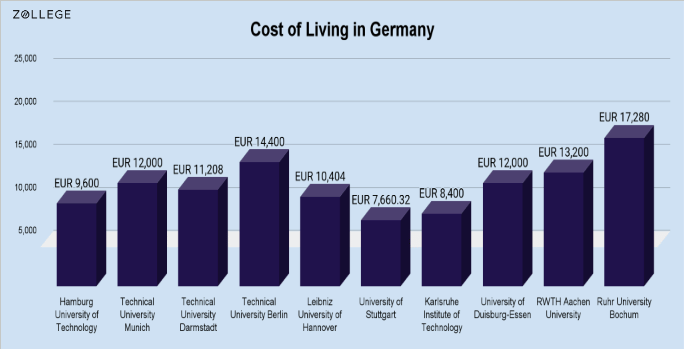
We must budget the MS in Mechanical Engineering in Germany cost of living before applying. As shown in the graph, Ruhr University Bochum offers the highest living cost to pursue the course. The city of Bochum is costly for its accommodation in Germany per month varies from EUR 350-700 (INR 31,502-63,008). University of Stuttgart offers the lowest living cost as compared to other universities. Stuttgart is most affordable as it charges between EUR 350 (INR 31,502) and EUR 500 (INR 45,003) for rent per month. The graph below shows the annual cost of living in Germany for different universities for MS in Mechanical Engineering:
Scholarships for Masters in Mechanical Engineering in Germany
You can apply for scholarships in Germany to pursue MS in Mechanical Engineering in Germany. You must have a good GPA of around 2.74 or better to be eligible for scholarships. The table below highlights the popular scholarships for Masters in Mechanical Engineering in Germany:
| Top Universities | Scholarship Name | Eligibility | Award |
| Hamburg University of Technology | Hans Böckler Stiftung | Students with financial difficulties and strong academic grades are eligible | Varies |
| Technical University Munich | TUM awards scholarships | Strong academic achievements in previous studies in required | EUR 500 (INR 45,003) and EUR 1,800 (INR 1,62,012) per semester |
| Technical University Darmstadt | Graduation Scholarship | Students must maintain a GPA of 2.74 | Varies |
| Technical University Berlin | Heinrich Böll Stiftung | You must have outstanding academic records. | Varies |
| Leibniz University of Hannover | Deutschlandstipendium | Students with strong grades in academics can apply | EUR 300 (INR 27,002) per month |
| University of Stuttgart | DAAD Stibet I scholarship | Applicants with outstanding grades are eligible | Varies |
| Karlsruhe Institute of Technology | Friedrich Ebert Foundation | Students having first grades in academics can apply | EUR 850 (INR 76,505) |
| University of Duisburg-Essen | Deutschlandstipendium | Must demonstrate strong academic achievements | EUR 300 (INR 27,002) per month |
| RWTH Aachen University | High Potential Student Grant | Must have strong records in academics | 25% of tuition fees |
| Ruhr University Bochum | DAAD scholarships | Applicants must have good academic performance to apply | Varies |
EUR 1 = INR 89.99 as dated on 28th March 2024
MS in Mechanical Engineering in Germany Job Outcomes
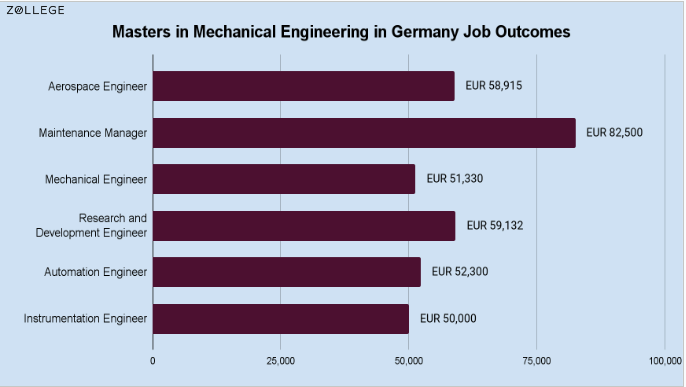
Masters in Mechanical Engineering in Germany open various career opportunities for students. You can attain various job prospects like Aerospace Engineers, Mechanical Engineers etc. with salaries from EUR 50,000-82,500 (INR 44,99,100-74,23,515). You can also find part-time jobs in Germany like bloggers, waiters, research assistants etc. while attaining MS in Mechanical Engineering in Germany. You can earn around EUR 12.41 (INR 1,117) per hour as minimum wage as a part-time employer. The graph below shows the breakdown of salaries of various jobs after MS in Mechanical Engineering in Germany:
Top Recruiters for MS in Mechanical Engineering in Germany
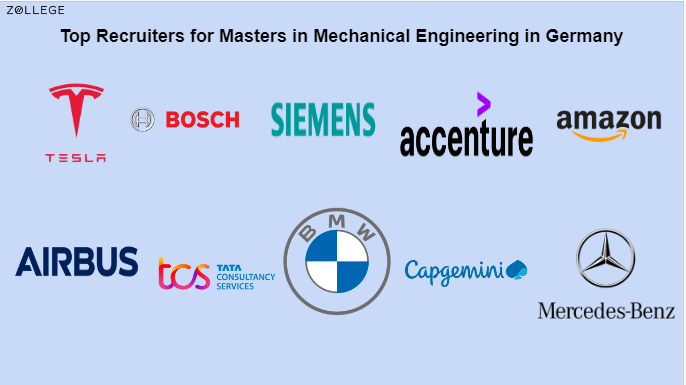
Graduates get jobs in Germany after completing Mechanical Engineering Masters in top manufacturing, automotive, and industrial sectors. More than 6000 companies hired graduates in the field of Mechanical Engineering. The top recruiting companies in Germany for MS in Mechanical Engineering are as follows:
Work Permit
After getting the employment offer letter, graduates must apply for a work permit visa Germany. You must visit the Embassy nearer to your location to apply for the visa. You must register your address of residence at the Office of the Embassy. You will avail of General Work Permit to attain jobs after MS in Mechanical Engineering. Another visa type EU Blue Card can be obtained if you earn a gross salary of at least EUR 43,800 (INR 39,40,448). It will take around 1–3 months to process the visa. The documents required for applying work permit are as follows:
- Transcripts
- Resume
- Proof of Health insurance
- Employment offer letter
- Bank statement
- Passport
- SOP for work permit visa
- Passport size pictures
Students focusing on seeking Master degree in Mechanical Engineering in Germany must have strong records in academics. Students must check the deadlines and fees to apply for the program. You can apply for scholarships to cover the accommodation, utilities and fees for pursuing the program.
FAQs
Ques: Is Germany good for MS in Mechanical Engineering?
Ans: Yes, Germany is expected to recruit 3.2 million efficient workers by 2030. Hence, there will be huge job openings in Germany for MS in Mechanical Engineering.
Ques: How much does MS in mechanical engineering cost in Germany?
Ans: More than 300 universities in Germany do not require any tuition fees for pursuing the program. You need to pay semester fees of EUR 440-700 to attain MS in Mechanical Engineering in public universities in Germany. We may charge around EUR 900.93-12,000 to seek the degree in other public or private universities.
Ques: How much CGPA is required for MS in Mechanical Engineering in Germany?
Ans: You must hold a bachelor degree in Mechanical Engineering to pursue the program. A CGPA of 2.5 or better is required for admission to German universities for the coursework.
Ques: Which mechanical field is in demand in Germany?
Ans: The automobile and machinery industry are in high demand in Germany for mechanical engineers. You can get hired by top companies like Mercedes Benz, BMW Group etc.
Ques: What is the minimum salary for a mechanical engineer in Germany?
Ans: Students pursuing MS in Mechanical Engineering in Germany may earn a salary ranging from EUR 50,000-82,500. The average annual salary for Mechanical Engineers in Germany is EUR 51,330.
Ques: Which company is best for Mechanical Engineers in Germany?
Ans: You get hired in the automotive, manufacturing and industrial sectors after MS in Mechanical Engineering in Germany. The top companies for Mechanical Engineers in Germany are BMW Group, Mercedes Benz, Siemens etc.
Ques: What is the cost of living in Germany to pursue MS in Mechanical Engineering in Germany?
Ans: The cost of living in Germany for pursuing MS in Mechanical Engineering in Germany varies from EUR 7660.32-17,280. You can apply for scholarships to pursue the program with ease.
Ques: Which university is best for MS in mechanical engineering in Germany?
Ans: The best universities for MS in mechanical engineering in Germany are Hamburg University of Technology, TU Darmstadt, TU Berlin etc. You must have a GPA of 2.5 or better to get into these universities.
Ques: Is doing an MS in Germany for mechanical engineering students a good choice?
Ans: Yes, MS in mechanical engineering in Germany is the best choice. Germany is projected to hire around 3.2 million efficient workers by 2030. This will raise more job opportunities for mechanical engineering students to get employment in Germany.
Ques: What are the eligibility criteria for doing MS in mechanical engineering from Germany?
Ans: For pursuing MS in Mechanical Engineering in Germany, you must hold a bachelor degree in mechanical engineering with 2.5 GPA. You must have language proficiency in German and English to pursue the program.
Ques: What are the fees for MS in Mechanical Engineering in Germany?
Ans: Most public universities like TU Darmstadt, TU Berlin etc. do not require any tuition fees for pursuing the program. You need to pay EUR 900.93-12,000 as tuition fees to attain MS in Mechanical Engineering in Germany.
Ques: When can you apply for MS in Mechanical Engineering in Germany?
Ans: You can apply for MS in Mechanical Engineering in the summer or winter semester in Germany. For summer intake, you can apply from early September to late March. You need to apply between early May to late July for winter intake.
Ques: How to do MS in Germany for Mechanical Engineering?
Ans: To apply for MS in Germany in Mechanical Engineering, register through the university’s application portal or uni-assist portal. You need to submit your application with the required documents like transcripts, LOR, SOP etc. for pursuing Mechanical Engineering Master in Germany.
Ques: What are the requirements for MS in Mechanical Engineering in Germany?
Ans: You must attain DSH level 2 or TestDAF 4 to prove your German language skills for pursuing MS in Mechanical Engineering. You also need to prove your English proficiency skills to pursue the program.
Ques: Can I get support for scholarships for MS in Mechanical Engineering in Germany?
Ans: Yes, you can apply for various scholarships to pursue MS in Mechanical Engineering in Germany. The most popular scholarships in Germany are Heinrich Böll Stiftung, Deutschlandstipendium, DAAD etc.
Ques: What is the job scope for MS in Mechanical Engineering in Germany?
Ans: Students find various job roles like Aerospace Engineer, Mechanical Engineer, Automation Engineer etc after completing MS in Mechanical Engineering in Germany. You can earn average salaries ranging from EUR 50,000-82,500 per year.
Ques: Can I work as a part-time employee while studying MS in Mechanical Engineering in Germany?
Ans: Yes, you can apply for part-time jobs by getting permission from the university while pursuing the program. Students work as waiters, bloggers, research assistants etc during the weekend or study breaks.
Ques: What are the application fees for MS in Mechanical Engineering in Germany?
Ans: Most universities do not charge any application fee for MS in Mechanical Engineering in Germany. While applying through uni-assist, you may be required to pay an application fee of EUR 75.
Ques: What is the English language requirement for MS in Mechanical Engineering in Germany?
Ans: You must submit an IELTS, TOEFL or PTE score to pursue MS in Mechanical Engineering in Germany. You require 4.5 IELTS score, 53 TOEFL score or 43 PTE score to attain the course study.
Ques: What are the documents required for Mechanical Engineering masters in Germany?
Ans: You submit the complete application form with transcripts, LOR, SOP, resume, APS certificate etc. You must provide English and German language proficiency scores to pursue Mechanical Engineering masters in Germany.

![Humboldt University of Berlin [HU]](https://static.zollege.in/public/college_data/images/studyabroad/logos/college_632_29-15:02_6.png?tr=w-50,h-50,c-force?tr=h-40,w-35,c-force)
![Technical University Munich [TUM]](https://static.zollege.in/public/college_data/images/studyabroad/logos/college_691_02-13:08_691.png?tr=w-50,h-50,c-force?tr=h-40,w-35,c-force)
![Ludwig Maximilian University of Munich [LMU]](https://static.zollege.in/public/college_data/images/studyabroad/logos/college_690_02-13:05_690.png?tr=w-50,h-50,c-force?tr=h-40,w-35,c-force)
![Free University of Berlin [FU]](https://static.zollege.in/public/college_data/images/studyabroad/logos/college_631_29-15:01_5.png?tr=w-50,h-50,c-force?tr=h-40,w-35,c-force)
.png?tr=w-50,h-50,c-force?tr=h-40,w-35,c-force)


