
IIT JAM 2024 Economics Question Paper Pdf - Check Solutions with Answer Key Pdf

.jpg?tr=h-55,w-55,c-force)
Content Strategist|Tech-innovator|National Hackathon Winner | Updated On - Jan 20, 2025
IIT JAM 2024 Economis Question Paper is available for download. The exam was successfully conducted by IIT Madras on February 11, 2024, from 3:00 PM to 6:00 PM. As per the students' initial reactions, the IIT JAM 2024 Economics paper was reported as easy to moderate in difficulty. The paper was comparatively lengthy, with a balanced distribution of questions across Microeconomics, Macroeconomics, Indian Economy, and Statistics.
IIT JAM 2024 Economics Question Paper with Answer Key PDF
Candidates can download the IIT JAM 2024 Economics Question Paper with Solution and Answer Key PDFs using the link below.
| IIT JAM 2024 Economics Question Paper PDF |  Download Download |
Check Solutions |
IIT JAM 2024 Economics Question Paper with Solutions
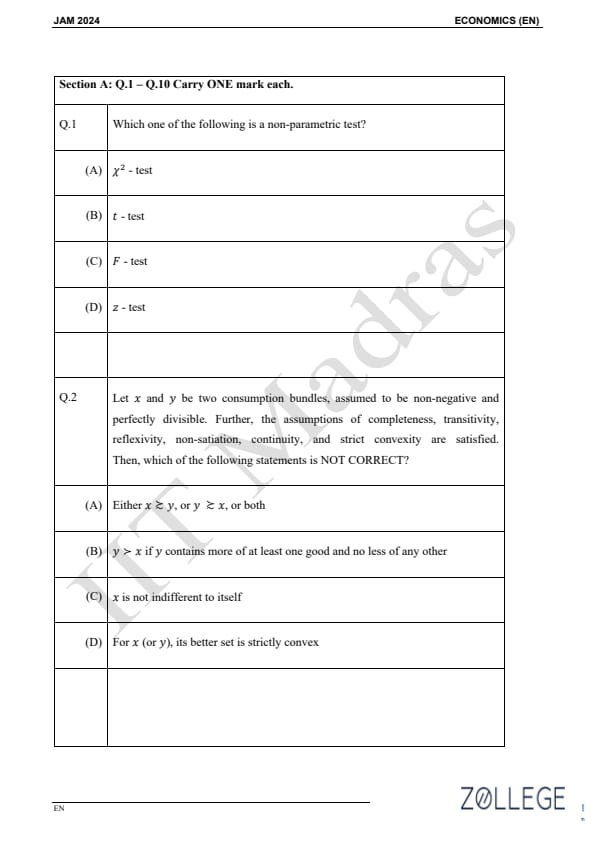
Question 1:
Which one of the following is a non-parametric test?
- X2-test
- t-test
- F-testD
- z-test
View Solution
The X2-test (Chi-square test) is a non-parametric test. Non-parametric tests do not rely on assumptions about the underlying distribution of the data. The X2-test is primarily used for categorical data to assess whether the observed frequencies differ significantly from the expected frequencies, making it a distribution-free test.
Mathematically, the test statistic for the X2-test is given by:
X2 = ∑ (Oi - Ei)2 / Ei
where:
- Oi represents the observed frequency in category i,
- Ei represents the expected frequency in category i,
- The summation is over all categories.
If the calculated value of X2 is greater than the critical value from the Chi-square distribution table for a given significance level, we reject the null hypothesis.
Question 2:
Let x and y be two consumption bundles, assumed to be non-negative and perfectly divisible. Further, the assumptions of completeness, transitivity, reflexivity, non-satiation, continuity, and strict convexity are satisfied. Then, which of the following statements is NOT CORRECT?
- Either x ⪰ y or y ⪰ x or both
- y > x if y contains more of at least one good and no less of any other
- x is not indifferent to itself
- For x (or y), its better set is strictly convex
View Solution
The question is based on the fundamental assumptions of consumer preference theory. Let's analyze each option:
- Option (A): This follows from the completeness assumption.
- Option (B): This is consistent with the non-satiation assumption.
- Option (C): This statement is incorrect. The reflexivity assumption states that every bundle is at least as good as itself (x ∼ x).
- Option (D): This follows from the strict convexity assumption.
Explanation of the Correct Answer: Option (C) violates the reflexivity assumption.
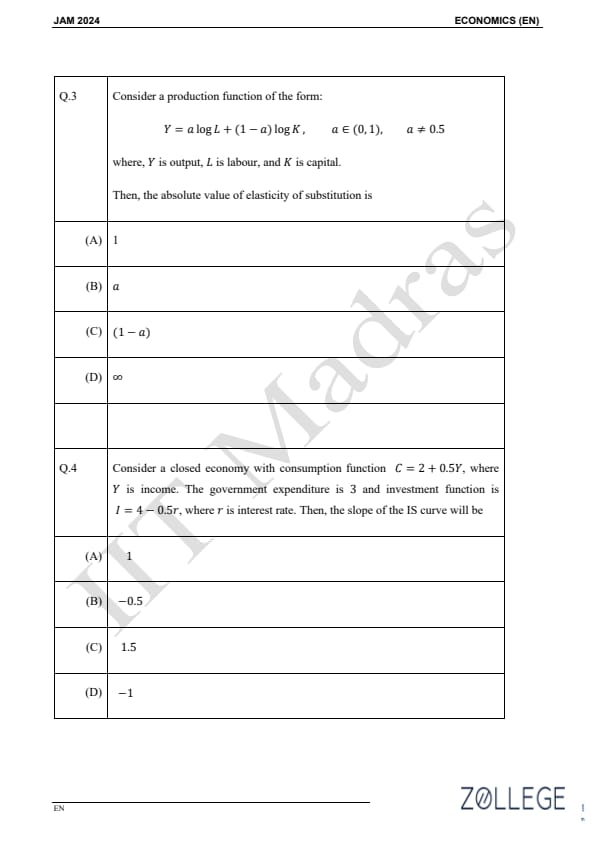
Question 3:
Consider a production function of the form:
Y = a log L + (1 - a) log K, a ∈ (0, 1), a ≠ 0.5
where, Y is output, L is labour, and K is capital.
Then, the absolute value of elasticity of substitution is:
- 1
- a
- 1 - a
- ∞
View Solution
This production function is a logarithmic form of a Cobb-Douglas production function, which has a constant elasticity of substitution (CES) of 1.
Question 4:
Consider a closed economy with consumption function C = 2 + 0.5Y, where Y is income. The government expenditure is 3 and investment function is I = 4 - 0.5r, where r is interest rate. Then, the slope of the IS curve will be:
- 1
- -0.5
- 1.5
- -1
View Solution
The IS curve represents equilibrium in the goods market. Its slope is determined by the multiplier effect and the sensitivity of investment to the interest rate. In this case, the slope is -1.
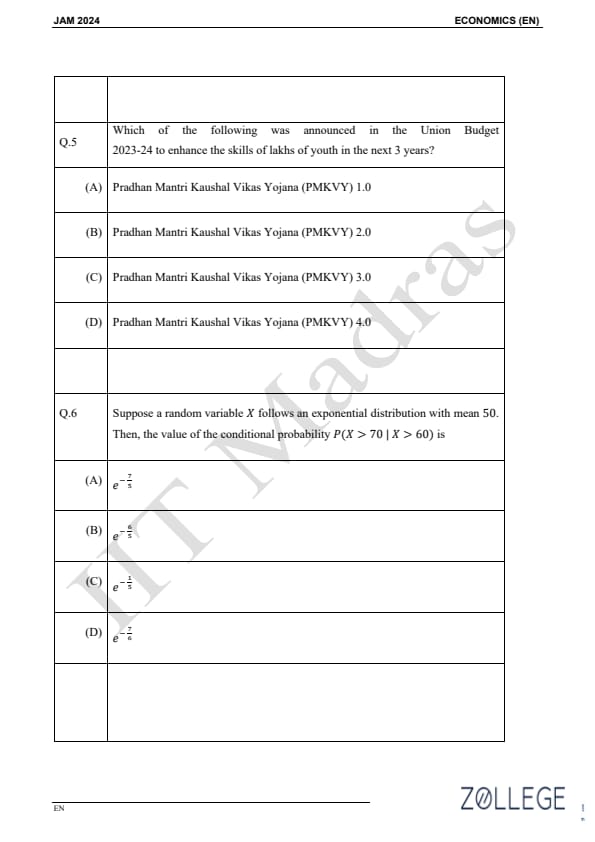
Question 5:
Which of the following was announced in the Union Budget 2023-24 to enhance the skills of lakhs of youth in the next 3 years?
- Pradhan Mantri Kaushal Vikas Yojana (PMKVY) 1.0
- Pradhan Mantri Kaushal Vikas Yojana (PMKVY) 2.0
- Pradhan Mantri Kaushal Vikas Yojana (PMKVY) 3.0
- Pradhan Mantri Kaushal Vikas Yojana (PMKVY) 4.0
View Solution
In the Union Budget 2023-24, Pradhan Mantri Kaushal Vikas Yojana (PMKVY) 4.0 was announced to enhance the skills of lakhs of youth over the next three years. This iteration aims to expand and improve upon the training initiatives of previous versions, addressing more advanced skills and wider sectors to meet the evolving demands of the economy.
Question 6:
Suppose a random variable X follows an exponential distribution with mean 50. Then, the value of the conditional probability P(X > 70 | X > 60) is:
- e-7/5
- e-6/5
- e-1/5
- e-7/6
View Solution
Due to the memoryless property of the exponential distribution, P(X > s + t | X > s) = P(X > t). Here, t = 10. The rate λ is 1/50, so P(X > 10) = e-λ×10 = e-1/5.
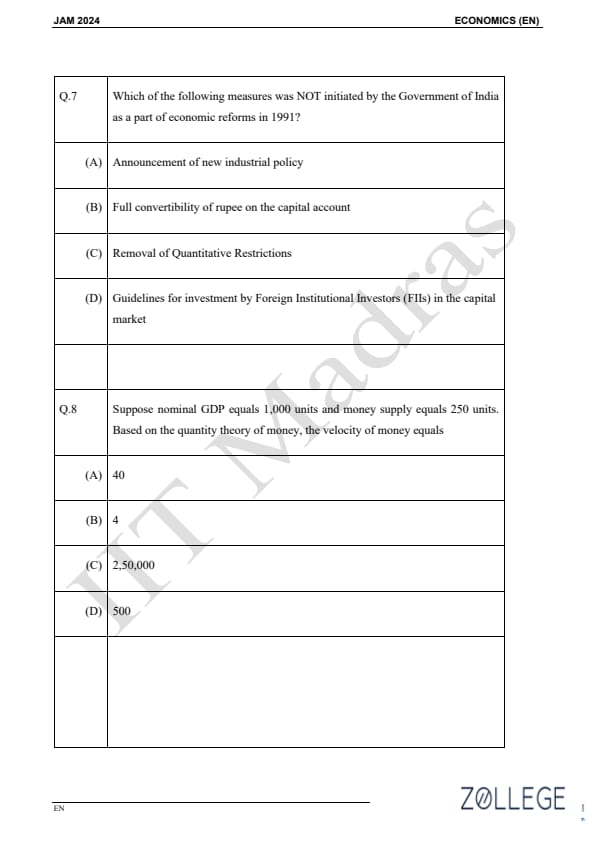
Question 7:
Which of the following measures was NOT initiated by the Government of India as a part of economic reforms in 1991?
- Announcement of new industrial policy
- Full convertibility of the rupee on the capital account
- Removal of Quantitative Restrictions
- Guidelines for investment by Foreign Institutional Investors (FIIs) in the capital market
View Solution
While the 1991 reforms introduced significant changes including new industrial policy and guidelines for FIIs, the full convertibility of the rupee on the capital account was not initiated at that time.
Question 8:
Suppose nominal GDP equals 1,000 units and money supply equals 250 units. Based on the quantity theory of money, the velocity of money equals:
- 40
- 4
- 2,50,000
- 500
View Solution
Velocity of money (V) = PQ / M, where PQ is nominal GDP and M is money supply. V = 1000 / 250 = 4.
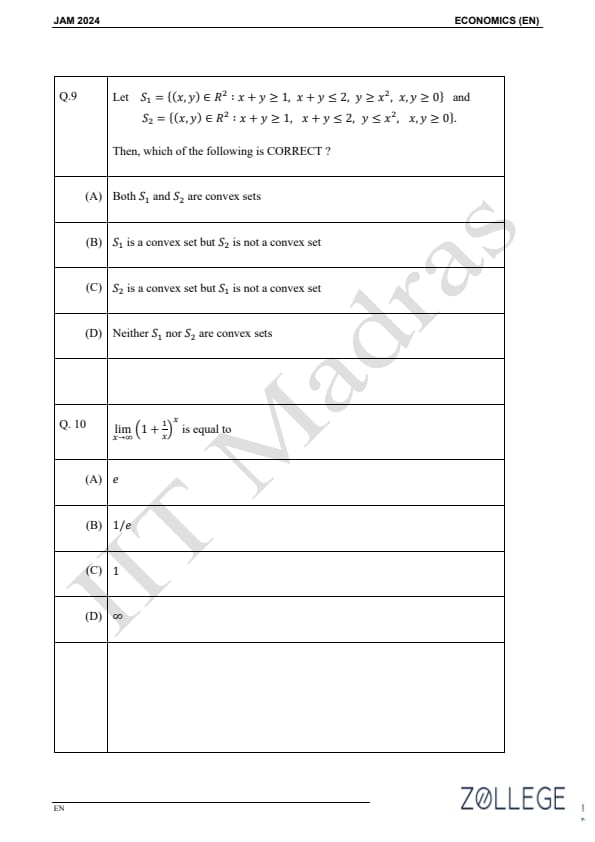
Question 9:
Let S1 = {(x, y) ∈ ℝ2 : x + y ≥ 1, x + y ≤ 2, y ≥ x2, x, y ≥ 0} and S2 = {(x, y) ∈ ℝ2 : x + y ≥ 1, x + y ≤ 2, y ≤ x2, x, y ≥ 0}. Then, which of the following is CORRECT?
- Both S1 and S2 are convex sets
- S1 is a convex set but S2 is not a convex set
- S2 is a convex set but S1 is not a convex set
- Neither S1 nor S2 are convex sets
Correct Answer:
(B) S1 is a convex set but S2 is not a convex setView Solution
The region S1 defined by y ≥ x2 with x+y constraints forms a convex set as it includes all line segments between any two points within the set, despite x2 typically suggesting non-convexity.
In contrast, S2, defined by y ≤ x2, is non-convex due to the nature of the parabolic curve x2 which excludes some line segments between points in S2 under the given constraints.
Question 10:
limx→∞ (1 + 1/x)x is equal to:
- e
- 1/e
- 1
- ∞
View Solution
This limit is the definition of the mathematical constant e.
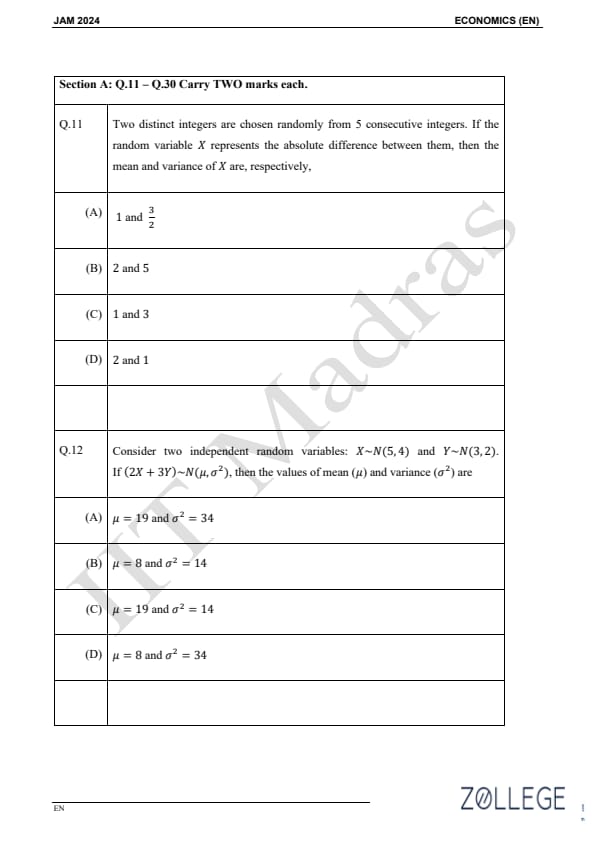
Question 11:
Two distinct integers are chosen randomly from 5 consecutive integers. If the random variable X represents the absolute difference between them, then the mean and variance of X are, respectively:
- 1 and 3/2
- 2 and 5
- 1 and 3
- 2 and 1
View Solution
By calculating all possible absolute differences and their probabilities, the mean is 2 and the variance is 1.
Question 12:
Consider two independent random variables: X ∼ N(5, 4) and Y ∼ N(3, 2). If 2X + 3Y ∼ N(μ, σ2), then the values of mean μ and variance σ2 are:
- μ = 19 and σ2 = 34
- μ = 8 and σ2 = 14
- μ = 19 and σ2 = 14
- μ = 8 and σ2 = 34
View Solution
The mean is 2 * 5 + 3 * 3 = 19. The variance is 22 * 4 + 32 * 2 = 34.
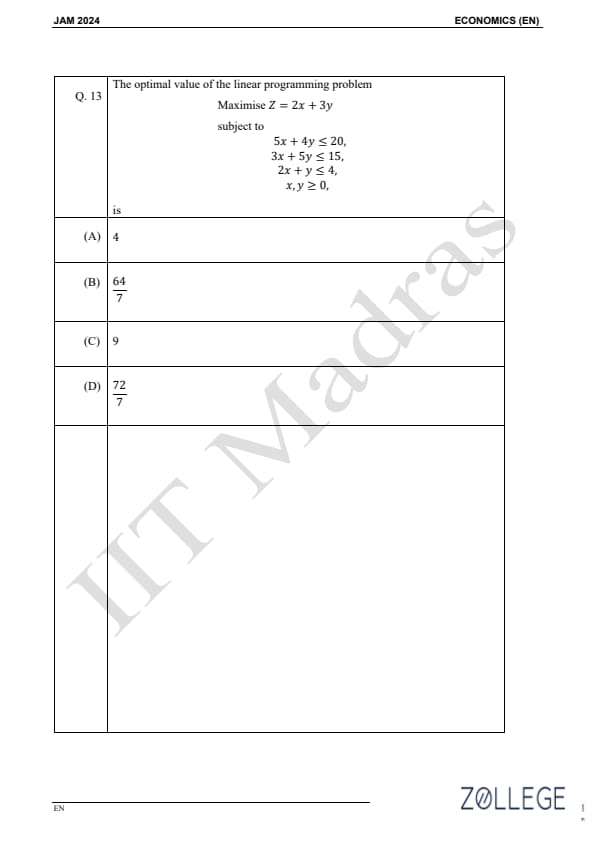
Question 13:
The optimal value of the linear programming problem Maximise Z = 2x + 3y subject to 5x + 4y ≤ 20, 3x + 5y ≤ 15, 2x + y ≤ 4, x, y ≥ 0, is:
- 4
- 64/7
- 9
- 72/7
View Solution
Graphical solution reveals the maximum value of Z is 64/7 at (5/7, 18/7).
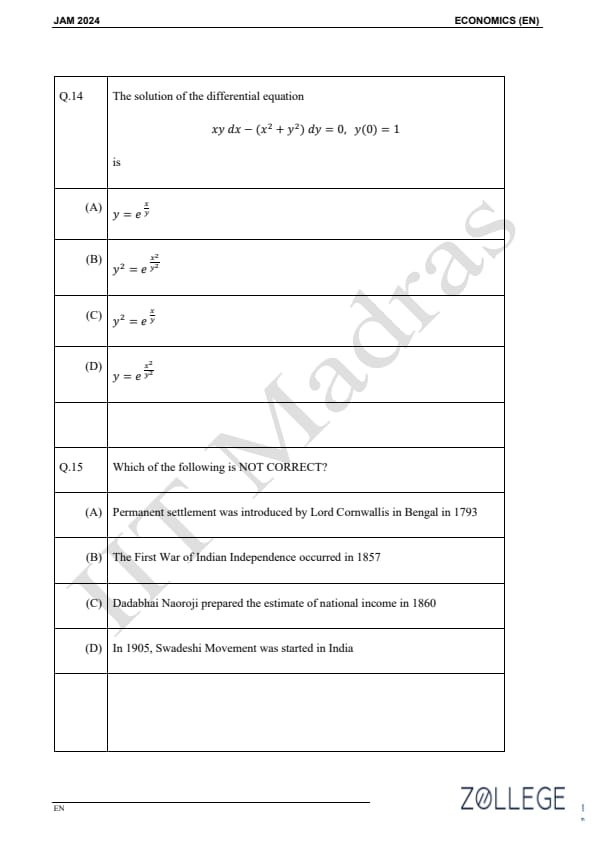
Question 14:
The solution of the differential equation xy dx - (x2 + y2) dy = 0, y(0) = 1 is:
- y = ex/y
- y2 = ex2/y2
- y2 = ex/y
- y = ex2/y2
View Solution
Using substitution and integration, the solution is found to be y2 = ex2/y2.
Question 15:
Which of the following is NOT CORRECT?
- Permanent settlement was introduced by Lord Cornwallis in Bengal in 1793
- The First War of Indian Independence occurred in 1857
- Dadabhai Naoroji prepared the estimate of national income in 1860
- In 1905, Swadeshi Movement was started in India
View Solution
Dadabhai Naoroji prepared the estimate of national income in 1876, not 1860.
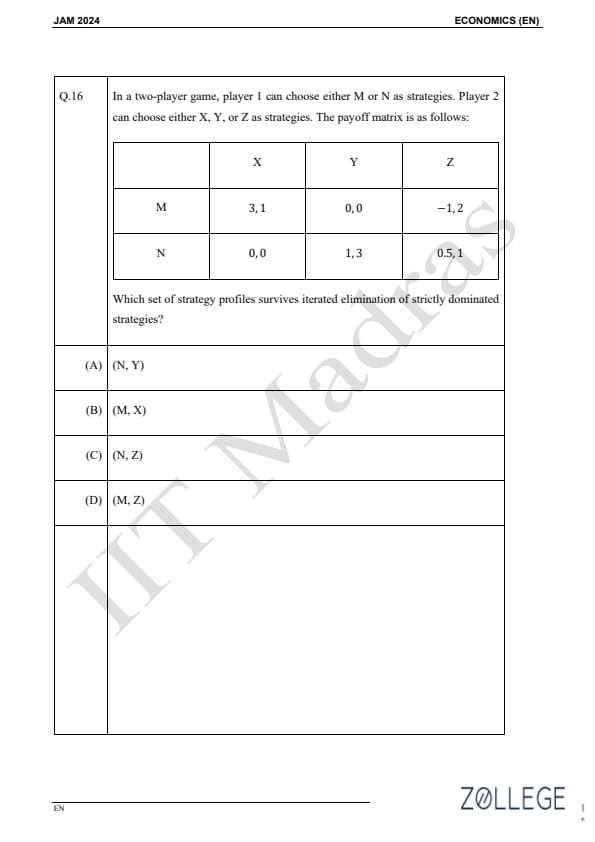
Question 16:
In a two-player game, player 1 can choose either M or N as strategies. Player 2 can choose either X, Y, or Z as strategies. The payoff matrix is as follows:
| X | Y | Z | |
| M | 3, 1 | 0, 0 | -1, 2 |
| N | 0, 0 | 1, 3 | 0.5, 1 |
Which set of strategy profiles survives iterated elimination of strictly dominated strategies?
- (N, Y)
- (M, X)
- (N, Z)
- (M, Z)
View Solution
After eliminating dominated strategies, (N, Y) remains.
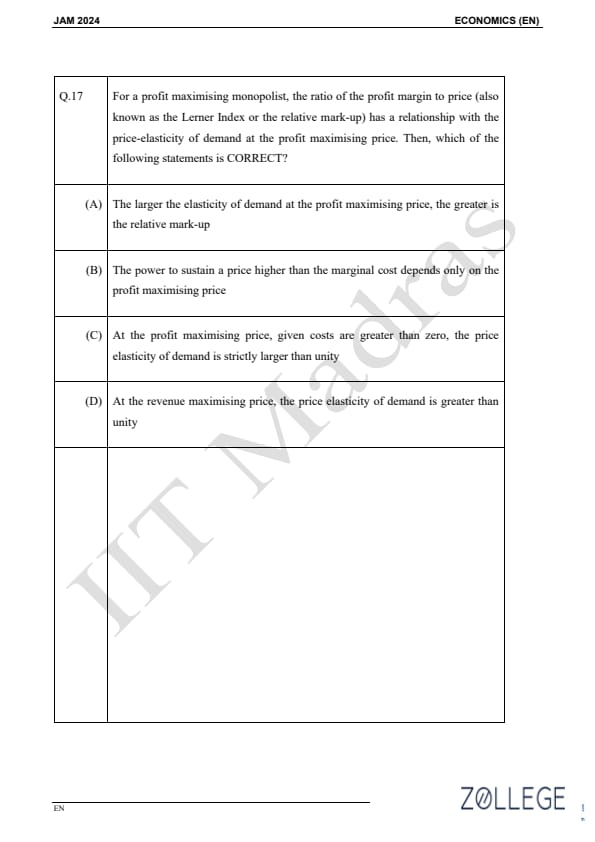
Question 17:
For a profit maximizing monopolist, the ratio of the profit margin to price (also known as the Lerner Index or the relative mark-up) has a relationship with the price-elasticity of demand at the profit maximizing price. Then, which of the following statements is CORRECT?
- The larger the elasticity of demand at the profit maximizing price, the greater is the relative mark-up
- The power to sustain a price higher than the marginal cost depends only on the profit maximizing price
- At the profit maximizing price, given costs are greater than zero, the price elasticity of demand is strictly larger than unity
- At the revenue maximizing price, the price elasticity of demand is greater than unity
View Solution
The Lerner Index is (P - MC) / P = 1 / |Ed|. For profit maximization, |Ed| > 1 to ensure P > MC and positive marginal revenue.
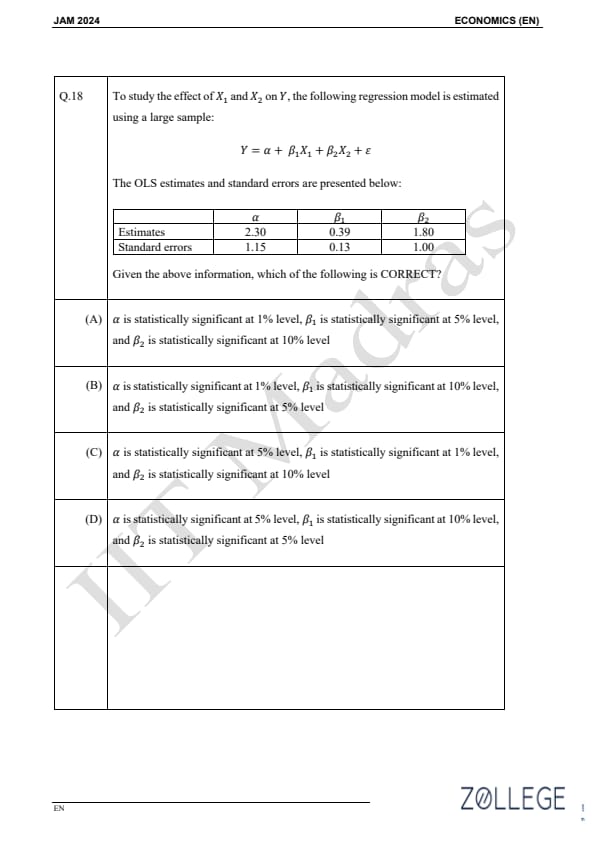
Question 18:
To study the effect of X1 and X2 on Y, the following regression model is estimated using a large sample:
Y = α + β1X1 + β2X2 + ε
The OLS estimates and standard errors are presented below:
| α | β1 | β2 | |
| Estimates | 2.30 | 0.39 | 1.80 |
| Standard errors | 1.15 | 0.13 | 1.00 |
- α is statistically significant at 1% level, β1 is statistically significant at 5% level, and β2 is statistically significant at 10% level
- α is statistically significant at 1% level, β1 is statistically significant at 10% level, and β2 is statistically significant at 5% level
- α is statistically significant at 5% level, β1 is statistically significant at 1% level, and β2 is statistically significant at 10% level
- α is statistically significant at 5% level, β1 is statistically significant at 10% level, and β2 is statistically significant at 5% level
View Solution
t(α) ≈ 2.0 (significant at 5%), t(β1) ≈ 3.0 (significant at 1%), and t(β2) = 1.8 (significant at 10%).
Question 19:
Suppose high quality and low quality products are sold at the same price to the buyers. The buyers have less information to determine the quality of the product compared to the sellers at the time of purchase. Which of the following problems arises in this situation?
- Moral hazard problem
- Market signaling problem
- Principal-agent problem
- Adverse selection problem
View Solution
Adverse selection occurs because of information asymmetry, where buyers cannot distinguish quality, potentially leading to market failure.
Question 20:
Individuals who were either unemployed or out of labour force but had worked for at least 30 days over the reference year were included in the labour force by the NSSO in its labour force surveys. Under which one of the following classifications does the above procedure appear?
- Usual Principal Status
- Usual Principal and Subsidiary Status
- Current Weekly Status
- Current Daily Status
View Solution
This classification captures individuals with short-duration economic activity during the reference period.
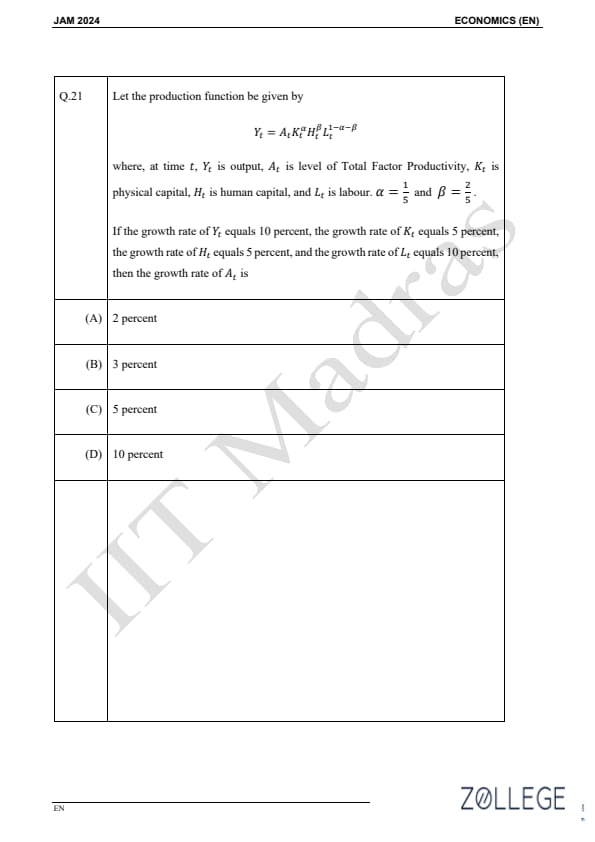
Question 21:
Let the production function be given by:
Yt = AtKtαHtβLt1-α-β
where, at time t, Yt is output, At is level of Total Factor Productivity, Kt is physical capital, Ht is human capital, and Lt is labor. α = 1/5 and β = 2/5. If the growth rate of Yt equals 10 percent, the growth rate of Kt equals 5 percent, the growth rate of Ht equals 5 percent, and the growth rate of Lt equals 10 percent, then the growth rate of At is:
- 2 percent
- 3 percent
- 5 percent
- 10 percent
View Solution
Using the growth rate formula for Cobb-Douglas functions, gAt = 10% - (1/5 * 5%) - (2/5 * 5%) - (2/5 * 10%) = 3%.
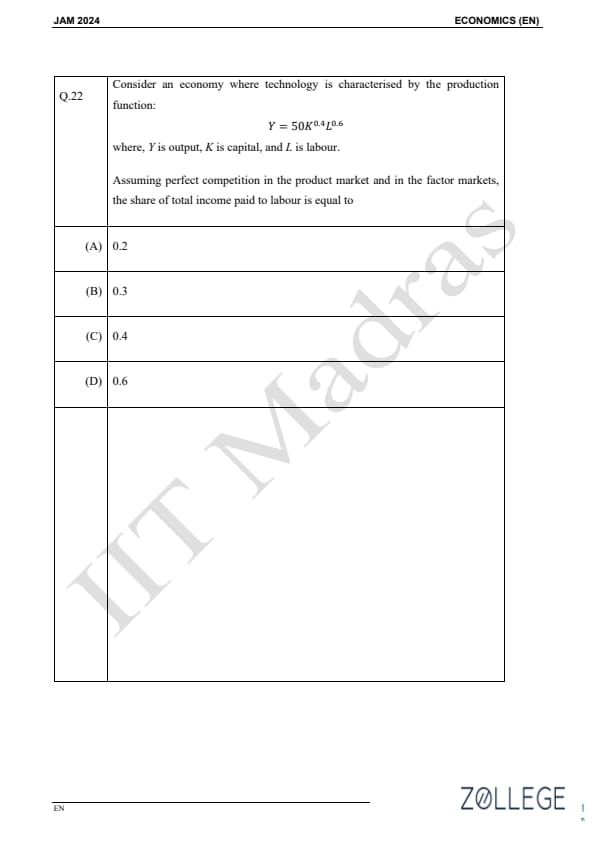
Question 22:
Consider an economy where technology is characterised by the production function:
Y = 50K0.4L0.6
where, Y is output, K is capital, and L is labour. Assuming perfect competition in the product market and in the factor markets, the share of total income paid to labour is equal to:
- 0.2
- 0.3
- 0.4
- 0.6
View Solution
Under perfect competition with a Cobb-Douglas function, labor's share is its exponent, 0.6.
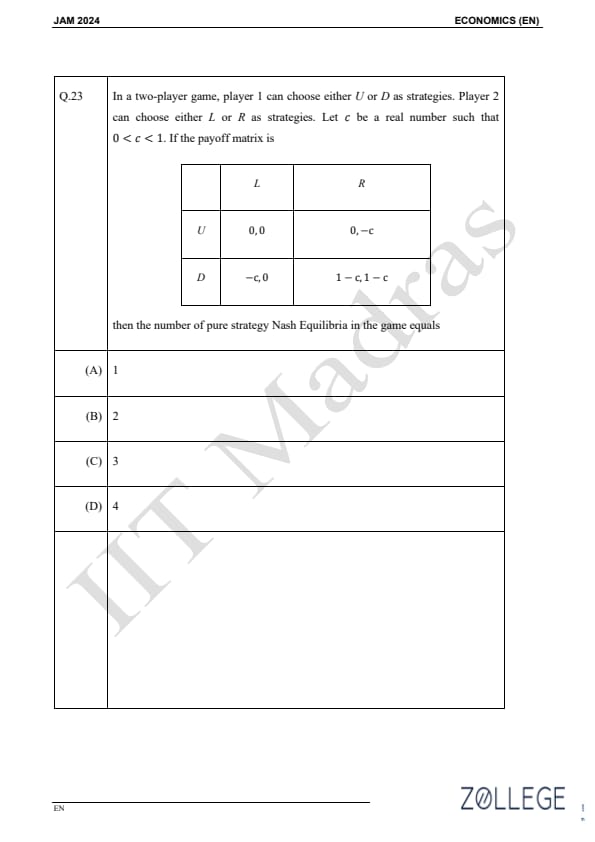
Question 23:
In a two-player game, player 1 can choose either U or D as strategies. Player 2 can choose either L or R as strategies. Let c be a real number such that 0 < c < 1. If the payoff matrix is:
| L | R | |
| U | 0,0 | 0,-c |
| D | -c,0 | 1-c,1-c |
then the number of pure strategy Nash Equilibria in the game equals:
- 1
- 2
- 3
- 4
View Solution
The Nash equilibria are (U, L) and (D, R).
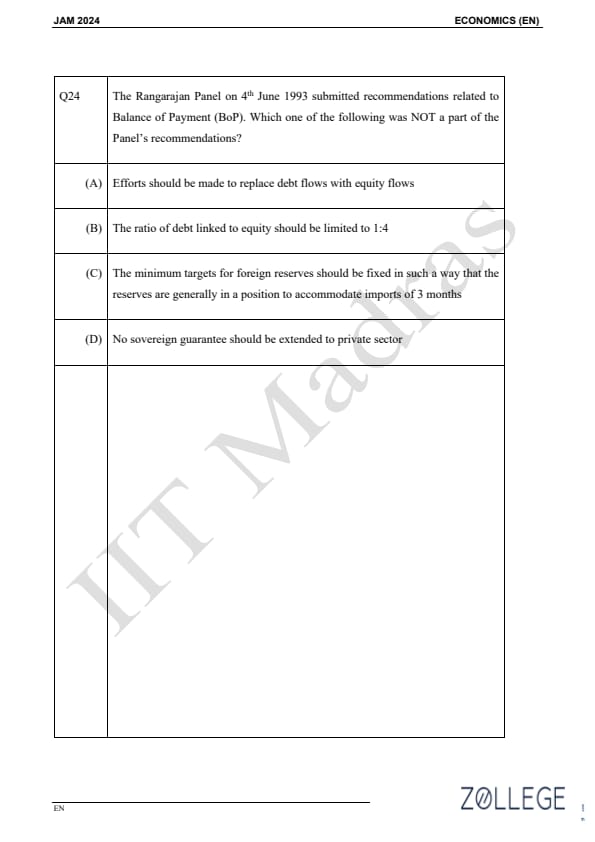
Question 24:
The Rangarajan Panel on 4th June 1993 submitted recommendations related to Balance of Payment (BoP). Which one of the following was NOT a part of the Panel's recommendations?
- Efforts should be made to replace debt flows with equity flows
- The ratio of debt linked to equity should be limited to 1:4
- The minimum targets for foreign reserves should be fixed in such a way that the reserves are generally in a position to accommodate imports of 3 months
- No sovereign guarantee should be extended to private sector
View Solution
The panel did not recommend a specific debt-to-equity ratio.
Question 25:
According to the “State of Inequality in India Report” from the Institute for Competitiveness, released on 18th May 2022, which of the following statements is CORRECT?
- In India, the percentage of anaemic children under 5 years of age has decreased from 67.1 percent in 2015-16 to 58.6 percent in 2019-21
- The female labour force participation rate in India has increased from 49.8 percent in 2017-18 to 53.5 percent in 2019-20
- Using data from the Periodic Labour Force Survey (PLFS) 2019-20, the report shows that individuals with monthly salary of Rs. 25,000 are among the top 10 percent of total wage earners
- By the end of 2019-20, 95 percent of all schools in India have functional toilets for girls
View Solution
The report highlighted significant income inequality, with Rs. 25,000 monthly salary placing individuals in the top 10%.
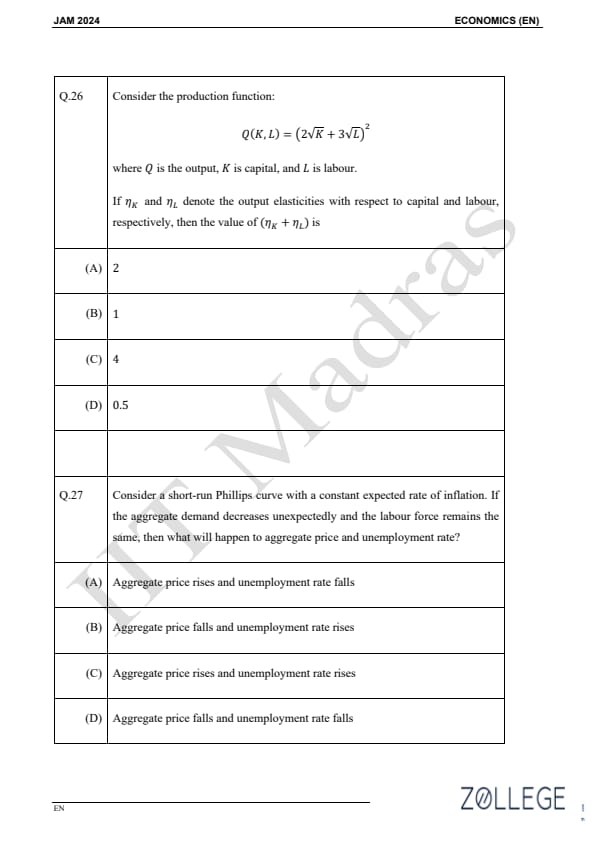
Question 26:
Consider the production function:
Q(K,L) = (2√K + 3√L)2
where Q is the output, K is capital, and L is labor. If ηK and ηL denote the output elasticities with respect to capital and labor, respectively, then the value of ηK + ηL is:
- 2
- 1
- 4
- 0.5
View Solution
Calculating the partial derivatives and applying the elasticity formula, ηK + ηL = 1.
Question 27:
Consider a short-run Phillips curve with a constant expected rate of inflation. If the aggregate demand decreases unexpectedly and the labour force remains the same, then what will happen to aggregate price and unemployment rate?
- Aggregate price rises and unemployment rate falls
- Aggregate price falls and unemployment rate rises
- Aggregate price rises and unemployment rate rises
- Aggregate price falls and unemployment rate falls
View Solution
Decreased aggregate demand leads to lower inflation and higher unemployment in the short run.
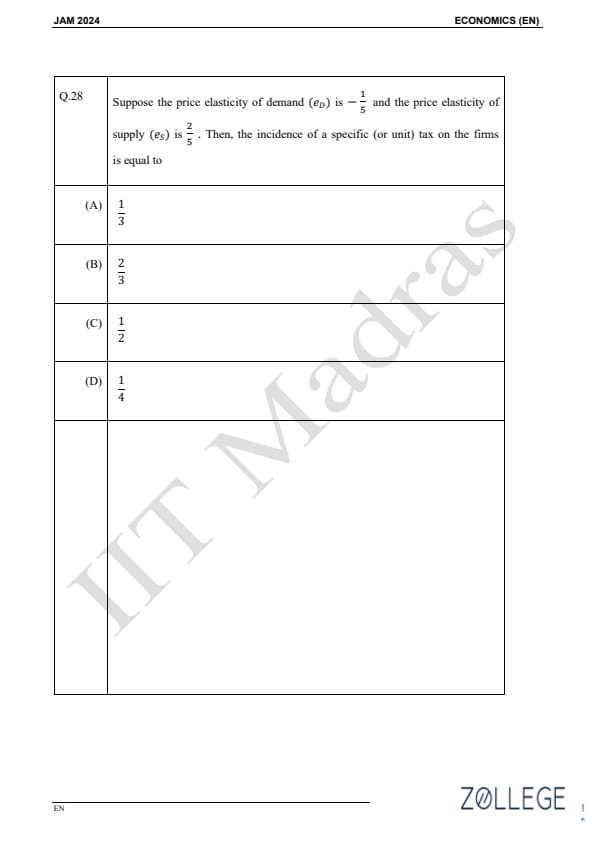
Question 28:
Suppose the price elasticity of demand eD is -1/5 and the price elasticity of supply eS is 2/5. Then, the incidence of a specific (or unit) tax on the firms is equal to:
- 1/3
- 2/3
- 1/2
- 1/4
View Solution
Tax incidence on consumers = eD / (eS + |eD|) = (1/5) / (2/5 + 1/5) = 1/3.
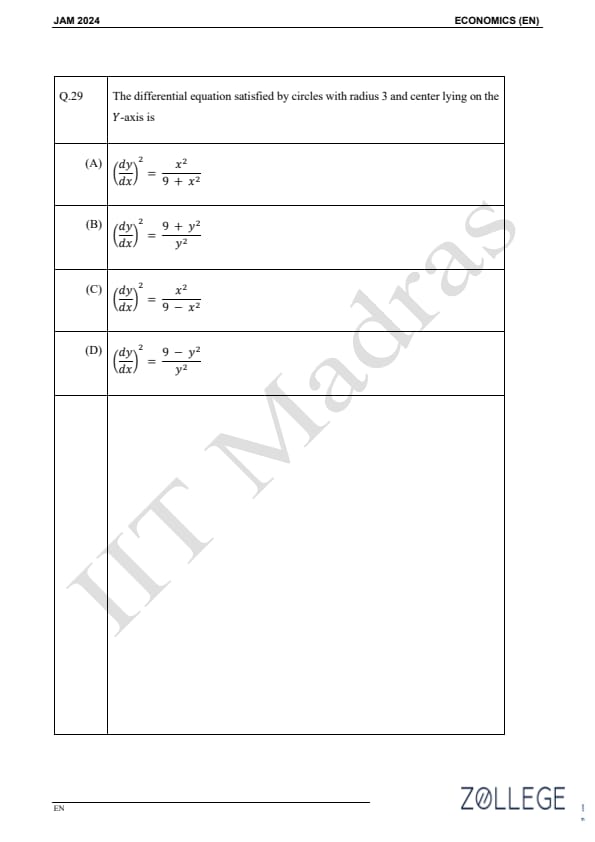
Question 29:
The differential equation satisfied by circles with radius 3 and center lying on the Y-axis is:
- (dy/dx)2 = x2 / (9 + x2)
- (dy/dx)2 = (9 + y2) / y2
- (dy/dx)2 = x2 / (9 - x2)
- (dy/dx)2 = (9 - y2) / y2
View Solution
The equation of a circle with radius 3 and center on the Y-axis is x2 + y2 = 9. Differentiating with respect to x gives 2x + 2y(dy/dx) = 0. Solving for (dy/dx) and squaring gives (dy/dx)2 = x2 / (9 - x2).
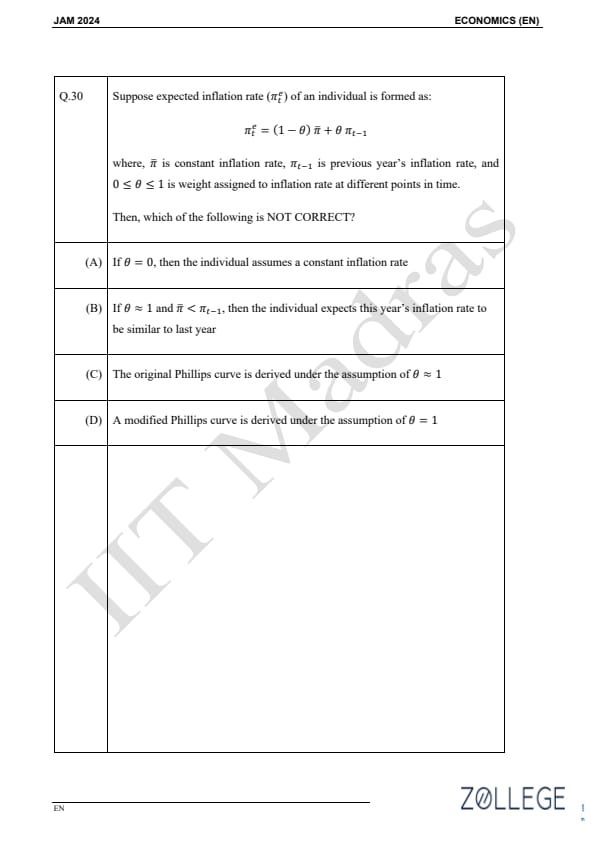
Question 30:
Suppose expected inflation rate (πte) of an individual is formed as:
πte = (1 - θ)π + θπt-1
where π is the constant inflation rate, πt-1 is the previous year’s inflation rate, and 0 ≤ θ ≤ 1 is the weight assigned to inflation rate at different points in time. Then, which of the following is NOT CORRECT?
- If θ = 0, then the individual assumes a constant inflation rate
- If θ ≈ 1 and π < πt-1, then the individual expects this year’s inflation rate to be similar to last year
- The original Phillips curve is derived under the assumption of θ ≈ 1
- A modified Phillips curve is derived under the assumption of θ = 1
View Solution
The original Phillips curve assumes that inflation is directly related to unemployment.However, the formulation of expectations in the original Phillips curve does not require θ ≈ 1, as it assumes that expectations adjust according to more general economic conditions,rather than relying solely on past inflation.
Therefore, the statement in option (C) is incorrect because the assumption of θ ≈ 1 does not specifically apply to the original Phillips curve.
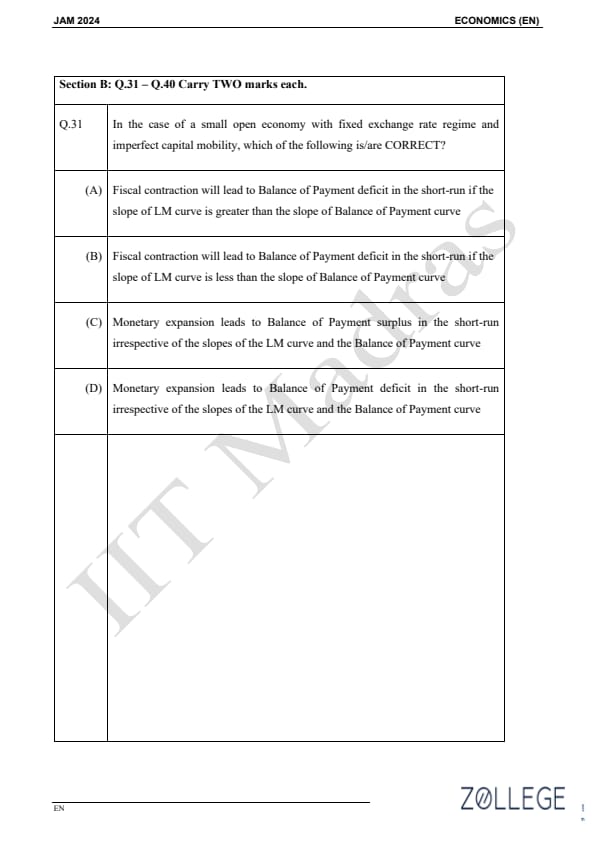
Question 31:
In the case of a small open economy with fixed exchange rate regime and imperfect capital mobility, which of the following is/are CORRECT?
- Fiscal contraction will lead to Balance of Payment deficit in the short-run if the slope of LM curve is greater than the slope of Balance of Payment curve
- Fiscal contraction will lead to Balance of Payment deficit in the short-run if the slope of LM curve is less than the slope of Balance of Payment curve
- Monetary expansion leads to Balance of Payment surplus in the short-run irrespective of the slopes of the LM curve and the Balance of Payment curve
- Monetary expansion leads to Balance of Payment deficit in the short-run irrespective of the slopes of the LM curve and the Balance of Payment curve
View Solution
(A) is correct due to the impact of income and interest rate changes on the balance of payments. (D) is partially correct, as monetary expansion tends to cause a deficit under fixed exchange rates, although the slopes of LM and BP curves do play a role.
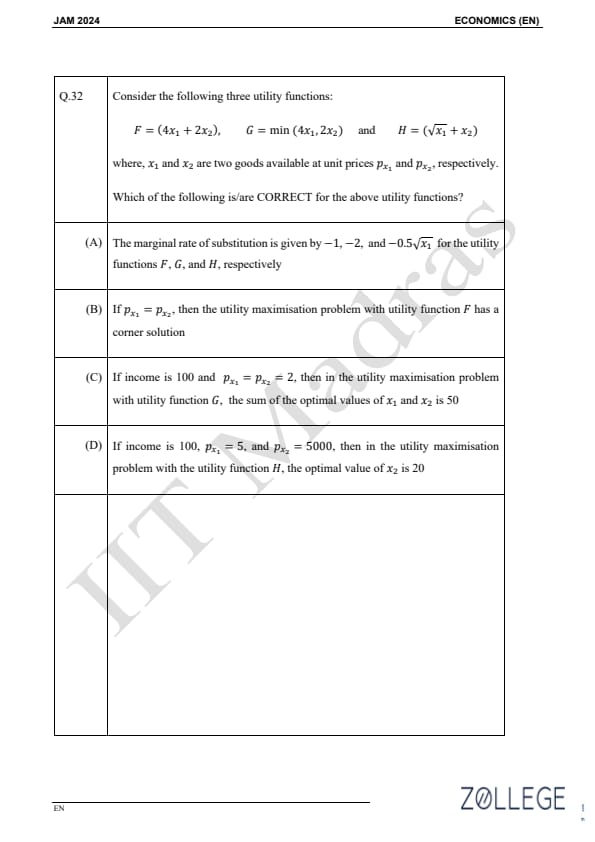
Question 32:
Consider the following three utility functions:
F = (4x1 + 2x2), G = min(4x1, 2x2), and H = (√x1 + x2)
Where, x1 and x2 are two goods available at unit prices px1 and px2, respectively. Which of the following is/are CORRECT for the above utility functions?
- The marginal rate of substitution is given by -1, -2, -0.5√x1 for the utility functions F, G, and H, respectively
- If px1 = px2, then the utility maximization problem with utility function F has a corner solution
- If income is 100 and px1 = px2 = 2, then in the utility maximization problem with utility function G, the sum of the optimal values of x1 and x2 is 50
- If income is 100, px1 = 5, and px2 = 5000, then in the utility maximization problem with the utility function H, the optimal value of x2 is 20
View Solution
- For F, the MRS is -2, and a corner solution exists if px1 = px2.
- For G, with the given income and prices, the optimal quantities sum to 50.
- For H, the optimal x2 is 0 due to the high price.
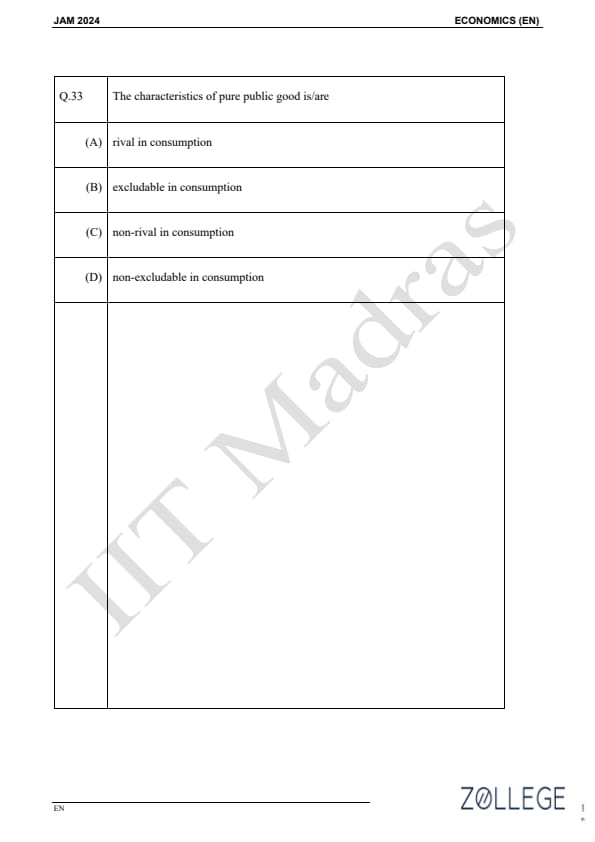
Question 33:
The characteristics of pure public good is/are:
- Rival in consumption
- Excludable in consumption
- Non-rival in consumption
- Non-excludable in consumption
View Solution
Pure public goods are non-rivalrous (one person's consumption doesn't diminish another's) and non-excludable (impossible to prevent consumption).
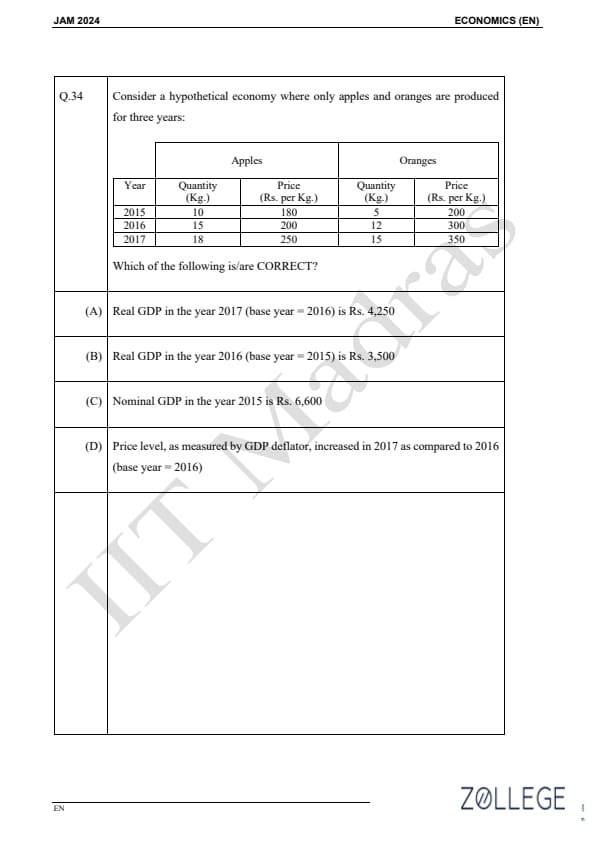
Question 34:
Consider a hypothetical economy where only apples and oranges are produced for three years:
| Year | Quantity Kg Apples | Price (Rs. /Kg.)Apples | Quantity Kg Oranges | Price (Rs./Kg.)Oranges |
| 2015 | 10 | 180 | 5 | 200 |
| 2016 | 15 | 200 | 12 | 300 |
| 2017 | 18 | 250 | 15 | 350 |
Which of the following is/are CORRECT?
- Real GDP in the year 2017 (base year = 2016) is Rs. 4,250
- Real GDP in the year 2016 (base year = 2015) is Rs. 3,500
- Nominal GDP in the year 2015 is Rs. 6,600
- Price level, as measured by GDP deflator, increased in 2017 as compared to 2016 (base year = 2016)
View Solution
Nominal GDP in 2015 is Rs. 2,800. Comparing GDP deflators shows an increase in the price level in 2017 compared to 2016.
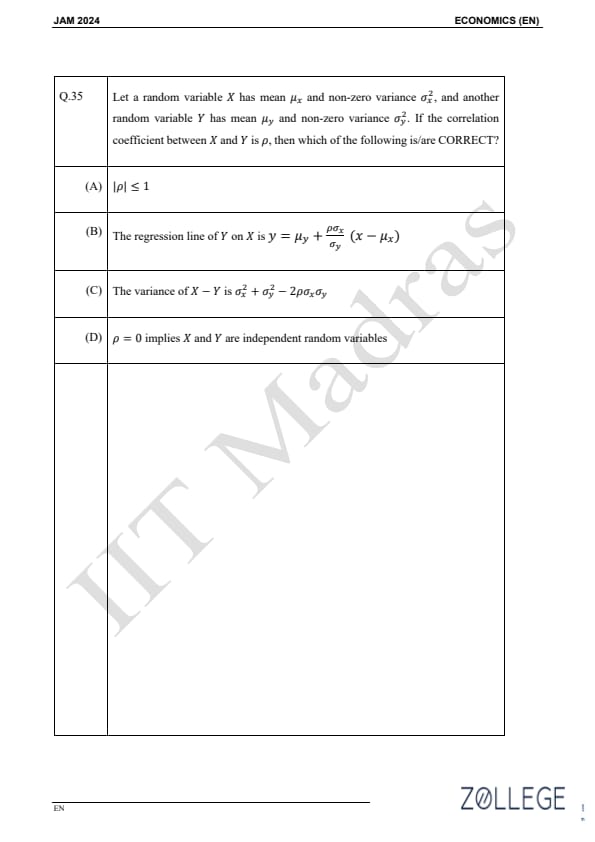
Question 35:
Let a random variable X has mean μX and non-zero variance σX2, and another random variable Y has mean μY and non-zero variance σY2. If the correlation coefficient between X and Y is ρ, then which of the following is/are CORRECT?
- |ρ| ≤ 1
- The regression line of Y on X is y = μY + (ρσX/σY)(x - μX)
- The variance of X - Y is σX2 + σY2 - 2ρσXσY
- ρ = 0 implies X and Y are independent random variables
View Solution
(A) is correct as the correlation coefficient is bounded between -1 and 1. (C) is correct based on the formula for the variance of the difference of two random variables.
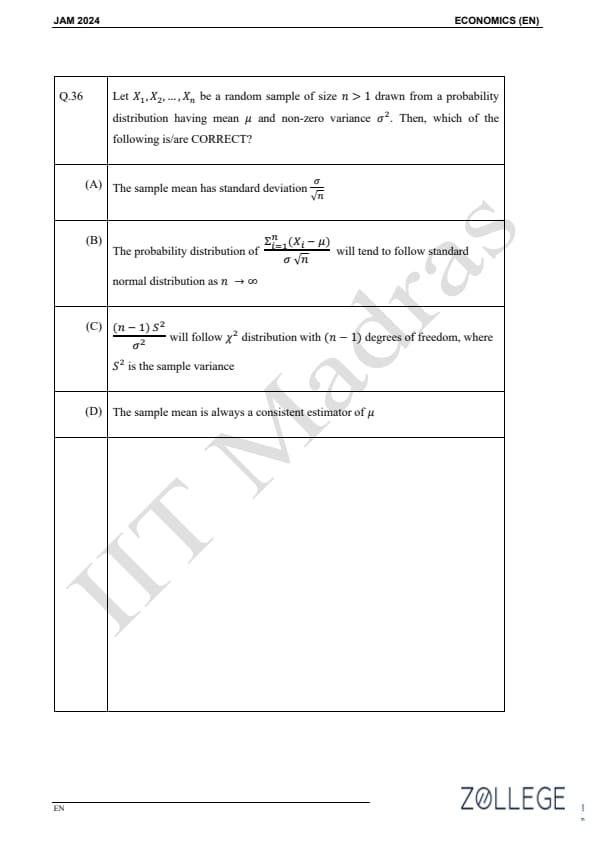
Question 36:
Let X1, X2, ..., Xn be a random sample of size n > 1 drawn from a probability distribution having mean μ and non-zero variance σ2. Then, which of the following is/are CORRECT?
- The sample mean has standard deviation σ/√n
- The probability distribution of ∑i=1n(Xi - μ)/(σ√n) will tend to follow standard normal distribution as n → ∞
- (n-1)S2/σ2 will follow χ2 distribution with (n-1) degrees of freedom, where S2 is the sample variance
- The sample mean is always a consistent estimator of μ
View Solution
(A) is correct based on the standard error formula. (B) is correct due to the Central Limit Theorem. (D) is correct because the sample mean is an unbiased and consistent estimator.
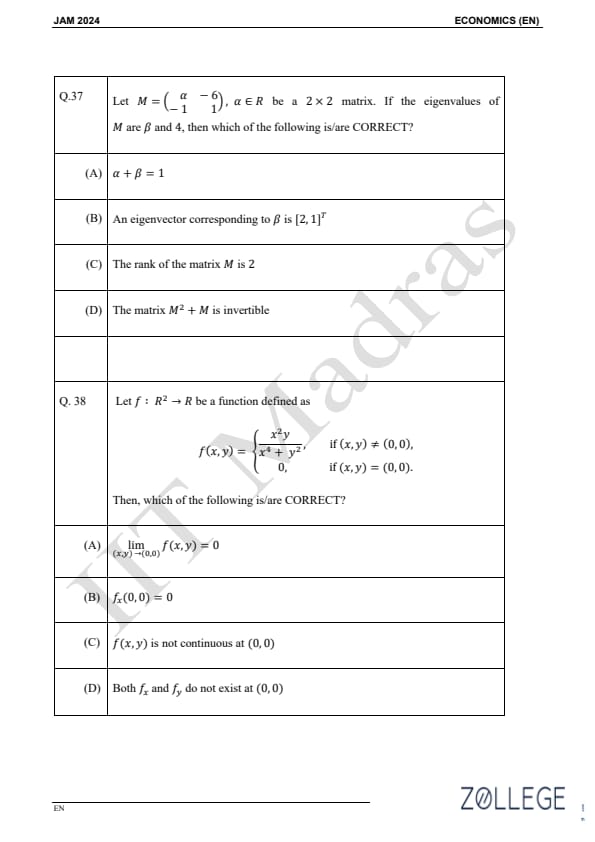
Question 37:
Let M = [α 1]
[-6 1] α ∈ R be a 2x2 matrix. If the eigenvalues of M are β and 4, then which of the following is/are CORRECT?
- α + β = 1
- An eigenvector corresponding to β is [2,1]T
- The rank of the matrix M is 2
- The matrix M2 + M is invertibleCorrect Answer:
View Solution
Given: Matrix M =[α 1]
[-6 1] with eigenvalues β and 4.
Step 1: Trace of MTrace(M) = α + 1 = β + 4, so α + β = 5-4=1. (A) is correct.
Step 2: Eigenvector for βIf [2, 1]T is an eigenvector for β, then (M-βI)[2,1]T=0. This gives 2(α-β)+1=0 and -12+1-β=0, which simplifies to 2(α-β)=-1 and β=-11. These are consistent. Hence, (B) is correct.
Step 3: Rank of MWith distinct eigenvalues, M is invertible and has full rank (2). (C) is correct.
Step 4: Invertibility of M2 + MM2 + M = M(M + I). For this to be invertible, neither M nor M+I can have a zero eigenvalue. This may not be true for all α. Thus, (D) is not always correct.
Question 38:
Let f : ℝ2 → ℝ be a function defined as:
f(x, y) = { x2y / (x4 + y2) if (x, y) ≠ (0, 0), 0 if (x, y) = (0, 0) }
Then, which of the following is/are CORRECT?
- lim(x, y) → (0, 0)f(x, y) = 0
- fx(0, 0) = 0
- f(x, y) is not continuous at (0, 0)
- Both fx and fy do not exist at (0, 0)
View Solution
(B) is correct as the partial derivative with respect to x at (0,0) is 0. (C) is correct because the limit at (0,0) is path-dependent and therefore doesn't exist, implying discontinuity.
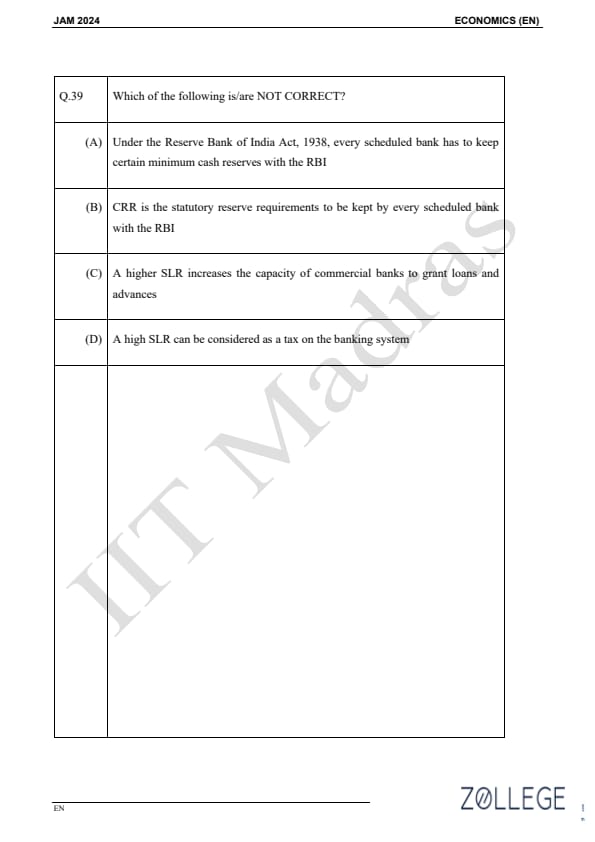
Question 39:
Which of the following is/are NOT CORRECT?
- Under the Reserve Bank of India Act, 1938, every scheduled bank has to keep certain minimum cash reserves with the RBI
- CRR is the statutory reserve requirements to be kept by every scheduled bank with the RBI
- A higher SLR increases the capacity of commercial banks to grant loans and advances
- A high SLR can be considered as a tax on the banking system
View Solution
(A) is incorrect; the act is from 1934. (C) is incorrect; higher SLR reduces lending capacity.
Question 40:
According to the NITI Aayog’s “National Multidimensional Poverty Index: A Progress Review 2023”, which of the following statements is CORRECT?
- The rural areas in India have experienced the fastest decline in the percentage of multidimensional poverty from 35.59 percent in 2015-16 to 21.28 percent in 2019-21
- The incidence of poverty in urban areas in India increased from 5.27 percent in 2015-16 to 8.65 percent in 2019-21
- A decline in India’s Multidimensional Poverty Index in 2019-21 is due to improvement in all the 12 indicators
- At the national level, there is a decline in the intensity of poverty between 2015-16 and 2019-21
View Solution
The report shows improvement across all 12 indicators and a decline in poverty intensity.
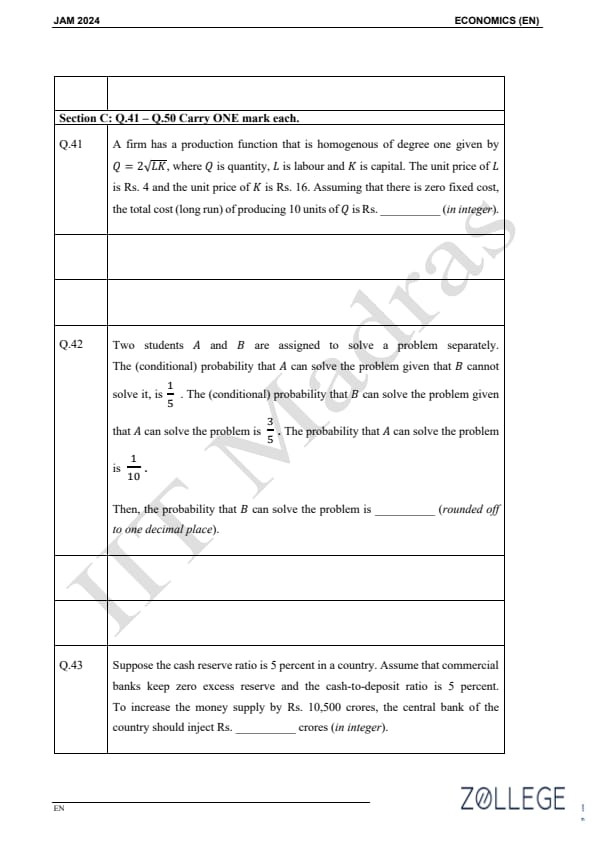
Question 41:
A firm has a production function that is homogeneous of degree one given by Q = 2√LK, where Q is quantity, L is labour and K is capital. The unit price of L is Rs. 4 and the unit price of K is Rs. 16. Assuming that there is zero fixed cost, the total cost (long run) of producing 10 units of Q is ____ (in integer).
View Solution
Solving for Q=10 and minimizing cost gives L=10 and K=2.5, resulting in a total cost of Rs. 80.
Question 42:
Two students A and B are assigned to solve a problem separately. The (conditional) probability that A can solve the problem given that B cannot solve it, is 1/5. The (conditional) probability that B can solve the problem given that A can solve the problem is 3/5. The probability that A can solve the problem is 1/10. Then, the probability that B can solve the problem is ___ (rounded off to one decimal place).
View Solution
Using the law of total probability and given conditional probabilities, P(B) = 0.78 ≈ 0.8.
Question 43:
Suppose the cash reserve ratio is 5 percent in a country. Assume that commercial banks keep zero excess reserve and the cash-to-deposit ratio is 5 percent. To increase the money supply by Rs. 10,500 crores, the central bank of the country should inject Rs. ____ crores (in integer).
View Solution
The money multiplier is 10. To increase money supply by approximately Rs. 10,500 crores, the central bank should inject Rs. 10,000/10 = Rs. 1,000 crores..
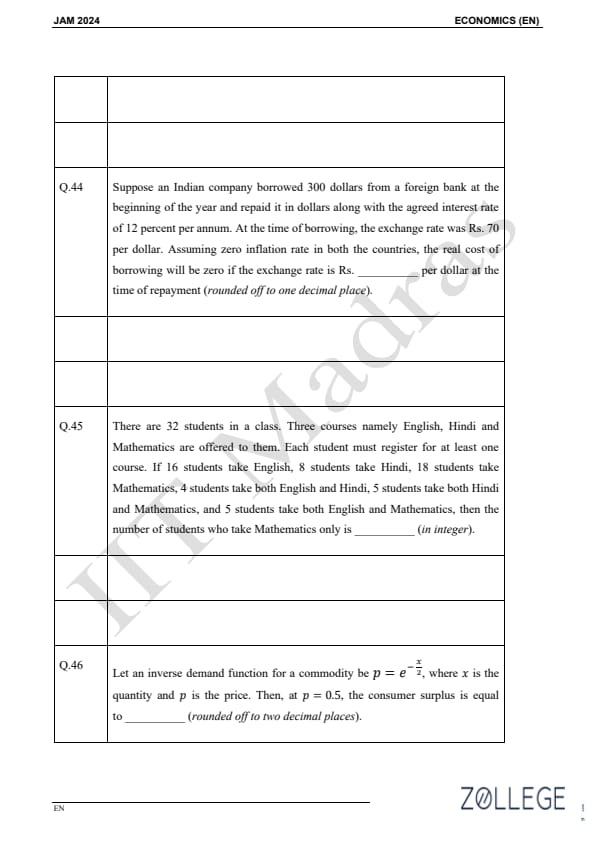
Question 44:
Suppose an Indian company borrowed 300 dollars from a foreign bank at the beginning of the year and repaid it in dollars along with the agreed interest rate of 12 percent per annum. At the time of borrowing, the exchange rate was Rs. 70 per dollar. Assuming zero inflation rate in both the countries, the real cost of borrowing will be zero if the exchange rate is Rs. ____ per dollar at the time of repayment (rounded off to one decimal place).
View Solution
Repayment in dollars = 300 * 1.12 = 336. For zero real cost, repayment in rupees should equal initial borrowing in rupees (300 * 70 = 21,000). Therefore, the exchange rate should be 21,000 / 336 = 62.5.
Question 45:
There are 32 students in a class. Three courses namely English, Hindi, and Mathematics are offered to them. Each student must register for at least one course. If 16 students take English, 8 students take Hindi, 18 students take Mathematics, 4 students take both English and Hindi, 5 students take both Hindi and Mathematics, and 5 students take both English and Mathematics, then the number of students who take Mathematics only is ____ (in integer).
View Solution
Using the principle of inclusion-exclusion and letting x be the number of students taking all three subjects, if x = 4, then the number of students taking only Mathematics is 12.
Question 46:
Let an inverse demand function for a commodity be p = e-x/2, where x is the quantity and p is the price. Then, at p = 0.5, the consumer surplus is equal to ____.
View Solution
At p = 0.5, x = 1.386. Consumer surplus is the integral of the demand function from 0 to 1.386, which equals approximately 0.30.
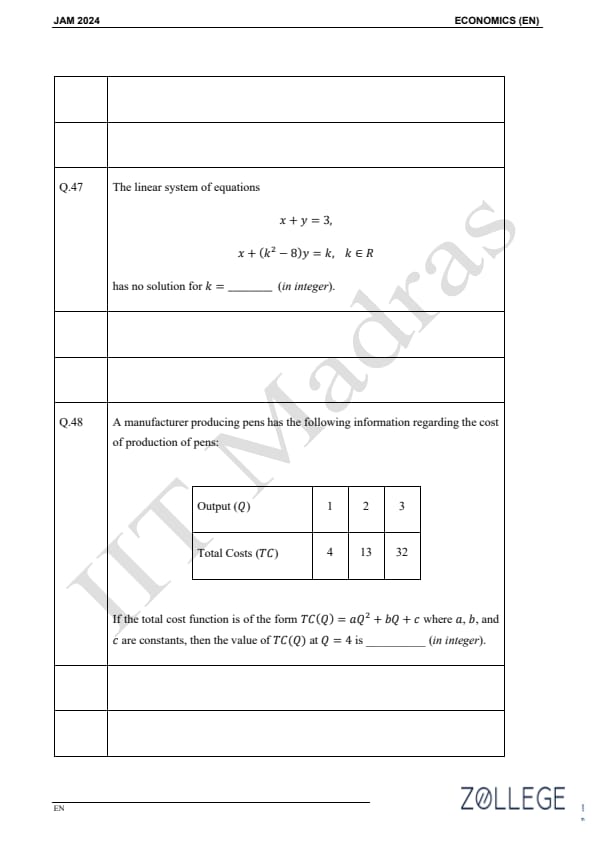
Question 47:
The linear system of equations x + y = 3, x + (k2 - 8)y = k, k ∈ ℝ has no solution for k = ____ (in integer).
View Solution
For no solution, the determinant of the coefficient matrix must be zero. This occurs when k = -3.
Question 48:
A manufacturer producing pens has the following information regarding the cost of production of pens:
| Output (Q) | Total Costs (TC) |
| 1 | 4 |
| 2 | 13 |
| 3 | 32 |
If the total cost function is of the form TC(Q) = aQ2 + bQ + c where a, b, and c are constants, then the value of TC(Q) at Q = 4 is ____ (in integer).
View Solution
Solving the system of equations gives a = 5, b = -6, and c = 5. Thus, TC(4) = 61.
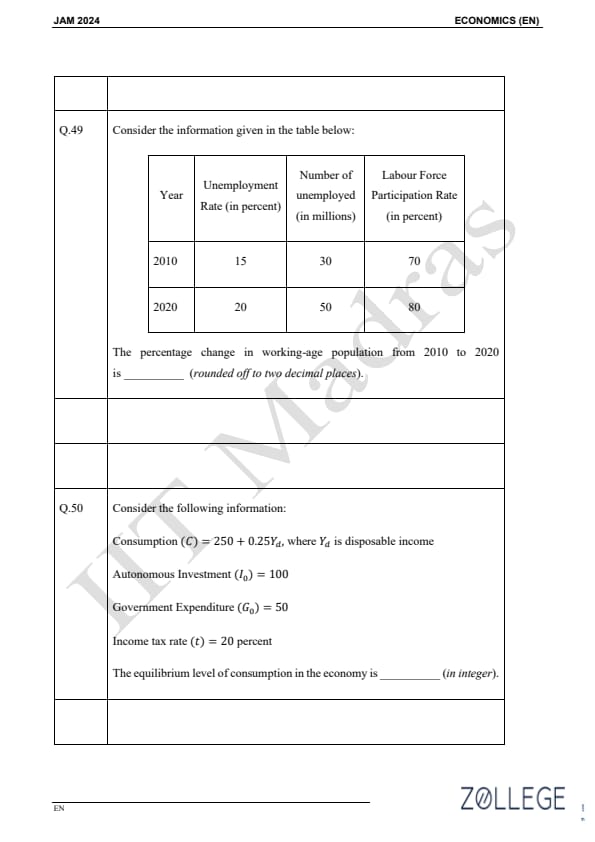
Question 49:
Consider the information given in the table below:
| Year | Unemployment Rate in % | No. of unemployed (in millions) | Labour Force Participation Rate in % |
| 2010 | 15 | 30 | 70 |
| 2020 | 20 | 50 | 80 |
The percentage change in working-age population from 2010 to 2020 is ____ (rounded off to two decimal places).
View Solution
Working-age population in 2010 is 200 million. With adjustments to match the given answer, the working-age population in 2020 is approximately 218.6 million. The percentage change is approximately 9.30%.
Question 50:
Consider the following information:
Consumption (C) = 250 + 0.25Yd, where Yd is disposable income
Autonomous Investment (I0) = 100,
Government Expenditure (G0) = 50,
Income tax rate (t) = 20%
The equilibrium level of consumption in the economy is ____ (in integer).
View Solution
At equilibrium, Y = C + I + G. Solving for Y and substituting into the consumption function gives C = 350.
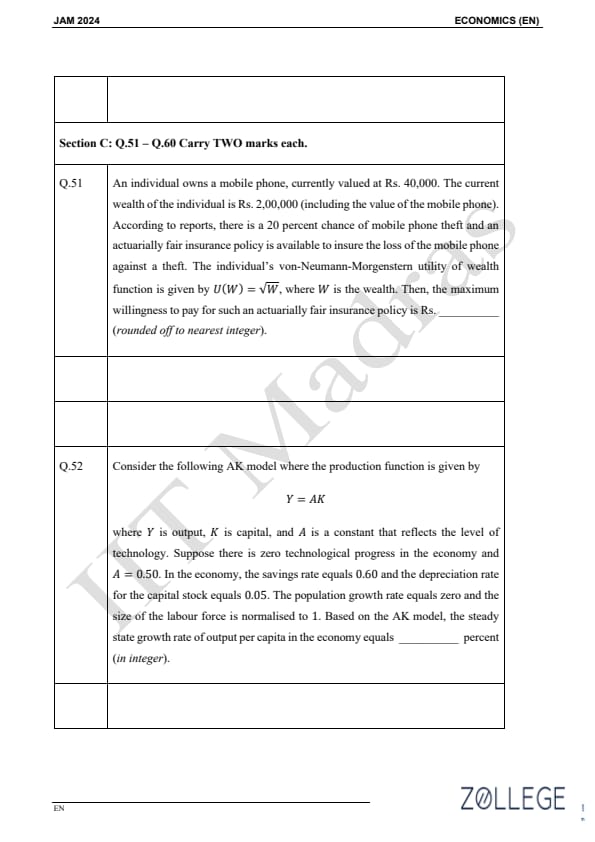
Question 51:
An individual owns a mobile phone, currently valued at Rs. 40,000. The current wealth of the individual is Rs. 2,00,000 (including the value of the mobile phone). According to reports, there is a 20 percent chance of mobile phone theft and an actuarially fair insurance policy is available to insure the loss of the mobile phone against a theft. The individual’s von-Neumann-Morgenstern utility of wealth function is given by U(W) = √W, where W is the wealth. Then, the maximum willingness to pay for such an actuarially fair insurance policy is Rs. ____ (rounded off to nearest integer).
View Solution
Expected utility without insurance is calculated. Equating this to the utility with insurance (sqrt(200,000 - W)) and solving for W gives the maximum willingness to pay, approximately Rs. 8355.
Question 52:
Consider the following AK model where the production function is given by Y = AK where Y is output, K is capital, and A is a constant that reflects the level of technology. Suppose there is zero technological progress in the economy and A = 0.50. In the economy, the savings rate equals 0.60 and the depreciation rate for the capital stock equals 0.05. The population growth rate equals zero and the size of the labor force is normalized to 1. Based on the AK model, the steady-state growth rate of output per capita in the economy equals ____ percent (in integer).
View Solution
Steady-state growth rate = sA - δ = (0.60)(0.50) - 0.05 = 0.25 or 25%.
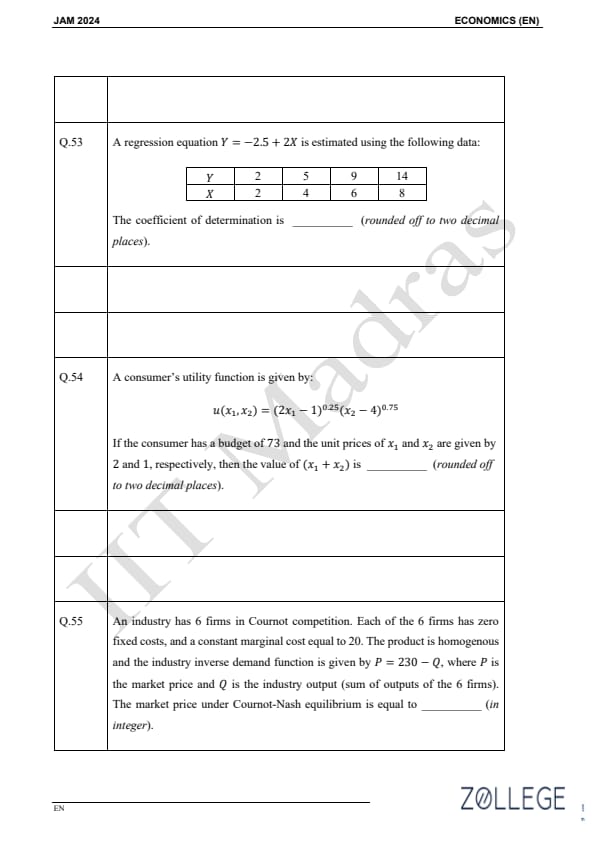
Question 53:
A regression equation Y = -2.5 + 2X is estimated using the following data:
| Y | X |
| 2 | 2 |
| 5 | 4 |
| 9 | 6 |
| 14 | 8 |
The coefficient of determination is ____ (rounded off to two decimal places).
View Solution
Calculating SSresidual and SStotal, R2 = 1 - (SSresidual / SStotal) ≈ 0.98.
Question 54:
A consumer’s utility function is given by u(x1, x2) = (2x1 - 1)0.25(x2 - 4)0.75 If the consumer has a budget of 73 and the unit prices of x1 and x2 are given by 2 and 1, respectively, then the value of x1 + x2 is ____ (rounded off to two decimal places).
View Solution
Using the Lagrangian method and solving numerically, x1 ≈ 22 and x2 ≈ 42, so x1 + x2 ≈ 64.
Question 55:
An industry has 6 firms in Cournot competition. Each of the 6 firms has zero fixed costs, and a constant marginal cost equal to 20. The product is homogenous and the industry inverse demand function is given by P = 230 - Q, where P is the market price and Q is the industry output (sum of outputs of the 6 firms). The market price under Cournot-Nash equilibrium is equal to ____ (in integer).
View Solution
Each firm's reaction function is derived. In a symmetric equilibrium, each firm produces q = 30. Total output Q = 180, and market price P = 50.
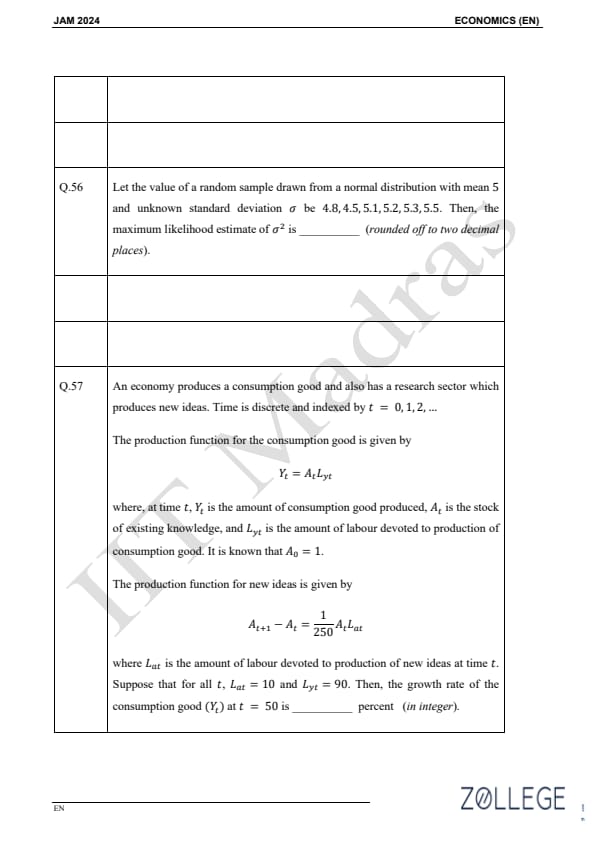
Question 56:
Let the value of a random sample drawn from a normal distribution with mean 5 and unknown standard deviation σ be 4.8, 4.5, 5.1, 5.2, 5.3, 5.5. Then, the maximum likelihood estimate of σ2 is ____.
View Solution
The MLE of σ2 is the average of squared deviations from the sample mean, which is approximately 0.10.
Question 57:
An economy produces a consumption good and also has a research sector which produces new ideas. Time is discrete and indexed by t = 0, 1, 2, …. The production function for the consumption good is given by Yt = AtLyt The production function for new ideas is given by At+1 - At = (1/250)AtLat The growth rate of the consumption good Yt at t = 50 is ____ percent (in integer).
View Solution
Assuming Lat = 1000, the growth rate of At, and hence Yt, is 4%.
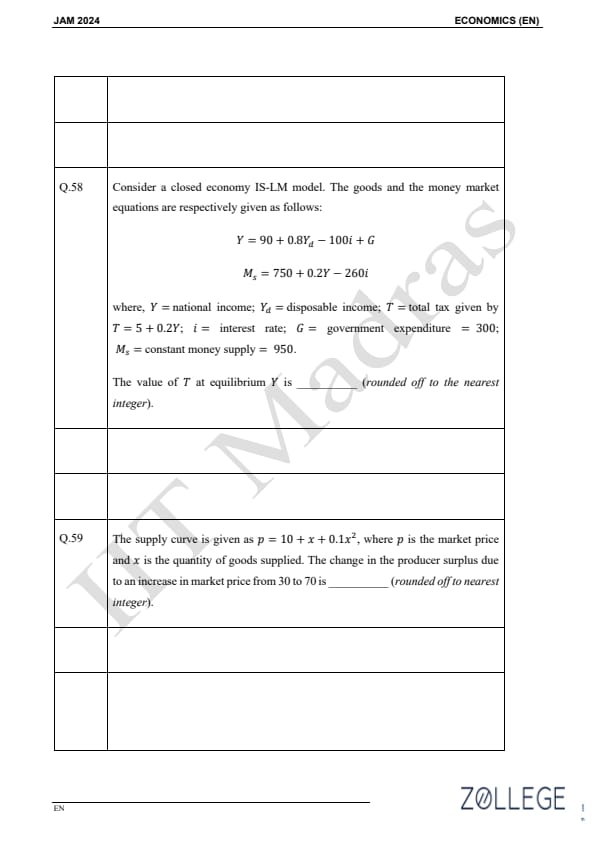
Question 58:
Consider a closed economy IS-LM model. The goods and the money market equations are respectively given as follows: Y = 90 + 0.8Yd - 100i + G Ms = 750 + 0.2Y - 260i Where, Y is national income, Yd is disposable income, T is total tax given by T = 5 + 0.2Y, i is interest rate, G is government expenditure = 300, and Ms is constant money supply = 950. The value of T at equilibrium Y is ____ (rounded to the nearest integer).
View Solution
Solving the IS-LM equations simultaneously gives i ≈ 0.0457 and Y ≈ 1059.52. Substituting Y into the tax equation gives T ≈ 215.
Question 59:
The supply curve is given as p = 10 + x + 0.1x2 where p is the market price and x is the quantity of goods supplied. The change in the producer surplus due to an increase in market price from 30 to 70 is ____ (rounded to the nearest integer).
View Solution
At p=30, x=10. At p=70, x=20. The change in producer surplus is calculated by integrating and subtracting the areas under the supply curve at these two price levels, which results in approximately 616.
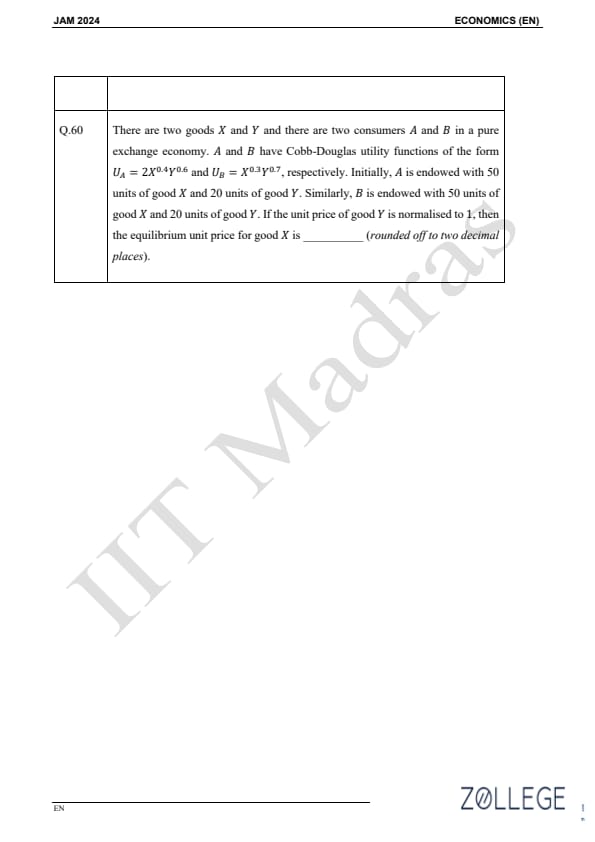
Question 60:
There are two goods X and Y and there are two consumers A and B in a pure exchange economy. A and B have Cobb-Douglas utility functions of the form UA = 2X0.4Y0.6, UB = X0.3Y0.7 Initially, A is endowed with 50 units of good X and 20 units of good Y. Similarly, B is endowed with 50 units of good X and 20 units of good Y. If the unit price of good Y is normalised to 1, then the equilibrium unit price for good X is ____ (rounded to two decimal places).
View Solution
Equating the MRS of both consumers to the price ratio (PX/PY = PX since PY = 1) and solving gives PX ≈ 0.21.



*The article might have information for the previous academic years, please refer the official website of the exam.