
IIT JAM Syllabus 2026: Subject-wise Syllabus PDF, Important Topics


Content Writer | Updated On - Nov 4, 2025
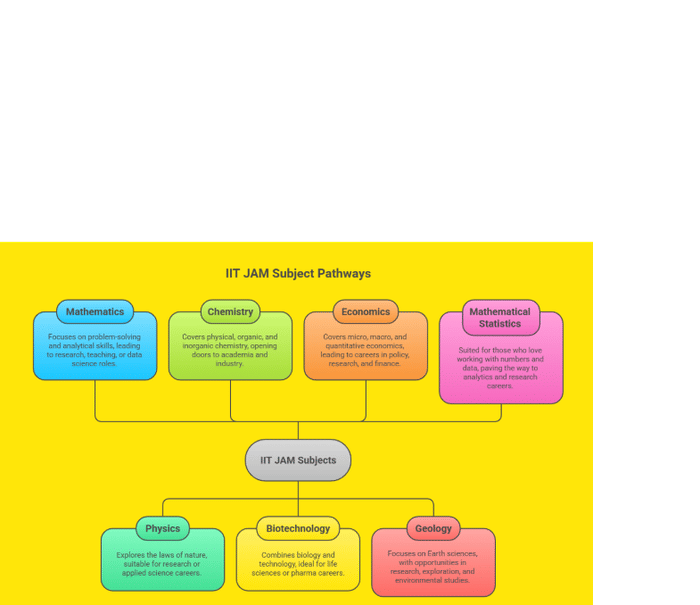
Understanding the IIT JAM Syllabus is essential for candidates appearing for IIT JAM 2026. The IIT JAM 2026 syllabus, as officially announced by the conducting body, IIT Madras, remains unchanged. IIT JAM 2026 will be conducted for various subjects, including Mathematics, Mathematical Statistics, Biotechnology, Physics, Chemistry, Economics, and Geology.
IIT JAM 2026 will be conducted on 15 February 2026, for three hours in online CBT mode. The IIT JAM Question Paper comprises a total of 60 questions, with a total of 100 marks.
- The syllabus largely builds on what you’ve already learned during your undergraduate studies, but the focus here is on how well you grasp the fundamentals and how effectively you can use them to solve problems.
- IIT JAM is conducted in subjects such as Physics, Chemistry, Mathematics, Mathematical Statistics, Biotechnology, Geology, and Economics. While each subject has its own unique topics, the underlying approach is the same, strengthen your core concepts, hone your problem-solving abilities, and practice consistently.
| Key Summary:
|
- What is IIT JAM Syllabus 2026?
- IIT JAM 2026 Subject Wise Syllabus
-
-
- IIT JAM 2026 Chemistry Syllabus
- IIT JAM 2026 Mathematics Syllabus
- IIT JAM 2026 Syllabus Biotechnology
- IIT JAM 2026 Syllabus Economy
-
- IIT JAM 2026 Mathematical Statistics Syllabus
- IIT JAM 2026 Topic Wise Weightage
- How to Prepare Effectively for IIT JAM 2026 Syllabus
- Frequently Asked Questions
What is IIT JAM Syllabus 2026?
The IIT JAM 2026 syllabus is basically your roadmap for preparing for the Joint Admission Test for Masters (JAM), an exam that opens the door to postgraduate science programs like M.Sc., M.Sc.-PhD Dual Degrees, and Joint M.Sc.-PhD at the IITs, IISc, and other top institutes across India.
Every subject in IIT JAM has its own detailed syllabus that covers the important concepts you studied during your undergraduate degree. The exam mainly checks how well you understand core topics, how you apply them to solve problems, and how strong your analytical thinking is.
For IIT JAM 2026, there are seven subjects you can choose from:
Biotechnology (BT)
Chemistry (CY)
Economics (EN)
Geology (GG)
Mathematical Statistics (MS)
Mathematics (MA)
Physics (PH)
IIT JAM 2026 Subject Wise Syllabus
From the below table, candidates will get a detailed idea about the syllabus of different subjects for the IIT JAM 2026:
| IIT JAM Subjects | Topics |
|---|---|
| Mathematics | Sequences and series of Real Numbers, Vector Calculus, Real Analysis, Linear Algebra, Group Theory, Differential Equations, Functions of Two Real Variables |
| Mathematical Statistics | Mathematics and Statistics |
| Physics | Mathematical Methods, Oscillations, Electricity and magnetism, Solid State Physics, Waves and optics, Mechanics and General Properties of Matter, Devices and electronics, Kinetic Theory, Thermodynamics, Modern Physics, Simple Oscillators |
| Chemistry | Organic Chemistry, Inorganic Chemistry, Physical Chemistry |
| Geology | Applied Geology, Geomorphology, Stratigraphy, Petrology, Structural Geology, Economic Geology, The Planet Earth |
| Economy | Production, Costs with perfectly competitive markets, Public goods and market failure, General Equilibrium & Welfare, Consumer theory, Business Cycles, Market Structure, Behavioural and technological Functions, Economic Models, National Income Accounting, Game theory |
| Biotechnology | Mathematics, Physics, Chemistry, Biology |
IIT JAM Syllabus PDF 2026
Candidates can download the IIT JAM Syllabus PDF from the links given in the table below:
| IIT JAM 2026 Subjects | |
|---|---|
| Chemistry | Click here |
| Economics | Click here |
| Geology | Click here |
| Mathematical Statistics | Click here |
| Mathematics | Click here |
| Biotechnology | Click here |
| Physics | Click here |
IIT JAM Subject wise Topics 2026
The IIT JAM syllabus is designed around the core concepts from your undergraduate science subjects. Rather than testing rote learning, it focuses on conceptual clarity and problem-solving ability. Each subject covers specific topic areas that candidates must master for the exam. Here’s a subject-wise list of IIT JAM 2026 topics:
| Subject | Key Topics Covered in IIT JAM 2026 Syllabus |
|---|---|
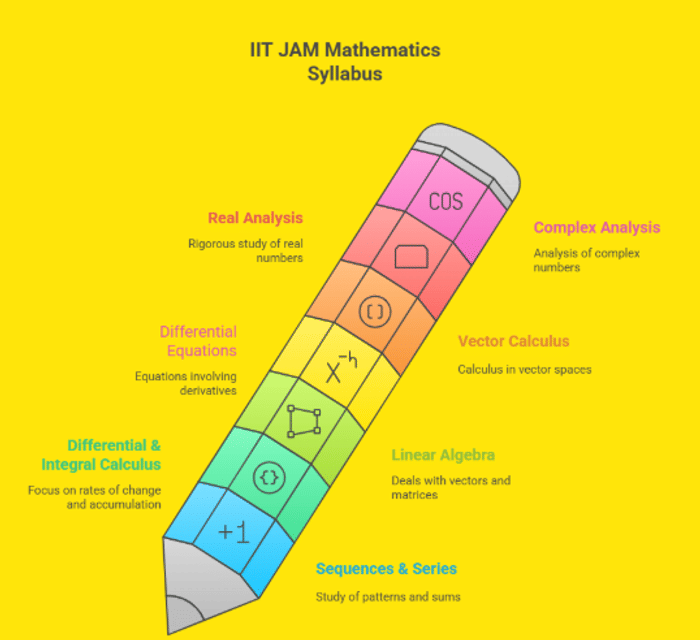
| Mathematics | Sequences & Series, Differential & Integral Calculus, Linear Algebra, Differential Equations, Vector Calculus, Real Analysis, Complex Analysis |
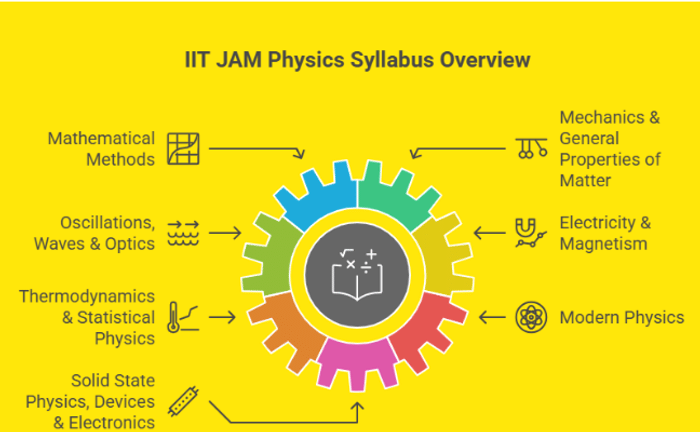
| Physics | Mathematical Methods, Mechanics & General Properties of Matter, Oscillations, Waves & Optics, Electricity & Magnetism, Thermodynamics & Statistical Physics, Modern Physics, Solid State Physics, Devices & Electronics |
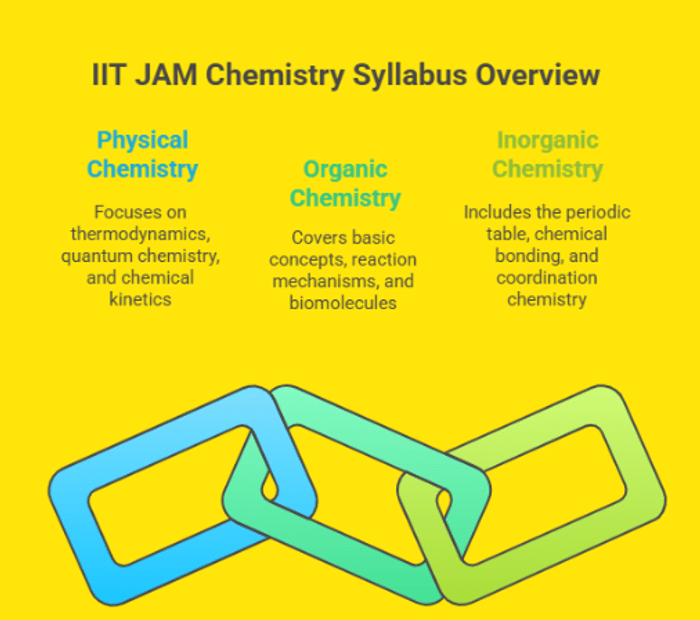
| Chemistry | Physical Chemistry (Thermodynamics, Quantum Chemistry, Chemical Kinetics), Organic Chemistry (Basic Concepts, Reaction Mechanisms, Biomolecules), Inorganic Chemistry (Periodic Table, Chemical Bonding, Coordination Chemistry) |
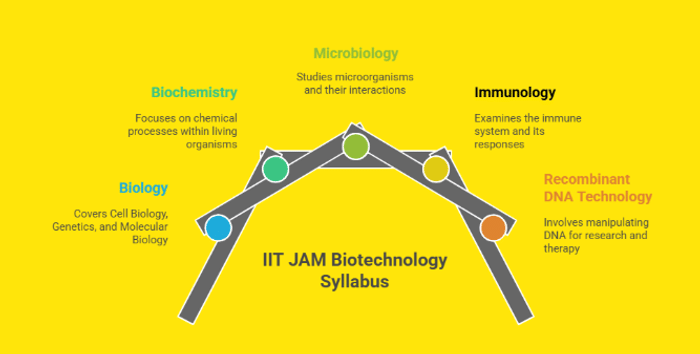
| Biotechnology | Biology (Cell Biology, Genetics, Molecular Biology), Biochemistry, Microbiology, Immunology, Recombinant DNA Technology |
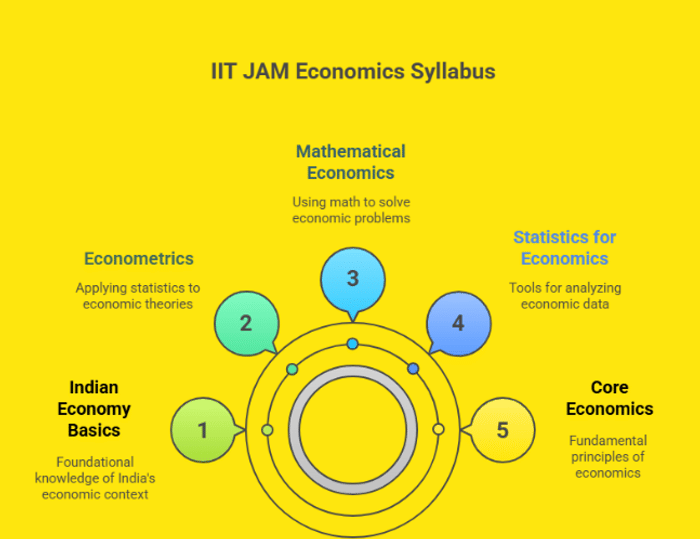
| Economics | Microeconomics, Macroeconomics, Statistics for Economics, Econometrics, Mathematical Economics, Indian Economy Basics |
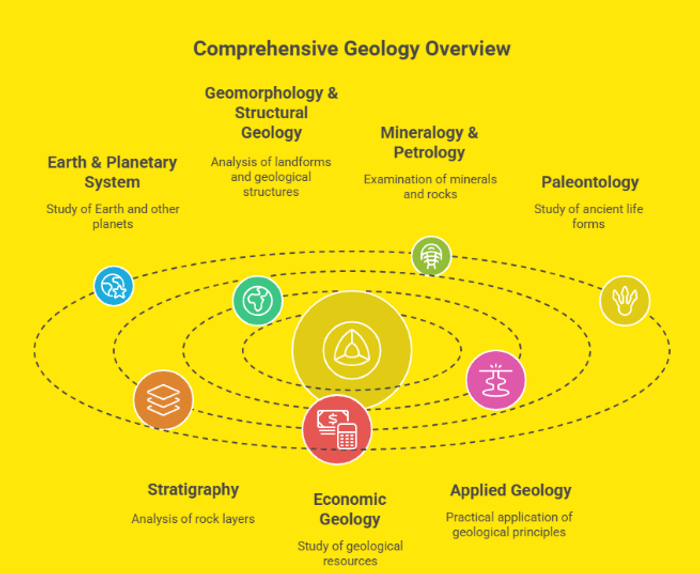
| Geology | Earth & Planetary System, Geomorphology & Structural Geology, Mineralogy & Petrology, Paleontology, Stratigraphy, Economic Geology, Applied Geology |
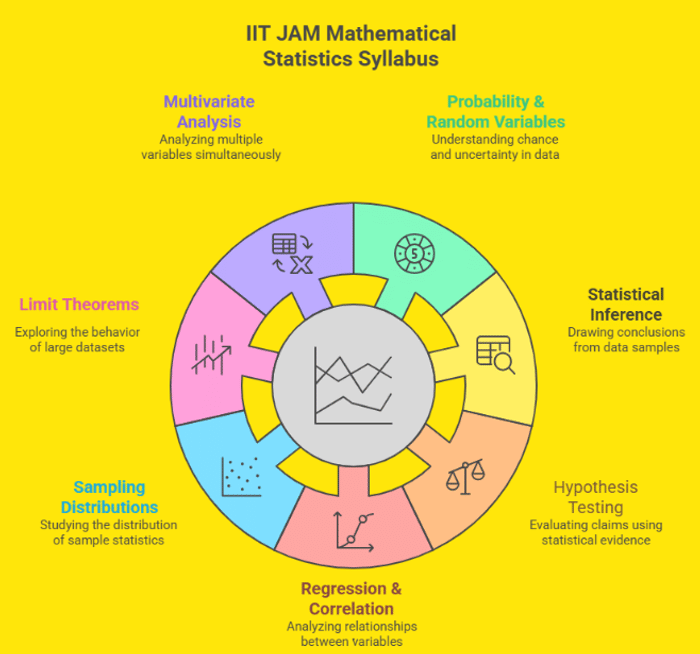
| Mathematical Statistics | Probability & Random Variables, Statistical Inference, Hypothesis Testing, Regression & Correlation, Sampling Distributions, Limit Theorems, Multivariate Analysis |
Also Read-
IIT JAM 2026 Chemistry Syllabus
The IIT JAM Syllabus 2026 for Chemistry Syllabus is quite vast as it contains three subjects which are Physical Chemistry, Organic Chemistry, and Inorganic Chemistry. The detailed IIT JAM Chemistry Syllabus has been discussed below.
Physical Chemistry
| Topics | Sub-Topics |
|---|---|
| Atomic & Molecular Structure | Fundamental particles, Bohr’s theory of hydrogen-like atom, wave-particle duality, uncertainty principle, Schrodinger’s wave equation, quantum numbers, shapes of orbits, Hund’s rule and Pauli’s exclusion principle, electronic configuration of simple homonuclear diatomic molecules |
| Adsorption | Gibbs adsorption, isotherm adsorption, types of adsorptions, surface area of adsorptions, surface films on liquids |
| Basic Mathematical Concepts | Functions, maxima and minima, integrals, ordinary differential equations, vectors and matrices, determinants, elementary statistics & probability theory |
| Chemical and Phase Equilibria | Law of mass action, Kp, Kc, Kx, and Kn, effect of temperature on K, iconic equilibria in solutions, pH & buffer solutions, hydrolysis, solubility product, phase equilibria-phase rule and its application to one-component and two-component systems, colligative properties |
| Chemical Kinetics | Reactions of various order, Arrhenius equation, collision theory, transition state theory, chain – normal & branched, enzyme kinetics, photochemical processes, catalysis |
| Chemical Thermodynamics | Reversible & irreversible processes, first law & its application to ideal & nonideal gases, thermochemistry, second law, entropy & free energy, criteria for spontaneity |
| Electrochemistry | Conductance & its applications, transport number, galvanic cells, EMF & free energy, concentration cells with and without transport, polarography, concentration cells with and without transport, Debye-Huckel-Onsagar theory of strong electrolytes |
| Spectroscopy | Beer-Lambert law, fundamental concepts of rotational, vibrational, electronic & magnetic resonance spectroscopy |
| Solid State | Crystals & crystal system, X-rays. NaCl and KCl structure, close packing, atomic, radii, radius ratio rules, lattice energy, Born-Haber cycle, isomorphism, the heat capacity of solids |
| Theory of Gases | Equation of state for ideal & non-ideal gasses, Kinetic theory of gasses, Maxwell-Boltzmann distribution law, equipartition of energy |
Organic Chemistry
| Topics | Sub-Topics |
|---|---|
| Basic Concepts of Organic Chemistry & Stereochemistry | Electronic effects (resonance, inductive, hyperconjugation) and steric effects and its applications (acids or base property); optical isomerism in compounds with and without any stereocenters- allenes, biphenyls; conformation of acyclic systems- mono- and di-substituted ethane/n-propane/n-butane and cyclic systems- mono-and di-substituted cyclohexanes |
| Organic Reaction Mechanism and Synthetic Applications | Chemistry of reactive intermediates- carbocations, carbanions, free radicals, carbenes, nitrenes, benzynes, etc; Hofmann-Cirtius-Lossen rearrangement, Wolff rearrangement, Simmons-Smith reaction, Wittig reaction, Reimer-Tiemann reaction, Michael reaction, Darzens reaction, McMurry reaction; Pinacol-pinacolone, Favorskii, benzylic acid rearrangement, dienone-phenol rearrangement, Baeyer-Villeger reaction; oxidation and reduction reactions, in organic chemistry; organometallic reagents in organic synthesis-Grignard, organolithium and organocopper; Diels-Alder, electrocyclic and sigmatropic reactions; functional group interconversions and structural problems using chemical reactions |
| Chemistry of alkaloids, steroids, terpenes, carbohydrates, amino acids, peptides, & nucleic acids | – |
| Natural Products Chemistry | Aromatic & Heterocyclic Chemistry- Monocyclic, bicyclic, & tricyclic aromatic hydrocarbons and monocyclic compounds with one hetero atom- synthesis, reactivity & properties |
| Qualitative Organic Analysis | Identification of functional groups by chemical tests; elementary UV, IR, and 1H NMR spectroscopic techniques as tools for structural elucidation |
Inorganic Chemistry
| Topics | Sub-Topics |
|---|---|
| ChemicalBonding & Shapes of Compounds | Types of bonding, VSEPR theory & shapes of molecules, hybridization, dipole moment, iconic solids, structure of NaCl, CsCl, diamond and graphite, lattice energy |
| Main Group Elements | General concepts on group relationships and graduation in properties, structure of electron-deficient compounds involving main group elements |
| Transition Metals (d block) | Characteristics of 3D elements, oxide, hydroxide and salts of first row metals, coordination complexes, structure, isomerism, reaction mechanism, and electronic spectra, VB, MO and Crystal field theoretical approaches for structure, color and magnetic properties of metal complexes, organometallic compounds having ligands with back bonding capabilities such as metal carbonyls, carbenes, nitrosyls and metallocenes, homogenous catalysis |
| Periodic table | Periodic classification of elements and periodicity in properties, general methods of isolation and purification of elements |
| Bioinorganic Chemistry | Essentials and trace elements of life, basic reactions in the biological systems and the role of metal ions mainly Fe2+, Fe3+, Cu2+ and Zn2, structure and function of hemoglobin and myoglobin and carbonic anhydrase |
| Instrumental Methods of Analysis | Basic principles, instrumentals and analysis, acids applications of conductometry, potentiometry, and UV-vis spectrophotometry, analysis of water, air and solids samples |
| Analytical Chemistry | Principal of qualitative, and quantitative analysis, acid-base, oxidation-reduction and complexometric titrations using EDTA, precipitation reactions, use of indicators, use of organic reagents in inorganic analysis, radioactivity, nuclear, reactions, applications of isotopes |
IIT JAM 2026 Mathematics Syllabus
The below table mentions important topics of IIT JAM Mathematics Syllabus:
| Sequences and Series of Real Numbers | Real Analysis |
|---|---|
| Series of real numbers, absolute convergence, tests of convergence for series of positive terms | Rank and inverse of a matrix |
| Functions of Two or Three Real Variables | Linear Algebra |
| Integral Calculus | Group Theory |
| Double and triple integrals | Vector Calculus |
| Differential Equations | -- |
Also Read: IIT JAM Exam Centres
IIT JAM 2026 Syllabus Biotechnology
IIT JAM Biotechnology Syllabus 2026 includes three subjects Maths, Physics, and Biology. The detailed IIT JAM Syllabus for Biotechnology has been discussed below:
Biology
| General Biology | Biochemistry & Physiology |
|---|---|
| Basic Biotechnology | Molecular Biology |
| Cell Biology | Microbiology |
Mathematics
| Binomial Theorem | Exponential and Logarithmic Series | Mathematical Logic |
|---|---|---|
| Statistics | Three Dimensional Geometry | Vectors |
| Matrices and Determinants | Boolean Algebra | Probability |
| Functions | limits and Continuity | Differentiation |
| Application of Derivatives | Definite and Indefinite Integrals | Differential Equations |
| Sets, Relations, and Functions | Mathematical Induction | Logarithms |
| Complex numbers | Linear and Quadratic equations | Sequences and Series |
| Trigonometry | Cartesian System of Rectangular Coordinates | Straight Lines and Family |
| Circles | Conic Sections | Permutations and Combinations |
Physics
| Electromagnetic Induction and Alternating Current | Electromagnetic waves | Optics |
|---|---|---|
| Dual Nature of Matter and Radiations | Atomic Nucleus | Solids and Semiconductor Devices |
| Principles of Communication | Motion of System of Particles and Rigid Body | Gravitation |
| Mechanics of Solids and Fluids | Heat and Thermodynamics | Oscillations, Waves |
| Physical World and Measurement | Elementary Statics and Dynamics | Kinematics |
| Laws of Motion | Work | Energy and Power |
| Electrostatics | Current electricity | Magnetic Effects of Current and Magnetism |
IIT JAM 2026 Syllabus Economy
The IIT JAM Syllabus 2026 for Economy Syllabus is quite vast and the students need to learn various topics of different parts for the exam. The detailed IIT JAM Economics Syllabus has been discussed below:
Macroeconomics
| Topics | Sub-Topics |
|---|---|
| Behavioural and Technological functions | Consumption functions- absolute income hypothesis, life-cycle and permanent income hypothesis, random walk model of consumption, investment functions- Keynesian, money, demand and supply functions, production function |
| Business cycles and economic models (closed economy) | Business cycles-facts and features, the classical model of the business cycle, the Keynesian model of the business cycle, simple Keynesian cross model of income and employment determination and the multiplier, IS-LM Model, Hicks’ IS-LM synthesis, role of monetary and fiscal policies |
| Business cycles and economic models (open economy) | Open economy, Mundell-Fleming model, Keynesian flexible price model, role of monetary and fiscal policies |
| Natural Income accounting | Structure, key concepts, measurements and circular flow of income- for closed and open economy, money, fiscal and foreign sector variables- concepts and measurements |
Statistics for Economics
| Topics | Sub-Topics |
|---|---|
| Probability theory | Sample space and events, axioms of probability and their properties, conditional probability and Bayes’ rule, independent events, random variables and probability distributions, expectation, variance and higher order moments, functions of random variables, properties of commonly used discrete and continuous distributions, density and distribution functions for jointly distributed random variables, mean and variance of jointly distributed random variables, covariance and correlation coefficients |
| Mathematical Statistics | Random sampling, types of sampling, point and interval estimation, estimation of population parameters using methods of moments and maximum likelihood procedures, properties of estimators, sampling distribution, confidence intervals, central limit theorem, law of large numbers |
Mathematics For Economics
| Topics | Sub-Topics |
|---|---|
| Differential calculus | Limits, continuity and differentiability, mean value theorems, Taylor’s theorem, partial differentiation, gradient, chain rule, second and higher order derivatives- properties & applications, implicit function theorem, and application to comparative statics problems, homogeneous and homothetic functions- characteristics & applications |
| Integral calculus | Definite integrals, fundamental theorems, indefinite integrals, and applications |
| Preliminaries and functions | Set theory and number theory, elementary functions- quadratic, polynomial, power, exponential, logarithmic, functions of several variables, graphs & level curves, convex set, concavity & quasiconcavity of function, convexity & quasi-convexity of functions, sequences & series- convergence, algebraic properties and applications, complex numbers & its geometrical representation, De Moivre’s theorem and its application |
Indian Economy
| Topics | Sub-Topics |
|---|---|
| Indian Economy before 1950 | Transfer of tribute, deindustrialization of India, Planning and Indian development- planning models, relation between agricultural, and industrial growth, challenges faced by Indian planning, Indian economy after 1991- Balance of payments crisis in 1991, major aspects of economic reforms in India after 1991, reforms in trade and foreign investments |
| Banking, finance, and macroeconomic policies | Aspects of Banking in India, CRR and SLR, financial sector reforms in India, fiscal and monetary policy, savings and investments rates in India, Inequalities in social development- India’s achievements in health, education and other social sectors, disparities between Indian States in Human Development, Poverty- Methodology of poverty estimations, issues in poverty estimation in India, India’s labor market- unemployment, labor force participation rates |
IIT JAM 2026 Syllabus Geology
The complete IIT JAM Geology syllabus 2026 is mentioned below:
| Topics | Topics |
|---|---|
| Structural Geology | Applied Geology |
| Petrology | The Planet Earth |
| Economic Geology | Stratigraphy |
| Paleontology | Mineralogy |
Also Check -
IIT JAM 2026 Physics Syllabus
For the IIT JAM Physics Syllabus 2026 candidates need to learn the following topics:
| Oscillations | Mechanics & General Properties of Matter |
| Waves & Optics | Electricity & Magnetism |
| Kinetic Theory | Thermodynamics |
IIT JAM 2026 Mathematical Statistics Syllabus
In the IIT JAM syllabus of Mathematical Statistics is divided into two parts mathematics and statistics. The IIT JAM Mathematical Statistics Syllabus is mentioned in the table below:
| Mathematics Syllabus | |
|---|---|
| Matrices | Sequences & Series |
| Integral Calculus | Differential Calculus |
| Statistics Syllabus | |
| Standard Distributions | Probability |
| Estimation | Joint Distributions |
| Testing of Hypotheses | Sampling Distributions and Limit Theorems |
| Random Variables | — |
IIT JAM 2026 Topic Wise Weightage
Here’s a breakdown of the important topics and their approximate weightage for each IIT JAM subject, so you know exactly where to put your effort for the best results.
| Subject | High-Weightage Topics | Approx. Weightage (%) |
|---|---|---|
| Biotechnology (BT) | Biology (Molecular biology, Genetics, Cell biology) | 44% |
| Chemistry (General chemistry applied to biology) | 20% | |
| Mathematics (Statistics & calculations) | 18% | |
| Physics (Optics, Thermodynamics, Mechanics) | 18% |
| Subject | High-Weightage Topics | Approx. Weightage (%) |
|---|---|---|
| Chemistry (CY) | Organic Chemistry (Reactions, Mechanisms, Stereochemistry) | 30–40% |
| Inorganic Chemistry (Periodic table, Transition metals, Coordination compounds) | 25–30% | |
| Physical Chemistry (Thermodynamics, Kinetics, Phase equilibria, Spectroscopy) | 30–35% |
| Subject | High-Weightage Topics | Approx. Weightage (%) |
|---|---|---|
| Physics (PH) | Modern Physics (Quantum, Atomic, Nuclear) | 20–22% |
| Mathematical Methods / Physics Math | 12–15% | |
| Thermodynamics & Kinetic Theory | 14% | |
| Electricity & Magnetism | 12% | |
| Solid State & Electronics | 8–10% | |
| Waves, Optics, Oscillations | 10% | |
| Mechanics (General) | 10–15% |
| Subject | High-Weightage Topics | Approx. Weightage (%) |
|---|---|---|
| Mathematics (MA) | Differential Calculus (Single Variable) | 20–25% |
| Linear Algebra | 13% | |
| Sequences & Series | 12% | |
| Differential Equations | 12% | |
| Integral Calculus | 10–12% | |
| Vector Calculus | 10% |
| Subject | High-Weightage Topics | Approx. Weightage (%) |
|---|---|---|
| Mathematical Statistics (MS) | Random Variables | 18–20% |
| Estimation | 14–15% | |
| Differential Calculus Topics | 12–13% | |
| Matrices, Series, Miscellaneous | 10–12% each |
| Subject | High-Weightage Topics | Approx. Weightage (%) |
|---|---|---|
| Geology (GG) | Petrology | 25% |
| Mineralogy | 20% | |
| Structural Geology | 18% | |
| Planet Earth / Earth Structure | 15–20% | |
| Paleontology | 9–10% | |
| Sedimentology, Stratigraphy, Applied Geology | 10–15% combined |
| Subject | High-Weightage Topics | Approx. Weightage (%) |
|---|---|---|
| Economics (EN) | Microeconomics, Macroeconomics, Statistics & Maths for Economics | N/A (Quantitative topics carry higher marks) |
How to Prepare Effectively for IIT JAM 2026 Syllabus
- Begin by getting a clear grasp of the syllabus so you know exactly what areas need your attention.
- Gather the right books and study materials that thoroughly cover your subjects.
- Stick to a well structured study plan to stay organized and make steady progress.
- Focus on truly understanding the concepts rather than just memorizing them.
- Practice regularly with problem-solving exercises and past years’ papers to boost your confidence.
- Keep revising using quick notes and diagrams to reinforce what you’ve learned.
- Manage your time smartly, both while studying and during the exam.
- Most importantly, take care of your health, stay motivated, and trust in your abilities.
Frequently Asked Questions
Ques. What is the syllabus for IIT JAM 2026?
Ans. The IIT JAM syllabus 2026 is based on the subjects you’ve already studied at the undergraduate level, whether it’s Physics, Chemistry, Mathematics, Biotechnology, Geology, Economics, or Mathematical Statistics. The exam isn’t just about memorizing facts—it’s designed to test how well you understand the core concepts and how confidently you can apply them to solve problems. For the full, detailed syllabus, it’s best to check the official IIT JAM website.
Ques. How many attempts for IIT JAM 2026?
Ans. You can take the IIT JAM 2026 as many times as you want, there’s no restriction on attempts. Just make sure you meet the age and educational eligibility requirements each time you appear.
Ques. Is IIT JAM 2026 MCQ based?
Ans. Yes, the exam includes MCQs (Multiple Choice Questions), along with MSQs (Multiple Select Questions) and NATs (Numerical Answer Type questions). Only MCQs carry negative marking, while MSQs and NATs are penalty free.
Ques. Are there any cross topic areas in IIT JAM 2026 I should focus on?
Ans. Definitely! Some topics appear in more than one subject, for example, calculus plays a big role in both Physics and Economics, while probability and statistics pop up in Economics, Biotechnology, and Mathematical Statistics. Paying extra attention to these overlapping areas can save you time and make your preparation much more efficient.
*The article might have information for the previous academic years, please refer the official website of the exam.
Ask your question
Answered Questions
Hi Bina! You cannot use your JEE Mains 2024 score to get admission in the academic year 2025-2026. The validity of JEE Mains score is for one year only.
The eligibility criteria for admission to KNRUHS courses such as MBBS, MD, MS, etc. are based on merit. For admission in undergraduate courses like BDS, BHMS, BUMS, B.A.M.S., and BNYS, National Eligibility cum Entrance test (NEET-UG) scores are considered. The post-graduate level courses like MS/ MD/ PG Diploma/ MPH, and NEET-PG scores are considered for admission. Other than this, admission in Kaloji Narayana Rao University’s courses like M.H.M.S, M.U.M.S, AND M.A.M.S, is done based on AIAPGET score. Bachelor’s degree is considered only for admission to M.Sc. and MPT in KNRUHS. For super Specialty courses like M.CH and DM or Doctorate of Medicine program, the admission is done based on NEET-SS( Super Speciality Courses ) score.
The colleges affiliated with VTU are required to submit the list of admitted students for various courses within a due period along with necessary documents and prescribed fees. The admissions made by the college can be Cancelled / Disapproved by the University if found not eligible for any valid reasons.
No, Jadavpur University (JU) only accepts admission through entrance exams, such as WBJEE, NATA, GATE, WB JECA, and GPAT. JU does not accept JEE Main scores for admission in its engineering courses.
Jadavpur University is a state university in West Bengal. Admission is done through WBJEE, the West Bengal Joint Entrance Examination Board. The university also accepts other entrance exams, including:
CAT, MAT, XAT, JEMAT, ATMA, GATE.
Upcoming exams

Indian Institute of Science - [IISc]
Bangalore, KarnatakaIIT Madras - Indian Institute of Technology - [IITM]
Chennai, Tamil NaduIIT Kharagpur - Indian Institute of Technology - [IITKGP]
Kharagpur, West BengalIndian Institute of Technology - [IITD]
New Delhi, Delhi NCRIIT Kanpur - Indian Institute of Technology - [IITK]
Kanpur, Uttar Pradesh


