
IIT JAM 2025 Biotechnology Question Paper (Available)- Question Paper with Solution PDF


| Updated On - Sep 10, 2025
The IIT JAM 2025 Shift 2 was conducted on February 2, 2025 from 2:30pm to 5:30pm for Biotechnology, Physics, Economics and Mathematical Statistics.The Biotechnology question paper with solutions PDF is available to download here.
| IIT JAM 2025 Biotechnology Question Paper with Answer Key | Download PDF | Solution PDF |

IIT JAM 2025 Biotechnology Questions with Solutions
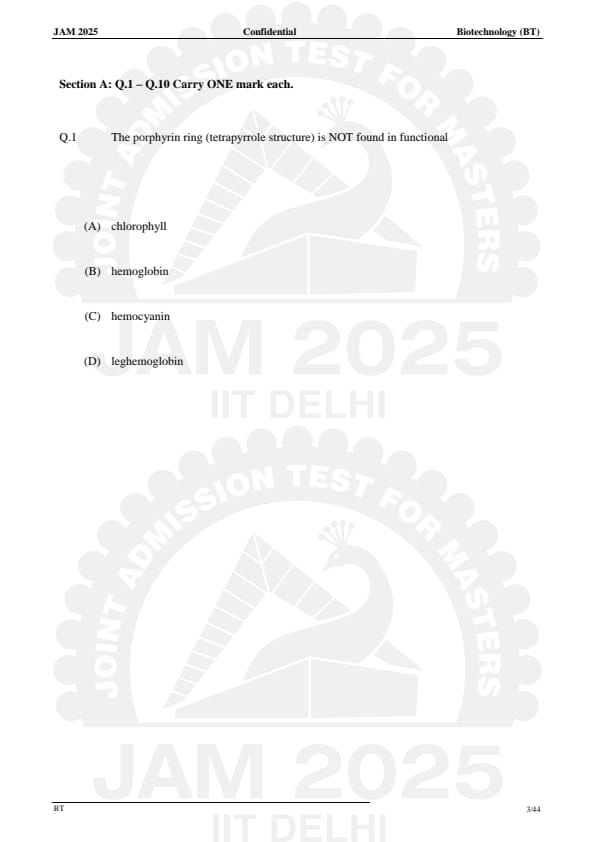
The porphyrin ring (tetrapyrrole structure) is NOT found in functional
View Solution
Step 1: Understanding porphyrin ring (tetrapyrrole).
A porphyrin ring is a cyclic tetrapyrrole structure that binds metal ions (like Fe or Mg) at its center. This structure is critical for many biological pigments and proteins.
Step 2: Evaluate each option.
- Option (A) Chlorophyll: Contains a porphyrin ring with central Mg\(^{2+}\), crucial for photosynthesis.
- Option (B) Hemoglobin: Contains heme, a porphyrin ring with central Fe\(^{2+}\), essential for oxygen transport.
- Option (C) Hemocyanin: Found in mollusks and arthropods; uses Cu ions bound to histidine residues. It does not contain a porphyrin ring.
- Option (D) Leghemoglobin: Similar to hemoglobin, contains a heme group (iron–porphyrin complex).
Step 3: Conclusion.
Among the given options, only hemocyanin does not contain a porphyrin ring.
Final Answer: \[ \boxed{Hemocyanin is the protein that lacks a porphyrin (tetrapyrrole) ring.} \] Quick Tip: Porphyrin-based structures include chlorophyll (Mg-porphyrin) and hemoproteins like hemoglobin and leghemoglobin (Fe-porphyrin). Hemocyanin is unique—it uses Cu without porphyrin.
If
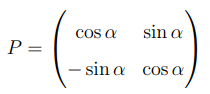
and \(P + P^T = I\), the value of \(\alpha \; (0 \leq \alpha \leq \pi/2)\) is
View Solution
Step 1: Write down \(P^T\).
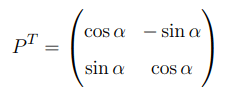
Step 2: Compute \(P + P^T\).

Step 3: Condition given.
We want

Thus, \[ 2\cos\alpha = 1 \quad \Rightarrow \quad \cos\alpha = \frac{1}{2} \]
Step 4: Solve for \(\alpha\).
\[ \alpha = \cos^{-1}\left(\frac{1}{2}\right) = \frac{\pi}{3} \]
Final Answer: \[ \boxed{\alpha = \dfrac{\pi}{3}} \] Quick Tip: For such matrix problems, use the property \(P + P^T\) often leads to a diagonal form when the off-diagonal terms cancel.
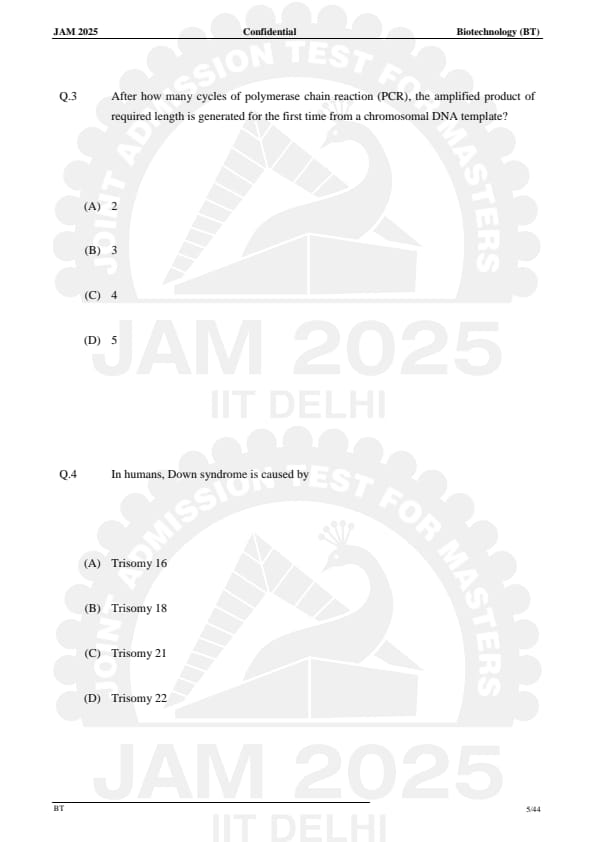
After how many cycles of polymerase chain reaction (PCR), the amplified product of required length is generated for the first time from a chromosomal DNA template?
View Solution
Step 1: Understand PCR mechanism.
PCR consists of three steps: denaturation, annealing, and extension. In the initial cycles, the DNA products are longer than the desired target.
Step 2: Cycle analysis.
- Cycle 1: Produces fragments longer than the target sequence (overhangs remain).
- Cycle 2: Still produces long DNA strands with one end defined.
- Cycle 3: For the first time, double-stranded DNA molecules of the exact required length are generated.
Step 3: Conclusion.
Thus, the required-length product first appears after 3 cycles.
Final Answer: \[ \boxed{After 3 cycles of PCR, the required-length product appears for the first time.} \] Quick Tip: In PCR, the exponential amplification of target-sized fragments begins from the 3rd cycle onward.
In humans, Down syndrome is caused by
View Solution
Step 1: Definition.
Down syndrome is a genetic disorder caused by an extra copy of chromosome 21 (also called trisomy 21).
Step 2: Exclude other options.
- Option (A) Trisomy 16: Causes miscarriage, not Down syndrome.
- Option (B) Trisomy 18: Causes Edwards syndrome.
- Option (C) Trisomy 21: Correct – leads to Down syndrome.
- Option (D) Trisomy 22: Causes severe abnormalities but not Down syndrome.
Step 3: Clinical features.
Common features of Down syndrome include intellectual disability, characteristic facial features, and congenital heart defects.
Final Answer: \[ \boxed{Down syndrome is caused by Trisomy 21.} \] Quick Tip: Remember: Down syndrome = Trisomy 21, Edwards syndrome = Trisomy 18, Patau syndrome = Trisomy 13.
Which one of the following hormones is produced by the adrenal gland?
View Solution
Step 1: Recall adrenal gland hormones.
The adrenal glands consist of two parts: adrenal cortex and adrenal medulla.
- The adrenal cortex secretes cortisol, aldosterone, and androgens.
- The adrenal medulla secretes adrenaline and noradrenaline.
Step 2: Evaluate options.
- Thyroxine: Produced by the thyroid gland, not adrenal.
- Cortisol: A glucocorticoid hormone secreted by the adrenal cortex. Correct.
- Insulin: Produced by the pancreas (beta cells).
- Melatonin: Produced by the pineal gland.
Step 3: Conclusion.
Hence, cortisol is the hormone secreted by the adrenal gland.
Final Answer: \[ \boxed{Cortisol is produced by the adrenal gland.} \] Quick Tip: Adrenal cortex → Cortisol, Aldosterone; Adrenal medulla → Adrenaline, Noradrenaline.
What is the ploidy level of a sporophyte in angiosperms?
View Solution
Step 1: Recall alternation of generations.
In plants, life cycles alternate between:
- Gametophyte (n): haploid, produces gametes.
- Sporophyte (2n): diploid, develops after fertilization and produces spores via meiosis.
Step 2: Apply to angiosperms.
In angiosperms, the zygote (2n) divides mitotically to form the sporophyte, which is diploid (2n).
Step 3: Conclusion.
The ploidy of a sporophyte in angiosperms is diploid (2n).
Final Answer: \[ \boxed{Sporophyte in angiosperms is diploid (2n).} \] Quick Tip: Sporophyte = 2n, Gametophyte = n in alternation of generations.
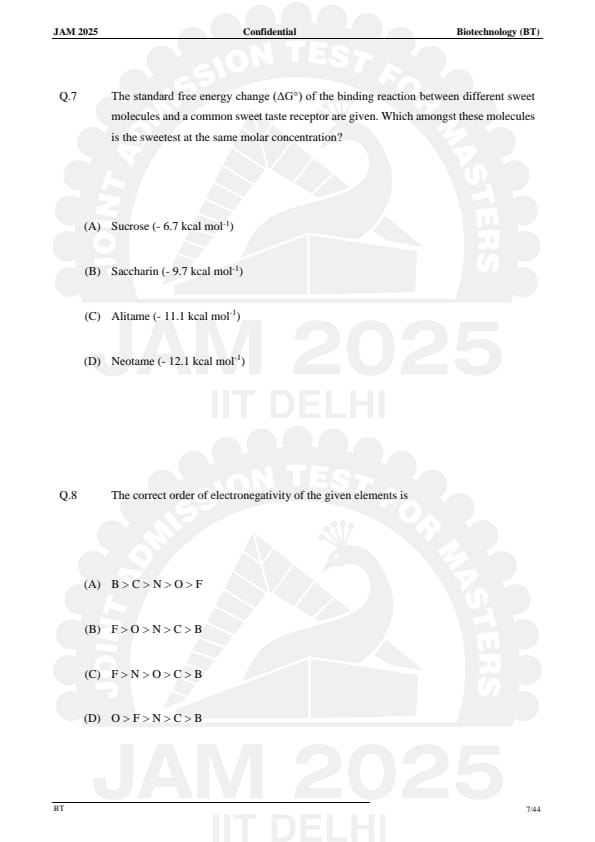
The standard free energy change (\(\Delta G^0\)) of the binding reaction between different sweet molecules and a common sweet taste receptor are given. Which amongst these molecules is the sweetest at the same molar concentration?
View Solution
Step 1: Recall principle.
The sweeter the molecule, the stronger its binding affinity to the sweet receptor. Stronger binding corresponds to more negative \(\Delta G^0\).
Step 2: Compare values.
- Sucrose: -6.7 kcal/mol (least negative).
- Saccharin: -9.7 kcal/mol.
- Alitame: -11.1 kcal/mol.
- Neotame: -12.1 kcal/mol (most negative, strongest binding).
Step 3: Conclusion.
Thus, Neotame is the sweetest molecule at the same molar concentration.
Final Answer: \[ \boxed{Neotame (-12.1 kcal mol^{-1}) is the sweetest.} \] Quick Tip: More negative \(\Delta G^0\) \(\Rightarrow\) higher binding affinity \(\Rightarrow\) sweeter taste.
The correct order of electronegativity of the given elements is
View Solution
Step 1: Recall periodic trend.
Electronegativity increases across a period (left to right) and decreases down a group.
Step 2: Arrange given elements (Period 2).
- B < C < N < O < F
(Fluorine being the most electronegative element).
Step 3: Match with options.
The correct order is F > O > N > C > B, which matches option (B).
Final Answer: \[ \boxed{Electronegativity order is F > O > N > C > B.} \] Quick Tip: Always remember: Fluorine is the most electronegative element in the periodic table.
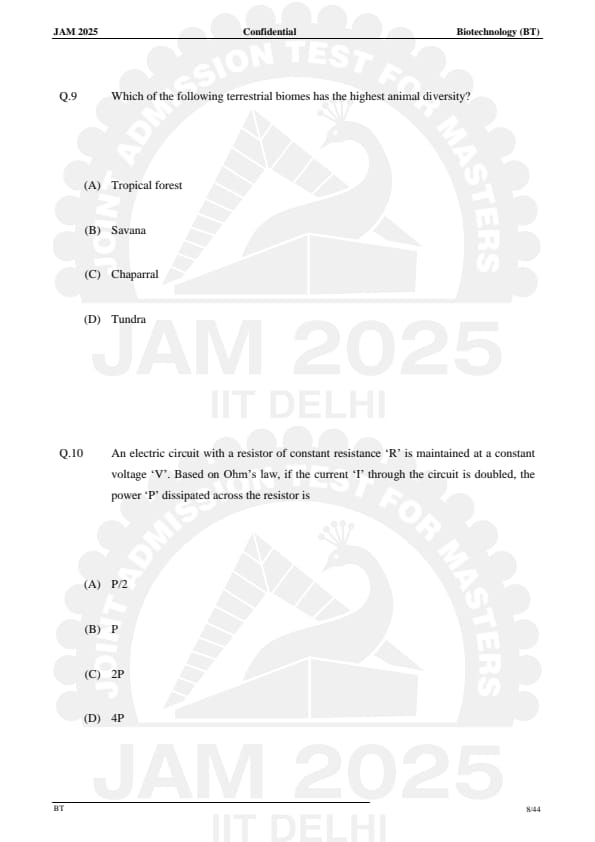
Which of the following terrestrial biomes has the highest animal diversity?
View Solution
Step 1: General knowledge of biomes.
Different terrestrial biomes vary in biodiversity depending on climate, productivity, and habitat complexity.
Step 2: Evaluate each option.
- Tropical forest: Known for being the most species-rich biome. They have warm temperatures, high rainfall, and layered vegetation, supporting maximum biodiversity including insects, birds, mammals, and reptiles.
- Savana: Grass-dominated biome with scattered trees. Animal diversity is lower than tropical forests.
- Chaparral: Found in Mediterranean climates, has shrubs and small mammals, not high in animal diversity.
- Tundra: Harsh cold environment with very limited diversity.
Step 3: Conclusion.
Tropical forests are the most biodiverse terrestrial biome.
Final Answer: \[ \boxed{Tropical forests have the highest animal diversity.} \] Quick Tip: Tropical forests = highest biodiversity; Tundra = lowest biodiversity.
An electric circuit with a resistor of constant resistance ‘R’ is maintained at a constant voltage ‘V’. Based on Ohm’s law, if the current ‘I’ through the circuit is doubled, the power ‘P’ dissipated across the resistor is
View Solution
Step 1: Recall power formula.
\[ P = I^2 R \]
Step 2: Consider doubling the current.
If the current becomes \(2I\), then power becomes: \[ P' = (2I)^2 R = 4I^2R \]
Step 3: Compare with original power.
Original power = \(P = I^2R\).
Thus, \[ P' = 4P \]
Step 4: Clarification about constant voltage.
Since \(V = IR\), doubling \(I\) would imply \(V\) changes. But if \(V\) is held constant externally, then \(I\) cannot double. However, as per the problem statement assumption, when current doubles, the mathematical relation yields \(P' = 4P\).
Final Answer: \[ \boxed{4P} \] Quick Tip: Always remember: Power \(P\) in a resistor is proportional to \(I^2\). Doubling current makes power 4 times.
Sequence comparison of which of the following genes is used as a measure of evolutionary divergence across bacterial species?
View Solution
Step 1: Importance of gene markers.
For bacterial phylogenetic studies, highly conserved genes are required to trace evolutionary relationships across species.
Step 2: Role of 16S rRNA.
The 16S ribosomal RNA (rRNA) gene is universally present in bacteria, highly conserved, and contains both conserved and variable regions.
- Conserved regions help in universal primer design.
- Variable regions allow differentiation among bacterial species.
Step 3: Exclude other options.
- pbpG and slyD are not standard markers for evolutionary divergence.
- 18S rRNA is used in eukaryotes (not bacteria).
Step 4: Conclusion.
Hence, the 16S rRNA gene is the gold standard for measuring bacterial evolutionary divergence.
Final Answer: \[ \boxed{16S rRNA is used for bacterial evolutionary divergence studies.} \] Quick Tip: 16S rRNA → Prokaryotic phylogeny; 18S rRNA → Eukaryotic phylogeny.
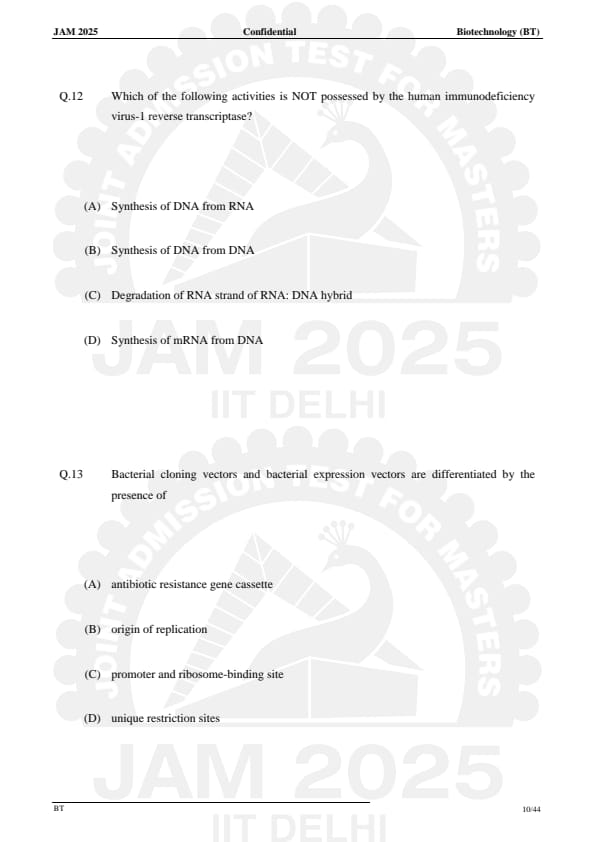
Which of the following activities is NOT possessed by the human immunodeficiency virus-1 reverse transcriptase?
View Solution
Step 1: Recall reverse transcriptase functions.
HIV-1 reverse transcriptase is a multifunctional enzyme with three activities:
1. RNA-dependent DNA polymerase (synthesizes DNA from RNA).
2. DNA-dependent DNA polymerase (synthesizes DNA from DNA).
3. RNase H activity (degrades RNA strand of RNA:DNA hybrid).
Step 2: Check missing activity.
It does not possess the activity of synthesizing mRNA from DNA. That function is carried out by RNA polymerase in cells, not reverse transcriptase.
Final Answer: \[ \boxed{Reverse transcriptase does not synthesize mRNA from DNA.} \] Quick Tip: Reverse transcriptase → DNA from RNA; RNA polymerase → mRNA from DNA.
Bacterial cloning vectors and bacterial expression vectors are differentiated by the presence of
View Solution
Step 1: Cloning vector.
A cloning vector is designed to replicate DNA fragments. It contains an origin of replication, selection markers, and restriction sites, but it does not express the gene product.
Step 2: Expression vector.
An expression vector is specialized for gene expression inside bacteria. It must contain additional regulatory elements such as a strong promoter and ribosome-binding site to allow transcription and translation of the inserted gene.
Step 3: Differentiate.
Thus, the presence of a promoter and ribosome-binding site distinguishes expression vectors from simple cloning vectors.
Final Answer: \[ \boxed{Expression vectors contain promoter and ribosome-binding site.} \] Quick Tip: Cloning vector = replication only; Expression vector = replication + protein expression.
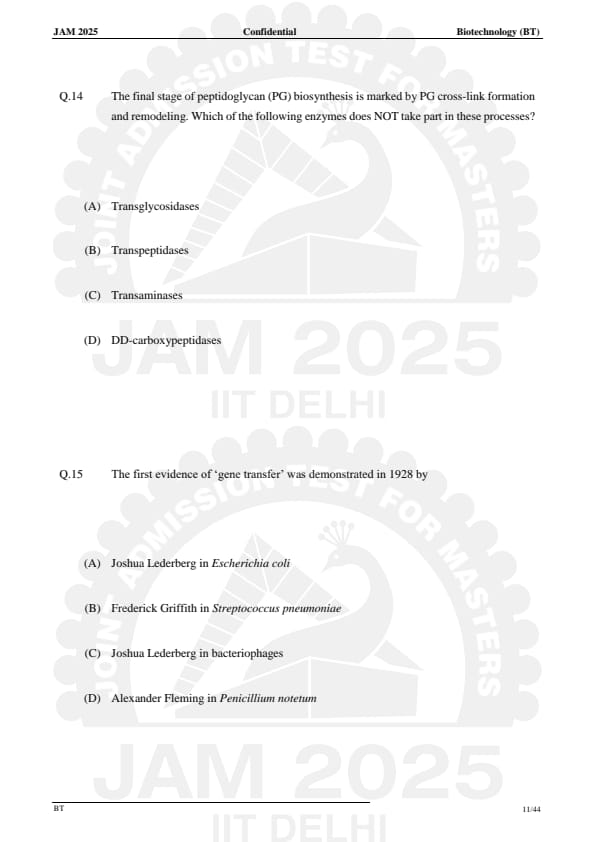
The final stage of peptidoglycan (PG) biosynthesis is marked by PG cross-link formation and remodeling. Which of the following enzymes does NOT take part in these processes?
View Solution
Step 1: Recall peptidoglycan biosynthesis.
- Transglycosidases: Link glycan chains.
- Transpeptidases: Cross-link peptide chains.
- DD-carboxypeptidases: Modify cross-links in PG remodeling.
Step 2: Exclude non-participant.
Transaminases are involved in amino acid metabolism, not in PG cross-linking or remodeling.
Final Answer: \[ \boxed{Transaminases do not participate in peptidoglycan biosynthesis.} \] Quick Tip: Transpeptidases (penicillin-binding proteins) are key targets of β-lactam antibiotics.
The first evidence of ‘gene transfer’ was demonstrated in 1928 by
View Solution
Step 1: Griffith’s experiment (1928).
Griffith performed experiments with virulent (smooth, S-type) and non-virulent (rough, R-type) strains of Streptococcus pneumoniae.
Step 2: Key observation.
When heat-killed S strain was mixed with live R strain, the R strain transformed into a virulent form. This provided the first evidence of “gene transfer” through transformation.
Step 3: Later confirmation.
Avery, MacLeod, and McCarty (1944) later confirmed DNA as the genetic material responsible for this transformation.
Final Answer: \[ \boxed{Frederick Griffith in Streptococcus pneumoniae (1928).} \] Quick Tip: Griffith → Transformation (1928); Avery–MacLeod–McCarty → DNA as genetic material (1944).
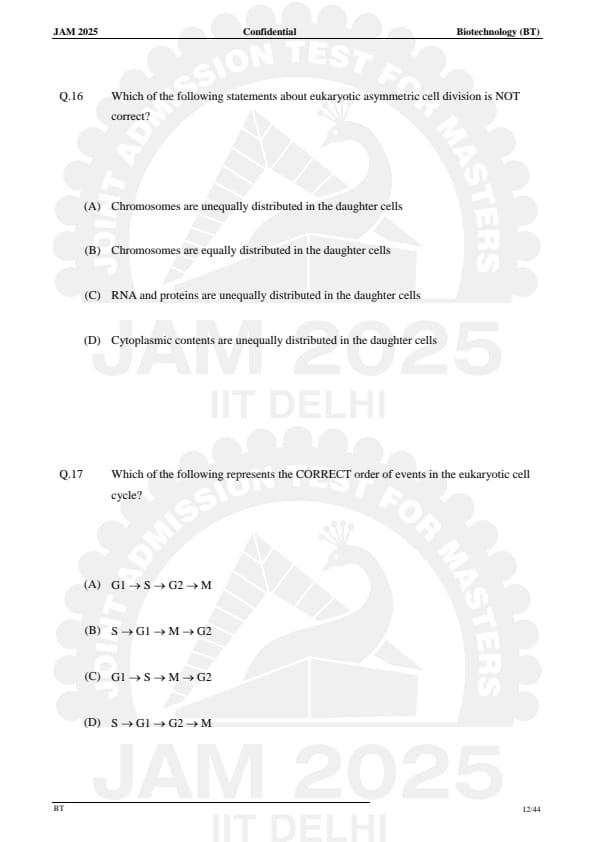
Which of the following statements about eukaryotic asymmetric cell division is NOT correct?
View Solution
Step 1: Define asymmetric cell division.
In asymmetric cell division, daughter cells receive equal genetic material (chromosomes), but they differ in cytoplasmic determinants such as RNA, proteins, and organelles. This leads to functional diversity.
Step 2: Evaluate options.
- (A) Incorrect. Chromosomes are always equally distributed in daughter cells during normal mitosis/meiosis. Unequal distribution would cause aneuploidy, not asymmetry.
- (B) Correct statement. Chromosomes are equally distributed.
- (C) Correct statement. RNA and proteins are unequally distributed.
- (D) Correct statement. Cytoplasmic contents differ between cells.
Final Answer: \[ \boxed{Chromosomes are unequally distributed in the daughter cells (NOT correct).} \] Quick Tip: Asymmetric division = equal chromosomes, unequal cytoplasmic determinants.
Which of the following represents the CORRECT order of events in the eukaryotic cell cycle?
View Solution
Step 1: Recall phases of cell cycle.
- G1 (Gap 1): Cell growth and preparation.
- S (Synthesis): DNA replication occurs.
- G2 (Gap 2): Further growth and preparation for mitosis.
- M (Mitosis): Chromosome segregation and cytokinesis.
Step 2: Compare sequences.
Only option (A) correctly follows the standard cell cycle order.
Final Answer: \[ \boxed{Correct order is G1 → S → G2 → M.} \] Quick Tip: Easy mnemonic: “Grow → Synthesize → Grow again → Mitosis” = G1 → S → G2 → M.
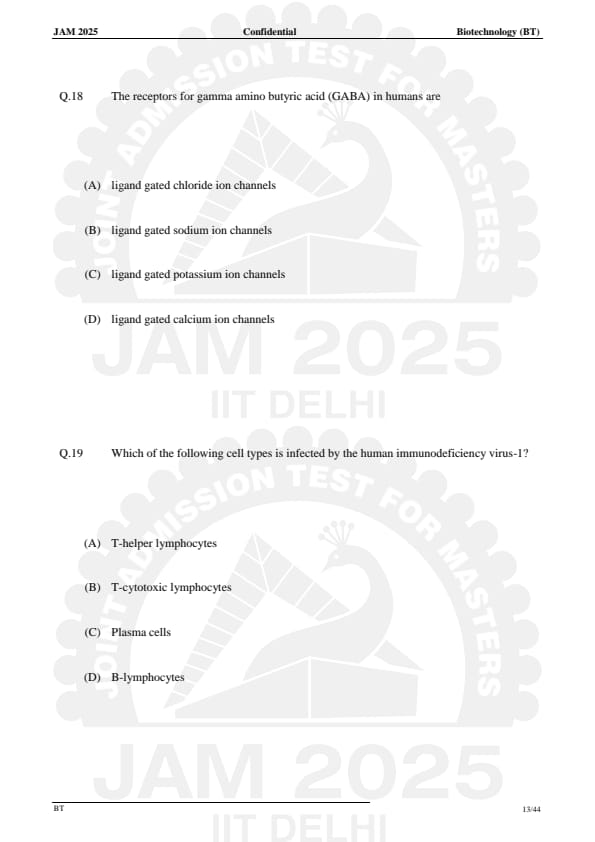
The receptors for gamma amino butyric acid (GABA) in humans are
View Solution
Step 1: Recall GABA receptor types.
- GABA\(_A\) receptors are ionotropic and function as ligand-gated chloride channels.
- GABA\(_B\) receptors are metabotropic (G-protein coupled).
Step 2: Function.
When GABA binds, chloride ions enter the neuron, hyperpolarizing the cell and inhibiting firing.
Step 3: Eliminate wrong options.
Sodium, potassium, and calcium ion channels are not the primary GABA receptor mechanism.
Final Answer: \[ \boxed{GABA receptors are ligand-gated chloride ion channels.} \] Quick Tip: Remember: GABA\(_A\) → chloride channel (fast inhibition); GABA\(_B\) → GPCR (slow inhibition).
Which of the following cell types is infected by the human immunodeficiency virus-1?
View Solution
Step 1: Identify target of HIV-1.
HIV specifically binds to CD4 receptors, which are highly expressed on T-helper lymphocytes (CD4+ cells).
Step 2: Mechanism.
Entry requires CD4 receptor plus co-receptors (CCR5 or CXCR4). The virus destroys T-helper cells, leading to immunodeficiency.
Step 3: Rule out other options.
- Cytotoxic T cells (CD8+) are not directly infected.
- Plasma cells and B-lymphocytes are not the primary targets.
Final Answer: \[ \boxed{HIV infects CD4+ T-helper lymphocytes.} \] Quick Tip: HIV attacks CD4+ T-helper cells → weakens immunity → hallmark of AIDS.
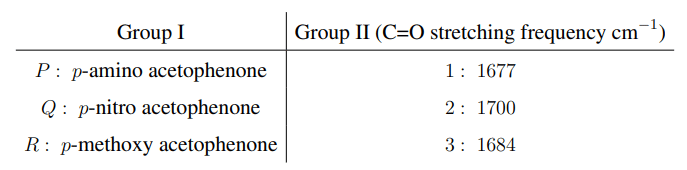
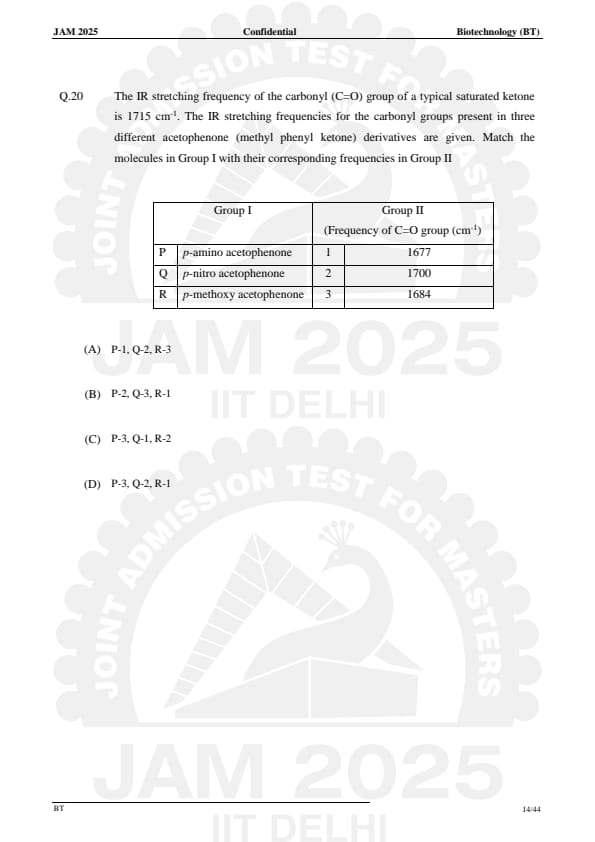
The IR stretching frequency of the carbonyl (C=O) group of a typical saturated ketone is 1715 cm\(^{-1}\). The IR stretching frequencies for the carbonyl groups present in three different acetophenone derivatives are given. Match the molecules in Group I with their corresponding frequencies in Group II.
View Solution
Step 1: Recall substituent effects.
- Electron-donating groups (EDG) decrease the C=O stretching frequency by stabilizing the carbonyl resonance.
- Electron-withdrawing groups (EWG) increase the C=O stretching frequency by reducing resonance stabilization, making the bond stronger.
Step 2: Apply to given groups.
- p-amino (EDG): Strongly donates electrons → lowers frequency → 1677 cm\(^{-1}\).
- p-nitro (EWG): Strongly withdraws electrons → raises frequency → 1700 cm\(^{-1}\).
- p-methoxy (EDG but weaker than amino): Slight lowering effect → 1684 cm\(^{-1}\).
Step 3: Match.
P-1, Q-2, R-3.
Final Answer: \[ \boxed{P-1,\; Q-2,\; R-3} \] Quick Tip: Rule: EDG → lower C=O frequency; EWG → higher C=O frequency.
Two charges \(10 \times 10^{-8}\,C\) and \(-6 \times 10^{-8}\,C\) are located 16 cm apart. The point(s) on the line joining the two charges, where the net electric potential is zero, will be
[Take the potential at infinity to be zero]
View Solution
Step 1: Recall formula.
Potential at a point due to a charge \(q\): \[ V = \frac{kq}{r} \]
Step 2: Define the setup.
- \(q_1 = +10 \times 10^{-8}\,C\), placed at \(x=0\).
- \(q_2 = -6 \times 10^{-8}\,C\), placed at \(x=16\) cm.
We need points where \(V_1 + V_2 = 0\).
Step 3: Between the charges.
At distance \(x\) from \(+q_1\): \[ \frac{10}{x} = \frac{6}{16-x} \] \[ 10(16-x) = 6x \quad \Rightarrow \quad 160 - 10x = 6x \quad \Rightarrow \quad 16x = 160 \quad \Rightarrow \quad x=10\ cm \]
Step 4: Outside the charges (on right side of -q).
At distance \(d\) from \(+q_1\) beyond the negative charge (\(x>16\)): \[ \frac{10}{d} = \frac{6}{d-16} \] \[ 10(d-16) = 6d \quad \Rightarrow \quad 10d - 160 = 6d \quad \Rightarrow \quad 4d = 160 \quad \Rightarrow \quad d = 40\ cm \]
Step 5: Conclusion.
Zero potential points are at 10 cm and 40 cm from the positive charge on the side of the negative charge.
Final Answer: \[ \boxed{10 cm and 40 cm away from the positive charge on the side of the negative charge.} \] Quick Tip: For zero potential points, solve \(\frac{q_1}{r_1} + \frac{q_2}{r_2} = 0\). Both “between” and “outside” regions should be checked.
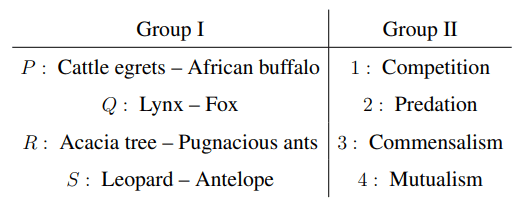
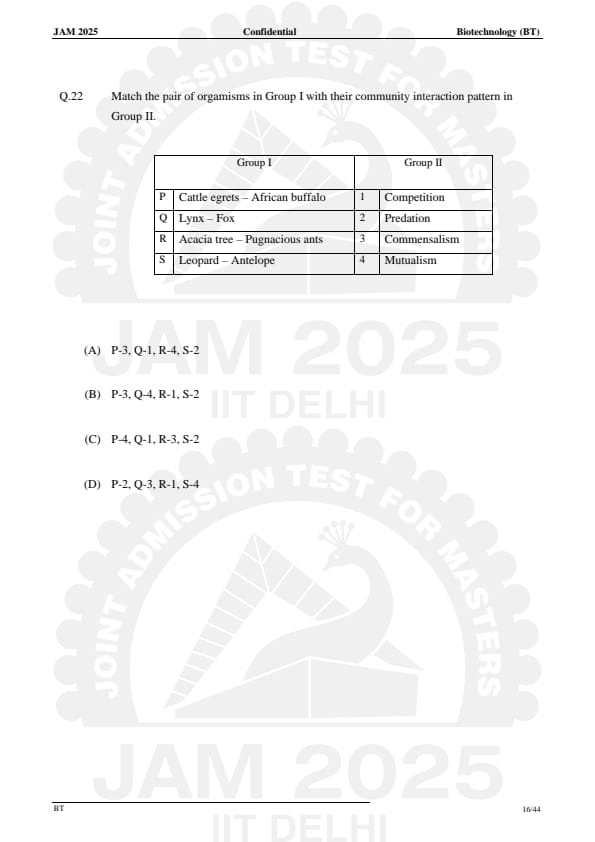
Match the pair of organisms in Group I with their community interaction pattern in Group II.
View Solution
Step 1: Analyze each pair.
- Cattle egrets – African buffalo: Egrets benefit by eating insects stirred by buffalo; buffalo unaffected → Commensalism (3).
- Lynx – Fox: Both are predators competing for similar prey → Competition (1).
- Acacia tree – Pugnacious ants: Ants protect tree from herbivores, tree provides shelter/food → Mutualism (4).
- Leopard – Antelope: Predator-prey relationship → Predation (2).
Step 2: Match.
P-3, Q-1, R-4, S-2.
Final Answer: \[ \boxed{P-3,\; Q-1,\; R-4,\; S-2} \] Quick Tip: Commensalism = one benefits, other neutral; Mutualism = both benefit; Predation = one benefits, one harmed; Competition = both harmed.
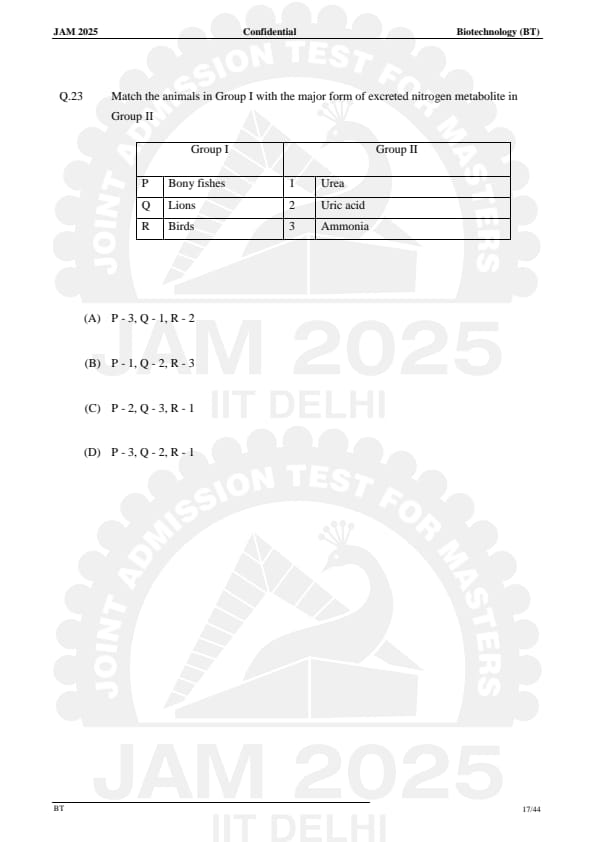
Match the animals in Group I with the major form of excreted nitrogen metabolite in Group II.
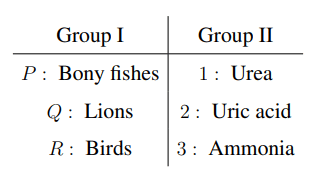
View Solution
Step 1: Recall nitrogenous waste types.
- Ammonotelic animals: Excrete ammonia (aquatic animals like bony fishes).
- Ureotelic animals: Excrete urea (mammals like lions).
- Uricotelic animals: Excrete uric acid (birds and reptiles).
Step 2: Match each.
- Bony fishes → Ammonia (3).
- Lions → Urea (1).
- Birds → Uric acid (2).
Final Answer: \[ \boxed{P-3,\; Q-1,\; R-2} \] Quick Tip: Remember: Fish = ammonia, Mammals = urea, Birds/Reptiles = uric acid.
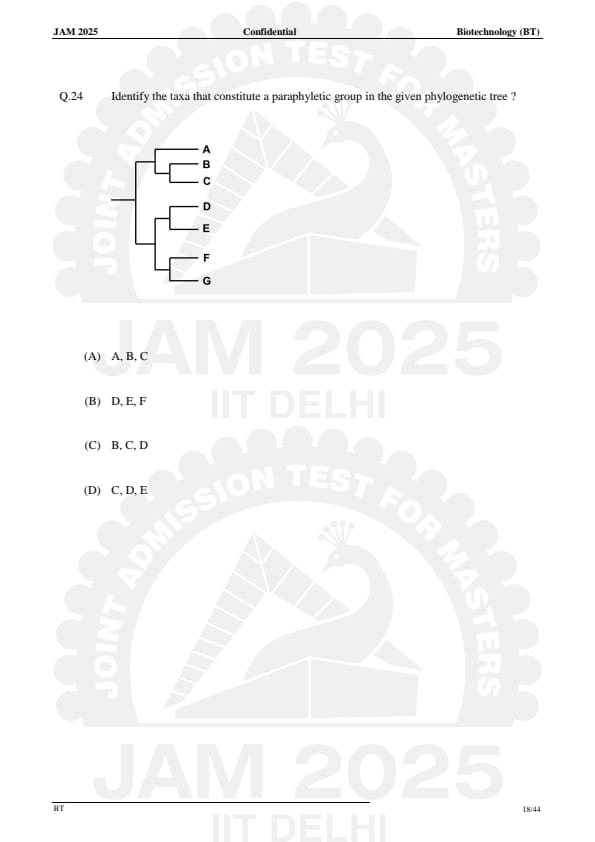
Identify the taxa that constitute a paraphyletic group in the given phylogenetic tree.
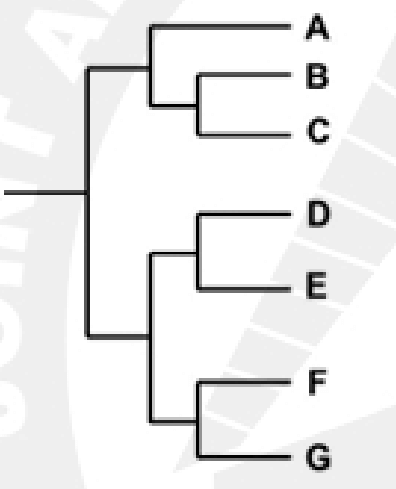
View Solution
Step 1: Recall group definitions.
- Monophyletic group: Includes a common ancestor and all descendants.
- Paraphyletic group: Includes a common ancestor but only some descendants (not all).
- Polyphyletic group: Includes members without their most recent common ancestor.
Step 2: Analyze tree.
- A, B, C: These form a monophyletic group (all descendants included).
- D, E, F: Share a common ancestor, but G (a descendant of the same ancestor) is excluded → Paraphyletic.
- B, C, D: Members from two different clades → polyphyletic.
- C, D, E: Not valid clade grouping.
Step 3: Conclusion.
The paraphyletic group is D, E, F.
Final Answer: \[ \boxed{D, E, F form a paraphyletic group.} \] Quick Tip: Paraphyletic = ancestor + some descendants (excluding at least one).
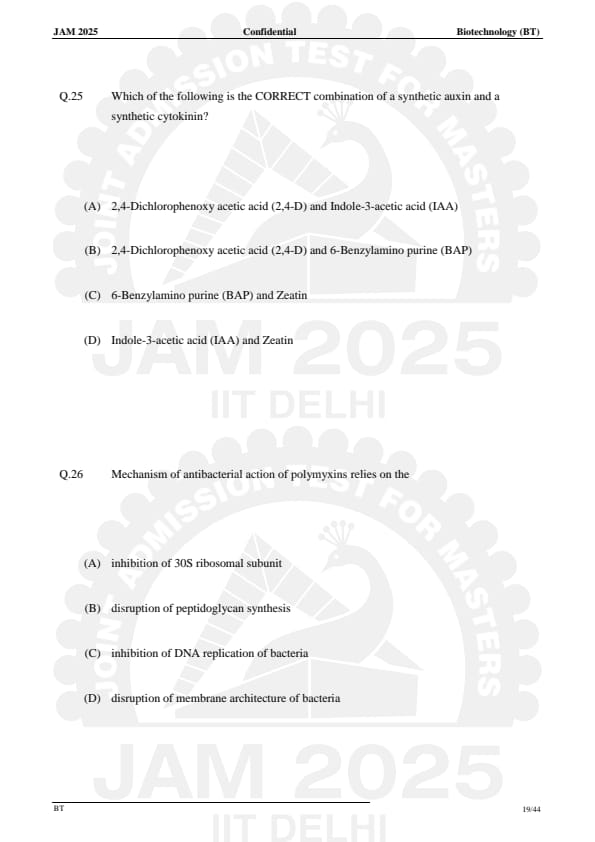
Which of the following is the CORRECT combination of a synthetic auxin and a synthetic cytokinin?
View Solution
Step 1: Recall synthetic hormones.
- Auxins: Natural auxin is Indole-3-acetic acid (IAA). A synthetic auxin is 2,4-D.
- Cytokinins: Natural cytokinin is Zeatin. A synthetic cytokinin is 6-Benzylamino purine (BAP).
Step 2: Evaluate options.
- (A) Wrong: IAA is natural, not synthetic.
- (B) Correct: 2,4-D (synthetic auxin) + BAP (synthetic cytokinin).
- (C) Wrong: Both BAP and Zeatin are cytokinins.
- (D) Wrong: Both IAA and Zeatin are natural hormones.
Step 3: Conclusion.
The correct combination is 2,4-D and BAP.
Final Answer: \[ \boxed{2,4-D (synthetic auxin) and BAP (synthetic cytokinin).} \] Quick Tip: Auxin: IAA (natural), 2,4-D (synthetic). Cytokinin: Zeatin (natural), BAP (synthetic).
Mechanism of antibacterial action of polymyxins relies on the
View Solution
Step 1: Recall polymyxins.
Polymyxins are cationic polypeptide antibiotics that interact with lipopolysaccharides (LPS) of Gram-negative bacterial outer membranes.
Step 2: Mechanism.
- They bind to phospholipids.
- Disrupt membrane permeability.
- Cause leakage of cellular contents and bacterial death.
Step 3: Rule out other mechanisms.
- (A) Inhibition of 30S ribosome: Done by aminoglycosides, tetracyclines.
- (B) Inhibition of peptidoglycan synthesis: Done by β-lactams, vancomycin.
- (C) Inhibition of DNA replication: Done by quinolones.
Final Answer: \[ \boxed{Polymyxins disrupt bacterial membrane architecture.} \] Quick Tip: Remember: Polymyxins = membrane disruptors (esp. Gram-negative).
The 5' cap of eukaryotic mRNAs contains
View Solution
Step 1: Recall the function of the 5' cap.
- The 5' cap is a modified guanine nucleotide added to the 5' end of eukaryotic mRNAs.
- It protects the mRNA from degradation and assists in ribosome binding during translation.
Step 2: Analyze the options.
- (A) Correct: The 5' cap is composed of a modified guanine nucleotide (7-methylguanosine).
- (B) Incorrect: The 5' cap does not contain adenine.
- (C) Incorrect: The 5' cap does not contain cytosine.
- (D) Incorrect: The 5' cap does not contain uracil.
Step 3: Conclusion.
The 5' cap contains a modified guanine nucleotide.
Final Answer: \[ \boxed{The 5' cap contains a modified guanine nucleotide.} \] Quick Tip: Remember: The 5' cap is essential for mRNA stability and translation initiation.
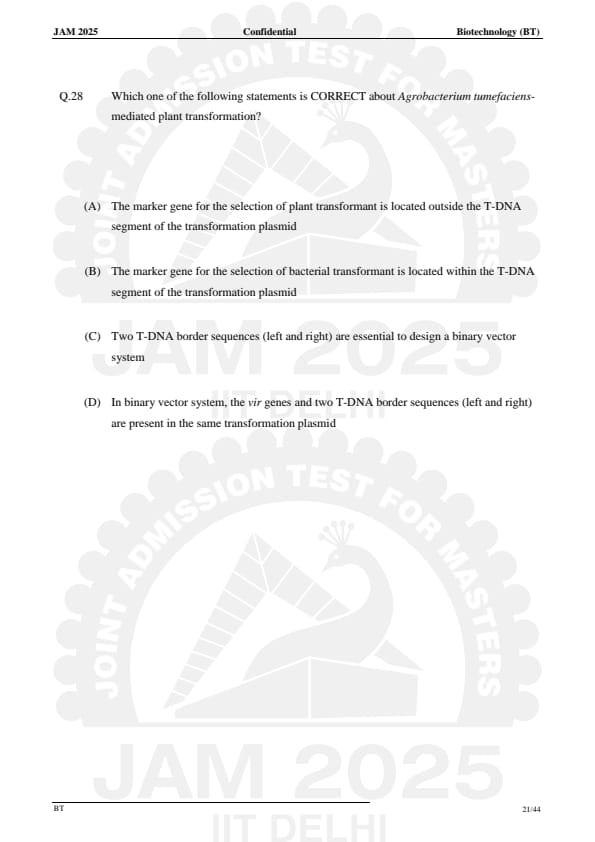
Which one of the following statements is CORRECT about Agrobacterium tumefaciens-mediated plant transformation?
View Solution
Step 1: Analyze the options.
- (A) Incorrect: The marker gene for plant selection is typically within the T-DNA region.
- (B) Incorrect: The marker gene for bacterial transformants is usually located outside the T-DNA region, on the plasmid itself.
- (C) Correct: Two T-DNA border sequences (left and right) are essential for T-DNA insertion into the plant genome in the binary vector system.
- (D) Incorrect: The vir genes and T-DNA border sequences are typically located on separate plasmids in the binary vector system.
Step 2: Conclusion.
The correct statement is that two T-DNA border sequences are essential for binary vector design.
Final Answer: \[ \boxed{Two T-DNA border sequences (left and right) are essential to design a binary vector system.} \] Quick Tip: In Agrobacterium-mediated transformation, the binary vector system separates the vir genes and T-DNA.
Which of the following conditions is CORRECT for free expansion of an ideal gas under adiabatic condition? (q = heat, \(\Delta T = \) temperature difference, w = work)
View Solution
Step 1: Understand free expansion.
In free expansion, the gas expands without doing work on the surroundings and without any heat exchange. This means:
- \( w = 0 \) (no work done by the gas).
- \( q = 0 \) (no heat is transferred).
Step 2: Analyze temperature change.
Since no work is done and no heat is transferred, the internal energy of the ideal gas does not change. For an ideal gas, if the internal energy remains unchanged, the temperature must also remain constant, so \( \Delta T = 0 \).
Step 3: Conclusion.
Thus, the correct conditions for free expansion are:
- \( q = 0 \),
- \( \Delta T = 0 \),
- \( w = 0 \).
Final Answer: \[ \boxed{For free expansion, \( q = 0, \Delta T = 0, w = 0 \).} \] Quick Tip: Free expansion means no heat exchange, no work done, and no change in temperature.
Four alkyl halides, MeBr, EtBr, iPrBr, and tBuBr, undergo S\(_N\)2 reactions in the presence of hydroxide ion to yield the corresponding alcohols and the halide ion. The CORRECT order of the alkyl halides based on the rates of reactions is
View Solution
Step 1: Analyze the S\(_N\)2 reaction mechanism.
The S\(_N\)2 mechanism involves the attack of a nucleophile (OH\(^-\)) on the electrophilic carbon of the alkyl halide. The rate of the reaction depends on the steric hindrance of the alkyl group. Less steric hindrance leads to faster reactions.
Step 2: Analyze the alkyl halides.
- MeBr: Methyl group has the least steric hindrance, so it reacts the fastest.
- EtBr: Ethyl group has slightly more steric hindrance than methyl.
- iPrBr: Isopropyl group has even more steric hindrance.
- tBuBr: Tert-butyl group has the highest steric hindrance, making it the slowest.
Step 3: Conclusion.
The order of reactivity is:
- MeBr > EtBr > iPrBr > tBuBr.
Final Answer: \[ \boxed{MeBr > EtBr > iPrBr > tBuBr.} \] Quick Tip: For S\(_N\)2 reactions, less steric hindrance leads to faster reaction rates.
Which of the following statement(s) is/are CORRECT about Deinococcus radiodurans?
View Solution
Step 1: Analyze the options.
- (A) Correct: Deinococcus radiodurans is known for its unique cell wall structure that includes several layers, and unlike typical Gram-negative bacteria, it lacks lipid A in the outer membrane.
- (B) Incorrect: Deinococcus radiodurans has ornithine in the peptidoglycan structure, but this does not replace diaminopimelic acid in cross-bridges.
- (C) Incorrect: Deinococcus radiodurans is a Gram-positive bacterium with a unique cell wall structure.
- (D) Correct: Deinococcus radiodurans is extremely radiation-resistant and can survive exposures up to 15000 Gy of ionizing radiation.
Step 2: Conclusion.
The correct statements are that Deinococcus radiodurans has a cell wall with several layers and lacks lipid A in its outer membrane, and it can survive extreme ionizing radiation exposure.
Final Answer: \[ \boxed{\textbf{Deinococcus radiodurans has a unique cell wall structure and is highly radiation-resistant.}} \] Quick Tip: \(\textbf{Deinococcus radiodurans}\) is a Gram-positive bacterium with extraordinary resistance to radiation.
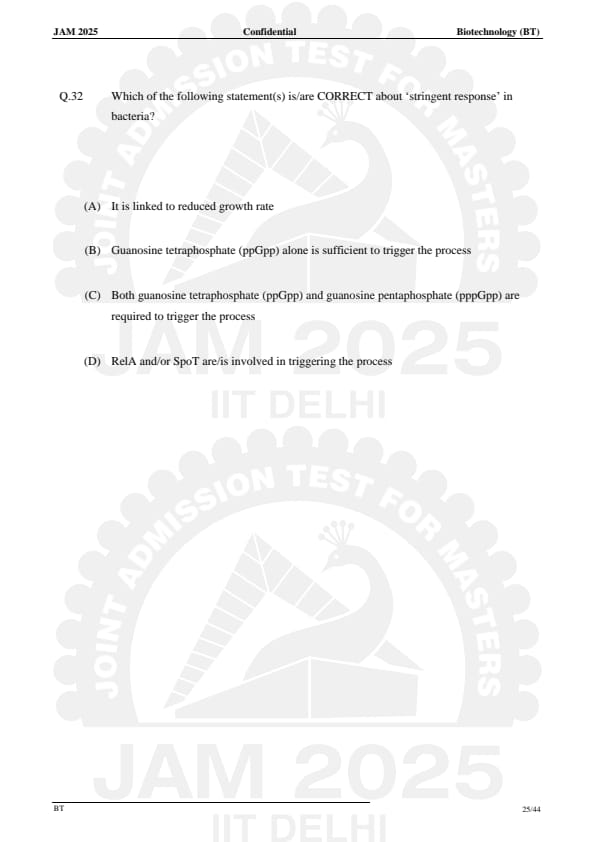
Which of the following statement(s) is/are CORRECT about 'stringent response' in bacteria?
View Solution
Step 1: Understand stringent response.
The stringent response is a bacterial stress response activated under nutrient limitation or other stress conditions. It leads to a slowdown in growth and changes in gene expression to conserve resources.
Step 2: Analyze the options.
- (A) Correct: The stringent response is indeed linked to reduced growth rate as the bacteria slow down their metabolic processes to conserve resources.
- (B) Incorrect: While ppGpp is a key molecule, it is not sufficient alone to trigger the stringent response.
- (C) Incorrect: Both ppGpp and pppGpp are involved in the stringent response, but ppGpp is more critical.
- (D) Correct: The stringent response is regulated by the proteins RelA and SpoT, which synthesize or hydrolyze ppGpp in response to stress.
Step 3: Conclusion.
RelA and SpoT play a critical role in triggering the stringent response in bacteria.
Final Answer: \[ \boxed{RelA and SpoT are critical in triggering the stringent response in bacteria.} \] Quick Tip: The stringent response is regulated by ppGpp and is linked to reduced bacterial growth rate under stress.
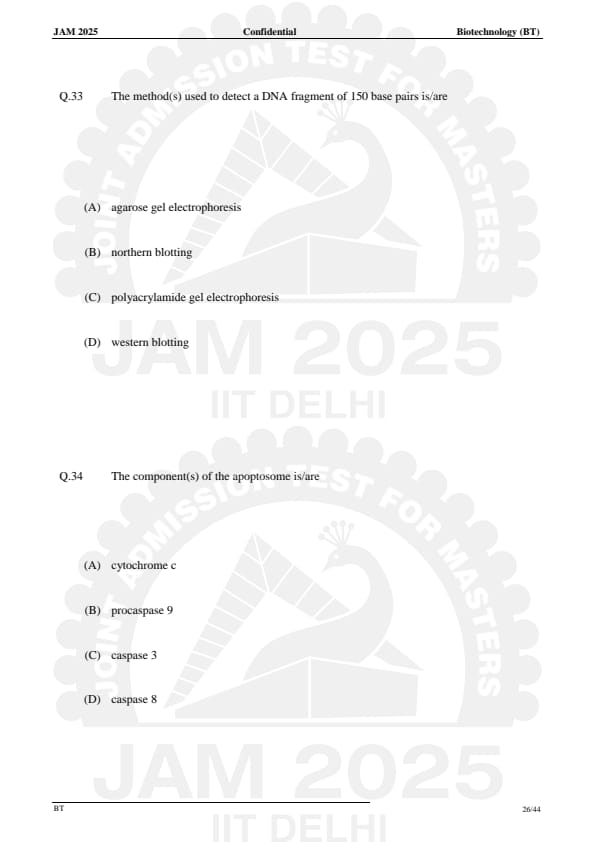
The method(s) used to detect a DNA fragment of 150 base pairs is/are
View Solution
Step 1: Understanding the methods.
- Agarose gel electrophoresis is the most commonly used method to separate and visualize DNA fragments. It allows DNA of various sizes to be separated by size, with shorter fragments traveling faster than longer ones. A DNA fragment of 150 base pairs can be easily separated using this method.
- Northern blotting involves the detection of RNA, not DNA, and thus is not suitable for detecting a DNA fragment.
- Polyacrylamide gel electrophoresis is typically used for separating smaller fragments, such as proteins or smaller nucleic acid sequences, but for 150 base pairs, agarose gel electrophoresis is more suitable.
- Western blotting is used to detect proteins, not nucleic acids, so it is not applicable for detecting DNA fragments.
Step 2: Conclusion.
The correct method to detect a DNA fragment of 150 base pairs is agarose gel electrophoresis.
Final Answer: \[ \boxed{Agarose gel electrophoresis is used to detect a DNA fragment of 150 base pairs.} \] Quick Tip: For DNA detection, use agarose gel electrophoresis. Northern blotting and western blotting are for RNA and protein, respectively.
The component(s) of the apoptosome is/are
View Solution
Step 1: Understanding the apoptosome.
The apoptosome is a large protein complex involved in the initiation of apoptosis, which is a programmed cell death process. The apoptosome is formed in response to stress or damage signals, and it plays a crucial role in activating caspases that execute the cell death process.
Step 2: Analyzing the options.
- (A) Cytochrome c is released from mitochondria during apoptosis and is a key molecule that triggers the formation of the apoptosome, but it is not itself a component of the apoptosome.
- (B) Correct: Procaspase 9 is a key component of the apoptosome. When cytochrome c binds to apoptotic protease activating factor-1 (Apaf-1), it activates procaspase 9, which then initiates the caspase cascade leading to cell death.
- (C) Caspase 3 is activated downstream of procaspase 9. It is involved in the execution phase of apoptosis but is not a component of the apoptosome.
- (D) Caspase 8 is involved in the extrinsic apoptotic pathway and does not directly participate in the apoptosome formation.
Step 3: Conclusion.
The apoptosome contains procaspase 9 as a major component.
Final Answer: \[ \boxed{Procaspase 9 is a component of the apoptosome.} \] Quick Tip: Cytochrome c triggers the formation of the apoptosome, which contains procaspase 9, leading to the activation of caspases during apoptosis.
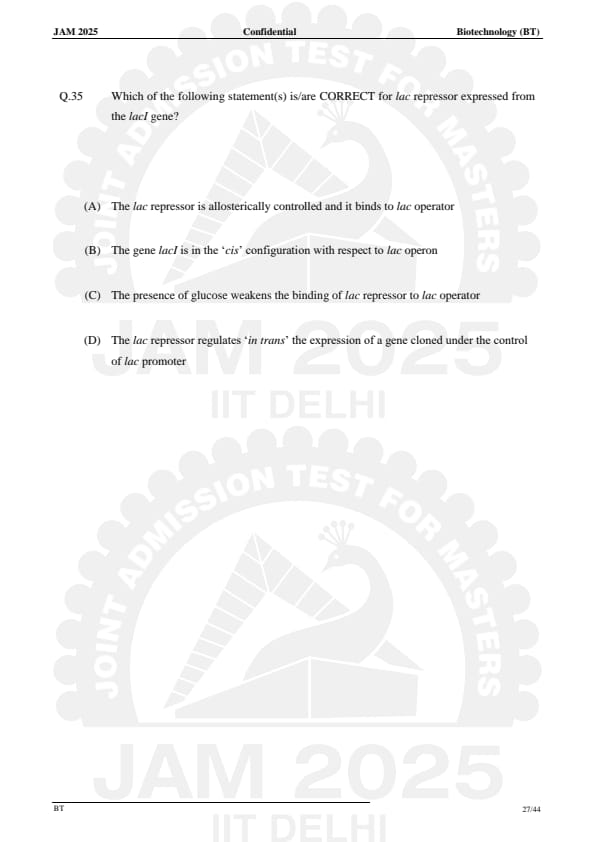
Which of the following statement(s) is/are CORRECT for lac repressor expressed from the lacI gene?
View Solution
Step 1: Understanding the lac repressor mechanism.
The lac repressor is a protein expressed from the lacI gene that regulates the lac operon, which controls the metabolism of lactose in bacteria. It works by binding to the lac operator, preventing transcription of the lac genes unless an inducer (e.g., allolactose) is present to relieve repression.
Step 2: Analyzing the options.
- (A) Correct: The lac repressor is indeed allosterically controlled. It binds to the lac operator region on the DNA and prevents the transcription of the lac operon unless an inducer like allolactose is present. The binding of the inducer changes the shape of the repressor, reducing its affinity for the operator and allowing transcription.
- (B) Incorrect: The lacI gene is in the 'trans' configuration with respect to the lac operon. The lac repressor is a diffusible molecule that can act on any lac operon in the cell, regardless of whether it is on the same DNA molecule as the lacI gene. It does not act 'cis' (on the same DNA molecule).
- (C) Incorrect: The presence of glucose actually weakens the effect of the lac repressor, but through a different mechanism, involving catabolite repression. When glucose levels are high, the levels of cyclic AMP (cAMP) are low, leading to reduced activation of the lac operon. However, this is separate from the direct action of the lac repressor.
- (D) Correct: The lac repressor regulates gene expression 'in trans', meaning it can act on any lac operon in the cell, even if the lacI gene and the lac operon are on different DNA molecules. This allows the lac repressor to regulate genes that are not on the same chromosome.
Final Answer: \[ \boxed{(A) and (D) are correct.} \] Quick Tip: The lac repressor is a trans-acting molecule, meaning it can affect lac operons on different DNA molecules. It is regulated allosterically and binds to the lac operator, blocking transcription unless induced by an inducer like allolactose.
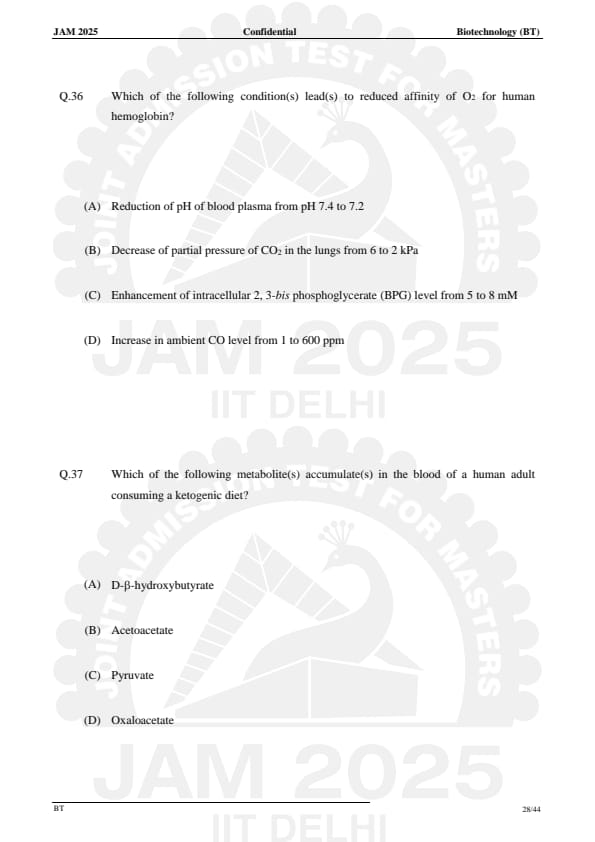
Which of the following condition(s) lead(s) to reduced affinity of \(O_2\) for human hemoglobin?
View Solution
Step 1: Understanding the factors that affect hemoglobin affinity for \(O_2\).
The affinity of hemoglobin for oxygen is influenced by various factors including pH, partial pressure of \(CO_2\), levels of 2, 3-bisphosphoglycerate (BPG), and ambient \(CO_2\) levels.
Step 2: Analyzing the options.
- (A) Correct: A decrease in pH, or acidosis, reduces the affinity of hemoglobin for oxygen, known as the Bohr effect. This facilitates the release of oxygen to tissues.
- (B) Incorrect: Decrease in partial pressure of \(CO_2\) increases the affinity of hemoglobin for oxygen, making it less likely to release \(O_2\).
- (C) Correct: Higher levels of 2, 3-bisphosphoglycerate (BPG) decrease the affinity of hemoglobin for \(O_2\), promoting oxygen release to tissues.
- (D) Incorrect: While an increase in ambient CO_2 levels affects the respiratory system, it does not directly reduce the affinity of hemoglobin for oxygen in this context.
Final Answer: \[ \boxed{(A) and (C) are correct.} \] Quick Tip: The Bohr effect describes how decreased pH and increased BPG levels decrease hemoglobin's affinity for oxygen, aiding oxygen release in tissues.
Which of the following metabolite(s) accumulate(s) in the blood of a human adult consuming a ketogenic diet?
View Solution
Step 1: Understanding the metabolic effects of a ketogenic diet.
A ketogenic diet promotes the production of ketone bodies from fatty acids. These ketone bodies are used as an alternative energy source when glucose is limited.
Step 2: Analyzing the options.
- (A) Correct: D-β-hydroxybutyrate is one of the primary ketone bodies produced during ketosis, and its levels accumulate in the blood during a ketogenic diet.
- (B) Correct: Acetoacetate is another ketone body that accumulates in the blood during a ketogenic diet, serving as a source of energy for tissues like the brain.
- (C) Incorrect: Pyruvate is a key intermediate in glucose metabolism but does not accumulate during a ketogenic diet. In fact, its production is reduced in favor of ketone bodies.
- (D) Incorrect: Oxaloacetate is involved in gluconeogenesis and is not a product of ketogenesis. Its levels are typically low during a ketogenic diet.
Final Answer: \[ \boxed{(A) and (B) are correct.} \] Quick Tip: A ketogenic diet increases the production of ketone bodies like D-β-hydroxybutyrate and acetoacetate, which provide an alternative energy source to glucose.
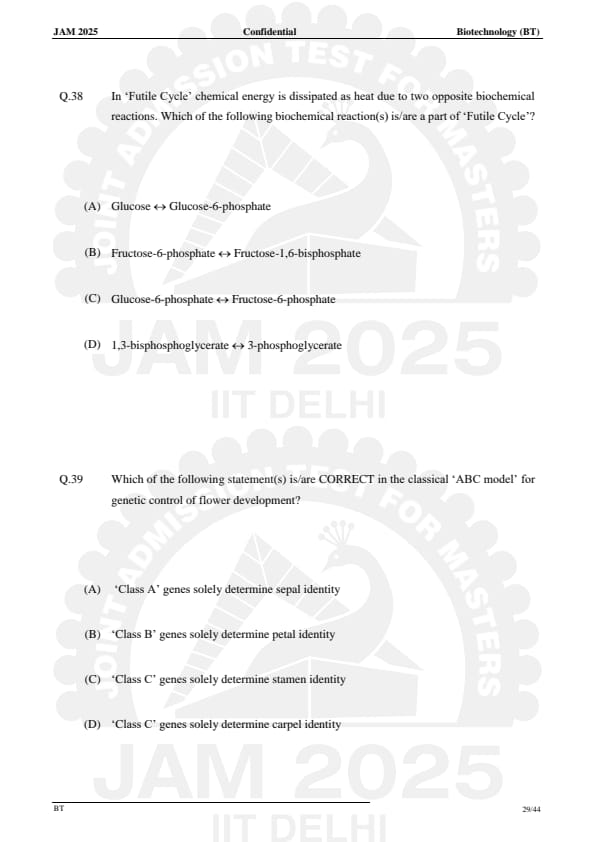
In ‘Futile Cycle’ chemical energy is dissipated as heat due to two opposite biochemical reactions. Which of the following biochemical reaction(s) is/are a part of ‘Futile Cycle’?
View Solution
Step 1: Understanding the 'Futile Cycle'.
A futile cycle is a biochemical process where two opposing metabolic pathways run simultaneously, leading to the hydrolysis of ATP and the dissipation of energy as heat. This process typically involves reversible reactions that, when coupled, result in no net change in the products but lead to the expenditure of energy.
Step 2: Analyzing the options.
- (A) Incorrect: The reaction between glucose and glucose-6-phosphate is part of the glycolysis and gluconeogenesis pathways, but it is not part of the futile cycle, since it does not lead to energy dissipation through opposing reactions.
- (B) Correct: The interconversion between fructose-6-phosphate and fructose-1,6-bisphosphate involves the opposing actions of phosphofructokinase (PFK) and fructose-1,6-bisphosphatase, which is a classic example of a futile cycle. These opposing reactions lead to ATP hydrolysis and heat production without any net change in metabolite concentrations.
- (C) Correct: The reaction between glucose-6-phosphate and fructose-6-phosphate can also be part of a futile cycle, particularly during the process of gluconeogenesis and glycolysis, where opposing reactions involving phosphoglucoisomerase and glucose-6-phosphatase contribute to energy dissipation.
- (D) Incorrect: The reaction between 1,3-bisphosphoglycerate and 3-phosphoglycerate is involved in the glycolysis and gluconeogenesis pathways but does not typically form a futile cycle.
Final Answer: \[ \boxed{(B) and (C) are correct.} \] Quick Tip: Futile cycles are metabolic processes that result in the dissipation of energy as heat through opposing biochemical reactions, such as those in glycolysis and gluconeogenesis.
Which of the following statement(s) is/are CORRECT in the classical ‘ABC model’ for genetic control of flower development?
View Solution
Step 1: Understanding the ABC model of flower development.
The ABC model describes how three classes of genes (A, B, and C) control flower organ identity during development. These genes work in overlapping combinations to specify the identity of each floral organ.
Step 2: Analyzing the options.
- (A) Correct: ‘Class A’ genes are responsible for the development of sepals. Sepals form the outermost part of the flower, and their identity is regulated by Class A genes such as APETALA1 (AP1).
- (B) Correct: ‘Class B’ genes are responsible for the development of petals and stamens. Petals, which are the second layer of the flower, are regulated by Class B genes like APETALA3 (AP3) and PISTILLATA (PI).
- (C) Correct: ‘Class C’ genes are responsible for the development of stamens and carpels. Class C genes such as AGAMOUS (AG) are critical for the formation of the male and female reproductive organs.
- (D) Incorrect: Class C genes do not solely determine carpel identity. Although Class C genes contribute to carpel development, the carpel is also influenced by the interaction of Class A and Class B genes.
Final Answer: \[ \boxed{(A), (B), and (C) are correct.} \] Quick Tip: The ABC model explains flower organ identity, where Class A genes specify sepals, Class B genes specify petals and stamens, and Class C genes specify stamens and carpels.
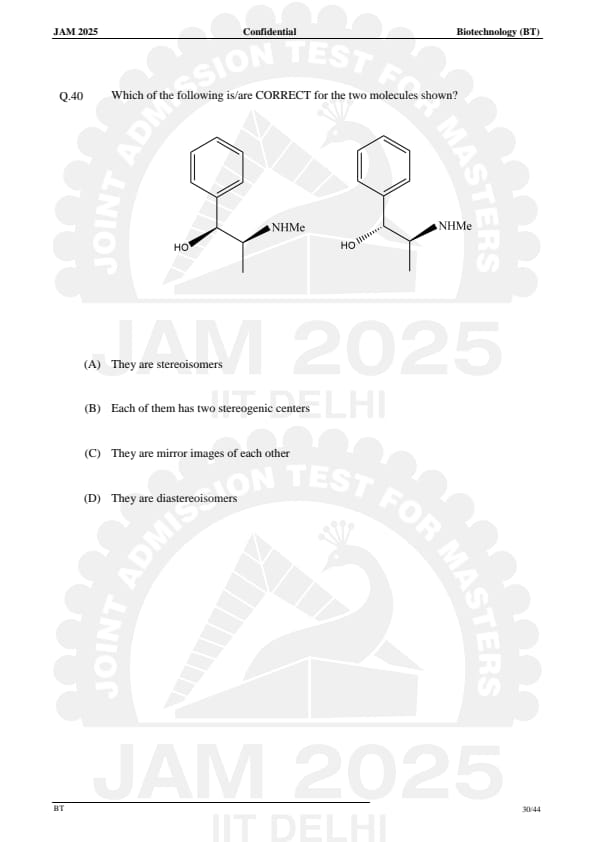
Which of the following is/are CORRECT for the two molecules shown?
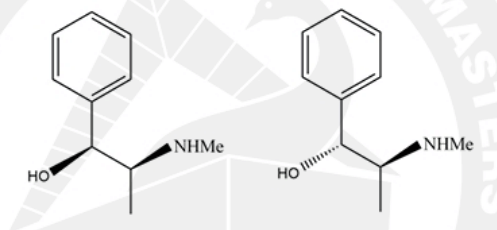
View Solution
Step 1: Analyzing the structures.
The two molecules shown in the image are organic compounds that differ in their spatial arrangement around the stereocenters. Let's examine their relationship based on stereochemistry.
Step 2: Understanding the options.
- (A) Correct: These molecules are stereoisomers because they have the same molecular formula and connectivity of atoms but differ in their spatial arrangement of atoms, which makes them stereoisomers.
- (B) Incorrect: The two molecules shown each have only one stereocenter, not two. A stereogenic center is a carbon atom bonded to four different substituents.
- (C) Incorrect: The molecules are not mirror images of each other. Mirror images are enantiomers, but these molecules are not enantiomers because they are not related by reflection in a mirror.
- (D) Correct: These molecules are diastereoisomers. Diastereoisomers are stereoisomers that are not mirror images of each other. Since the two molecules are not mirror images but differ in their spatial arrangement, they are diastereoisomers.
Final Answer: \[ \boxed{(A) and (D) are correct.} \] Quick Tip: Stereoisomers have the same connectivity of atoms but differ in spatial arrangement. Diastereoisomers are stereoisomers that are not mirror images of each other.
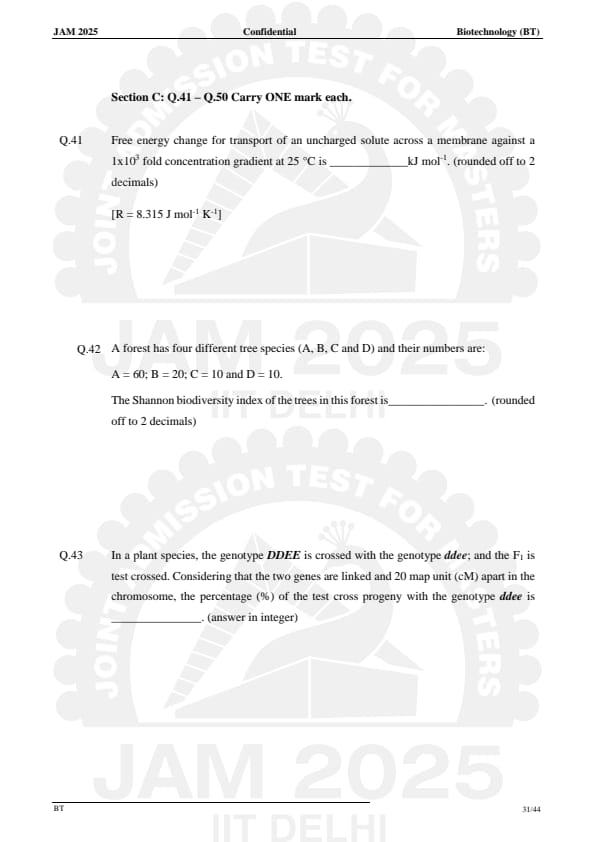
Free energy change for transport of an uncharged solute across a membrane against a \(1 \times 10^3\) fold concentration gradient at 25°C is ............... kJ mol\(^{-1}\). (rounded off to 2 decimals) \[ R = 8.315 \, J mol^{-1} \, K^{-1} \]
View Solution
Step 1: Formula for Free Energy Change
The formula for the free energy change (\(\Delta G\)) for the transport of an uncharged solute across a membrane is given by:
\[ \Delta G = - RT \ln \left( \frac{C_2}{C_1} \right) \]
Where:
- \( R \) = Gas constant = 8.315 J mol\(^{-1}\) K\(^{-1}\)
- \( T \) = Temperature in Kelvin = 25°C = 298 K
- \( C_2/C_1 \) = Fold concentration gradient = \(1 \times 10^3\)
Step 2: Substituting the given values
Now, substituting the known values into the equation:
\[ \Delta G = - (8.315) \times (298) \times \ln (1 \times 10^3) \]
Step 3: Calculation \[ \ln(1 \times 10^3) = \ln(1000) = 6.907 \]
\[ \Delta G = - (8.315 \times 298 \times 6.907) \, J mol^{-1} \]
\[ \Delta G = - 17160.23 \, J mol^{-1} = -17.16 \, kJ mol^{-1} \]
Final Answer: \[ \boxed{-17.16 \, kJ mol^{-1}} \] Quick Tip: To calculate the free energy change for transport, use the formula \(\Delta G = - RT \ln (C_2/C_1)\) where \( R \) is the gas constant, \( T \) is temperature in Kelvin, and \( C_2/C_1 \) is the fold concentration gradient.
A forest has four different tree species (A, B, C, and D) and their numbers are: \( A = 60 \); \( B = 20 \); \( C = 10 \); and \( D = 10 \).
The Shannon biodiversity index of the trees in this forest is ................... (rounded off to 2 decimals)
View Solution
Step 1: Formula for Shannon Biodiversity Index
The Shannon biodiversity index (\(H'\)) is given by the formula:
\[ H' = - \sum_{i=1}^{S} p_i \ln p_i \]
Where:
- \( S \) = Total number of species in the ecosystem
- \( p_i \) = Proportion of the \(i\)-th species in the community, calculated as \(\frac{N_i}{N_{total}}\), where \( N_i \) is the number of individuals of species \(i\) and \( N_{total} \) is the total number of individuals in all species.
Step 2: Calculating the total number of trees
The total number of trees in the forest is: \[ N_{total} = 60 + 20 + 10 + 10 = 100 \]
Step 3: Calculating the proportion of each species
- \( p_A = \frac{60}{100} = 0.60 \)
- \( p_B = \frac{20}{100} = 0.20 \)
- \( p_C = \frac{10}{100} = 0.10 \)
- \( p_D = \frac{10}{100} = 0.10 \)
Step 4: Applying the formula \[ H' = - \left( 0.60 \ln 0.60 + 0.20 \ln 0.20 + 0.10 \ln 0.10 + 0.10 \ln 0.10 \right) \]
Calculating the logarithms: \[ \ln 0.60 = -0.5108, \quad \ln 0.20 = -1.6094, \quad \ln 0.10 = -2.3026 \]
Substituting these into the equation: \[ H' = - \left( 0.60 \times (-0.5108) + 0.20 \times (-1.6094) + 0.10 \times (-2.3026) + 0.10 \times (-2.3026) \right) \]
\[ H' = - \left( -0.3065 - 0.3219 - 0.2303 - 0.2303 \right) = 1.0889 \]
Final Answer: \[ \boxed{1.09} \] Quick Tip: The Shannon biodiversity index measures the diversity of a community by considering both the number of species and the evenness of their distribution. A higher index indicates greater diversity.
In a plant species, the genotype \( DDEE \) is crossed with the genotype \( ddee \); and the F1 is test crossed. Considering that the two genes are linked and 20 map unit (cM) apart in the chromosome, the percentage (%) of the test cross progeny with the genotype \( ddee \) is ........................ (answer in integer)
View Solution
Step 1: Understanding the problem
The genes are linked, which means the two loci are on the same chromosome and do not assort independently. The distance between the two genes is given as 20 cM, which corresponds to 20% recombinant offspring. This means that 20% of the gametes will be recombinant, and 80% will be parental.
Step 2: Calculating recombinant and parental gametes
- The parental gametes are \( DE \) and \( de \), which make up 80% of the gametes.
- The recombinant gametes are \( De \) and \( dE \), which make up 20% of the gametes.
Step 3: Genotype of F1 and test cross
The F1 plants are \( DdEe \). When test crossed with \( ddee \), the possible gametes from the F1 plant will be:
- Parental: \( DE \) and \( de \) (80%)
- Recombinant: \( De \) and \( dE \) (20%)
The test cross will produce the following combinations:
- \( ddee \) (from \( de \) and \( de \))
- \( ddeE \) (from \( de \) and \( dE \))
- \( Ddee \) (from \( DE \) and \( de \))
- \( DDEe \) (from \( DE \) and \( dE \))
Step 4: Percentage of \( ddee \) genotype
The genotype \( ddee \) is produced by the combination of two \( de \) gametes. The percentage of this genotype is: \[ \frac{1}{4} \times 80% = 20% \]
Final Answer: \[ \boxed{20} \] Quick Tip: When calculating the percentage of a specific genotype in a test cross involving linked genes, consider the recombination frequency (given in cM) to determine the proportion of recombinant and parental gametes.
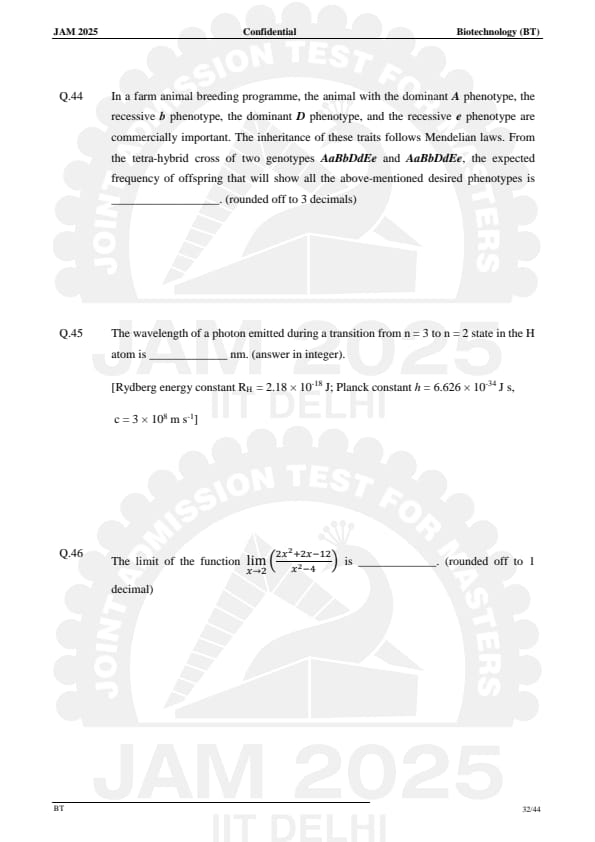
In a farm animal breeding programme, the animal with the dominant A phenotype, the recessive b phenotype, the dominant D phenotype, and the recessive e phenotype are commercially important. The inheritance of these traits follows Mendelian laws. From the tetra-hybrid cross of two genotypes AaBbDdEe and AaBbDdEe, the expected frequency of offspring that will show all the above-mentioned desired phenotypes is ................... (rounded off to 3 decimals)
View Solution
Step 1: Identifying the inheritance pattern.
We are dealing with a tetra-hybrid cross, which involves four traits (A, B, D, and E) with two alleles each. The genotypes of the parents are AaBbDdEe. The desired phenotypes for each trait are:
- \( A \) = dominant phenotype
- \( b \) = recessive phenotype
- \( D \) = dominant phenotype
- \( e \) = recessive phenotype
Step 2: Calculating probabilities for each trait.
- For the A trait: \( Aa \times Aa \) cross gives a probability of \( \frac{3}{4} \) for offspring with dominant \( A \).
- For the b trait: \( Bb \times Bb \) cross gives a probability of \( \frac{1}{4} \) for offspring with recessive \( b \).
- For the D trait: \( Dd \times Dd \) cross gives a probability of \( \frac{3}{4} \) for offspring with dominant \( D \).
- For the e trait: \( Ee \times Ee \) cross gives a probability of \( \frac{1}{4} \) for offspring with recessive \( e \).
Step 3: Calculating the overall probability.
The overall probability of obtaining the desired phenotypes is the product of the probabilities for each individual trait:
\[ P(desired offspring) = \left( \frac{3}{4} \right) \times \left( \frac{1}{4} \right) \times \left( \frac{3}{4} \right) \times \left( \frac{1}{4} \right) \]
\[ P(desired offspring) = \frac{3}{4} \times \frac{1}{4} \times \frac{3}{4} \times \frac{1}{4} = \frac{9}{256} = 0.035 \]
Final Answer: \[ \boxed{0.035} \] Quick Tip: To calculate the probability of multiple desired traits, multiply the individual probabilities for each trait's phenotype, considering whether the trait is dominant or recessive.
The wavelength of a photon emitted during a transition from \( n = 3 \) to \( n = 2 \) state in the H atom is .............. nm. (answer in integer).
View Solution
Step 1: Formula for energy of the photon.
The energy of the photon emitted during the transition of an electron in a hydrogen atom from one energy level to another is given by the Rydberg formula:
\[ E = - \frac{R_H}{n^2} \]
Where \( R_H = 2.18 \times 10^{-18} \, J \) is the Rydberg energy constant and \( n \) is the principal quantum number.
The energy difference between the \( n = 3 \) and \( n = 2 \) states is:
\[ \Delta E = \left( - \frac{R_H}{2^2} \right) - \left( - \frac{R_H}{3^2} \right) \]
\[ \Delta E = R_H \left( \frac{1}{4} - \frac{1}{9} \right) = R_H \times \frac{5}{36} \]
Substituting the value of \( R_H \):
\[ \Delta E = 2.18 \times 10^{-18} \times \frac{5}{36} = 3.03 \times 10^{-19} \, J \]
Step 2: Calculating the wavelength.
The energy of a photon is related to its wavelength \( \lambda \) by the equation:
\[ E = \frac{h c}{\lambda} \]
Where:
- \( h = 6.626 \times 10^{-34} \, J s \) is Planck’s constant
- \( c = 3 \times 10^8 \, m/s \) is the speed of light
Rearranging to solve for \( \lambda \):
\[ \lambda = \frac{h c}{\Delta E} \]
Substituting the values:
\[ \lambda = \frac{(6.626 \times 10^{-34}) \times (3 \times 10^8)}{3.03 \times 10^{-19}} = 6.56 \times 10^{-7} \, m = 656 \, nm \]
Final Answer: \[ \boxed{656 \, nm} \] Quick Tip: The wavelength of a photon emitted during a transition between energy levels in a hydrogen atom can be calculated using the Rydberg formula and the relationship between energy and wavelength.
The limit of the function \( \lim_{x \to 2} \frac{2x^2 + 2x - 12}{x^2 - 4} \) is .............. (rounded off to 1 decimal)
View Solution
Step 1: Analyzing the function.
We are given the function:
\[ f(x) = \frac{2x^2 + 2x - 12}{x^2 - 4} \]
First, we check if substituting \( x = 2 \) directly into the function gives a meaningful value:
Substituting \( x = 2 \):
\[ Numerator = 2(2^2) + 2(2) - 12 = 8 + 4 - 12 = 0 \]
\[ Denominator = (2^2) - 4 = 4 - 4 = 0 \]
Since both the numerator and denominator are 0, we have an indeterminate form \( \frac{0}{0} \), so we must simplify the expression.
Step 2: Simplifying the expression.
Factor the numerator and denominator:
\[ Numerator: \, 2x^2 + 2x - 12 = 2(x^2 + x - 6) = 2(x - 2)(x + 3) \]
\[ Denominator: \, x^2 - 4 = (x - 2)(x + 2) \]
Now the function becomes:
\[ f(x) = \frac{2(x - 2)(x + 3)}{(x - 2)(x + 2)} \]
We can cancel out the common factor \( (x - 2) \):
\[ f(x) = \frac{2(x + 3)}{x + 2} \]
Step 3: Substituting \( x = 2 \) again.
Substitute \( x = 2 \) into the simplified expression:
\[ f(2) = \frac{2(2 + 3)}{2 + 2} = \frac{2(5)}{4} = \frac{10}{4} = 2.5 \]
Final Answer: \[ \boxed{2.5} \] Quick Tip: When faced with the indeterminate form \( \frac{0}{0} \), factor both the numerator and denominator to simplify the expression before substituting the value of \( x \).
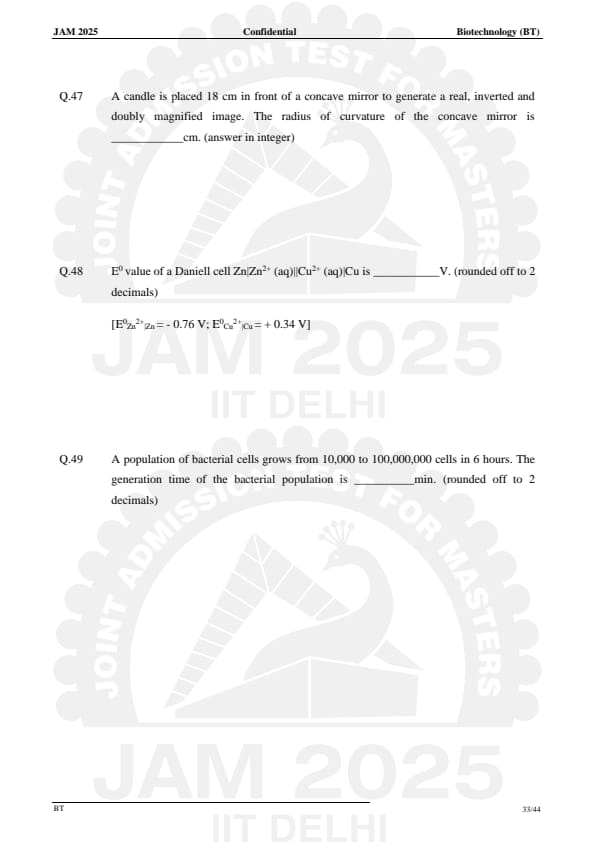
A candle is placed 18 cm in front of a concave mirror to generate a real, inverted and doubly magnified image. The radius of curvature of the concave mirror is ................ cm. (answer in integer)
View Solution
Step 1: Understanding the relationship for magnification.
For a concave mirror, the magnification \( m \) is given by:
\[ m = \frac{-v}{u} \]
Where:
- \( v \) is the image distance
- \( u \) is the object distance
- Given that the image is real, inverted, and doubly magnified, the magnification \( m = -2 \).
So, we have:
\[ -2 = \frac{-v}{18} \quad \Rightarrow \quad v = 36 \, cm \]
Step 2: Using the mirror equation.
The mirror equation relates the object distance \( u \), image distance \( v \), and the focal length \( f \):
\[ \frac{1}{f} = \frac{1}{v} + \frac{1}{u} \]
Since \( v = 36 \) cm and \( u = -18 \) cm (object is in front of the mirror), we substitute these values into the equation:
\[ \frac{1}{f} = \frac{1}{36} + \frac{1}{-18} \]
\[ \frac{1}{f} = \frac{1}{36} - \frac{1}{18} = \frac{-1}{36} \]
\[ f = -36 \, cm \]
Step 3: Relating focal length to radius of curvature.
The radius of curvature \( R \) is related to the focal length \( f \) by:
\[ R = 2f \]
So, the radius of curvature is:
\[ R = 2 \times (-36) = -72 \, cm \]
Final Answer: \[ \boxed{-72 \, cm} \] Quick Tip: The magnification for concave mirrors is given by \( m = -\frac{v}{u} \). Use the mirror equation to find the focal length and then use \( R = 2f \) to find the radius of curvature.
\( E^\circ \) value of a Daniell cell \( Zn | Zn^{2+} \, (aq) || Cu^{2+} \, (aq) | Cu \) is ............ V. (rounded off to 2 decimals)
View Solution
Step 1: Using the Nernst equation for calculating cell potential.
The cell potential \( E^\circ \) is calculated using the standard electrode potentials for the half-reactions:
\[ E^\circ_{cell} = E^\circ_{cathode} - E^\circ_{anode} \]
For the Daniell cell:
- The reduction half-reaction at the cathode (copper): \[ Cu^{2+} + 2e^- \to Cu \quad E^\circ_{Cu} = +0.34 \, V \]
- The oxidation half-reaction at the anode (zinc): \[ Zn \to Zn^{2+} + 2e^- \quad E^\circ_{Zn} = -0.76 \, V \]
Step 2: Calculating the standard cell potential. \[ E^\circ_{cell} = 0.34 - (-0.76) = 0.34 + 0.76 = 1.10 \, V \]
Final Answer: \[ \boxed{1.10 \, V} \] Quick Tip: The standard cell potential is the difference between the reduction potential at the cathode and the anode. Use the standard values from the table to calculate \( E^\circ_{cell} \).
A population of bacterial cells grows from 10,000 to 100,000,000 cells in 6 hours. The generation time of the bacterial population is ........... min. (rounded off to 2 decimals)
View Solution
Step 1: Using the exponential growth formula.
The exponential growth formula for a population is given by:
\[ N_t = N_0 \times 2^n \]
Where:
- \( N_t \) is the final population size
- \( N_0 \) is the initial population size
- \( n \) is the number of generations
We are given:
- \( N_0 = 10,000 \)
- \( N_t = 100,000,000 \)
- Time = 6 hours
We need to find \( n \), the number of generations:
\[ 100,000,000 = 10,000 \times 2^n \]
\[ 2^n = \frac{100,000,000}{10,000} = 10,000 \]
Taking the logarithm of both sides:
\[ n \log 2 = \log 10,000 \]
\[ n = \frac{\log 10,000}{\log 2} = \frac{4}{0.3010} \approx 13.29 \, generations \]
Step 2: Calculating generation time.
The generation time \( T \) is the time per generation:
\[ T = \frac{Total time}{n} = \frac{6 \, hours \times 60 \, minutes/hour}{13.29} \]
\[ T = \frac{360}{13.29} \approx 27.1 \, minutes \]
Final Answer: \[ \boxed{27.1 \, min} \] Quick Tip: The generation time can be calculated using the formula \( N_t = N_0 \times 2^n \), where \( n \) is the number of generations. Divide the total time by the number of generations to get the generation time.
In a sampling expedition near a peninsula, 180 dolphins from a large population of dolphins were captured and marked by tagging their dorsal fins. The tagged dolphins were then allowed to join back into the population. In a subsequent expedition, 42 dolphins were photographed from the same large population. Among these, 7 dolphins contained the tags. Assuming that the population size remains the same and that tags were not lost, the estimated population size of dolphins in the peninsula is ........... (answer in integer)
View Solution
Step 1: Understanding the method.
This problem involves the use of the Mark and Recapture method to estimate the population size of animals. The formula for this method is:
\[ \frac{M}{N} = \frac{m}{n} \]
Where:
- \( M \) = number of dolphins initially tagged = 180
- \( N \) = total estimated population size (what we are solving for)
- \( m \) = number of tagged dolphins in the second sample = 7
- \( n \) = total number of dolphins in the second sample = 42
Step 2: Substituting the known values into the equation.
We can rearrange the formula to solve for \( N \):
\[ N = \frac{M \times n}{m} \]
Substituting the values:
\[ N = \frac{180 \times 42}{7} = \frac{7560}{7} = 1080 \]
Final Answer: \[ \boxed{1080} \] Quick Tip: The Mark and Recapture method estimates population size by assuming that the proportion of tagged individuals in a sample is the same as the proportion in the entire population.
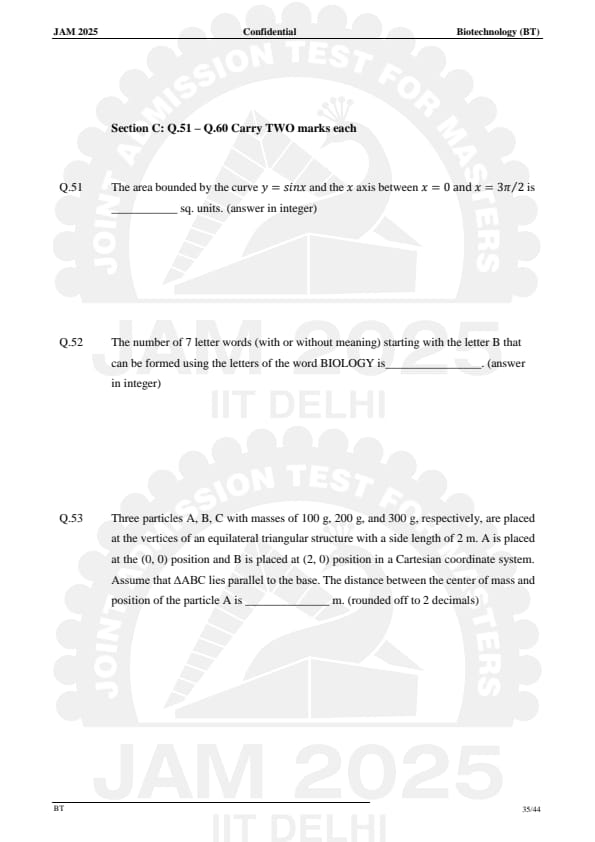
The area bounded by the curve \( y = \sin x \) and the x-axis between \( x = 0 \) and \( x = \frac{3\pi}{2} \) is ............. sq. units. (answer in integer)
View Solution
Step 1: Understanding the problem.
We are asked to find the area bounded by the curve \( y = \sin x \) and the x-axis between \( x = 0 \) and \( x = \frac{3\pi}{2} \). The area under the curve from \( x = 0 \) to \( x = \frac{3\pi}{2} \) can be found using the definite integral:
\[ Area = \int_0^{\frac{3\pi}{2}} \sin x \, dx \]
Step 2: Solving the integral.
We need to evaluate the integral:
\[ \int \sin x \, dx = -\cos x \]
Now, applying the limits:
\[ Area = - \cos \left( \frac{3\pi}{2} \right) + \cos (0) \]
\[ \cos \left( \frac{3\pi}{2} \right) = 0 \quad and \quad \cos (0) = 1 \]
So, the area is:
\[ Area = - (0) + 1 = 1 \]
Final Answer: \[ \boxed{1} \] Quick Tip: The area under a sine curve can be calculated by evaluating the definite integral of \( \sin x \) over the given limits.
The number of 7 letter words (with or without meaning) starting with the letter B that can be formed using the letters of the word BIOLOGY is .............. (answer in integer)
View Solution
Step 1: Understanding the problem.
We need to form 7-letter words starting with the letter B from the word "BIOLOGY". The available letters in "BIOLOGY" are: B, I, O, L, O, G, Y. The task is to form a 7-letter word starting with "B".
Step 2: Considering the positions of letters.
Since the word must start with "B", the remaining 6 positions can be filled with the remaining letters: I, O, L, O, G, Y.
The number of possible words is determined by how many different ways we can arrange the remaining 6 letters: I, O, L, O, G, Y. Notice that there are 2 O's, so the number of distinct arrangements is:
\[ \frac{6!}{2!} \]
Step 3: Calculating the number of arrangements.
First, calculate \( 6! \) and \( 2! \):
\[ 6! = 6 \times 5 \times 4 \times 3 \times 2 \times 1 = 720 \]
\[ 2! = 2 \times 1 = 2 \]
Now, calculate the number of distinct arrangements:
\[ \frac{6!}{2!} = \frac{720}{2} = 360 \]
Final Answer: \[ \boxed{360} \] Quick Tip: When calculating arrangements of letters with repeated characters, divide by the factorial of the number of repetitions to account for indistinguishable arrangements.
Three particles A, B, C with masses of 100 g, 200 g, and 300 g, respectively, are placed at the vertices of an equilateral triangular structure with a side length of 2 m. A is placed at the \( (0, 0) \) position and B is placed at \( (2, 0) \) position in a Cartesian coordinate system. Assume that \( \triangle ABC \) lies parallel to the base. The distance between the center of mass and the position of the particle A is ........... m. (rounded off to 2 decimals)
View Solution
Step 1: Understanding the problem.
We are asked to find the distance between the center of mass of the system and particle A. The center of mass of a system of particles is given by the weighted average of the coordinates of the particles:
\[ x_{cm} = \frac{\sum m_i x_i}{\sum m_i}, \quad y_{cm} = \frac{\sum m_i y_i}{\sum m_i} \]
Where \( m_i \) and \( (x_i, y_i) \) are the mass and coordinates of the \( i \)-th particle, respectively.
Step 2: Assigning coordinates and masses.
- Particle A: \( m_A = 100 \, g, \, (x_A, y_A) = (0, 0) \)
- Particle B: \( m_B = 200 \, g, \, (x_B, y_B) = (2, 0) \)
- Particle C: \( m_C = 300 \, g, \, (x_C, y_C) = (1, \sqrt{3}) \) (since the height of an equilateral triangle with side length 2 m is \( \sqrt{3} \))
Step 3: Calculating the center of mass coordinates.
First, calculate \( x_{cm} \) and \( y_{cm} \):
\[ x_{cm} = \frac{100(0) + 200(2) + 300(1)}{100 + 200 + 300} = \frac{600 + 300}{600} = \frac{900}{600} = 1.5 \]
\[ y_{cm} = \frac{100(0) + 200(0) + 300(\sqrt{3})}{100 + 200 + 300} = \frac{300\sqrt{3}}{600} = 0.5\sqrt{3} \approx 0.866 \]
Step 4: Calculating the distance from A to the center of mass.
The distance \( d \) from particle A to the center of mass is given by the distance formula:
\[ d = \sqrt{(x_{cm} - x_A)^2 + (y_{cm} - y_A)^2} \]
Substituting the values:
\[ d = \sqrt{(1.5 - 0)^2 + (0.866 - 0)^2} = \sqrt{(1.5)^2 + (0.866)^2} = \sqrt{2.25 + 0.749} = \sqrt{2.999} \approx 1.73 \, m \]
Final Answer: \[ \boxed{1.73 \, m} \] Quick Tip: To calculate the distance between a particle and the center of mass, first compute the center of mass coordinates using the mass-weighted average, then apply the distance formula.
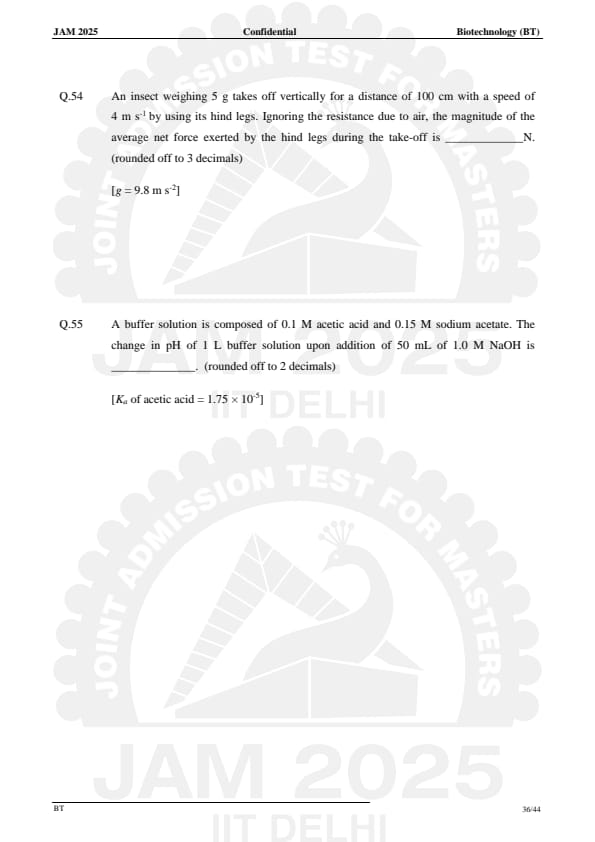
An insect weighing 5 g takes off vertically for a distance of 100 cm with a speed of 4 m s\(^{-1}\) by using its hind legs. Ignoring the resistance due to air, the magnitude of the average net force exerted by the hind legs during the take-off is ............ N. (rounded off to 3 decimals)
View Solution
Step 1: Given values.
- Mass of the insect, \( m = 5 \, g = 0.005 \, kg \)
- Distance traveled during take-off, \( d = 100 \, cm = 1 \, m \)
- Initial speed, \( u = 0 \, m/s \) (since the insect starts from rest)
- Final speed, \( v = 4 \, m/s \)
- Gravitational acceleration, \( g = 9.8 \, m/s^2 \)
Step 2: Use of kinematic equation to find acceleration.
To find the acceleration during take-off, we use the following kinematic equation:
\[ v^2 = u^2 + 2ad \]
Substituting the known values:
\[ % Option (4)^2 = 0^2 + 2 \times a \times 1 \]
\[ 16 = 2a \quad \Rightarrow \quad a = 8 \, m/s^2 \]
Step 3: Using Newton's second law to find the net force.
The net force required for the insect to take off is the sum of the force needed to overcome gravity and the force needed to accelerate. The total force \( F_{net} \) is given by:
\[ F_{net} = ma \]
Substituting the mass and acceleration:
\[ F_{net} = 0.005 \times 8 = 0.04 \, N \]
Additionally, the force required to overcome gravity is:
\[ F_{gravity} = mg = 0.005 \times 9.8 = 0.049 \, N \]
So, the total net force exerted by the hind legs during take-off is:
\[ F_{legs} = F_{net} + F_{gravity} = 0.04 + 0.049 = 0.089 \, N \]
Final Answer: \[ \boxed{0.089 \, N} \] Quick Tip: To calculate the force exerted during take-off, use Newton's second law to find the net force needed to accelerate the insect, and add the force required to overcome gravity.
A buffer solution is composed of 0.1 M acetic acid and 0.15 M sodium acetate. The change in pH of 1 L buffer solution upon addition of 50 mL of 1.0 M NaOH is ............... (rounded off to 2 decimals)
View Solution
Step 1: Understanding the problem.
We are given a buffer solution composed of acetic acid (weak acid) and sodium acetate (conjugate base). The pH change is caused by the addition of NaOH, which will neutralize some of the acetic acid in the buffer.
Step 2: Using the Henderson-Hasselbalch equation.
The pH of a buffer solution is given by the Henderson-Hasselbalch equation:
\[ pH = pK_a + \log \left( \frac{[A^-]}{[HA]} \right) \]
Where:
- \( pK_a \) of acetic acid = 4.76
- \( [A^-] \) = concentration of acetate ions (conjugate base)
- \( [HA] \) = concentration of acetic acid
Step 3: Initial concentrations.
Initially, the concentrations are:
- \( [HA] = 0.1 \, M \)
- \( [A^-] = 0.15 \, M \)
Using the Henderson-Hasselbalch equation:
\[ pH = 4.76 + \log \left( \frac{0.15}{0.1} \right) \]
\[ pH = 4.76 + \log (1.5) = 4.76 + 0.176 = 4.936 \]
Step 4: After addition of NaOH.
The moles of NaOH added are:
\[ moles of NaOH = 0.05 \, L \times 1.0 \, M = 0.05 \, moles \]
The moles of acetic acid before addition of NaOH are:
\[ moles of HA = 1.0 \, L \times 0.1 \, M = 0.1 \, moles \]
The NaOH will neutralize an equivalent amount of acetic acid:
\[ moles of HA remaining = 0.1 - 0.05 = 0.05 \, moles \]
The moles of acetate ions after neutralization will be:
\[ moles of A^- = 0.15 + 0.05 = 0.2 \, moles \]
Now, the new concentrations of \( HA \) and \( A^- \) are:
\[ [HA] = \frac{0.05}{1.05} = 0.0476 \, M, \quad [A^-] = \frac{0.2}{1.05} = 0.1905 \, M \]
Step 5: Re-calculating the pH.
Using the Henderson-Hasselbalch equation again:
\[ pH = 4.76 + \log \left( \frac{0.1905}{0.0476} \right) \]
\[ pH = 4.76 + \log (4.0) = 4.76 + 0.602 = 5.362 \]
Step 6: Finding the change in pH.
The change in pH is:
\[ \Delta pH = 5.362 - 4.936 = 0.426 \]
Final Answer: \[ \boxed{0.43} \] Quick Tip: To calculate the pH change in a buffer solution, use the Henderson-Hasselbalch equation before and after the addition of the strong base, considering the neutralization of the weak acid.
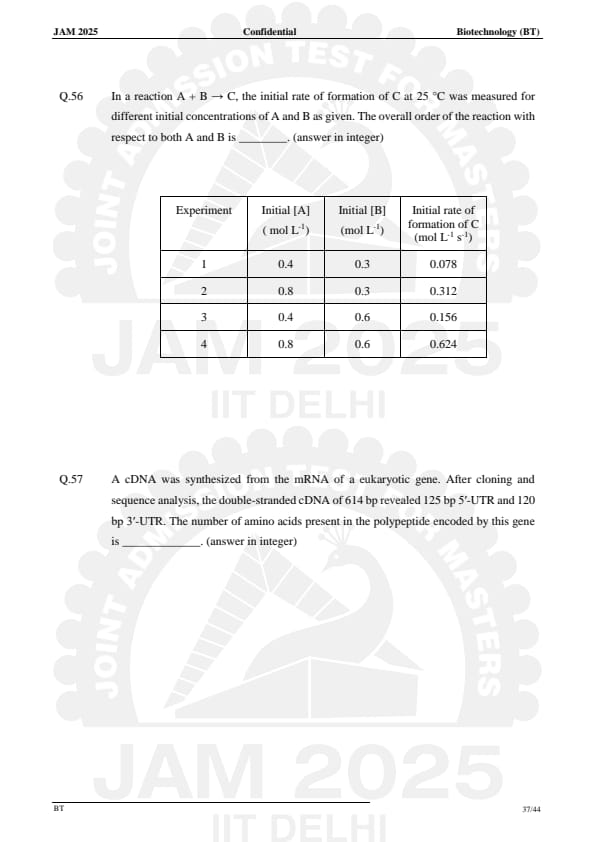
In a reaction \( A + B \to C \), the initial rate of formation of C at 25°C was measured for different initial concentrations of A and B as given. The overall order of the reaction with respect to both A and B is ................. (answer in integer)
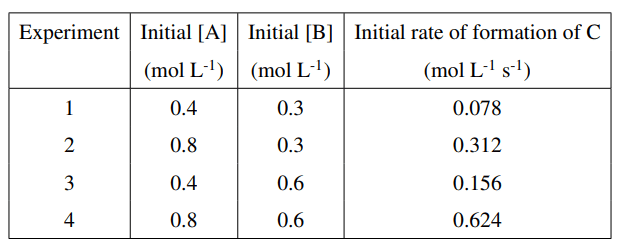
View Solution
Step 1: Understanding the reaction rate law.
The general form of the rate law for this reaction is:
\[ Rate = k[A]^m[B]^n \]
Where:
- \( k \) is the rate constant,
- \( m \) and \( n \) are the orders of the reaction with respect to A and B, respectively.
We are given the experimental data for different concentrations of A and B, and we need to find the orders \( m \) and \( n \).
Step 2: Using the data from experiments to determine the orders of reaction.
From the provided table:

Step 3: Finding the order with respect to A.
We will compare experiments 1 and 2, where the concentration of B is held constant, and only A changes.
For experiments 1 and 2:
\[ \frac{Rate_2}{Rate_1} = \frac{k[A_2]^m[B]^n}{k[A_1]^m[B]^n} = \left( \frac{A_2}{A_1} \right)^m \]
Substitute the values from experiments 1 and 2:
\[ \frac{0.312}{0.078} = \left( \frac{0.8}{0.4} \right)^m \quad \Rightarrow \quad 4 = 2^m \]
Solving for \( m \):
\[ m = 2 \]
Step 4: Finding the order with respect to B.
Now, we compare experiments 1 and 3, where the concentration of A is held constant, and only B changes.
For experiments 1 and 3:
\[ \frac{Rate_3}{Rate_1} = \frac{k[A]^m[B_3]^n}{k[A]^m[B_1]^n} = \left( \frac{B_3}{B_1} \right)^n \]
Substitute the values from experiments 1 and 3:
\[ \frac{0.156}{0.078} = \left( \frac{0.6}{0.3} \right)^n \quad \Rightarrow \quad 2 = 2^n \]
Solving for \( n \):
\[ n = 1 \]
Step 5: Determining the overall order.
The overall order of the reaction is the sum of the individual orders:
\[ Overall order = m + n = 2 + 1 = 3 \]
Final Answer: \[ \boxed{3} \] Quick Tip: To find the orders of reaction, use the rate law and compare experiments where one reactant is held constant while the other is varied. This allows you to isolate the effect of each reactant on the rate.
A cDNA was synthesized from the mRNA of a eukaryotic gene. After cloning and sequence analysis, the double-stranded cDNA of 614 bp revealed 125 bp 5'-UTR and 120 bp 3'-UTR. The number of amino acids present in the polypeptide encoded by this gene is ............... (answer in integer)
View Solution
Step 1: Understanding the problem.
We are given a cDNA of 614 base pairs (bp) that includes 125 bp 5'-UTR and 120 bp 3'-UTR. The coding region (which codes for the polypeptide) will be the remaining part of the cDNA after subtracting the UTR regions.
\[ Length of coding region = 614 \, bp - 125 \, bp (5'-UTR) - 120 \, bp (3'-UTR) = 369 \, bp \]
Step 2: Converting the coding region length to amino acids.
Each codon consists of 3 base pairs, and each codon codes for one amino acid. To find the number of amino acids, divide the length of the coding region by 3:
\[ Number of amino acids = \frac{369}{3} = 123 \]
Final Answer: \[ \boxed{123} \] Quick Tip: To calculate the number of amino acids encoded by a gene, first subtract the UTR regions from the total cDNA length to get the coding region, then divide by 3 to account for the codon length.
A rare genetic disorder resulting from homozygosity for a recessive allele (\( r \)) occurs in 2 out of every 10,000 individuals in a population. Assuming that (i) the disorder is not lethal, (ii) the disorder does not impact reproductive success, (iii) no new mutations are introduced in the population, and (iv) the population follows Hardy-Weinberg equilibrium, the percentage (%) of the carriers in the population that pass the \( r \) allele to offspring is .......... (rounded off to 1 decimal)
View Solution
Step 1: Understanding Hardy-Weinberg equilibrium.
According to Hardy-Weinberg equilibrium, the frequency of the homozygous recessive genotype (\( rr \)) is given by \( q^2 \), where \( q \) is the frequency of the recessive allele \( r \). The given information tells us that \( q^2 = \frac{2}{10,000} = 0.0002 \).
Step 2: Finding the frequency of allele \( r \).
To find \( q \), take the square root of \( q^2 \):
\[ q = \sqrt{0.0002} \approx 0.01414 \]
Step 3: Finding the frequency of the dominant allele.
Since \( p + q = 1 \), where \( p \) is the frequency of the dominant allele \( R \), we can calculate \( p \):
\[ p = 1 - q = 1 - 0.01414 = 0.98586 \]
Step 4: Finding the carrier frequency.
The frequency of the carriers (heterozygous \( Rr \)) is \( 2pq \):
\[ 2pq = 2 \times 0.98586 \times 0.01414 \approx 0.0278 \]
So, the percentage of carriers is:
\[ Percentage of carriers = 0.0278 \times 100 \approx 2.78% \]
Final Answer: \[ \boxed{2.8\%} \] Quick Tip: The carrier frequency in Hardy-Weinberg equilibrium is calculated using \( 2pq \), where \( p \) and \( q \) are the frequencies of the dominant and recessive alleles, respectively.
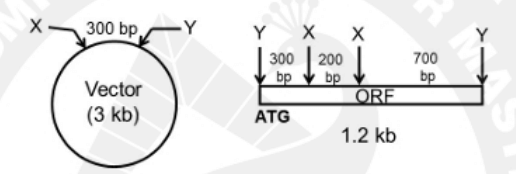
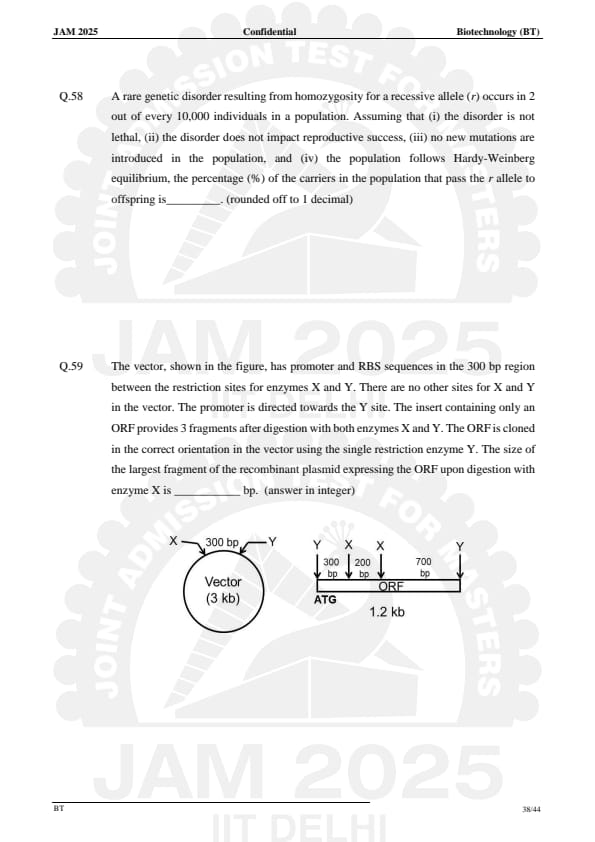
The vector, shown in the figure, has promoter and RBS sequences in the 300 bp region between the restriction sites for enzymes X and Y. There are no other sites for X and Y in the vector. The promoter is directed towards the Y site. The insert containing only an ORF provides 3 fragments after digestion with both enzymes X and Y. The ORF is cloned in the correct orientation in the vector using the single restriction enzyme Y. The size of the largest fragment of the recombinant plasmid expressing the ORF upon digestion with enzyme X is ........... bp. (answer in integer)
View Solution
Step 1: Understanding the figure.
The vector contains a 300 bp region between the restriction sites for enzymes X and Y. The promoter and RBS sequences are within this 300 bp region, and there are no other restriction sites for X and Y.
The insert with the ORF is placed in the vector in the correct orientation, and upon digestion with enzymes X and Y, 3 fragments are generated.
Step 2: Analyzing the digestion.
Since enzyme Y is used to cut the vector and the insert is in the correct orientation, the fragments generated after digestion with X are as follows:
- The fragment created by enzyme X is the largest one, which includes the 300 bp region of the vector plus the ORF.
- The other two fragments are smaller, and one of them corresponds to the promoter region and the RBS.
The largest fragment will be the one containing the 300 bp region plus the insert, which has a size of 1.2 kb (as given in the figure).
Final Answer: \[ \boxed{1200 \, bp} \] Quick Tip: When cloning a gene, the size of the largest fragment after digestion with restriction enzymes is the sum of the vector region and the insert size, assuming the insert is in the correct orientation.
The length of the edge of a variable cube is increasing at the rate of 25 cm s\(^{-1}\). If the initial length of the edge of the cube is 10 cm, the rate of increase of the surface area of the cube is .............. cm\(^2\) s\(^{-1}\). (answer in integer)
View Solution
Step 1: Understanding the problem.
The surface area \( A \) of a cube is given by the formula:
\[ A = 6a^2 \]
Where \( a \) is the length of the edge of the cube. We are given that \( \frac{da}{dt} = 25 \, cm/s \), and we need to find \( \frac{dA}{dt} \), the rate of change of the surface area.
Step 2: Differentiating the surface area formula.
To find \( \frac{dA}{dt} \), we differentiate the surface area equation with respect to time:
\[ \frac{dA}{dt} = 12a \frac{da}{dt} \]
Step 3: Substituting the known values.
At the initial length of the edge of the cube \( a = 10 \, cm \) and \( \frac{da}{dt} = 25 \, cm/s \):
\[ \frac{dA}{dt} = 12 \times 10 \times 25 = 3000 \, cm^2 \, s^{-1} \]
Final Answer: \[ \boxed{3000} \] Quick Tip: To find the rate of change of the surface area of a cube, differentiate the surface area formula \( A = 6a^2 \) with respect to time and substitute the given values for \( a \) and \( \frac{da}{dt} \).













*The article might have information for the previous academic years, please refer the official website of the exam.