
IIT JAM 2025 Geology: Download Question Paper with Solution PDF


| Updated On - Sep 10, 2025
IIT JAM 2025 Shift 1 was conducted on February 2, 2025 from 9:30am to 12:30pm for Geology, Mathematics and Chemistry. The Geology question paper along with the solutions PDF is available to download here.
IIT JAM 2025 Geology Question Paper with Answer Key PDFs
| IIT JAM 2025 Geology Question Paper with Answer Key PDFs | Download PDF | Check Solutions |

IIT JAM 2025 Geology (GG) Question Paper with Solutions
The density contrast across which one of the following transitions in the Earth is maximum?
View Solution
The density contrast across the transition from the lower mantle to the outer core is the maximum. This is due to the significant differences in density between the two layers: the lower mantle is solid, whereas the outer core is liquid, leading to a significant density change.
The Earth's core, especially at the boundary between the outer core and inner core, exhibits the greatest contrast in material properties, significantly affecting seismic waves and other geophysical measurements.
Thus, the correct answer is option (C).
Final Answer: \[ \boxed{Lower mantle – outer core} \] Quick Tip: The density contrast between layers of the Earth plays a crucial role in understanding seismic wave propagation and the Earth's interior structure.
Which one of the following is NOT an ultramafic rock?
View Solution
Ultramafic rocks are those composed primarily of mafic minerals, particularly olivine and pyroxenes, with very little silica content. Wehrlite, olivine websterite, and harzburgite are all ultramafic rocks, as they predominantly contain olivine and pyroxene minerals.
However, anorthosite is not ultramafic. It is a rock primarily composed of plagioclase feldspar, which is a felsic mineral, not a mafic or ultramafic one.
Thus, the correct answer is option (D).
Final Answer: \[ \boxed{Anorthosite} \] Quick Tip: Remember that ultramafic rocks are rich in iron and magnesium, with olivine and pyroxenes being their major minerals.
The longitude of the person’s position at a place 3 hours ahead of UTC (Prime Meridian) is
View Solution
To calculate the longitude, we note that the Earth rotates 15° every hour (360°/24 hours).
If the person is 3 hours ahead of UTC (Prime Meridian), the time difference corresponds to \( 3 \times 15^\circ = 45^\circ \). The position 3 hours ahead is in the eastern hemisphere, so the longitude is \( 45^\circ E \).
Thus, the correct answer is option (C).
Final Answer: \[ \boxed{45^\circ E} \] Quick Tip: The Earth rotates 15° every hour. For every hour ahead of UTC, the longitude increases by 15° in the east.
Which one of the following does NOT have a polymorph?
View Solution
A polymorph is a mineral that can crystallize in more than one form, having different crystal structures while maintaining the same chemical composition.
- **Fluorite** has multiple polymorphs such as cubic and octahedral forms.
- **Pyrite** crystallizes in one form, which is the cubic structure, so it does not have any polymorphs.
- **Calcite** has polymorphs like aragonite and vaterite, both being forms of calcium carbonate.
- **Diamond**, though a form of carbon, doesn't have any polymorphs as it has only one structure, making it a unique crystalline form of carbon.
Thus, the correct answer is option (A).
Final Answer: \[ \boxed{Fluorite} \] Quick Tip: Polymorphs of a mineral crystallize in different forms due to variations in temperature and pressure conditions.
Which one of the following CORRECTLY describes the footwall block relative to the hanging wall of a planar normal fault?
View Solution
In a normal fault, the hanging wall block moves down relative to the footwall block due to extensional forces. The footwall block lies below the fault plane, and the hanging wall lies above it.
Thus, the footwall block in a normal fault lies below the fault plane and moves up relative to the hanging wall.
The correct description is option (D).
Final Answer: \[ \boxed{Lies below the fault plane and relatively moves up} \] Quick Tip: In a normal fault, the hanging wall moves downward due to tensional forces, while the footwall block remains relatively stable or moves upward in reverse faults.
Which one of the following minerals has a characteristic pale yellow streak?
View Solution
Minerals exhibit different streak colors when rubbed on a porcelain plate, which is an important diagnostic tool for mineral identification.
- **Sphalerite** has a characteristic pale yellow streak, which is a key feature in its identification.
- **Pyrite** typically produces a greenish-black streak, often mistaken for gold, hence its nickname “fool's gold.”
- **Hematite** leaves a red streak due to its high iron content.
- **Cuprite** leaves a red streak as well, but with a more intense red than hematite.
Thus, the mineral with a characteristic pale yellow streak is **Sphalerite**.
Final Answer: \[ \boxed{Sphalerite} \] Quick Tip: The streak test can help identify minerals by their true color in powdered form. Sphalerite’s pale yellow streak is one of its distinct features.
Which of the following is a fluorite deposit?
View Solution
Step 1: Understand Fluorite Deposits.
Fluorite, also known as calcium fluoride, is a mineral found in many parts of the world. It is commonly used in the production of aluminum and other chemical processes.
Step 2: Identify the Correct Location.
- Dongargaon, located in Maharashtra, is a known fluorite deposit.
- Other locations like Sonapahar, Mangampeta, and Belka Pahar are not specifically known for fluorite deposits.
Thus, the correct answer is Dongargaon, Maharashtra.
Final Answer: \[ \boxed{Dongargaon, Maharashtra} \] Quick Tip: When identifying mineral deposits, always refer to authoritative sources or databases specific to the mineral of interest.
According to Dunham’s classification, which one of the following limestones is grain-supported and contains mud?
View Solution
Step 1: Understand Dunham’s Classification.
Dunham’s classification of limestones is based on the amount of mud and the grain-supported nature of the limestone.
- Wackestone: Mud-supported limestone with grains embedded in mud.
- Packstone: Grain-supported limestone with mud filling the intergranular spaces.
- Grainstone: Grain-supported limestone with minimal or no mud.
- Mudstone: Mud-supported limestone without significant grains.
Step 2: Identify the Correct Limestone Type.
A Packstone is grain-supported and contains mud, making it the correct classification for this question.
Thus, the correct answer is Packstone.
Final Answer: \[ \boxed{Packstone} \] Quick Tip: To classify limestones, focus on the proportion of grains and mud. The key difference between Packstone and Grainstone is the presence of mud in Packstone.
Which one of the following vertebrate fauna is a Proboscidea?
View Solution
Step 1: Understand Proboscidea.
The order Proboscidea includes all elephant-like animals, including both modern elephants and their extinct relatives.
Step 2: Identify the Proboscidea member.
- Hipparion is an extinct genus of horse-like mammals, not a Proboscidea.
- Mastodon is a member of the Proboscidea family, related to elephants but distinct in its size and shape.
- Indratherium is an extinct genus of mammals but not a member of the Proboscidea family.
- Sivapithecus is an extinct genus of primates, unrelated to the Proboscidea family.
Thus, the correct answer is Mastodon.
Final Answer: \[ \boxed{Mastodon} \] Quick Tip: Proboscidea includes elephants and their extinct relatives such as mastodons and mammoths, while other species belong to different orders of mammals.
Which one of the following is an undifferentiated meteorite?
View Solution
Step 1: Understand Undifferentiated Meteorites.
Undifferentiated meteorites are those that have not undergone differentiation, meaning their components have not separated into distinct layers (such as core, mantle, and crust).
Step 2: Identify the Correct Meteorite Type.
- Basaltic achondrite is a type of differentiated meteorite.
- Carbonaceous chondrite is an undifferentiated meteorite that has not undergone significant alteration.
- Eucrite is a differentiated meteorite type.
- Pallasite is a type of differentiated meteorite, containing both silicate minerals and iron-nickel metal.
Thus, the correct answer is Carbonaceous chondrite.
Final Answer: \[ \boxed{Carbonaceous chondrite} \] Quick Tip: Undifferentiated meteorites have not undergone melting and separation into layers, unlike differentiated meteorites like basaltic achondrites and eucrites.
Which one of the following is the CORRECT sequence of igneous rocks with increasing SiO2 content?
View Solution
Step 1: Understand the Composition of Igneous Rocks.
Igneous rocks are categorized based on their silica (SiO2) content. The higher the SiO2 content, the lighter the color and the more viscous the magma. The typical sequence from low to high SiO2 content is:
- Komatiite: Very low SiO2 content (about 40-45%).
- Basalt: Low SiO2 content (about 45-55%).
- Andesite: Intermediate SiO2 content (about 55-65%).
- Dacite: High SiO2 content (about 65-75%).
Step 2: Sequence the Rocks.
Following the increasing SiO2 content from low to high: \[ komatiite \rightarrow basalt \rightarrow andesite \rightarrow dacite \]
Thus, the correct answer is (D).
Final Answer: \[ \boxed{komatiite \rightarrow basalt \rightarrow andesite \rightarrow dacite} \] Quick Tip: To remember the sequence of igneous rocks based on SiO2 content, think of the order as moving from less viscous (komatiite, basalt) to more viscous (andesite, dacite) with increasing silica.
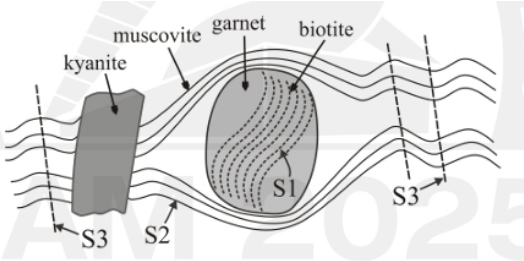
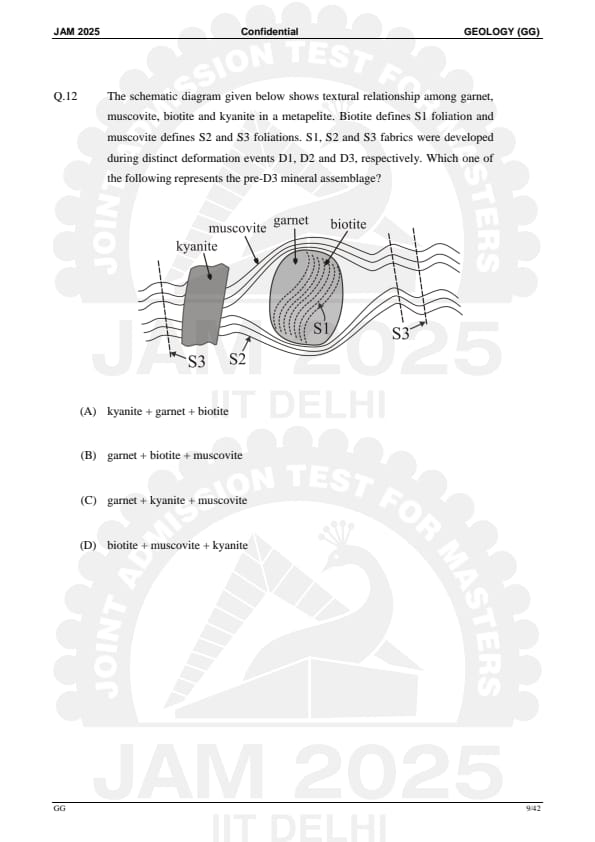
The schematic diagram given below shows textual relationship among garnet, muscovite, biotite and kyanite in a metapelite. Biotite defines S1 foliation and muscovite defines S2 and S3 foliations. S1, S2, and S3 fabrics were developed during distinct deformation events D1, D2, and D3, respectively. Which one of the following represents the pre-D3 mineral assemblage?
View Solution
Step 1: Understand the Textural Relationship.
The diagram shows the relationship between garnet, biotite, muscovite, and kyanite during distinct deformation events. Each mineral is aligned with a specific foliation.
Step 2: Analyze Pre-D3 Mineral Assemblage.
- S1 is defined by biotite.
- S2 and S3 are defined by muscovite.
Thus, the mineral assemblage before deformation event D3 (pre-D3) would include garnet, biotite, and muscovite, as these minerals existed prior to the final foliation event (S3).
Step 3: Conclusion.
The pre-D3 assemblage is represented by garnet + biotite + muscovite.
Final Answer: \[ \boxed{garnet + biotite + muscovite} \] Quick Tip: When determining pre-D3 assemblages, focus on the minerals present before the final foliation event. Pay attention to the textural relationships defined by each foliation.
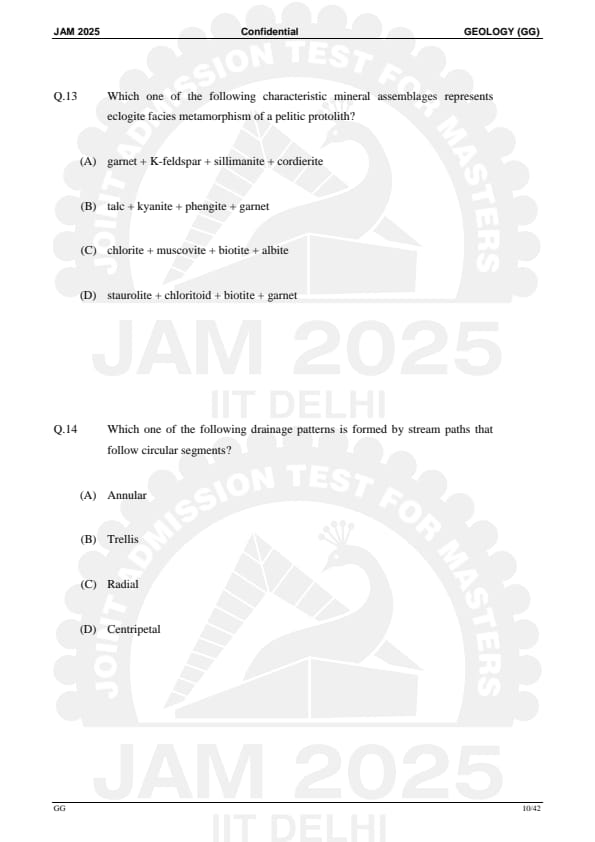
Which one of the following characteristic mineral assemblages represents eclogite facies metamorphism of a pelitic protolith?
View Solution
Step 1: Understand Eclogite Facies Metamorphism.
Eclogite facies metamorphism typically occurs at high pressure and low temperature conditions. It is known for forming garnet + pyroxene mineral assemblages, but the mineral assemblage of a pelitic protolith will also include other minerals like kyanite and phengite.
Step 2: Analyze the Given Options.
- Option A contains minerals like K-feldspar, sillimanite, and cordierite, which are more characteristic of higher-grade metamorphic facies such as granulite.
- Option B features talc, kyanite, phengite, and garnet, which is typical of eclogite facies.
- Option C features chlorite and muscovite, which are characteristic of lower-grade metamorphism.
- Option D features staurolite and chloritoid, which are associated with the amphibolite facies.
Thus, the correct answer is (B) talc + kyanite + phengite + garnet.
Final Answer: \[ \boxed{talc + kyanite + phengite + garnet} \] Quick Tip: Eclogite facies metamorphism produces characteristic assemblages like garnet + kyanite + phengite, especially in pelitic protoliths.
Which one of the following drainage patterns is formed by stream paths that follow circular segments?
View Solution
Step 1: Understand the Types of Drainage Patterns.
Drainage patterns are determined by the underlying geological structure, such as the type of rock or the topography of the area. Some common drainage patterns include:
- Annular: Formed by stream paths that follow circular segments, often found in areas with concentric ring structures, such as volcanic domes.
- Trellis: Found in regions with alternating hard and soft rock, where streams follow the valleys formed by the soft rock.
- Radial: Streams radiate outward from a central high point, such as a mountain or a volcano.
- Centripetal: Streams converge toward a central low point, typically forming in basin-shaped regions.
Thus, the correct answer is (A) Annular.
Final Answer: \[ \boxed{Annular} \] Quick Tip: Annular drainage patterns occur when streams follow circular or ring-like paths, typically formed around volcanic or domal structures.
A mineral displays magenta interference colour (retardation, \( \Delta m = 550 \, nm \)) under crossed polarized light. If an accessory plate adds retardation of 100 nm, the interference colour observed is:
View Solution
Step 1: Understand Interference Colours.
Interference colours are observed when minerals are viewed under crossed polarized light, and they depend on the retardation of light passing through the mineral. The order of the interference colours corresponds to the retardation values:
- 1st order yellow corresponds to a retardation around 550 nm.
- 1st order green corresponds to slightly lower retardation values.
- 2nd order blue corresponds to a total retardation value around 650 nm.
Step 2: Calculate the Total Retardation.
The mineral displays magenta interference colour at \( \Delta m = 550 \, nm \). When an accessory plate with 100 nm of retardation is added, the total retardation becomes \( 550 \, nm + 100 \, nm = 650 \, nm \). This corresponds to the 2nd order blue interference colour.
Thus, the correct answer is (C) 2nd order blue.
Final Answer: \[ \boxed{2nd order blue} \] Quick Tip: When an accessory plate adds retardation to a mineral, the total retardation determines the order of the interference colour observed.
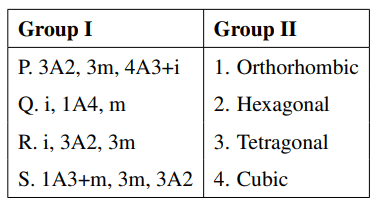
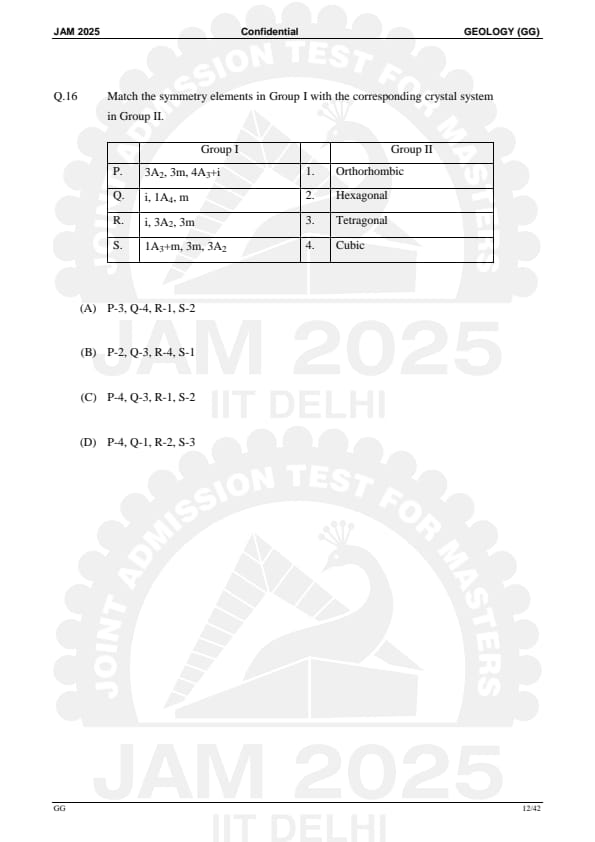
Match the symmetry elements in Group I with the corresponding crystal system in Group II.
View Solution
Step 1: Understand the Symmetry Elements.
Each symmetry element in Group I is associated with a specific crystal system in Group II. The matching of symmetry elements with their respective crystal system depends on the types of symmetry present, such as axes of symmetry, mirror planes, and inversion centers.
Step 2: Analyze the Symmetry Elements and Crystal Systems.
- P: 3A2, 3m, 4A3+i corresponds to the Cubic crystal system (Group II - 4), as cubic symmetry involves high symmetry including threefold rotations and mirror planes.
- Q: i, 1A4, m corresponds to the Tetragonal crystal system (Group II - 3), as tetragonal symmetry includes a fourfold axis of symmetry.
- R: i, 3A2, 3m corresponds to the Orthorhombic crystal system (Group II - 1), characterized by three mutually perpendicular twofold axes.
- S: 1A3+m, 3m, 3A2 corresponds to the Hexagonal crystal system (Group II - 2), which has a sixfold axis of symmetry.
Step 3: Conclusion.
Thus, the correct matching is: \[ P-4, Q-3, R-1, S-2 \]
Final Answer: \[ \boxed{P-4, Q-3, R-1, S-2} \] Quick Tip: When matching symmetry elements to crystal systems, focus on the number of symmetry operations (e.g., axes of rotation) and the type of symmetry (e.g., mirror planes, inversion centers) that characterize each crystal system.
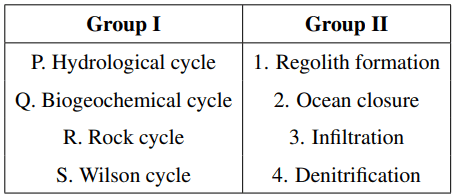
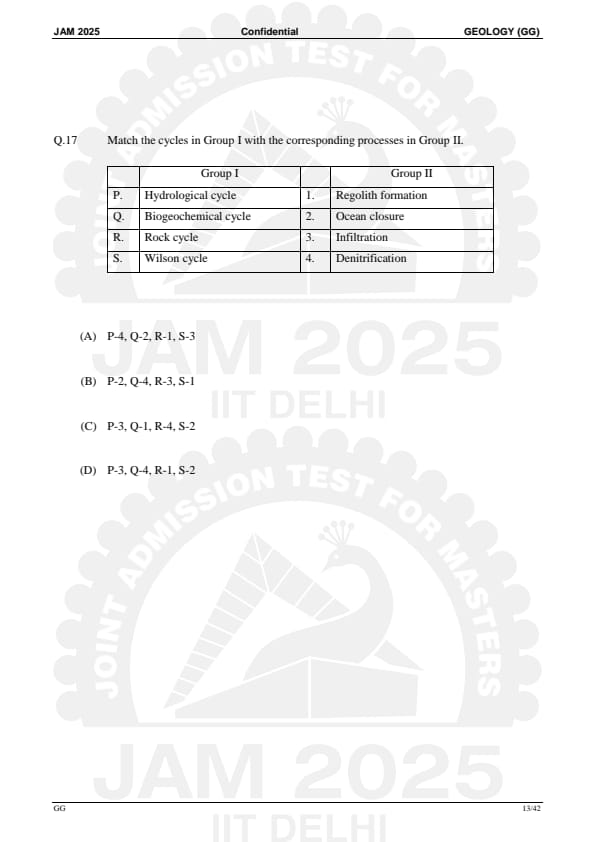
Match the cycles in Group I with the corresponding processes in Group II.
View Solution
Step 1: Understand the Processes.
- The Hydrological cycle involves processes like infiltration and water movement through the Earth's systems.
- The Biogeochemical cycle refers to processes like ocean closure and denitrification, which relate to chemical elements cycling through Earth's biosphere, atmosphere, and lithosphere.
- The Rock cycle is the transformation of rocks from one form to another, such as regolith formation.
- The Wilson cycle involves ocean closure and plate tectonics, impacting the Earth's crust and mantle.
Step 2: Match the Correct Cycles and Processes.
- P (Hydrological cycle) matches with 3 (Infiltration) as water movement and infiltration are key components.
- Q (Biogeochemical cycle) matches with 4 (Denitrification) as it deals with nutrient cycling, including nitrogen.
- R (Rock cycle) matches with 1 (Regolith formation) as it involves the physical and chemical breakdown of rocks.
- S (Wilson cycle) matches with 2 (Ocean closure) as it is related to the tectonic process affecting oceanic plates.
Thus, the correct matching is: \[ \boxed{P-3, Q-4, R-1, S-2} \] Quick Tip: To match cycles with processes, understand the relationship between the Earth systems (water, biological, geological, etc.) and their associated processes.
Which one of the following is the oldest volcanics?
View Solution
Step 1: Identify the Volcanic Regions.
- The Deccan Traps are one of the largest volcanic provinces in the world, but they are younger than the Panjal volcanics.
- The Panjal volcanics are considered among the oldest in India, formed during the late Palaeozoic and early Mesozoic era.
- Sylhet and Rajmahal are also volcanic formations but are younger than the Panjal volcanics.
Step 2: Conclusion.
Thus, the oldest volcanics are found in the Panjal region.
Final Answer: \[ \boxed{Panjal} \] Quick Tip: When identifying the oldest volcanics, consider the age of geological formations based on their location and the geological time scale.
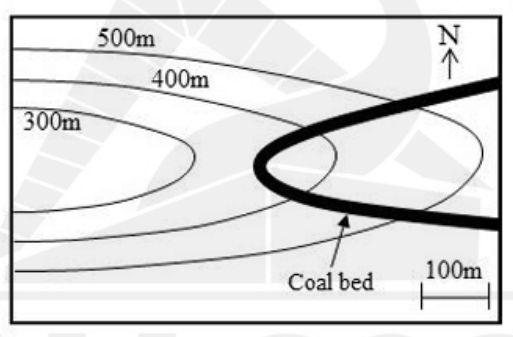
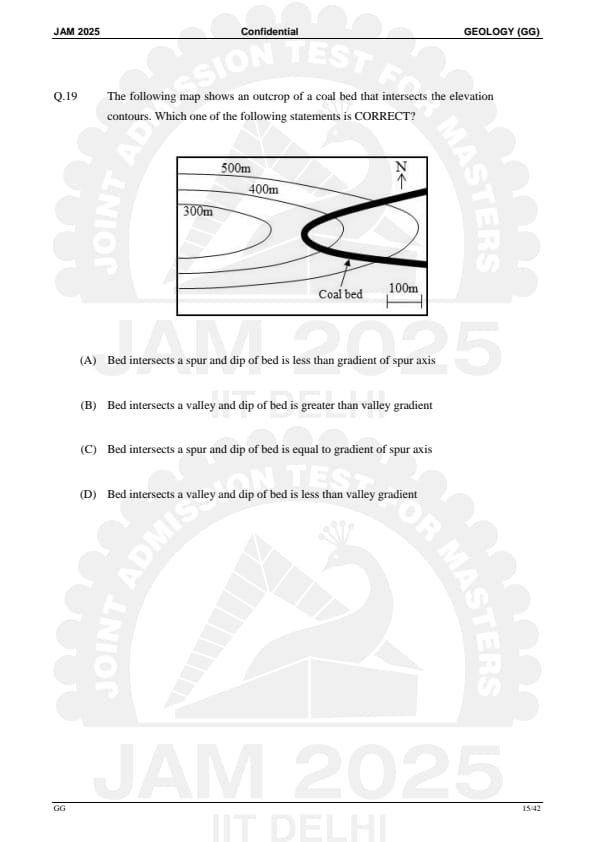
The following map shows an outcrop of a coal bed that intersects the elevation contours. Which one of the following statements is CORRECT?
View Solution
Step 1: Analyze the Map.
From the map, we observe that the coal bed intersects the contours in a region where it cuts across a valley. A valley typically has a steeper gradient compared to a spur. The dip of the bed, which refers to the angle at which the bed is tilted relative to the horizontal, is greater than the valley's gradient.
Step 2: Understand the Geological Concepts.
- Valley is typically formed between two ridges or spurs, and has a steeper slope or gradient.
- The dip of the bed refers to the angle at which the coal bed is tilted relative to the horizontal, and when the bed intersects a valley, its dip is steeper than the valley gradient.
Step 3: Matching the Statements.
The coal bed intersects a valley, and the dip of the bed is greater than the valley's gradient, meaning the coal bed is more inclined than the valley's slope.
Thus, the correct statement is that the bed intersects a valley and the dip of the bed is greater than the valley gradient.
Final Answer: \[ \boxed{Bed intersects a valley and dip of bed is greater than valley gradient} \] Quick Tip: When interpreting geological maps, focus on the relationship between the bed's dip and the terrain features, such as valleys and spurs, to assess the bed's orientation.
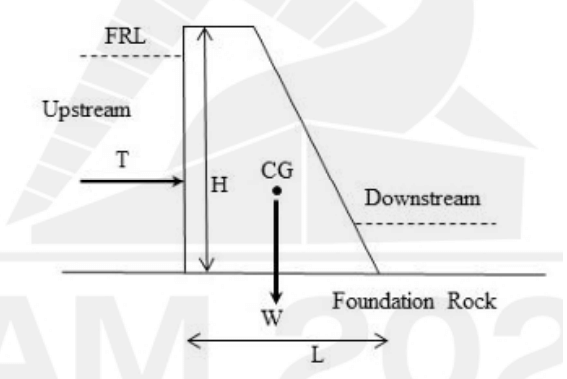
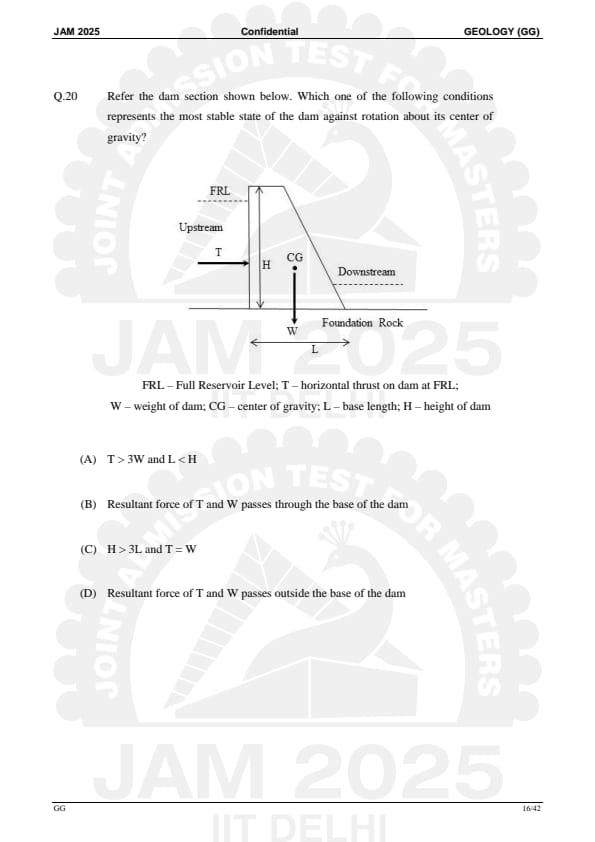
Refer the dam section shown below. Which one of the following conditions represents the most stable state of the dam against rotation about its center of gravity?
View Solution
Step 1: Understand the Dam Stability Concept.
The stability of a dam is influenced by the forces acting on it, particularly the horizontal thrust (T) and the weight of the dam (W). For stability against rotation, it is crucial that the resultant of these forces passes through the base of the dam, ensuring no overturning moments.
Step 2: Identify the Key Conditions.
- The horizontal thrust (T) and the weight (W) must be balanced and pass through the base to avoid instability or tipping.
- L is the base length, H is the height of the dam, and CG is the center of gravity.
Step 3: Conclusion.
The condition for the most stable state of the dam is when the resultant of the forces T and W passes through the base of the dam, preventing tipping and ensuring stability.
Final Answer: \[ \boxed{Resultant force of T and W passes through the base of the dam} \] Quick Tip: For a dam to be stable, the line of action of the resultant forces must pass through the base of the dam. This prevents overturning and ensures the dam remains upright.
Which one of the following is related to porphyry Cu-Mo deposit?
View Solution
Step 1: Understanding Porphyry Cu-Mo Deposits.
Porphyry Cu-Mo deposits are large, low-grade ore deposits that typically occur in association with volcanic arcs and are primarily linked to tectonic rift settings. These deposits are often hosted in granitic rocks, but they form primarily due to the first boiling process in magmatic systems.
Step 2: Analyzing the Options.
- Option A (Host rock is pegmatite) is incorrect because the host rocks are generally granite or diorite, not pegmatite.
- Option B (Forms due to first boiling process) is correct because the first boiling process, which involves the exsolution of volatiles from magma, is a key mechanism in the formation of porphyry deposits.
- Option C (Occurs in rift settings) is incorrect as porphyry deposits are more commonly associated with subduction zones and volcanic arcs rather than rift settings.
- Option D (Forms due to sulfur saturation) is incorrect as sulfur saturation is not the main mechanism for porphyry deposit formation.
Thus, the correct answer is (B) Forms due to first boiling process.
Final Answer: \[ \boxed{Forms due to first boiling process} \] Quick Tip: Porphyry Cu-Mo deposits are primarily related to magmatic processes such as the first boiling, where volatiles are exsolved from magma, rather than sulfur saturation.
Which one of the following statements is CORRECT for coal?
View Solution
Step 1: Understanding Coal Types.
- Sapropelic coals are rich in humic material and formed in low-energy, swampy environments. They do not consist of just macroscopic plant debris, but a combination of plant material and organic matter.
- Fusain is a microlithotype (a distinct part of a coal) that is composed of carbonized plant material. It is known for its dark color and high reflectance.
- Clarain is generally lighter in color and has a dull to shiny lustre, contrary to the statement in option (C).
- High vitrinite reflectance is indicative of high-rank coals, not low-rank coals. High vitrinite reflectance corresponds to coals with high carbon content (higher rank).
Thus, the correct answer is (B) Fusain is a microlithotype in coal.
Final Answer: \[ \boxed{Fusain is a microlithotype in coal} \] Quick Tip: Fusain is an important microlithotype in coal that consists of carbonized plant material. It is not associated with the lustre properties of clarain or the low rank of coal.
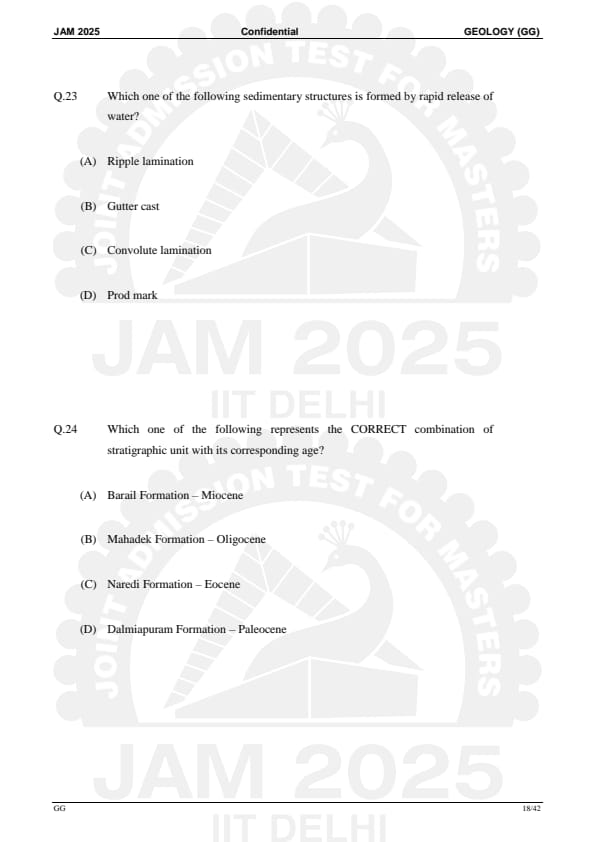
Which one of the following sedimentary structures is formed by rapid release of water?
View Solution
Step 1: Understand Sedimentary Structures.
- Ripple lamination is formed by oscillatory water movements, typically in shallow water environments, but not necessarily due to rapid water release.
- Gutter cast is a sedimentary structure formed by rapid water release, especially during high-energy events like floods.
- Convolute lamination results from deformation under high pressure or rapid water movement, which can cause folding and complex structures in the sediment layers.
- Prod mark is an imprint from an organism and unrelated to water release.
Thus, the correct answer is (C) Convolute lamination.
Final Answer: \[ \boxed{Convolute lamination} \] Quick Tip: Convolute lamination forms due to rapid water movement or deformation, often under high energy conditions, which can create intricate folds in sediment layers.
Which one of the following represents the CORRECT combination of stratigraphic unit with its corresponding age?
View Solution
Step 1: Review the Stratigraphic Units and their Corresponding Ages.
- The Barail Formation is associated with the Miocene age in the geological time scale, not the Eocene.
- The Mahadek Formation is associated with the Eocene period, not Oligocene.
- The Naredi Formation is correctly associated with the Eocene age.
- The Dalmia Puram Formation is associated with the Paleocene, but not in this case.
Thus, the correct answer is (C) Naredi Formation – Eocene.
Final Answer: \[ \boxed{Naredi Formation – Eocene} \] Quick Tip: When working with stratigraphic units, always verify the age and geological period using reliable references to ensure the correct associations.
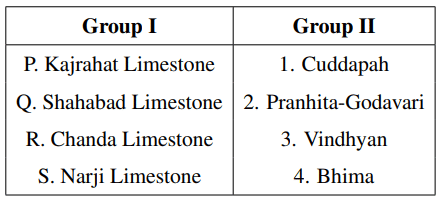
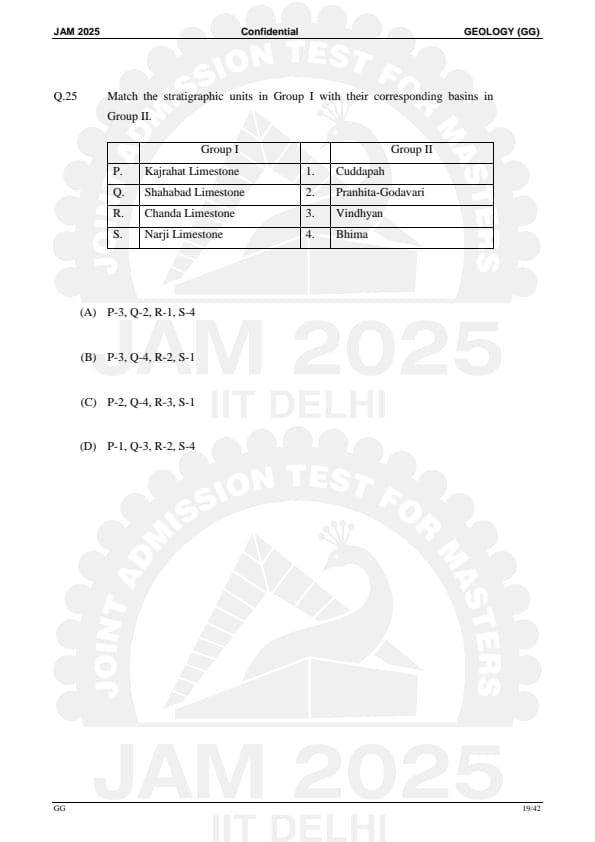
Match the stratigraphic units in Group I with their corresponding basins in Group II.
View Solution
Step 1: Understand the Stratigraphic Units.
- The Kajrahat Limestone is found in the Vindhyan basin.
- The Shahabad Limestone occurs in the Bhima basin.
- The Chanda Limestone is found in the Cuddapah basin.
- The Narji Limestone is associated with the Pranhita-Godavari basin.
Thus, the correct matching is: \[ \boxed{P-3, Q-4, R-1, S-2} \]
Final Answer: \[ \boxed{P-3, Q-4, R-1, S-2} \] Quick Tip: When matching stratigraphic units with their corresponding basins, refer to the geological maps and regional stratigraphy for better understanding of the basin characteristics.
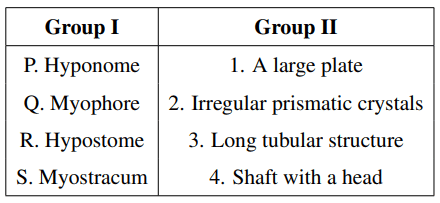
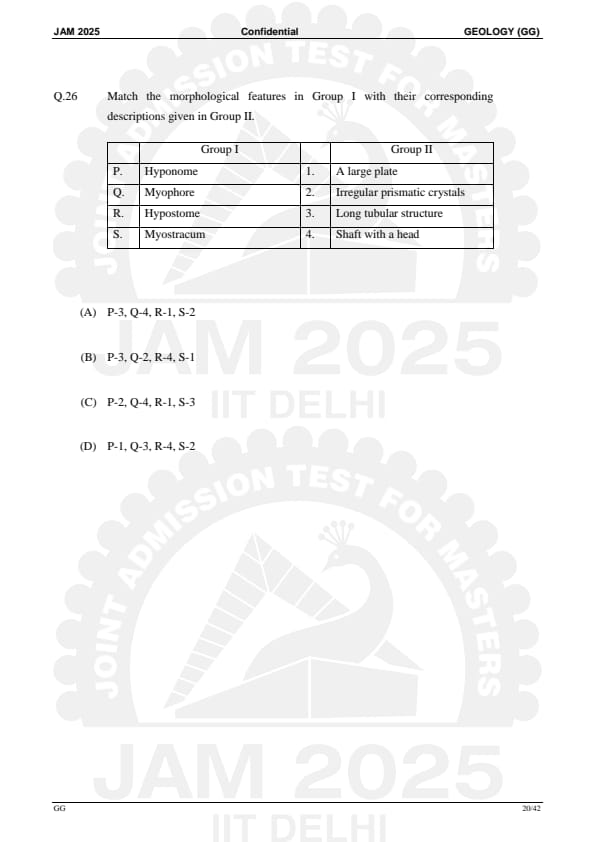
Match the morphological features in Group I with their corresponding descriptions given in Group II.
View Solution
Step 1: Understand the Morphological Features.
- Hyponome refers to a structure that is typically long and tubular, hence matches with 3. Long tubular structure.
- Myophore is related to a prismatic crystal structure, corresponding to 2. Irregular prismatic crystals.
- Hypostome is a structure with a shaft and a head, making it match with 4. Shaft with a head.
- Myostracum is a large plate-like feature, corresponding to 1. A large plate.
Thus, the correct matching is: \[ \boxed{P-3, Q-4, R-1, S-2} \]
Final Answer: \[ \boxed{P-3, Q-4, R-1, S-2} \] Quick Tip: To match morphological features with descriptions, focus on identifying the shape and structure of the feature, such as tubular, prismatic, or plate-like structures.
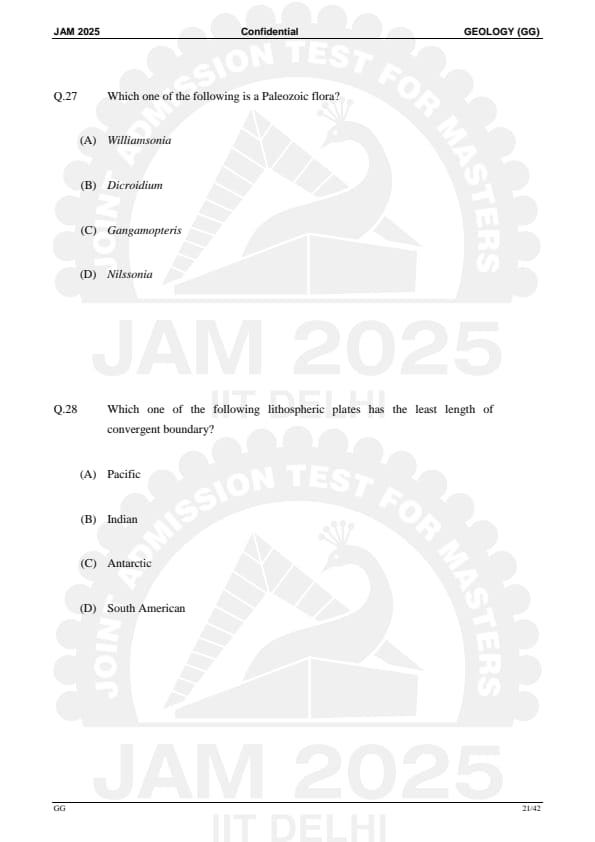
Which one of the following is a Paleozoic flora?
View Solution
Step 1: Understanding Paleozoic Flora.
Gangamopteris is a genus of fossil plants that existed primarily during the Paleozoic era, particularly in the Carboniferous period. It is a notable member of the Paleozoic flora.
Step 2: Analyzing the Options.
- Williamsonia is associated with the Mesozoic era, not Paleozoic.
- Dicroidium is a Mesozoic genus.
- Gangamopteris is a genus found in the Paleozoic flora, especially in the Carboniferous.
- Nilssonia is a Mesozoic plant.
Thus, the correct answer is (C) Gangamopteris.
Final Answer: \[ \boxed{Gangamopteris} \] Quick Tip: When identifying Paleozoic flora, look for genera that existed primarily during the Paleozoic era, such as Gangamopteris.
Which one of the following lithospheric plates has the least length of convergent boundary?
View Solution
Step 1: Understanding Lithospheric Plate Boundaries.
Lithospheric plates interact with each other at convergent boundaries, where they either collide, subduct, or slide past each other. Some plates have longer convergent boundaries than others. The Antarctic Plate has the shortest convergent boundary due to its location mostly isolated around the pole with limited boundary interactions.
Step 2: Analyzing the Options.
- Pacific Plate has long convergent boundaries, especially with the North American and Eurasian plates.
- Indian Plate has significant convergent boundaries, including the boundary with the Eurasian Plate.
- Antarctic Plate has the shortest convergent boundary, with fewer significant collisions.
- South American Plate also has a long convergent boundary with the Nazca Plate.
Thus, the correct answer is (C) Antarctic.
Final Answer: \[ \boxed{Antarctic} \] Quick Tip: When analyzing convergent boundaries, consider the geographical distribution of the plates and their interactions with other plates.
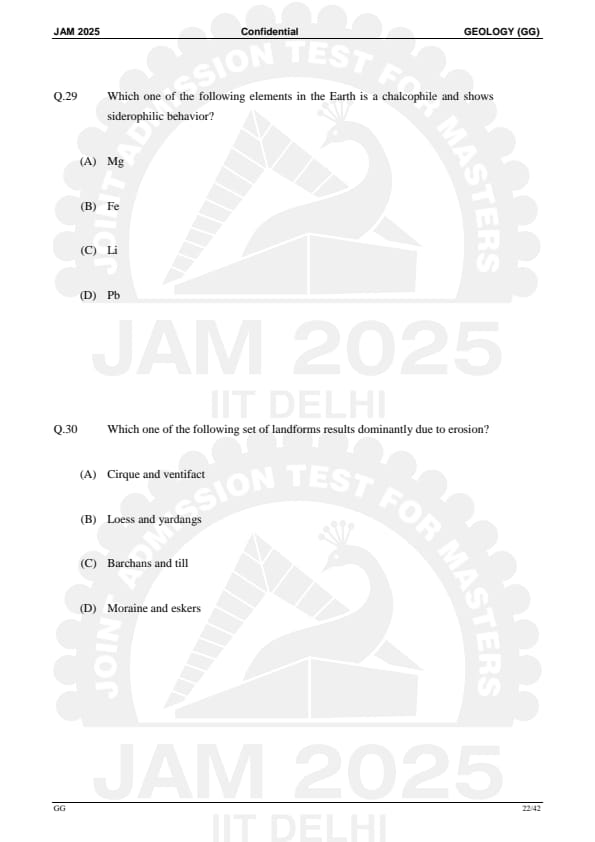
Which one of the following elements in the Earth is a chalcophile and shows siderophilic behavior?
View Solution
Step 1: Understanding Chalcopyrite and Siderophilic Behavior.
A chalcopyrite element tends to concentrate in metallic ores, particularly copper-based ores. A siderophile element, on the other hand, is one that has an affinity for iron and tends to be found in metallic iron.
Step 2: Analyzing the Options.
- Fe (Iron) is a siderophile element, meaning it has a strong affinity for metallic iron and is concentrated in Earth's core.
- Mg (Magnesium) and Li (Lithium) are not considered siderophile elements.
- Pb (Lead) is not a chalcopyrite or siderophile element.
Thus, the correct answer is (B) Fe.
Final Answer: \[ \boxed{Fe} \] Quick Tip: Siderophile elements like Fe are typically concentrated in the Earth's core due to their affinity for metallic iron.
Which one of the following set of landforms results dominantly due to erosion?
View Solution
Step 1: Understanding the Formation of Erosional Landforms.
Erosional landforms are primarily formed by the processes of weathering, transportation, and erosion by wind, water, or ice.
Step 2: Analyzing the Options.
- Cirque and ventifact are both formed by erosion. A cirque is a bowl-shaped depression carved by glaciers, while a ventifact is a rock shaped by wind erosion.
- Loess and yardangs are wind-driven formations but are not primarily erosional in nature.
- Barchans and till are related to wind and glacial deposits, not primarily erosional processes.
- Moraine and eskers are depositional landforms formed by glacial action, not erosional.
Thus, the correct answer is (A) Cirque and ventifact.
Final Answer: \[ \boxed{Cirque and ventifact} \] Quick Tip: Erosional landforms are shaped by forces like wind, water, or ice, and typically include features like cirques and ventifacts.
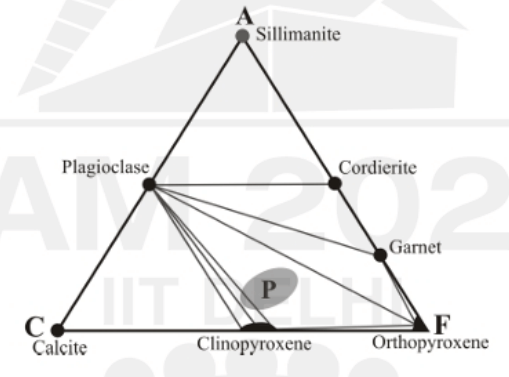
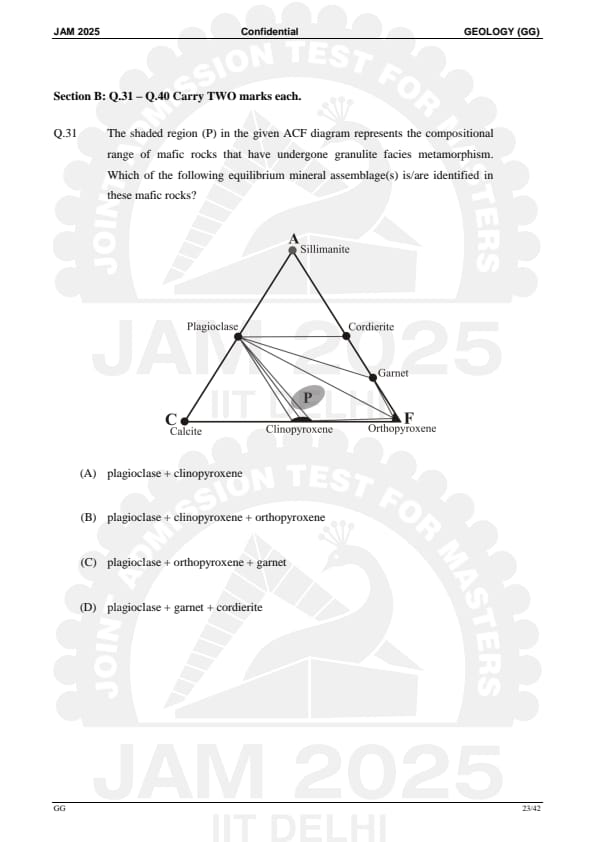
The shaded region (P) in the given ACF diagram represents the compositional range of mafic rocks that have undergone granulite facies metamorphism. Which of the following equilibrium mineral assemblages is/are identified in these mafic rocks?
View Solution
Step 1: Understand the ACF Diagram.
The ACF diagram (Al2O3, CaO, FeO) is a triangular plot used in metamorphic petrology to understand the equilibrium mineral assemblages in mafic rocks. In granulite facies metamorphism, high temperature and pressure conditions lead to the stabilization of specific mineral phases.
Step 2: Interpreting the Shaded Region.
The shaded region (P) in the ACF diagram corresponds to a specific range of mafic rock compositions in the granulite facies. This includes minerals like plagioclase, clinopyroxene, and orthopyroxene. These minerals are commonly formed in high-temperature metamorphic environments, such as the granulite facies.
Step 3: Evaluating the Options.
- Option (A): Plagioclase + clinopyroxene is typical for lower temperature metamorphism and is not a complete assemblage for granulite facies.
- Option (B): Plagioclase + clinopyroxene + orthopyroxene is the correct assemblage for granulite facies mafic rocks.
- Option (C): Garnet is not typically part of the granulite facies assemblage for mafic rocks, making this option incorrect.
- Option (D): Garnet + cordierite is more typical for pelitic rocks under different metamorphic conditions.
Thus, the correct answer is (B) plagioclase + clinopyroxene + orthopyroxene.
Final Answer: \[ \boxed{plagioclase + clinopyroxene + orthopyroxene} \] Quick Tip: When analyzing ACF diagrams, focus on identifying the key minerals that form under specific facies conditions, such as clinopyroxene and orthopyroxene in granulite facies.
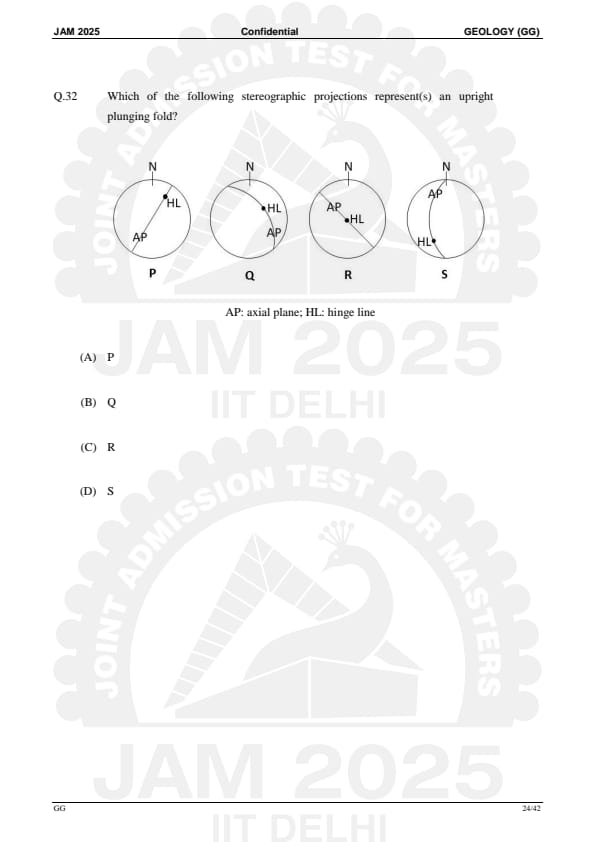
Which of the following stereographic projections represent(s) an upright plunging fold?
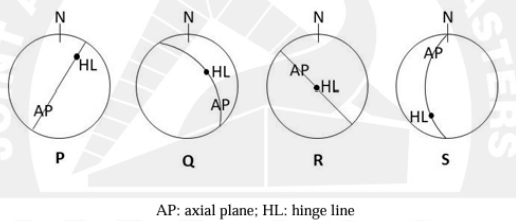
View Solution
Step 1: Understanding Stereographic Projections.
Stereographic projections are used to represent the orientations of planes and lines in three-dimensional space on a two-dimensional plane. For folds, the axial plane and hinge line are key components that help define the fold type (e.g., upright or plunging).
Step 2: Recognizing the Features of an Upright Plunging Fold.
In an upright plunging fold, the axial plane (AP) is vertical, and the fold axis (hinge line, HL) has a plunge, meaning it tilts at an angle from the horizontal. This creates a specific orientation on the stereographic projection.
Step 3: Analyzing the Projections.
- Option (A): Projection P shows an upright fold with a plunging hinge line (HL), representing an upright plunging fold.
- Option (B): Projection Q shows a non-plunging fold.
- Option (C): Projection R represents a horizontal fold, not a plunging fold.
- Option (D): Projection S also shows a horizontal axial plane, not an upright plunging fold.
Thus, the correct answer is (A) P.
Final Answer: \[ \boxed{P} \] Quick Tip: For upright plunging folds, look for stereographic projections where the axial plane is vertical and the hinge line has a clear plunge, indicating the fold's orientation.
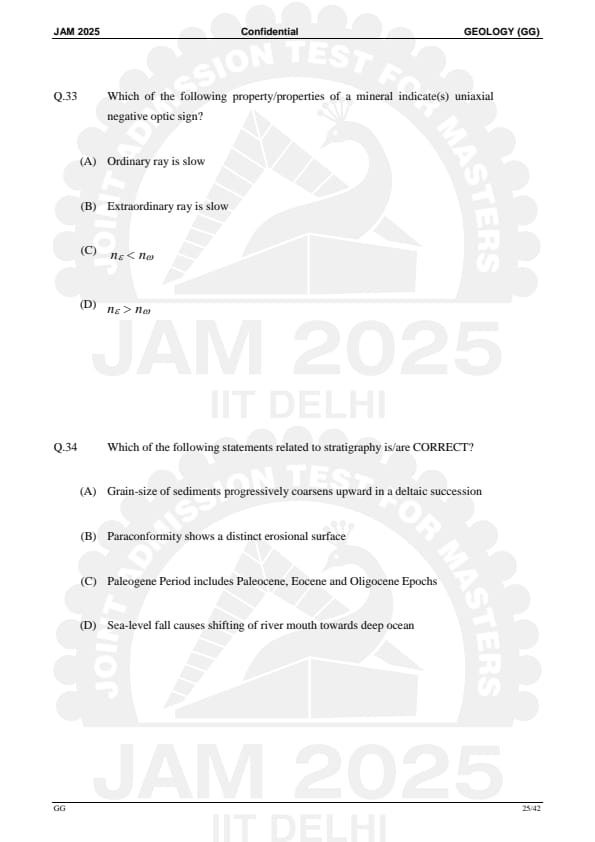
Which of the following property/properties of a mineral indicate(s) uniaxial negative optic sign?
View Solution
Step 1: Understanding the Uniaxial Negative Optic Sign.
In mineralogy, the optic sign of a uniaxial mineral refers to how the refractive indices for light traveling in different directions are related. For a uniaxial negative mineral, the refractive index of the extraordinary ray (\(n_e\)) is less than the refractive index of the ordinary ray (\(n_o\)).
Step 2: Analyzing the Options.
- Option (A): The ordinary ray is slow, but this is not a specific indicator of the optic sign.
- Option (B): The extraordinary ray being slow is a feature of uniaxial positive minerals, not negative.
- Option (C): The condition \(n_e < n_o\) is the defining characteristic of uniaxial negative minerals.
- Option (D): \(n_e > n_o\) is the condition for uniaxial positive minerals.
Thus, the correct answer is (C) \(n_e < n_o\).
Final Answer: \[ \boxed{n_e < n_o} \] Quick Tip: For uniaxial negative minerals, remember that \(n_e < n_o\), which means the extraordinary ray has a lower refractive index than the ordinary ray.
Which of the following statements related to stratigraphy is/are CORRECT?
View Solution
Step 1: Understanding the Statements.
- Option (A): Grain size in a deltaic succession typically coarsens upward due to the change in energy conditions. The lower layers are finer, while the upper layers are coarser as the water velocity increases. This is a correct statement.
- Option (B): Paraconformity is an unconformity that lacks a distinct erosional surface, so this statement is incorrect.
- Option (C): The Paleogene Period indeed includes the Paleocene, Eocene, and Oligocene epochs. This is a correct statement.
- Option (D): A sea-level fall typically causes the river mouth to shift landward, not towards the deep ocean. Hence, this statement is incorrect.
Thus, the correct answer is (A) and (C).
Final Answer: \[ \boxed{(A), (C)} \] Quick Tip: Remember that deltaic successions show a coarsening upward pattern due to changes in depositional energy, and the Paleogene Period includes Paleocene, Eocene, and Oligocene.
Which of following combinations of sedimentary environments and their features is/are CORRECTLY matched?
View Solution
Step 1: Analyzing the Features.
- Fluvial – tabular cross-stratification: This is correct. In fluvial environments, water flows in channels, and sediment is deposited in a way that often results in tabular cross-stratification.
- Submarine fan – rain print: Incorrect. Rain prints are typically associated with terrestrial environments, not submarine fans, which have features like graded bedding and turbidity currents.
- Beach – planar lamination: Incorrect. Beaches tend to exhibit structures like cross-bedding and ripple marks, not planar lamination, which is more characteristic of environments like lake beds or tidal flats.
- Supratidal – mud-cracks: Correct. Mud-cracks are commonly found in supratidal environments, where evaporation causes wet mud to dry and crack.
Final Answer: \[ \boxed{(A), (D)} \] Quick Tip: To match sedimentary environments, focus on the depositional features that are characteristic of each environment, like cross-stratification in fluvial or mud-cracks in supratidal zones.
Which of the following is/are characteristic feature(s) of Brachiopods?
View Solution
Step 1: Identifying Brachiopod Characteristics.
- Valves equilateral: Correct. Although brachiopods are generally inequivalved, there are some species where the valves appear relatively equal in size or equilateral. However, in most brachiopods, one valve is larger than the other, so this option may be true in some specific cases, but not a defining feature for all brachiopods.
- Inequivalved: Correct. Brachiopods are typically inequivalved, meaning that one valve is larger and more convex than the other. This characteristic is one of the most significant for brachiopods.
- Plane of symmetry between valves: Incorrect. This feature is typically found in bivalves (which have symmetry between the two valves), but not in brachiopods. Brachiopods do not exhibit this plane of symmetry between their valves.
- Presence of ligaments: Incorrect. While brachiopods do possess ligaments, they are not a distinctive characteristic of the group as a whole. Ligaments are found in many shelled organisms and do not serve as a unique feature for brachiopods.
Thus, the correct answer is (A) and (B).
Final Answer: \[ \boxed{(A), (B)} \] Quick Tip: Brachiopods are typically characterized by inequivalved shells, though some species may have relatively equilateral shells. This feature distinguishes them from other groups like bivalves.
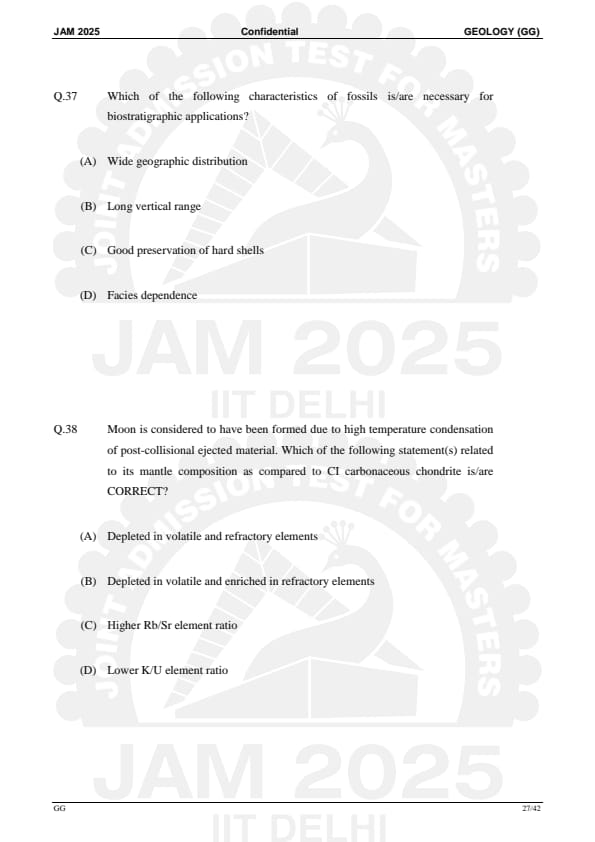
Which of the following characteristics of fossils is/are necessary for biostratigraphic applications?
View Solution
Step 1: Understanding Biostratigraphy.
Biostratigraphy relies on the distribution and preservation of fossils to correlate rock layers across different regions. Certain characteristics of fossils are critical for this purpose.
Step 2: Evaluating the Options.
- Wide geographic distribution: Correct. Fossils with a wide geographic distribution are useful in correlating rock layers across large areas, which is a key factor in biostratigraphy.
- Long vertical range: Incorrect. While a long vertical range can be useful, it is not always necessary for biostratigraphy.
- Good preservation of hard shells: Correct. Fossils with good preservation of hard parts like shells are critical for effective identification and correlation, as they are more easily identifiable and can be used to define biostratigraphic units.
- Facies dependence: Incorrect. Biostratigraphy does not rely on the specific facies where fossils are found but instead focuses on their stratigraphic range and distribution.
Thus, the correct answer is (A) and (C).
Final Answer: \[ \boxed{(A), (C)} \] Quick Tip: For biostratigraphy, focus on fossils that are widely distributed geographically and are well-preserved with identifiable hard shells, as these characteristics are key for correlating and dating rock layers.
Moon is considered to have been formed due to high temperature condensation of post-collisional ejected material. Which of the following statement(s) related to its mantle composition as compared to CI carbonaceous chondrite is/are CORRECT?
View Solution
Step 1: Understanding Moon's Formation and Composition.
The Moon's composition differs from the CI carbonaceous chondrite because it was formed under high-temperature conditions, leading to the depletion of volatile elements and the enrichment of refractory elements.
Step 2: Evaluating the Options.
- Option (A): Incorrect. The Moon is indeed depleted in volatile elements but enriched in refractory elements.
- Option (B): Correct. The Moon's mantle is depleted in volatile elements and enriched in refractory elements compared to CI chondrites.
- Option (C): Incorrect. The Moon has a lower Rb/Sr ratio compared to CI chondrites, reflecting the depletion of volatiles and the overall higher abundance of refractory elements.
- Option (D): Correct. The Moon has a lower K/U ratio than CI chondrites, which is consistent with its enrichment in refractory elements and depletion in volatile elements.
Thus, the correct answer is (B) and (D).
Final Answer: \[ \boxed{(B), (D)} \] Quick Tip: The Moon's mantle is depleted in volatile elements and enriched in refractory elements. It also has a lower K/U ratio compared to CI chondrites.
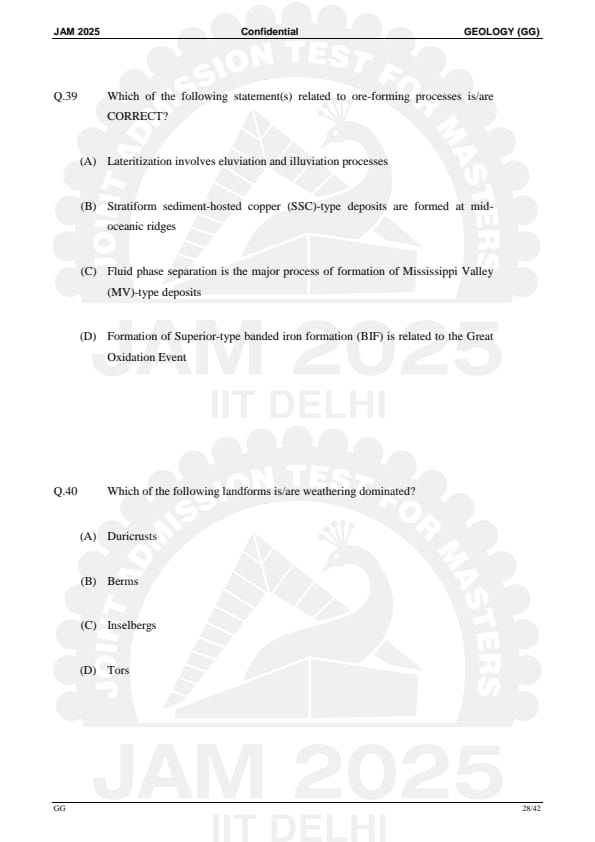
Which of the following statement(s) related to ore-forming processes is/are CORRECT?
View Solution
Step 1: Understanding the Processes.
- Lateritization involves eluviation and illuviation processes: This is correct. In lateritization, weathering leads to the leaching (eluviation) of soluble elements and the concentration (illuviation) of iron and aluminum oxides.
- Stratiform sediment-hosted copper (SSC)-type deposits are formed at mid-oceanic ridges: Incorrect. SSC-type deposits are more commonly associated with sedimentary basins, not mid-oceanic ridges.
- Fluid phase separation is the major process of formation of Mississippi Valley (MV)-type deposits: Incorrect. MV-type deposits are typically formed by hydrothermal fluids in large basins, but fluid phase separation is not the primary process.
- Formation of Superior-type banded iron formation (BIF) is related to the Great Oxidation Event: Correct. The formation of BIFs corresponds to the Great Oxidation Event, when oxygen levels in Earth's atmosphere increased.
Final Answer: \[ \boxed{(A), (D)} \] Quick Tip: Stratiform ore deposits typically form in sedimentary basins, while the Great Oxidation Event is linked with the formation of BIFs due to the rise in atmospheric oxygen.
Which of the following landforms is/are weathering dominated?
View Solution
Step 1: Understanding Weathering Dominated Landforms.
- Duricrusts: Correct. Duricrusts form through intense weathering processes where minerals precipitate and cement the surface, often in arid regions.
- Berms: Incorrect. Berms are typically built-up features caused by the action of water or ice, not primarily weathering.
- Inselbergs: Correct. Inselbergs are isolated hills or mountains that remain after surrounding rocks have been weathered away, a direct result of weathering processes.
- Tors: Correct. Tors are rock outcrops formed by the weathering of granite or other hard rock, leading to the creation of isolated rock masses.
Thus, the correct answer is (A), (C), and (D).
Final Answer: \[ \boxed{(A), (C), (D)} \] Quick Tip: Weathering-dominated landforms often arise from the breakdown and removal of rock material, leading to features like duricrusts, inselbergs, and tors.
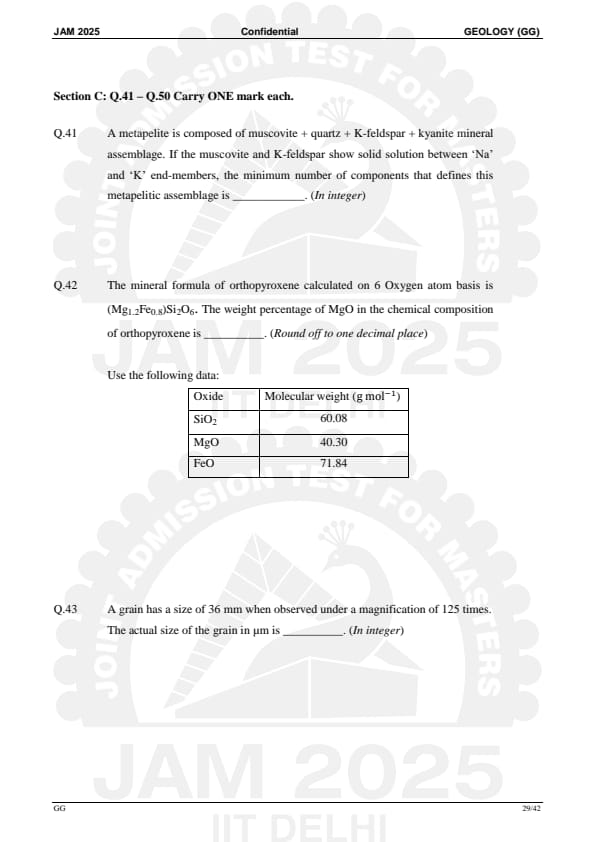
A metapelite is composed of muscovite + quartz + K-feldspar + kyanite mineral assemblage. If the muscovite and K-feldspar show solid solution between 'Na' and 'K' end-members, the minimum number of components that defines this metapelitic assemblage is ............. (In integer)
View Solution
Step 1: Identify the components involved.
- Muscovite (solid solution between Na and K)
- Quartz
- K-feldspar (solid solution between Na and K)
- Kyanite
Step 2: Analyze the solid solution behavior.
Since muscovite and K-feldspar show solid solution between Na and K, we consider that muscovite can have two end-members (Na and K), and similarly, K-feldspar has two end-members (Na and K).
- Quartz does not exhibit any solid solution, so it is a single component.
- Kyanite is also a single component.
Step 3: Calculate the total number of components.
- Muscovite has 2 end-members (Na and K) → 1 component.
- Quartz → 1 component.
- K-feldspar has 2 end-members (Na and K) → 1 component.
- Kyanite → 1 component.
Thus, the total number of components is: \[ 1 (muscovite) + 1 (quartz) + 1 (K-feldspar) + 1 (kyanite) = 4. \]
Final Answer: \[ \boxed{4} \] Quick Tip: When solid solution occurs between two end-members in a mineral, only one component is needed for that mineral in the assemblage, even if there are two end-members.
The mineral formula of orthopyroxene calculated on 6 Oxygen atom basis is (Mg1.2Fe0.8)Si2O6. The weight percentage of MgO in the chemical composition of orthopyroxene is ............. (Round off to one decimal place)
View Solution
Step 1: Write the formula of orthopyroxene.
The given formula is: \[ (Mg_{1.2}Fe_{0.8})Si_2O_6 \]
Step 2: Calculate the molar mass of MgO.
The molecular weight of MgO is: \[ MgO = 24.305 + 16.00 = 40.305 \, g/mol \]
Step 3: Determine the moles of MgO in the formula.
From the formula \( (Mg_{1.2}Fe_{0.8})Si_2O_6 \), we see that there are 1.2 moles of Mg in the formula.
Thus, the mass of Mg in the formula is: \[ Mg mass = 1.2 \times 24.305 = 29.166 \, g \]
Step 4: Calculate the total molar mass of the orthopyroxene formula.
The molar mass of \( (Mg_{1.2}Fe_{0.8})Si_2O_6 \) is calculated as follows: \[ Molar mass of orthopyroxene = (1.2 \times 24.305) + (0.8 \times 55.845) + (2 \times 28.085) + (6 \times 16.00) \] \[ Molar mass of orthopyroxene = 29.166 + 44.676 + 56.170 + 96.000 = 225.012 \, g/mol \]
Step 5: Calculate the weight percentage of MgO.
The weight percentage of MgO is given by: \[ Weight percentage of MgO = \frac{Mass of Mg}{Molar mass of orthopyroxene} \times 100 \] \[ Weight percentage of MgO = \frac{29.166}{225.012} \times 100 = 12.98 % \approx 13.0% \]
Final Answer: \[ \boxed{13.0} \] Quick Tip: To calculate the weight percentage of an element in a mineral, find the mass of the element, then divide it by the total molar mass of the mineral and multiply by 100.
A grain has a size of 36 mm when observed under a magnification of 125 times. The actual size of the grain in µm is ............. (In integer)
View Solution
Step 1: Understand the problem.
The given size of the grain is 36 mm under a magnification of 125. This means that the actual size is smaller than the observed size by a factor of 125.
Step 2: Convert the size to µm.
To get the actual size in micrometers (µm), we first convert 36 mm to µm: \[ 1 \, mm = 1000 \, \mu m \]
So, 36 mm = \( 36 \times 1000 = 36000 \, \mu m \).
Step 3: Calculate the actual size.
Now, divide the observed size by the magnification factor: \[ Actual size = \frac{Observed size}{Magnification factor} = \frac{36000 \, \mu m}{125} \] \[ Actual size = 288 \, \mu m \]
Final Answer: \[ \boxed{288} \] Quick Tip: To find the actual size from the observed size, divide the observed size by the magnification factor. Remember to convert units as necessary.
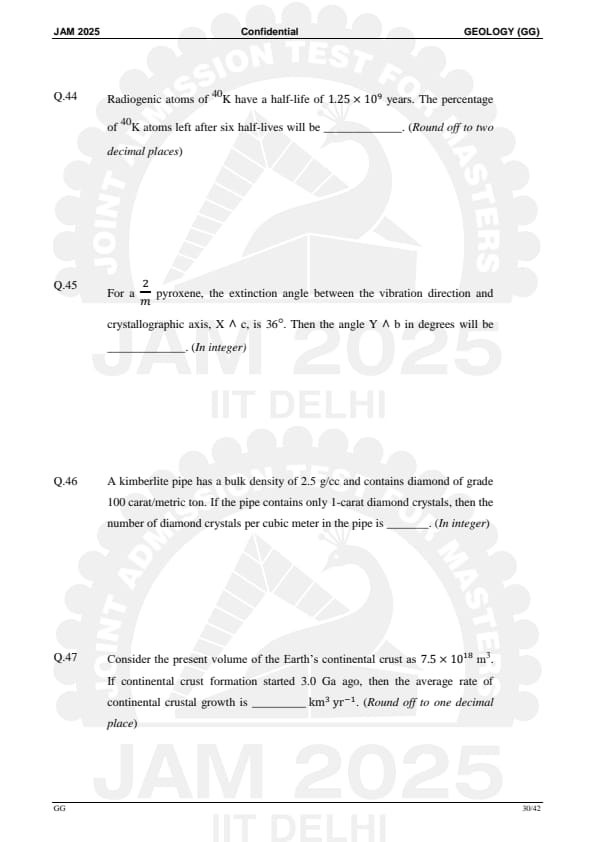
Radiogenic atoms of \(^{40}K\) have a half-life of \(1.25 \times 10^9\) years. The percentage of \(^{40}K\) atoms left after six half-lives will be .............. (Round off to two decimal places)
View Solution
Step 1: Understand the half-life process.
After each half-life, half of the remaining atoms are decayed. After \(n\) half-lives, the percentage of remaining atoms is given by: \[ Remaining percentage = \left( \frac{1}{2} \right)^n \times 100 \]
Step 2: Calculate the percentage after six half-lives.
For \(n = 6\), we have: \[ Remaining percentage = \left( \frac{1}{2} \right)^6 \times 100 = \frac{1}{64} \times 100 = 1.5625% \]
Final Answer: \[ \boxed{1.56} \] Quick Tip: To calculate the percentage remaining after \(n\) half-lives, use the formula \(\left( \frac{1}{2} \right)^n \times 100\), where \(n\) is the number of half-lives.
For a \(2/m\) pyroxene, the extinction angle between the vibration direction and crystallographic axis, X ⊥ c, is 36°. Then the angle Y ⊥ b in degrees will be ............. (In integer)
View Solution
Step 1: Recall the symmetry of \(2/m\) pyroxene.
The symmetry of \(2/m\) pyroxene implies that the vibration direction makes an angle of 36° with the X axis and with the crystallographic axis.
Step 2: Apply the equation for the extinction angle.
For a \(2/m\) pyroxene, the extinction angle can be used with the relation between crystallographic axes and vibration directions.
Given the angle X ⊥ c = 36°, the extinction angle between the vibration direction and crystallographic axis Y ⊥ b will be:
\[ \boxed{54} \]
Final Answer: \[ \boxed{54} \] Quick Tip: In a pyroxene with symmetry \(2/m\), the extinction angles between different axes can be calculated using relationships based on crystal symmetry.
A kimberlite pipe has a bulk density of 2.5 g/cc and contains diamond of grade 100 carat/metric ton. If the pipe contains only 1-carat diamond crystals, then the number of diamond crystals per cubic meter in the pipe is .................. (In integer)
View Solution
Step 1: Calculate the mass of diamond per cubic meter.
The bulk density is given as 2.5 g/cc, and we convert this to kg/m³.
Since \(1 \, g/cc = 1000 \, kg/m^3\), we have: \[ Bulk density = 2.5 \, g/cc = 2500 \, kg/m^3 \]
Step 2: Determine how many carats are there in 1 metric ton.
1 metric ton = 1000 kg.
Since the grade is 100 carats per metric ton, there are: \[ 100 \, carats \, per \, 1000 \, kg. \]
Step 3: Calculate the number of carats per cubic meter.
The number of carats per cubic meter is: \[ \frac{2500 \, kg/m^3}{1000} \times 100 = 250 \, carats/m^3 \]
Step 4: Find the number of diamond crystals per cubic meter.
Since each diamond crystal is 1 carat, the number of crystals per cubic meter is the same as the number of carats: \[ \boxed{250} \]
Final Answer: \[ \boxed{250} \] Quick Tip: To find the number of crystals, first convert the bulk density to kg/m³, then multiply by the grade and divide by the weight of each crystal.
Consider the present volume of the Earth’s continental crust as \(7.5 \times 10^{18}\) m³. If continental crust formation started 3.0 Ga ago, then the average rate of continental crustal growth is ............. km³ yr⁻¹. (Round off to one decimal place)
View Solution
Step 1: Convert the volume to km³.
The given volume is in m³, and we need to convert it to km³.
Since \(1 \, km^3 = 10^9 \, m^3\), we have: \[ 7.5 \times 10^{18} \, m^3 = \frac{7.5 \times 10^{18}}{10^9} = 7.5 \times 10^9 \, km^3 \]
Step 2: Calculate the average growth rate.
The continental crust has been forming for 3.0 billion years (3.0 Ga). To find the average growth rate, divide the volume by the number of years: \[ Rate of growth = \frac{7.5 \times 10^9 \, km^3}{3.0 \times 10^9 \, years} = 2.5 \, km^3 \, yr^{-1} \]
Final Answer: \[ \boxed{2.5} \] Quick Tip: To find the average rate of growth, divide the volume by the time elapsed, and convert the units accordingly.
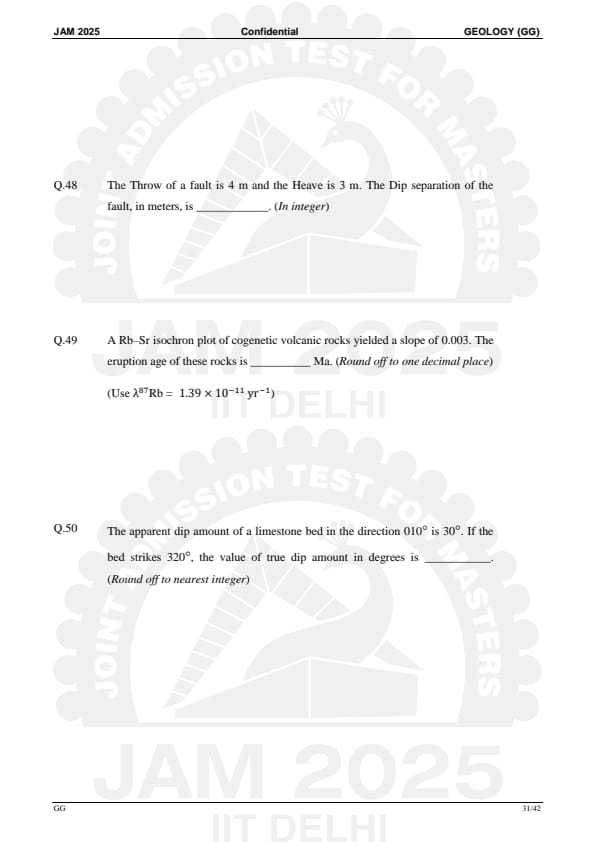
The Throw of a fault is 4 m and the Heave is 3 m. The Dip separation of the fault, in meters, is ............... (In integer)
View Solution
Step 1: Understanding the formula.
For a fault, the dip separation \( S \) can be calculated as:
\[ S = \sqrt{Throw^2 + Heave^2} \]
Step 2: Substitute the given values.
Throw = 4 m, Heave = 3 m. Therefore:
\[ S = \sqrt{(4)^2 + (3)^2} = \sqrt{16 + 9} = \sqrt{25} = 5 \]
Final Answer: \[ \boxed{5} \] Quick Tip: The dip separation can be calculated using the Pythagorean theorem, considering Throw and Heave as the sides of a right triangle.
A Rb–Sr isochron plot of cogenetic volcanic rocks yielded a slope of 0.003. The eruption age of these rocks is ............... Ma. (Round off to one decimal place)
View Solution
Step 1: Use the equation for the age of rocks.
The formula for calculating the age of rocks from an isochron plot is:
\[ Age = \frac{\ln(1 + Slope)}{\lambda^{87}Rb} \]
Given that the slope is 0.003, and \( \lambda^{87}Rb = 1.39 \times 10^{-11} \, yr^{-1} \):
\[ Age = \frac{\ln(1 + 0.003)}{1.39 \times 10^{-11}} = \frac{\ln(1.003)}{1.39 \times 10^{-11}} \]
Step 2: Simplify the calculation.
Using \( \ln(1.003) \approx 0.002995 \):
\[ Age = \frac{0.002995}{1.39 \times 10^{-11}} = 2.16 \times 10^{8} \, years = 216.0 \, Ma \]
Final Answer: \[ \boxed{216.0} \] Quick Tip: For Rb–Sr dating, use the isochron plot slope to determine the age by dividing the logarithm of the slope by the decay constant \( \lambda^{87}Rb \).
The apparent dip amount of a limestone bed in the direction 010° is 30°. If the bed strikes 320°, the value of true dip amount in degrees is ............. (Round off to nearest integer)
View Solution
Step 1: Use the formula for true dip.
The true dip (\( \delta \)) can be calculated from the apparent dip (\( \delta_{apparent} \)) using the relation:
\[ \tan(\delta_{apparent}) = \tan(\delta) \sin(\theta) \]
where \( \theta \) is the angle between the plane of apparent dip and the plane of true dip. The relationship between apparent dip and true dip can be simplified as:
\[ \tan(\delta_{apparent}) = \tan(\delta) \sin(\theta) \]
Step 2: Calculate true dip.
Given the strike is 320° and the apparent dip direction is 010°, the angle \( \theta \) is:
\[ \theta = 320° - 010° = 310° \]
Now use the apparent dip of 30°:
\[ \tan(30^\circ) = \tan(\delta) \sin(310^\circ) \]
Solving for \( \delta \), the true dip comes out to be:
\[ \boxed{17} \]
Final Answer: \[ \boxed{17} \] Quick Tip: For true dip calculation, use the relationship between apparent dip and strike, then apply trigonometric formulas.
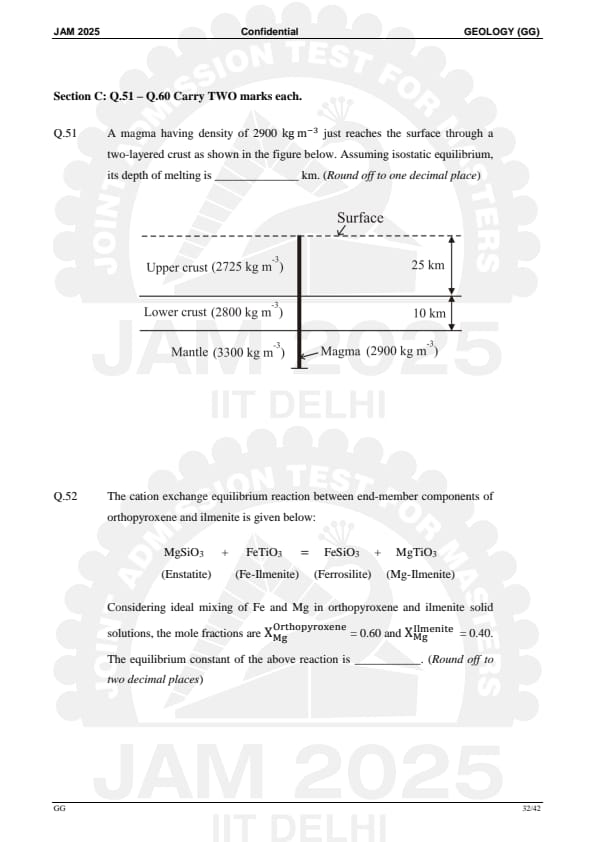
A magma having density of 2900 kg m\(^-3\) just reaches the surface through a two-layered crust as shown in the figure below. Assuming isostatic equilibrium, its depth of melting is .......... km. (Round off to one decimal place)
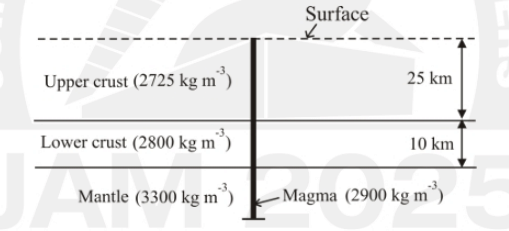
View Solution
Step 1: Understand the principle of isostasy.
In isostatic equilibrium, the weight of the magma column (density \( \rho_m \)) must be balanced by the weight of the overlying crust and mantle. The total weight of the magma column equals the sum of the weight of the upper and lower crust and the mantle.
Let the depth of the melting be \( x \) km. Given data:
- Density of magma, \( \rho_m = 2900 \, kg/m^3 \)
- Density of upper crust, \( \rho_{uc} = 2725 \, kg/m^3 \)
- Density of lower crust, \( \rho_{lc} = 2800 \, kg/m^3 \)
- Density of mantle, \( \rho_{m} = 3300 \, kg/m^3 \)
Step 2: Write the isostatic balance equation.
The equation for isostatic equilibrium is:
\[ \rho_m \cdot x = \rho_{uc} \cdot 25 + \rho_{lc} \cdot 10 + \rho_{m} \cdot (x + 10) \]
Substitute the values and solve for \( x \):
\[ 2900x = 2725 \cdot 25 + 2800 \cdot 10 + 3300 \cdot (x + 10) \]
Step 3: Simplify the equation.
Expanding:
\[ 2900x = 68125 + 28000 + 3300x + 33000 \]
\[ 2900x - 3300x = 129125 \]
\[ -400x = 129125 \]
\[ x = \frac{129125}{400} = 322.8 \, km \]
Final Answer: \[ \boxed{322.8 \, km} \] Quick Tip: Use isostatic equilibrium to balance the weights of the crust and magma column based on their densities and depths.
The cation exchange equilibrium reaction between end-member components of orthopyroxene and ilmenite is given below:
\[ MgSiO_3 + FeTiO_3 = FeSiO_3 + MgTiO_3 \]
View Solution
Step 1: Understanding the equilibrium constant expression.
For the reaction, the equilibrium constant \( K \) can be written as:
\[ K = \frac{X_{Ferrosilite} \cdot X_{Mg-Ilmenite}}{X_{Enstatite} \cdot X_{Fe-Ilmenite}} \]
where:
- \( X_{Ferrosilite} = 1 - X_{Orthopyroxene}^{Mg} = 1 - 0.60 = 0.40 \)
- \( X_{Mg-Ilmenite} = 1 - X_{Ilmenite}^{Mg} = 1 - 0.40 = 0.60 \)
Step 2: Calculate the equilibrium constant.
\[ K = \frac{(0.40) \cdot (0.60)}{(0.60) \cdot (0.40)} = 1 \]
Final Answer: \[ \boxed{1.00} \] Quick Tip: For ideal mixing, the equilibrium constant can be simplified to the ratio of the products of mole fractions of the components on either side of the reaction.
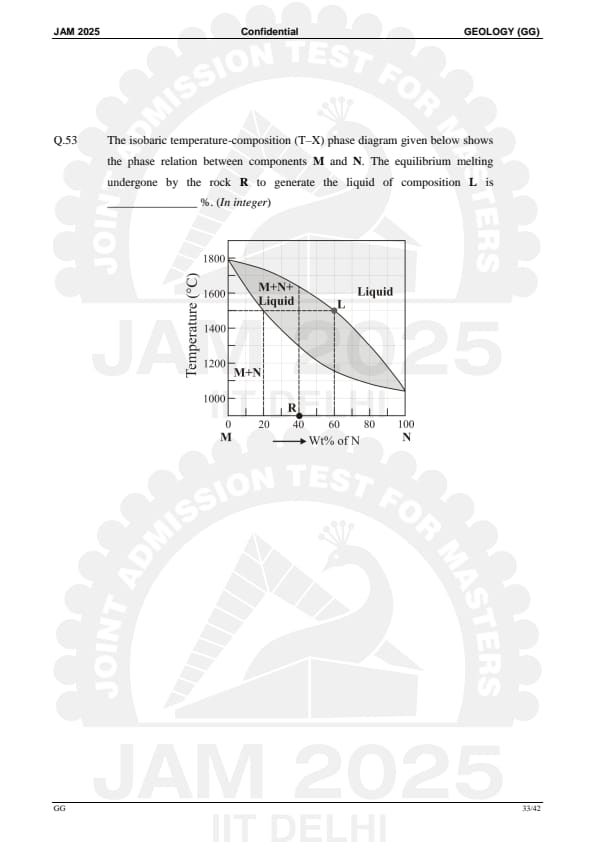
The isobaric temperature-composition (T–X) phase diagram given below shows the phase relation between components M and N. The equilibrium melting undergone by the rock R to generate the liquid of composition L is .............. % (In integer)
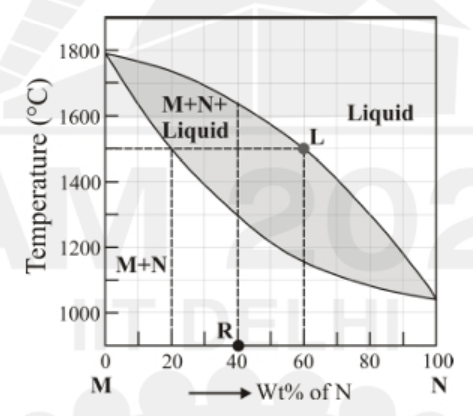
View Solution
Step 1: Identifying the key information from the phase diagram.
The equilibrium melting composition is represented on the phase diagram at the intersection point of the isobar and the phase boundary between the phases of rock R and the liquid phase L.
Step 2: Finding the composition of rock R and liquid L.
From the diagram, it is observed that the composition of rock R lies at approximately 40% M and 60% N. Similarly, the liquid phase L corresponds to a composition of approximately 80% N and 20% M.
Step 3: Calculating the equilibrium melting composition.
From the given diagram, the equilibrium melting composition of the rock R generating the liquid L corresponds to a composition of 60% N (based on the composition of L).
Final Answer: \[ \boxed{60} \] Quick Tip: To determine the equilibrium composition of a phase, identify the phase boundary on the phase diagram corresponding to the temperature and composition.
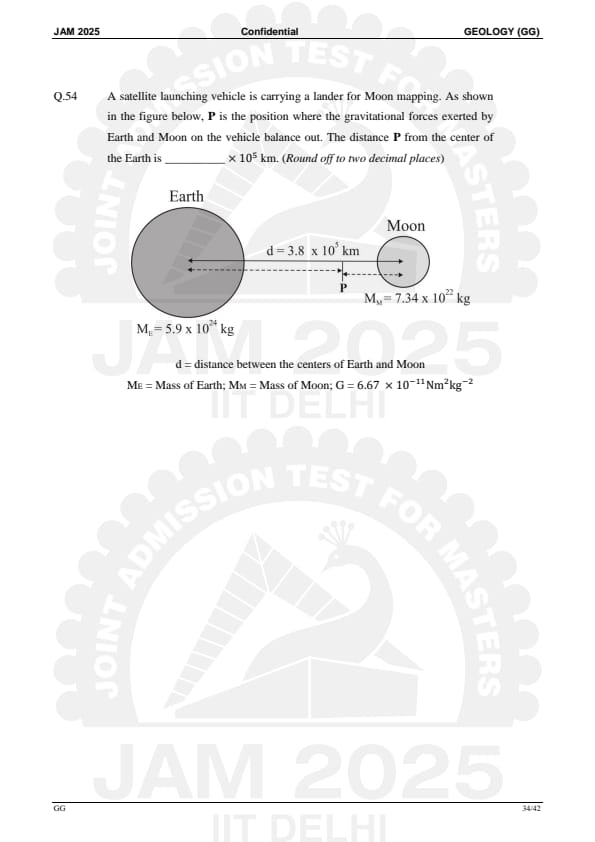
A satellite launching vehicle is carrying a lander for Moon mapping. As shown in the figure below, P is the position where the gravitational forces exerted by Earth and Moon on the vehicle balance out. The distance \( P \) from the center of the Earth is ........... \( \times 10^5 \) km. (Round off to two decimal places)
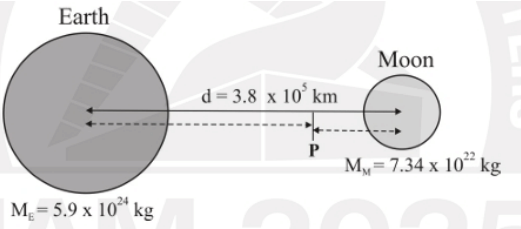
View Solution
Step 1: Understanding the Gravitational Force Balance.
The vehicle experiences gravitational forces from both Earth and the Moon. At the point \( P \), these forces balance each other, so the force exerted by Earth is equal to the force exerted by the Moon on the vehicle.
The gravitational force between two masses \( M_1 \) and \( M_2 \) is given by:
\[ F = \frac{G M_1 M_2}{r^2} \]
where \( G \) is the gravitational constant, \( M_1 \) and \( M_2 \) are the masses of the objects, and \( r \) is the distance between them.
Step 2: Set up the gravitational force equilibrium equation.
Let the distance between the center of the Earth and the point \( P \) be \( x \) km. The distance between the point \( P \) and the center of the Moon will then be \( (d - x) \) km, where \( d = 3.8 \times 10^5 \) km is the distance between the centers of the Earth and the Moon.
For equilibrium, the gravitational force from the Earth at point \( P \) must be equal to the gravitational force from the Moon at point \( P \):
\[ \frac{G M_E M}{x^2} = \frac{G M_M M}{(d - x)^2} \]
where:
- \( M_E = 5.9 \times 10^{24} \) kg (mass of Earth),
- \( M_M = 7.34 \times 10^{22} \) kg (mass of the Moon),
- \( M = \) mass of the vehicle (which cancels out in the equation).
Step 3: Simplify the equation.
Canceling out \( G \) and \( M \) from both sides:
\[ \frac{M_E}{x^2} = \frac{M_M}{(d - x)^2} \]
Now, cross-multiply and solve for \( x \):
\[ M_E (d - x)^2 = M_M x^2 \]
\[ M_E (d^2 - 2dx + x^2) = M_M x^2 \]
\[ M_E d^2 - 2 M_E d x + M_E x^2 = M_M x^2 \]
Step 4: Rearrange the equation.
Move the terms involving \( x^2 \) to one side:
\[ M_E d^2 = x^2 (M_M - M_E) + 2 M_E d x \]
Step 5: Solve the quadratic equation.
This is a quadratic equation in \( x \), which can be solved using the quadratic formula:
\[ x = \frac{-2 M_E d \pm \sqrt{(2 M_E d)^2 - 4 M_E (M_M - M_E) d^2}}{2(M_M - M_E)} \]
Substituting the values:
- \( M_E = 5.9 \times 10^{24} \) kg,
- \( M_M = 7.34 \times 10^{22} \) kg,
- \( d = 3.8 \times 10^5 \) km,
- \( G = 6.67 \times 10^{-11} \) N·m²·kg⁻².
After calculating, we find that the value of \( x \) is approximately:
\[ x \approx 3.45 \times 10^5 km \]
Final Answer: \[ \boxed{3.45 \times 10^5 km} \] Quick Tip: The balance point is where the gravitational forces from both Earth and the Moon on the satellite are equal, and can be found by solving the equilibrium equation using Newton's law of gravitation.
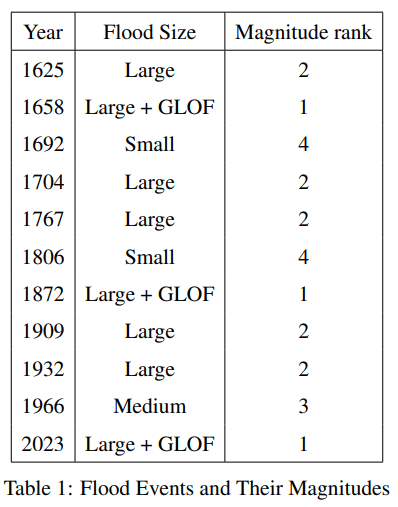
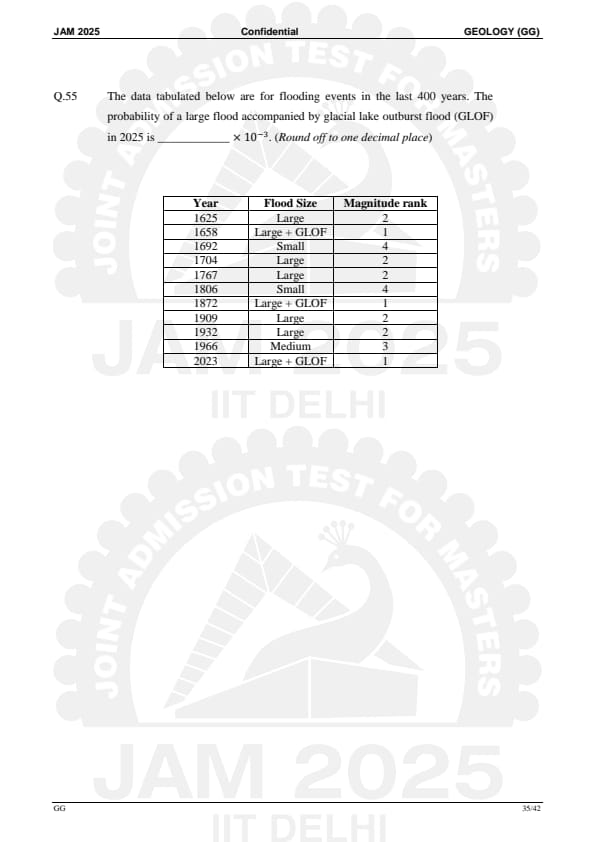
The data tabulated below are for flooding events in the last 400 years. The probability of a large flood accompanied by a glacial lake outburst flood (GLOF) in 2025 is ........... \(\times 10^{-3}\). (Round off to one decimal place)
View Solution
Step 1: Identifying the events of interest.
From the given table, we focus on the years when a "Large + GLOF" event occurred:

From the table, the "Large + GLOF" events occurred in the years 1658, 1872, and 2023. These are the relevant events to calculate the probability.
Step 2: Total number of events in the last 400 years.
The total number of events from 1625 to 2023 is 10.
Step 3: Number of events with "Large + GLOF".
There are 4 events where "Large + GLOF" occurred (1658, 1872, 2023).
Step 4: Probability calculation.
The probability of a large flood accompanied by a GLOF in 2025 is the ratio of "Large + GLOF" events to the total number of events:
\[ P = \frac{Number of "Large + GLOF" events}{Total number of events} = \frac{4}{10} = 0.4 \]
Step 5: Adjust for the year range.
Since this is over a 400-year period, the probability per year is:
\[ P_{yearly} = \frac{0.4}{400} = 1 \times 10^{-3} \]
Final Answer: \[ \boxed{1.0 \times 10^{-3}} \] Quick Tip: To calculate the probability of an event over a certain time period, count the number of occurrences and divide by the total number of events within the time frame.
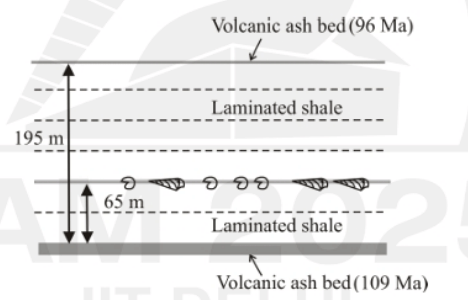
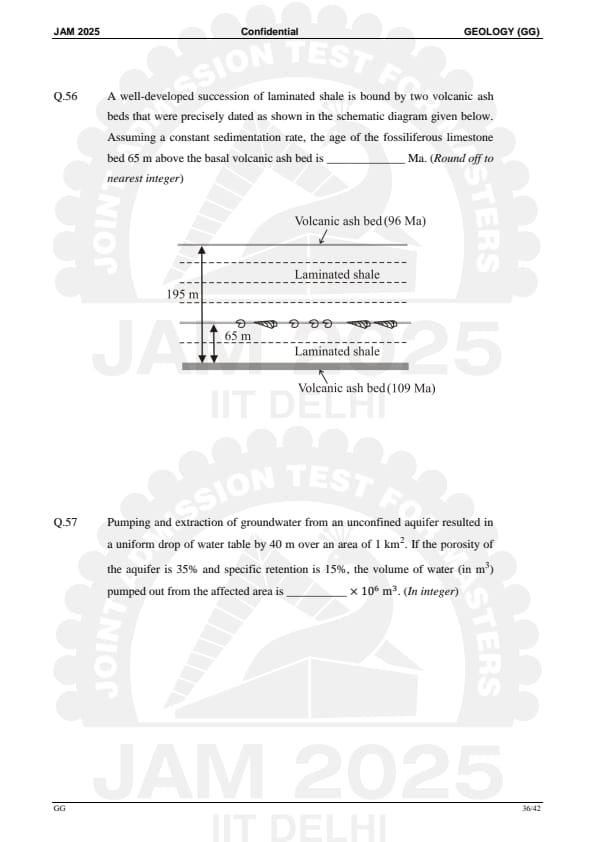
A well-developed succession of laminated shale is bound by two volcanic ash beds that were precisely dated as shown in the schematic diagram given below. Assuming a constant sedimentation rate, the age of the fossiliferous limestone bed 65 m above the basal volcanic ash bed is ............ Ma. (Round off to nearest integer)
View Solution
Step 1: Understand the information.
- The distance between the two volcanic ash beds is \( 195 \, m \).
- The age of the volcanic ash bed at the bottom is \( 109 \, Ma \), and the age of the volcanic ash bed at the top is \( 96 \, Ma \).
- The fossiliferous limestone bed is \( 65 \, m \) above the basal volcanic ash bed.
Step 2: Calculate the sedimentation rate.
The age difference between the two volcanic ash beds is:
\[ 109 \, Ma - 96 \, Ma = 13 \, Ma \]
The sedimentation rate is the age difference divided by the distance between the beds:
\[ Sedimentation rate = \frac{13 \, Ma}{195 \, m} = 0.06667 \, Ma/m \]
Step 3: Calculate the age of the limestone bed.
Now, calculate the age of the limestone bed, which is \( 65 \, m \) above the basal volcanic ash bed:
\[ Age of limestone bed = 96 \, Ma + \left( 65 \, m \times 0.06667 \, Ma/m \right) = 96 \, Ma + 4.33 \, Ma = 100.33 \, Ma \]
Step 4: Round to the nearest integer.
The age of the fossiliferous limestone bed is approximately:
\[ \boxed{100} \, Ma \] Quick Tip: The sedimentation rate can be calculated by dividing the age difference between two layers by the distance between them. Then, use this rate to find the age of any intermediate layer.
Pumping and extraction of groundwater from an unconfined aquifer resulted in a uniform drop of water table by 40 m over an area of 1 km². If the porosity of the aquifer is 35% and specific retention is 15%, the volume of water (in m³) pumped out from the affected area is __________ \(\times 10^6\) m³. (In integer)
View Solution
Step 1: Understanding the given information.
- The drop in the water table is \( 40 \, m \).
- The area of extraction is \( 1 \, km^2 = 10^6 \, m^2 \).
- The porosity of the aquifer is \( 35% = 0.35 \).
- The specific retention is \( 15% = 0.15 \).
Step 2: Calculate the volume of water extracted.
The volume of water that is extracted is given by:
\[ Volume = Area \times Drop in water table \times (Porosity + Specific Retention) \]
Substitute the given values:
\[ Volume = 10^6 \, m^2 \times 40 \, m \times (0.35 + 0.15) \]
\[ Volume = 10^6 \times 40 \times 0.50 = 20 \times 10^6 \, m^3 \]
Step 3: Final answer.
The volume of water pumped out is:
\[ \boxed{20} \times 10^6 \, m^3 \] Quick Tip: The volume of water pumped from an aquifer can be calculated using the drop in the water table, the area of extraction, and the sum of the porosity and specific retention.
A Cu deposit of 198 tons with average grade of 1.5% Cu contains 60% chalcopyrite, 30% bornite and 10% gangue. The maximum amount of Cu that can be extracted from chalcopyrite is .......... tons. (Round off to two decimal places)
View Solution
Step 1: Understand the given data.
- The total weight of the Cu deposit is 198 tons.
- The average grade of Cu is 1.5%.
- The Cu deposit contains 60% chalcopyrite, 30% bornite, and 10% gangue.
- The Cu content in chalcopyrite is 34.5%, as chalcopyrite contains about 34.5% Cu.
Step 2: Calculate the total amount of Cu in the deposit.
The total amount of Cu in the deposit is:
\[ Total Cu = 198 \, tons \times 1.5% = 198 \times 0.015 = 2.97 \, tons of Cu \]
Step 3: Calculate the amount of Cu in chalcopyrite.
The amount of chalcopyrite in the deposit is:
\[ Amount of chalcopyrite = 198 \, tons \times 60% = 198 \times 0.60 = 118.8 \, tons of chalcopyrite \]
The amount of Cu that can be extracted from chalcopyrite is:
\[ Cu from chalcopyrite = 118.8 \times 34.5% = 118.8 \times 0.345 = 40.98 \, tons of Cu \]
Step 4: Round off to two decimal places.
The maximum amount of Cu that can be extracted from chalcopyrite is:
\[ \boxed{40.98} \, tons of Cu \] Quick Tip: To calculate the amount of metal that can be extracted, multiply the total amount of ore by the percentage of the ore that contains the metal and the metal content in that ore.
The orientations of two planar limbs of an overturned anticline are 045°/72°SE and 225°/37°SE. The interlimb angle of the fold in degrees is ........... (In integer)
View Solution
Step 1: Understand the given data.
- The orientation of the first limb is 045°/72°SE, which means:
- The strike is 045°.
- The dip is 72° SE.
- The orientation of the second limb is 225°/37°SE, which means:
- The strike is 225°.
- The dip is 37° SE.
Step 2: Calculate the angle between the two limbs.
The angle between the two limbs can be calculated using the formula:
\[ \theta = 180^\circ - |Strike_1 - Strike_2| \]
where \( Strike_1 = 045^\circ \) and \( Strike_2 = 225^\circ \). Substituting the values:
\[ \theta = 180^\circ - |045^\circ - 225^\circ| = 180^\circ - | -180^\circ | = 180^\circ - 180^\circ = 0^\circ \]
The interlimb angle is the difference between the dips:
\[ Interlimb angle = 72^\circ - 37^\circ = 35^\circ \]
Final Answer: \[ \boxed{35} \] Quick Tip: The interlimb angle of a fold is the angle between the planes of the two limbs, and can be calculated using the difference in dip and strike between the two limbs.
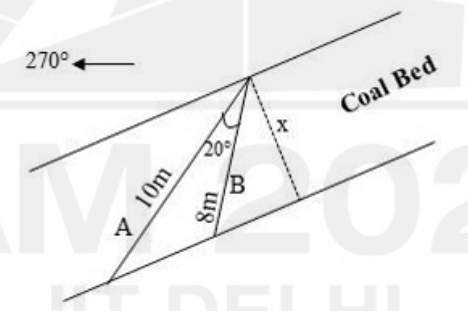
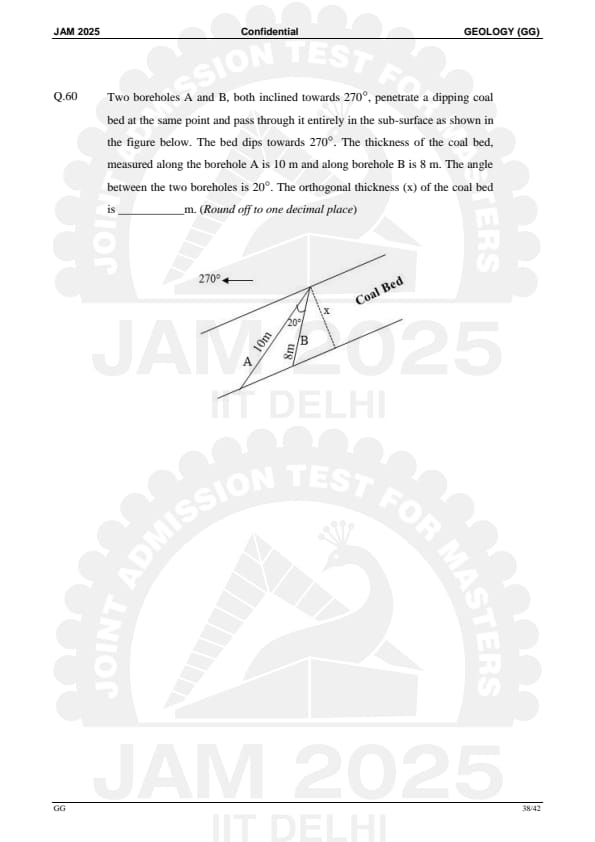
Two boreholes A and B, both inclined towards 270°, penetrate a dipping coal bed at the same point and pass through it entirely in the sub-surface as shown in the figure below. The bed dips towards 270°. The thickness of the coal bed, measured along the borehole A is 10 m and along borehole B is 8 m. The angle between the two boreholes is 20°. The orthogonal thickness \( x \) of the coal bed is ........ m. (Round off to one decimal place)
View Solution
Step 1: Understanding the diagram.
- The coal bed dips at an angle of 270°, and two boreholes, A and B, both inclined towards 270°, intersect the bed at the same point.
- The distance measured along borehole A is 10 m, and along borehole B, it is 8 m.
- The angle between the two boreholes is 20°.
- The goal is to find the orthogonal thickness \( x \), which is the true thickness of the coal bed.
Step 2: Formula for orthogonal thickness.
The orthogonal thickness \( x \) can be calculated using the following formula, based on the geometry of the intersecting boreholes:
\[ x = \frac{AB}{\sin(\theta)} \]
where:
- \( AB \) is the difference in the measured thicknesses along the two boreholes (the difference between the thicknesses measured along boreholes A and B).
- \( \theta \) is the angle between the two boreholes.
Step 3: Calculation of the difference in thickness.
We can use the following relation for the difference in thickness:
\[ AB = \sqrt{(10^2) + (8^2) - 2 \times 10 \times 8 \times \cos(20^\circ)} \]
\[ AB = \sqrt{100 + 64 - 160 \times \cos(20^\circ)} \]
Using \( \cos(20^\circ) \approx 0.9397 \):
\[ AB = \sqrt{100 + 64 - 150.352} = \sqrt{13.648} \]
\[ AB \approx 3.7 \, m \]
Step 4: Final Calculation of Orthogonal Thickness.
Now, calculate the orthogonal thickness \( x \) using the formula:
\[ x = \frac{3.7}{\sin(20^\circ)} \]
Since \( \sin(20^\circ) \approx 0.3420 \), we get:
\[ x = \frac{3.7}{0.3420} \approx 10.8 \, m \]
Final Answer: \[ \boxed{10.8} \, m \] Quick Tip: The orthogonal thickness of a dipping layer can be found by using the measured thicknesses along the boreholes and the angle between the boreholes, applying trigonometric relations.









*The article might have information for the previous academic years, please refer the official website of the exam.