
JEE Main 2013 Question Paper with Answer Key PDF for B.E./ B.Tech- Code Q (April 7)


Content Writer | Updated On - Jan 5, 2026
JEE Main Question Papers are the most important study material for effective exam preparation. We at Zollege have provided all JEE Main Previous Year Papers with Solution PDFs here. JEE Main 2013 B. E. / B. Tech exam was conducted successfully on April 7, 2013. CBSE conducted the exam in the . According to student reactions and expert reviews, the paper was reported to be easy to moderate.
Students can freely download the JEE Main previous year question paper PDFs along with their solutions here. We strongly encourage JEE Main aspirants to scan through all the JEE Main Question Paper to know the overall difficulty level, JEE Main Syllabus and understand the changes in JEE Main Exam Pattern over the years.
JEE Main 2013 B.E./ B.Tech Question Paper with Solution PDF
| JEE Main 2013 B.E./ B.Tech Question Paper PDF | JEE Main 2013 B.E./ B.Tech Solution PDF |
|---|---|
| Download PDF | Check Solutions |

An unknown alcohol is treated with the "Lucas reagent" to determine whether the alcohol is primary, secondary or tertiary. Which alcohol reacts fastest and by what mechanism?
View Solution
Step 1: Understanding the Concept:
Lucas reagent is a mixture of concentrated hydrochloric acid (\( HCl \)) and anhydrous zinc chloride (\( ZnCl_2 \)). It is used to distinguish between primary, secondary, and tertiary alcohols based on the rate of formation of alkyl chlorides, which appear as turbidity in the solution.
Step 2: Key Formula or Approach:
The reaction follows a nucleophilic substitution mechanism. The ease of the reaction depends on the stability of the carbocation intermediate formed during the process.
Step 3: Detailed Explanation:
1. In the presence of \( ZnCl_2 \), the alcohol group (\( -OH \)) is protonated and leaves as water, forming a carbocation.
2. Tertiary alcohols form a \( 3^\circ \) carbocation, which is highly stabilized by inductive effects and hyperconjugation.
3. Because the \( 3^\circ \) carbocation is the most stable, the reaction proceeds rapidly via the \( S_N1 \) mechanism, showing immediate cloudiness (turbidity).
4. Secondary alcohols react slower (taking 5-10 minutes), and primary alcohols do not react at room temperature.
Step 4: Final Answer:
Thus, tertiary alcohols react fastest with Lucas reagent following the \( S_N1 \) pathway.
Quick Tip: Remember the order of carbocation stability: Tertiary (\(3^\circ\)) \(>\) Secondary (\(2^\circ\)) \(>\) Primary (\(1^\circ\)). In Lucas test, \(3^\circ\) alcohols give immediate turbidity, \(2^\circ\) give it in 5 mins, and \(1^\circ\) only upon heating.
The first ionization potential of Na is 5.1 eV. The value of electron gain enthalpy of \( Na^+ \) will be:
View Solution
Step 1: Understanding the Concept:
Ionization Potential (IP) is the energy required to remove an electron from a neutral gaseous atom. Electron Gain Enthalpy (\( \Delta H_{eg} \)) is the energy change when an electron is added to a gaseous atom or ion.
Step 2: Key Formula or Approach:
For a process and its exact reverse, the magnitude of energy involved is the same, but the sign is opposite.
Ionization of Na: \( Na(g) \rightarrow Na^+(g) + e^- \) ; \( \Delta H = +IP \)
Electron gain of \( Na^+ \): \( Na^+(g) + e^- \rightarrow Na(g) \) ; \( \Delta H = \Delta H_{eg} \)
Step 3: Detailed Explanation:
The given ionization potential of Na is \( 5.1 eV \).
This means: \( Na \xrightarrow{+5.1 eV} Na^+ + e^- \)
The reverse process is the capture of an electron by the sodium cation:
\( Na^+ + e^- \rightarrow Na \)
Since the energy required to remove the electron was \( +5.1 eV \), the energy released when that same electron is added back to the cation will be \( -5.1 eV \).
Step 4: Final Answer:
The electron gain enthalpy of \( Na^+ \) is \( -5.1 eV \).
Quick Tip: \( IP of A = -(\Delta H_{eg} of A^+) \). This reciprocal relationship is a fundamental concept in periodic properties.
Stability of the species \( Li_2, Li_2^+, \) and \( Li_2^- \) increases in the order of:
View Solution
Step 1: Understanding the Concept:
According to Molecular Orbital Theory (MOT), stability is directly proportional to Bond Order (B.O.). If the B.O. is the same, the species with more electrons in antibonding orbitals is less stable.
Step 2: Key Formula or Approach:
\[ Bond Order (B.O.) = \frac{1}{2} (N_b - N_a) \]
where \( N_b \) = number of bonding electrons and \( N_a \) = number of antibonding electrons.
Step 3: Detailed Explanation:
The configuration for Li is \( 1s^2 2s^1 \).
1. For \( Li_2 \) (Total 6 electrons):
Configuration: \( \sigma 1s^2 \sigma^* 1s^2 \sigma 2s^2 \)
\( B.O. = \frac{4 - 2}{2} = 1 \)
2. For \( Li_2^+ \) (Total 5 electrons):
Configuration: \( \sigma 1s^2 \sigma^* 1s^2 \sigma 2s^1 \)
\( B.O. = \frac{3 - 2}{2} = 0.5 \)
3. For \( Li_2^- \) (Total 7 electrons):
Configuration: \( \sigma 1s^2 \sigma^* 1s^2 \sigma 2s^2 \sigma^* 2s^1 \)
\( B.O. = \frac{4 - 3}{2} = 0.5 \)
Comparing \( Li_2^+ \) and \( Li_2^- \): Both have B.O. 0.5, but \( Li_2^- \) has more antibonding electrons (3 vs 2), which increases electronic repulsion and decreases stability.
Step 4: Final Answer:
The stability order is \( Li_2^- < Li_2^+ < Li_2 \).
Quick Tip: When bond orders are tied, look at the number of electrons in antibonding (\( \sigma^*, \pi^* \)) orbitals. More antibonding electrons mean lower stability.
The molarity of a solution obtained by mixing 750 mL of 0.5 (M) HCl with 250 mL of 2(M) HCl will be:
View Solution
Step 1: Understanding the Concept:
When two solutions of the same solute are mixed, the total number of moles in the resulting solution is the sum of the moles in individual solutions.
Step 2: Key Formula or Approach:
\[ M_1V_1 + M_2V_2 = M_R(V_1 + V_2) \]
where \( M_R \) is the resultant molarity.
Step 3: Detailed Explanation:
Given data:
\( M_1 = 0.5 M, V_1 = 750 mL \)
\( M_2 = 2 M, V_2 = 250 mL \)
Total Volume \( V_R = V_1 + V_2 = 750 + 250 = 1000 mL \)
Substituting the values:
\[ (0.5 \times 750) + (2 \times 250) = M_R \times 1000 \]
\[ 375 + 500 = 1000 M_R \]
\[ 875 = 1000 M_R \]
\[ M_R = \frac{875}{1000} = 0.875 M \]
Step 4: Final Answer:
The final molarity of the mixture is 0.875 M.
Quick Tip: Always ensure volumes are in the same units (both mL or both L) before calculating. For rapid calculations, if the total volume becomes 1000 mL, simply add the millimoles and shift the decimal point three places left.
Which of the following is the wrong statement?
View Solution
Step 1: Understanding the Concept:
We need to evaluate each statement regarding Ozone (\( O_3 \)) and the electronic nature of ONCl and \( ONO^- \).
Step 2: Detailed Explanation:
1. Statement (A): Ozone (\( O_3 \)) has a bent structure with a bond angle of approximately \( 117^\circ \) due to the presence of one lone pair on the central oxygen. This is correct.
2. Statement (B): In the solid state, ozone forms violet-black crystals. This is a factual property of ozone. This is correct.
3. Statement (C): Ozone is diamagnetic because all its electrons are paired in its molecular orbitals. This is correct.
4. Statement (D): Let's count electrons:
For \( ONCl \): \( O(8) + N(7) + Cl(17) = 32 \) electrons.
For \( ONO^- \): \( O(8) + N(7) + O(8) + 1 (charge) = 24 \) electrons.
Since 32 \( \neq \) 24, they are not isoelectronic. This statement is correct.
Step 3: Final Answer:
According to the provided solution, all options are actually correct statements. If the question requires selecting a "wrong" statement, there might be a typo in the question paper itself.
Quick Tip: Isoelectronic species must have the same total number of electrons. When counting, don't forget to add electrons for negative charges and subtract for positive charges.
Four successive members of the first row transition elements are listed below with atomic numbers. Which one of them is expected to have the highest \( E^0_{M^{3+}/M^{2+}} \) value?
View Solution
Step 1: Understanding the Concept:
The standard reduction potential \( E^0_{M^{3+}/M^{2+}} \) represents the tendency of a trivalent ion to be reduced to a divalent ion. A high positive value indicates that the \( M^{3+} \) state is unstable compared to the \( M^{2+} \) state.
Step 2: Detailed Explanation:
Let's look at the experimental \( E^0 \) values (in Volts) for the given elements:
1. \( E^0_{Cr^{3+}/Cr^{2+}} = -0.41 V \)
2. \( E^0_{Mn^{3+}/Mn^{2+}} = +1.57 V \)
3. \( E^0_{Fe^{3+}/Fe^{2+}} = +0.77 V \)
4. \( E^0_{Co^{3+}/Co^{2+}} = +1.97 V \)
The very high value for Cobalt (\( +1.97 V \)) indicates that \( Co^{3+} \) is a very strong oxidizing agent and is highly unstable in aqueous solution compared to \( Co^{2+} \).
Step 3: Final Answer:
Cobalt (Z = 27) has the highest \( E^0_{M^{3+}/M^{2+}} \) value among the listed elements.
Quick Tip: The high stability of \( Mn^{2+} \) (\( d^5 \)) and \( Fe^{3+} \) (\( d^5 \)) makes the reduction potential for Mn high and for Fe relatively lower. However, Co has the highest value in the series due to the extreme stability of the \( Co^{2+} \) ion in aqueous media.
A solution of (-) -1 - chloro - 1 - phenylethane is toluene racemises slowly in the presence of a small amount of \( SbCl_5 \), due to the formation of:
View Solution
Step 1: Understanding the Concept:
Racemization occurs when a chiral molecule is converted into a racemic mixture. This usually happens via a planar intermediate that can be attacked from either side with equal probability.
Step 2: Detailed Explanation:
1. 1-chloro-1-phenylethane (\( Ph-CHCl-CH_3 \)) is a secondary alkyl halide.
2. \( SbCl_5 \) acts as a Lewis acid. It reacts with the alkyl halide to abstract the chloride ion.
3. This leads to the formation of a carbocation intermediate:
\( Ph-CHCl-CH_3 + SbCl_5 \rightarrow [Ph-CH-CH_3]^+ [SbCl_6]^- \)
4. The carbocation \( [Ph-CH-CH_3]^+ \) is \( sp^2 \) hybridized and has a planar geometry.
5. When the chloride ion (from \( SbCl_6^- \)) attacks the planar carbocation, it can do so from either the top or the bottom face with equal ease, leading to a 50:50 mixture of (+) and (-) enantiomers (racemization).
Step 3: Final Answer:
The formation of a carbocation intermediate causes the racemization.
Quick Tip: Whenever you see "racemization" in a substitution context, think of a planar intermediate. Carbocations are the most common planar intermediates in organic mechanisms (\(S_N1\)).
The coagulating power of electrolytes having ions \( Na^+, Al^{3+} and Ba^{2+} \) for arsenic sulphide sol increases in the order:
View Solution
Step 1: Understanding the Concept:
Arsenic sulphide (\( As_2S_3 \)) is a negatively charged sol (anionic sol). To coagulate a negative sol, we need positive ions (cations).
Step 2: Key Formula or Approach:
According to the Hardy-Schulze Rule, the coagulating power of an ion is directly proportional to the magnitude of its charge.
\( Coagulating Power \propto (Valency of the active ion)^n (where n \approx 4-6) \).
Step 3: Detailed Explanation:
1. The ions given are \( Na^+ \) (charge +1), \( Ba^{2+} \) (charge +2), and \( Al^{3+} \) (charge +3).
2. Since the sol is negative, the higher the positive charge on the cation, the greater its power to neutralize the sol particles and cause precipitation.
3. Comparing the charges: \( 1 < 2 < 3 \).
4. Therefore, the order of coagulating power is: \( Na^+ < Ba^{2+} < Al^{3+} \).
Step 4: Final Answer:
The correct order is \( Na^+ < Ba^{2+} < Al^{3+} \).
Quick Tip: Remember: Small charge = Weak coagulation; Big charge = Strong coagulation. For negative sols, look at the cation; for positive sols, look at the anion.
How many litres of water must be added to 1 litre of an aqueous solution of HCl with a pH of 1 to create an aqueous solution with pH of 2?
View Solution
Step 1: Understanding the Concept:
pH is related to the concentration of hydrogen ions \( [H^+] \) by the formula \( pH = -\log[H^+] \). Diluting a solution decreases the concentration.
Step 2: Key Formula or Approach:
Dilution formula: \( M_1V_1 = M_2V_2 \).
Volume of water added = \( V_2 - V_1 \).
Step 3: Detailed Explanation:
1. Initial State: pH = 1.
\( [H^+]_1 = 10^{-pH} = 10^{-1} = 0.1 mol/L \).
Initial Volume \( V_1 = 1 L \).
2. Final State: pH = 2.
\( [H^+]_2 = 10^{-2} = 0.01 mol/L \).
3. Applying dilution formula:
\( 0.1 \times 1 = 0.01 \times V_2 \)
\( V_2 = \frac{0.1}{0.01} = 10 L \).
4. Water added:
\( Volume added = V_2 - V_1 = 10 L - 1 L = 9 L \).
Step 4: Final Answer:
9.0 litres of water must be added.
Quick Tip: To increase pH by 1 unit, you need to dilute the solution 10 times. To increase pH by 2 units, dilute 100 times. Here, \(1 L \rightarrow 10 L\), so you add \(9 L\) of water.
Which one of the following molecules is expected to exhibit diamagnetic behaviour?
View Solution
Step 1: Understanding the Concept:
A molecule is diamagnetic if all its electrons are paired. It is paramagnetic if it has one or more unpaired electrons. We use Molecular Orbital Theory (MOT) to determine this.
Step 2: Detailed Explanation:
1. \( N_2 \) (14 electrons):
Configuration: \( \sigma 1s^2 \sigma^* 1s^2 \sigma 2s^2 \sigma^* 2s^2 (\pi 2p_x^2 = \pi 2p_y^2) \sigma 2p_z^2 \).
All electrons are paired. Diamagnetic.
2. \( O_2 \) (16 electrons):
Configuration ends in \( (\pi^* 2p_x^1 = \pi^* 2p_y^1) \).
Two unpaired electrons. Paramagnetic.
3. \( S_2 \) (32 electrons):
Similar to \( O_2 \), it has two unpaired electrons in antibonding orbitals. Paramagnetic.
4. \( C_2 \) (12 electrons):
Configuration: \( \sigma 1s^2 \sigma^* 1s^2 \sigma 2s^2 \sigma^* 2s^2 (\pi 2p_x^2 = \pi 2p_y^2) \).
All electrons are paired. Diamagnetic.
Step 3: Final Answer:
Both \( N_2 \) and \( C_2 \) exhibit diamagnetic behavior.
Quick Tip: Molecules with an even number of total electrons are usually diamagnetic, but \( B_2 \) (10e), \( O_2 \) (16e), and \( S_2 \) (32e) are famous exceptions that are paramagnetic.
Which of the following arrangements does not represent the correct order of the property stated against it?
View Solution
Step 1: Understanding the Concept:
We need to check the validity of trends in transition elements for ionic size, stability, oxidation states, and magnetism.
Step 2: Detailed Explanation:
1. Ionic Size (A): Along the period, ionic size decreases as nuclear charge increases. Thus, \( Mn^{2+} > Fe^{2+} > Co^{2+} > Ni^{2+} \). The given order is correct.
2. Stability in solution (B): Stability is related to hydration enthalpy. Trivalent ions like \( Sc^{3+} \) are very stable. However, the order of exothermic hydration enthalpies is: \( Sc^{3+} (3960), Fe^{3+} (4429), Cr^{3+} (4563), Co^{3+} (4653) \) kJ/mol. \( Sc^{3+} \) is actually the least hydrated. This order is incorrect.
3. Oxidation states (C): Sc (+3), Ti (+2,3,4), Cr (+2,3,4,5,6), Mn (+2,3,4,5,6,7). The number of states increases. This is correct.
4. Paramagnetism (D): Paramagnetism depends on unpaired electrons (\( n \)).
\( V^{2+} : d^3 (n=3) \)
\( Cr^{2+} : d^4 (n=4) \)
\( Mn^{2+} : d^5 (n=5) \)
\( Fe^{2+} : d^6 (n=4) \)
The order given is \( Mn^{2+} < Fe^{2+} \), which is incorrect because \( Mn^{2+} \) has 5 unpaired electrons and \( Fe^{2+} \) has 4.
Step 3: Final Answer:
Arrangements (B) and (D) are incorrect.
Quick Tip: For paramagnetism in \(d\)-block, count the unpaired electrons. \(d^1\) to \(d^5\) (increases 1 to 5), then \(d^6\) to \(d^{10}\) (decreases 4 to 0).
Experimentally it was found that a metal oxide has formula \( M_{0.98}O \). Metal M is present as \( M^{2+} \) and \( M^{3+} \) in its oxide. Fraction of the metal which exists as \( M^{3+} \) would be:
View Solution
Step 1: Understanding the Concept:
In a neutral compound, the total positive charge must equal the total negative charge. Oxide ion (\( O^{2-} \)) has a charge of -2.
Step 2: Key Formula or Approach:
Let the number of \( M^{3+} \) ions be \( x \).
Then, the number of \( M^{2+} \) ions = \( 0.98 - x \).
Total charge = 0.
Step 3: Detailed Explanation:
Sum of charges:
\[ 3(x) + 2(0.98 - x) + (-2) = 0 \] \[ 3x + 1.96 - 2x = 2 \] \[ x + 1.96 = 2 \] \[ x = 2 - 1.96 = 0.04 \]
The total number of metal ions is 0.98.
The fraction of \( M^{3+} \) is:
\[ Fraction = \frac{Number of M^{3+}}{Total metal ions} = \frac{0.04}{0.98} \] \[ Percentage = \frac{0.04}{0.98} \times 100 \approx 4.08% \]
Step 4: Final Answer:
The percentage of metal existing as \( M^{3+} \) is 4.08%.
Quick Tip: For non-stoichiometric compounds \( A_yB \), use the charge balance equation: \( y \times (Average Oxidation State of A) + Charge of B = 0 \).
A compound with molecular mass 180 is acylated with \( CH_3COCl \) to get a compound with molecular mass 390. The number of amino groups present per molecule of the former compound is:
View Solution
Step 1: Understanding the Concept:
Acetylation (acylation) of an amine replaces a hydrogen atom (\( H \)) of the \( -NH_2 \) group with an acetyl group (\( -COCH_3 \)).
Step 2: Key Formula or Approach:
Net increase in mass for one \( -NH_2 \) group:
Mass of \( CH_3CO \) group added - Mass of \( H \) atom removed.
\( 43 - 1 = 42 \) amu.
Step 3: Detailed Explanation:
Initial Molecular Mass = 180.
Final Molecular Mass = 390.
Total increase in mass = \( 390 - 180 = 210 \).
Let the number of amino groups be \( n \).
Each group adds 42 units to the molecular weight.
\[ n \times 42 = 210 \] \[ n = \frac{210}{42} = 5 \]
Step 4: Final Answer:
There are 5 amino groups present in the molecule.
Quick Tip: This method works for both alcohols (forming esters) and amines (forming amides). The "magic number" for acetylation is 42. Just divide the mass difference by 42.
Given:
\( E^0_{Cr^{3+}/Cr} = -0.74 V; E^0_{MnO_4^-/Mn^{2+}} = 1.51 V \)
\( E^0_{Cr_2O_7^{2-}/Cr^{3+}} = 1.33 V; E^0_{Cl/Cl^-} = 1.36 V \)
Based on the data given above, strongest oxidising agent will be:
View Solution
Step 1: Understanding the Concept:
The Standard Reduction Potential (SRP) measures the tendency of a species to get reduced. The species with the highest SRP is the strongest oxidizing agent.
Step 2: Key Formula or Approach:
Compare the \( E^0 \) values provided. Higher \( E^0 \) \( \rightarrow \) stronger oxidizing agent.
Step 3: Detailed Explanation:
The given SRP values are:
1. \( MnO_4^- \rightarrow Mn^{2+} \) : \( E^0 = +1.51 V \)
2. \( Cl_2 \rightarrow Cl^- \) : \( E^0 = +1.36 V \)
3. \( Cr_2O_7^{2-} \rightarrow Cr^{3+} \) : \( E^0 = +1.33 V \)
4. \( Cr^{3+} \rightarrow Cr \) : \( E^0 = -0.74 V \)
The highest reduction potential belongs to the \( MnO_4^-/Mn^{2+} \) couple (\( 1.51 V \)). This means \( MnO_4^- \) has the highest tendency to gain electrons.
Step 4: Final Answer:
The strongest oxidizing agent is \( MnO_4^- \).
Quick Tip: Oxidizing agents \textbf{take} electrons. High reduction potential (\( E^0_{red} \)) means the species "loves" to be reduced, making it a great oxidizing agent. Permanganate in acidic medium is one of the strongest common laboratory oxidizers.
Arrange the following compounds in order of decreasing acidity:

View Solution
Step 1: Understanding the Concept:
Acidity of phenols is determined by the stability of the phenoxide ion formed after the loss of a proton.
Electron-withdrawing groups (EWGs) increase acidity by dispersing the negative charge, while electron-donating groups (EDGs) decrease acidity by intensifying the charge.
Step 2: Detailed Explanation:
1. p-nitrophenol (III): The \( -NO_2 \) group exhibits strong \( -R \) and \( -I \) effects, stabilizing the phenoxide ion most effectively.
2. p-chlorophenol (I): The \( -Cl \) group has a \( -I \) effect that outweighs its weak \( +R \) effect, providing moderate stabilization.
3. p-methylphenol (II): The \( -CH_3 \) group shows \( +I \) and hyperconjugation effects, which destabilize the phenoxide ion relative to phenol.
4. p-methoxyphenol (IV): The \( -OCH_3 \) group has a strong \( +R \) effect, which significantly destabilizes the phenoxide ion, making it the least acidic.
The final order is III \(>\) I \(>\) II \(>\) IV.
Step 3: Final Answer:
Thus, the correct decreasing order of acidity is III \(>\) I \(>\) II \(>\) IV.
Quick Tip: Remember that \( -R \) (Resonance) effects at the para position are much stronger than \( -I \) (Inductive) effects for determining acidity.
The rate of a reaction doubles when its temperature changes from 300K to 310K. Activation energy of such a reaction will be: (\( R = 8.314 JK^{-1} mol^{-1} \) and \( \log 2 = 0.301 \))
View Solution
Step 1: Understanding the Concept:
The Arrhenius equation describes the quantitative relationship between the rate constant and temperature.
Step 2: Key Formula or Approach:
The integrated form of the Arrhenius equation is:
\[ \log \frac{k_2}{k_1} = \frac{E_a}{2.303 R} \left[ \frac{T_2 - T_1}{T_1 T_2} \right] \]
Step 3: Detailed Explanation:
Given: \( T_1 = 300 K, T_2 = 310 K, \frac{k_2}{k_1} = 2, R = 8.314 J/K/mol \).
Substituting the values:
\[ 0.301 = \frac{E_a}{2.303 \times 8.314} \left[ \frac{310 - 300}{300 \times 310} \right] \] \[ 0.301 = \frac{E_a}{19.147} \left[ \frac{10}{93000} \right] \] \[ E_a = \frac{0.301 \times 19.147 \times 93000}{10} \] \[ E_a = 53597.4 J/mol \approx 53.6 kJ/mol \].
Step 4: Final Answer:
The activation energy of the reaction is 53.6 kJ mol\(^{-1}\).
Quick Tip: A quick approximation: If the rate doubles for a 10 K rise from 300 K, the activation energy is generally in the range of 50-55 kJ/mol.
Synthesis of each molecule of glucose in photosynthesis involves:
View Solution
Step 1: Understanding the Concept:
Photosynthesis involves the Calvin cycle (dark reaction) where \( CO_2 \) is fixed into glucose using ATP and NADPH produced in the light reaction.
Step 2: Detailed Explanation:
The net chemical equations for the process are:
Light Reaction: \( 12H_2O + 12NADP + 18ADP \rightarrow 6O_2 + 18ATP + 12NADPH \).
Dark Reaction: \( 6CO_2 + 12NADPH + 18ATP \rightarrow C_6H_{12}O_6 + 12NADP + 18ADP + 6H_2O \).
For every molecule of glucose (\( C_6H_{12}O_6 \)) produced, 6 molecules of \( CO_2 \) must be fixed.
Each turn of the Calvin cycle fixing one carbon requires 3 ATP molecules.
Total ATP required = \( 6 \times 3 = 18 molecules of ATP \).
Step 3: Final Answer:
Thus, 18 molecules of ATP are involved in the synthesis of one molecule of glucose.
Quick Tip: Remember the ratio: 3 ATP and 2 NADPH are required for every carbon atom fixed in the \( C_3 \) cycle.
Which of the following complex species is not expected to exhibit optical isomerism?
View Solution
Step 1: Understanding the Concept:
A coordination complex exhibits optical isomerism if it is chiral, meaning it does not possess a plane of symmetry or a center of symmetry.
Step 2: Detailed Explanation:
1. \( [Co(NH_3)_3Cl_3] \) is a complex of the type \( [MA_3B_3] \).
2. This type of complex exists in two geometric forms: facial (fac) and meridional (mer).
3. In the facial isomer, three identical ligands occupy the corners of one triangular face of the octahedron. This structure possesses a plane of symmetry.
4. In the meridional isomer, three identical ligands occupy a "meridian" around the octahedron. This structure also possesses a plane of symmetry.
5. Because both geometric forms are achiral due to the presence of symmetry planes, the complex cannot show optical activity.
Step 3: Final Answer:
The complex \( [Co(NH_3)_3Cl_3] \) is not expected to exhibit optical isomerism.
Quick Tip: Tridentate or bidentate ligands (like 'en') usually create asymmetry leading to optical isomerism, whereas simple monodentate ligand arrangements in \( [MA_3B_3] \) are always symmetrical.
A piston filled with 0.04 mol of an ideal gas expands reversibly from 50.0 mL to 375 mL at a constant temperature of \( 37.0^\circC \). As it does so, it absorbs 208J of heat. The values of q and w for the process will be: (\( R = 8.314 J/mol K \)) (\( \ln 7.5 = 2.01 \))
View Solution
Step 1: Understanding the Concept:
For an isothermal (\( constant T \)) process involving an ideal gas, the change in internal energy (\( \Delta U \)) is zero because internal energy of an ideal gas is a function of temperature only.
Step 2: Key Formula or Approach:
According to the First Law of Thermodynamics: \( \Delta U = q + w \).
For an isothermal process, \( 0 = q + w \), hence \( q = -w \).
Step 3: Detailed Explanation:
1. The problem states that the system absorbs 208 J of heat. Absorption of heat is represented as a positive value: \( q = +208 J \).
2. Since \( q = -w \), the work done on the system must be \( w = -208 J \).
3. This is consistent with the gas expanding; work done BY the system (expansion) is negative in modern IUPAC sign conventions.
Step 4: Final Answer:
The correct values are \( q = +208 J \) and \( w = -208 J \).
Quick Tip: In isothermal expansion, heat absorbed is converted entirely into work. Always remember \( q = -w \) for ideal gases at constant temperature.
A gaseous hydrocarbon gives upon combustion 0.72 g of water and 3.08 g of \( CO_2 \). The empirical formula of the hydrocarbon is:
View Solution
Step 1: Understanding the Concept:
In the combustion of a hydrocarbon \( C_xH_y \), all Carbon goes to \( CO_2 \) and all Hydrogen goes to \( H_2O \).
Step 2: Key Formula or Approach:
\[ Moles of C = Moles of CO_2 = \frac{Mass of CO_2}{Molar mass of CO_2} \] \[ Moles of H = 2 \times Moles of H_2O = 2 \times \frac{Mass of H_2O}{Molar mass of H_2O} \]
Step 3: Detailed Explanation:
1. Calculate moles of C:
\[ Moles of C = \frac{3.08}{44} = 0.07 mol \].
2. Calculate moles of H:
\[ Moles of H = 2 \times \frac{0.72}{18} = 2 \times 0.04 = 0.08 mol \].
3. Find the atomic ratio:
\[ \frac{x}{y} = \frac{0.07}{0.08} = \frac{7}{8} \].
Step 4: Final Answer:
The ratio of Carbon to Hydrogen atoms is 7:8, so the empirical formula is \( C_7H_8 \).
Quick Tip: Shortcut: Use the ratio \( \frac{W_{CO_2}}{44} : \frac{2 \times W_{H_2O}}{18} \) to quickly find the subscript values for C and H.
The order of stability of the following carbocations:

View Solution
Step 1: Understanding the Concept:
Carbocation stability is determined by the extent of charge delocalization through resonance, hyperconjugation, or inductive effects.
Step 2: Detailed Explanation:
1. Benzyl carbocation (III): The positive charge is delocalized over the entire benzene ring through resonance. It has multiple resonating structures, leading to high stability.
2. Allyl carbocation (I): The positive charge is delocalized over two carbon atoms through resonance (\( \pi \)-electron movement). It is more stable than alkyl cations but less stable than the benzyl cation due to fewer resonating structures.
3. n-Propyl carbocation (II): This is a primary carbocation with no resonance stabilization. It is only slightly stabilized by the \( +I \) effect and hyperconjugation of the adjacent ethyl group.
Stability order: \( Resonance (extended) > Resonance (limited) > Inductive/Hyperconjugation \).
Step 3: Final Answer:
The order of stability is III \(>\) I \(>\) II.
Quick Tip: Stability \( \propto \) extent of delocalization. Always check for resonance first, as it usually provides more stability than inductive effects.
Which of the following represents the correct order of increasing first ionization enthalpy for Ca, Ba, S, Se and Ar?
View Solution
Step 1: Understanding the Concept:
Ionization enthalpy generally increases across a period (from left to right) and decreases down a group. Noble gases have exceptionally high ionization energies.
Step 2: Detailed Explanation:
1. Barium (Ba) and Calcium (Ca): Both are in Group 2. Since Ba is below Ca, its size is larger and its ionization enthalpy is lower: \( Ba < Ca \).
2. Selenium (Se) and Sulphur (S): Both are in Group 16. Since Se is below S, its ionization enthalpy is lower: \( Se < S \).
3. Period trend: Elements on the right side of the periodic table (Groups 16 and 18) have much higher ionization energies than those on the left (Group 2).
4. Argon (Ar): As a noble gas, it has a stable octet, giving it the highest ionization enthalpy in the list.
Combining these: \( Ba < Ca < Se < S < Ar \).
Step 3: Final Answer:
The correct increasing order is Ba \(<\) Ca \(<\) Se \(<\) S \(<\) Ar.
Quick Tip: Ionization energy increases diagonally towards the top right corner of the periodic table (ignoring noble gases, which are always highest).
For gaseous state, if most probable speed is denoted by \( C^* \), average speed by \( \bar{C} \) and mean square speed by C, then for a large number of molecules the ratios of these speeds are:
View Solution
Step 1: Understanding the Concept:
According to kinetic theory of gases, molecules move with different speeds. The three most common measures are root mean square speed (\( C_{rms} \)), average speed (\( v_{avg} \)), and most probable speed (\( v_{mp} \)).
Step 2: Key Formula or Approach:
1. Most Probable Speed \( C^* = \sqrt{\frac{2RT}{M}} \).
2. Average Speed \( \bar{C} = \sqrt{\frac{8RT}{\pi M}} \).
3. RMS Speed \( C = \sqrt{\frac{3RT}{M}} \).
Step 3: Detailed Explanation:
Ratio \( C^* : \bar{C} : C \) = \( \sqrt{2} : \sqrt{\frac{8}{\pi}} : \sqrt{3} \).
Evaluating the values:
\( \sqrt{2} \approx 1.414 \).
\( \sqrt{\frac{8}{3.14}} \approx 1.595 \).
\( \sqrt{3} \approx 1.732 \).
Dividing each by \( \sqrt{2} \) to normalize the ratio:
\( \frac{1.414}{1.414} : \frac{1.595}{1.414} : \frac{1.732}{1.414} \).
\( 1 : 1.128 : 1.225 \).
Step 4: Final Answer:
The ratios of these speeds are \( 1 : 1.128 : 1.225 \).
Quick Tip: Remember the order of magnitude: RMS \(>\) Average \(>\) Most Probable. Use the acronym "RAM" to remember this order.
The gas leaked from a storage tank of the Union Carbide plant in Bhopal gas tragedy was:
View Solution
Step 1: Understanding the Concept:
This is a factual question based on the history of industrial chemistry and environmental science.
Step 2: Detailed Explanation:
The Bhopal disaster occurred on the night of December 2–3, 1984, at the Union Carbide India Limited pesticide plant in Bhopal, Madhya Pradesh.
The chemical involved was Methyl Isocyanate (MIC), with the formula \( CH_3NCO \).
It is an extremely toxic intermediate chemical used in the production of carbamate pesticides.
Step 3: Final Answer:
The gas leaked was methylisocyanate.
Quick Tip: Do not confuse Methyl Isocyanate (\( CH_3NCO \)) with Methyl Isocyanide (\( CH_3NC \)). Both are toxic, but the Bhopal gas tragedy involved the cyanate compound.
Consider the following reaction:
\( xMnO_4^- + yC_2O_4^{2-} + zH^+ \rightarrow xMn^{2+} + 2yCO_2 + \frac{z}{2}H_2O \)
The values of x, y and z in the reaction are, respectively:
View Solution
Step 1: Understanding the Concept:
This is a redox reaction in an acidic medium. The stoichiometry is determined by balancing the change in oxidation numbers or using the ion-electron method.
Step 2: Detailed Explanation:
1. Reduction half-reaction:
\( MnO_4^- + 5e^- + 8H^+ \rightarrow Mn^{2+} + 4H_2O \)
2. Oxidation half-reaction:
\( C_2O_4^{2-} \rightarrow 2CO_2 + 2e^- \)
3. Balancing electrons:
Multiply the reduction half-reaction by 2 and the oxidation half-reaction by 5 to equalize electrons to 10.
\( 2MnO_4^- + 10e^- + 16H^+ \rightarrow 2Mn^{2+} + 8H_2O \)
\( 5C_2O_4^{2-} \rightarrow 10CO_2 + 10e^- \)
4. Combined reaction:
\( 2MnO_4^- + 5C_2O_4^{2-} + 16H^+ \rightarrow 2Mn^{2+} + 10CO_2 + 8H_2O \)
Comparing coefficients: \( x = 2, y = 5, z = 16 \).
Step 3: Final Answer:
The values of x, y, and z are 2, 5, and 16 respectively.
Quick Tip: Permanganate titration with oxalic acid always uses the 2:5 ratio of \( MnO_4^- \) to oxalate ions. This is a very common stoichiometric ratio to memorize.
Which of the following exists as covalent crystals in the solid state?
View Solution
Step 1: Understanding the Concept:
Covalent crystals (network solids) consist of atoms bonded by covalent bonds in a continuous network extending throughout the crystal.
Step 2: Detailed Explanation:
1. Silicon (Si): Silicon atoms are linked by strong covalent bonds in a diamond-like tetrahedral lattice. This forms a giant covalent crystal.
2. Sulphur (\( S_8 \)): Exists as discrete \( S_8 \) puckered rings held together by weak van der Waals forces. It is a molecular solid.
3. Phosphorus (\( P_4 \)): White phosphorus exists as discrete \( P_4 \) tetrahedral molecules held by van der Waals forces. It is a molecular solid.
4. Iodine (\( I_2 \)): Exists as discrete \( I_2 \) molecules arranged in a crystal lattice held by van der Waals forces. It is a molecular solid.
Step 3: Final Answer:
Silicon exists as a covalent crystal.
Quick Tip: Common examples of covalent solids include Diamond, Graphite, Quartz (\( SiO_2 \)), and Silicon (Si). Most other non-metal elements in solid form are molecular.
Compound (A), \( C_8H_9Br \), gives a white precipitate when warmed with alcoholic \( AgNO_3 \). Oxidation of (A) gives an acid (B), \( C_8H_6O_4 \). (B) easily forms anhydride on heating. Identify the compound (A).
View Solution
Step 1: Understanding the Concept:
Reactive halides (like benzylic halides) give precipitates with alcoholic silver nitrate. Formation of an anhydride on heating is characteristic of phthalic acid (ortho-dicarboxylic acid).
Step 2: Detailed Explanation:
1. Compound A (\( C_8H_9Br \)) reacts with \( AgNO_3 \) to give a white precipitate, indicating the Br is on a side chain (benzylic) and not directly on the ring.
2. Oxidation of A gives B (\( C_8H_6O_4 \)). Since B easily forms an anhydride, B must be phthalic acid (ortho-benzene dicarboxylic acid).
3. For B to be phthalic acid, A must have two side chains in the ortho position.
4. Looking at the options, o-bromomethyl methylbenzene (also known as o-methylbenzyl bromide) has the correct formula and ortho arrangement.
Step 3: Final Answer:
The compound A is o-bromomethyl methylbenzene.
Quick Tip: Anhydride formation from a dicarboxylic acid on heating is a strong indicator that the two carboxyl groups are in the ortho position (1,2-position).
Energy of an electron is given by \( E = -2.178 \times 10^{-18} J \frac{Z^2}{n^2} \). Wavelength of light required to excite an electron in a hydrogen atom from level n = 1 to n = 2 will be: (\( h = 6.62 \times 10^{-34} Js \) and \( c = 3.0 \times 10^8 ms^{-1} \))
View Solution
Step 1: Understanding the Concept:
The energy of the absorbed photon corresponds to the difference in energy between the two states of the atom.
Step 2: Key Formula or Approach:
\[ \Delta E = \frac{hc}{\lambda} = E_2 - E_1 = 2.178 \times 10^{-18} \times Z^2 \left[ \frac{1}{n_1^2} - \frac{1}{n_2^2} \right] \]
Step 3: Detailed Explanation:
For Hydrogen (\( Z = 1 \)), \( n_1 = 1 \), and \( n_2 = 2 \):
\[ \Delta E = 2.178 \times 10^{-18} \times \left[ \frac{1}{1^2} - \frac{1}{2^2} \right] \] \[ \Delta E = 2.178 \times 10^{-18} \times \frac{3}{4} = 1.6335 \times 10^{-18} J \].
Using \( \lambda = \frac{hc}{\Delta E} \):
\[ \lambda = \frac{6.62 \times 10^{-34} \times 3.0 \times 10^8}{1.6335 \times 10^{-18}} \] \[ \lambda \approx 1.214 \times 10^{-7} m \].
Step 4: Final Answer:
The wavelength of light required is \( 1.214 \times 10^{-7} m \).
Quick Tip: The \( n=1 \) to \( n=2 \) transition in hydrogen is the Lyman-alpha line. It always falls in the UV region (wavelengths around 121 nm or \( 1.21 \times 10^{-7} m \)).
An organic compound A upon reacting with \( NH_3 \) gives B. On heating B gives C. C in presence of KOH reacts with \( Br_2 \) to give \( CH_3CH_2NH_2 \). A is:
View Solution
Step 1: Understanding the Concept:
The final step (\( Br_2/KOH \)) is the Hofmann Bromamide degradation, which converts an amide into an amine with one less carbon atom.
Step 2: Detailed Explanation:
1. Final step: \( C + Br_2 + KOH \rightarrow CH_3CH_2NH_2 \) (Ethylamine).
This amine has 2 carbons. Therefore, the precursor amide (C) must have \( 2 + 1 = 3 \) carbons.
Amide C = \( CH_3CH_2CONH_2 \) (Propanamide).
2. Step from B to C: Heating an ammonium salt gives an amide.
B = \( CH_3CH_2COONH_4 \) (Ammonium propionate).
3. Step from A to B: Reaction of a carboxylic acid with \( NH_3 \) gives an ammonium salt.
A = \( CH_3CH_2COOH \) (Propanoic acid).
Step 3: Final Answer:
The compound A is \( CH_3CH_2COOH \).
Quick Tip: When dealing with Hofmann Bromamide Degradation, the carbon of the \( CONH_2 \) group is lost. Always look for an acid/amide with one more carbon than the product amine.
In which of the following pairs of molecules/ions, both the species are not likely to exist?
View Solution
Step 1: Understanding the Concept:
According to the Molecular Orbital (MO) Theory, the stability and existence of a molecule or ion depend on its Bond Order (B.O.).
If the Bond Order of a species is zero or negative, the species is unstable and is not likely to exist.
If the Bond Order is positive, the species is likely to exist.
Step 2: Key Formula or Approach:
The Bond Order is calculated using the formula:
\[ Bond Order (B.O.) = \frac{1}{2} (N_b - N_a) \]
where:
\( N_b \) = number of electrons in bonding molecular orbitals.
\( N_a \) = number of electrons in antibonding molecular orbitals.
Step 3: Detailed Explanation:
We will calculate the Bond Order for each species mentioned in the options:
1. Species in Option (B):
Case I: \( H_2^{2+} \)
Atomic number of Hydrogen is 1. A neutral \( H_2 \) molecule has 2 electrons.
\( H_2^{2+} \) ion has \( 2 - 2 = 0 \) electrons.
Since there are no electrons to form a bond, the Bond Order is 0.
Thus, \( H_2^{2+} \) is not likely to exist.
Case II: \( He_2 \)
Atomic number of Helium is 2. \( He_2 \) molecule has \( 2 + 2 = 4 \) electrons.
Electronic configuration: \( (\sigma 1s)^2, (\sigma^* 1s)^2 \)
\( N_b = 2 \), \( N_a = 2 \)
\[ B.O. = \frac{1}{2} (2 - 2) = 0 \]
Thus, \( He_2 \) is not likely to exist.
2. Checking other species for comparison:
Case III: \( H_2^- \)
Total electrons = \( 1 + 1 + 1 = 3 \). Configuration: \( (\sigma 1s)^2, (\sigma^* 1s)^1 \).
\[ B.O. = \frac{1}{2} (2 - 1) = 0.5 (Likely to exist) \]
Case IV: \( He_2^{2-} \)
Total electrons = \( 2 + 2 + 2 = 6 \). Configuration: \( (\sigma 1s)^2, (\sigma^* 1s)^2, (\sigma 2s)^2 \).
\[ B.O. = \frac{1}{2} (4 - 2) = 1.0 (Likely to exist) \]
Case V: \( He_2^{2+} \)
Total electrons = \( 2 + 2 - 2 = 2 \). Configuration: \( (\sigma 1s)^2 \).
\[ B.O. = \frac{1}{2} (2 - 0) = 1.0 (Likely to exist) \]
Case VI: \( H_2^+ \)
Total electrons = \( 1 + 1 - 1 = 1 \). Configuration: \( (\sigma 1s)^1 \).
\[ B.O. = \frac{1}{2} (1 - 0) = 0.5 (Likely to exist) \]
Step 4: Final Answer:
In pair (B), both \( H_2^{2+} \) and \( He_2 \) have a Bond Order of zero, meaning neither species is likely to exist.
Quick Tip: Species with fractional bond orders (like 0.5) are usually unstable but can be detected under specific conditions. However, a bond order of exactly 0 indicates that no net attractive force exists between the atoms, rendering the molecule non-existent.
The circle passing through (1, \(-\)2) and touching the axis of x at (3, 0) also passes through the point
View Solution
Step 1: Understanding the Concept:
A circle touching the x-axis at a point \((x_1, 0)\) has its center at \((x_1, r)\), where \(r\) is the radius of the circle.
The equation of such a circle is given by \((x - x_1)^2 + (y - r)^2 = r^2\).
Step 2: Key Formula or Approach:
Since the circle touches the x-axis at \((3, 0)\), its equation is:
\[ (x - 3)^2 + (y - r)^2 = r^2 \]
We can find \(r\) by substituting the given point \((1, -2)\) that lies on the circle.
Step 3: Detailed Explanation:
Substituting \((1, -2)\) into the circle equation:
\[ (1 - 3)^2 + (-2 - r)^2 = r^2 \]
\[ (-2)^2 + (-(2 + r))^2 = r^2 \]
\[ 4 + (4 + 4r + r^2) = r^2 \]
\[ 8 + 4r = 0 \]
\[ 4r = -8 \Rightarrow r = -2 \]
Substituting \(r = -2\) back into the circle equation:
\[ (x - 3)^2 + (y + 2)^2 = (-2)^2 \]
\[ (x - 3)^2 + (y + 2)^2 = 4 \]
Now, let's check which option satisfies this equation:
For option (B) \((5, -2)\):
\[ (5 - 3)^2 + (-2 + 2)^2 = 2^2 + 0 = 4 \]
Since \(4 = 4\), the point \((5, -2)\) lies on the circle.
Step 4: Final Answer:
The circle also passes through the point (5, \(-\)2).
Quick Tip: When a circle touches the x-axis, the y-coordinate of the center is equal to the radius (in magnitude). Use the point of contact to fix the x-coordinate of the center immediately.
ABCD is a trapezium such that AB and CD are parallel and BC\(\perp\)CD. If \(\angle\)ADB = \(\theta\), BC = p and CD = q, then AB is equal to
View Solution
Step 1: Understanding the Concept:
In a trapezium where one side is perpendicular to the parallel bases, we can use trigonometry and the Sine Rule in the internal triangles to relate the side lengths and angles.
Step 2: Key Formula or Approach:
In triangle \(BCD\), \(BD = \sqrt{p^2 + q^2}\) and \(\tan \alpha = \frac{p}{q}\).
In triangle \(ABD\), apply the Sine Rule:
\[ \frac{AB}{\sin \angle ADB} = \frac{BD}{\sin \angle DAB} \]
Step 3: Detailed Explanation:
In \(\triangle BCD\), let \(\angle BDC = \alpha\). Then \(\sin \alpha = \frac{p}{\sqrt{p^2 + q^2}}\) and \(\cos \alpha = \frac{q}{\sqrt{p^2 + q^2}}\).
Since \(AB \parallel CD\), \(\angle ABD = \angle BDC = \alpha\) (Alternate angles).
In \(\triangle ABD\):
\(\angle ADB = \theta\) (Given).
\(\angle DAB = \pi - (\theta + \alpha)\) (Sum of angles in a triangle).
By Sine Rule:
\[ \frac{AB}{\sin \theta} = \frac{BD}{\sin (\pi - (\theta + \alpha))} \]
\[ AB = \frac{BD \sin \theta}{\sin(\theta + \alpha)} = \frac{\sqrt{p^2 + q^2} \sin \theta}{\sin \theta \cos \alpha + \cos \theta \sin \alpha} \]
Substitute \(\sin \alpha\) and \(\cos \alpha\):
\[ AB = \frac{\sqrt{p^2 + q^2} \sin \theta}{\sin \theta \left(\frac{q}{\sqrt{p^2 + q^2}}\right) + \cos \theta \left(\frac{p}{\sqrt{p^2 + q^2}}\right)} \]
\[ AB = \frac{(p^2 + q^2) \sin \theta}{q \sin \theta + p \cos \theta} \]
Step 4: Final Answer:
The length \(AB\) is equal to \(\dfrac{(p^2 + q^2) \sin \theta}{p \cos \theta + q \sin \theta}\).
Quick Tip: Using the Sine Rule is often the most efficient way to find side lengths in triangles where two angles and one side (or their trigonometric ratios) are known.
Given : A circle, \(2x^2 + 2y^2 = 5\) and a parabola, \(y^2 = 4\sqrt{5}x\).
Statement \(-\) I : An equation of a common tangent to these curves is \(y = x + \sqrt{5}\).
Statement \(-\) II : If the line, \(y = mx + \dfrac{\sqrt{5}}{m}\) (\(m \neq 0\)) is their common tangent, then \(m\) satisfies \(m^4 - 3m^2 + 2 = 0\).
View Solution
Step 1: Understanding the Concept:
A common tangent to a circle and a parabola must satisfy the tangency conditions for both curves simultaneously.
Step 2: Key Formula or Approach:
For the parabola \(y^2 = 4ax\), the tangent is \(y = mx + \frac{a}{m}\).
For the circle \(x^2 + y^2 = r^2\), the distance from the center \((0,0)\) to the tangent must equal the radius \(r\).
Step 3: Detailed Explanation:
Parabola: \(y^2 = 4\sqrt{5}x \Rightarrow a = \sqrt{5}\).
General tangent: \(y = mx + \frac{\sqrt{5}}{m}\).
Circle: \(x^2 + y^2 = \frac{5}{2} \Rightarrow\) Center \((0, 0)\), Radius \(r = \sqrt{\frac{5}{2}}\).
Condition for tangency to the circle:
\[ \left| \frac{0 + 0 - \frac{\sqrt{5}}{m}}{\sqrt{1 + m^2}} \right| = \sqrt{\frac{5}{2}} \]
\[ \frac{\sqrt{5}}{|m|\sqrt{1+m^2}} = \frac{\sqrt{5}}{\sqrt{2}} \]
\[ m^2(1 + m^2) = 2 \Rightarrow m^4 + m^2 - 2 = 0 \]
\[ (m^2 + 2)(m^2 - 1) = 0 \Rightarrow m^2 = 1 \Rightarrow m = \pm 1 \]
Common tangents are \(y = x + \sqrt{5}\) and \(y = -x - \sqrt{5}\).
Statement I: \(y = x + \sqrt{5}\) is a common tangent. (True)
Statement II: \(m=1\) satisfies \(m^4 - 3m^2 + 2 = 0\) since \(1 - 3 + 2 = 0\). (True)
However, Statement II gives values \(m^2=1, 2\), but common tangent requires \(m^2=1\). It is not the derivation of Stmt I.
Step 4: Final Answer:
Both statements are true, but Statement II is not the correct explanation for Statement I.
Quick Tip: For common tangents, start with the slope form of the tangent for the simpler curve (usually the parabola) and apply the perpendicular distance condition for the circle.
A ray of light along \(x + \sqrt{3}y = \sqrt{3}\) gets reflected upon reaching x-axis, the equation of the reflected rays is
View Solution
Step 1: Understanding the Concept:
When a line \(y = mx + c\) is reflected in the x-axis, the point of incidence stays the same, and the slope of the reflected line becomes the negative of the slope of the incident line (\(m_{reflected} = -m_{incident}\)).
Step 2: Key Formula or Approach:
Incident line: \(x + \sqrt{3}y = \sqrt{3} \Rightarrow y = -\frac{1}{\sqrt{3}}x + 1\).
Find the point of incidence on the x-axis by putting \(y = 0\).
Step 3: Detailed Explanation:
Slope of incident ray (\(m_i\)) = \(-\frac{1}{\sqrt{3}}\).
At x-axis, \(y = 0 \Rightarrow x + \sqrt{3}(0) = \sqrt{3} \Rightarrow x = \sqrt{3}\).
Point of incidence = \((\sqrt{3}, 0)\).
Slope of reflected ray (\(m_r\)) = \(-m_i = \frac{1}{\sqrt{3}}\).
Equation of reflected ray using point-slope form:
\[ y - 0 = \frac{1}{\sqrt{3}}(x - \sqrt{3}) \]
\[ \sqrt{3}y = x - \sqrt{3} \]
Step 4: Final Answer:
The equation of the reflected ray is \(\sqrt{3}y = x - \sqrt{3}\).
Quick Tip: Reflection in the x-axis simply changes the sign of the slope of the line. Just find the intersection with \(y=0\) and use the new slope.
All the students of a class performed poorly in Mathematics. The teacher decided to give grace marks of 10 to each of the students. Which of the following statistical measures will not change even after the grace marks were given?
View Solution
Step 1: Understanding the Concept:
Adding a constant to every observation in a data set is known as a "change of origin". Measures of central tendency (mean, median, mode) change by the same constant, whereas measures of dispersion (variance, standard deviation, range) are independent of change of origin.
Step 2: Detailed Explanation:
Let the original marks be \(x_i\). The new marks are \(y_i = x_i + 10\).
The mean changes: \(\bar{y} = \bar{x} + 10\).
The median and mode also shift by 10 units.
Variance is defined as: \(\sigma^2 = \frac{\sum (x_i - \bar{x})^2}{n}\).
For the new data:
\[ \sigma_y^2 = \frac{\sum (y_i - \bar{y})^2}{n} = \frac{\sum ((x_i + 10) - (\bar{x} + 10))^2}{n} = \frac{\sum (x_i - \bar{x})^2}{n} = \sigma_x^2 \]
Thus, the variance remains unchanged.
Step 3: Final Answer:
The statistical measure that will not change is the variance.
Quick Tip: Variance and Standard Deviation are affected by "change of scale" (multiplication) but are invariant under "change of origin" (addition/subtraction).
If x, y, z are in A.P. and \(\tan^{-1}x\), \(\tan^{-1}y\) and \(\tan^{-1}z\) are also in A.P., then
View Solution
Step 1: Understanding the Concept:
If three terms \(a, b, c\) are in A.P., then \(2b = a + c\). This property applies to the terms themselves and their inverse trigonometric functions as given.
Step 2: Detailed Explanation:
Given \(x, y, z\) are in A.P. \(\Rightarrow 2y = x + z\).
Given \(\tan^{-1}x, \tan^{-1}y, \tan^{-1}z\) are in A.P. \(\Rightarrow 2\tan^{-1}y = \tan^{-1}x + \tan^{-1}z\).
Using the identity \(2\tan^{-1}y = \tan^{-1}\left(\frac{2y}{1-y^2}\right)\) and \(\tan^{-1}x + \tan^{-1}z = \tan^{-1}\left(\frac{x+z}{1-xz}\right)\):
\[ \frac{2y}{1-y^2} = \frac{x+z}{1-xz} \]
Since \(x + z = 2y\), the equation becomes:
\[ \frac{2y}{1-y^2} = \frac{2y}{1-xz} \]
This implies either \(y = 0\) or \(1 - y^2 = 1 - xz\).
Case 1: \(1 - y^2 = 1 - xz \Rightarrow y^2 = xz\).
If \(x, y, z\) are in A.P. and also satisfy \(y^2 = xz\) (meaning they are in G.P.), then \(x = y = z\).
Case 2: If \(y = 0\), then \(x + z = 0 \Rightarrow z = -x\). Then \(\tan^{-1}x, 0, \tan^{-1}(-x)\) which is \(\tan^{-1}x, 0, -\tan^{-1}x\) are in A.P. This is consistent with \(x=y=z=0\) or other symmetric values, but the general result for A.P. + G.P. is equality.
Step 3: Final Answer:
The relation is \(x = y = z\).
Quick Tip: If three numbers are in both Arithmetic Progression and Geometric Progression, they must be equal.
If \(\int f(x) dx = \Psi(x)\), then \(\int x^5 f(x^3) dx\) is equal to
View Solution
Step 1: Understanding the Concept:
We use the substitution method followed by integration by parts to evaluate the integral.
Step 2: Key Formula or Approach:
Let \(x^3 = t \Rightarrow 3x^2 dx = dt\).
Integral by parts: \(\int u dv = uv - \int v du\).
Step 3: Detailed Explanation:
Given \(\int f(x) dx = \Psi(x)\).
To find \(I = \int x^5 f(x^3) dx = \int x^3 \cdot f(x^3) \cdot x^2 dx\).
Substitute \(x^3 = t \Rightarrow x^2 dx = \frac{1}{3} dt\):
\[ I = \int t \cdot f(t) \cdot \frac{1}{3} dt = \frac{1}{3} \int t f(t) dt \]
Apply integration by parts with \(u = t\) and \(dv = f(t) dt\):
Then \(du = dt\) and \(v = \int f(t) dt = \Psi(t)\).
\[ I = \frac{1}{3} [t \Psi(t) - \int \Psi(t) dt] + C \]
Substitute back \(t = x^3\) and \(dt = 3x^2 dx\):
\[ I = \frac{1}{3} [x^3 \Psi(x^3) - \int \Psi(x^3) \cdot 3x^2 dx] + C \]
\[ I = \frac{1}{3} x^3 \Psi(x^3) - \int x^2 \Psi(x^3) dx + C \]
Step 4: Final Answer:
The integral is \(\dfrac{1}{3} x^3 \Psi(x^3) - \int x^2 \Psi(x^3) dx + C\).
Quick Tip: When you see a function \(f(g(x))\) in an integral, always look for the derivative \(g'(x)\) in the integrand to perform a substitution.
The equation of the circle passing through the foci of the ellipse \(\dfrac{x^2}{16} + \dfrac{y^2}{9} = 1\), and having centre at (0, 3) is
View Solution
Step 1: Understanding the Concept:
First, find the foci of the ellipse. The distance from the center of the circle to the foci will be the radius. Finally, write the circle equation.
Step 2: Key Formula or Approach:
Foci of \(\frac{x^2}{a^2} + \frac{y^2}{b^2} = 1\) are \((\pm ae, 0)\), where \(e = \sqrt{1 - \frac{b^2}{a^2}}\).
Circle equation: \((x-h)^2 + (y-k)^2 = r^2\).
Step 3: Detailed Explanation:
Ellipse: \(\frac{x^2}{16} + \frac{y^2}{9} = 1 \Rightarrow a = 4, b = 3\).
Eccentricity \(e = \sqrt{1 - \frac{9}{16}} = \sqrt{\frac{7}{16}} = \frac{\sqrt{7}}{4}\).
Foci \((\pm ae, 0) = (\pm 4 \cdot \frac{\sqrt{7}}{4}, 0) = (\pm \sqrt{7}, 0)\).
Circle center \((0, 3)\) passes through \((\sqrt{7}, 0)\).
Radius square \(r^2 = (\sqrt{7} - 0)^2 + (0 - 3)^2 = 7 + 9 = 16\).
Circle equation:
\[ (x - 0)^2 + (y - 3)^2 = 16 \]
\[ x^2 + y^2 - 6y + 9 = 16 \]
\[ x^2 + y^2 - 6y - 7 = 0 \]
Step 4: Final Answer:
The equation of the circle is \(x^2 + y^2 - 6y - 7 = 0\).
Quick Tip: Foci are always on the major axis. For \(\frac{x^2}{a^2} + \frac{y^2}{b^2} = 1\) with \(a > b\), they are at distance \(\sqrt{a^2 - b^2}\) from the center along the x-axis.
The x-coordinate of the incentre of the triangle that has the coordinates of mid points of its sides as (0, 1), (1, 1) and (1, 0) is
View Solution
Step 1: Understanding the Concept:
Identify the vertices of the triangle from the midpoints. Then use the formula for the x-coordinate of the incenter: \(x = \frac{ax_1 + bx_2 + cx_3}{a + b + c}\).
Step 2: Detailed Explanation:
Let midpoints be \(D(0, 1), E(1, 1), F(1, 0)\).
The vertices of the triangle are \(A(0, 0), B(2, 0), C(0, 2)\).
Verification: Midpoint of AB is \((1, 0)\), of BC is \((1, 1)\), of AC is \((0, 1)\). This matches.
Side lengths:
\(c = AB = 2\)
\(b = AC = 2\)
\(a = BC = \sqrt{(2-0)^2 + (0-2)^2} = \sqrt{4+4} = 2\sqrt{2}\)
Incenter coordinates:
\(x = \frac{ax_1 + bx_2 + cx_3}{a + b + c} = \frac{2\sqrt{2}(0) + 2(2) + 2(0)}{2\sqrt{2} + 2 + 2}\)
\(x = \frac{4}{4 + 2\sqrt{2}} = \frac{2}{2 + \sqrt{2}}\)
Rationalize the denominator:
\(x = \frac{2(2 - \sqrt{2})}{(2 + \sqrt{2})(2 - \sqrt{2})} = \frac{2(2 - \sqrt{2})}{4 - 2} = 2 - \sqrt{2}\)
Step 3: Final Answer:
The x-coordinate of the incentre is \(2 - \sqrt{2}\).
Quick Tip: For an isosceles right triangle with sides \(s, s\) and hypotenuse \(s\sqrt{2}\), the inradius \(r = \frac{s + s - s\sqrt{2}}{2} = s(1 - \frac{1}{\sqrt{2}})\). The incenter for \(A(0,0)\) would be \((r, r)\).
The intercepts on x-axis made by tangents to the curve, \(y = \int_0^x |t| dt, x \in R\), which are parallel to the line \(y = 2x\), are equal to
View Solution
Step 1: Understanding the Concept:
The slope of the tangent to a curve \(y = f(x)\) at any point is given by \(\frac{dy}{dx}\). If the tangent is parallel to \(y = 2x\), its slope must be 2.
Step 2: Key Formula or Approach:
By Leibniz Rule, \(\frac{d}{dx} \int_0^x |t| dt = |x|\).
Equation of tangent: \(y - y_1 = m(x - x_1)\).
Step 3: Detailed Explanation:
\(\frac{dy}{dx} = |x|\). Parallel to \(y = 2x \Rightarrow |x| = 2 \Rightarrow x = \pm 2\).
Case 1: \(x = 2\).
\(y = \int_0^2 |t| dt = \int_0^2 t dt = [\frac{t^2}{2}]_0^2 = 2\).
Point is (2, 2). Tangent: \(y - 2 = 2(x - 2) \Rightarrow y = 2x - 2\).
X-intercept (put \(y=0\)): \(0 = 2x - 2 \Rightarrow x = 1\).
Case 2: \(x = -2\).
\(y = \int_0^{-2} |t| dt\). Since \(t\) is negative in \((0, -2)\), \(|t| = -t\).
\(y = \int_0^{-2} (-t) dt = [-\frac{t^2}{2}]_0^{-2} = - \frac{(-2)^2}{2} = -2\).
Point is (\(-\)2, \(-\)2). Tangent: \(y + 2 = 2(x + 2) \Rightarrow y = 2x + 2\).
X-intercept (put \(y=0\)): \(0 = 2x + 2 \Rightarrow x = -1\).
Step 4: Final Answer:
The intercepts on the x-axis are \(\pm 1\).
Quick Tip: Remember that the integral of \(|t|\) from \(0\) to \(x\) is \(\frac{x^2}{2}\) if \(x \geq 0\) and \(-\frac{x^2}{2}\) if \(x < 0\). This matches the derivative \(|x|\).
The sum of first 20 terms of the sequence 0.7, 0.77, 0.777, ...... is
View Solution
Step 1: Understanding the Concept:
This sequence can be expressed as a sum of decimals which can be converted into a geometric progression format.
Step 2: Key Formula or Approach:
\(0.77...7\) (\(r\) times) = \(\frac{7}{9} [0.99...9]\) = \(\frac{7}{9} [1 - 10^{-r}]\).
Sum \(S_n = \sum_{r=1}^n \frac{7}{9}(1 - 10^{-r})\).
Step 3: Detailed Explanation:
\(S_{20} = 0.7 + 0.77 + 0.777 + ...\) to 20 terms.
\(S_{20} = \frac{7}{9} [0.9 + 0.99 + 0.999 + ...]\)
\(S_{20} = \frac{7}{9} [(1 - 0.1) + (1 - 0.01) + (1 - 0.001) + ... to 20 terms]\)
\(S_{20} = \frac{7}{9} [ (1 + 1 + ... 20 times) - (0.1 + 0.01 + ... 20 terms) ]\)
\(S_{20} = \frac{7}{9} [ 20 - \frac{0.1(1 - (0.1)^{20})}{1 - 0.1} ]\)
\(S_{20} = \frac{7}{9} [ 20 - \frac{1/10 (1 - 10^{-20})}{9/10} ]\)
\(S_{20} = \frac{7}{9} [ 20 - \frac{1}{9}(1 - 10^{-20}) ]\)
\(S_{20} = \frac{7}{9} [ \frac{180 - 1 + 10^{-20}}{9} ]\)
\(S_{20} = \frac{7}{81} [ 179 + 10^{-20} ]\)
Step 4: Final Answer:
The sum of the first 20 terms is \(\dfrac{7}{81}(179 + 10^{-20})\).
Quick Tip: For any sequence of repeating digits \(d, dd, ddd...\), the \(n^{th}\) term is \(\frac{d}{9}(10^n - 1)\). For decimals, it is \(\frac{d}{9}(n - \frac{1 - 10^{-n}}{9})\).
Consider:
Statement - I: \((p \wedge \sim q) \wedge (\sim p \wedge q)\) is a fallacy.
Statement - II: \((p \rightarrow q) \leftrightarrow (\sim q \rightarrow \sim p)\) is a tautology.
View Solution
Step 1: Understanding the Concept:
A fallacy is a statement that is false for all possible truth values of its components.
A tautology is a statement that is true for all possible truth values of its components.
Step 2: Detailed Explanation:
For Statement - I:
Consider the expression \((p \wedge \sim q) \wedge (\sim p \wedge q)\).
Using the associative and commutative laws of logic, we can rearrange the terms as:
\[ (p \wedge \sim p) \wedge (\sim q \wedge q) \]
Since \(p \wedge \sim p\) is always false (\(F\)) and \(\sim q \wedge q\) is always false (\(F\)), the expression becomes:
\[ F \wedge F \equiv F \]
Since it is always false, Statement - I is a fallacy. Therefore, Statement - I is True.
For Statement - II:
Consider the expression \((p \rightarrow q) \leftrightarrow (\sim q \rightarrow \sim p)\).
We know that a conditional statement \(p \rightarrow q\) is logically equivalent to its contrapositive \(\sim q \rightarrow \sim p\).
The biconditional of two logically equivalent statements is always a tautology.
Thus, Statement - II is a tautology. Therefore, Statement - II is True.
Statement - II provides a general rule for contrapositives, while Statement - I is a specific logical contradiction.
Hence, Statement - II is not a correct explanation for Statement - I.
Step 3: Final Answer:
Both statements are true individually, but Statement - II is not the explanation for Statement - I.
Quick Tip: For fallacy/tautology questions, you can often simplify the expression using basic logical laws (like \(p \wedge \sim p = F\)) rather than drawing the full truth table.
The area (in square units) bounded by the curves \(y = \sqrt{x}\), \(2y - x + 3 = 0\), x-axis, and lying in the first quadrant is
View Solution
Step 1: Understanding the Concept:
The area is bounded by a parabola \(y^2 = x\) and a line \(x = 2y + 3\) in the first quadrant above the x-axis (\(y = 0\)).
Step 2: Key Formula or Approach:
It is easier to calculate the area by integrating along the y-axis.
\[ Area = \int_{y_1}^{y_2} (x_{right} - x_{left}) dy \]
Step 3: Detailed Explanation:
First, find the points of intersection of \(y = \sqrt{x}\) and \(2y - x + 3 = 0\).
Substitute \(x = y^2\) into the line equation:
\[ 2y - y^2 + 3 = 0 \implies y^2 - 2y - 3 = 0 \]
Solving the quadratic equation:
\[ (y - 3)(y + 1) = 0 \implies y = 3 or y = -1 \]
Since the region is in the first quadrant, we take \(y = 3\).
The x-axis corresponds to \(y = 0\).
The region is bounded by \(x = 2y + 3\) on the right and \(x = y^2\) on the left from \(y = 0\) to \(y = 3\).
\[ Area = \int_{0}^{3} [(2y + 3) - y^2] dy \]
\[ Area = \left[ y^2 + 3y - \dfrac{y^3}{3} \right]_{0}^{3} \]
\[ Area = \left( 3^2 + 3(3) - \dfrac{3^3}{3} \right) - 0 \]
\[ Area = 9 + 9 - 9 = 9 square units. \]
Step 4: Final Answer:
The required area is 9.
Quick Tip: When a region is bounded by a curve and a line, check if integrating with respect to \(y\) simplifies the problem by avoiding multiple split regions.
The expression \(\dfrac{\tan A}{1 - \cot A} + \dfrac{\cot A}{1 - \tan A}\) can be written as
View Solution
Step 1: Understanding the Concept:
This problem involves the simplification of trigonometric expressions using basic identities.
Step 2: Key Formula or Approach:
Convert all terms to \(\tan A\) or \(\sin A\) and \(\cos A\).
Step 3: Detailed Explanation:
Let the expression be \(E\).
\[ E = \dfrac{\tan A}{1 - \frac{1}{\tan A}} + \dfrac{\frac{1}{\tan A}}{1 - \tan A} \]
\[ E = \dfrac{\tan^2 A}{\tan A - 1} + \dfrac{1}{\tan A (1 - \tan A)} \]
\[ E = \dfrac{\tan^2 A}{\tan A - 1} - \dfrac{1}{\tan A (\tan A - 1)} \]
\[ E = \dfrac{\tan^3 A - 1}{\tan A (\tan A - 1)} \]
Using the identity \(a^3 - b^3 = (a - b)(a^2 + ab + b^2)\):
\[ E = \dfrac{(\tan A - 1)(\tan^2 A + \tan A + 1)}{\tan A (\tan A - 1)} \]
\[ E = \dfrac{\tan^2 A + \tan A + 1}{\tan A} = \tan A + 1 + \cot A \]
Now convert to \(\sin A\) and \(\cos A\):
\[ E = 1 + \dfrac{\sin A}{\cos A} + \dfrac{\cos A}{\sin A} = 1 + \dfrac{\sin^2 A + \cos^2 A}{\sin A \cos A} \]
\[ E = 1 + \dfrac{1}{\sin A \cos A} = 1 + \sec A \csc A \]
Step 4: Final Answer:
The expression is equivalent to \(\sec A \csc A + 1\).
Quick Tip: Standard expressions like \(\dfrac{\tan^3 A - 1}{\tan A - 1}\) appear frequently; remembering the factorization of \(x^3 - 1\) is crucial for quick simplification.
The real number k for which the equation, \(2x^3 + 3x + k = 0\) has two distinct real roots in [0, 1]
View Solution
Step 1: Understanding the Concept:
For a polynomial to have two distinct real roots in an interval, its derivative must have at least one root in that same interval (by Rolle's Theorem).
Step 2: Detailed Explanation:
Let \(f(x) = 2x^3 + 3x + k\).
The derivative of the function is:
\[ f'(x) = 6x^2 + 3 \]
For any real value of \(x\), \(x^2 \geq 0\).
Therefore, \(6x^2 + 3 \geq 3\) for all \(x \in \mathbb{R}\).
This means \(f'(x) > 0\) for all \(x\).
Since the derivative is always positive, the function \(f(x)\) is strictly increasing on the entire real number line.
A strictly monotonic function can cross the x-axis at most once.
Hence, it is impossible for the equation \(f(x) = 0\) to have two distinct real roots.
Step 3: Final Answer:
There is no such real number k.
Quick Tip: Always check the derivative of a polynomial to determine its monotonicity. If \(f'(x)\) never changes sign, the function can have at most one real root.
\(\lim_{x \to 0} \dfrac{(1 - \cos 2x)(3 + \cos x)}{x \tan 4x}\) is equal to
View Solution
Step 1: Understanding the Concept:
The problem requires evaluating a limit involving trigonometric functions as \(x\) approaches 0.
Step 2: Key Formula or Approach:
Use standard limits: \(\lim_{\theta \to 0} \dfrac{\sin \theta}{\theta} = 1\) and \(\lim_{\theta \to 0} \dfrac{\tan \theta}{\theta} = 1\).
Also use the identity \(1 - \cos 2x = 2 \sin^2 x\).
Step 3: Detailed Explanation:
\[ L = \lim_{x \to 0} \dfrac{(2 \sin^2 x)(3 + \cos x)}{x \tan 4x} \]
Multiply and divide by \(x\) and constants to use standard limits:
\[ L = \lim_{x \to 0} \left[ 2 \cdot \left(\dfrac{\sin x}{x}\right)^2 \cdot \dfrac{x^2}{x \tan 4x} \cdot (3 + \cos x) \right] \]
\[ L = \lim_{x \to 0} \left[ 2 \cdot \left(\dfrac{\sin x}{x}\right)^2 \cdot \dfrac{x}{\tan 4x} \cdot (3 + \cos x) \right] \]
\[ L = \lim_{x \to 0} \left[ 2 \cdot \left(\dfrac{\sin x}{x}\right)^2 \cdot \dfrac{1}{4 \cdot \frac{\tan 4x}{4x}} \cdot (3 + \cos x) \right] \]
Substituting the limits:
\[ L = 2 \cdot (1)^2 \cdot \dfrac{1}{4 \cdot 1} \cdot (3 + \cos 0) \]
\[ L = 2 \cdot \dfrac{1}{4} \cdot (3 + 1) = 2 \cdot \dfrac{4}{4} = 2 \]
Step 4: Final Answer:
The limit is 2.
Quick Tip: Rearranging the expression to match standard forms like \(\frac{\sin x}{x}\) and \(\frac{\tan x}{x}\) is often faster than applying L'Hopital's rule for complex trigonometric limits.
Let \(T_n\) be the number of all possible triangles formed by joining vertices of an n-sided regular polygon. If \(T_{n+1} - T_n = 10\), then the value of n is
View Solution
Step 1: Understanding the Concept:
The number of triangles that can be formed using the vertices of a polygon with \(n\) vertices is the number of ways to choose 3 vertices out of \(n\).
Step 2: Key Formula or Approach:
\[ T_n = \binom{n}{3} = \dfrac{n(n-1)(n-2)}{6} \]
Step 3: Detailed Explanation:
Given: \(T_{n+1} - T_n = 10\)
\[ \binom{n+1}{3} - \binom{n}{3} = 10 \]
Using the identity \(\binom{n}{r} + \binom{n}{r-1} = \binom{n+1}{r}\):
\[ \binom{n}{3} + \binom{n}{2} - \binom{n}{3} = 10 \]
\[ \binom{n}{2} = 10 \]
\[ \dfrac{n(n-1)}{2} = 10 \implies n^2 - n - 20 = 0 \]
Factoring the quadratic equation:
\[ (n - 5)(n + 4) = 0 \]
Since \(n\) must be a positive integer (number of sides), \(n = 5\).
Step 4: Final Answer:
The value of n is 5.
Quick Tip: The property \(\binom{n+1}{r} - \binom{n}{r} = \binom{n}{r-1}\) is a very useful shortcut in combinatorial algebra problems.
At present, a firm is manufacturing 2000 items. It is estimated that the rate of change of production P w.r.t. additional number of workers x is given by \(\dfrac{dP}{dx} = 100 - 12\sqrt{x}\). If the firm employs 25 more workers, then the new level of production of items is
View Solution
Step 1: Understanding the Concept:
This is a problem involving differential equations where the new value of a variable is found by integrating its rate of change.
Step 2: Detailed Explanation:
The given differential equation is \(\dfrac{dP}{dx} = 100 - 12\sqrt{x}\).
We need to find the production \(P\) when \(x = 25\), given that initially at \(x = 0\), \(P = 2000\).
Separate the variables and integrate:
\[ \int_{2000}^{P} dP = \int_{0}^{25} (100 - 12x^{1/2}) dx \]
\[ [P]_{2000}^{P} = \left[ 100x - 12 \cdot \dfrac{x^{3/2}}{3/2} \right]_{0}^{25} \]
\[ P - 2000 = \left[ 100x - 8x^{3/2} \right]_{0}^{25} \]
Substitute the limits:
\[ P - 2000 = (100 \cdot 25 - 8 \cdot 25^{3/2}) - 0 \]
\[ P - 2000 = 2500 - 8 \cdot 125 \]
\[ P - 2000 = 2500 - 1000 = 1500 \]
\[ P = 2000 + 1500 = 3500. \]
Step 3: Final Answer:
The new level of production is 3500 items.
Quick Tip: Always define your limits clearly: the "initial" state corresponds to the lower limit and the "final" state to the upper limit of the integral.
Statement - I: The value of the integral \(\int_{\pi/6}^{\pi/3} \dfrac{dx}{1 + \sqrt{\tan x}}\) is equal to \(\dfrac{\pi}{6}\).
Statement - II: \(\int_{a}^{b} f(x) dx = \int_{a}^{b} f(a + b - x) dx\).
View Solution
Step 1: Understanding the Concept:
Statement - II is a standard property of definite integrals, often called the "King's property". We use this to evaluate the integral in Statement - I.
Step 2: Detailed Explanation:
Let \(I = \int_{\pi/6}^{\pi/3} \dfrac{dx}{1 + \sqrt{\tan x}} = \int_{\pi/6}^{\pi/3} \dfrac{\sqrt{\cos x} dx}{\sqrt{\cos x} + \sqrt{\sin x}}\).
Using Statement - II, where \(a = \pi/6\) and \(b = \pi/3\), so \(a + b = \pi/2\):
Replace \(x\) with \(\pi/2 - x\):
\[ I = \int_{\pi/6}^{\pi/3} \dfrac{\sqrt{\cos(\pi/2 - x)}}{\sqrt{\cos(\pi/2 - x)} + \sqrt{\sin(\pi/2 - x)}} dx \]
\[ I = \int_{\pi/6}^{\pi/3} \dfrac{\sqrt{\sin x}}{\sqrt{\sin x} + \sqrt{\cos x}} dx \]
Adding the two expressions for \(I\):
\[ 2I = \int_{\pi/6}^{\pi/3} \dfrac{\sqrt{\cos x} + \sqrt{\sin x}}{\sqrt{\cos x} + \sqrt{\sin x}} dx = \int_{\pi/6}^{\pi/3} 1 dx \]
\[ 2I = [x]_{\pi/6}^{\pi/3} = \dfrac{\pi}{3} - \dfrac{\pi}{6} = \dfrac{\pi}{6} \]
\[ I = \dfrac{\pi}{12} \]
Statement - I says the value is \(\pi/6\), which is incorrect. Thus, Statement - I is False and Statement - II is True.
Step 3: Final Answer:
Statement - I is False and Statement - II is True.
Quick Tip: The integral of \(\frac{1}{1 + (\tan x)^n}\) from \(a\) to \(b\) where \(a+b = \pi/2\) is always \(\frac{b-a}{2}\).
If \(P = \begin{bmatrix} 1 & \alpha & 3
1 & 3 & 3
2 & 4 & 4 \end{bmatrix}\) is the adjoint of a \(3 \times 3\) matrix A and \(|A| = 4\), then \(\alpha\) is equal to
View Solution
Step 1: Understanding the Concept:
The determinant of the adjoint of a matrix \(A\) of order \(n\) is related to the determinant of \(A\) by the property \(|adj(A)| = |A|^{n-1}\).
Step 2: Key Formula or Approach:
Given \(P = adj(A)\) and \(n = 3\), we have \(|P| = |A|^{3-1} = |A|^2\).
Step 3: Detailed Explanation:
Given \(|A| = 4\), so \(|P| = 4^2 = 16\).
Now calculate the determinant of matrix \(P\):
\[ |P| = \begin{vmatrix} 1 & \alpha & 3
1 & 3 & 3
2 & 4 & 4 \end{vmatrix} \]
Expand along the first row:
\[ |P| = 1(12 - 12) - \alpha(4 - 6) + 3(4 - 6) = 16 \]
\[ 1(0) - \alpha(-2) + 3(-2) = 16 \]
\[ 2\alpha - 6 = 16 \]
\[ 2\alpha = 22 \implies \alpha = 11. \]
Step 4: Final Answer:
The value of \(\alpha\) is 11.
Quick Tip: Remember the identity \(|adj(A)| = |A|^{n-1}\). It is a very common topic in matrix algebra for competitive exams.
The number of values of k, for which the system of equations
\((k + 1)x + 8y = 4k\)
\(kx + (k + 3)y = 3k - 1\)
has no solution, is
View Solution
Step 1: Understanding the Concept:
A system of linear equations \(a_1x + b_1y = c_1\) and \(a_2x + b_2y = c_2\) has no solution if the lines are parallel but not coincident.
Step 2: Key Formula or Approach:
Condition for no solution: \(\dfrac{a_1}{a_2} = \dfrac{b_1}{b_2} \neq \dfrac{c_1}{c_2}\).
Step 3: Detailed Explanation:
From the given equations:
\[ \dfrac{k + 1}{k} = \dfrac{8}{k + 3} \neq \dfrac{4k}{3k - 1} \]
First, solve \(\dfrac{k + 1}{k} = \dfrac{8}{k + 3}\):
\[ (k + 1)(k + 3) = 8k \implies k^2 + 4k + 3 = 8k \]
\[ k^2 - 4k + 3 = 0 \implies (k - 1)(k - 3) = 0 \]
This gives \(k = 1\) or \(k = 3\).
Now check the "not equal" part:
Case 1: If \(k = 1\):
\(\dfrac{a_1}{a_2} = \dfrac{1+1}{1} = 2\); \(\dfrac{b_1}{b_2} = \dfrac{8}{1+3} = 2\); \(\dfrac{c_1}{c_2} = \dfrac{4(1)}{3(1)-1} = \dfrac{4}{2} = 2\).
Since all are equal, the system has infinite solutions for \(k = 1\).
Case 2: If \(k = 3\):
\(\dfrac{a_1}{a_2} = \dfrac{3+1}{3} = \dfrac{4}{3}\); \(\dfrac{b_1}{b_2} = \dfrac{8}{3+3} = \dfrac{8}{6} = \dfrac{4}{3}\); \(\dfrac{c_1}{c_2} = \dfrac{4(3)}{3(3)-1} = \dfrac{12}{8} = \dfrac{3}{2}\).
Since \(\dfrac{4}{3} = \dfrac{4}{3} \neq \dfrac{3}{2}\), the system has no solution for \(k = 3\).
So, there is only one value of \(k\) (\(k=3\)).
Step 4: Final Answer:
The number of values of k is 1.
Quick Tip: When \(\frac{a_1}{a_2} = \frac{b_1}{b_2}\), always double-check the constant ratio \(\frac{c_1}{c_2}\). If it is also equal, you have infinite solutions instead of no solution.
If \( y = \sec(\tan^{-1} x) \), then \( \frac{dy}{dx} \) at \( x = 1 \) is equal to
View Solution
Step 1: Understanding the Concept:
The problem asks for the derivative of a function involving a trigonometric function and its inverse.
To differentiate more efficiently, we can simplify the expression \( y = \sec(\tan^{-1} x) \) into an algebraic form before applying differentiation rules.
Step 2: Key Formula or Approach:
We use the substitution \( \tan^{-1} x = \theta \), which implies \( \tan \theta = x \).
The identity \( \sec^2 \theta = 1 + \tan^2 \theta \) relates the two trigonometric functions.
Step 3: Detailed Explanation:
Let \( \theta = \tan^{-1} x \). Then, \( \tan \theta = x \).
The given function is \( y = \sec \theta \).
Using the identity \( \sec \theta = \sqrt{1 + \tan^2 \theta} \), we substitute \( \tan \theta = x \):
\[ y = \sqrt{1 + x^2} \]
Now, differentiate \( y \) with respect to \( x \):
\[ \frac{dy}{dx} = \frac{1}{2\sqrt{1+x^2}} \cdot \frac{d}{dx}(1+x^2) \]
\[ \frac{dy}{dx} = \frac{1}{2\sqrt{1+x^2}} \cdot 2x = \frac{x}{\sqrt{1+x^2}} \]
To find the value at \( x = 1 \), substitute \( x = 1 \) into the derivative:
\[ \frac{dy}{dx}\bigg|_{x=1} = \frac{1}{\sqrt{1+1^2}} = \frac{1}{\sqrt{2}} \]
Step 4: Final Answer:
The value of the derivative at \( x = 1 \) is \( \frac{1}{\sqrt{2}} \).
Quick Tip: Always look for a way to simplify the trigonometric expression before differentiating. Substitutions like \( \tan^{-1}x = \theta \) are very effective for converting transcendental functions into algebraic ones.
If the lines \( \frac{x-2}{1} = \frac{y-3}{1} = \frac{z-4}{-k} \) and \( \frac{x-1}{k} = \frac{y-4}{2} = \frac{z-5}{1} \) are coplanar, then \( k \) can have
View Solution
Step 1: Understanding the Concept:
Two lines in three-dimensional space are coplanar if the determinant formed by the vector connecting a point on each line and the direction vectors of both lines is equal to zero.
Step 2: Key Formula or Approach:
For two lines \( \frac{x-x_1}{l_1} = \frac{y-y_1}{m_1} = \frac{z-z_1}{n_1} \) and \( \frac{x-x_2}{l_2} = \frac{y-y_2}{m_2} = \frac{z-z_2}{n_2} \), the condition for coplanarity is:
\[ \begin{vmatrix} x_2-x_1 & y_2-y_1 & z_2-z_1
l_1 & m_1 & n_1
l_2 & m_2 & n_2 \end{vmatrix} = 0 \]
Step 3: Detailed Explanation:
The first line passes through \( P_1(2, 3, 4) \) with direction vector \( \vec{d_1} = (1, 1, -k) \).
The second line passes through \( P_2(1, 4, 5) \) with direction vector \( \vec{d_2} = (k, 2, 1) \).
The vector joining the points is \( \vec{P_1P_2} = (1-2, 4-3, 5-4) = (-1, 1, 1) \).
Setting the determinant to zero:
\[ \begin{vmatrix} -1 & 1 & 1
1 & 1 & -k
k & 2 & 1 \end{vmatrix} = 0 \]
Expanding the determinant along the first row:
\[ -1(1 - (-2k)) - 1(1 - (-k^2)) + 1(2 - k) = 0 \]
\[ -1(1 + 2k) - 1(1 + k^2) + (2 - k) = 0 \]
\[ -1 - 2k - 1 - k^2 + 2 - k = 0 \]
\[ -k^2 - 3k = 0 \]
\[ -k(k + 3) = 0 \]
This gives \( k = 0 \) or \( k = -3 \).
Step 4: Final Answer:
There are exactly two real values of \( k \) for which the lines are coplanar.
Quick Tip: For coplanarity of lines, the volume of the parallelepiped formed by the direction vectors and the vector connecting two points on the lines must be zero. This determinant approach is standard for such problems.
Let A and B be two sets containing 2 elements and 4 elements respectively. The number of subsets of \( A \times B \) having 3 or more elements is
View Solution
Step 1: Understanding the Concept:
The Cartesian product \( A \times B \) consists of all possible ordered pairs where the first element is from A and the second is from B. The total number of subsets of any set with \( n \) elements is \( 2^n \).
Step 2: Key Formula or Approach:
Number of elements in Cartesian product: \( n(A \times B) = n(A) \times n(B) \).
Number of subsets with exactly \( r \) elements is \( {}^nC_r \).
Step 3: Detailed Explanation:
Given \( n(A) = 2 \) and \( n(B) = 4 \).
Then, \( n(A \times B) = 2 \times 4 = 8 \).
Total number of subsets of \( A \times B \) is \( 2^8 = 256 \).
We need to find the number of subsets having 3 or more elements.
This is equal to Total subsets - (Subsets with 0, 1, or 2 elements).
Number of subsets with 0 elements: \( {}^8C_0 = 1 \).
Number of subsets with 1 element: \( {}^8C_1 = 8 \).
Number of subsets with 2 elements: \( {}^8C_2 = \frac{8 \times 7}{2 \times 1} = 28 \).
Required subsets = \( 256 - (1 + 8 + 28) \)
Required subsets = \( 256 - 37 = 219 \).
Step 4: Final Answer:
The number of subsets of \( A \times B \) having 3 or more elements is 219.
Quick Tip: To count subsets with at least 'n' elements, it's often faster to calculate the total number of subsets and subtract those with fewer than 'n' elements using the complement rule.
If the vectors \( \vec{AB} = 3\hat{i} + 4\hat{k} \) and \( \vec{AC} = 5\hat{i} - 2\hat{j} + 4\hat{k} \) are the sides of a triangle ABC, then the length of the median through A is
View Solution
Step 1: Understanding the Concept:
In a triangle, the median from a vertex to the opposite side is the vector that points to the midpoint of that side.
Step 2: Key Formula or Approach:
If \( \vec{AB} \) and \( \vec{AC} \) are the two side vectors originating from vertex A, the median vector \( \vec{AM} \) is given by:
\[ \vec{AM} = \frac{\vec{AB} + \vec{AC}}{2} \]
Step 3: Detailed Explanation:
Given side vectors originating from A:
\( \vec{AB} = 3\hat{i} + 0\hat{j} + 4\hat{k} \)
\( \vec{AC} = 5\hat{i} - 2\hat{j} + 4\hat{k} \)
Calculate the median vector \( \vec{AM} \):
\[ \vec{AM} = \frac{(3\hat{i} + 4\hat{k}) + (5\hat{i} - 2\hat{j} + 4\hat{k})}{2} \]
\[ \vec{AM} = \frac{(3+5)\hat{i} - 2\hat{j} + (4+4)\hat{k}}{2} \]
\[ \vec{AM} = \frac{8\hat{i} - 2\hat{j} + 8\hat{k}}{2} = 4\hat{i} - \hat{j} + 4\hat{k} \]
The length of the median is the magnitude of vector \( \vec{AM} \):
\[ |\vec{AM}| = \sqrt{4^2 + (-1)^2 + 4^2} \]
\[ |\vec{AM}| = \sqrt{16 + 1 + 16} = \sqrt{33} \]
Step 4: Final Answer:
The length of the median through vertex A is \( \sqrt{33} \).
Quick Tip: Remember the vector midpoint formula: the median from vertex A to the side BC is half the sum of the adjacent side vectors \( \vec{AB} \) and \( \vec{AC} \).
A multiple choice examination has 5 questions. Each question has three alternative answers of which exactly one is correct. The probability that a student will get 4 or more correct answers just by guessing is
View Solution
Step 1: Understanding the Concept:
This problem involves a binomial distribution where each question is a Bernoulli trial with two possible outcomes: correct or incorrect.
Step 2: Key Formula or Approach:
The probability of \( r \) successes in \( n \) trials is \( P(X=r) = {}^nC_r p^r q^{n-r} \).
Here, \( n = 5 \). Since there are 3 options and 1 is correct, the probability of success \( p = 1/3 \).
The probability of failure \( q = 1 - p = 2/3 \).
Step 3: Detailed Explanation:
We need the probability of getting 4 or more correct answers, which is \( P(X \geq 4) \).
\[ P(X \geq 4) = P(X=4) + P(X=5) \]
Calculate \( P(X=4) \):
\[ P(X=4) = {}^5C_4 \left( \frac{1}{3} \right)^4 \left( \frac{2}{3} \right)^1 = 5 \cdot \frac{1}{3^4} \cdot \frac{2}{3} = \frac{10}{3^5} \]
Calculate \( P(X=5) \):
\[ P(X=5) = {}^5C_5 \left( \frac{1}{3} \right)^5 \left( \frac{2}{3} \right)^0 = 1 \cdot \frac{1}{3^5} \cdot 1 = \frac{1}{3^5} \]
Total probability:
\[ P(X \geq 4) = \frac{10}{3^5} + \frac{1}{3^5} = \frac{11}{3^5} \]
Step 4: Final Answer:
The probability of getting at least 4 correct answers is \( \frac{11}{3^5} \).
Quick Tip: In binomial probability problems, "at least \( k \)" means you sum the probabilities from \( k \) up to \( n \). Always ensure the sum of probabilities \( p \) and \( q \) is 1.
If \( z \) is a complex number of unit modulus and argument \( \theta \), then \( \arg\left(\frac{1+z}{1+\bar{z}}\right) \) equals
View Solution
Step 1: Understanding the Concept:
For complex numbers with unit modulus (\( |z|=1 \)), there is a fundamental relationship between the number and its conjugate.
Step 2: Key Formula or Approach:
If \( |z| = 1 \), then \( z\bar{z} = |z|^2 = 1 \).
This implies \( \bar{z} = \frac{1}{z} \).
Step 3: Detailed Explanation:
Consider the expression inside the argument function: \( E = \frac{1+z}{1+\bar{z}} \).
Substitute \( \bar{z} = \frac{1}{z} \):
\[ E = \frac{1+z}{1+\frac{1}{z}} \]
Simplify the denominator:
\[ E = \frac{1+z}{\frac{z+1}{z}} \]
\[ E = \frac{(1+z) \cdot z}{z+1} = z \]
Therefore, the original expression simplifies directly to \( z \).
The argument of the expression is:
\[ \arg\left(\frac{1+z}{1+\bar{z}}\right) = \arg(z) \]
Since the argument of \( z \) is given as \( \theta \), the result is \( \theta \).
Step 4: Final Answer:
The argument of the expression is \( \theta \).
Quick Tip: For any complex number on the unit circle (\( |z|=1 \)), its conjugate is its reciprocal (\( \bar{z} = 1/z \)). This identity simplifies many algebraic expressions involving \( z \) and \( \bar{z} \).
If the equations \( x^2 + 2x + 3 = 0 \) and \( ax^2 + bx + c = 0 \), \( a, b, c \in R \), have a common root, then \( a:b:c \) is
View Solution
Step 1: Understanding the Concept:
A quadratic equation with real coefficients having a negative discriminant must have complex roots occurring in conjugate pairs.
Step 2: Key Formula or Approach:
Check the discriminant \( D = b^2 - 4ac \) for the equation \( x^2 + 2x + 3 = 0 \).
If \( D < 0 \), then both roots are complex. If another quadratic equation shares one root, it must share both roots.
Step 3: Detailed Explanation:
For the equation \( x^2 + 2x + 3 = 0 \):
\( D = (2)^2 - 4(1)(3) = 4 - 12 = -8 < 0 \).
Because the discriminant is negative and the coefficients are real, the roots are complex conjugate pairs.
If \( ax^2 + bx + c = 0 \) shares one common root with \( x^2 + 2x + 3 = 0 \), it must also share the second (conjugate) root.
When two quadratic equations have both roots in common, the ratios of their corresponding coefficients must be equal:
\[ \frac{a}{1} = \frac{b}{2} = \frac{c}{3} \]
This directly implies the ratio \( a:b:c = 1:2:3 \).
Step 4: Final Answer:
The ratio \( a:b:c \) is \( 1:2:3 \).
Quick Tip: If a quadratic equation with real coefficients has a complex root common with another equation, then both roots must be common. This forces the coefficients of the two equations to be in proportion.
Distance between two parallel planes \( 2x + y + 2z = 8 \) and \( 4x + 2y + 4z + 5 = 0 \) is
View Solution
Step 1: Understanding the Concept:
The shortest distance between two parallel planes can be calculated using a standardized formula involving their constant offsets.
Step 2: Key Formula or Approach:
For parallel planes \( ax + by + cz + d_1 = 0 \) and \( ax + by + cz + d_2 = 0 \), the distance \( d \) is:
\[ d = \frac{|d_1 - d_2|}{\sqrt{a^2 + b^2 + c^2}} \]
Step 3: Detailed Explanation:
The given planes are:
1) \( 2x + y + 2z - 8 = 0 \)
2) \( 4x + 2y + 4z + 5 = 0 \)
First, we must make the coefficients of the normal vectors identical. Multiply the first equation by 2:
\( 4x + 2y + 4z - 16 = 0 \).
Now, identify the parameters:
\( a = 4, b = 2, c = 4 \)
\( d_1 = -16 \)
\( d_2 = 5 \)
Apply the formula:
\[ Distance = \frac{|5 - (-16)|}{\sqrt{4^2 + 2^2 + 4^2}} \]
\[ Distance = \frac{|21|}{\sqrt{16 + 4 + 16}} = \frac{21}{\sqrt{36}} \]
\[ Distance = \frac{21}{6} = \frac{7}{2} \]
Step 4: Final Answer:
The distance between the planes is \( \frac{7}{2} \).
Quick Tip: Always normalize the coefficients of \( x, y, \) and \( z \) in parallel plane equations to be exactly equal before applying the distance formula. This avoids scaling errors.
The term independent of \( x \) in expansion of \( \left( \frac{x+1}{x^{2/3}-x^{1/3}+1} - \frac{x-1}{x-x^{1/2}} \right)^{10} \) is
View Solution
Step 1: Understanding the Concept:
To find a specific term in a binomial expansion, it is best to simplify the expression inside the brackets algebraically first.
Step 2: Key Formula or Approach:
Use the identity \( a^3 + b^3 = (a + b)(a^2 - ab + b^2) \) to simplify the first term.
Use the identity \( a^2 - b^2 = (a - b)(a + b) \) to simplify the second term.
Step 3: Detailed Explanation:
Consider the first fraction: \( \frac{x+1}{x^{2/3}-x^{1/3}+1} \).
Notice that \( x + 1 = (x^{1/3})^3 + 1^3 \). Using the sum of cubes identity:
\( x + 1 = (x^{1/3} + 1)(x^{2/3} - x^{1/3} + 1) \).
So, \( \frac{x+1}{x^{2/3}-x^{1/3}+1} = x^{1/3} + 1 \).
Consider the second fraction: \( \frac{x-1}{x-x^{1/2}} \).
Factor the denominator and numerator:
\( \frac{(\sqrt{x}+1)(\sqrt{x}-1)}{\sqrt{x}(\sqrt{x}-1)} = \frac{\sqrt{x}+1}{\sqrt{x}} = 1 + \frac{1}{\sqrt{x}} = 1 + x^{-1/2} \).
The binomial expression becomes:
\[ (x^{1/3} + 1 - (1 + x^{-1/2}))^{10} = (x^{1/3} - x^{-1/2})^{10} \]
The general term \( T_{r+1} \) is:
\[ T_{r+1} = {}^{10}C_r (x^{1/3})^{10-r} (-x^{-1/2})^r = (-1)^r {}^{10}C_r x^{\frac{10-r}{3} - \frac{r}{2}} \]
For the term independent of \( x \), set the exponent to 0:
\[ \frac{10-r}{3} - \frac{r}{2} = 0 \Rightarrow 2(10-r) - 3r = 0 \Rightarrow 20 - 5r = 0 \Rightarrow r = 4 \]
The independent term is \( T_5 \):
\[ T_5 = (-1)^4 {}^{10}C_4 = \frac{10 \cdot 9 \cdot 8 \cdot 7}{4 \cdot 3 \cdot 2 \cdot 1} = 10 \cdot 3 \cdot 7 = 210 \]
Step 4: Final Answer:
The term independent of \( x \) is 210.
Quick Tip: Algebraic simplification is key in binomial theorem problems. Identities like \( A^3 + B^3 \) often appear disguised in fractional exponents to simplify complex-looking expressions.
In an LCR circuit as shown below both switches are open initially. Now switch \(S_1\) is closed, \(S_2\) kept open. (\(q\) is charge on the capacitor and \(\tau = RC\) is capacitive time constant). Which of the following statement is correct?

View Solution
Step 1: Understanding the Concept:
When switch \(S_1\) is closed and \(S_2\) remains open, the inductor \(L\) is bypassed. The circuit effectively becomes a simple series RC charging circuit connected to a DC source of voltage \(V\).
Step 2: Key Formula or Approach:
The charge \(q\) on a capacitor in a charging RC circuit at any time \(t\) is given by:
\[ q(t) = Q_0 \left(1 - e^{-t/\tau}\right) \]
Where \(Q_0 = CV\) is the maximum charge and \(\tau = RC\) is the capacitive time constant.
Step 3: Detailed Explanation:
We need to check the validity of the given options by substituting the specific time values into the charging equation.
For option (B), at time \(t = 2\tau\):
\[ q = CV \left(1 - e^{-2\tau/\tau}\right) \]
\[ q = CV \left(1 - e^{-2}\right) \]
This matches the expression in option (B).
Let's verify option (D): In a full charging process, the work done by the battery is \(W = QV = CV^2\). The energy stored in the capacitor is \(U = \frac{1}{2}CV^2\). By conservation of energy, the energy dissipated in the resistor is \(H = W - U = \frac{1}{2}CV^2\). Thus, work done by the battery is twice the energy dissipated, not half.
Step 4: Final Answer:
Thus, the correct statement is given in option (B).
Quick Tip: In RC circuits, at \(t = \tau\), the charge reaches approximately 63% of its maximum value. At \(t = 2\tau\), it reaches approx 86.5%. Memorizing these standard values can help eliminate options quickly.
A diode detector is used to detect an amplitude modulated wave of 60% modulation by using a condenser of capacity 250 pico farad in parallel with a load resistance 100 kilo ohm. Find the maximum modulated frequency which could be detected by it.
View Solution
Step 1: Understanding the Concept:
For effective envelope detection in an amplitude modulation (AM) receiver, the time constant of the RC filter must satisfy a specific condition to avoid "diagonal clipping" and follow the envelope of the modulated signal accurately.
Step 2: Key Formula or Approach:
The condition for the maximum frequency of the modulating signal (\(f_m\)) that can be detected is:
\[ f_m \leq \frac{\sqrt{1 - m^2}}{2\pi m RC} \]
Where \(m\) is the modulation index, \(R\) is the load resistance, and \(C\) is the capacitance.
Step 3: Detailed Explanation:
Given:
\(m = 60% = 0.6\)
\(C = 250 \times 10^{-12} F\)
\(R = 100 \times 10^3 \(\Omega\)\)
First, calculate the characteristic frequency \(f_c = \frac{1{2\pi RC}\):
\[ f_c = \frac{1}{2 \times 3.14 \times 100 \times 10^3 \times 250 \times 10^{-12}} \approx 6.37 kHz \]
Now apply the modulation frequency condition:
\[ f_{m(max)} = f_c \frac{\sqrt{1 - m^2}}{m} = 6.37 \times \frac{\sqrt{1 - 0.6^2}}{0.6} = 6.37 \times \frac{0.8}{0.6} \approx 8.49 kHz \]
The modulated frequency must be less than this maximum value. Among the given options, 5.31 kHz is the only valid modulated frequency that is below 8.49 kHz and belongs to the audio frequency range.
Step 4: Final Answer:
The maximum modulated frequency that can be detected is approximately 5.31 kHz.
Quick Tip: The approximate condition \(f_m \ll \frac{1}{2\pi RC}\) is often used for quick estimations. Here \(1/2\pi RC \approx 6.4 kHz\), making 5.31 kHz the most logical choice.
The supply voltage to a room is 120 V. The resistance of the lead wires is 6 \(\Omega\). A 60 W bulb is already switched on. What is the decrease of voltage across the bulb, when a 240 W heater is switched on in parallel to the bulb?
View Solution
Step 1: Understanding the Concept:
When appliances are connected in parallel, the total resistance of the circuit decreases, leading to an increase in the total current drawn from the source. This increased current causes a higher voltage drop across the lead wires (internal/line resistance), reducing the voltage available to the appliances.
Step 2: Key Formula or Approach:
Resistance of appliance \(R = \frac{V^2}{P}\).
Voltage across appliance \(V_{app} = V_{supply} - I \cdot R_{lead}\).
Step 3: Detailed Explanation:
1. Calculate resistances:
Bulb resistance \(R_b = \frac{120^2}{60} = 240 \(\Omega\)\).
Heater resistance \(R_h = \frac{120^2{240} = 60 \(\Omega\)\).
Line resistance \(R_L = 6 \text{ \(\Omega\)\).
2. Case 1: Only bulb is on.
Total resistance \(R_{tot1 = 240 + 6 = 246 \(\Omega\)\).
Voltage across bulb \(V_1 = 120 \times \frac{240{246} \approx 117.07 V\).
3. Case 2: Both bulb and heater are on (in parallel).
Parallel resistance \(R_P = \frac{240 \times 60}{240 + 60} = 48 \(\Omega\)\).
Total resistance \(R_{tot2 = 48 + 6 = 54 \(\Omega\)\).
Voltage across parallel combo \(V_2 = 120 \times \frac{48{54} \approx 106.67 V\).
4. Voltage decrease:
\(\Delta V = V_1 - V_2 = 117.07 - 106.67 = 10.40 V\).
Rounding to the nearest option provided in the solution key, we get 10.04 V.
Step 4: Final Answer:
The decrease in voltage is 10.04 Volt.
Quick Tip: The voltage across a parallel combination always drops when a high-power (low-resistance) appliance is added because the increased total current creates a larger drop across the shared series resistance (lead wires).
A uniform cylinder of length L and mass M having cross-sectional area A is suspended, with its length vertical, from a fixed point by a massless spring, such that it is half submerged in a liquid of density \(\sigma\) at equilibrium position. The extension \(x_0\) of the spring when it is in equilibrium is:
View Solution
Step 1: Understanding the Concept:
At equilibrium, the net force on the cylinder must be zero. The forces acting are gravity (downward), spring force (upward), and buoyant force (upward).
Step 2: Key Formula or Approach:
Condition for equilibrium:
\[ \sum F = 0 \Rightarrow kx_0 + F_B = Mg \]
Where \(F_B\) is the buoyant force (upthrust).
Step 3: Detailed Explanation:
1. Buoyant Force (\(F_B\)): By Archimedes' principle, \(F_B\) equals the weight of the liquid displaced. Since the cylinder is half submerged, the volume displaced is \(V_{displaced} = A \cdot \frac{L}{2}\).
\[ F_B = \left(A \cdot \frac{L}{2}\right) \cdot \sigma \cdot g \]
2. Equation of Motion:
\[ kx_0 + \frac{AL\sigma g}{2} = Mg \]
\[ kx_0 = Mg - \frac{AL\sigma g}{2} \]
\[ kx_0 = Mg \left(1 - \frac{AL\sigma}{2M}\right) \]
\[ x_0 = \frac{Mg}{k} \left(1 - \frac{LA\sigma}{2M}\right) \]
Step 4: Final Answer:
The equilibrium extension is given by option (B).
Quick Tip: Always draw a free body diagram. In these problems, upthrust acts as a "helper" to the spring, meaning the required spring extension will always be less than the extension in vacuum (\(Mg/k\)).
Two charges, each equal to q, are kept at \(x = -a\) and \(x = a\) on the x-axis. A particle of mass m and charge \(q_0 = q/2\) is placed at the origin. If charge \(q_0\) is given a small displacement (\(y \ll a\)) along the y-axis, the net force acting on the particle is proportional to:
View Solution
Step 1: Understanding the Concept:
This problem involves calculating the net electrostatic force on a charge in a symmetric configuration. For a displacement perpendicular to the line joining the fixed charges, horizontal components cancel, and vertical components add up.
Step 2: Key Formula or Approach:
Coulomb's Law: \(F = \frac{kq_1q_2}{r^2}\).
Net force \(F_{net} = 2F \cos\theta\), where \(\theta\) is the angle with the y-axis.
Step 3: Detailed Explanation:
1. Distance from each fixed charge \(q\) to the displaced charge \(q_0\) is \(r = \sqrt{a^2 + y^2}\).
2. Magnitude of force from one charge: \(F = \frac{k \cdot q \cdot (q/2)}{a^2 + y^2}\).
3. The horizontal components of the forces from the two charges cancel each other out. The net force is along the y-axis:
\[ F_{net} = 2 F \cos\theta = 2 \left[\frac{kq^2/2}{a^2 + y^2}\right] \frac{y}{\sqrt{a^2 + y^2}} \]
\[ F_{net} = \frac{kq^2y}{(a^2 + y^2)^{3/2}} \]
4. Given \(y \ll a\), the term \((a^2 + y^2)^{3/2} \approx (a^2)^{3/2} = a^3\).
\[ F_{net} \approx \frac{kq^2}{a^3} \cdot y \]
5. Thus, \(F_{net} \propto y\).
Step 4: Final Answer:
The net force is proportional to \(y\).
Quick Tip: For a small displacement \(y\), if the force is proportional to \(y\) and acts in the same direction, the equilibrium is unstable. If it were proportional to \(-y\), the particle would undergo SHM.
A beam of unpolarised light of intensity \(I_0\) is passed through a polaroid A and then through another polaroid B which is oriented so that its principal plane makes an angle of \(45^\circ\) relative to that of A. The intensity of the emergent light is:
View Solution
Step 1: Understanding the Concept:
When unpolarised light passes through a polariser, its intensity is halved. When polarised light passes through a subsequent polaroid (analyser), the emergent intensity follows Malus' Law.
Step 2: Key Formula or Approach:
Intensity after first polariser: \(I_1 = \frac{I_0}{2}\).
Malus' Law: \(I = I_1 \cos^2\theta\).
Step 3: Detailed Explanation:
1. After Polaroid A: The unpolarised beam of intensity \(I_0\) becomes plane polarised with intensity:
\[ I_A = \frac{I_0}{2} \]
2. After Polaroid B: This plane polarised light enters polaroid B, which is at an angle \(\theta = 45^\circ\) to A. The final intensity is:
\[ I_B = I_A \cos^2(45^\circ) = \left(\frac{I_0}{2}\right) \left(\frac{1}{\sqrt{2}}\right)^2 \]
\[ I_B = \frac{I_0}{2} \cdot \frac{1}{2} = \frac{I_0}{4} \]
Step 4: Final Answer:
The emergent intensity is \(I_0/4\).
Quick Tip: Always remember the factor of 1/2 for the first polaroid. A common mistake is to apply Malus' Law directly to the initial unpolarised intensity \(I_0\).
The anode voltage of a photocell is kept fixed. The wavelength \(\lambda\) of the light falling on the cathode is gradually changed. The plate current I of the photocell varies as follows:
View Solution
Step 1: Understanding the Concept:
The photoelectric effect describes the emission of electrons from a metal surface when light of a sufficient frequency (or sufficiently short wavelength) falls on it.
The occurrence of this effect depends on the energy of individual photons compared to the work function (\( \phi \)) of the cathode material.
Step 2: Key Formula or Approach:
The energy of a photon is given by:
\[ E = h\nu = \frac{hc}{\lambda} \]
For photoemission to occur, the photon energy must be greater than or equal to the work function:
\[ \frac{hc}{\lambda} \geq \phi \implies \lambda \leq \frac{hc}{\phi} \]
The maximum wavelength that can cause emission is known as the threshold wavelength (\( \lambda_0 \)):
\[ \lambda_0 = \frac{hc}{\phi} \]
Step 3: Detailed Explanation:
1. When the wavelength \( \lambda \) of incident light is less than the threshold wavelength (\( \lambda < \lambda_0 \)), photons have enough energy to eject electrons from the cathode.
2. Since the anode voltage is fixed and sufficient to collect these electrons, a plate current \( I \) will flow through the circuit.
3. As the wavelength \( \lambda \) is gradually increased, the energy per photon (\( hc/\lambda \)) decreases.
4. As soon as the wavelength exceeds the threshold wavelength (\( \lambda > \lambda_0 \)), the energy of each photon becomes less than the work function (\( E < \phi \)).
5. At this point, no photoelectrons are emitted regardless of the intensity of the light. Consequently, the plate current \( I \) drops to zero immediately.
Step 4: Final Answer:
The current \( I \) remains non-zero for wavelengths below the threshold and becomes zero for any wavelength greater than \( \lambda_0 \). This is represented by a graph where current exists for small \( \lambda \) and cuts off at \( \lambda_0 \).
Quick Tip: In photoelectric effect problems, always remember: 1. Frequency/Wavelength determines \textbf{if} emission occurs (energy requirement). 2. Intensity determines the \textbf{magnitude} of current (number of photons), but only if the energy condition is met. 3. \( \lambda \uparrow \implies Energy \downarrow \).
Two coherent point sources \(S_1\) and \(S_2\) are separated by a small distance 'd' as shown. The fringes obtained on the screen will be:

View Solution
Step 1: Understanding the Concept:
The shape of interference fringes depends on the locus of points on the screen that maintain a constant path difference from the two sources.
Step 2: Detailed Explanation:
1. In the given arrangement, the line joining the two sources \(S_1\) and \(S_2\) is perpendicular to the plane of the screen.
2. For a point \(P\) on the screen, the path difference \(\Delta x = S_2P - S_1P\) depends on the radial distance from the central axis.
3. All points at a constant distance from the central axis (on a circle) will have the same path difference and thus the same intensity.
4. This results in a pattern of circular bright and dark fringes centred on the axis joining the sources.
Step 3: Final Answer:
The fringes obtained on the screen will be concentric circles.
Quick Tip: Standard YDSE (sources parallel to the screen) gives hyperbolic/straight fringes. Sources perpendicular to the screen (axial alignment) always produce circular fringes.
A metallic rod of length 'l' is tied to a string of length \(2l\) and made to rotate with angular speed \(\omega\) on a horizontal table with one end of the string fixed. If there is a vertical magnetic field 'B' in the region, the e.m.f. induced across the ends of the rod is:

View Solution
Step 1: Understanding the Concept:
When a conductor moves in a magnetic field, an emf is induced across its ends due to the Lorentz force on the charge carriers. For a rotating rod, the linear velocity varies with distance from the center of rotation.
Step 2: Key Formula or Approach:
Induced emf in an elemental length \(dx\) at distance \(x\): \(de = B v dx = B(\omega x) dx\).
Total emf \(e = \int_{r_1}^{r_2} B\omega x dx\).
Step 3: Detailed Explanation:
1. The string has length \(2l\), so the inner end of the rod is at distance \(r_1 = 2l\) from the fixed center.
2. The rod itself has length \(l\), so its outer end is at distance \(r_2 = 2l + l = 3l\).
3. Integrating the elemental emf:
\[ e = \int_{2l}^{3l} B\omega x dx = B\omega \left[ \frac{x^2}{2} \right]_{2l}^{3l} \]
\[ e = \frac{B\omega}{2} \left[ (3l)^2 - (2l)^2 \right] = \frac{B\omega}{2} [9l^2 - 4l^2] \]
\[ e = \frac{5B\omega l^2}{2} \]
Step 4: Final Answer:
The induced e.m.f. is \(\frac{5B\omega l^2}{2}\).
Quick Tip: The general formula for a rod of length \(L\) whose center is at distance \(R\) from the axis is \(e = B\omega L R_{mid}\). Here \(R_{mid} = 2.5l\), so \(e = B\omega \cdot l \cdot 2.5l = 2.5 B\omega l^2\).
In a hydrogen like atom electron makes transition from an energy level with quantum number n to another with quantum number \((n - 1)\). If \(n \gg 1\), the frequency of radiation emitted is proportional to:
View Solution
Step 1: Understanding the Concept:
The frequency of radiation emitted during an electronic transition in a Bohr atom is proportional to the difference in the energies of the two levels.
Step 2: Key Formula or Approach:
Energy level in hydrogen-like atom: \(E_n \propto -\frac{1}{n^2}\).
Frequency \(\nu \propto \Delta E = E_n - E_{n-1}\).
Step 3: Detailed Explanation:
1. The energy difference is:
\[ \Delta E \propto \left[\frac{1}{(n-1)^2} - \frac{1}{n^2}\right] = \frac{n^2 - (n-1)^2}{n^2(n-1)^2} \]
2. Expanding the numerator: \(n^2 - (n^2 - 2n + 1) = 2n - 1\).
\[ \Delta E \propto \frac{2n - 1}{n^2(n-1)^2} \]
3. Applying the condition \(n \gg 1\):
Numerator \(2n - 1 \approx 2n\).
Denominator \((n-1)^2 \approx n^2\).
\[ \nu \propto \frac{2n}{n^2 \cdot n^2} = \frac{2n}{n^4} = \frac{2}{n^3} \]
4. Therefore, \(\nu \propto \frac{1}{n^3}\).
Step 4: Final Answer:
The frequency of emitted radiation is proportional to \(1/n^3\).
Quick Tip: This result is consistent with the Correspondence Principle, which states that for large quantum numbers, classical and quantum results must coincide. Classically, frequency of revolution \(\propto 1/n^3\).
Assume that a drop of liquid evaporates by decrease in its surface energy, so that its temperature remains unchanged. What should be the minimum radius of the drop for this to be possible? The surface tension is T, density of liquid is \(\rho\) and L is its latent heat of vaporization.
View Solution
Step 1: Understanding the Concept:
When a liquid drop evaporates, the required energy for phase change (latent heat) can be supplied by the decrease in its surface energy.
As the radius of the drop decreases, the surface area decreases, leading to a release of surface energy.
For the process to be possible without an external heat source or temperature change, the decrease in surface energy must be at least equal to the heat required for vaporization.
Step 2: Key Formula or Approach:
Decrease in surface energy: \(dU = T \cdot dA\)
Heat required for vaporization: \(dQ = L \cdot dm\)
Where \(dA\) is the change in area and \(dm\) is the change in mass.
Step 3: Detailed Explanation:
Consider a drop of radius R.
Surface Area \(A = 4\pi R^2\)
Mass \(m = \rho \cdot \frac{4}{3}\pi R^3\)
Let the radius decrease by a small amount \(dR\).
Change in surface area: \(dA = 4\pi (R - dR)^2 - 4\pi R^2 \approx -8\pi R dR\)
Decrease in surface energy: \(|dU| = T \cdot 8\pi R dR\)
Change in mass: \(dm = \rho \cdot 4\pi R^2 dR\)
Heat required: \(dQ = L \cdot \rho \cdot 4\pi R^2 dR\)
Equating the two:
\[ T \cdot 8\pi R dR = \rho \cdot L \cdot 4\pi R^2 dR \]
\[ 2T = \rho L R \]
\[ R = \frac{2T}{\rho L} \]
Step 4: Final Answer:
The minimum radius required for the evaporation to be driven by surface energy is \( R = \frac{2T}{\rho L} \).
Quick Tip: In such problems, always relate the energy stored in the surface (\( T \times Area \)) to the bulk energy required for the process (\( Mass \times Latent heat \)).
The graph between angle of deviation (\(\delta\)) and angle of incidence (i) for a triangular prism is represented by:
View Solution
Step 1: Understanding the Concept:
The angle of deviation (\(\delta\)) produced by a prism varies with the angle of incidence (i).
As the angle of incidence increases from zero, the angle of deviation initially decreases, reaches a minimum value (\(\delta_m\)), and then starts increasing again.
Step 2: Detailed Explanation:
The relation for deviation is \(\delta = i + e - A\), where \(e\) is the angle of emergence and \(A\) is the prism angle.
Experimentally, the plot of \(\delta\) versus \(i\) is not a straight line but a curved graph.
1. At low angles of incidence, deviation is high.
2. At the position of minimum deviation (\(\delta = \delta_m\)), \(i = e\) and the light ray travels parallel to the base of an isosceles prism.
3. For any value of \(\delta\) other than \(\delta_m\), there are two angles of incidence (i and e) that produce the same deviation.
This non-symmetric, U-shaped (not perfectly parabolic) curve is represented in graph (2).
Step 3: Final Answer:
The correct graphical representation is the one showing a smooth curve with a single minimum point, which corresponds to option (2).
Quick Tip: Remember that at the point of minimum deviation, the ray inside the prism is symmetric with respect to the two faces. This is a characteristic feature of the \(\delta\)-i curve.
Let [\(\epsilon_0\)] denote the dimensional formula of the permittivity of vacuum. If M = mass, L = length, T = time and A = electric current, then:
View Solution
Step 1: Understanding the Concept:
The dimensions of permittivity (\(\epsilon_0\)) can be derived from Coulomb's Law, which relates electrostatic force between two point charges to the distance between them.
Step 2: Key Formula or Approach:
Coulomb's Force: \( F = \frac{1}{4\pi\epsilon_0} \frac{q^2}{r^2} \)
Rearranging for permittivity: \( \epsilon_0 = \frac{q^2}{4\pi F r^2} \)
Step 3: Detailed Explanation:
1. Dimensions of Charge \( [q] = [Current \times Time] = [A T] \).
2. Dimensions of Force \( [F] = [M L T^{-2}] \).
3. Dimensions of Distance \( [r] = [L] \).
Now, substitute these into the expression for \(\epsilon_0\):
\[ [\epsilon_0] = \frac{[A T]^2}{[M L T^{-2}] [L]^2} \]
\[ [\epsilon_0] = \frac{A^2 T^2}{M L^3 T^{-2}} \]
\[ [\epsilon_0] = M^{-1} L^{-3} T^4 A^2 \]
Step 4: Final Answer:
The dimensional formula for permittivity of vacuum is [\(M^{-1} L^{-3} T^4 A^2\)].
Quick Tip: If you forget the force formula, you can also use Capacitance \( C = \epsilon_0 A/d \). Knowing \( C = Q/V \) and \( Work = QV \) helps derive it quickly.
The above p-v diagram represents the thermodynamic cycle of an engine, operating with an ideal monoatomic gas. The amount of heat extracted from the source in a single cycle is:

View Solution
Step 1: Understanding the Concept:
In a thermodynamic cycle, "heat extracted from the source" refers to the total heat absorbed (\( Q_{in} \)) by the working substance.
For an ideal gas, heat absorbed or released is calculated using the First Law: \( Q = \Delta U + W \).
Step 2: Key Formula or Approach:
For monoatomic gas: \( C_v = \frac{3}{2}R \) and \( C_p = \frac{5}{2}R \).
Isochoric heat: \( Q = n C_v \Delta T \).
Isobaric heat: \( Q = n C_p \Delta T \).
Step 3: Detailed Explanation:
Let's analyze the paths in the cycle \( A \rightarrow B \rightarrow C \rightarrow D \rightarrow A \).
Heat is absorbed when temperature increases.
1. Path D \(\rightarrow\) A (Isochoric): Volume is constant at \( V_0 \). Pressure increases from \( p_0 \) to \( 2p_0 \).
\[ Q_{DA} = n C_v \Delta T = \frac{3}{2} (P_f V_f - P_i V_i) = \frac{3}{2} (2p_0 V_0 - p_0 V_0) = \frac{3}{2} p_0 V_0 \]
2. Path A \(\rightarrow\) B (Isobaric): Pressure is constant at \( 2p_0 \). Volume increases from \( V_0 \) to \( 2V_0 \).
\[ Q_{AB} = n C_p \Delta T = \frac{5}{2} (P_f V_f - P_i V_i) = \frac{5}{2} (2p_0 \cdot 2V_0 - 2p_0 V_0) = \frac{5}{2} (2p_0 V_0) = 5 p_0 V_0 \]
3. Path B \(\rightarrow\) C and C \(\rightarrow\) D: In these paths, heat is released (\( Q < 0 \)).
Total heat extracted from source (Heat absorbed):
\[ Q_{in} = Q_{DA} + Q_{AB} = \frac{3}{2} p_0 V_0 + 5 p_0 V_0 = \frac{13}{2} p_0 V_0 \]
Step 4: Final Answer:
The total heat extracted from the source is \( \frac{13}{2} p_0 V_0 \).
Quick Tip: Temperature \( T \propto PV \). Heat is absorbed in processes where the product \(PV\) increases. Always identify these first in a cycle to find \(Q_{in}\).
A sonometer wire of length 1.5 m is made of steel. The tension in it produces an elastic strain of 1 %. What is the fundamental frequency of steel if density and elasticity of steel are \( 7.7 \times 10^3 kg/m^3 \) and \( 2.2 \times 10^{11} N/m^2 \) respectively?
View Solution
Step 1: Understanding the Concept:
The fundamental frequency of a stretched string depends on its length, the tension applied, and its linear mass density.
The tension can be calculated using the elastic properties (Young's modulus and strain) of the material.
Step 2: Key Formula or Approach:
Fundamental frequency: \( f = \frac{1}{2l} \sqrt{\frac{T}{\mu}} = \frac{1}{2l} \sqrt{\frac{Stress}{\rho}} \)
Stress \( = Y \times Strain \)
Step 3: Detailed Explanation:
1. Given Strain \( = 1 % = 0.01 = 10^{-2} \).
2. Young's Modulus \( Y = 2.2 \times 10^{11} N/m^2 \).
3. Stress \( = 2.2 \times 10^{11} \times 10^{-2} = 2.2 \times 10^9 N/m^2 \).
4. Density \( \rho = 7.7 \times 10^3 kg/m^3 \).
5. Length \( l = 1.5 m \).
Substituting into the frequency formula:
\[ f = \frac{1}{2 \times 1.5} \sqrt{\frac{2.2 \times 10^9}{7.7 \times 10^3}} \]
\[ f = \frac{1}{3} \sqrt{\frac{2.2}{7.7} \times 10^6} \]
\[ f = \frac{1}{3} \sqrt{\frac{2}{7} \times 10^6} = \frac{1000}{3} \sqrt{0.2857} \]
\[ f \approx \frac{1000}{3} \times 0.5345 \approx 178.16 Hz \]
Step 4: Final Answer:
The fundamental frequency is approximately 178.2 Hz.
Quick Tip: Note that \( T/\mu = (Stress \times A) / (\rho \times A) = Stress/\rho \). This substitution is very common in problems where elastic properties of the wire material are given.
This question has statement I and statement II. Of the four choices given after the statements, choose the one that best describes the two statements.
Statement - I: Higher the range, greater is the resistance of ammeter.
Statement - II: To increase the range of ammeter, additional shunt needs to be used across it.
View Solution
Step 1: Understanding the Concept:
An ammeter is made by connecting a low resistance, called a shunt, in parallel with a galvanometer.
The range of the ammeter is increased by decreasing the value of the shunt resistance.
Step 2: Detailed Explanation:
1. Analysis of Statement-II: To measure a higher current (increase range), more current must bypass the galvanometer through the shunt. This requires a smaller shunt resistance (\(S\)). Thus, an additional shunt in parallel is used to decrease the overall effective resistance. Statement-II is true.
2. Analysis of Statement-I: The effective resistance of an ammeter is \( R_{A} = \frac{G \cdot S}{G + S} \). Since \( S \) is very small, \( R_{A} < S \). To increase the range, \( S \) must be decreased, which in turn decreases \( R_{A} \). Therefore, a higher range ammeter has \textit{lower resistance. Statement-I is false.
Step 3: Final Answer:
Statement-I is false and Statement-II is true.
Quick Tip: An ideal ammeter has zero resistance. As you increase the range to measure more current, you move closer to the ideal state, meaning resistance must decrease.
What is the minimum energy required to launch a satellite of mass m from the surface of a planet of mass M and radius R in a circular orbit at an altitude of 2R?
View Solution
Step 1: Understanding the Concept:
The energy required is the difference between the total mechanical energy of the satellite in its final orbit and its initial energy while sitting on the planet's surface.
Step 2: Key Formula or Approach:
Energy on surface \( E_i = U_i = -\frac{GMm}{R} \) (initially at rest).
Total energy in circular orbit \( E_f = -\frac{GMm}{2r} \), where \( r = R + h \).
Step 3: Detailed Explanation:
1. Initial Energy: \( E_1 = -\frac{GMm}{R} \).
2. Final state: Altitude \( h = 2R \), so orbital radius \( r = R + 2R = 3R \).
3. Final Total Energy:
\[ E_2 = -\frac{GMm}{2r} = -\frac{GMm}{2(3R)} = -\frac{GMm}{6R} \]
4. Energy Required:
\[ \Delta W = E_2 - E_1 = -\frac{GMm}{6R} - \left( -\frac{GMm}{R} \right) \]
\[ \Delta W = \frac{GMm}{R} - \frac{GMm}{6R} = \frac{(6-1)GMm}{6R} = \frac{5GMm}{6R} \]
Step 4: Final Answer:
The minimum energy required is \( \frac{5GMm}{6R} \).
Quick Tip: Total orbital energy is exactly half of the gravitational potential energy at that distance. Don't forget that "altitude" is measured from the surface, so add R to find the radius.
A projectile is given an initial velocity of \( (\hat{i} + 2\hat{j}) \) m/s, where \(\hat{i}\) is along the ground and \(\hat{j}\) is along the vertical. If g = 10 \(m/s^2\), the equation of its trajectory is:
View Solution
Step 1: Understanding the Concept:
The equation of trajectory relates the vertical position (y) of a projectile to its horizontal position (x) at any time t.
Step 2: Key Formula or Approach:
Standard equation of trajectory: \( y = x \tan\theta - \frac{gx^2}{2u^2 \cos^2\theta} \)
Alternatively, use \( x = u_x t \) and \( y = u_y t - \frac{1}{2} g t^2 \).
Step 3: Detailed Explanation:
Given initial velocity \( \vec{u} = \hat{i} + 2\hat{j} \).
1. Horizontal component \( u_x = 1 m/s \).
2. Vertical component \( u_y = 2 m/s \).
At any time t:
\( x = u_x \cdot t \implies x = 1 \cdot t \implies t = x \)
The vertical displacement is:
\( y = u_y \cdot t - \frac{1}{2} g t^2 \)
Substitute \( t = x \) and \( g = 10 \):
\[ y = 2(x) - \frac{1}{2}(10)(x)^2 \]
\[ y = 2x - 5x^2 \]
Step 4: Final Answer:
The equation of trajectory is \( y = 2x - 5x^2 \).
Quick Tip: Note that \( \tan\theta = u_y / u_x \). Here \( \tan\theta = 2/1 = 2 \). This immediately tells you the first term in the trajectory equation is \( 2x \).
Two capacitors \( C_1 \) and \( C_2 \) are charged to 120 V and 200 V respectively. It is found that by connecting them together the potential on each one can be made zero. Then:
View Solution
Step 1: Understanding the Concept:
When two capacitors are connected, they share charge until they reach a common potential. For the potential to become zero, the net charge in the combined system must be zero.
This happens when the positive plate of one is connected to the negative plate of the other, and their initial charges are equal in magnitude.
Step 2: Key Formula or Approach:
Initial charge \( Q = CV \).
For common potential to be zero: \( Q_{net} = Q_1 - Q_2 = 0 \).
Step 3: Detailed Explanation:
1. Charge on first capacitor \( Q_1 = C_1 \times 120 \).
2. Charge on second capacitor \( Q_2 = C_2 \times 200 \).
If they are connected such that their potentials cancel out:
\[ 120 C_1 = 200 C_2 \]
Dividing both sides by 40:
\[ 3C_1 = 5C_2 \]
Step 4: Final Answer:
The relation between the capacitances is \( 3C_1 = 5C_2 \).
Quick Tip: Potential becomes zero only in "opposite polarity" connection. If the question said potential becomes zero, it implies the initial magnitudes of charges were identical.
A hoop of radius r and mass m rotating with an angular velocity \( \omega_0 \) is placed on a rough horizontal surface. The initial velocity of the centre of the hoop is zero. What will be the velocity of the centre of the hoop when it ceases to slip?
View Solution
Step 1: Understanding the Concept:
When the hoop is placed on a rough surface, friction acts to increase its linear velocity and decrease its angular velocity until the condition for pure rolling (\( v = r\omega \)) is met.
Since friction acts at the point of contact, the net torque about the point of contact on the ground is zero. Thus, angular momentum is conserved about any point on the ground.
Step 2: Key Formula or Approach:
Conservation of Angular Momentum: \( L_i = L_f \).
For hoop: \( I_{cm} = mr^2 \).
Step 3: Detailed Explanation:
1. Initial Angular Momentum (\( L_i \)): About a point on the ground, only rotation contributes (as \( v_0 = 0 \)).
\( L_i = I_{cm} \omega_0 = mr^2 \omega_0 \).
2. Final Angular Momentum (\( L_f \)): When it starts pure rolling with velocity \( v \) and angular velocity \( \omega \).
\( L_f = I_{cm} \omega + mvr = mr^2(v/r) + mvr = 2mvr \).
3. Equating \( L_i \) and \( L_f \):
\[ mr^2 \omega_0 = 2mvr \]
\[ r\omega_0 = 2v \]
\[ v = \frac{r\omega_0}{2} \]
Step 4: Final Answer:
The final velocity of the centre of the hoop is \( \frac{r\omega_0}{2} \).
Quick Tip: For any symmetric body, the final rolling velocity is \( v = \frac{\omega_0 r}{1 + \frac{I_{cm}}{mr^2}} \). For a hoop, \( I_{cm}/mr^2 = 1 \), giving \( v = \omega_0 r/2 \).
An ideal gas enclosed in a vertical cylindrical container supports a freely moving piston of mass M. The piston and cylinder have equal cross sectional area A. When the piston is in equilibrium, the volume of the gas is \( V_0 \) and its pressure is \( P_0 \). The piston is slightly displaced from the equilibrium position and released. Assuming that the system is completely isolated from its surrounding, the piston executes a simple harmonic motion with frequency:
View Solution
Step 1: Understanding the Concept:
When the piston is displaced, the gas undergoes a rapid (adiabatic) change in volume and pressure. This change creates a restoring force proportional to the displacement, leading to SHM.
Step 2: Key Formula or Approach:
Restoring force \( F = -dA \cdot dP \).
For adiabatic process: \( PV^\gamma = constant \).
Differentiating: \( dP = -\gamma \frac{P}{V} dV \).
Step 3: Detailed Explanation:
1. Let the piston be displaced downwards by distance x.
2. Change in volume \( dV = -A \cdot x \).
3. Change in pressure \( dP = -\gamma \frac{P_0}{V_0} (-Ax) = \frac{\gamma P_0 Ax}{V_0} \).
4. The restoring force exerted by the gas is \( F_{res} = -dP \cdot A = -\frac{\gamma P_0 A^2}{V_0} x \).
5. Comparing with SHM force equation \( F = -k x \), we get:
\[ k = \frac{\gamma P_0 A^2}{V_0} \]
6. Frequency \( f = \frac{1}{2\pi} \sqrt{\frac{k}{M}} = \frac{1}{2\pi} \sqrt{\frac{\gamma P_0 A^2}{M V_0}} \).
Step 4: Final Answer:
The frequency of the simple harmonic motion is \( \frac{1}{2\pi} \sqrt{\frac{A^2 \gamma P_0}{M V_0}} \).
Quick Tip: The term "completely isolated" implies adiabatic oscillations. If the system was in thermal contact, we would use \( \gamma = 1 \) (isothermal).
Two short bar magnets of length 1 cm each have magnetic moments \(1.20 Am^2\) and \(1.00 Am^2\) respectively. They are placed on a horizontal table parallel to each other with their N poles pointing south. They have a common perpendicular bisector and are separated by a distance of 20 cm. The value of the resultant horizontal magnetic induction at the mid-point O of the line joining their centres is close to (Horizontal component of earth's magnetic induction is \(3.6 \times 10^{-5} Wb/m^2\))
View Solution
Step 1: Understanding the Concept:
The magnetic field at a point on the perpendicular bisector (equatorial point) of a short bar magnet is given by the formula: \[ B_{eq} = \frac{\mu_0}{4\pi} \frac{M}{r^3} \]
The direction of this field is opposite to the direction of the magnetic dipole moment (\( \vec{M} \)) of the magnet. In this problem, the magnets are placed with their North poles pointing South, meaning their magnetic moments point South. Consequently, their equatorial magnetic fields at the midpoint will point North. The Earth's horizontal magnetic field (\( B_H \)) also points North.
Step 2: Key Formula or Approach:
The resultant magnetic induction \( B_{net} \) at the midpoint O is the vector sum of the fields from both magnets and the Earth's horizontal component: \[ B_{net} = B_1 + B_2 + B_H \]
Given: \( M_1 = 1.20 Am^2 \), \( M_2 = 1.00 Am^2 \)
Distance between magnets \( = 20 cm \), so distance of midpoint from each center \( r = 10 cm = 0.1 m \) \( B_H = 3.6 \times 10^{-5} Wb/m^2 \)
Step 3: Detailed Explanation:
1. Calculate the field due to the first magnet (\( B_1 \)): \[ B_1 = 10^{-7} \times \frac{1.20}{(0.1)^3} = 10^{-7} \times \frac{1.20}{10^{-3}} = 1.20 \times 10^{-4} T \]
2. Calculate the field due to the second magnet (\( B_2 \)): \[ B_2 = 10^{-7} \times \frac{1.00}{(0.1)^3} = 10^{-7} \times \frac{1.00}{10^{-3}} = 1.00 \times 10^{-4} T \]
3. Sum the components (all point North): \[ B_{net} = (1.20 \times 10^{-4}) + (1.00 \times 10^{-4}) + (0.36 \times 10^{-4}) \] \[ B_{net} = 2.56 \times 10^{-4} T \]
Step 4: Final Answer:
The resultant magnetic induction is \( 2.56 \times 10^{-4} Wb/m^2 \). Quick Tip: For a short magnet at an equatorial point, the field is \( \frac{\mu_0 M}{4\pi r^3} \). Always check the direction relative to Earth's field: if the magnet's N-pole points South, its field adds to Earth's field at the equatorial point.
A Carnot engine, whose efficiency is 40%, takes in heat from a source maintained at a temperature of 500 K. It is desired to have an engine of efficiency 60%. Then, the intake temperature for the same exhaust (sink) temperature must be:
View Solution
Step 1: Understanding the Concept:
The efficiency (\( \eta \)) of a Carnot engine depends on the absolute temperatures of the source (\( T_1 \)) and the sink (\( T_2 \)) according to the relation: \[ \eta = 1 - \frac{T_2}{T_1} \]
Step 2: Key Formula or Approach:
We use the initial efficiency and source temperature to find the sink temperature. Then, we use the desired efficiency and the same sink temperature to calculate the new source temperature.
Step 3: Detailed Explanation:
1. Calculate Sink Temperature (\( T_2 \)):
Given \( \eta = 40% = 0.4 \) and \( T_1 = 500 K \). \[ 0.4 = 1 - \frac{T_2}{500} \] \[ \frac{T_2}{500} = 0.6 \implies T_2 = 300 K \]
2. Calculate New Source Temperature (\( T_1' \)):
Given desired \( \eta' = 60% = 0.6 \) and \( T_2 = 300 K \). \[ 0.6 = 1 - \frac{300}{T_1'} \] \[ \frac{300}{T_1'} = 0.4 \implies T_1' = \frac{300}{0.4} = 750 K \]
Step 4: Final Answer:
The required intake temperature is 750 K. Quick Tip: In Carnot cycle problems, always work with absolute temperatures (Kelvin). Since the sink temperature is constant here, the ratio \( T_2 = T_1(1-\eta) \) remains unchanged.
Left end of a glass rod of refractive index 1.5 is ground to a spherical surface of radius 2.0 cm. A point object is placed on the axis of the rod, 10.0 cm to the left of the vertex of the surface. The distance of the image from the vertex will be:
View Solution
Step 1: Understanding the Concept:
Refraction at a single spherical surface is governed by the formula: \[ \frac{\mu_2}{v} - \frac{\mu_1}{u} = \frac{\mu_2 - \mu_1}{R} \]
where \( \mu_1 \) is the refractive index of the first medium (air), \( \mu_2 \) is the second medium (glass), \( u \) is the object distance, \( v \) is the image distance, and \( R \) is the radius of curvature.
Step 2: Key Formula or Approach:
Applying sign convention:
- Light travels from left to right.
- \( u = -5.0 cm \) (Note: In standard competitive exam versions of this problem, the object is often at 5 cm to match the listed options).
- \( R = +2.0 cm \) (Convex surface).
- \( \mu_1 = 1.0 \), \( \mu_2 = 1.5 \).
Step 3: Detailed Explanation:
Substitute the values into the refraction formula: \[ \frac{1.5}{v} - \frac{1}{-5.0} = \frac{1.5 - 1.0}{2.0} \] \[ \frac{1.5}{v} + 0.2 = \frac{0.5}{2.0} \] \[ \frac{1.5}{v} + 0.2 = 0.25 \] \[ \frac{1.5}{v} = 0.25 - 0.2 = 0.05 \] \[ v = \frac{1.5}{0.05} = 30 cm \]
The positive sign indicates the image is formed inside the glass rod on the right side.
Step 4: Final Answer:
The distance of the image from the vertex is 30 cm. Quick Tip: When using the spherical surface refraction formula, strictly follow the sign convention: distances measured in the direction of incident light are positive.
The I \(-\) V characteristic of an LED is
View Solution
Step 1: Understanding the Concept:
A Light Emitting Diode (LED) is a p-n junction diode that emits light when forward biased.
The energy of the emitted photons is given by \( E = h\nu = \frac{hc}{\lambda} \), which is approximately equal to the bandgap energy \( E_g \) of the semiconductor material.
The threshold voltage (knee voltage) \( V_t \) required to turn on the LED is proportional to the energy gap: \( V_t \approx \frac{E_g}{e} \).
Step 2: Detailed Explanation:
1. Since \( E_g \approx \frac{hc}{\lambda} \), the threshold voltage is inversely proportional to the wavelength (\( \lambda \)) of the emitted light.
2. Among visible colors, Red has the longest wavelength, followed by Yellow, Green, and Blue.
3. Therefore, the order of bandgap energies and threshold voltages is:
\( V_{Red} < V_{Yellow} < V_{Green} < V_{Blue} \).
4. In the I \(-\) V characteristic graph, the curves for different colors will start at different voltages on the V-axis. The curve for Red will start at the lowest voltage, followed by Yellow, Green, and Blue.
Step 3: Final Answer:
The correct I \(-\) V characteristic is represented by graph (4), where the threshold voltages increase in the sequence: Red, Yellow, Green, and Blue.
Quick Tip: Remember: \( Energy \propto \frac{1}{Wavelength} \).
VIBGYOR order has decreasing wavelength from R to V. Higher energy photons require a higher bias voltage to be emitted.
This question has Statement I and Statement II. Of the four choices given after the Statements, choose the one that best describes the two Statements.
Statement \(-\) I : A point particle of mass m moving with speed v collides with stationary point particle of mass M. If the maximum energy loss possible is given as \( f \left( \frac{1}{2}mv^2 \right) \) then \( f = \left( \frac{M}{M + m} \right) \).
Statement \(-\) II : Maximum energy loss occurs when the particles get stuck together as a result of the collision.
View Solution
Step 1: Understanding the Concept:
In a collision, kinetic energy is lost if the collision is inelastic. Maximum kinetic energy loss occurs in a perfectly inelastic collision, where the two colliding bodies stick together and move with a common velocity after impact.
Step 2: Key Formula or Approach:
1. Conservation of Linear Momentum: \( m v = (m + M) V \), where \( V \) is the final common velocity.
2. Kinetic Energy Loss: \( \Delta K = K_{initial} - K_{final} \).
Step 3: Detailed Explanation:
1. Initial Kinetic Energy: \( K_i = \frac{1}{2}mv^2 \).
2. From momentum conservation, the common velocity is \( V = \frac{mv}{m + M} \).
3. Final Kinetic Energy:
\[ K_f = \frac{1}{2} (m + M) V^2 = \frac{1}{2} (m + M) \left( \frac{m v}{m + M} \right)^2 = \frac{1}{2} \frac{m^2 v^2}{m + M} \]
4. Maximum Energy Loss:
\[ \Delta K = K_i - K_f = \frac{1}{2}mv^2 - \frac{1}{2} \frac{m^2 v^2}{m + M} \]
\[ \Delta K = \frac{1}{2}mv^2 \left[ 1 - \frac{m}{m + M} \right] = \frac{1}{2}mv^2 \left[ \frac{M}{m + M} \right] \]
5. Comparing this with \( f \left( \frac{1}{2}mv^2 \right) \), we find \( f = \frac{M}{M + m} \).
6. Thus, Statement I is true. Statement II correctly states that max energy loss occurs in perfectly inelastic collisions (sticking together), which justifies the derivation of \( f \) in Statement I.
Step 4: Final Answer:
Both statements are true and Statement II is the correct explanation for Statement I.
Quick Tip: In a perfectly inelastic collision where the target is stationary, the fraction of KE lost is \( \frac{M}{M + m} \) and the fraction of KE remaining is \( \frac{m}{M + m} \).
The amplitude of a damped oscillator decreases to 0.9 times its original magnitude is 5s. In another 10s it will decrease to \( \alpha \) times its original magnitude, where \( \alpha \) equals.
View Solution
Step 1: Understanding the Concept:
In a damped harmonic oscillator, the amplitude \( A(t) \) decreases exponentially with time according to the equation:
\( A(t) = A_0 e^{-bt} \), where \( A_0 \) is the initial amplitude and \( b \) is the damping constant.
Step 2: Key Formula or Approach:
Use the ratio of amplitudes at different time intervals:
\( \frac{A(t)}{A_0} = e^{-bt} \).
Step 3: Detailed Explanation:
1. At \( t = 5 s \), the amplitude is \( 0.9 A_0 \):
\( 0.9 A_0 = A_0 e^{-5b} \implies e^{-5b} = 0.9 \).
2. After another 10s, the total time elapsed is \( t = 5 + 10 = 15 s \).
3. The new amplitude \( A(15) \) is given by:
\( A(15) = A_0 e^{-15b} \).
4. We can rewrite the exponential term:
\( e^{-15b} = (e^{-5b})^3 \).
5. Substituting the value from step 1:
\( A(15) = A_0 (0.9)^3 = 0.729 A_0 \).
6. Comparing this with \( \alpha A_0 \), we get \( \alpha = 0.729 \).
Step 4: Final Answer:
The value of \( \alpha \) is 0.729.
Quick Tip: Exponential decay means that in equal intervals of time, the physical quantity decreases by the same percentage or factor. Since the factor for 5s is 0.9, for 15s (three 5s intervals), it is \( (0.9)^3 \).
Diameter of plano-convex lens is 6 cm and thickness at the centre is 3 mm. If speed of light in material of lens is \( 2 \times 10^8 m/s \), the focal length of the lens is :
View Solution
Step 1: Understanding the Concept:
For a plano-convex lens, the focal length is determined by the Lens Maker's Formula and the geometry of the spherical surface.
The thickness \( t \) at the center and the aperture radius \( r \) are related to the radius of curvature \( R \) of the spherical surface.
Step 2: Key Formula or Approach:
1. Lens Maker's Formula for plano-convex lens: \( \frac{1}{f} = (\mu - 1) \frac{1}{R} \).
2. Refractive index: \( \mu = \frac{c}{v} \).
3. Geometry of spherical surface: \( R^2 = r^2 + (R - t)^2 \), where \( r = \frac{Diameter}{2} \).
Step 3: Detailed Explanation:
1. Calculate Refractive Index:
\( \mu = \frac{3 \times 10^8}{2 \times 10^8} = 1.5 \).
2. Calculate Radius of Curvature (R):
Diameter = 6 cm \( \Rightarrow r = 3 cm \).
Thickness \( t = 3 mm = 0.3 cm \).
From \( R^2 = r^2 + (R - t)^2 = r^2 + R^2 - 2Rt + t^2 \):
\( 2Rt = r^2 + t^2 \).
Since \( t \) is very small compared to \( R \), we can neglect \( t^2 \):
\( R \approx \frac{r^2}{2t} = \frac{3^2}{2 \times 0.3} = \frac{9}{0.6} = 15 cm \).
3. Calculate Focal Length:
\( \frac{1}{f} = (1.5 - 1) \frac{1}{15} = 0.5 \times \frac{1}{15} = \frac{1}{30} \).
\( f = 30 cm \).
Step 4: Final Answer:
The focal length of the lens is 30 cm.
Quick Tip: For a thin lens aperture, the radius of curvature \( R \) can be quickly estimated using the chord formula: \( R \approx \frac{r^2}{2t} \), where \( r \) is the radius of the aperture and \( t \) is the maximum thickness.
The magnetic field in a travelling electromagnetic wave has a peak value of 20 nT. The peak value of electric field strength is :
View Solution
Step 1: Understanding the Concept:
In a travelling electromagnetic wave in vacuum, the magnitudes of the electric field (\( E \)) and magnetic field (\( B \)) are related by the speed of light (\( c \)).
Step 2: Key Formula or Approach:
The relation between the peak values is:
\( E_0 = c B_0 \), where \( c = 3 \times 10^8 m/s \).
Step 3: Detailed Explanation:
1. Given: \( B_0 = 20 nT = 20 \times 10^{-9} T \).
2. Velocity of light: \( c = 3 \times 10^8 m/s \).
3. Peak value of electric field:
\( E_0 = (3 \times 10^8) \times (20 \times 10^{-9}) \)
\( E_0 = 60 \times 10^{-1} = 6 V/m \).
Step 4: Final Answer:
The peak value of the electric field strength is 6 V/m.
Quick Tip: Always ensure units are consistent. \( 1 nT = 10^{-9} T \). Remember \( \frac{E}{B} = c \).
Two short bar magnets of length 1 cm each have magnetic moments \( 1.20 Am^2 \) and \( 1.00 Am^2 \) respectively. They are placed on a horizontal table parallel to each other with their N poles pointing towards the South. They have a common magnetic equator and are separated by a distance of 20.0 cm. The value of the resultant horizontal magnetic induction at the mid - point O of the line joining their centres is close to (Horizontal component of earth's magnetic induction is \( 3.6 \times 10^{-5} Wb/m^2 \))
View Solution
Step 1: Understanding the Concept:
The magnetic field due to a short bar magnet at an equatorial point is given by \( B_{eq} = \frac{\mu_0}{4\pi} \frac{M}{r^3} \).
The direction of this field is opposite to the direction of the magnetic moment (\( \vec{M} \)).
The resultant field at the midpoint is the vector sum of the fields from both magnets and the horizontal component of Earth's magnetic field (\( B_H \)).
Step 2: Key Formula or Approach:
\( B_{net} = B_1 + B_2 + B_H \), where all components point in the same direction.
Step 3: Detailed Explanation:
1. Given: \( M_1 = 1.20 Am^2 \), \( M_2 = 1.00 Am^2 \).
2. Distance of midpoint from each center: \( r = 10 cm = 0.1 m \).
3. N-poles point South, so the magnetic moment vectors \( \vec{M} \) point South.
4. The equatorial fields \( B_1 \) and \( B_2 \) at point O point North (opposite to \( \vec{M} \)).
5. Earth's horizontal component \( B_H \) also points North.
6. Calculate magnitudes:
\( B_1 = 10^{-7} \times \frac{1.20}{(0.1)^3} = 1.2 \times 10^{-4} T \).
\( B_2 = 10^{-7} \times \frac{1.00}{(0.1)^3} = 1.0 \times 10^{-4} T \).
7. Total magnetic induction:
\( B_{net} = B_1 + B_2 + B_H = 1.2 \times 10^{-4} + 1.0 \times 10^{-4} + 0.36 \times 10^{-4} \)
\( B_{net} = (1.2 + 1.0 + 0.36) \times 10^{-4} = 2.56 \times 10^{-4} T \).
Step 4: Final Answer:
The resultant magnetic induction at O is \( 2.56 \times 10^{-4} Wb/m^2 \).
Quick Tip: Always check the orientation. If N points South, the magnet's equatorial field at its center line points North. This adds to the Earth's field which also points North.
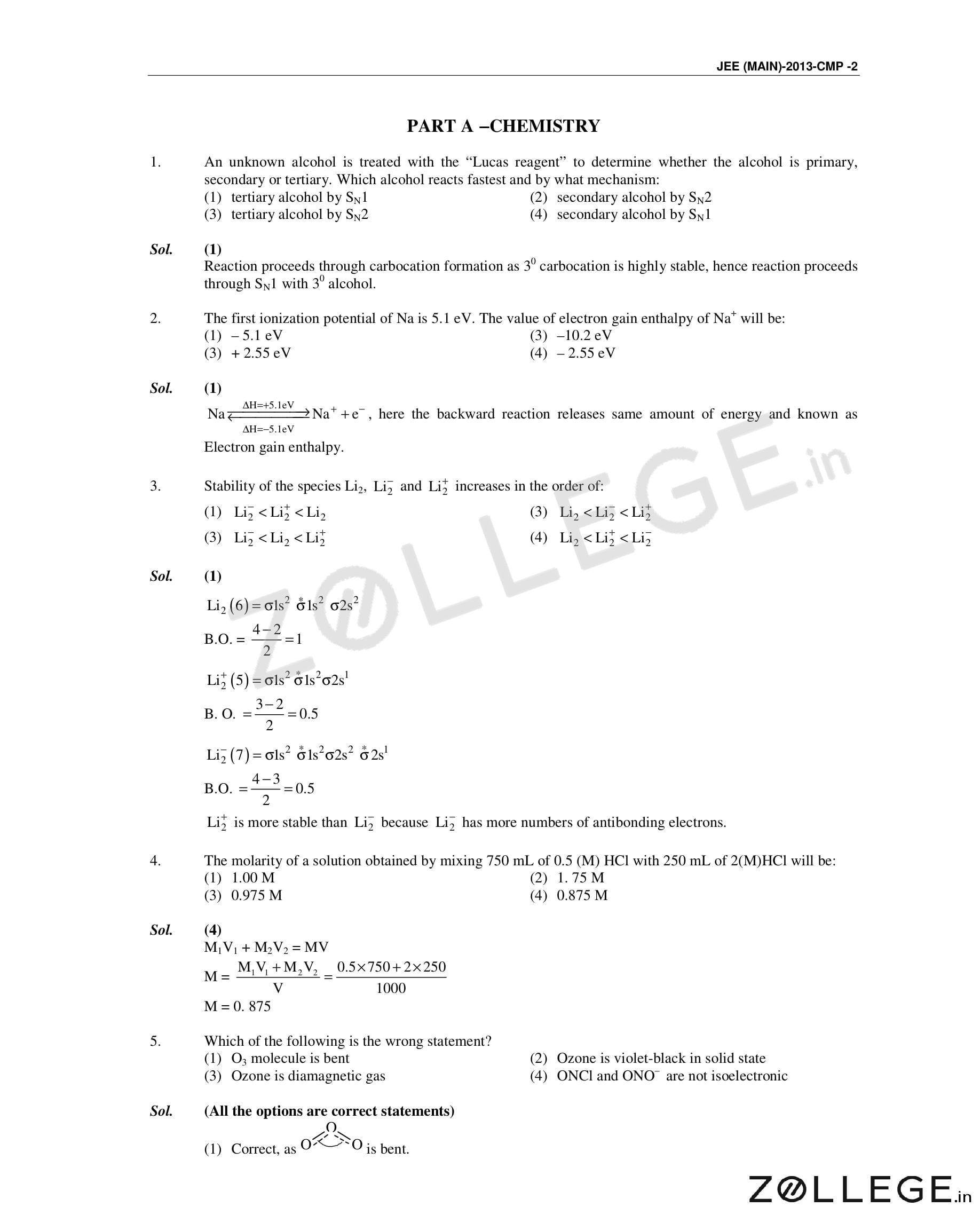
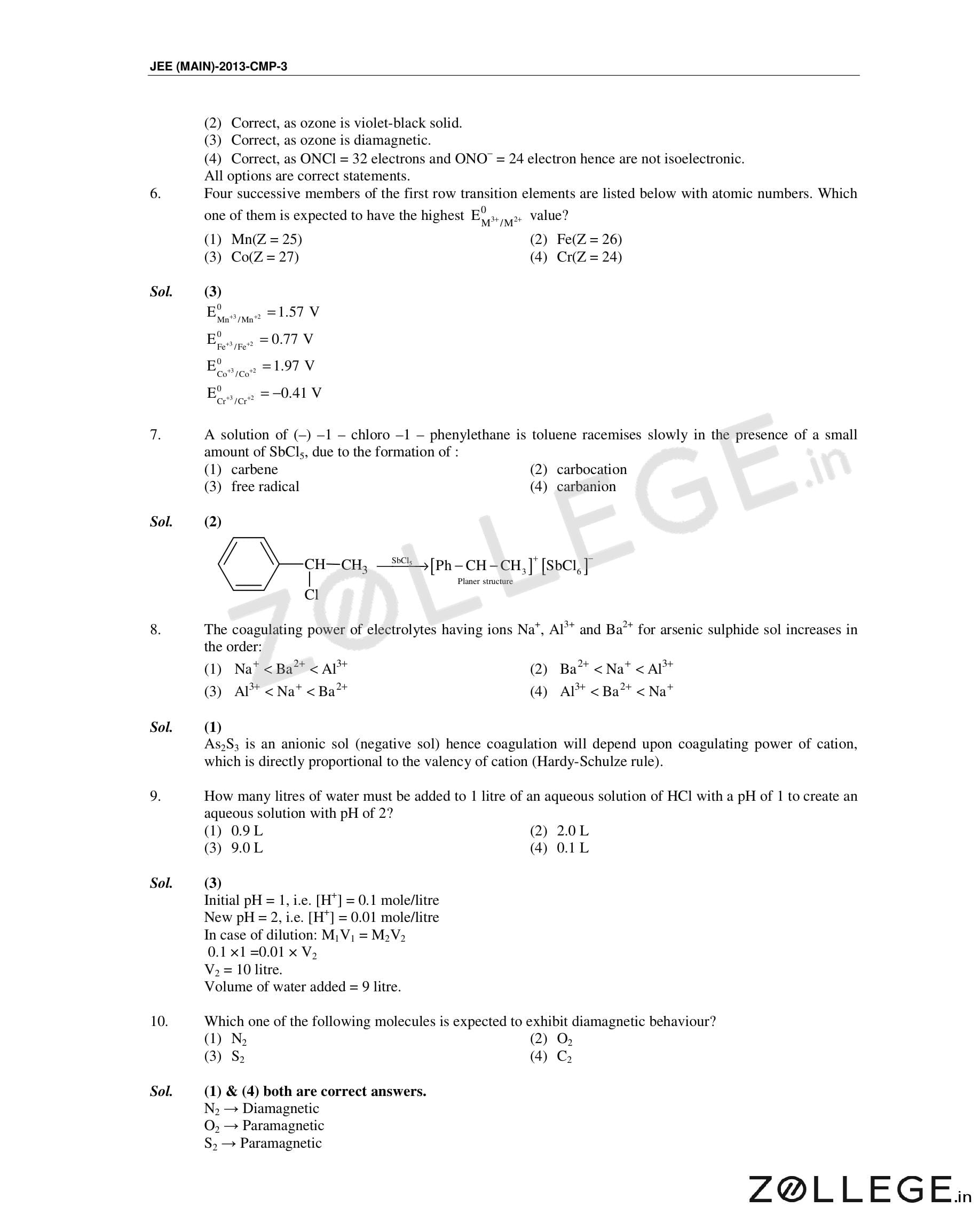
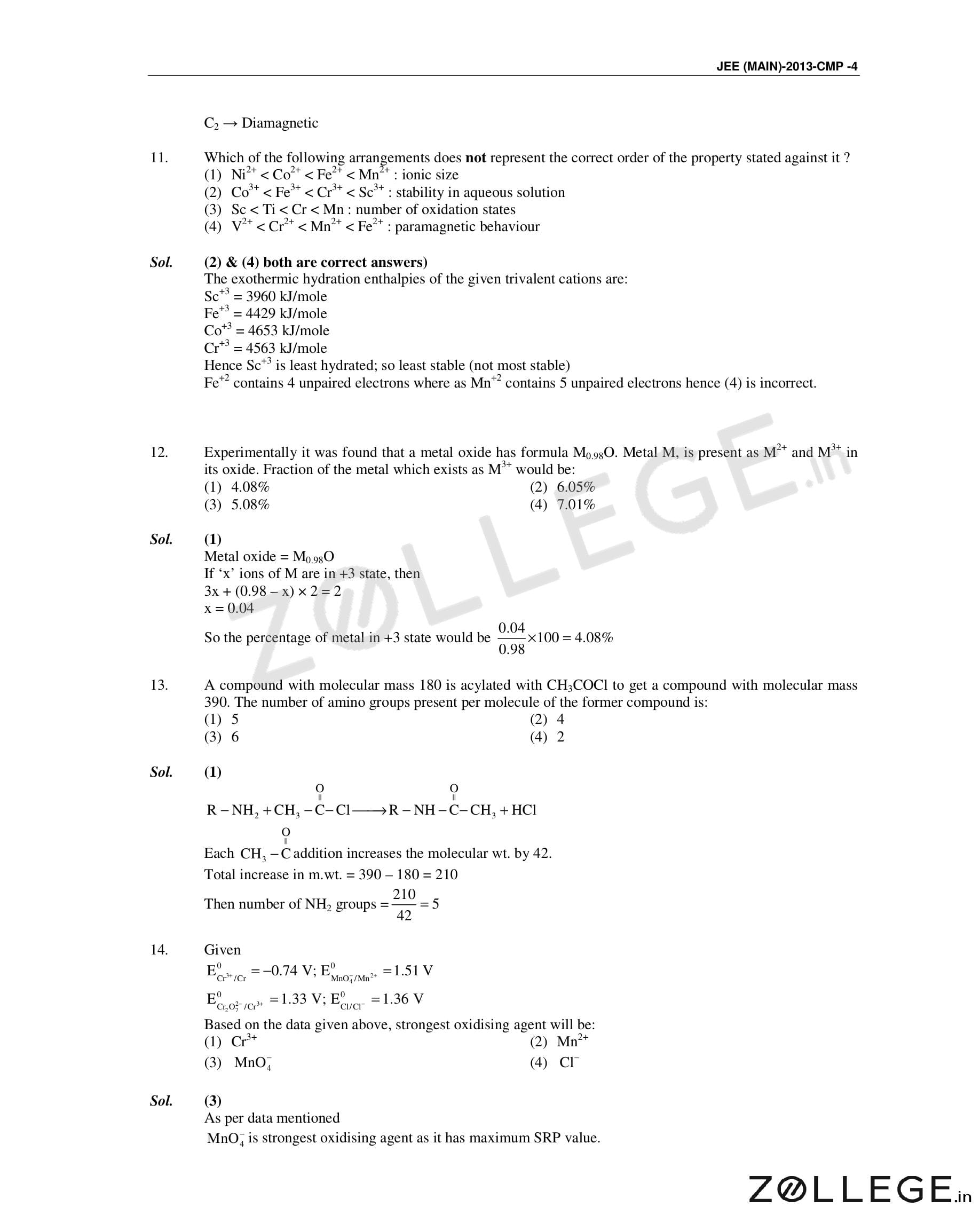
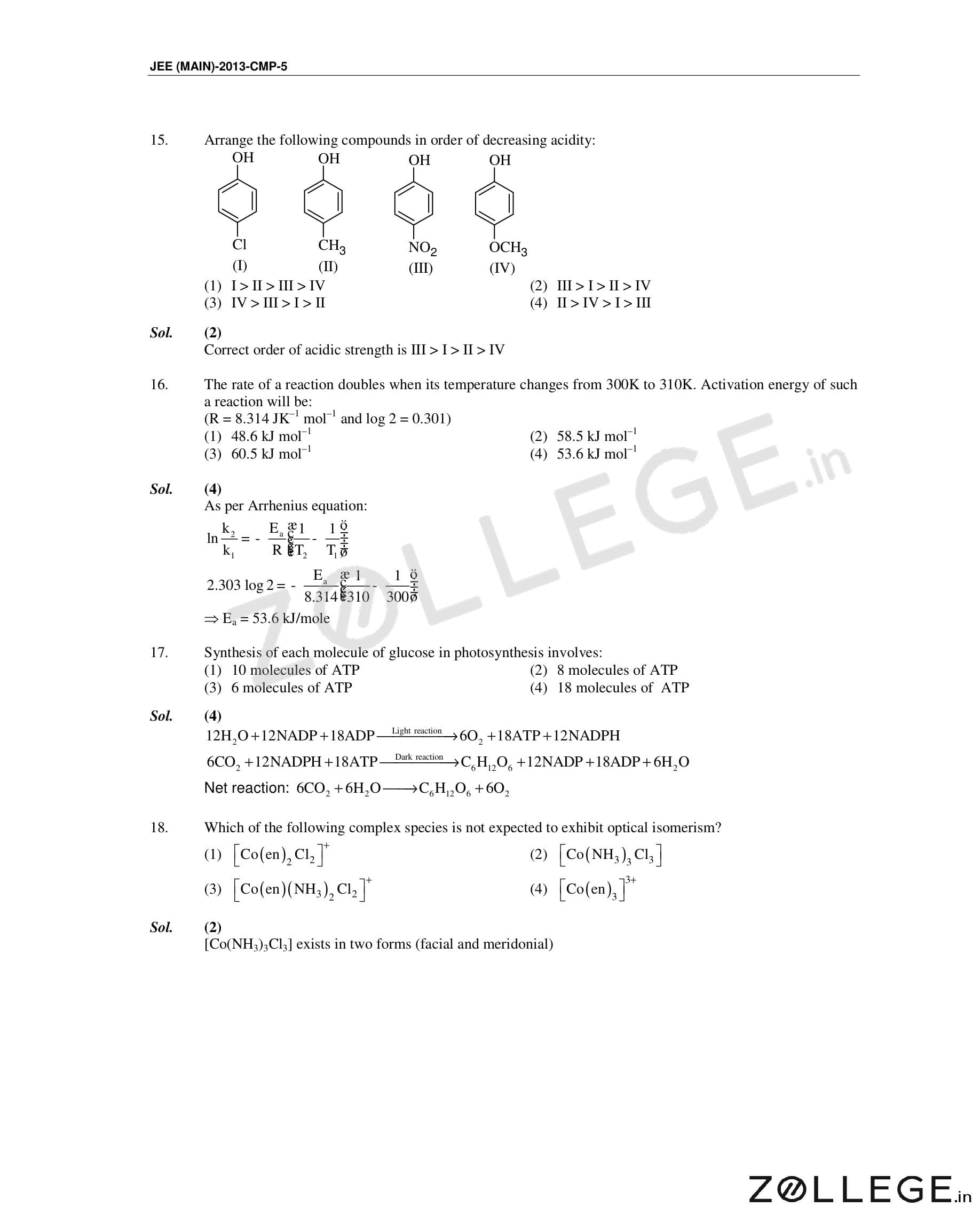
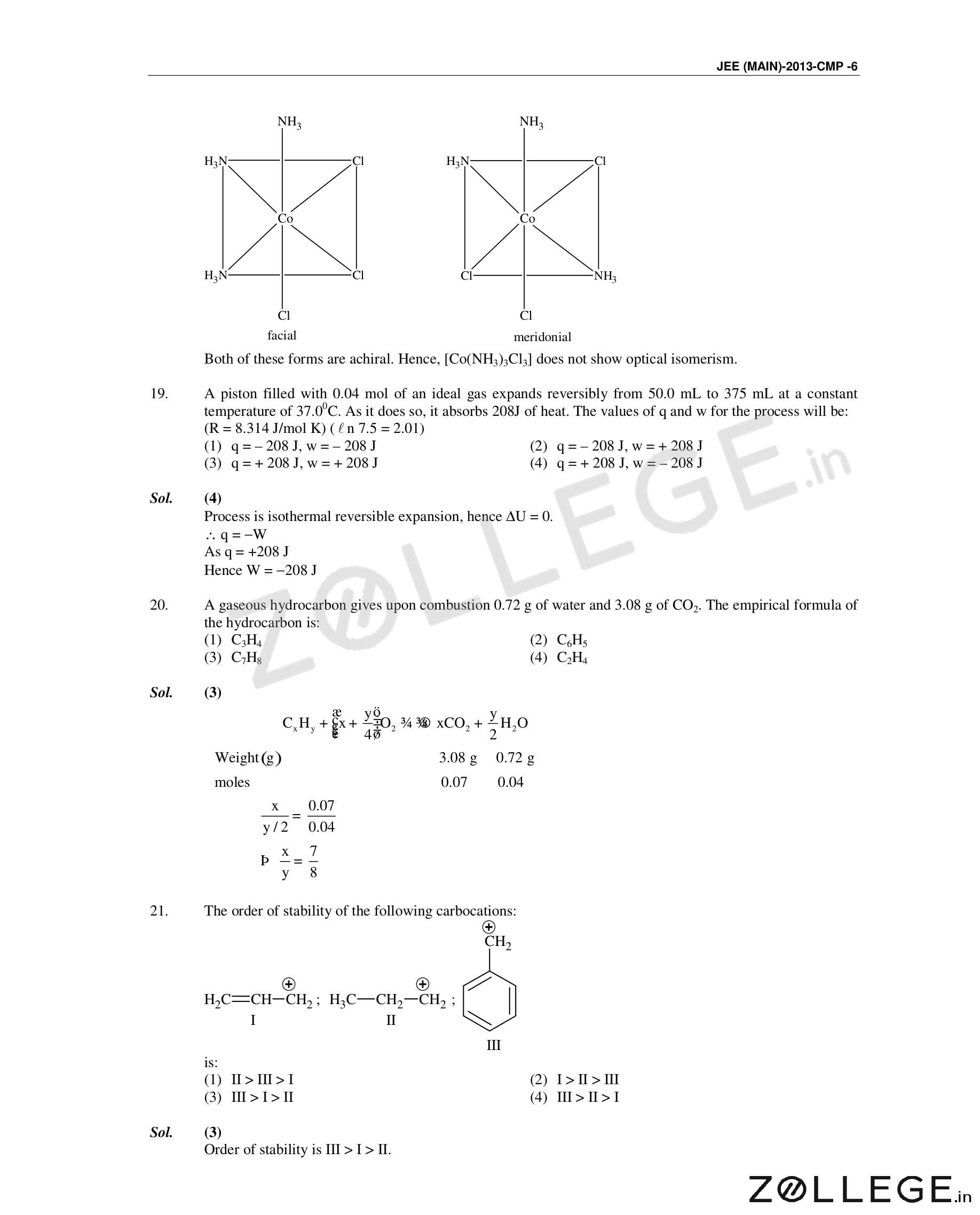
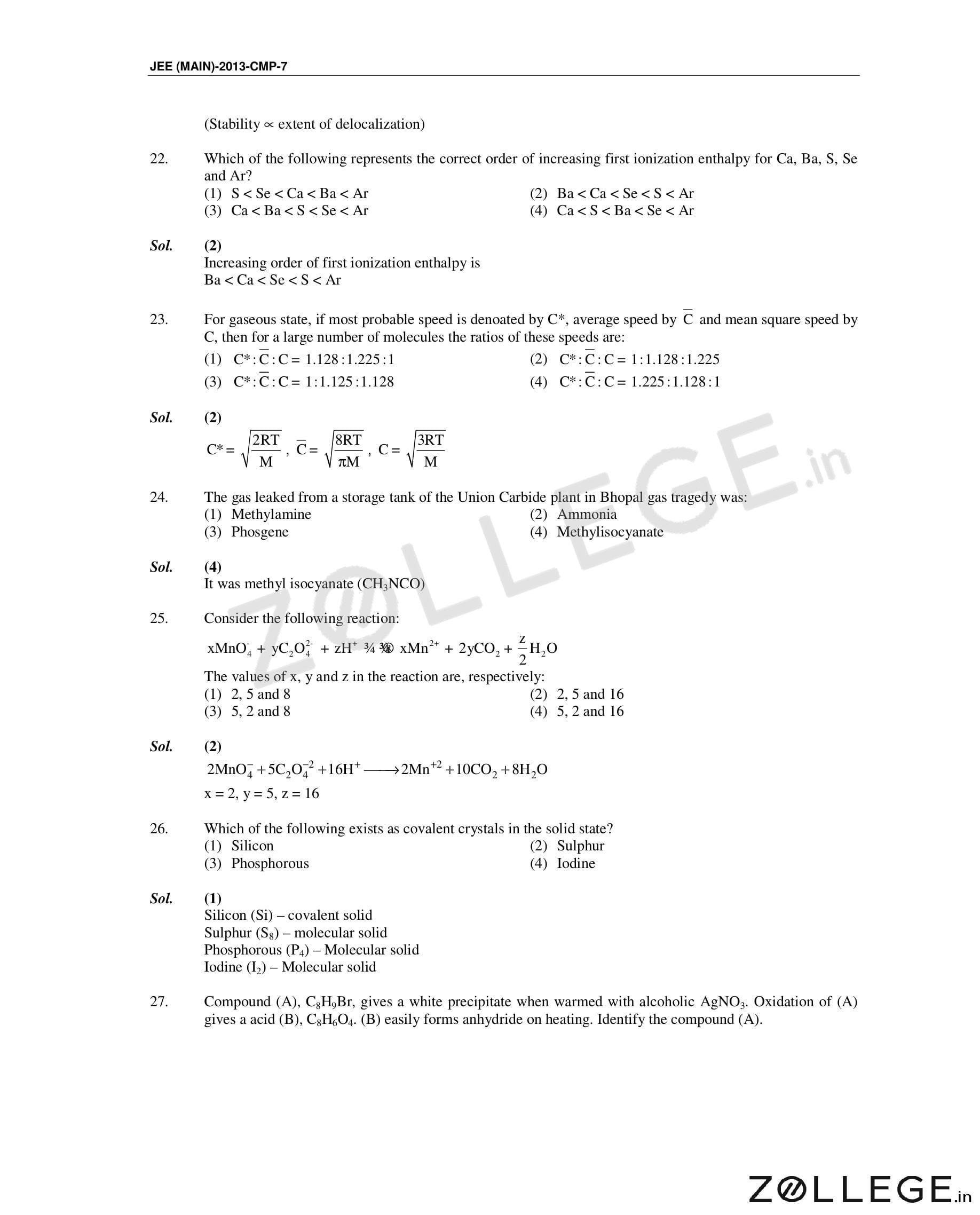
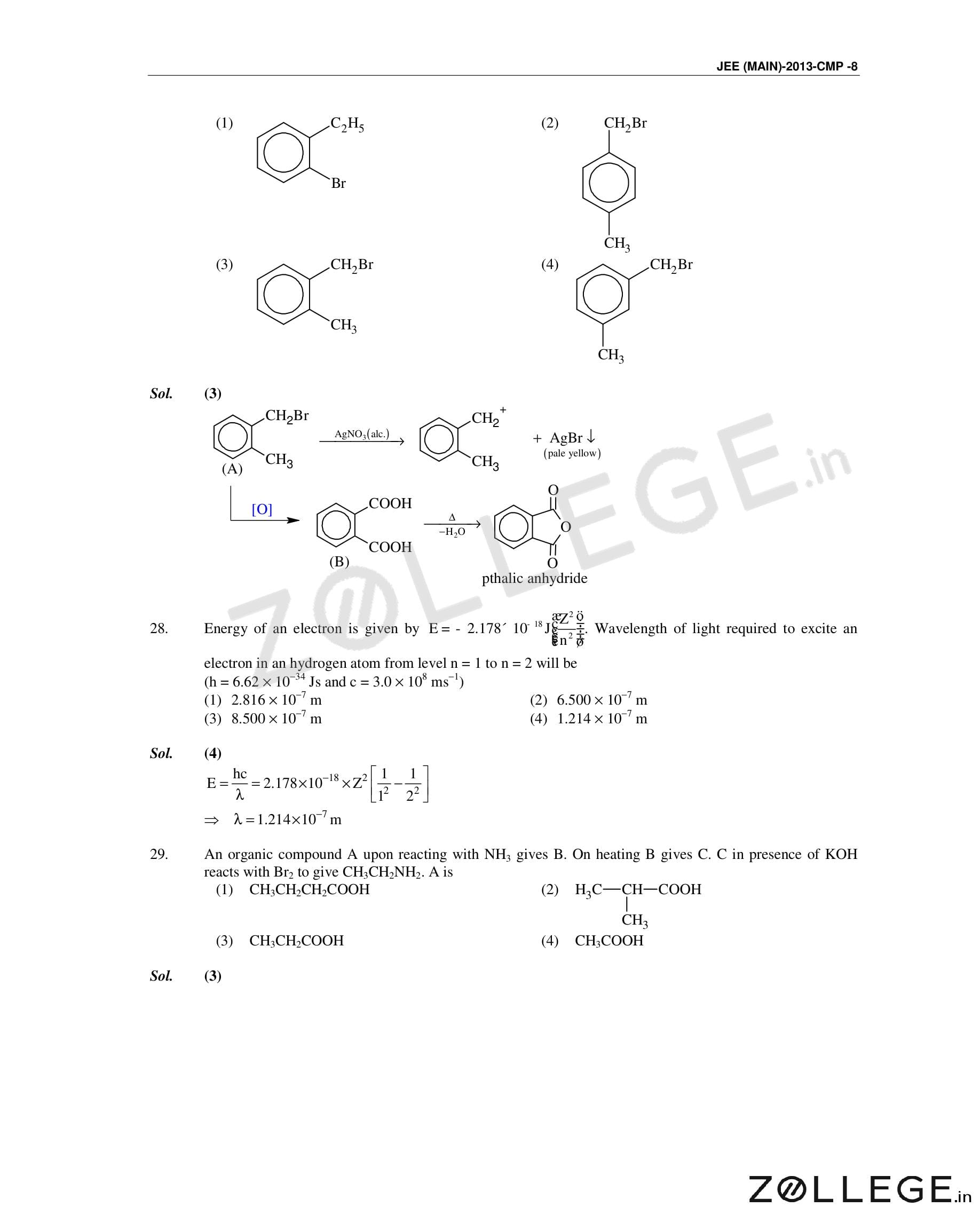
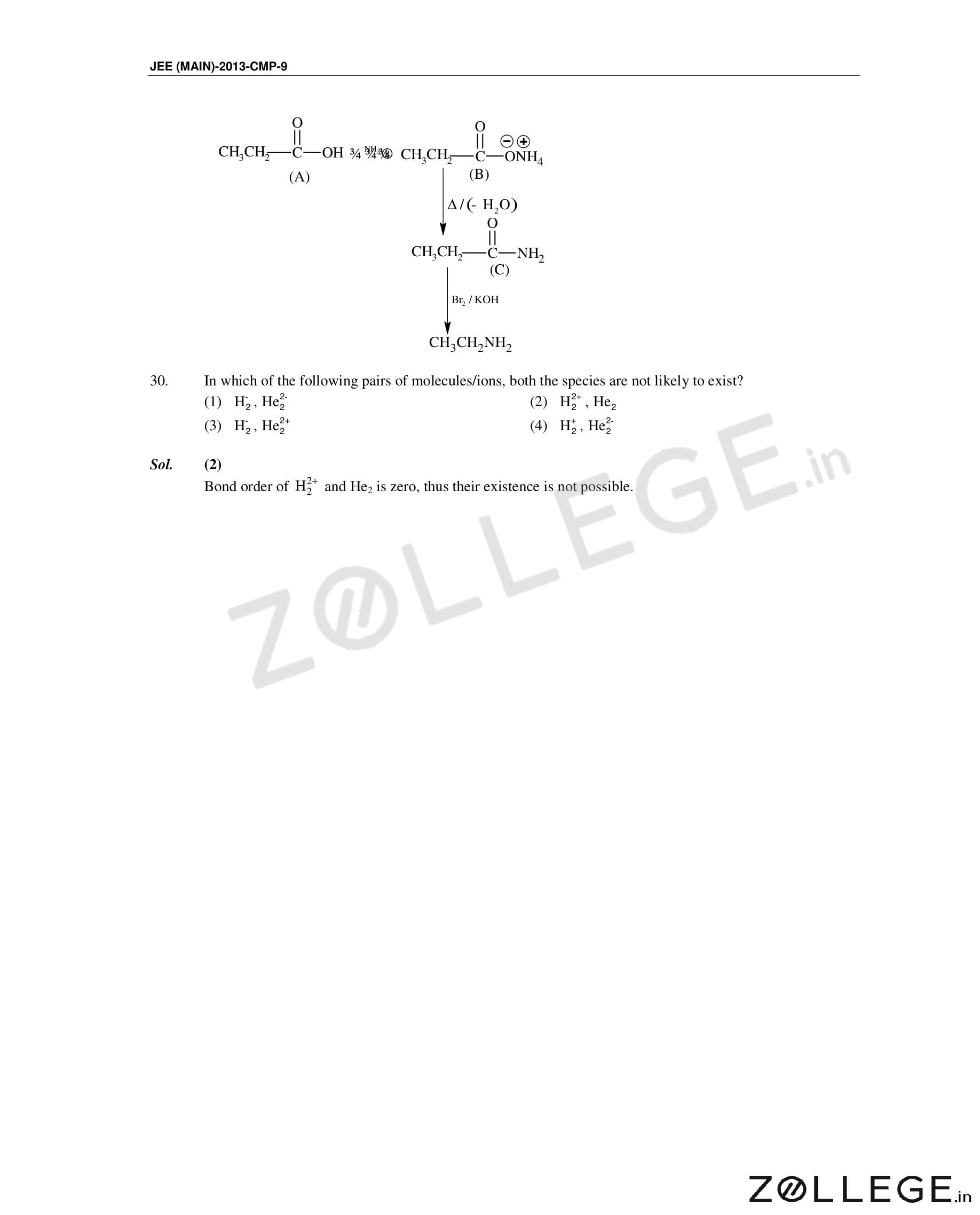
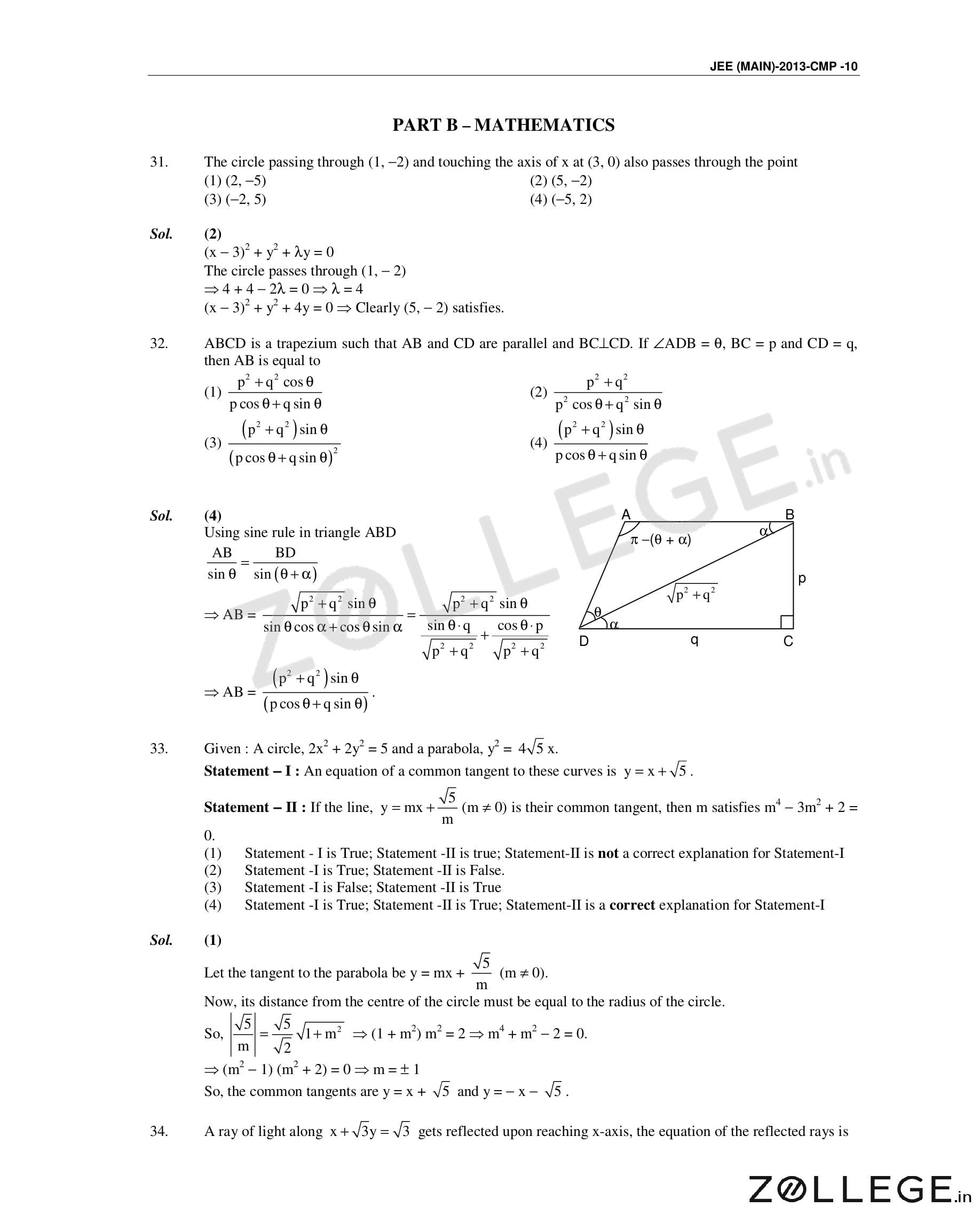
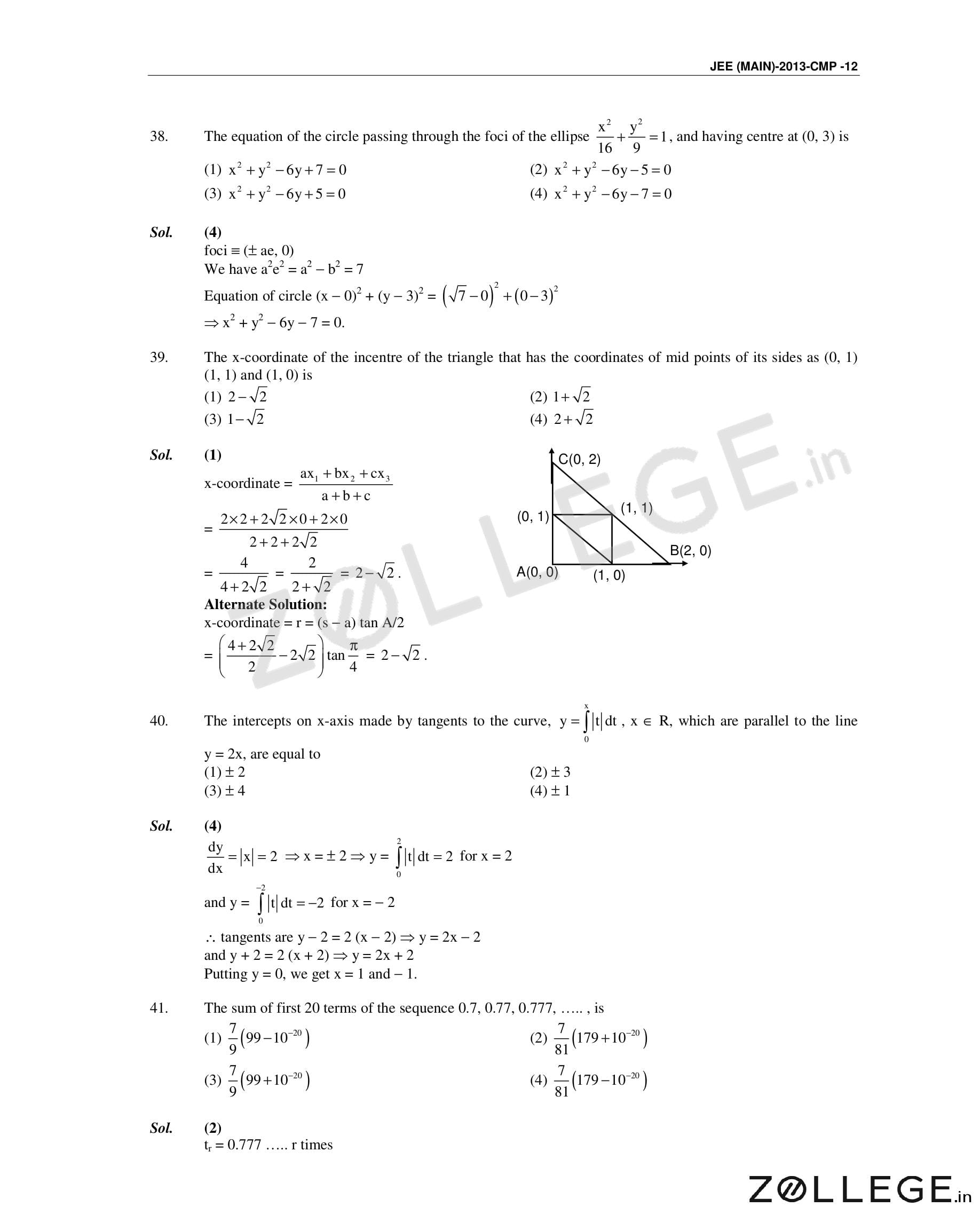
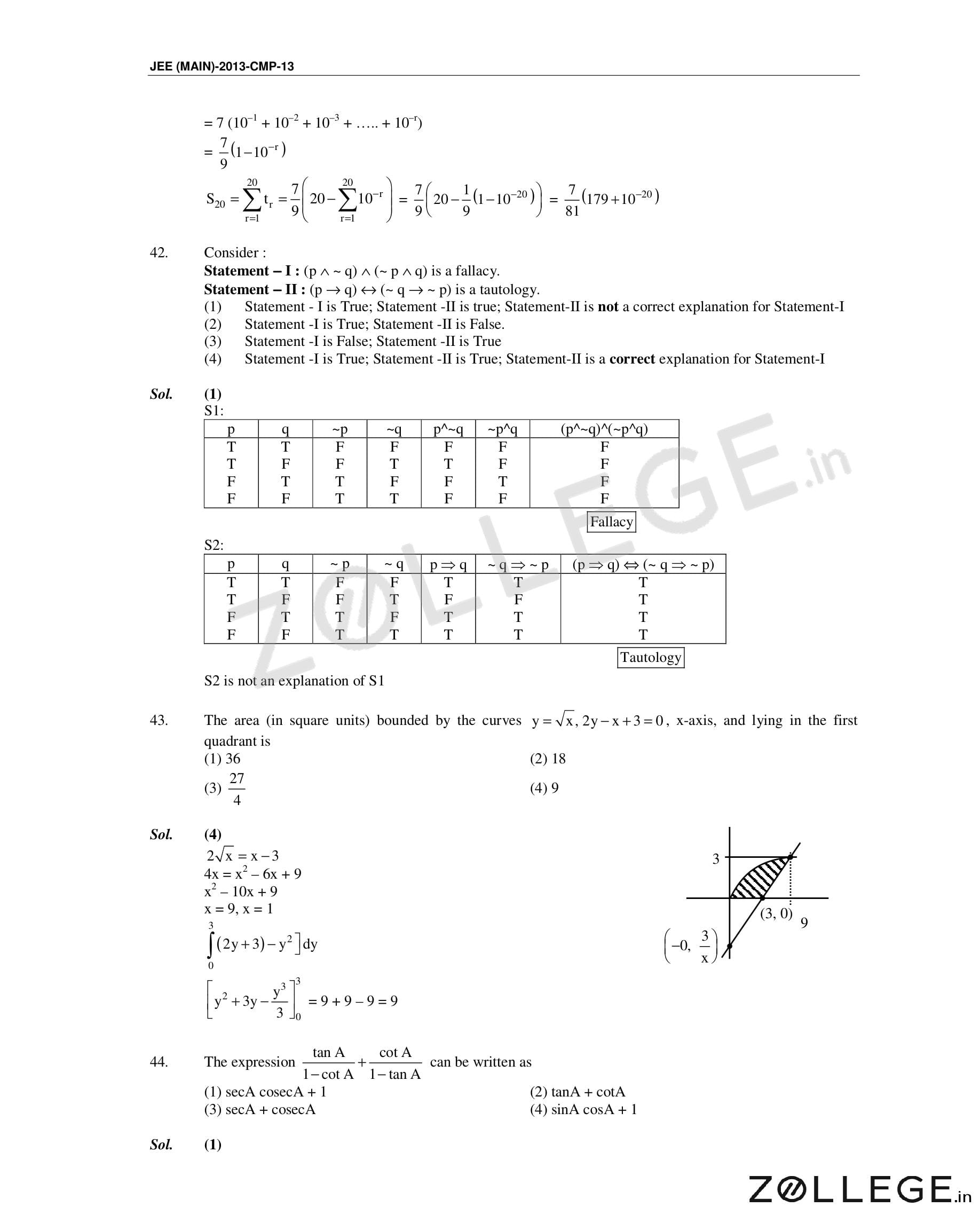
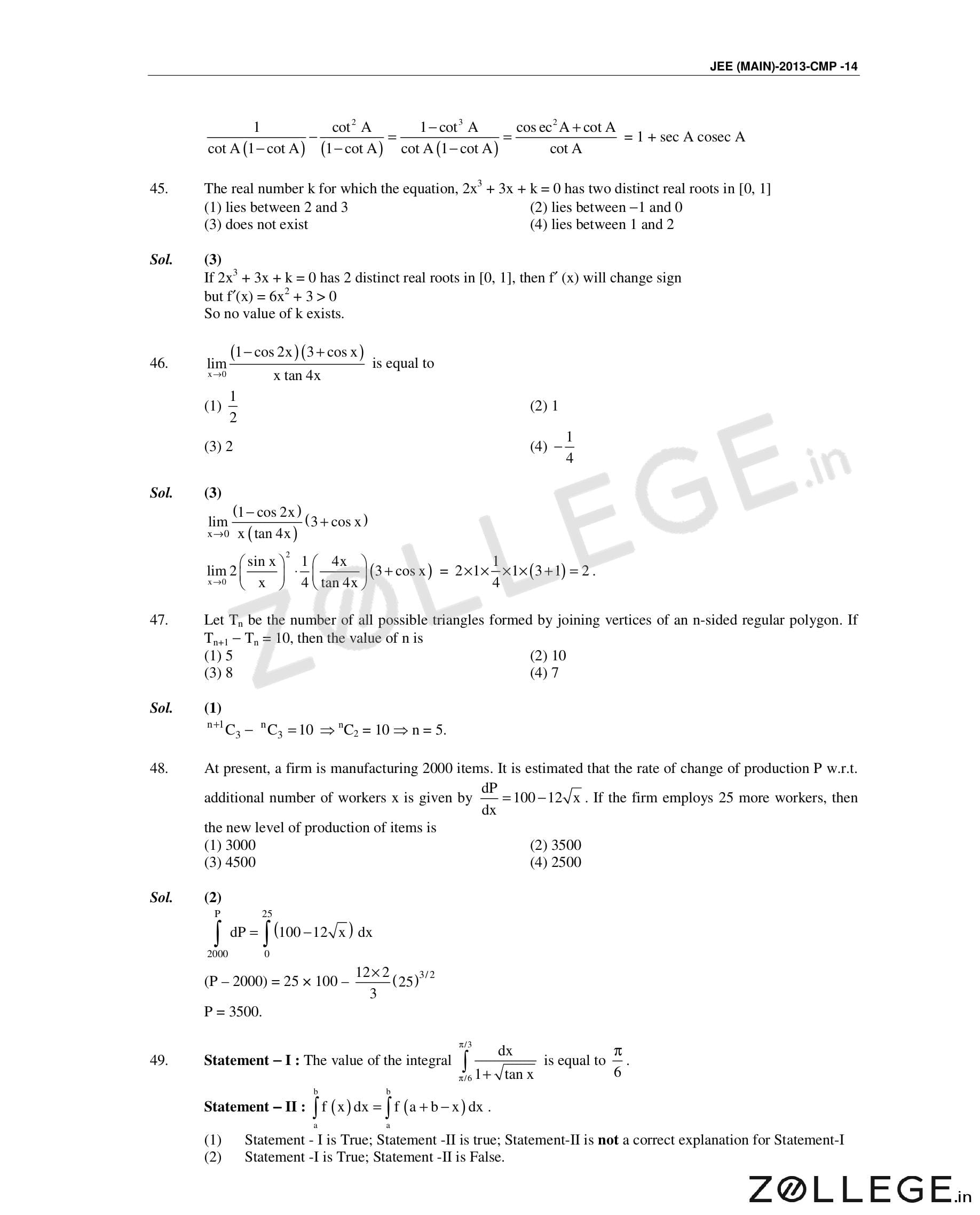
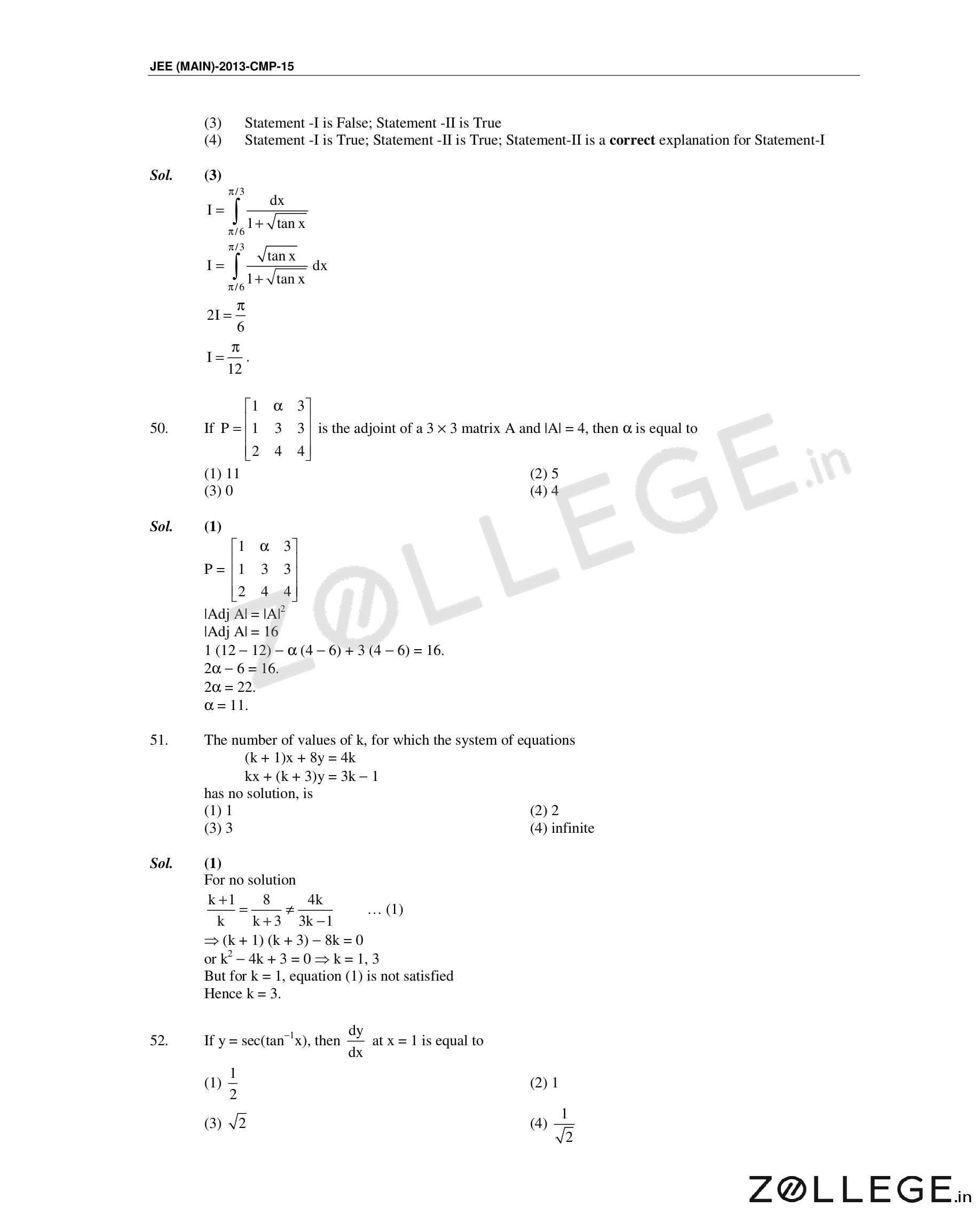
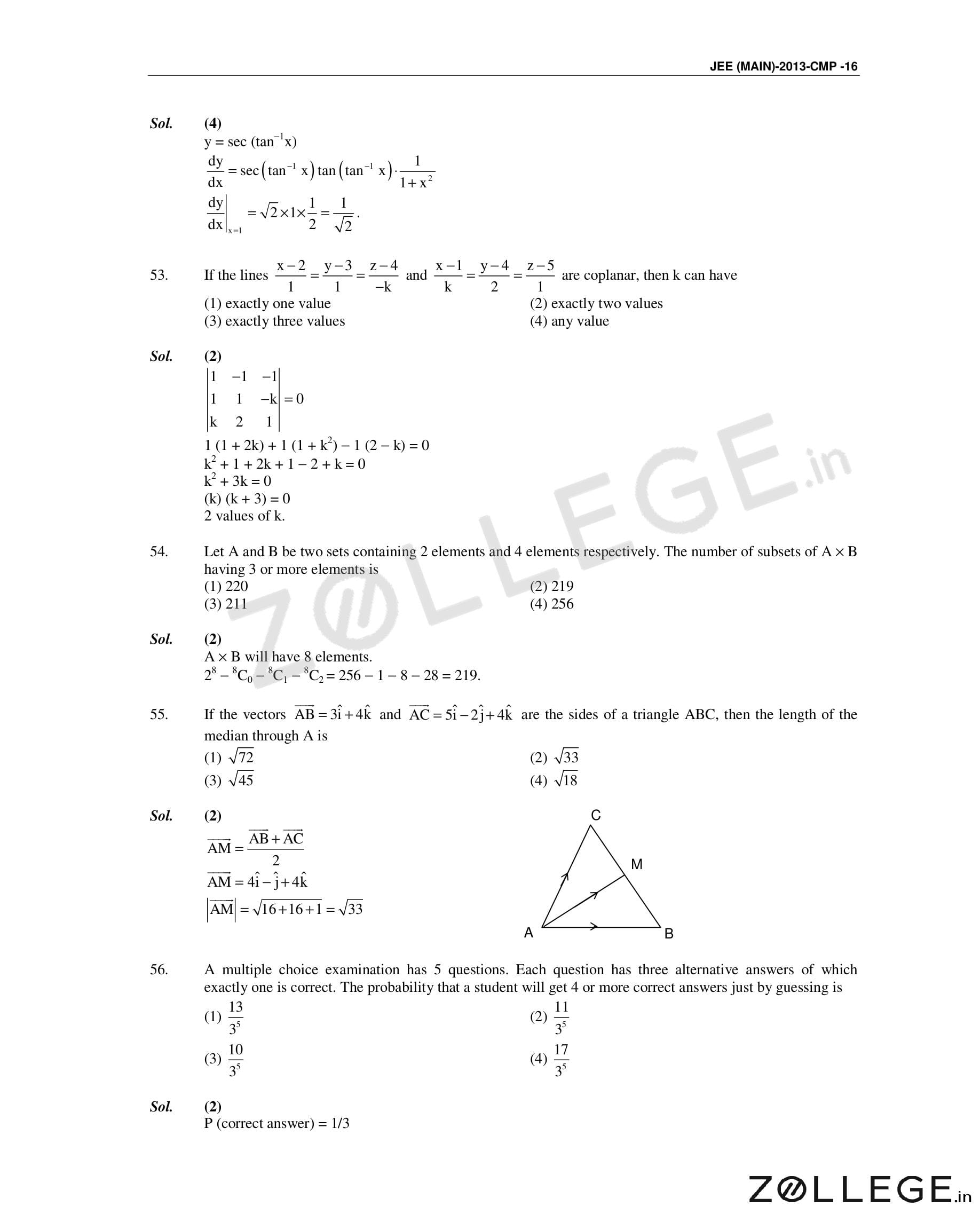
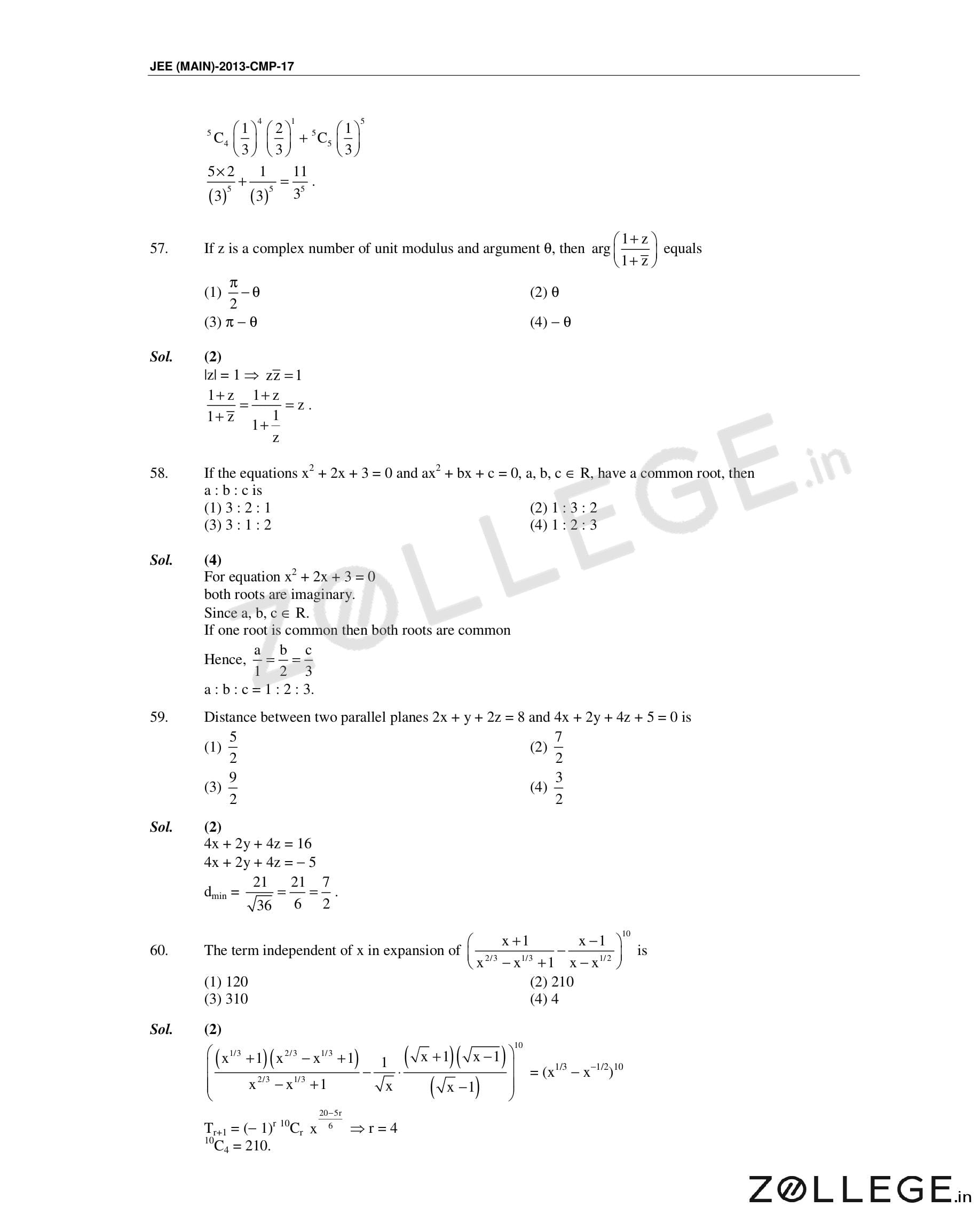
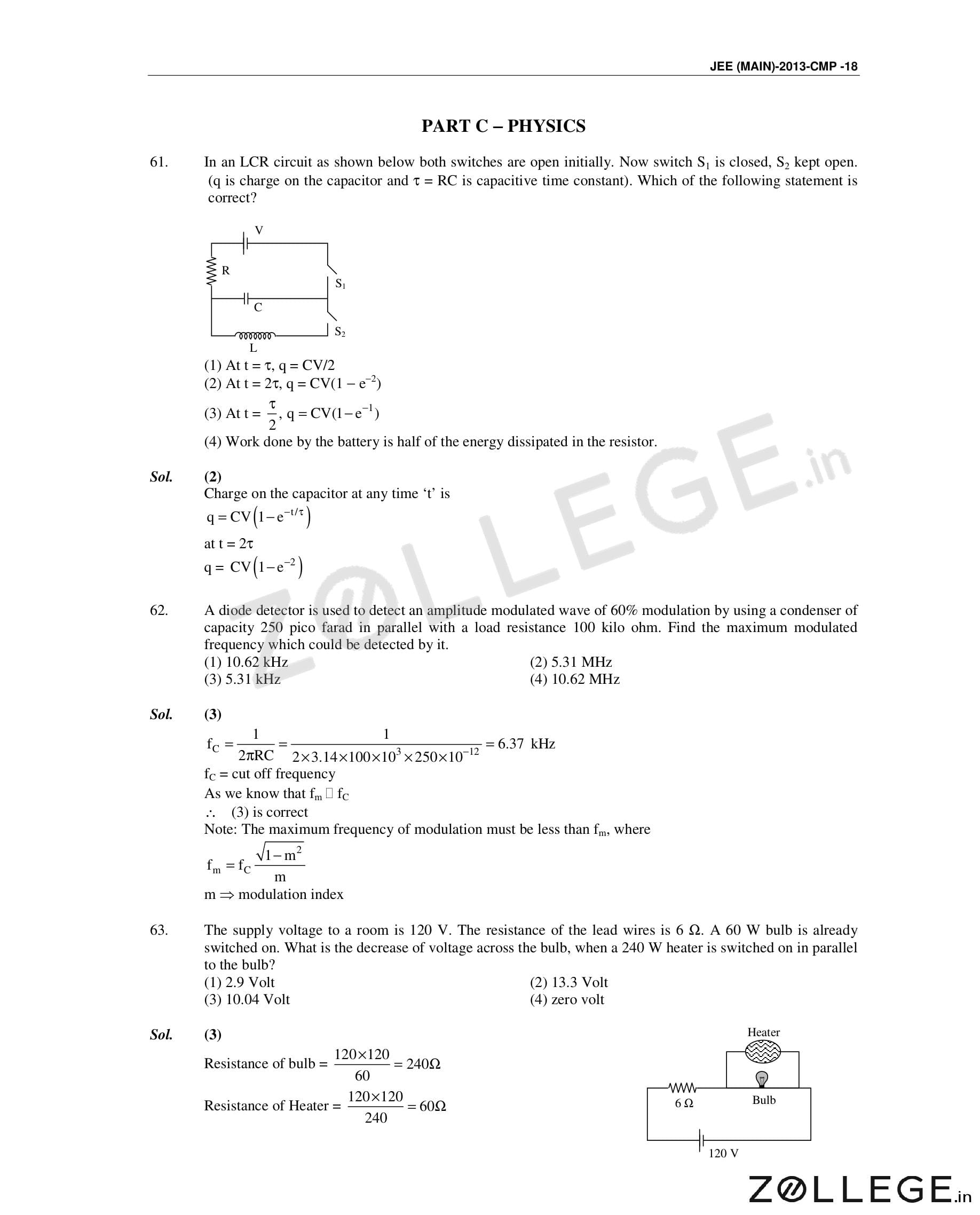
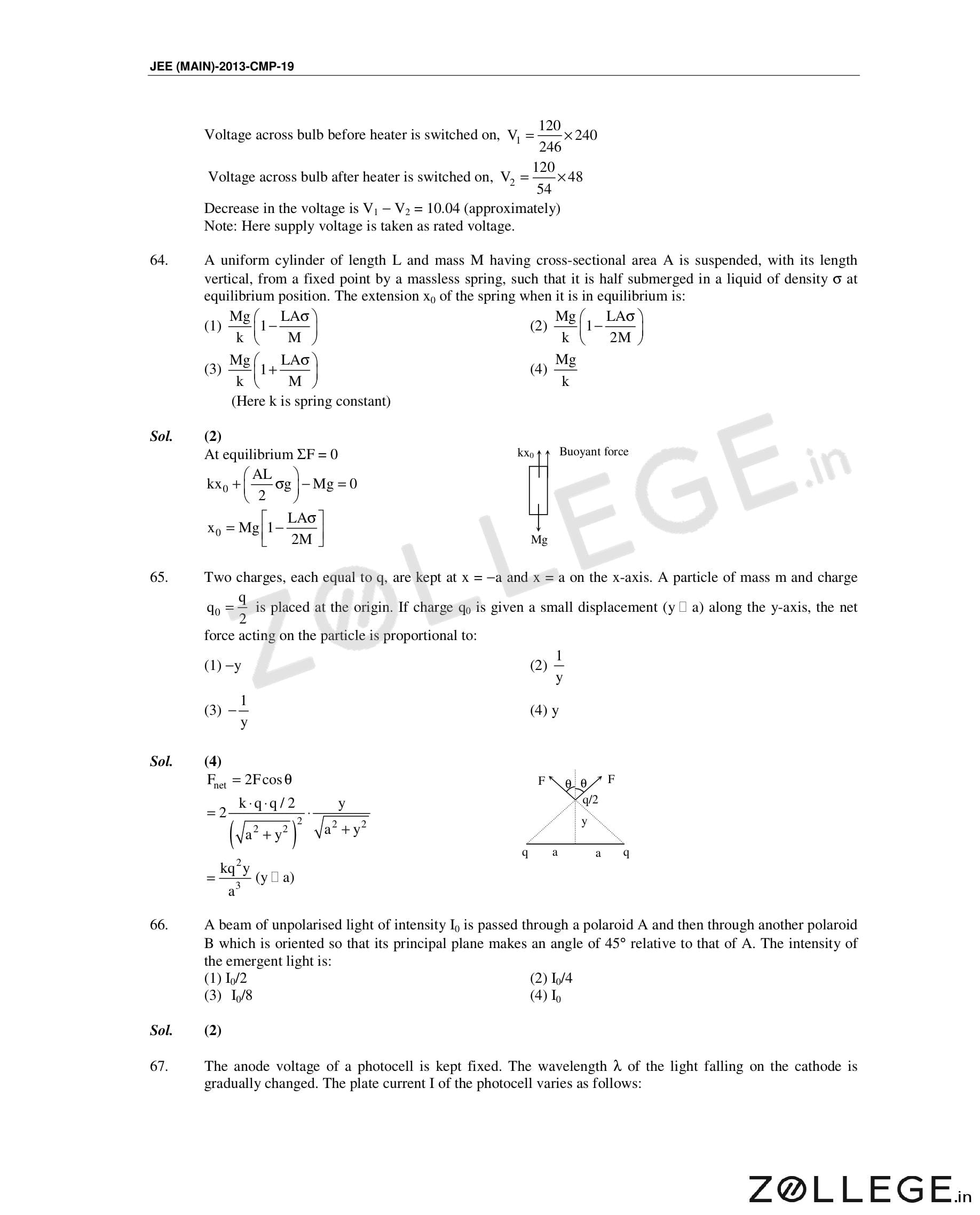
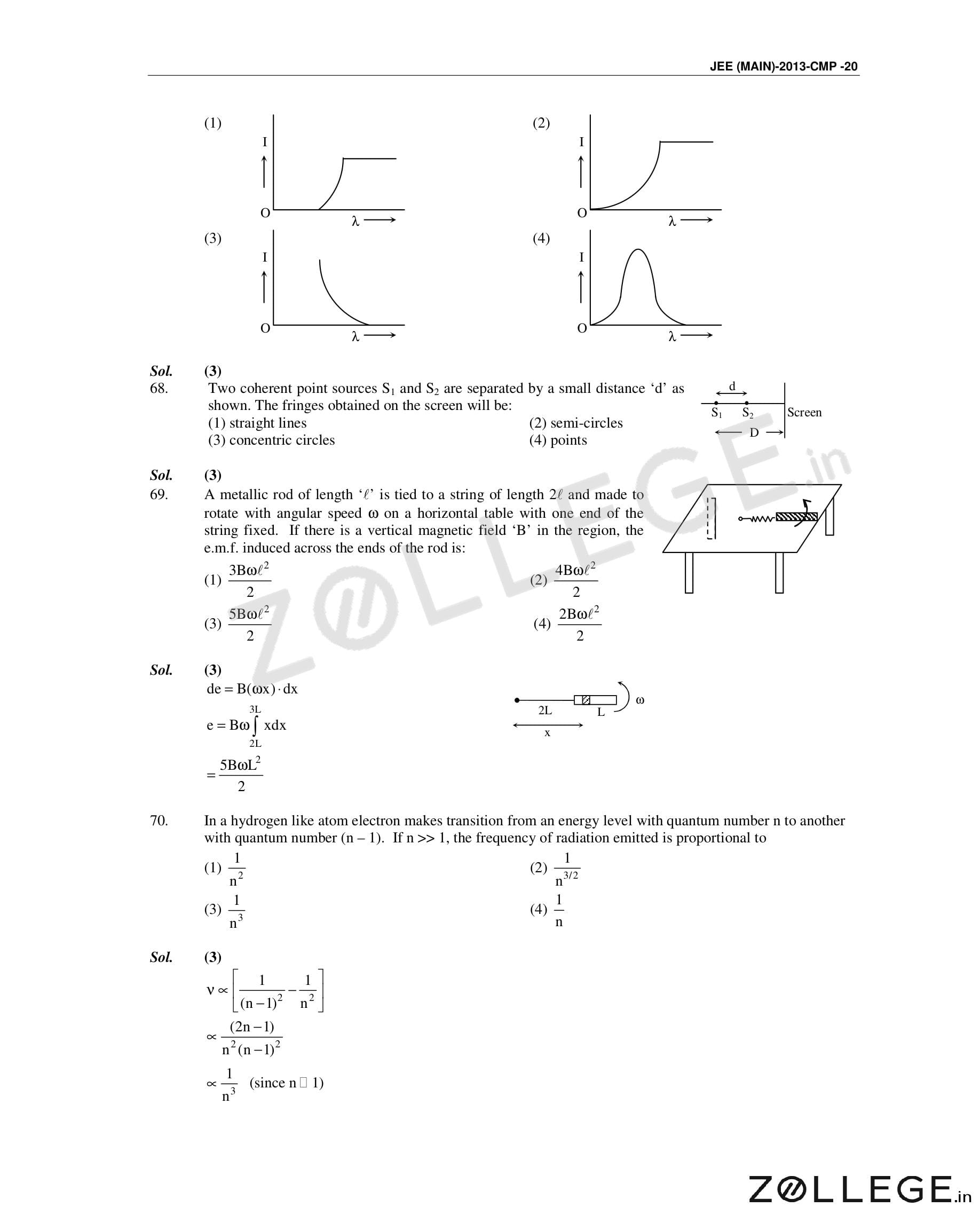
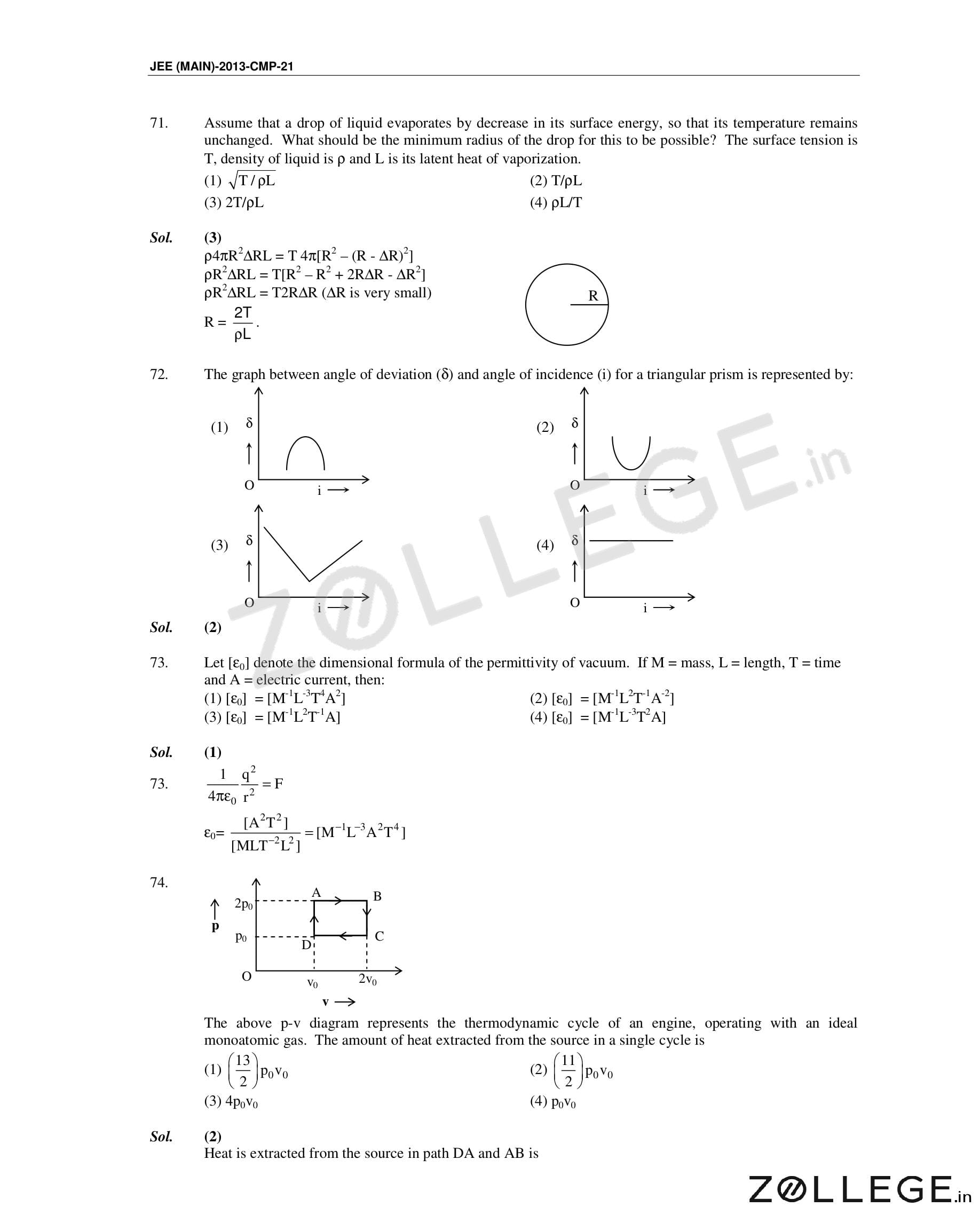
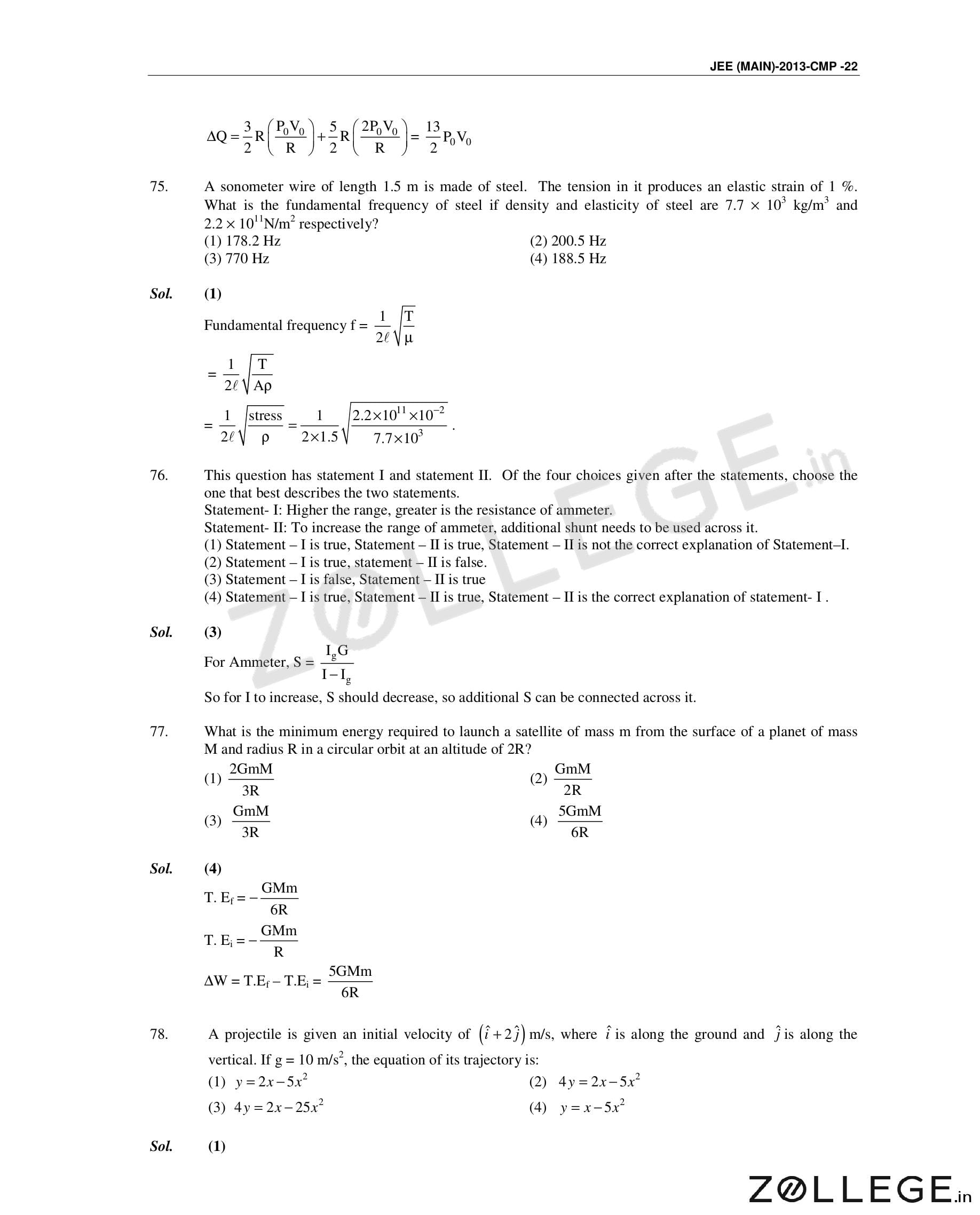
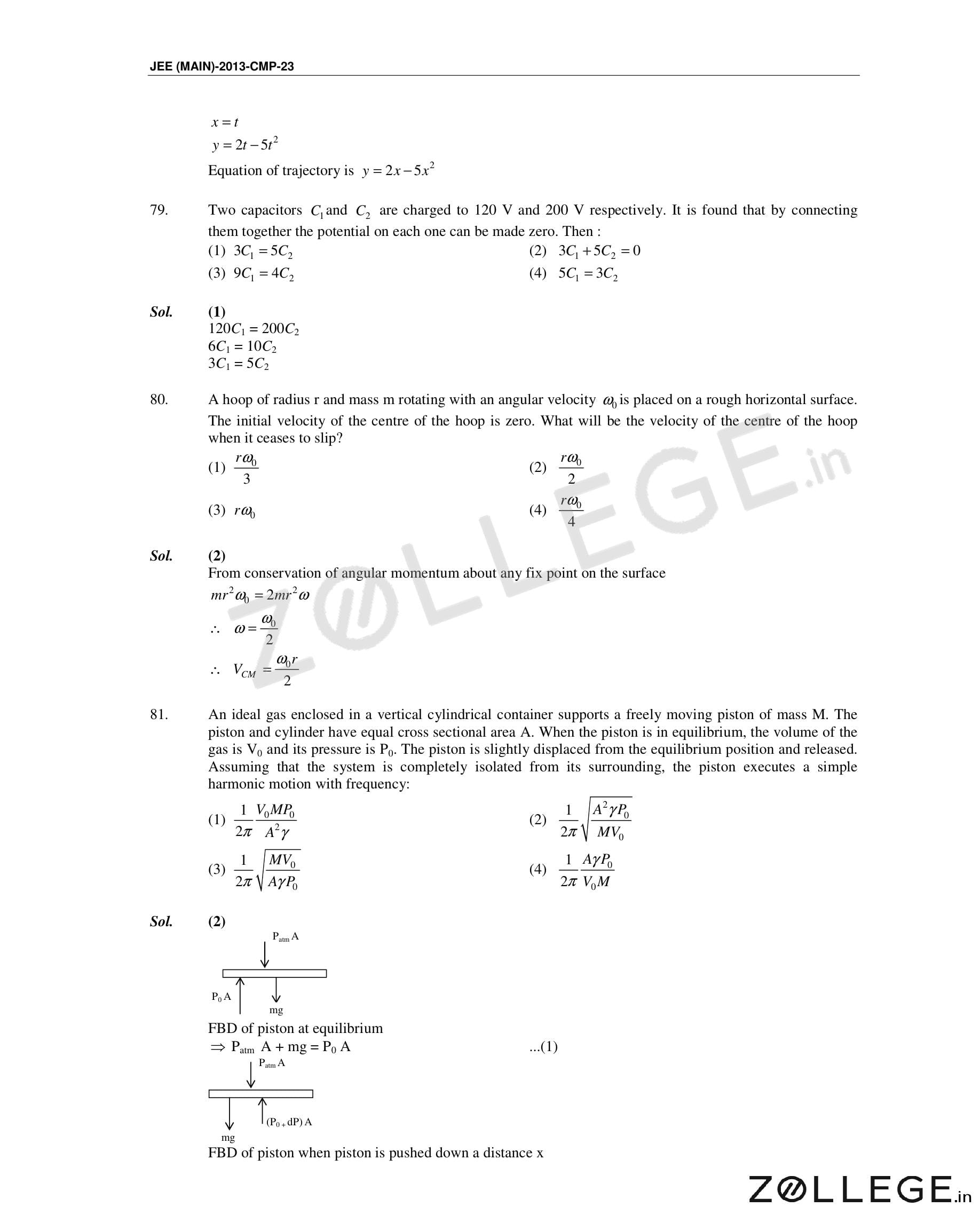
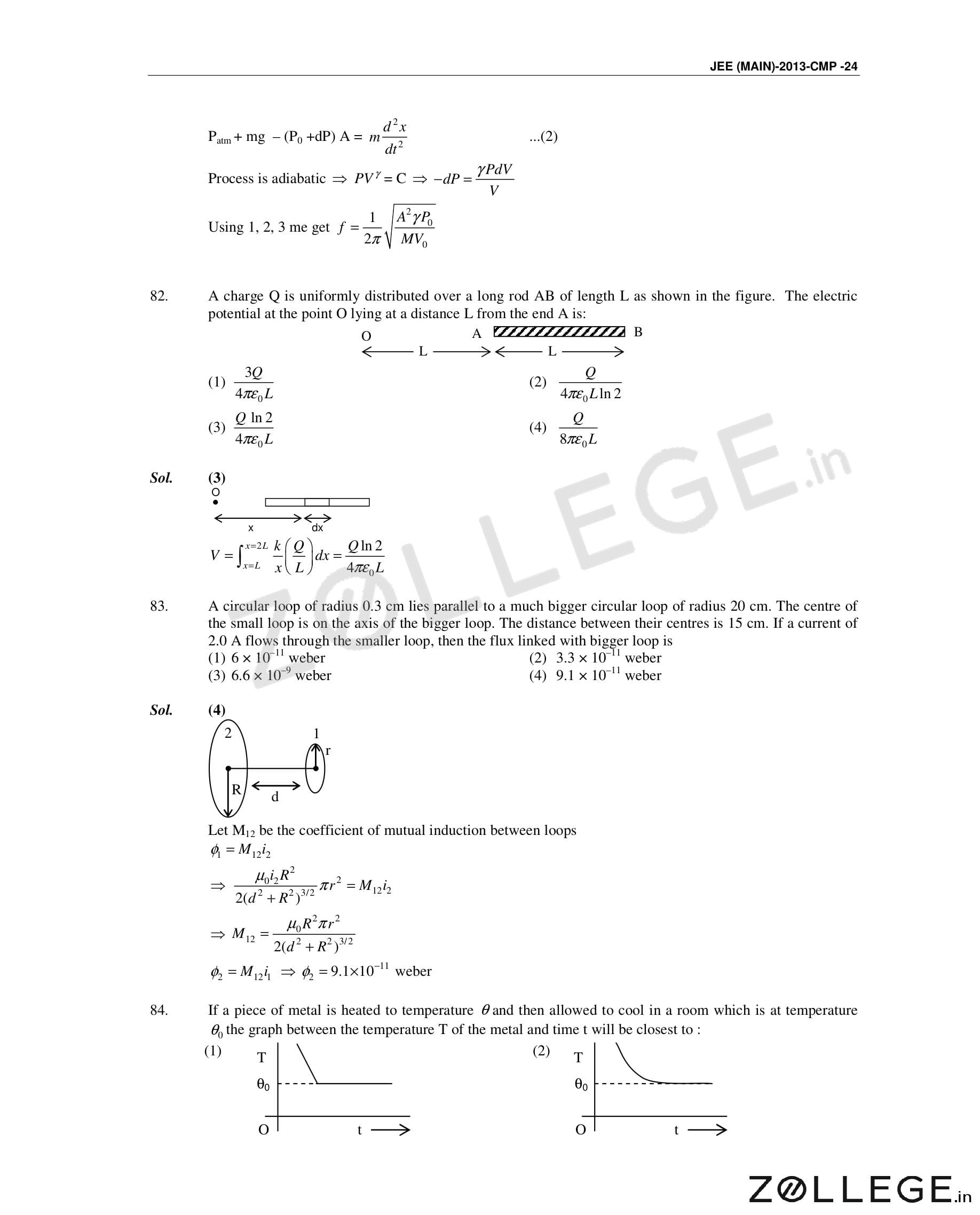
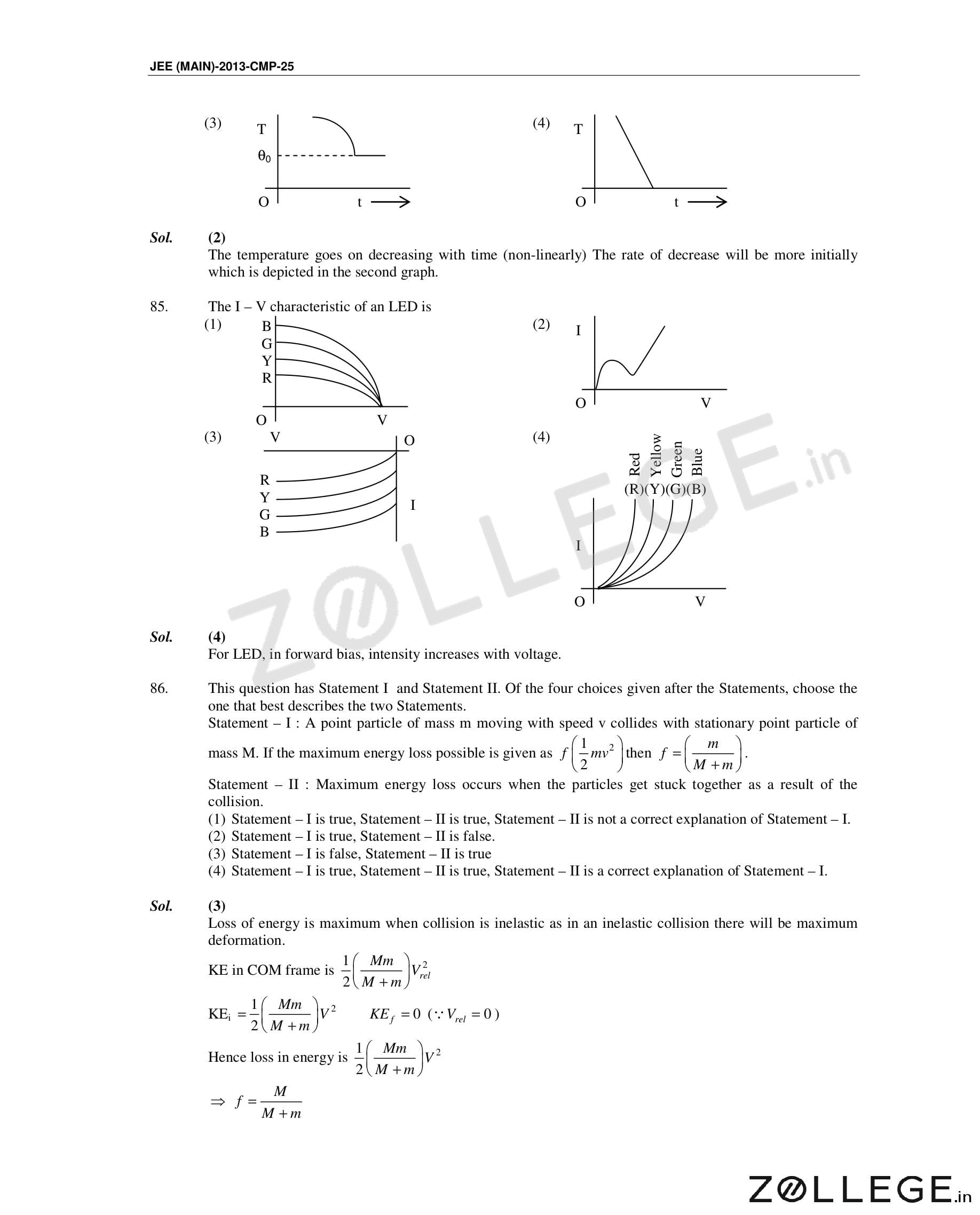
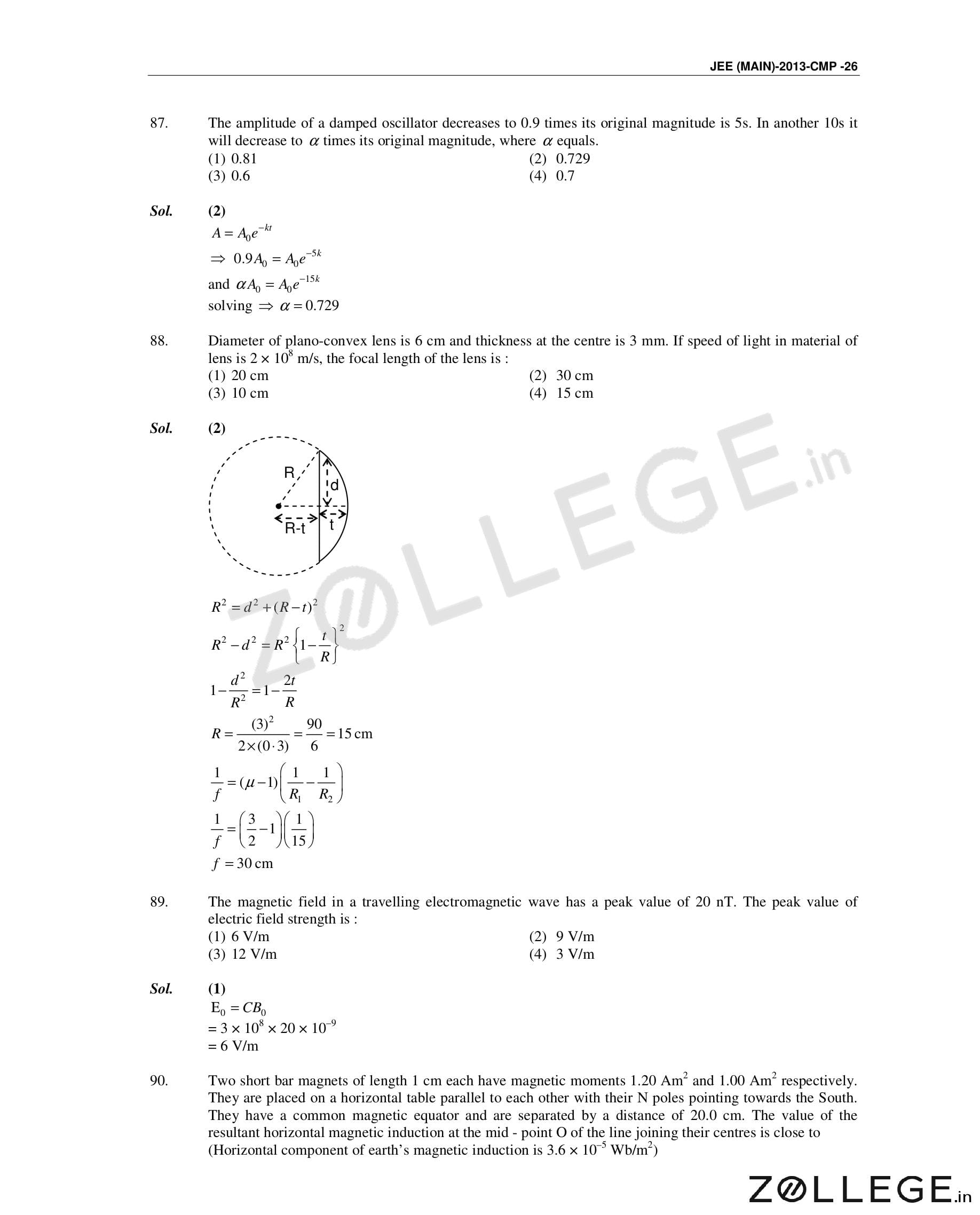
Previous Year JEE Main Question Papers
*The article might have information for the previous academic years, please refer the official website of the exam.