2 April 2026: Download JEE Main 2026 Session 2 Question papers

JEE Main 2026 B.Arch Syllabus: Exam Pattern, Important Topics, Best Books & Preparation Strategy


Content Writer | Updated On - Apr 4, 2026
What's New?
The National Testing Agency (NTA) will conduct the JEE Main 2026 B.Arch exam (Paper 2A) for B.Arch program admissions in India. JEE Mains 2026 B.Arch exam is on 29 January 2026 for January session and for April session it will be between 1- 10 April.
- The JEE Main 2026 B.Arch exam is of 400 marks. General Aptitude and Drawing make up 75% of the total score, so they're most important for scoring high marks.It includes Mathematics (100 marks), General Aptitude (200 marks), and Drawing (100 marks).
- Past results suggest that focusing on 3D thinking, knowing about buildings, and perspective drawing, plus math that uses calculus, gives you the best chance of scoring high. Put these at the top of your list as you get ready.
Table of Contents
- JEE Main 2026 B.Arch Exam Pattern
- JEE Main 2026 B.Arch Marking Scheme
- JEE Main 2026 B.Arch Syllabus - Mathematics
- JEE Main 2026 B.Arch Syllabus- Drawing
- JEE Main 2026 B.Arch Syllabus - General Aptitude
-
- JEE Main 2026 B.Arch Exam Recommended Books
- Important Topics for JEE Main 2026 B.Arch
- How to Prepare for JEE Main B.Arch 2026
- Frequently Asked Questions

Key Summary -
|
JEE Main 2026 B.Arch Exam Pattern
The JEE Main B.Arch Exam Pattern is structured to evaluate a candidate’s proficiency in Mathematics, General Aptitude and Drawing. It is a highly competitive Exam that assesses both technical knowledge and creative skills required for architecture.
Here’s is the concise Breakdown of the JEE Main 2026 Exam Pattern
| Section | Subjects | Number of Questions | Marks per Question | Total Marks |
|---|---|---|---|---|
| Mathematics (Section A) | Mathematics | 20 MCQs +5 Integer-Type | +4 for correct | 100 |
| General Aptitude (Section B) | General Aptitude | 50 | +4 for correct | 200 |
| Drawing (Section C) | Drawing & Sketching | 2 | +100 for correct answers | 100 |
Reddit Users-
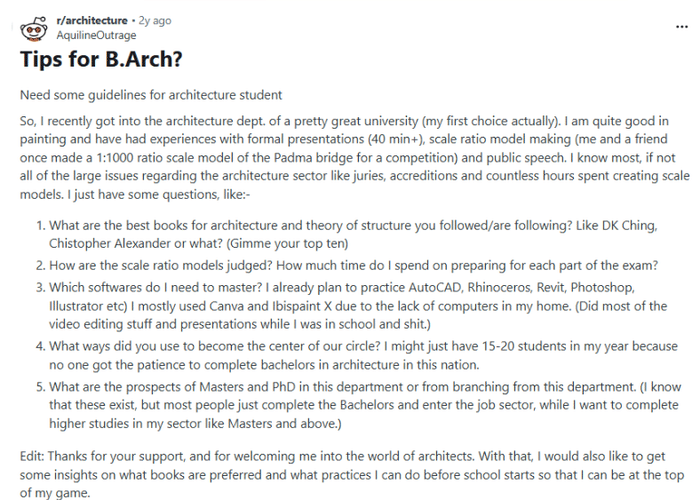
Reddit Users Replied - https://www.reddit.com/r/architecture/comments/1bsy9jp/tips_for_barch/
JEE Main 2026 B.Arch Marking Scheme
JEE Main B.Arch is specially designed for students aspiring to pursue undergraduate programs in architecture. The marking scheme helps candidates understand how marks are awarded and deducted in the examination. Below is the detailed marking scheme
| Section | Number of Questions | Marks Per Question | Total Marks | Type of Questions |
|---|---|---|---|---|
| Mathematics | 20 MCQs + 5 NATs* | 4 | 100 | MCQs (Multiple-Choice Questions), NATs (Numerical Answer Type) |
| Aptitude | 50 | 4 | 200 | MCQs(Multiple-Choice Question) |
| Drawing | 2 | 50 | 100 | Subjective Questions (Drawing-based) |
| Total | 77 Questions | - | 400 Marks | Combination of MCQs, NATs, and Subjective |
JEE Main 2026 B.Arch Syllabus - Mathematics
The mathematics section in JEE Main B.Arch focuses on various core topics related to algebra , calculus, and statistics. Below is the detailed breakdown of the syllabus for the Mathematics Section:
| Topic | Key Concepts Included |
|---|---|
| Sets, Relations & Functions | Sets and their representation; types of relations; functions (one-one, onto, into); composition of functions. |
| Complex Numbers & Quadratic Equations | Complex numbers (algebra and Argand plane); quadratic equations and roots. |
| Matrices & Determinants | Types of matrices; operations; determinants; inverse and applications to linear equations. |
| Permutations & Combinations | Fundamental counting principle; nPr, nCr; applications. |
| Binomial Theorem & Its Applications | Binomial expansion, middle term, simple applications. |
| Sequence & Series | AP, GP; insertion of means; series sums. |
| Limits, Continuity & Differentiability | Limits of functions; continuity; differentiation basics and rules. |
| Integral Calculus | Integration as inverse of differentiation; definite integrals and properties. |
| Differential Equations | Ordinary differential equations; solution methods. |
| Trigonometry | Trigonometric ratios; identities; inverse trig functions. |
| Coordinate Geometry | Straight lines; circles; conic sections (parabola, ellipse, hyperbola). |
| Three-Dimensional Geometry | Direction ratios; equation of a line and a plane in 3D. |
| Vector Algebra | Vectors and scalars; addition; dot and cross products. |
| Statistics & Probability | Mean, median, mode; probability basics; random variables & distributions. |
JEE Main 2026 B.Arch Syllabus- Drawing
JEE Main B.Arch 2026 Drawing test is designed to evaluate a Candidate Creativity, visualization skills and basic understanding of architectural concepts. The section assesses how well candidates can represent real world projects and abstract ideas through drawings. These sections hold significant weightage as it accounts for 25-30% of total marks in the B.Arch Exam.
Below is the detailed Breakdown of the syllabus for the Drawing Section of the Exam:
| Area | Topics Covered |
|---|---|
| Freehand Drawing | Drawing from imagination; sketching everyday objects and scenes; sense of proportion and scale |
| Geometrical Drawing | Construction and composition using basic geometric shapes; visual balance and symmetry |
| Perspective Drawing | One-point and two-point perspective; 3D representation of objects and built forms |
| Architectural & Urban Sketching | Streetscapes, monuments, buildings, furniture, and natural elements |
| Three-Dimensional Composition | Creating 3D forms using cubes, cones, cylinders, spheres, etc. |
| Visual Composition & Creativity | Aesthetic sense, color application (where asked), originality, and clarity of ideas |
JEE Main 2026 B.Arch Syllabus - General Aptitude
This section tests your logical thinking, spatial awareness and knowledge of architecture. It includes topics like mental ability, visualizing 3D objects, architectural awareness, and basic reasoning. This section makes up to 25-30% of the total Marks in the B.Arch Exam.
Below is the Detailed Breakdown of the Syllabus for General Aptitude Exam:
| Area | Topics Covered |
|---|---|
| Architectural Awareness | Famous buildings and architects, monuments, heritage structures, architectural styles, materials used in construction |
| Visual Reasoning | Mental ability, visual patterns, symmetry, mirror images, embedded figures |
| Three-Dimensional Perception | 3D shapes, cubes and blocks, elevation and plan understanding, solid figures |
| Analytical & Logical Reasoning | Series, analogies, classification, basic logical problems |
| Imagination & Aesthetic Sensitivity | Visual composition, color harmony, texture, proportion, balance |
| Design Sensitivity | Scale and proportion, context-based design thinking, basic design principles |
| Environmental & Social Awareness | General knowledge related to environment, sustainability, and social relevance in architecture |

Reddit Users Replies - https://www.reddit.com/r/Indian_architects/comments/1lpt719/can_someone_explain_the_curriculum_of_b_arch_in/
JEE Main 2026 B.Arch Subject Wise Weightage
The subject wise weightage for JEE Main B.Arch will help candidates prioritize their preparation for the Exam. The Exam will consist of three sections: Mathematics , General Aptitude and Drawing, each with a different weightage.
Here’s a breakdown of expected weightage for each section in JEE Main B.Arch 2026:
| Subject | Key Topics | Weightage |
|---|---|---|
| Mathematics | Algebra, Calculus, Coordinate Geometry | 25-30% |
| General Aptitude | Spatial Reasoning, Analytical Skills | 50% |
| Drawing | Sketching, Perspective, Creativity | 20-25% |
JEE Main 2026 B.Arch Exam Recommended Books
To prepare effectively for the JEE Main B.Arch 2026 exam, it is important to use the right study material. The following books are highly recommended for each section of the exam: Mathematics, General Aptitude and Drawing.
These Books will help you to build a strong foundation and provide practice to excel the exam.
| Subject | Book Title | Author | Key Features |
|---|---|---|---|
| Mathematics | IIT Mathematics | M.L. Khanna | Comprehensive book covering algebra, calculus, geometry, and trigonometry. |
| Higher Algebra | Hall and Knight | Focuses on algebra with detailed explanations and practice problems. | |
| Problems in Calculus of One Variable | I.A. Maron | In-depth problems on calculus, essential for mastering limits, differentiation, and integration. | |
| Objective Mathematics | R.D. Sharma | Popular for problem-solving practice with a wide range of problems and solutions. | |
| Trigonometry | S.L. Loney | Covers core trigonometric concepts and provides plenty of practice problems. | |
| General Aptitude | A Modern Approach to Logical Reasoning | R.S. Aggarwal | Comprehensive guide for logical reasoning with puzzles and series questions. |
| General Aptitude for JEE Main B.Arch | S.K. Gupta | Covers spatial visualization, logical reasoning, and analytical ability. | |
| Quantitative Aptitude for Competitive Examinations | R.S. Aggarwal | Excellent for mental and numerical ability, with a variety of practice questions. | |
| N.D. Khandelwal’s Reasoning Book | N.D. Khandelwal | Focuses on reasoning and spatial ability with multiple practice sets. | |
| Spatial Ability and Visual Reasoning | Dr. R.K. Gupta | Develops spatial visualization skills essential for B.Arch General Aptitude section. | |
| Drawing | NID (National Institute of Design) Studio Test | S.C. Gupta | Excellent for sketching, visualization, and shading, ideal for the Drawing section. |
| Creative Perspective Drawing | M.V. N. Murthy | Focuses on perspective drawing techniques and improving 3D visualization skills. | |
| How to Draw | Scott Robertson | Builds strong foundations in drawing and visualizing objects in perspective. | |
| Drawing and Designing for B.Arch | B.B. Soni | Specialized book for drawing, ideal for B.Arch aspirants, covering sketching and visualization. | |
| Perspective Drawing for Beginners | Michael R. L. | Focuses on perspective drawing, essential for the B.Arch exam. | |
| Mock Test Papers | Previous Years’ Solved Papers for JEE Main B.Arch | Arihant | Contains solved previous years' papers to understand question patterns. |
| JEE Main B.Arch Mock Test Papers | Arihant/MTG | Helps practice mock tests to get familiar with the exam format and improve time management. |
Important Topics for JEE Main 2026 B.Arch
The JEE Main B.Arch 2026 exam checks what candidates know in Math, General Skills, and Drawing. Each part tests skills you need for architecture. If you spend time on the topics that show up a lot, it can really help your score, mainly since the Skills and Drawing sections add up to 300 out of 400 marks.
The table below shows the topics that are most important for the JEE Main B.Arch 2026. We learned what matters by looking at old tests and how people scored.
| Subject | Unit | Important Topics |
|---|---|---|
| Mathematics | Calculus | Limits & Continuity, Differentiability, Application of Derivatives, Definite Integrals, Differential Equations |
| Coordinate Geometry | Straight Line, Circle, Parabola, Ellipse, Hyperbola | |
| Algebra | Matrices & Determinants, Complex Numbers, Quadratic Equations, Sequences & Series | |
| Vectors & 3D Geometry | Vector Algebra, Direction Cosines & Ratios, Line & Plane | |
| Trigonometry | Trigonometric Identities, Equations, Inverse Trigonometric Functions | |
| Probability & Statistics | Probability Basics, Mean, Variance, Standard Deviation | |
| General Aptitude | Architectural Awareness | Famous buildings, architects, monuments, materials, architectural styles |
| Visual Reasoning | Mirror images, symmetry, pattern recognition, embedded figures | |
| 3D Visualization | Cubes & blocks, elevations, solids, perspective understanding | |
| Analytical Reasoning | Series, analogies, classification, logical puzzles | |
| Aesthetic Sensitivity | Color harmony, texture, balance, proportion | |
| Environmental Awareness | Sustainability, eco-friendly design, social relevance | |
| Drawing Test | Freehand Sketching | Objects, daily-life scenes, proportion & scale |
| Perspective Drawing | One-point & two-point perspective, streetscapes | |
| 3D Composition | Cubes, cylinders, cones, spheres, abstract forms | |
| Architectural Drawing | Buildings, furniture, interior/exterior elements | |
| Creativity & Presentation | Originality, neatness, visual balance, clarity |
How to Prepare for JEE Main B.Arch 2026
- Focus on Aptitude and Drawing (300/400 marks) - Put more effort into visual thinking, understanding , and daily sketching since these areas have the biggest impact on your final grade.
- Stick to the shortened NCERT Maths syllabus - Concentrate on Calculus, Coordinate Geometry, Algebra, and Vectors & 3D Geometry. These topics make up about 65–70% of the Maths questions.
- Sketch every day (30–45 minutes) - Practice freehand drawing, one- and two-point perspective, and 3D layouts to get faster and more accurate with proportions.
- Build up your visualization skills - Regularly work through questions involving cubes, blocks, symmetry, and patterns to get better at the CBT section.
- Take a full mock test each week - Recreate exam conditions, keep track of your time on each section, and study your mistakes to get better.
- Study efficiently - Keep brief notes of Maths formulas and regularly go over architectural terms, well-known buildings, and design ideas.
Reddit Users-

Reddit User Replied - https://www.reddit.com/r/Indian_architects/comments/1ow7cw3/b_arch/
Frequently Asked Questions
Ques. What is the JEE Main 2026 B.Arch exam pattern?
Ans. The JEE Main 2026 B.Arch exam has three parts: Math (100 marks), Aptitude (200 marks), and Drawing (100 marks), for a total of 400 marks. You'll take the Math and Aptitude sections on a computer, but the Drawing test is done with pen and paper. The exam checks your problem-solving skills and your creativity.
Ques. Which topics are most important for JEE Main B.Arch 2026?
Ans. High-priority topics include Calculus, Coordinate Geometry, Algebra, and Vectors in Mathematics. In General Aptitude, 3D visualization, visual reasoning, and architectural awareness are most important. For Drawing, freehand sketching, perspective drawing, and 3D composition carry maximum scoring potential.
Ques. Are there weightage patterns for JEE Main B.Arch 2026 subjects?
Ans. General Aptitude is the most important, counting for about 50% of your score. Math is next at 25–30%, and Drawing makes up 20–25%. So, focusing on Aptitude and Drawing can really help boost your total score. Knowing these percentages lets you prep in a way that gets you the most points.
Ques. How should I prepare for JEE Main B.Arch 2026?
Aptitude and drawing skills are a big part of the score, so focus on those. For math, stick to the latest NCERT syllabus and practice with old exam questions. Sketching every day, working on your 3D thinking, and doing practice tests weekly, is the key to success.
Ques. Does the JEE Main B.Arch exam include negative marking?
Ans. For Mathematics and General Aptitude sections, you'll lose a mark for each wrong multiple-choice question. But don't worry, there's no penalty for wrong answers in the numerical answer type questions in Mathematics. And as for the Drawing section, it's all about showing off your creative side!
*The article might have information for the previous academic years, please refer the official website of the exam.
Ask your question
Answered Questions
a
SG
Without a doubt the best college in India for engineering are the top 3 IITs, IIT Delhi, IIT Bombay and IIT Madras. Then these are followed by BITs Pilania and so on.
...Show More
a
ZT
It is a subjective question. However, ideally once in the beginning to see where you stand and then after you are done with a major portion of the syllabus. Going through JEE Main previous year paper will prepare you mentally to appear for the exam.
...Show More
a
ZT
Yes, the JEE Main question paper for all shifts is different in order to prevent the leaking of questions. However, the authorities try to maintain the difficulty level across the slots.
...Show More
a
ZT
If the question paper of one slot comes difficult than the other, NTA will follow the process of normalisation of scores. This will ensure a fair marking approach across all shifts.
...Show More
a
ZT
The competition level of JEE Main is very high. Moreover, the difficulty level of question paper ranges from moderate to tough. So, only with a good preparation will you be able to clear the exam.
...Show More


