2 April 2026: Download JEE Main 2026 Session 2 Question papers

JEE Main Chemistry Syllabus: Exam Pattern, Weightage, Deleted Topics & Preparation Tips


Content Writer | Updated On - Apr 4, 2026
What's New?
The JEE Main 2026 Chemistry syllabus includes NCERT Class 11 & 12 books, just like in 2025. Chemistry consists of 100 out of 300 marks, so it really matters for better scores.
There are 25 questions (20 multiple choice and 5 numerical), and there's negative marking for wrong answers.
To do well in the January & April 2026 sessions (run by NTA), you should know the exam format, which topics are worth the most, what chapters have been removed, and how to study smart.
- Chemistry has about 6-9 questions from each of these sections: Physical, Inorganic, and Organic. Transition & Coordination Compounds and p-Block Elements are worth about 20% of the test, so focus on those if you're taking the test in 2026.
- About 80% of the Chemistry questions come from the NCERT books. Chapters that were cut in 2025 (like States of Matter, Surface Chemistry, Polymers) are still gone in 2026.
Table of Contents

Key Summary:
|
JEE MAIN 2026 Chemistry Syllabus
Below is the detailed JEE Mains 2026 Chemistry syllabus provided by NTA for 2026 session-
| Particulars | Chapters | Key Topics Included |
|---|---|---|
| Physical Chemistry | Some Basic Concepts of Chemistry | Mole concept, stoichiometry, concentration terms |
| Atomic Structure | Quantum numbers, electronic configuration | |
| Chemical Bonding & Molecular Structure | VSEPR theory, hybridisation, bond parameters | |
| Thermodynamics & Thermochemistry | Laws of thermodynamics, enthalpy, entropy | |
| Solutions & Colligative Properties | Raoult’s law, elevation/depression, van’t Hoff factor | |
| Chemical Equilibrium | Equilibrium constant, Le-Chatelier’s principle | |
| Ionic Equilibrium | pH, buffer solutions, solubility product | |
| Redox Reactions | Oxidation number, balancing redox reactions | |
| Electrochemistry | Galvanic cells, Nernst equation, EMF | |
| Chemical Kinetics | Rate law, order of reaction, Arrhenius equation | |
| Inorganic Chemistry | Periodic Table & Periodicity | Periodic trends, properties of elements |
| p-Block Elements | Groups 13–18 (basic properties & reactions) | |
| d- & f-Block Elements | Transition elements, lanthanides | |
| Coordination Compounds | Nomenclature, isomerism, bonding | |
| Nuclear Chemistry | Radioactivity, nuclear reactions | |
| Solid State (Limited) | Unit cell, packing efficiency (basic only) | |
| Organic Chemistry | General Organic Chemistry (GOC) | Inductive effect, resonance, acidity/basicity |
| Stereochemistry | Optical & geometrical isomerism | |
| Hydrocarbons | Alkanes, alkenes, alkynes, aromatics | |
| Alkyl Halides | Preparation, reactions (SN1, SN2, E1, E2) | |
| Alcohols, Phenols & Ethers | Properties, reactions | |
| Aldehydes & Ketones | Carbonyl reactions | |
| Carboxylic Acids & Derivatives | Acidic strength, reactions | |
| Amines | Basicity, preparation, reactions | |
| Biomolecules | Carbohydrates, amino acids, proteins | |
| Practical Organic Chemistry | Purification & qualitative analysis |
Reddit Users Discussing About-

Source - Reddit
JEE Main 2026 Chemistry Syllabus Marking Scheme
The marking scheme for JEE Main 2026 has been revised:
- Students will have to answer 20 Multiple Choice Questions (MCQs) and 10 Numerical Value-Based Questions
- There will be optional questions in Section B, all 5 questions are mandatory to attempt.
- A structured marking scheme assigns +4 marks for each correct answer, while there is a negative marking of -1 mark for incorrect
- Numerical Based Questions will also have -1 negative marking for incorrect answers
| Section | No. of Questions | Total Marks | Marks per question |
|---|---|---|---|
| Physical Chemistry | 6 - 8 questions(MCQs + Numerical) | 24 - 32 marks | +4 marks for correct answer-1 for incorrect answer0 for no answer |
| Inorganic Chemistry | 7 - 9 questions(MCQs + Numerical) | 28 - 36 marks | +4 marks for correct answer-1 for incorrect answer0 for no answer |
| Organic Chemistry | 6 - 8 questions(MCQs + Numerical) | 24 - 32 marks | +4 marks for correct answer-1 for incorrect answer0 for no answer |
| Total | 20 MCQs + 10 Numerical | 100 marks | 100 marks |
Check:
JEE Main 2026 Chemistry Syllabus Topic Wise Weightage
JEE Main 2026 Chemistry Syllabus consists of three main sections: Physical Chemistry, Organic Chemistry and Inorganic Chemistry. These sections possess few important topics which carry the maximum weightage in the exam. Having an understanding of these topics and their weightage gives the student an upper hand on the exam day to maximize their score.
Tabulated below is the topic wise weightage for the important topics in the Chemistry Syllabus:
| Topics | No.Of Questions | Weightage (%) |
|---|---|---|
| Mole Concept | 1 | 3.3% |
| Redox Reactions | 1 | 3.3% |
| Electrochemistry | 1 | 3.3% |
| Chemical Kinetics | 1 | 3.3% |
| Solution & Colligative Properties | 1 | 3.3% |
| General Organic Chemistry | 1 | 3.3% |
| Stereochemistry | 1 | 3.3% |
| Hydrocarbon | 1 | 3.3% |
| Alkyl Halides | 1 | 3.3% |
| Carboxylic Acids & their Derivatives | 1 | 3.3% |
| Carbohydrates, Amino-Acids, and Polymers | 1 | 3.3% |
| Aromatic Compounds | 1 | 3.3% |
| Atomic Structure | 2 | 6.6% |
| Chemical Bonding | 2 | 6.6% |
| Chemical and Ionic Equilibrium | 2 | 6.6% |
| Solid-State And Surface Chemistry | 2 | 6.6% |
| Nuclear & Environmental Chemistry | 2 | 6.6% |
| Thermodynamics & the Gaseous State | 2 | 6.6% |
| Transition Elements & Coordination Compounds | 3 | 9.9% |
| Periodic table, p-Block Elements | 3 | 9.9% |
JEE Main 2026 Chemistry Syllabus Deleted Topics
The National Testing Agency (NTA) has not deleted any chapter this year. JEE Mains 2026 syllabus does not change every year.
However, there are few chapters that got deleted in 2025, below is the list -
Reddit users Asked –
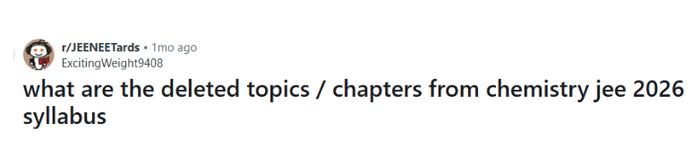
| Unit / Chapter | Deleted Topics |
|---|---|
| Some Basic Concepts in Chemistry | Physical quantities and their measurement (precision & accuracy, significant figures, SI units, dimensional analysis) |
| Atomic Structure | Thomson and Rutherford atomic models and their limitations |
| States of Matter | Entire chapter removed (gases, liquids, solids topics) |
| Surface Chemistry | Entire chapter removed |
| Hydrogen | Entire chapter removed |
| s-Block Elements | (Alkali & alkaline earth metals chapter removed) |
| General Principles & Processes of Isolation of Metals | Chapter removed |
| Environmental Chemistry | Entire chapter removed |
| Polymers | Entire chapter removed |
| Chemistry in Everyday Life | Entire chapter removed |
Read also:
JEE Main 2026 Chemistry Important Books
Having reliable study materials is very important. Approximately, 80% of the JEE Main 2026 Chemistry question paper is directly or indirectly based on NCERT, so the students should have a good grasp of NCERT first and only then move on to the other reference books.
Below listed are a few important books for your JEE Main 2026 Chemistry preparation:
| Important Books | Authors |
|---|---|
| Class 11th and 12th NCERT Books | NCERT |
| Inorganic Chemistry | O.P. Tandon |
| Organic Chemistry | Morrison and Boyd |
| Physical Chemistry | P.W. Atkins |
| Modern Approach to Chemical Calculations | R.C. Mukherjee |
| Concise Inorganic Chemistry | J.D. Lee |
JEE Main 2026 Chemistry Preparation Tips
- Students must read every line of the Class 11 & 12 NCERT books, mainly for Inorganic and Organic Chemistry. Many questions come straight from these books in the past years.
- Focus on important chapters, start with Chemical Bonding, Coordination Compounds, Thermodynamics, and GOC. These chapters have a lot of questions in the past years.
- Students should solve JEE Main past papers (2013–2025) and practice formula-based maths problems in Physical Chemistry to get faster and more accurate.
- Students are advised to solve 2-3 mock tests each week and then check their mistakes, go over the NCERT lines they are not sure about, and concentrate on being accurate to avoid losing marks.
Reddit User Discussed –

Source - Reddit
Frequently Asked Questions
Ques. Is the JEE Main 2026 Chemistry syllabus different from 2025?
Ans. The JEE Main 2026 Chemistry syllabus hasn't changed from 2025. The NTA's earlier reduced syllabus is still valid for 2026, and there haven't been any official updates. Students can keep studying using the 2025 syllabus.
Ques. Is the JEE Main 2026 Chemistry syllabus based on NCERT?
Ans. Yes, the JEE Main 2026 Chemistry syllabus follows the NCERT Class 11 and 12 books closely. A lot of the Inorganic and Organic Chemistry questions come straight from the NCERT theory, examples, and tables. If you want to do well, you really need to study the NCERT books carefully.
Ques. How many questions are asked from Chemistry in JEE Main 2026?
Ans. In the JEE Main 2026 exam, Chemistry has 25 questions. There are 20 multiple-choice questions and 5 questions where you have to solve a numerical value question.
Ques. Is there negative marking in Chemistry in JEE Main 2026?
Ans. Yes, for the JEE Main 2026 Chemistry section, there is negative marking. You get 4 marks for each correct answer, but 1 mark will be deducted for each wrong answer.
*The article might have information for the previous academic years, please refer the official website of the exam.
Ask your question
Answered Questions
a
SG
Without a doubt the best college in India for engineering are the top 3 IITs, IIT Delhi, IIT Bombay and IIT Madras. Then these are followed by BITs Pilania and so on.
...Show More
a
ZT
It is a subjective question. However, ideally once in the beginning to see where you stand and then after you are done with a major portion of the syllabus. Going through JEE Main previous year paper will prepare you mentally to appear for the exam.
...Show More
a
ZT
Yes, the JEE Main question paper for all shifts is different in order to prevent the leaking of questions. However, the authorities try to maintain the difficulty level across the slots.
...Show More
a
ZT
If the question paper of one slot comes difficult than the other, NTA will follow the process of normalisation of scores. This will ensure a fair marking approach across all shifts.
...Show More
a
ZT
The competition level of JEE Main is very high. Moreover, the difficulty level of question paper ranges from moderate to tough. So, only with a good preparation will you be able to clear the exam.
...Show More


