2 April 2026: Download JEE Main 2026 Session 2 Question papers

JEE Main Syllabus 2026: Subject-wise Syllabus PDF, Topic-wise Weightage, Preparation Strategy, And Previous Year Papers


Content Writer | Updated On - Apr 2, 2026
Important Updates for JEE Main} }
The National Testing Agency (NTA) has released the official JEE Main syllabus 2026. The syllabus of JEE Main is based on the NCERT books for classes 11 and 12.
- JEE Main 2026 Syllabus for Paper 1 (B.E/B.Tech): The subjects are Physics, Chemistry and Mathematics.
- The most important topics include - Integral Calculus and Continuity and Differentiation (20%), and Coordinate Geometry (16.6%), Modern Physics (15.9%), Optics, Heat and Thermodynamics, Current Electricity, Coordination compounds, Periodic Table and P-block elements (9.9% each).
- JEE Main 2026 Syllabus for Paper 2A (B.Arch): The subjects are Mathematics (25%), Drawing Test (25%), and General Aptitude (50%).
- JEE Main 2026 Syllabus for Paper 2B (B.Planning): The subjects have three parts - Mathematics (25%), General Aptitude (50%), and Planning Test (25%).
Though 21.3% of candidates clear JEE Advanced, getting an IIT seat is even more challenging. Out of 11.7 lakh candidates who appear every year, only around 16,700 candidates make it to IITs - just 1.42%. To prepare well, understand the syllabus, question distribution and JEE Main 2026 marking scheme to secure top rank.
Also Read:

Key Summary
|
Table of Contents
What is the JEE Main 2026 Syllabus?
The JEE Main syllabus 2026 typically covers Physics, Chemistry, and Mathematics based on class 11 and 12 NCERT curriculum. It is categorized into three papers, namely, Paper 1 for B.E/B.tech, Paper 2A for B.Arch and Paper 2B for B. Planning courses. The paper-wise syllabus and details are tabulated below:
| Paper & Course | Subjects | Syllabus Details |
|---|---|---|
| JEE Main Paper 1 (B.E./B.Tech) | Physics | Mechanics, Thermodynamics, Electromagnetism, Optics, Modern Physics, etc. |
| Chemistry | Physical Chemistry, Inorganic Chemistry, Organic Chemistry. | |
| Mathematics | Algebra, Calculus, Coordinate Geometry, Vectors, Trigonometry, etc. | |
| JEE Main Paper 2A(B. Arch) | Mathematics | Topics similar to Paper 1, with a focus on spatial reasoning and visualization. |
| General Aptitude | Logical reasoning, analytical ability, and problem-solving skills. | |
| Drawing | Sketching, freehand drawing, geometric construction, and 3D perception. | |
| JEE Main Paper 2B(B. Plan) | Mathematics | Topics similar to Paper 1, with a focus on spatial reasoning and visualization. |
| General Aptitude | Logical reasoning, analytical ability, and problem-solving skills. | |
| Planning | Urban and regional planning, design principles, and spatial organization. |
Also Read:
JEE Main 2026 Syllabus - Overview
Before starting with the preparations, you are advised to thoroughly read and review the JEE Main 2026 syllabus. The detailed syllabus for Paper 1 and Paper 2 is tabulated below:
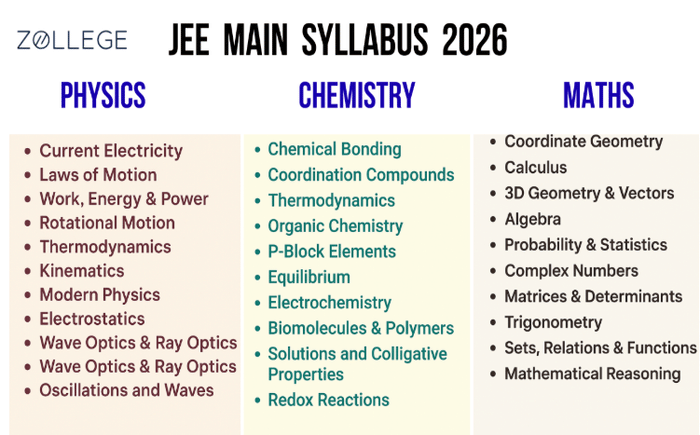
JEE Main Syllabus 2026 for Paper 1 - B.E/B.Tech
The JEE Main syllabus for Paper 1 covers Physics, Chemistry and Mathematics, based on Class 11 and 12 curriculum with 100 marks each, making a total of 300 marks. The detailed Chapter and Topic-wise syllabus for these three subjects are tabulated below:
JEE Main Mathematics Syllabus
| Unit No. | Title | Topics Covered |
|---|---|---|
| 1 | Sets, Relations and Functions | Sets and their representation, union, intersection, complement; algebraic properties; power set; relations; types of relations; equivalence relations; functions – one-one, onto, composition of functions |
| 2 | Complex Numbers and Quadratic Equations | Complex numbers as ordered pairs; Argand diagram; algebra of complex numbers; modulus and argument; quadratic equations in real and complex systems; relations between roots and coefficients; nature of roots; formation of equations with given roots |
| 3 | Matrices and Determinants | Algebra of matrices, types of matrices, determinants (order 2 and 3); area of triangle using determinants; adjoint and inverse; consistency and solution of linear equations in 2/3 variables |
| 4 | Permutations and Combinations | Fundamental principle of counting, meaning of P(n,r)P(n, r) and C(n,r)C(n, r); simple applications |
| 5 | Binomial Theorem and its Simple Applications | Binomial theorem for positive integral index, general term, middle term; simple applications |
| 6 | Sequence and Series | Arithmetic and geometric progressions; means; relation between A.M. and G.M. |
| 7 | Limit, Continuity and Differentiability | Real-valued functions; graphs; limits, continuity, differentiability; derivative of sum, product, quotient; derivatives of trigonometric, logarithmic, exponential, implicit functions; application of derivatives – monotonicity, maxima-minima |
| 8 | Integral Calculus | Integration as anti-derivative; algebraic, trigonometric, exponential, logarithmic integrals; substitution, partial fractions, trigonometric identities; definite integrals, areas under curves |
| 9 | Differential Equations | Order and degree; method of separation of variables; homogeneous and linear differential equations |
| 10 | Coordinate Geometry | Rectangular coordinates, distance, section formula, locus, slope, intercepts; equations of lines and circles, parabola, ellipse, hyperbola |
| 11 | Three Dimensional Geometry | Coordinates in space; distance; direction ratios and cosines; angle between lines; skew lines; shortest distance |
| 12 | Vector Algebra | Vectors, scalar and vector products, vector addition, components in 2D and 3D |
| 13 | Statistics and Probability | Mean, median, mode (grouped & ungrouped); standard deviation, variance; probability of events; Bayes' theorem; distribution of random variable |
| 14 | Trigonometry | Trigonometric identities and functions, inverse trigonometric functions and their properties |
JEE Main Physics Syllabus
| Unit No. | Title | Topics Covered |
|---|---|---|
| 1 | Units and Measurements | SI units, derived & fundamental units, significant figures, errors, dimensions and applications |
| 2 | Kinematics | Motion in straight line & plane, speed, velocity, acceleration, graphs, projectile motion, uniform circular motion |
| 3 | Laws of Motion | Newton’s laws, impulse, momentum, friction, centripetal force, vehicle on banked & level circular road |
| 4 | Work, Energy and Power | Work by constant/variable force, energy types, work-energy theorem, power, spring energy, conservation of energy, collisions |
| 5 | Rotational Motion | Centre of mass, torque, angular momentum, moment of inertia, rotational motion comparison |
| 6 | Gravitation | Universal law, variation with altitude/depth, Kepler’s laws, gravitational potential & energy, satellite motion |
| 7 | Properties of Solids and Liquids | Hooke’s Law, Young’s modulus, stress-strain, bulk modulus, viscosity, surface tension, Pascal’s law, fluid dynamics |
| 8 | Thermodynamics | Thermal equilibrium, laws of thermodynamics, heat, internal energy, reversible & irreversible processes |
| 9 | Kinetic Theory of Gases | Perfect gas equation, kinetic energy, temperature relation, RMS speed, degrees of freedom, Avogadro’s number |
| 10 | Oscillations and Waves | SHM, wave motion, displacement relation, superposition, resonance, beats, sound waves |
| 11 | Electrostatics | Electric charge, field, dipole, Gauss's law, potential, capacitors, conductors/insulators, dielectrics |
| 12 | Current Electricity | Electric current, Ohm’s law, resistance, resistivity, combinations of resistors, emf, internal resistance |
| 13 | Magnetic Effects of Current and Magnetism | Biot–Savart law, Ampere’s law, force on moving charge, torque, magnetic field, moving coil, magnetism |
| 14 | Electromagnetic Induction & Alternating Current | Faraday’s law, Lenz’s law, induced emf, eddy currents, LCR circuit, AC generator, transformer |
| 15 | Electromagnetic Waves | Characteristics, spectrum (radio to gamma), applications |
| 16 | Optics | Reflection, refraction, lenses, mirrors, wave optics (interference, diffraction, polarization) |
| 17 | Dual Nature of Matter and Radiation | Photoelectric effect, Einstein’s equation, de-Broglie relation |
| 18 | Atoms and Nuclei | Rutherford & Bohr model, atomic spectra, mass-energy relation, nuclear fission and fusion |
| 19 | Electronic Devices | Semiconductors, diodes, Zener diode, logic gates, photodiode, solar cell, LED |
JEE Main Chemistry Syllabus
| Unit No. | Title | Topics Covered |
|---|---|---|
| 1 | Some Basic Concepts in Chemistry | Matter, Dalton’s atomic theory, mole concept, chemical combination, atomic/molecular masses, molar mass, percentage composition, empirical & molecular formulae, chemical equations, stoichiometry |
| 2 | Atomic Structure | Electromagnetic radiation, photoelectric effect, hydrogen spectrum, Bohr’s model, de Broglie’s relationship, Heisenberg principle, quantum mechanics, atomic orbitals, quantum numbers, orbitals (s, p, d), Pauli’s exclusion principle, Hund’s rule, Aufbau principle, electronic configuration |
| 3 | Chemical Bonding and Molecular Structure | Kossel-Lewis theory, ionic/covalent bonds, Fajan’s rule, VSEPR theory, dipole moment, hybridization (s, p, d), resonance, MO theory, LCAO, sigma/pi bonds, metallic bonding |
| 4 | Chemical Thermodynamics | System & surroundings, extensive/intensive properties, entropy, enthalpy, internal energy, first and second law of thermodynamics, Hess’s law, Gibbs free energy, spontaneity, equilibrium constant |
| 5 | Solutions | Concentration terms (molality, molarity, etc.), Raoult’s Law, vapor pressure, colligative properties, abnormal molar mass, van’t Hoff factor |
| 6 | Equilibrium | Dynamic equilibrium, physical/chemical equilibria, Le Chatelier’s principle, equilibrium constants (Kp, Kc), ΔG°, acids/bases (Arrhenius, Bronsted-Lowry, Lewis), ionization constants, pH, common ion effect, buffer solutions |
| 7 | Redox Reactions & Electrochemistry | Oxidation/reduction concepts, redox titrations, electrochemical cells (galvanic/electrolytic), EMF, Nernst equation, cell potential, conductance, Kohlrausch’s law |
| 8 | Chemical Kinetics | Reaction rate, factors affecting rate (concentration, temperature, catalyst), order/molecularity, rate laws, activation energy, Arrhenius equation, collision theory |
| 9 | Classification of Elements & Periodicity | Periodic table (s, p, d, f-block), periodic trends: atomic/ionic radii, ionization enthalpy, electron gain enthalpy, valence, reactivity |
| 10 | p-Block Elements | Group 13 to 18: Electronic configuration, general physical/chemical trends, unique behavior of first element in group |
| 11 | d- and f-Block Elements | Transition and inner transition elements, properties/trends: ionization enthalpy, oxidation states, color, magnetic properties, catalysts, KMnO₄, K₂Cr₂O₇ |
| 12 | Coordination Compounds | Werner’s theory, ligands, coordination number, IUPAC nomenclature, isomerism, valence bond theory, crystal field theory, magnetic/electronic properties |
| 13 | Purification & Characterization | Purification methods (crystallization, distillation, etc.), qualitative/quantitative analysis, empirical/molecular formulae |
| 14 | Basic Principles of Organic Chemistry | Tetravalency, hybridization, classification of organic compounds, nomenclature (IUPAC), isomerism, electronic displacements (inductive, resonance), types of reactions (substitution, elimination, addition) |
| 15 | Hydrocarbons | Alkanes (conformations, halogenation), alkenes (addition reactions), alkynes (reactions), aromatic hydrocarbons (structure, reactions: nitration, halogenation, Friedel-Crafts) |
| 16 | Organic Compounds with Halogens | Nature of C-X bond, substitution mechanisms, preparation/reactions, environmental effects |
| 17 | Organic Compounds with Oxygen | Alcohols (types, dehydration), phenols (reactions), ethers (structure), aldehydes/ketones (nucleophilic addition, Grignard, oxidation/reduction), carboxylic acids (acidity) |
| 18 | Organic Compounds with Nitrogen | Amines (classification, properties, reactions), diazonium salts (synthetic uses) |
| 19 | Biomolecules | Carbohydrates (mono/di/oligosaccharides), proteins (amino acids, peptide bond), vitamins, nucleic acids (DNA/RNA), hormones |
| 20 | Principles Related to Practical Chemistry | Detection of elements in organics (N, S, halogens), tests for functional groups, titration (acid/base, redox), salt analysis (cation/anion), practicals like enthalpy of solution, neutralization, lyophilic/lyophobic sols, kinetics |
JEE Main Syllabus 2026 for Paper 2 - B.Arch/ B. Planning
For Paper 2A, JEE Main syllabus has three subjects - Mathematics, Aptitude Test and Drawing. On the other hand, Paper 2B also consists of three subjects - Mathematics, Aptitude Test and Planning Test. The detailed Chapter and Topic-wise syllabus for these subjects is mentioned below:
| Section | Topics |
|---|---|
| Mathematics | Complex numbers and quadratic equations, Matrices and determinants, Sets, relations, and functions, Permutations and combinations, Limit, continuity, and differentiability, Integral calculus, Three-dimensional geometry, Differential equations, Binomial theorem and its simple applications, Sequences and series, Vector algebra, Statistics and probability, Trigonometry, Coordinate geometry 2 |
| Aptitude Test | Comprehension (unseen passages), Map reading skills, Critical reasoning, Understanding of charts, graphs, and tables, Basic concepts of statistics and quantitative reasoning |
| Drawing (for B.Arch.) | Drawing of objects, both 2D and 3D, Geometrical drawing, Perspective drawing, Sketching of people and objects |
| Planning (for B.Plan.) | Urban planning, Rural Planning, Transportation Planning, Environmental planning, Housing and shelter |
Also Read:
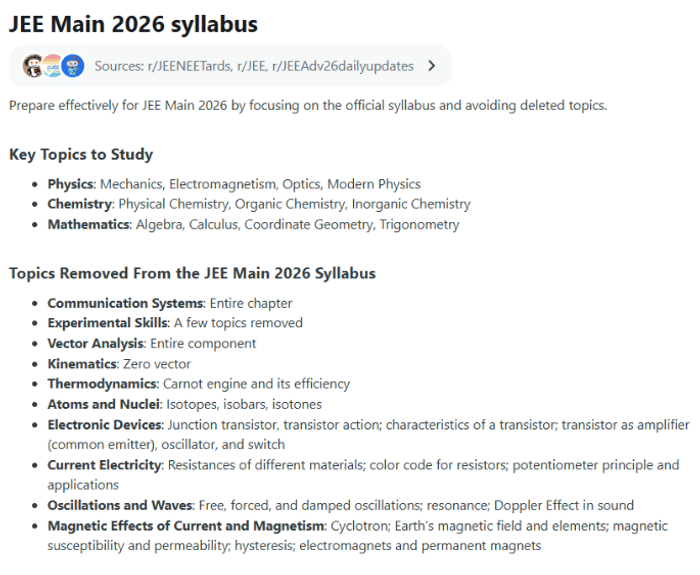
Is there any change in JEE Main 2026 Syllabus?
The syllabus for 2026 does not introduce any new topics and emphasizes concepts from Class 11 and 12 NCERT curriculum.
| Subject | Chapters / Topics removed |
|---|---|
| Physics | Communication Systems, Capacitors, Measuring Instruments, Zero Vector, Newton’s Law of Cooling, Cyclotron, Resolving Power |
| Chemistry | States of Matter, Surface Chemistry, Environmental Chemistry, Polymers, Chemistry in Everyday Life |
| Mathematics | Mathematical Induction, Mathematical Reasoning, Matrices & Determinants (selected parts), Integral Calculus (specific topics) |
Source: Reddit
Ques: Does the JEE Main syllabus change every year?
Ans: The JEE Main syllabus 2026 remains almost the same every year. Only small updates or changes may happen like adding, removing or updating a few topics.The syllabus is based on NCERT Physics, Chemistry and Mathematics books from class 11 and 12. Any changes to these textbooks will result in JEE Main syllabus update.
Ques: Is there any change in JEE Main 2026 Paper 2 syllabus?
Ans: No. As per NTA, there are no changes in the JEE Main syllabus for paper 2.
JEE Main Syllabus 2026 Topic-wise Weightage
To prepare strategically for this exam, it is also important to understand the topic-wise weightage. Based on previous year’s trends, here is the topic-wise weightage analysis:
Physics Chapter-wise Weightage in the JEE Main Syllabus 2026
- High Weightage Topics - Modern Physics has the highest weightage among all other topics at 15.9%, followed by Optics, Heat and Thermodynamics, and Current Electricity at 9.9% each.
- Moderate Weightage Topics - Chapters of Electrostatics, Magnetics, and others hold 6.6% weightage.
- Low Weightage Topics - Chapters like SHM, Sound Waves, Error in Measurement, Electromagnetic Waves, and Semiconductors carry 3.3% each.

Chemistry Chapter-wise Weightage in the JEE Main Syllabus 2026.
- High Weightage Topics - Transition Elements and Coordination Compounds, Periodic Table and p-Block Elements are the most important with highest weightage at 9.9% each.
- Moderate Weightage Topics - Topics like Thermodynamic, Equilibrium, Atomic Structure, Chemical Bonding and Organic Compounds appear frequently and hold 6.6% weightage each.
- Low Weightage Topics - There are several small chapters such as Redox Reactions, Electrochemistry and Hydrocarbons carry 3.3% weightage, but collectively form a sizable part of the paper.

Mathematics Chapter-wise Weightage in the JEE Main Syllabus 2026.
- High Weightage Topics - Coordinate Geometry leads with 16.6% weightage, followed by Continuity and Differentiation and Integral Calculus at 10% each.
- Moderate Weightage Topics- Complex Numbers, Vector Algebra, Matrices, Probability and 3D Geometry are valuable moderate weightage chapters.
- Low Weightage Topics- Chapters like Trigonometry, Permutation and Combination, Sequences, and others hold 3.3% weightage but collectively add good scoring potential.

Also Read:
How to complete the entire JEE Main syllabus before the exam?
Completing the JEE Main 2026 full syllabus is achievable with an early and planned preparation strategy. However, the JEE Main syllabus is vast and covering 100% is extremely challenging. Also, covering a full syllabus is not mandatory for securing a good rank but you must focus on high-weightage topics to score top percentile.
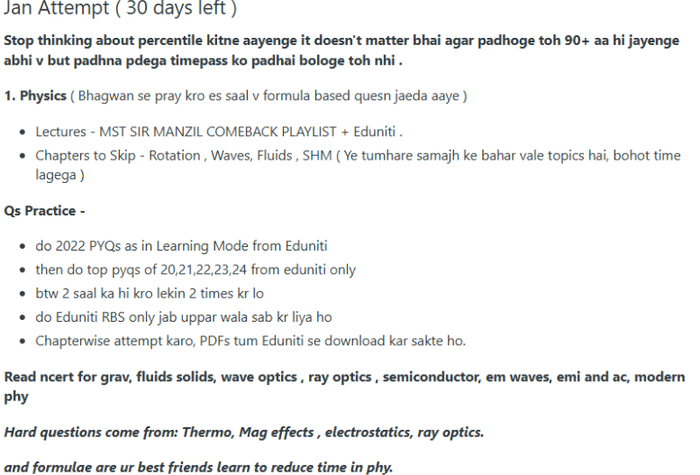
Refer to this 30-day revision strategy shared in a Reddit Post, covering how to study for boards and JEE Main both.
Source: Reddit.com
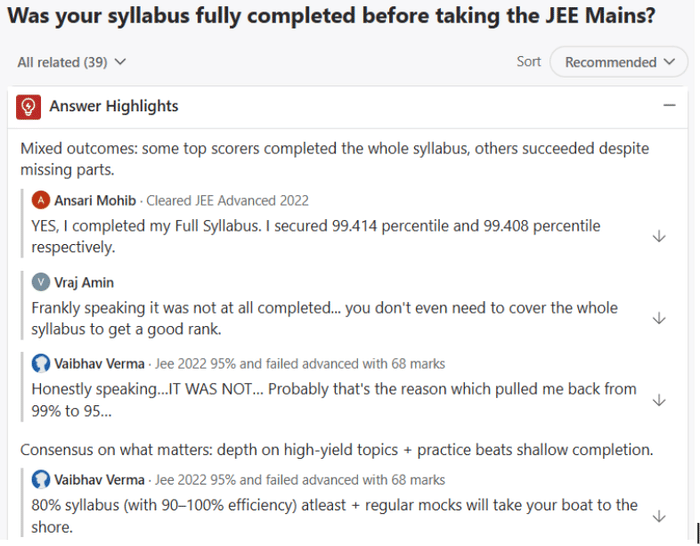
Another aspirant shared on Quora.com that even 80% syllabus completion builds strong confidence and significantly improves exam performance.
Source: Quora
JEE Main Syllabus 2026: Important Reference Books
Choosing the right books for the JEE Main 2026 exam is very important. NCERT textbooks are the first choice and must-read for all subjects. Along with NCERTs, reference books too have proven to be useful. The important reference book list is mentioned below:
| Subject | Book Name | Author / Publication |
|---|---|---|
| Physics | Concepts of Physics (Vol. 1 & 2) | H.C. Verma |
| Understanding Physics | Freedman and Young | |
| Problems in General Physics | I.E. Irodov | |
| Fundamentals of Physics | Halliday, Resnick & Walker | |
| Problems in Physics | S.S. Krotov | |
| Problems and Solutions in Physics | Shashi Bhushan Tiwari | |
| Chemistry | Modern Approach to Chemical Calculations | R.C. Mukherjee |
| Physical Chemistry | P.W. Atkins | |
| Concept of Physical Chemistry | P. Bahadur | |
| Concise Inorganic Chemistry | J.D. Lee | |
| Organic Chemistry | O.P. Tandon | |
| Organic Chemistry | Morrison & Boyd | |
| Mathematics | Objective Mathematics | R.D. Sharma |
| Plane Trigonometry | S.L. Loney | |
| The Elements of Coordinate Geometry | S.L. Loney | |
| Algebra | Dr. S.K. Goyal (Arihant Publications) | |
| Play with Graphs | Amit M. Agarwal (Arihant Publications) | |
| Differential Calculus | Amit M. Agarwal (Arihant Publications) | |
| Integral Calculus | Amit M. Agarwal (Arihant Publications) |
Quora user asked:

Source: Quora
JEE Main 2026 will prove to be moderate to difficult and accuracy-oriented with January attempt being the most crucial scoring session. It has also been noticed through data trends that the 99th percentile will become easier to secure with 175-185 marks in January rather than April, which will witness cutoff scores above 200+. Physics will form the core ruling factor while determining ranks with more _concept-oriented multi-step problems_, whereas Maths may remain lengthy. With negative marking in numerical problems, it has become important to emphasize accuracy over completeness with thorough post-exam analyses.
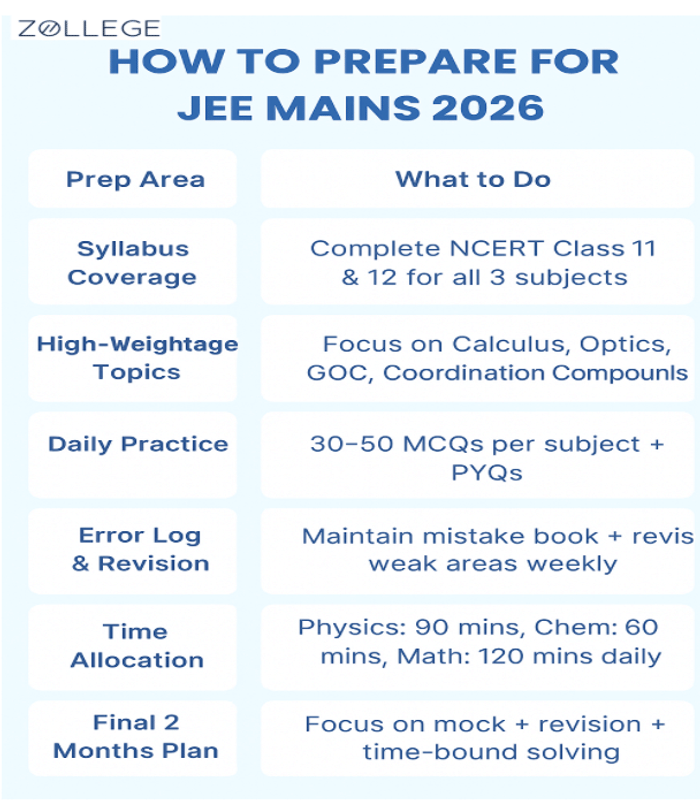
How to Prepare for the JEE Main 2026 Exam?
| Preparation Tip | What Toppers Suggest | What Students Experience | What Actually Works (User Experience) |
|---|---|---|---|
| Start with NCERT | Finish NCERT first | Jump to reference books early | NCERT builds strong base for all subjects |
| Concept Clarity | Learn concepts deeply | Formula memorisation | Clear concepts ease tough questions |
| Daily Practice | Regular problem solving | Irregular practice | PYQs + mocks boost speed & accuracy |
| Progress Check | Analyse every mock | Ignore test analysis | Weak-area analysis improves scores |
| Discipline | Fixed study routine | Routine breaks often | Consistency matters more than hours |

Source: Reddit
Also Read: JEE Main 2026 Preparation Tips
JEE Main Previous Year Question Papers with Solutions
Do not forget to practice PYQ as much as possible. 60-70% top scorers focus on solving PYQs.
Frequently Asked Questions
Ques. Is NCERT enough for JEE Mains 2026?
Ans. NCERTs are the basics and covers most of JEE Main questions (80%). But for a high score, candidates should read and practice important topics from reference books too.
Ques. What is the hardest topic in JEE Main?
Ans. As per past analysis, some of the hard or difficult topics in JEE main exam include:
- Mathematics: Calculus, Permutation and Combination, 3D Geometry
- Physics: Mechanics, Modern Physics, SHM and Waves
- Chemistry: Thermodynamics, Organic Reaction Mechanisms, Electrochemistry
Ques: How many JEE Main mock tests are ideal in the final 20 days of preparation?
Ans: During the final 20 days of JEE Main preparation, 10-15 full length mock tests are considered good. It will help you to avoid repeated mistakes and work on time management issues.
Ques. What does JEE Main syllabus 2026 cover?
Ans. The JEE Main syllabus 2026 covers Physics, Chemistry and Mathematics and is based on NCERT Class 11 and 12 syllabus. JEE Main 2026 has three papers:
| Paper | Subjects | No. of Questions | Marks |
|---|---|---|---|
| Paper 1 (B.E./B.Tech) | Physics, Chemistry , Mathematics | 75 | 300 |
| Paper 2A (B.Arch) | Mathematics, Aptitude Test, Drawing Test | 77 | 400 |
| Paper 2B (B.Planning) | Mathematics, Aptitude Test, Planning Test | 100 | 400 |
Ques. Can I finish the JEE Main syllabus 2026 in 6 months?
Ans. Yes, a candidate can cover the JEE Main syllabus in 6 months with a strict plan, 8-10 hours of study daily and regular revision. Focus should be on NCERTs, high-weightage topics and reference books. Focusing on 60% of the syllabus can yield about 80% of the score.
*The article might have information for the previous academic years, please refer the official website of the exam.
Ask your question
Answered Questions
a
SG
Without a doubt the best college in India for engineering are the top 3 IITs, IIT Delhi, IIT Bombay and IIT Madras. Then these are followed by BITs Pilania and so on.
...Show More
a
ZT
It is a subjective question. However, ideally once in the beginning to see where you stand and then after you are done with a major portion of the syllabus. Going through JEE Main previous year paper will prepare you mentally to appear for the exam.
...Show More
a
ZT
Yes, the JEE Main question paper for all shifts is different in order to prevent the leaking of questions. However, the authorities try to maintain the difficulty level across the slots.
...Show More
a
ZT
If the question paper of one slot comes difficult than the other, NTA will follow the process of normalisation of scores. This will ensure a fair marking approach across all shifts.
...Show More
a
ZT
The competition level of JEE Main is very high. Moreover, the difficulty level of question paper ranges from moderate to tough. So, only with a good preparation will you be able to clear the exam.
...Show More


