2 April 2026: Download JEE Main 2026 Session 2 Question papers

JEE Main 2026 Mathematics: Exam Pattern, Syllabus, Weightage, Important Topics, Best Books & Preparation Strategy


Content Writer | Updated On - Apr 4, 2026
What's New?
In the JEE Main 2026 Paper-1 (B.E./B.Tech), students tackle Mathematics along with Physics and Chemistry during the January and April sessions. Math is a big deal, worth 100 out of 300 marks, and includes 25 questions (20 MCQs and 5 numerical types). Doing well in Math can really boost your rank.
- Past exams show that around 65–70% of the Math questions usually come from Calculus, Coordinate Geometry, Algebra, and Vectors & 3D Geometry. If you want a high score, it’s key to prioritize these topics and practice efficiently.
- For preparation, stick to the Class 11 & 12 NCERT syllabus. Looking at the past 10-12 years of question papers, chapters like Integral Calculus (around 12%) and Conic Sections (about 10%) give you the most for your study time.

Key Summary
|
Quick Links:
Table of Contents
- JEE MAIN 2026 Mathematics Exam Pattern and Marking Scheme
- JEE MAIN 2026 Mathematics Syllabus
- Is The JEE Mains Mathematics Syllabus Reduced For 2026?
- JEE Main Mathematics Syllabus 2026 Chapter-Wise Weightage
- Important Topics in JEE Main 2026 (Mathematics)
- Best Books for JEE Mains Mathematics 2026
- JEE MAIN 2026 Mathematics Preparation Tips
- Frequently Asked Questions
JEE MAIN 2026 Mathematics Exam Pattern and Marking Scheme
The JEE Main 2026 Mathematics exam aims to check how well students understand math concepts, solve problems quickly, and get accurate answers. Math is a major part of Paper-1 (B.E./B.Tech), worth 100 marks, so doing well here can really boost a student's rank.
Knowing how the section is set up, what kinds of questions to expect, and how the grading works lets students plan their approach, use their time wisely, and get the best possible score.
| Subject | Type of Questions | No. of Questions | Total Marks |
|---|---|---|---|
| Section A | Multiple Choice Questions (MCQs) | 20 | 80 |
| Section B | Numerical Value Questions | 10 (attempt any 5) | 20 |
| Total | 20 | 25 | 100 |
| Question Type | Correct Answer | Incorrect Answer | Unattempted |
|---|---|---|---|
| MCQs (Section A) | +4 marks | −1 mark | 0 |
| Numerical Value Questions (Section B) | +4 marks | 0 (No negative marking) | 0 |
JEE MAIN 2026 Mathematics Syllabus
The JEE Main 2026 Mathematics syllabus checks how well students understand math ideas, solve math problems, and use what they learned in classes 11 and 12 (NCERT books). It mainly includes Algebra, Calculus, Coordinate Geometry, Trigonometry, Vector & 3D Geometry, and Statistics & Probability.
Getting good at these topics is key for further engineering studies. The detailed syllabus is in the table below in a clear way so you can plan your study time well and concentrate on the topics that will get you the most marks.
| Chapter | Key Topics Included |
|---|---|
| Sets, Relations & Functions | Sets and their representation; union, intersection, complement; power set; types of relations; equivalence relations; functions (one-one, onto, into); composition of functions. |
| Complex Numbers & Quadratic Equations | Complex numbers as ordered pairs; representation in a plane; algebra of complex numbers; Argand plane; modulus and argument; quadratic equations and roots. |
| Matrices & Determinants | Matrices (types, operations); determinants of order 2 & 3; properties; adjoint and inverse; area of triangles; solving linear equations. |
| Permutations & Combinations | Fundamental principle of counting; nPr, nCr; simple problems. |
| Binomial Theorem & Its Applications | Positive integral index theorem; general and middle term; simple applications. |
| Sequence & Series | Arithmetic progression (AP), geometric progression (GP); insertion of means; relation between AM & GM. |
| Limits, Continuity & Differentiability | Limits of functions; continuity; differentiability; derivative of sum, difference, product, quotient; higher order derivatives. |
| Integral Calculus | Integration as inverse of differentiation; definite integral; properties and simple applications. |
| Differential Equations | Ordinary differential equations; methods of solution and applications. |
| Trigonometry | Trig ratios; identities; solutions of trig equations; inverse trig functions. |
| Coordinate Geometry | Straight lines; pair of lines; circle; conic sections (parabola, ellipse, hyperbola). |
| Three-Dimensional Geometry | Direction cosines & ratios; equation of a line in 3D; plane. |
| Vector Algebra | Vectors and scalars; addition & scalar multiplication; dot and cross products. |
| Statistics & Probability | Mean, median, mode of grouped/un-grouped data; probability; random variables; distributions. |
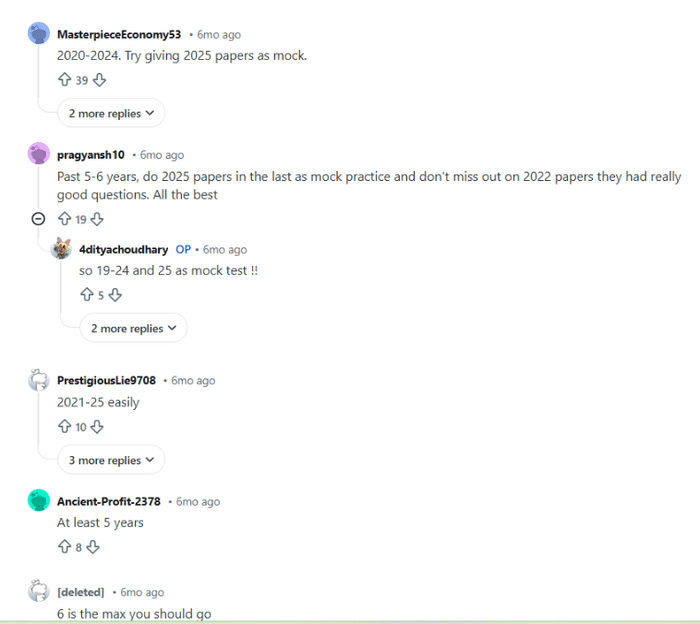
Reddit Users Discussed-

Source - Reddit
Is The JEE Mains Mathematics Syllabus Reduced For 2026?
The NTA has not removed any topic from the JEE Mains 2026 syllabus. Several topics were removed from the JEE Mains syllabus last year by the NTA. The deleted topics from the JEE Mains syllabus are:
| Topic | Deleted Topics |
|---|---|
| Complex Numbers & Quadratic Equations | Square root of a complex number; Triangle inequality |
| Matrices & Determinants | Properties of determinants; Elementary transformations |
| Binomial Theorem & Its Applications | Properties of binomial coefficients |
| Sequence & Series | Special series sums (Sn, Sn², Sn³); Arithmetico-Geometric progression |
| Limits, Continuity & Differentiability | Rolle’s and Lagrange’s Mean Value Theorems |
| Integral Calculus | ‘Integral as limit of a sum’ concept |
| Coordinate Geometry | Translation of axes; family of lines through intersection of two lines; certain circle tangents |
| Three-Dimensional Geometry | Equations of line/plane in different forms; intersection; coplanar conditions |
| Vector Algebra | Scalar and vector triple product |
| Statistics & Probability | Bernoulli trials; Binomial distribution |
| Trigonometry | Heights and distances |
| Mathematical Inductions | Entire chapter removed |
| Mathematical Reasoning | Entire chapter removed |
Check:
JEE Main Mathematics Syllabus 2026 Chapter-Wise Weightage
JEE Main 2026 Mathematics chapter wise can show students what topics are often asked on the test based on recent years. The math has 25 questions total (20 you must do and 5 that are optional).
If you understand how important each chapter is, you can give attention to the ones with high scores and chapters that are asked a lot like Calculus, Coordinate Geometry, and Algebra. The chart shows how the questions are spread out by chapter, so prepare in the correct way for JEE Main 2026 without wasting time.
| Topic | Approx. No. of Questions | Approx. Weightage (%) |
|---|---|---|
| Sequences & Series | 2 | 6.6% |
| Straight Lines (Coordinate Geometry) | 2 | 6.6% |
| 3-D Geometry | 2 | 6.6% |
| Determinants | 2 | 6.6% |
| Integral Calculus | 3-4 | 12% |
| Coordinate Geometry (Conic Sections) | 3 | 10% |
| Matrices & Determinants | 2-3 | 8% |
| Vector & 3-D Geometry | 2-3 | 8% |
| Differential Equations | 2 | 7% |
| Probability & Statistics | 2 | 7% |
| Trigonometry | 2 | 6% |
| Permutations & Combinations | 1-2 | 5% |
| Complex Numbers & Quadratics | 1-2 | 5% |
Important Topics in JEE Main 2026 (Mathematics)
The JEE Main 2026 Mathematics syllabus includes several important topics that are asked repeatedly in the exam and offer strong scoring potential if prepared well. Identifying these important topics helps aspirants focus their efforts on areas that contribute the most questions and marks, especially in a time-bound preparation phase.
The table below highlights the most important and frequently tested Mathematics topics for JEE Main 2026, based on previous year paper analysis and exam trends.
| Unit | High-Priority Topics |
|---|---|
| Calculus | Limits & Continuity, Differentiability, Application of Derivatives, Indefinite & Definite Integrals, Area under Curves, Differential Equations |
| Coordinate Geometry | Straight Line, Circle, Parabola, Ellipse, Hyperbola |
| Algebra | Matrices & Determinants, Complex Numbers, Quadratic Equations, Sequences & Series |
| Vectors & 3D Geometry | Vector Algebra (Dot & Cross Product), Direction Cosines & Ratios, Line and Plane |
| Trigonometry | Trigonometric Identities, Trigonometric Equations, Inverse Trigonometric Functions |
| Probability & Statistics | Probability Basics, Conditional Probability, Mean, Variance, Standard Deviation |
| Permutations & Combinations | Fundamental Counting Principle, Arrangements & Selections |
| Binomial Theorem | General Term, Middle Term, Simple Applications |
| Sets, Relations & Functions | Types of Functions, Composition of Functions, Inverse Functions |

Best Books for JEE Mains Mathematics 2026
Mathematics is an analytical subject, full of lengthy calculations and derivations. In a single mathematical problem of JEE Main, sometimes more than one formula has to be applied. Best Maths book for JEE Main 2026 can be found below:
| Book Name | Author |
|---|---|
| NCERT Class 11 and 12 Textbooks | NCERT |
| Objective Mathematics | R.D. Sharma |
| Plane Trigonometry | S.L. Loney |
| The Elements of Coordinate Geometry | S.L. Loney |
| Algebra | Dr. S.K. Goyal (Arihant) |
| Play with Graphs | Amit M. Agarwal (Arihant) |
| Differential Calculus | Amit M. Agarwal (Arihant) |
| Integral Calculus | Amit M. Agarwal (Arihant) |
| Complete Mathematics for JEE Main | TMH (Tata McGraw Hill) |
JEE MAIN 2026 Mathematics Preparation Tips
- First, focus on the topics that matter most like Calculus, Algebra, Coordinate Geometry, and Vectors & 3D Geometry usually make up 65-70% of the math questions in the JEE Main Exam.
- Try to solve 25-30 mixed questions each day. Work to get your solving time down to 2-3 minutes per question.
- Concentrate on formulas and how to use them, keep a short notebook of formulas and look over it each week. Most JEE Main math questions are straightforward but you need to understand how to apply the formulas.
- Solve questions from at least 10-12 years of past papers to see what concepts are repeated and how hard the questions are.
- Take practice tests for each section often. After each test, check your mistakes by topic to find your weak spots and get your accuracy above 85%.

Frequently Asked Questions
Ques. What is the syllabus of JEE Main 2026 Mathematics?
Ans.The JEE Main 2026 Math syllabus is from the Class 11 and 12 NCERT books. Key areas include Algebra, Calculus, Coordinate Geometry, Trigonometry, Vectors & 3D Geometry, plus Statistics and Probability. The focus is on understanding the ideas and using them to solve problems.
Ques. Is the JEE Main 2026 Mathematics syllabus reduced?
Ans. In JEE Main 2026 there is no recent change in the syllabus. NTA had changed and removed a few topics from the syllabus in the last year, and that is still applicable for JEE Main 2026.
Ques. How many chapters are there in the JEE Main 2026 Mathematics syllabus?
Ans. The JEE Main 2026 Mathematics syllabus has about 15 - 16 big chapters, covering chapters from both 11th and 12th grade.
Ques. Is NCERT enough for JEE Main 2026 Mathematics?
Ans. For JEE Main 2026 Mathematics, NCERT is a must, but it's not the only resource students should refer to. Get a strong grip on the ideas and formulas in NCERT books. Students should also solve past year questions.
Ques. Are numerical value questions included in JEE Main 2026 Maths?
Ans. Yes, the Mathematics section in Section B has questions where you have to solve a numerical question. Students need to try any 5 out of 10 of these questions. If you get them wrong, your score will not decrease. These questions are important for getting a high score.
*The article might have information for the previous academic years, please refer the official website of the exam.
Ask your question
Answered Questions
a
SG
Without a doubt the best college in India for engineering are the top 3 IITs, IIT Delhi, IIT Bombay and IIT Madras. Then these are followed by BITs Pilania and so on.
...Show More
a
ZT
It is a subjective question. However, ideally once in the beginning to see where you stand and then after you are done with a major portion of the syllabus. Going through JEE Main previous year paper will prepare you mentally to appear for the exam.
...Show More
a
ZT
Yes, the JEE Main question paper for all shifts is different in order to prevent the leaking of questions. However, the authorities try to maintain the difficulty level across the slots.
...Show More
a
ZT
If the question paper of one slot comes difficult than the other, NTA will follow the process of normalisation of scores. This will ensure a fair marking approach across all shifts.
...Show More
a
ZT
The competition level of JEE Main is very high. Moreover, the difficulty level of question paper ranges from moderate to tough. So, only with a good preparation will you be able to clear the exam.
...Show More


